Blog de Gridwise
¡Lee el blog de Gridwise para obtener consejos y sugerencias sobre cómo ganar más dinero mientras conduces para Lyft, Uber, DoorDash, GrubHub y más!

The Gridwise Job Board: Find Your Ideal Job or Gig Work
Gridwise is an essential assistant app created by gig workers for gig workers. Our mission is to support those engaged in gig work in every way possible. We understand how challenging it can be to deal with income instability, a lack of benefits, and job insecurity that often comes with gig work. The Gridwise app tracks and organizes earnings and expenses, and offers a wide array of discounts, deals, and services that make the lives of independent contractors easier and more rewarding.
We firmly believe it’s possible to make a viable living and create a gig experience that offers flexible hours, variety, and excitement. With issues such as consistent earnings and job security in mind, Gridwise is proud to offer a centralized platform that shows you how to find gig work and secure reliable opportunities. We’re proud to introduce the Gridwise Job Board.
[elementor-template id="20891"]
The Gridwise Job Board: Key features
Because Gridwise is dedicated to serving the gig worker community, we’ve filled the Gridwise Job Board with useful features that won’t waste your precious time.
- Comprehensive listings. Find part-time, full-time, temporary, and per-task work. Drive or deliver with your vehicle, utilize an employer’s vehicle, or even find non-driving gig work.
- User-friendly interface. Find the jobs that are right for you with a tap of your screen.
- Verified opportunities. We vet the jobs before they are listed to ensure you’re getting high-quality job postings.
How to get more gig work, seasonal, part-time or full-time jobs with the Gridwise Job Board
Looking specifically for “gig work apps” or “gig jobs near me?” You’re in luck. Our filters and search functions send you directly to the listings you seek.
Here’s how it works.
- Access the Job Board via the Gridwise website.
- Search for jobs by type, location, and more.
- Select the job that interests you, and read all about it.
- Scroll through the description, and if it appeals to you, click “Apply for job.”
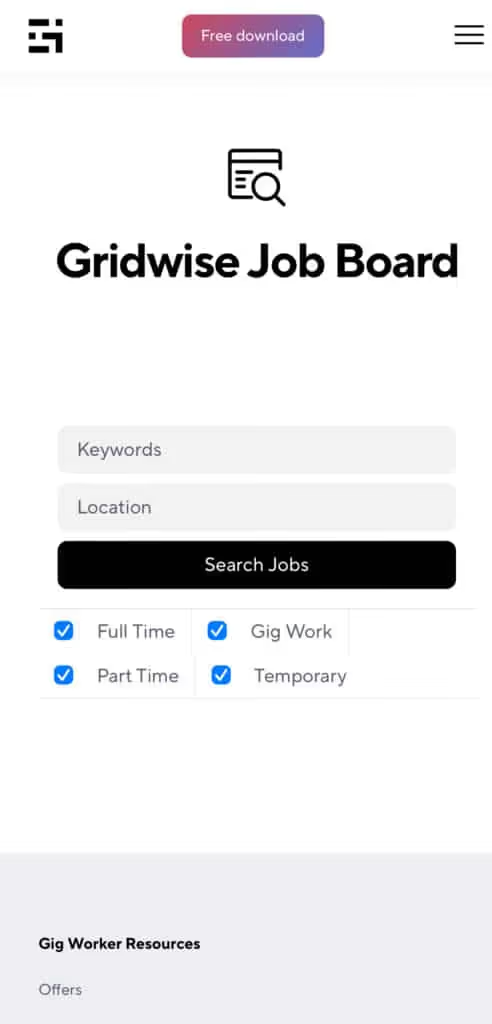
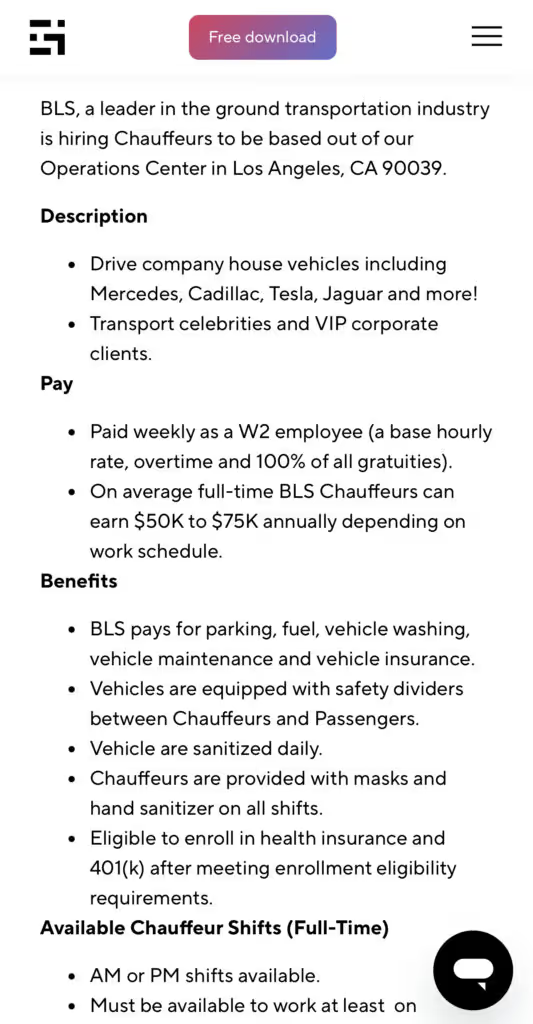
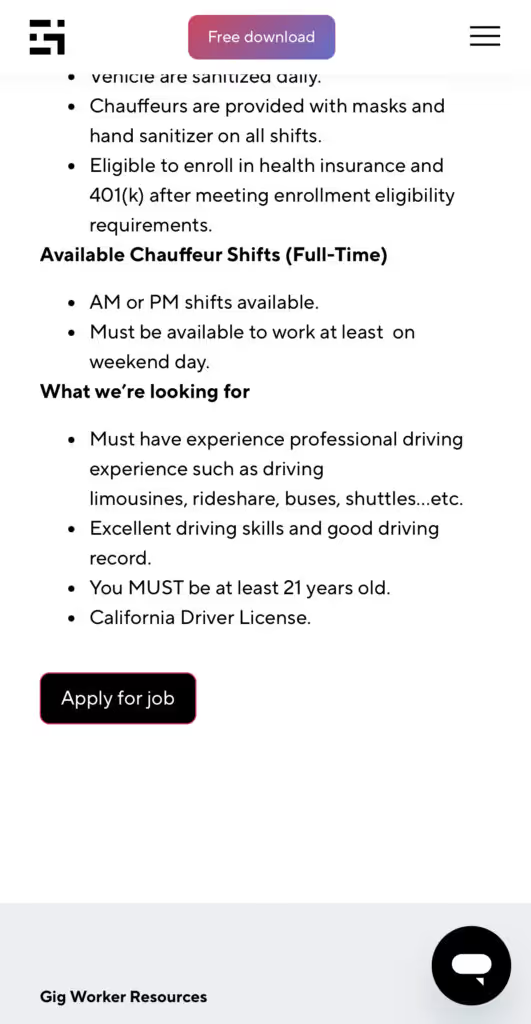
Many types of jobs are available. Adjust the search filter to see the full variety of opportunities that will let you cash in. Deliver food, set up catering, do rideshare driving, get paid for doing package delivery, and much more. You’ll find short-term gigs, long-term contracts, and part-time positions.
Perks of the Gridwise Job Board for gig workers
Gig workers who know how to make extra money will appreciate how the Gridwise Job Board lets you multiply your chances of bringing in big earnings. Here’s how:
- Increased stability. Use the Gridwise Job Board to find part-time or permanent jobs in addition to the part-time gigs you already have. Always keep a steady stream of earning opportunities flowing toward you.
- Flexibility and autonomy. Choose jobs that fit your schedule, work around other jobs and family duties, and still leave room for some fun in your life. Discover side hustles to supplement your full-time job, permanently or just for the season.
- Skill development. Find part-time work that lets you use a skill you already have, or try your hand at something new. It’s a smart way to develop a portfolio to showcase what you can do, or even to find permanent employment.
Get Gridwise and stay up to date on the Gridwise Job Board
Gig workers need plenty of information and assistance, and Gridwise is here to give it to you. Download the app and get essential features such as
- seamless earnings tracking
- mileage tracking
- expense recording, including notes
- low-cost and no-cost insurance benefits
- access to affordable medical, dental, vision, mental health, and alternative care
- professional services including legal and financial help
- deals and discounts
- weather, events, and traffic reports
- inside information on where and when to drive
[elementor-template id="20936"]
More to know about gig work:

5 Best Mileage Trackers For Gig Drivers
Many drivers ask, “Do I really need a mileage tracking app?” The answer is simple: only if you want to have an accurate count of all the miles you can legally deduct from your taxable income! You might think your rideshare or delivery driving app has got you covered. After all, they do quite a good job of logging the miles you drive while you’re on a trip or delivery. But, if you want to have the best app to track mileage for Uber, Lyft, Doordash, Instacart, or the other apps you may use, you need more. Why is that?
Without a separate tracker, you’re missing the miles you drive in between pings. Did you realize that all the miles you drive, from the moment you begin your shift until it’s over (as long as you don’t drive several miles on a break to hang with your friends), are tax deductible! That means you need something besides your driving app to keep an accurate count of your travels. Read this Gridwise post to see how important it is to keep track of every deductible mile.
You won’t be surprised to hear that there’s an app for tracking miles. In fact, there are several of them. Here, we’re going to tell you about five top mileage tracking apps, and help you figure out which one is best for you.
Before we get to the list and identify the best mileage tracker app, let’s clarify what exactly a mileage tracking app is. According to G2.com’s technology glossary, mileage tracking is done for the purpose of keeping a log of mileage that is either reimbursable or tax deductible.
And yes, of course you can track your miles simply by taking readings on your odometer. But are you really prepared to account for how many miles you drove for personal reasons and subtract them from the total to get your business mileage? Even if you can remember all that and do the arithmetic, if you want an accurate reading of the miles you drive for business, and can therefore deduct, a mileage tracking app will save you a lot of trouble and prevent you from making costly errors.
Plus, as a gig driver, you have specific needs when it comes to a mileage tracker. Ideally, you’d be able to handle mileage tracking and several other functions all in one app. It can be maddening enough to deal with driving apps, particularly if you’re an avid multi-apper. You would want your mileage tracker app to help you keep account of other aspects of your business, including income, expenses, and inside information about the art of gig driving.
Not all mileage apps are equal, to be sure! Let’s look at five of the best apps to track mileage and figure out which is the best app to track mileage with Uber and Lyft, or what mileage tracker app is best for DoorDash.
[elementor-template id="20891"]
1. Zoho Expense
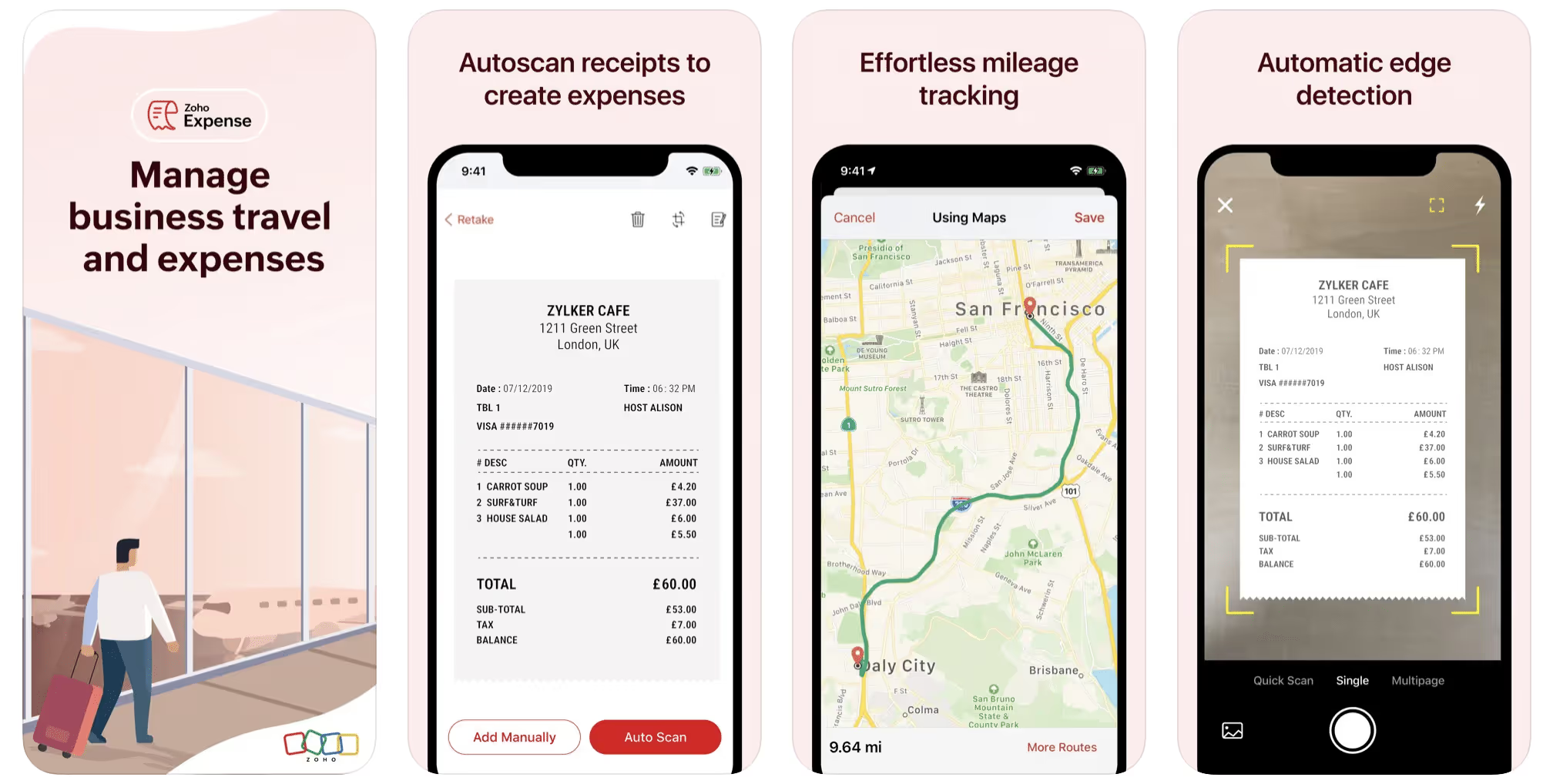
First up is Zoho Expense, which does exactly what its name says. This app is designed to allow companies to give employees a uniform way to create and submit expense reports. It can be used by individuals, including gig drivers, as well.
It includes a mileage tracker, as well as features that let you track other deductible expenses, including the ability to scan and record receipts.
Available on Android and Apple: Yes
Ratings: 4.8 stars on App Store, 4.7 stars on Google Play
Free Version: Yes
Subscription price: $3 per month, billed annually
Created specifically for gig drivers: No
2. Quickbooks Online
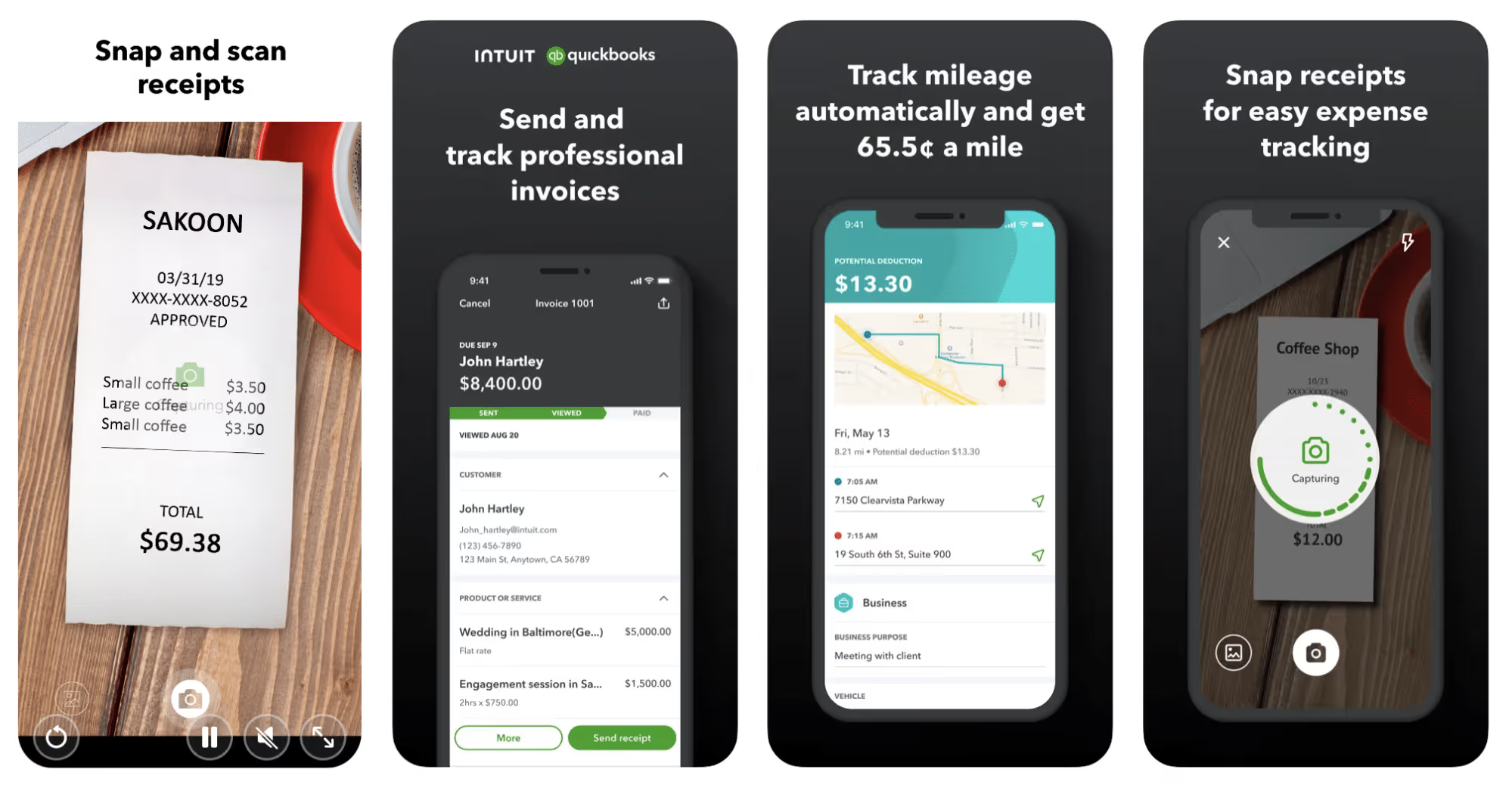
Quickbooks Online is a cloud-based app that allows you to track your mileage, earnings, and expenses. The information you enter can then be used to generate various reports that prepare you for tax time. It also allows you to create graphs that illustrate your cash flow, and includes a receipt scanner so you can instantly record deductible expenses. Quickbooks is popular, highly reliable, and designed mainly to help people keep track of their small businesses.
Available on Android and Apple: Yes
Ratings: 4.7 stars on App Store, 4.4 stars on Google Play
Free version: 30-day free trial
Subscription price: $15 per month for basic version if purchased for 3 months or more
Created specifically for gig drivers: No
Source: quickbooks.intuit.com
3. Shoeboxed
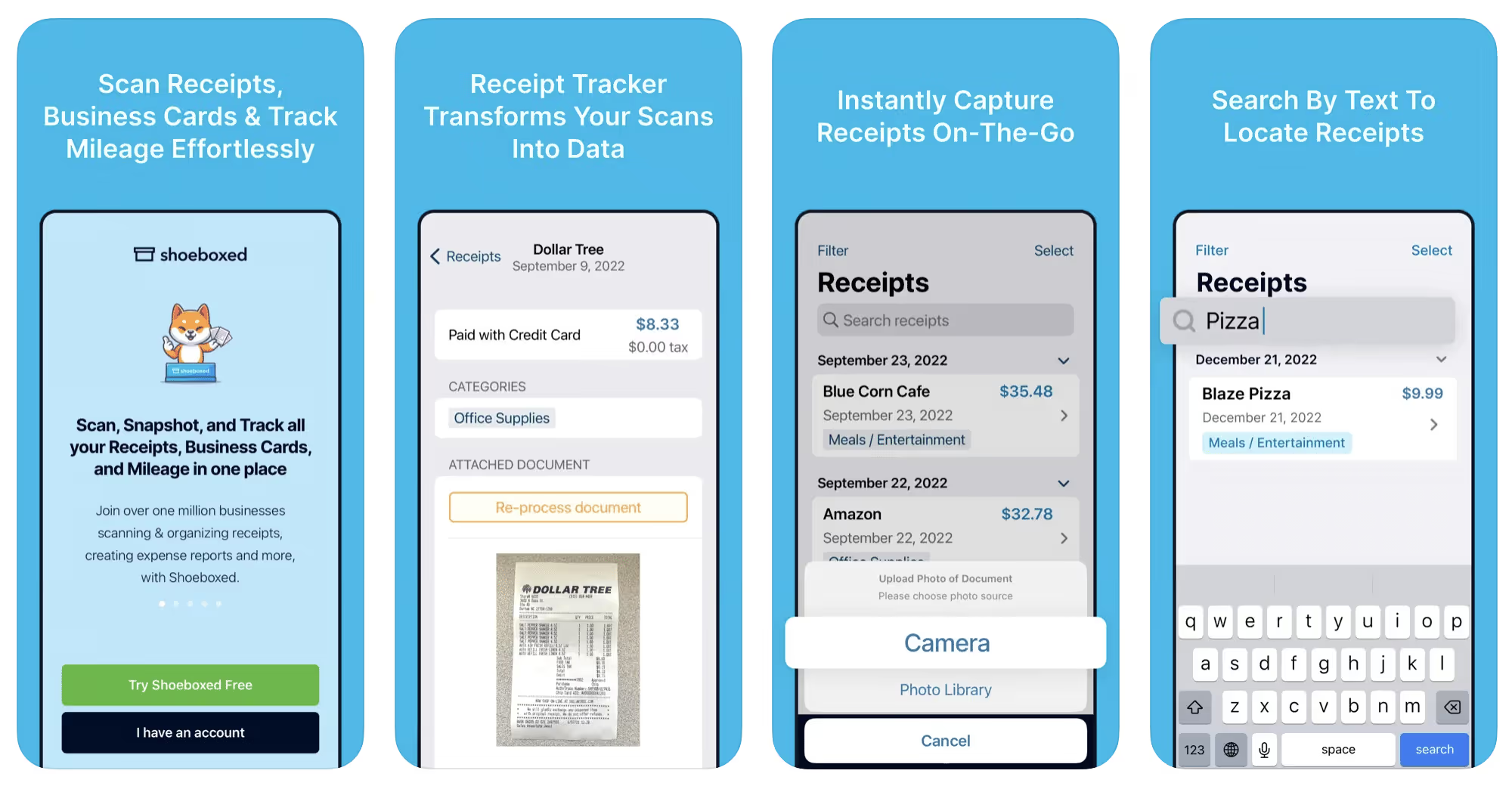
Shoeboxed started in 2007 as a service for scanning paper receipts into digital form. Now the app offers a free mileage tracker and has enabled users to scan receipts directly. It touts itself as the best mileage tracking app for DoorDash, but there are some elements missing that Dashers might like to have. While it provides features that record your expenses and prepare you for tax season, it doesn’t automatically track your earnings. The mileage tracker has a system where you can drop pins along your routes to make the tracking more precise, identifying those legs of a trip that you make for business purposes. The mileage tracker is “free” once you sign up for the basic version.
Available on Android and Apple: Yes
Ratings: 4.5 stars on App Store, 2.3 stars on Google Play
Free version: No
Subscription price: $18 per month for basic version
Created specifically for gig drivers: No
Source: blog.shoeboxed.com
4. Stride
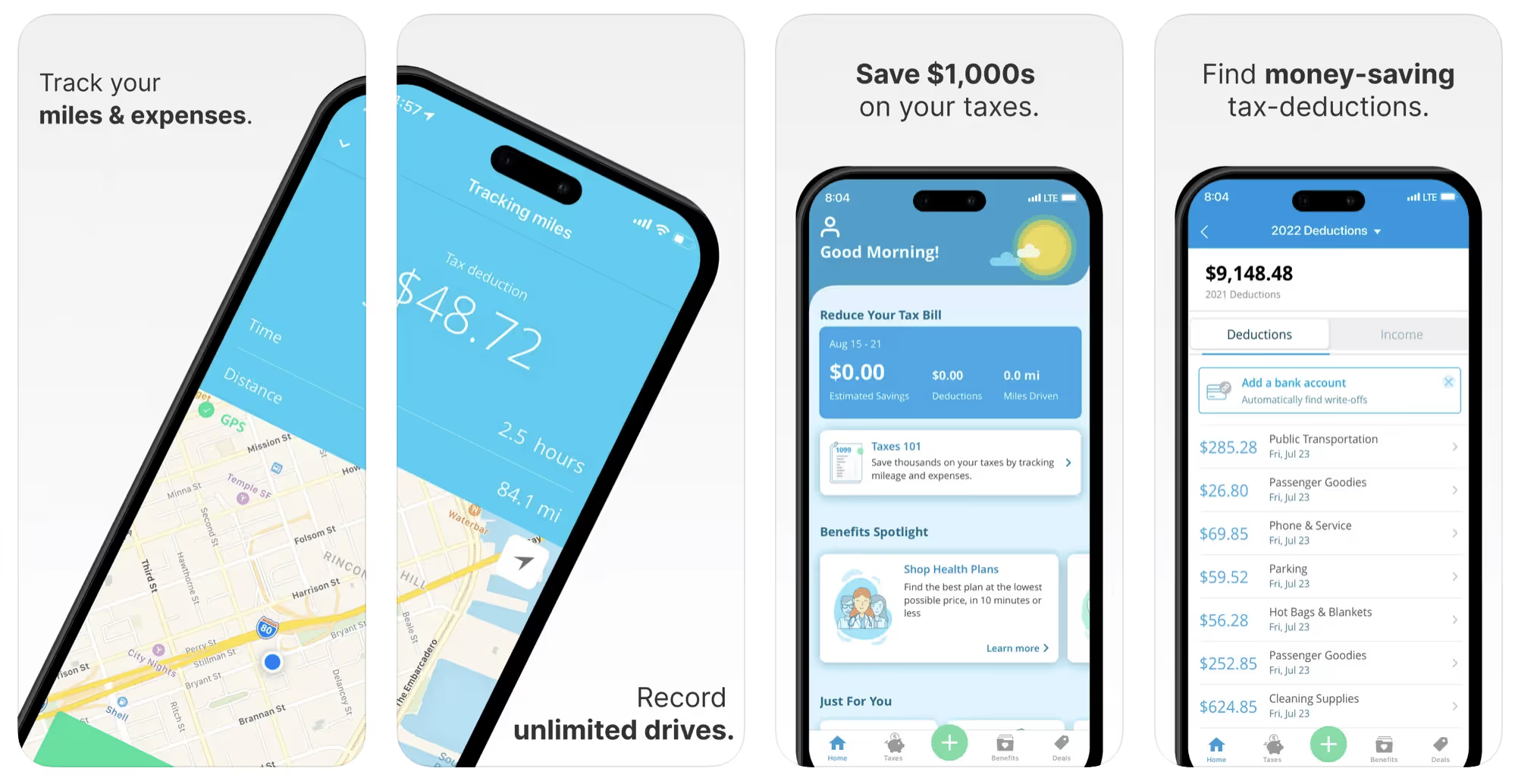
This free mileage tracker does a fair job of keeping track of the distances you rack up while gig driving, but it doesn’t automatically track earnings. It can be a big help, though, in tracking your expenses. You can link Stride to your bank account, and it will automatically scan your expenses to identify items you can potentially deduct. The app is totally free. This could make it the best free mileage tracker app, but there is a small price to pay. The app will persistently push you to consider various insurance plans that they are affiliated with. If you don’t mind that, this is a solid mileage tracker, even if it doesn’t track your earnings.
Available on Android and Apple: Yes
Ratings: 4.8 stars on App Store, 4.6 stars on Google Play
Free version: Yes
Subscription price: None. The app is free.
Created specifically for gig drivers: No
5. Gridwise
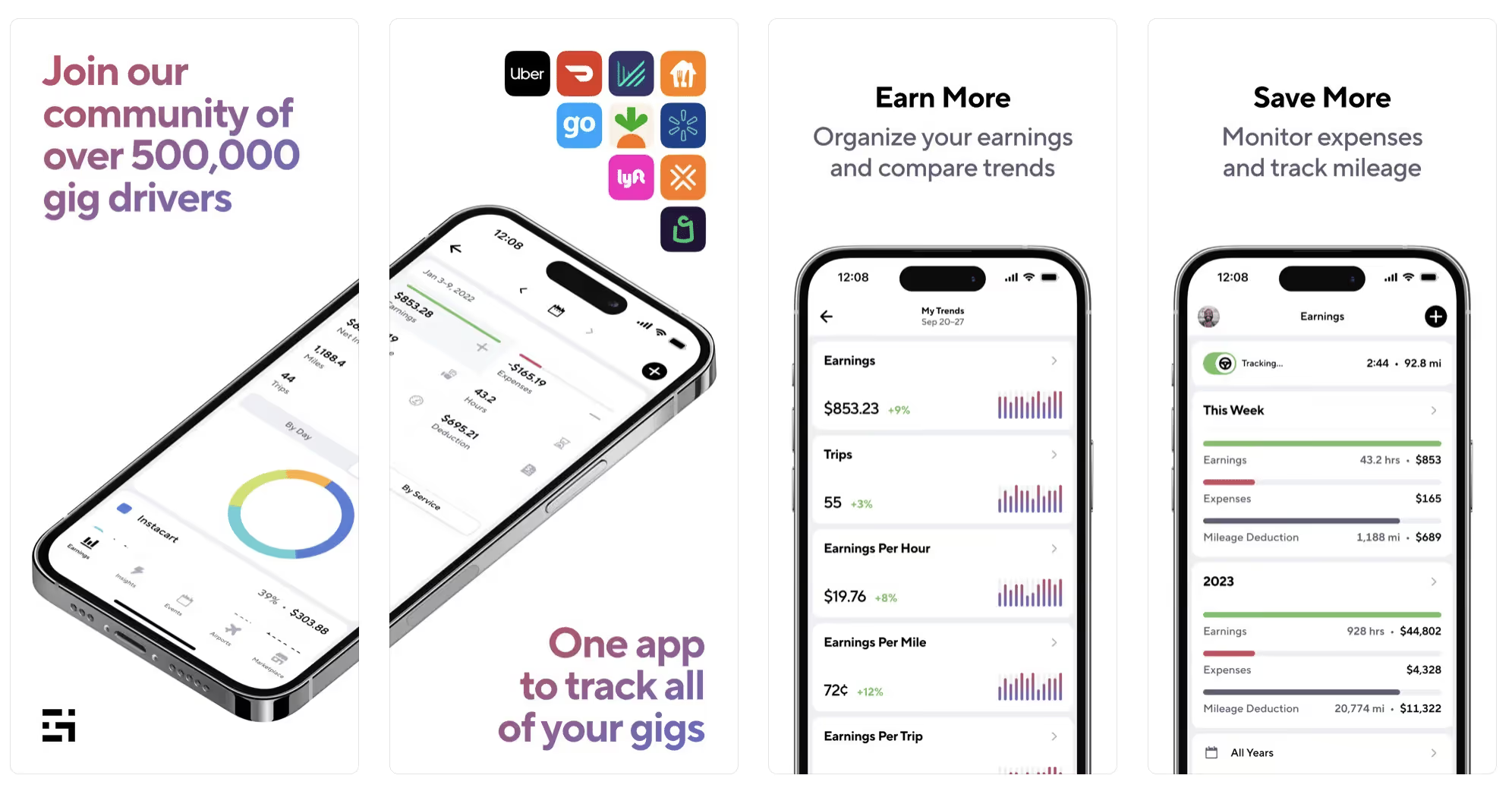
Gridwise has a free mileage tracker and free features that record your income and expenses. It gives you access to insurance and benefits, as well as insights about the best times and places to make the most money while gig driving. The Gridwise mileage tracker captures all the miles you drive while you’re on your driving shift, and it can be used if you have other trips you need to make which qualify as business travel.
Drivers love it because it is geared toward the needs of rideshare and delivery workers, providing free information about airport departures and arrivals, event start and let out times, weather, traffic, and more. The Gridwise Plus subscription adds value by providing additional insights and reports, discounts on benefits, the ability to export data in .csv format,, and more.
Available on Android and Apple: Yes
Ratings: 4.9 stars on App Store, 4.6 stars on Google Play
Free version: Yes
Subscription price: $9.95 per month for Gridwise Plus, or $95.99 per year (a $23.41 savings)
Created specifically for gig drivers: Yes!
What is the best mileage tracking app?
Now that we’ve checked them all out, we’re positive about the answer to that. Hands down, it’s Gridwise. Are we biased? You bet we are! But drivers love it too. Gridwise is the best mileage tracker app—and so much more. So many of the features are free, and the subscription to Gridwise Plus will pay for itself with additional insights to boost your earnings and deeper discounts on products and services.
Most important, Gridwise is designed specifically for gig drivers by experts who were once gig drivers themselves! Knowing what gig drivers need is a crucial step in creating an app that rideshare and delivery drivers can really use! Here are a few of the features, besides mileage tracking:
- seamless earnings tracking
- automatic, on/off toggle and manual mileage tracking
- mileage categorization
- airport, traffic, weather, and events information
- insights into where to drive and when to drive
- reports showing earnings across the platforms you use
- discounts on countless products and services for drivers
- additional resources for finding side gigs
- an informative and comprehensive blog
- affordable benefits, including insurance, medical, dental, and alternative practitioner discounts
- a community of drivers just like you
Don’t settle for just any app. Get the best mileage tracker, and so much more, from Gridwise!
[elementor-template id="21599"]

What Records Do Gig Drivers Need To Keep Track Of For Taxes?
* Gridwise does not provide tax, legal, or accounting advice. This material has been prepared for information purposes only, and is not intended to provide, and should not be relied on for tax, legal, or accounting advice. You should consult your own tax, legal, and accounting advisors before filing your return.
Record keeping? Who signed up for that? As a gig driver, it’s part of what you need to do to keep your business running. Don’t worry. It’s not as complicated as you might have been led to believe. This post will show you what you need to keep track of and the best ways to gather and preserve your tax-related records. We will cover
- How record keeping can help reduce income tax for freelancers
- Taxes and freelance work: Record keeping requirements
- Mileage tracking: Motives and methods
- More deductions and records to keep
- Make tax time easier
How record keeping can reduce income tax for freelancers
Tax time is not “fun time” for rideshare and delivery drivers. It’s easy to get used to watching your earnings pile up and come to believe they are all yours. Unfortunately, that isn’t the case. Gig work taxes can be especially painful because no one takes them out of your earnings for you, until the tax authorities insist that you do it for yourself.
You will need to show the tax authorities your income records, and they will gladly tell you to send them what they determine to be their fair share. Think that’s not fair? You’re not alone, but that doesn’t mean you’re going to get out of paying gig work taxes.
But you can find ways to pay the smallest amount that is legal and possible. The best way to defend yourself against having to pay astronomical amounts when you file your return is to know what expenses you can deduct from your gross income. When you subtract deductible expenses from your gross income, there is less left over to be taxed. This reduces the amount they can hit you with gig worker taxes. and can make your tax bill substantially lower.
While you want to keep good records so as to be in compliance with taxation entities such as the IRS, you also want to ensure you have proof of every last deductible expense you have accrued during the year. There are other records you must keep as well. Let’s look at some of the considerations you have, realizing that you now need to know how to do taxes as a freelancer.
Taxes and freelance work: Record keeping requirements
So many gig drivers fail to understand the responsibilities they have as independent contractors. Those who work part time for very few hours may even believe they don’t have to report the income they get from their driving gig payments. That would be a big mistake!
The company or companies you work for report your income to the IRS and state tax authorities. If you fail to report that income, you will risk some rather painful penalties. The IRS taxing side hustles is as much of a thing as the IRS taxing income from any other job. Your best bet is to report what you’ve earned, honestly and completely, and comply with other record keeping requirements such as
- gross income
- deductions and credits
- purchases (items you purchase and resell, such as snacks or bottled water)
- a log of all your mileage (or vehicle expenses, if greater)
- a list of all expenses and assets, such as utilities and other expenses associated with having a home office and equipment
- machinery and furniture you own, including when it was acquired, how much it cost, whether you previously took deductions on it, and selling price, if applicable (this includes your vehicle)
More things to consider:
- Pay attention to the retention of your records. You’ll need to keep all tax-return-related items— including income, deductions, and any tax credits reported— until the period of limitations runs out (3 years from date you filed, or 2 years from when you paid tax. If you have employees, keep your records for at least 4 years.)
- If you want to avoid paying self-employed taxes, you may want to set up a corporation or Limited Liability Corporation (LLC) for your business. This allows you to separate all your gig driving earnings from personal income, and permits you to take advantage of the additional advantages of working through a corporation. This includes exemption from self-employment taxes. You can learn more about how to pay self-employment taxes, if you opt for that, in this post from Keeper.
- You should always keep a separate checking account for your business, for convenience as well as clarity. While this is not a legal requirement, it is a smart move if you want to have an easier time managing your business.
- You are required, as an independent contractor, to file your taxes quarterly. Check out this Gridwise blog post for more information about quarterly tax payments and other matters that make filing delivery, Lyft and Uber taxes easier.
Mileage tracking: Motives and methods
Why you need to be meticulous about mileage
Mileage deduction, or the costs of operating your vehicle, will be the most important item to account for when you consider how to file taxes as a freelancer. While mileage is an important deduction for all independent contractors, as you might imagine, it’s even more essential for rideshare and delivery drivers.
There are two ways of keeping track of your mileage deduction. One is to use the IRS’ standard mileage deduction, which for 2022 is 58.5 cents per mile. This number takes into account the costs of operating your vehicle, from fuel and maintenance to registration, insurance, and depreciation. Alternatively, you can calculate all your own vehicle operating costs, but only after your first year of using the vehicle. You may discover that this second option allows you to have more money deducted from your taxable income. Learn more about the options for deducting your mileage in this Gridwise post.
No matter which way you decide to calculate the deductions for your mileage, you need to know what mileage you can and cannot deduct.
You can deduct
- miles driven to and from home when you go out to drive or deliver
- miles you accrue during your trips
- miles you drive on any other trips you make that are necessary as part of your business.
Examples:
- driving to return a lost cell phone or to an Uber Hub or another physical location where your company might make driver support available
- driving to pick up supplies, to get gas, or to have your car cleaned, serviced, or detailed, etc.
You cannot deduct
- miles you drive for personal trips
- miles for any trips you take that do not directly affect your business
Note: If imagining yourself becoming the not-so-proud owner of a shoebox filled with paper receipts gives you nightmares, stop worrying. Electronic records of purchases will satisfy reporting requirements. If you use cash, you can scan copies of your receipts, in some cases, right into your recording software or app. Gridwise and Keeper give you a simple to use interface that keeps all your receipts recorded without the messy pile of paper.
Mileage tracking methods
By now, you’re probably convinced that tracking mileage is important, despite all the other things drivers have to do. Now, let’s look at your options for keeping accurate records.
- Manual tracking: You can keep a logbook where you list every trip you make, starting and ending mileage, the date, and purpose of the trip. While this would work, it’s certainly not convenient. Besides, if that logbook gets lost, your plans for having a nice, fat tax deduction will go by the wayside.
- Spreadsheet: This is a bit more convenient and sophisticated way of tracking your business mileage. You’d need to be meticulous about making your entries, though. Even if you keep a spreadsheet app on your phone, it could be time consuming and inconvenient to keep doing it with all the other things going on in a rideshare or delivery driver’s day to day life.
- GPS-based mileage tracking apps: There are a bunch of apps that track mileage based on your GPS location, and most of them are pretty accurate and far more convenient than taking constant readings of your odometer. Your driving apps, such as Uber, Lyft, DoorDash, or Instacart, may also track your mileage, but be careful here. They will only track the miles you drive while you’re on a trip or delivery. They don’t count the miles you drive going to pick up a customer or when you make your move toward a restaurant or store.
Gridwise, on the other hand, will track all the miles you clock while you’re on your shift. All you need to do is make sure you start tracking the minute you leave home, and every gig driving mile will be logged. - OBD-II mileage tracking systems: There are plug-in modules that assess your vehicle’s mechanical health and track your miles. However, many authorities question the ability of OBD-II mileage tracking systems to get get accurate odometer readings. Insurance companies don’t consider them to be accurate enough gauges of odometer readings.
While mileage is a crucial deduction when you’re preparing your Uber, Lyft, or DoorDash taxes, it isn’t the only expense you’ll want to record.
More deductions and records to keep
Expenses you can deduct
You’re entitled to include the cost of other expenses that are directly related to your driving business. These include
- vehicle expenses
- equipment for your car and home office
- extra services and subscriptions
- business tools, including apps and software
You can learn much more about gig driver expenses that are eligible for deduction in this Gridwise article.
Ways to track and preserve deductible expenses
- The manual method: Just like you can with mileage, it’s possible to use a manual method, but in addition to logging each expense into a ledger, you would also need to keep physical receipts.
- Spreadsheets: You can record your expenses on a spreadsheet. This is somewhat less awkward than manually logging mileage, but there still will be plenty of room for failing to remember the case of water you bought for your customers, or losing the receipt from the thermal bag you purchased.
- Accounting software: You can use software that helps you track your expenses. This method usually interfaces well with any tax preparation software you or your tax professional might use.
- Gridwise: There are other apps that help you track your expenses, but Gridwise is designed specifically for gig drivers. It automatically tracks earnings and mileage, and lets you record your expenses the minute they come up. Gridwise’s partnership with Keeper gives you the ability to scan receipts and access a tax professional. This is a seamless way to record your expenses and a big help in learning how to file Uber taxes. Gridwise even provides .csv output, so you can feed your Gridwise data directly into tax preparation software. Check out what Gridwise and Keeper will do to super-charge your tax filing powers.
Organizing and categorizing expenses
Before you even begin to record expenses, you’ll want to set up categories for them. You can start by reviewing the categories listed above and checking out the Gridwise post that lists possible deductions.
If you’d like to learn more about how to categorize expenses, there is additional information available. This article from Motley Fool lists all possible categories any freelancer might use and also gives tips on how to customize them for your driving business.
One last tip
Using Gridwise, particularly for tracking mileage, is the easiest way to be in compliance with the IRS’ rules for deductible mileage. Gridwise tracks all the miles you drive for your gig, beyond what your company’s app might record. At the same time, you can log on and off Gridwise when you start and end your shift, so personal miles won’t be recorded. This eliminates confusion while capturing every deductible mile.
Gridwise Tax Help, a partnership with Keeper, has been created specifically to serve gig drivers. It provides affordable and easy ways to record expenses, scan receipts, and find deductions by analyzing your expenditures. Read about free resources from Keeper you can use to be fully prepared for tax season, and get all your earnings and expenses on the record.
Get the world’s best assistant for rideshare and delivery drivers, and tax help too.
Make tax time easier now!
The Car Maintenance Schedule Every Rideshare Driver Should Follow
When rideshare or delivery driving is your business, your car is more than just a vehicle. It’s your most important business asset and your source of income. Without your car, it’s pretty difficult to keep your cash flow going.
Because you depend so heavily on your car, you need to keep it in good working order at all times. Sure, maintenance can cost some money, but over time, it’ll be worth it. Why? Because if you don’t take care of your car, you could soon find you’re stuck coming up with cash to pay for a major repair.
If and when you do, that $100 you should have spent on maintenance could turn into $1000 or more in fixing what went wrong. On top of that, you could also lose out on $100’s or $1,000’s in income as you sit on the sidelines waiting for your car to be drivable again.
We want you and your car to be together for as long as possible, with as few breaks as possible, so we’ve put together a maintenance schedule every rideshare or delivery driver should follow.
Why do I have to follow a car maintenance schedule?
Like we already said, being left without your car can be a real catastrophe.
And I say this from experience.
When I was a full-time driver, I had a breakdown that took me off the road for nearly 2 weeks.
That meant $2,500 in repair expenses for me AND a loss of at least $2,000 in income. That was bad enough, but the most painful part of the ordeal was that it didn’t have to happen. The whole thing could have been avoided, if only I’d been on top of my car maintenance.
After that experience, I did the smart thing, and began to follow the following maintenance schedule.
Weekly Checks
Windshield wiper blades: If you want to drive like a pro, you definitely need to be able to have a perfectly clear view of the road! Check your wipers frequently, and if they aren’t working up to snuff, replace them with high-quality, long-lasting windshield wipers, such as Bosch ICON™.
Windshield wiper fluid: There’s nothing more annoying than getting caught without windshield wiper fluid! That’s why it’s a good practice to check your wiper fluid every week and ensure it’s at least half full. 7
Tires: Check all 4 of your tires for punctures, gashes, scuffs, or bulges. Also, ensure no steel cord is visible at all. If you see any issues, it might be time for a tire change.
Tire pressure: As rideshare drivers, we’re out on the road constantly, so our tire pressure can rapidly decrease. Take a moment to check your tire pressure once a week to make sure they are inflated properly. Compare your tire pressure to what is recommended in your owner’s manual. If you don’t have your owner’s manual, don’t worry. Google it!
Body and bumper damage: It’s incredibly easy to get a few bumps and scratches without knowing it when you drive 8 – 12 hours a day, often in congested areas. So once a week, or more, have a quick walk around your car to inspect for any new damage, including bumps and scratches. Check closely for any signs of rust as well.
Brake lights and headlights: This one’s especially important for late-night drivers. Park your car in a safe spot, turn your headlights on and ensure all bulbs illuminate. To check your brake lights, back up to a wall, press and hold your foot brakes and use side and rear mirrors to see both brake lights reflected by the wall.
Dashboard warning lights: This is an easy one. When you start your car, simply check your dashboard for warning lights. If you see one pop up, you can simply check your car manual for any lights that come on. If you don’t have your car manual, or even if you do, you can always Google your specific issue as there is almost definitely someone that’s asked about the light on a forum somewhere. Don’t fall into the habit of ignoring these lights!
Leaking fluids underneath the vehicle: Use a flashlight to look under your car for power steering fluid, brake fluid, coolant, transmission fluid, anti-freeze or anything else that could be leaking.
Oil level: Most mechanics and dealerships will recommend oil changes as specified in your car’s owner’s manual which usually falls somewhere between every 2,000 and 6,000 miles. When you’re a rideshare or delivery driver, that mileage piles up rather fast. Check your oil levels every week to make sure they’re keeping your engine running cool and clean.
To check your oil levels, make sure that your engine has cooled down. Then, take the dipstick out and wipe it off with a rag. Put the dipstick back in and then pull it out and see if the oil levels are where they should be. If they aren’t, you may have a leak which you should get checked out by a pro.
Pro Tip: Always check your engine lights everytime you drive and do your best to take care of any issues as soon as possible.
Every 3,000 Miles
Oil Change: Always check your vehicle’s oil change schedule in your maintenance manual. In most cases, you’ll probably want to change your oil somewhere around every 3,000 miles. Clean oil is crucial. It keeps your car running now, and it also contributes to the longevity of your car. You could stretch the oil changes a bit farther, but it’s safest to try to change your oil at 3,000 miles unless your owner’s manual says otherwise.
Check belts and hoses: Your car’s belts and hoses are key to keeping your car on the road. So, you’ll want to check them out regularly to see if they need to be replaced. If your hoses appear to be brittle, are worn or are bulging, you will need to get new ones. If your belts are frayed or worn, then you’ll need to get replacements.
Air filter: Your air filter keeps harmful substances from getting into your engine, so If it’s damaged or dirty, nasty particles can enter your engine and really clog up the works. Check to ensure that it’s not dirty or blocked. If so, you’ll need to have it replaced.
Brake pads, rotors, and fluid: Your brake pads, rotors, and braking fluid make up your braking system, and if your braking system isn’t working correctly, you might get into serious trouble. Every time you change your oil, take a quick look at your pads, rotors, and fluid to ensure they’re in good working order.
Every 6,000 miles
Tire Rotation: Tires last longer if they’re evenly worn down, but your front tires typically get worn faster. That’s why it’s important to get your tires rotated frequently to prevent the need to replace them faster than you’d like, and spending lots of extra money.
Spark plugs and wires: Ensure that your spark plugs and wires are ready to get the party started. These usually only need to be changed every 30,000 miles or so, so you probably won’t find problems with them all that often.
Replace your cabin air filter: Installing a fresh cabin air filter is probably one of the easiest things you can do to keep your car comfortable. Most vehicles make the cabin air filter easily accessible, and replacing it is as easy as opening a box. The cabin air filter may not be critical to your car’s operation, but it makes riding in your car far more pleasant! This is something you can do for yourself, so if you keep your eye on it and replace it as needed, it won’t turn into a repair you have to pay someone else to do.
Windshield wipers: Like we said before, good windshield wipers are something you can’t afford to ride without. Don’t wait until you can barely see through your windshield to check and change your windshield wipers. Constantly check your wipers to ensure they aren’t getting overly worn. When you replace them, do it with a wiper that’s going to stand up to all kinds of weather and last a long time. Bosch ICON™ windshield wipers last up to 40% longer than other premium wipers, thanks to the bracketless design and materials that are both flexible and durable.
Every 15,000 miles – Find a Good Mechanic
At 15,000 miles you’ll need to check your battery, serpentine belt, timing belt, and wheel alignment, among other things. For these more sophisticated maintenance tasks, it’s best to find a great and trustworthy mechanic, and take your car in for a full inspection.
A good mechanic is like having a good doctor. They give you good recommendations, and allow you to make the final decisions. When you find a mechanic you know you can trust, you will have made a connection you’ll want to keep for as long as possible.
A trustworthy pro can be the difference between your car lasting just 100,000 miles and 300,000 miles, so don’t take this task lightly. How do you find one? Ask friends and family, check Yelp and other review sites, and make sure you do your due diligence.
If you maintain your car with full attention and care, it will serve you well, and be a fully reliable source of income now and in years to come.

Are coding bootcamps worth it for rideshare and delivery drivers
While COVID-19 hasn’t managed to wipe out the rideshare and delivery driving business, it surely has made it riskier, as well as more difficult. Because of that, many drivers are looking around for new career opportunities.
If you’re among them, and the right opportunity came along, would you be tempted to drop driving for a new career?
It would have to be something worth taking a shot at. It would need to deliver on the financial side, and not require that you spend a lot of money and time to get started. It would need to be an in-demand and marketable career. And of course, you’d want it to be challenging and enjoyable.
What kind of career would offer all that and make it worth giving up driving, or at least putting driving on the back burner while you get up to speed with a new career?
The answer: coding.
Coding bootcamps are extremely popular now. For many reasons, a growing number of drivers view coding as a career that can get them out of the driving and delivering rut in these tenuous times. In this post, we’re going to look at the pros and cons of coding bootcamps from the point of view of a driver. Here’s what we’ll cover:
- What coding bootcamp is
- Why drivers might want to consider coding bootcamp
- The benefits of bootcamps
- The not-so-great aspects of bootcamps
- Is bootcamp worth it?
What coding bootcamp is
Does the word “bootcamp” make you break out in a cold sweat? Don’t worry, it’s not that kind of bootcamp. You won’t have to prove your physical prowess or report for reveille every morning before dawn.
Being in coding bootcamp can be an intense workout for your brain, though. It is a high-intensity, fast-paced program that teaches students how to write programs, analyze data, and provide security for websites and apps.
At coding bootcamp, you’ll learn about the field of development. This will teach you about creating and supporting software-based platforms that are used by corporations, governments, and nonprofit organizations. By the time you’re done with coding bootcamp, you’ll have learned enough to get a job writing apps, curating user experiences, analyzing data, and ensuring the security of websites and apps.
Coding bootcamps give you specific, job-related skills. Instructors don’t focus on the broad view or history of the field you’re training to enter. Rather, you get down to the business of learning computer languages and trying your hand at creating programs right away.
Bootcamps last anywhere from three to nine months, depending on what you choose to study. Some bootcamps are full-time, but others are part-time, so you could still drive and make money while you’re going through training.
For the most part, coding bootcamps are conducted online—and this is not due to the COVID-19 pandemic. Many bootcamps have always been online, so any program you enter now won’t differ from what it was before March 2020.
There might be occasional class meetings, but they are mostly for social and networking purposes. Now, even these are conducted online, so you’ll still be able to interact with your classmates if your bootcamp includes group projects or gatherings.
Why drivers may want to consider coding bootcamp
The most obvious reason for drivers to consider coding bootcamp is money. While there’s still a possibility to make good money driving, getting into the development field is going to pay a lot more. The right bootcamp can make a huge difference in your life.
Let’s look at one example: Kenzie Academy
An especially popular bootcamp, Kenzie is designed for people from all walks of life. You don’t have to be a lifelong geek or rocket scientist to succeed, and the academy respects the experience you’ve already had in your work. After all, who could be a better designer for an app’s screens or user experience than someone who uses apps all the time?
In a bootcamp like Kenzie, you’ll find support for your desire to make your life better with a new career. Bootcamp training is intense, to be sure, but it’s designed for people who want to go from zero to sixty fast, and get to a more prosperous place in life.
Bootcamps might sound too good to be true, but an estimated 80 percent of people who attend them land a job in their field, with median salaries around $66,000. You’ll have to pay for your tuition, of course, but it is much more affordable than what you’d be charged to get a degree at a four-year college.
A fabulous advantage of this type of program is that coding jobs are comparatively secure. You can get full-time work with a company that pays benefits such as health insurance, unemployment compensation, and paid vacation.
If you’d prefer to keep working part-time, that’s possible too. You can put in a limited amount of hours with a company, or you might even work out of your home as an independent consultant. That allows you to choose your own schedule, and decide how much work you can handle based on your home, family, or other responsibilities.
Now, we’ll look at some other pluses of attending coding bootcamp.
The benefits of bootcamps
Bootcamps aren’t the only way to get into the development field. You could go to a four-year university and study computer science or website design. You might also attend community college and get some of the skills that could lead to a job in coding.
However, if you enroll in a bootcamp like Kenzie, your education is streamlined. Here are just a few of the benefits of bootcamp training over college or university schooling.
- Flexible hours: You won’t have to sit in a classroom during set times; rather, most programs allow you to work from home. Although you may need to attend a class from time to time. This leaves you time to keep driving, and earning money, if that’s what you want to do.
- Short program duration: Unlike a long-term program at a college or university, bootcamps range from as short as three weeks to 48 weeks. You can even take self-paced courses and stretch out your program for as long as is practical for you.
- Job-oriented skills development: You’ll waste little or no time learning anything besides what you need to know to get a job in your chosen field. There are no language courses, electives, or any other requirements other than your full attention to developing your coding and other skills.
- Career assistance: Most bootcamps offer guidance about available careers, and some even assist you when it’s time to get a job. Many bootcamps have an urgent incentive to get you into the workforce ... they won’t collect tuition from you until you’re actually employed.
- Networking: Other students can be a great resource for job leads, including those you attend with and those who attended before you. This is a good reason to lean toward a bootcamp that lets you interact with the other coders in your community.
- Reasonable cost/Flexible plans: No training school is cheap, but coding bootcamp isn’t outrageously expensive; the full cost can range from $7,800 to $21,000. There are loans, of course, as well as Income Sharing Accounts (ISAs). These programs allow you to pay a certain percentage of your income, once you get a job in the field, until your tuition is all paid off. Some also have deferred tuition, which allows you to hold off paying until after you’ve been working for a certain time period.
As the old saying goes, “There’s good and bad in everything,” and that’s the case with bootcamps. In that spirit, it’s wise to look at all aspects of these programs, including negatives as well as positives.
The not-so-great aspects of bootcamps
While most people who attend coding bootcamps give them positive reviews, there are some negatives to consider before you invest your time and money in one of them.
- Financial commitment. Even though bootcamps are much less expensive than the cost of a four-year college degree, they still aren’t cheap and can cause a financial strain for drivers.
- Time commitment. There’s no doubt that you’ll be dedicating a lot of time to bootcamp, for your classwork as well as the projects you’ll be required to develop.
- Lack of fundamentals and theory teaching. The job-specific skills that coding bootcamps focus on don’t always give students the background they need to understand the big picture. This can be a problem when on-the-job experiences, or even job interviews, wander into theoretical territory.
- Skill limitations. Bootcamps strive to be cutting-edge, so they typically teach modern programming languages only. This can create challenges for graduates because not all companies are state-of-the-art, and older website designs or apps might be written in older languages that bootcamp grads can’t code in.
- Exaggerated promises about job placement and networking. Schools will say they’ll hold your hand through the process of securing a high-paying job, but in many cases, you’ll still have to do much of the legwork. The same goes for networking. You are likely to find that an independent spirit is required to find the kind of job you wanted when you first decided to enroll in bootcamp.
Is bootcamp worth it?
Only you can answer that for yourself. But keep in mind ...
Even if you go through bootcamp and decide you don’t want to work full-time, you’ll have valuable skills that you can always use. If you find it too technical for you to do 40 hours a week, you can finesse a way to use those skills for a career in marketing or social media advertising.
But if you really take to your new coding career, and you’re willing to put in the effort it takes to find the right job and get on a great professional path, the investments you’ll make in bootcamp can definitely be worth it.
And remember, as a driver you always have the option of driving part-time, while you’re studying, and also if you decide to work as a part-time coder. With these considerations in mind, we think it’s definitely worth your while to try coding bootcamp.
Before you do, though, we have a few suggestions:
- Read about coding to learn what it really is, and what else coding bootcamps teach;
- Assess your skills, and be realistic about how well you think you’ll do at coding;
- Be honest about the time commitment, and take a hard look at whether you have the time to devote to bootcamp;
- Make sure you’re self-motivated so you don’t fall behind;
- Be pragmatic about the financials: Are you certain that you can handle the costs?
To learn more about coding bootcamps, check out this article by Course Report, which provides a comprehensive and impartial list you can use to begin your search. We also advise that you look closely at Kenzie Academy, because we know that one of their highest priorities is helping drivers like you make your life more rewarding and prosperous.
Kenzie caters to drivers
When you make the commitment to bootcamp, it’s important that the one you choose is geared toward someone like you. Here are some reasons why Kenzie Academy is a great choice:
- Simple, easy to understand programs: Kenzie offers web development, software engineering, and UX design;
- Choose how long to attend: Programs are six or nine months long;
- Both full-time and part-time programs: Even the full-time programs leave time for driving if you wish to continue to earn while you learn;
- All online classes: No need to visit campus, and long-established experience with online format;
- Job guarantee for User Experience (UX) students: Kenzie sets you up for a future-proof career, meaning one that’s unlikely to be obsolete;
- Personalized attention from instructors: Small classes and career coaching;
- Fully accredited program;
- Solid alumni network.
For all these reasons and more, if you want to make a move from your driving career into the exciting field of coding, web design, and development, a great bootcamp like Kenzie Academy is well worth your consideration. They know what you need to be successful, and they want to help guide you into a rewarding, challenging, future-proof career.
5 reasons rideshare and delivery drivers should use electric vehicles
Electric vehicles (EVs) are popping up everywhere these days. There are sleek, high-end EVs that evoke the oohs and aahs of those watching them drive by. There are also utilitarian EVs that range from subcompact runabouts to SUVs and heavy-duty trucks.
Newer EVs are every bit as powerful as gasoline-powered cars, so there’s no longer any reason to worry about them getting you where you need to go. Also, the range of EVs is growing wider, and charging stations are commonplace in many areas.
In a world that is becoming increasingly conscious about the effects of carbon-heavy fumes being spewed into the atmosphere, the advent of electric vehicles isn’t all that surprising. Something pretty astounding about them, though, is how affordable they’ve become.
With the Fair Financing Program by Forth, it is now incredibly easy for drivers to own EVs, and use them for rideshare and delivery driving. We’ll talk more about this later, but first, let’s explore five good reasons for driving an EV:
- No more high fuel bills
- Fewer visits to the mechanic
- Smaller carbon footprint
- High-quality ride
- Affordability
1. No more high fuel bills
It’s really true. When you drive an EV, you do not have to buy gasoline, diesel fuel, natural gas, ethanol, or any other kind of fuel to keep your car moving.
As the driver of a vehicle with an internal combustion engine, you probably spend at least 9 or 10 cents per mile on gas. Multiply that by the 100 or 200 miles you travel in just a few hours of gig driving, and you’re spending a lot of cash just keeping that engine running; at least $10.00 a day, and probably more.
According to Kelley Blue Book, the average EV owner who drives around 1,000 miles per month, would pay from $50 to $56 monthly to charge the vehicle. Here’s how the math works:
- 1-kilowatt hour = 3.5 driving miles (approximately)
- 1,000 miles = 286-kilowatt hours
- 286-kilowatt hours x 20 cents per kilowatt hour = $57.20
So, if you drive 1,000 miles per week as a full-time rideshare or delivery driver, you would pay at least $100 per week on gas, or $400+ per month. With an EV, your cost would be $14.30 per week or $57.20 per month. That’s a huge difference and a great reason to consider an electric vehicle.
2. Fewer visits to the mechanic
Electric vehicles are much easier and cheaper to maintain. Many don’t require as much maintenance as an internal combustion engine, and they have fewer moving parts. Your battery, rather than that complicated contraption that consists of belts and valves and gaskets, is the focus of most maintenance concerns.
It’s easy to care for a battery. Although some vehicles have trouble charging in extreme cold or heat, there isn’t much else you have to worry about to maintain your car’s battery. Most manufacturers offer a warranty on their batteries, and today’s modern batteries are expected to last 10-20 years.
You will still have to deal with coolant and brakes, of course, but overall, owning an EV is much less taxing on your maintenance bills than a conventional vehicle could ever be.
3. Smaller carbon footprint
EVs, at least those that are not hybrid engines, emit nothing into the air, which is a huge advantage. Not only can you, as an individual, be free of any guilt for belching out extra fumes into the atmosphere; you’ll also be setting an example of how easy and convenient it can be to drive a vehicle that’s powerful as well as environmentally sound.
Of course, energy is still being consumed and there is some pollution caused by charging these vehicles, but it’s far less than emissions from traditional gas cars. If you’re still concerned about the pollution, consider using solar panels, or some other alternative energy source, to power the charging station you use. In this article, a company called EnergySage provides instructions about doing that.
There’s also the matter of the battery itself, and what happens to it after it’s no longer usable in your vehicle. The industry is working on better ways to recycle batteries because the current methods are less than great. But there are innovative ways of repurposing batteries, which you can read about in this The Next Web article.
Another interesting article about repurposing batteries is this one by the Institute of Energy Research. The authors point out that once EV batteries can no longer be fully charged in order to propel a vehicle, they can be used to power street lights, elevators, home generators, and data centers. Once the batteries fully expire, they can be recycled to utilize metals such as lithium, cobalt, and nickel.
4. High-quality ride
As you drive your EV along a city street or county road, you’ll notice how quiet and smooth the ride is. The engine is almost silent. You’ll still hear the tires on the road, and maybe a few clicks here and there, but for the most part, the lack of engine noise is a welcome change from combustion engine vehicles. Your customers will appreciate the quiet too.
Also, because there are no gears in electric cars, you won’t notice shifting when you speed up or slow down. Everything runs smoothly, and yet also powerfully.
Also, the smooth and quiet nature of the EV’s ride will keep you more relaxed as a driver. When you take a test drive, you might find that the only question left is: “How can I afford an electric vehicle?”
5. The real shocker: affordability
You read that right. You don’t have to be a high-tech corporate mogul to make an EV your next ride—especially now. Thanks to Forth, and its Fair Financing Program, owning and driving an EV is well within reach for rideshare and delivery drivers.
The program was designed, in fact, to help offset the detrimental effects of rideshare on the environment. Forth’s pilot program in Portland, Oregon was launched in response to data from the Union of Concerned Scientists. This well-respected environmental organization found that rideshare trips are about 69 percent more polluting than the rides they replace.
Forth saw the need to transform the smoggy clouds from all those rideshare and delivery vehicles’ fumes into a cloudless, smokeless sky, thanks to EVs and their ability to operate with zero emissions. Forth’s Fair Financing Program is designed to help drivers buy high-quality used EVs—regardless of their income.
With this innovative program, drivers get low-interest loans capped at 9.9 percent, enabling them to enjoy the lower maintenance and fuel costs of EV ownership. With smaller loan payments and lower operating costs, owning an EV actually allows you to increase your gig driving income.
As of December 2020 Forth Mobility’s Fair Financing Program is available exclusively in the Portland area. But it could expand, as more drivers experience the difference driving an EV can make to their rideshare and delivery gigs.
Owning an EV and using it for rideshare and delivery could save you money and let you drive with a clear conscience about your impact on the environment. Now, with the help of Forth’s Fair Financing Program, it can be within your financial reach. Check out Forth’s Fair Financing Program, and you’ll see!
5 ways Uber Lyft DoorDash and other gig-services can improve their rating systems
Rating systems have become a part of everyone’s life.
Nearly every time we complete a transaction, whether it’s a purchase on Amazon, a delivery by FedEx, or even a customer service phone call, companies and merchants follow up with requests like, “tell us how we did,” or “tell us how much you like our product.”
These rating systems give customers a chance to offer honest feedback, and (hopefully) incentivize companies to make improvements in products and/or services.
For rideshare or delivery drivers, however, the effects of rating systems can be brutal, and too often the “star rating” does not tell the whole story.
As a result, many drivers end up deactivated unfairly and without ever being able to plead their case.
In this post, we’ll cover some of the reasons why the current star rating isn’t always fair to drivers, and discuss some alternative options that the ride-hail and delivery drives could use.
Here’s what we’ll cover:
- Why ratings can be good for drivers… sometimes
- Bad ratings bring big problems
- Why ratings are not always fair
- Protecting yourself from bad ratings
- 5 steps companies can take to improve the system
Why ratings can be good for drivers… sometimes
Feedback can be a useful tool for gaining tips on how to improve performance and avoid doing things that make customers squirm. It’s nice to know that a passenger appreciated your conversation, the music you played, or your ability to go above and beyond.
In a similar (though less pleasant) way, it’s also good to know when you’ve done something to upset or irritate a customer.
Some customers like it when you stop at yellow lights, while others would prefer you hit the gas and get to your destination faster. You might get more appreciation for bringing extra napkins and condiments in a food order than you would for making the delivery five minutes sooner.
It’s hard to know exactly what to do in order to make customers happy, but most good drivers are always trying to do that. Even when you think you’ve done the right thing, and get a rating that says you could have done better, it’s still good information to have.
The other bonus of getting good ratings is that it enhances your reputation with the company and with potential customers. If you maintain a high rating, you might get extra bonuses from the company.
But when the ratings game works against you, it can be a whole other story.
Potential problems with bad ratings
There’s no doubt about the biggest and most serious impact bad ratings can have on drivers… the companies can, and do, use it as a measuring stick that can potentially hit drivers with deactivation.
How does this happen? If you drive now, you already know. Uber, Lyft, and some delivery services have a minimum level for drivers based on their star ratings. When a rating drops below a certain level, the company can fully deactivate the driver, just based on how well the majority of customers reacted to the question, “What did you think about your driver?”
The other problem bad ratings can cause is a change in your public impression with riders. When a rider has a choice between two drivers, one with a 4.9 rating, and the other with a 4.7 rating, it’s clear which driver will get the trip.
While most drivers aren’t too bothered by negative comments such as “hit the brakes too hard” or “music was too loud,” it’s very hard to shake the reality of a bad rating. Low star counts, and their consequences, are even more upsetting when they are unfairly attributed.
Why ratings are not always fair
Any time one person is asked to evaluate another, subjectivity and opinion can dominate the answers that are given, and so it is for most driver star ratings.
Passengers can make innocent mistakes or mischaracterizations, as well as observations that result from a customer’s preference or proclivities, such as conversation, appearance, wearing too much cologne, etc.
Of course, there are also valid reasons for customers to object to the performance of drivers. Safety, cleanliness, and following protocols such as wearing masks and sanitizing the vehicle are some. Others include inappropriate advances, offensive language, and rudeness.
But unfair, biased factors also influence ratings, such as sexism, bigotry, and even hate-inspired thinking. When these and other such factors play into a customer’s evaluation, the customer-driven, highly subjective, star rating systems fail miserably.
For example, drivers may have gotten poor ratings based on attributes such as:
- Gender: Some people (even in today’s day and age) think female drivers are not as competent as male drivers.
- Race: Prejudice based on race and nationality is an ugly, and all too common blight on society. Sometimes bigoted riders take a cultural difference or language gap out on drivers, and give them poor ratings based on it. You can read in this October 2020 article about one driver who has sued Uber, claiming the rating system allows for racial bias.
- Politics: For drivers, it’s never a good idea to wear or display political messages where they can be seen. If you do, you leave yourself open to being discriminated against for being on the wrong side in the opinion of your customers.
- Sexual orientation: It’s an unfortunate fact that not all customers are open-minded and accepting. An LGBT driver who ends up with one of these customers can, through no fault of his/her own, provoke a hateful person to give a bad rating.
- Physical challenges: Customers might expect more than a driver is capable of, depending on the driver’s physical abilities and limitations.
- Age: Whether the customer perceives the driver is too young or too old, derisive opinions about this can be unfairly factored into a star rating.
Some drivers are striking back at the companies for using the current rating system, which they believe discriminates against people who look and act different from what riders might consider acceptable.
This LA Times article is about an October 2020 class-action suit that was filed against Uber on behalf of nonwhite drivers nationwide.
Such behavior on the part of customers is appalling and unacceptable. But with the system the way that it is, drivers are vulnerable to mistreatment on many accounts. It pays to know how to prevent unfair ratings, and deactivations, from affecting you.
Protecting yourself from bad ratings
It’s obvious that the best way to protect yourself from bad ratings is to do everything you can to earn good ones. Here are some suggestions from Lyft and Uber to help drivers keep their ratings high:
- Be sensitive to your customer: Always be friendly, but learn to discern whether the customer wants to chat, or just wants to ride or take the delivery and go about his or her business. Also ask about music preferences, especially volume, and whether the passenger needs more heat or air conditioning.
- Be a good navigator: Follow the route in your app closely, and try not to make mistakes. Also, ask your passenger (or delivery customer) if they prefer that you take a different route.
- Stay safe: Drive like you have a state trooper in your car. Stop at intersections, and keep to the speed limit. Don’t text or talk on the phone while you’re driving. Your customer should experience the time with you behind the wheel as being safe as well as comfortable.
- Be clean and serene: Many customer complaints come from a rideshare driver having a dirty car, or a delivery person carrying food in a dirty bag. You may have to tidy up even between rides. Increase your awareness of your car’s state of sanitation, and you’ll see your ratings go up too.
- Help with doors, luggage, and special needs: Where and when it’s appropriate, rideshare drivers can go that extra mile by helping with groceries, luggage, and other cargo their customers might bring along. Also, if someone needs extra help getting in or out of your vehicle, don’t watch the person struggle unless you are specifically asked not to help. And, if your delivery customer is weak or disabled and needs help carrying bags, offer to help with that.
- Be polite, even when others are not: Having a customer scream at you is never a pleasant experience, but it happens—and when it does, it will always benefit you to be calm and quiet. You can still be firm, of course, especially if you have to enforce a rule or policy such as wearing a mask or requiring a car seat for a child. Contrary to popular opinion, it is very possible to be firm as well as polite.
- Get a dashcam: We’ve preached about this before, but we have to say it again: A dashcam is always good protection against being falsely accused. You can find more information about protecting yourself with a dashcam in this blog post.
You have control over these behaviors and habits, but as we said earlier, there are some incidents with customers that you cannot control—or even predict.
What can you do when you get low ratings for bad reasons? Here are some tips:
- If you have reason to believe a customer is going to leave you an unfair rating, contact your company’s driver service department and report it. When you are proactive about stating your side of the story, you will have a better chance of winning any appeal you might need to undertake later.
- If a customer has made you uncomfortable, either through sexual harassment or discrimination of any kind, note this on your rating of the customer. This will alert your company about the customer’s undesirable behavior, and will also prevent the customer from camouflaging it by lodging a complaint against you.
- Use your dashcam or bodycam video to prove what happened, what was said, and who said it. Present it as evidence to your company. Familiarize yourself with how to cut clips and transmit them. This kind of action can be a real job-saver.
The subjective and volatile nature of the star rating system is something we as drivers have to live with. We can do everything possible to keep our side of the street clean (so to speak), but we also believe there are steps companies can take to improve this subjective and volatile system.
5 steps companies can take to improve the system
Every system has room for improvement, and the star ratings used by Uber, Lyft, Postmates, and DoorDash are no exception. Many drivers feel the system, and the cutoffs (4.6 for Uber and 4.8 for Lyft) are unfair, especially if these arbitrary numbers are used to deactivate drivers.
There’s no reason to believe the companies will stop using this rating system anytime soon, but there are ways they could improve it. Here are our suggestions:
- Be more responsive to driver appeals. Some incidents, such as when a customer accuses a driver of being impaired, result in the driver getting immediately deactivated until the situation is investigated and resolved—which can take days. In lieu of that, the driver could be offered an immediate opportunity to prove that the accusation was false, perhaps through the hubs, a medical facility, or other means.
- Ensure that customers can back up their claims. Many customers make accusations just so they can get free rides or other bonuses from the companies. They should be asked to prove, perhaps with a formal statement, that the objectionable act actually was committed.
- Hold customers accountable for bias. Just as drivers are asked to do, customers could be required to watch videos about community standards that clearly state what they are not to do, and what they should not tolerate from drivers.
- Give drivers more access to their ratings. Drivers receive summaries of their ratings, but rarely do they get specific information about what they’re being accused of. While customers’ anonymity should be respected, the driver’s right to know what s/he is accused of should also be honored.
- Consider not allowing star ratings to be the sole basis for deactivation. Especially for drivers whose customers either have sky-high standards or little common sense, low star ratings don’t always mean the driver doesn’t deserve to be on the road.
So there you go. We’ve offered five suggestions for improvements, but we’re betting you can think of more. Leave us a comment below or contact us with ideas that you’re convinced the companies need to hear.
Improve your driving life
When you download Gridwise, your life as a driver gets better right away. Track your earnings on multiple platforms automatically! Just set up your accounts to work with Gridwise, and you’ll get slick-looking graphs like these:

Gridwise will tell you how much you earned from each service, what your expenses were, and how much you can deduct for your mileage.
While all that tracking goes on in the background, Gridwise offers airport and event information, weather, traffic, and access to our Perks tab. That’s where you’ll get notifications about new posts on our blog and YouTube channel. There are also discounts and deals for drivers to learn about—plus great gas card giveaways on our Facebook page. Like us, and you could be a winner.
Even if your luck doesn’t pan out for the gas card, you’ll still win just by driving with Gridwise. Say whaaaaaaat? You don’t have the app yet? Well download it now!

What rideshare lawyers say gig-drivers should do after an accident
Hopefully, you’ll never need this advice.
But let’s face it… car accidents aren’t exactly something you plan for.
If you’re a rideshare or delivery driver, and you’re involved in a crash, not only do you have to worry about personal injury to a possible passenger as well as yourself, you could lose your livelihood while repairs are being made. And those medical bills and repairs? They pile up fast, and the cost can be overwhelming.
It’s crucial that drivers be totally aware of the best way to handle accidents. That’s why we sat down with Bryant Greening of Legal Rideshare to hear what actual rideshare lawyers have to say about drivers protecting themselves from being exposed to additional losses after an accident. Here are some items our conversation covered:
- What rideshare and delivery drivers should do if they get in an accident
- The special needs of bike delivery workers
- Three ways rideshare and delivery drivers can protect themselves
- What rideshare lawyers can do for drivers
We also created a video of our conversation that you can watch below.
What rideshare and delivery drivers should do if they get in an accident
The first thing to remember: Remain calm. No, that isn’t always easy, so if you’re having trouble holding things together in the shock of the moment, take a couple of slow, deep breaths.
Then...
Stop the vehicle.
Assess the situation.
First, find out if anyone is injured. Assess your own physical condition, and then ask about any passengers you might have with you. Also, find out if there are injuries in the other vehicle(s), or if anyone needs medical attention.
Call 911.
You’ll need to report the accident and inform the dispatcher of any injuries.
Get to a safe location.
If you’re on a busy road or blocking traffic and are able to move the vehicle, move to the shoulder or take the nearest exit.
Exchange information with the other driver.
Get the license number of the other vehicle(s) involved in the accident. Also, record the other driver’s insurance information, registration, and driver’s license number. You can take photos of these documents and save them on your device.
Tell local law enforcement about the accident.
A written record of your accident will be crucial if you hope to be compensated by any insurance company. Sometimes they will come to the scene, but if no one is injured, they may ask that you and the other operator come to the nearest station to make a report there.
Gather evidence.
Before you leave the scene of the accident, get the names and contact information of any witnesses. Take photos of the vehicle, focusing on any damage from the accident. Make note of the road conditions. Get everything you need to support your version of the facts, which is hopefully corroborated by one or more witnesses.
Ask witnesses to help you.
Don’t be shy about asking your riders to provide their names and phone numbers where they can be reached. These will be your best witnesses, and insurance companies will view them as objective observers because they aren’t biased; i.e., they don’t have any particular interest in who wins the case. Getting into a “he said, she said” situation with another driver solves nothing and isn’t likely to work in your favor.
Call the company for whom you’re driving.
If you’re on the app and with a passenger, the rideshare or delivery company will have insurance coverage on you, as one of their drivers, that can save your financial life. This blog post gives you the details of how the companies deal with insurance in the event of an accident. Even though you might be hesitant about reporting your mishap to your company, Greening advises that this is a step you don’t want to skip.
The special needs of bicycle and scooter delivery workers
We asked Greening what advice he could give us for bike and scooter riders who get into an accident.
He said the main difference is they’re far more likely to be injured while piloting a bike or scooter than they are while driving a car. Here’s the advice he has for these workers:
“If you’ve been hit, don’t be a hero. If you’re hurt, stop. Call the police, and call an ambulance. Make sure your health is priority #1.”
Insurance is still very much a factor for those delivering via bike and scooter, because delivery companies offer insurance. Furthermore, if you’re in an accident on two wheels rather than four, it’s pretty likely that a car caused the accident. Unfortunately, most automobile drivers don’t always notice smaller vehicles like bikes and scooters, which is why they’re likely to be at fault.
In this case, the driver’s auto insurance comes into play, and can cover the cost of treating your physical injuries, as well as lost wages and emotional stress.
ALWAYS take the steps you need to protect yourself from injury and the cost of paying for your recovery. Take the driver’s information, exactly as you would after in an accident while driving a vehicle.
Three ways rideshare and delivery drivers can protect themselves
- Get a Dashcam
Greening pointed out how insurance companies make people jump through hoops in order to receive the settlements they deserve. He said, essentially, that it isn’t possible to overemphasize the importance of gathering evidence, and the very best way to get it is with photographic evidence of what was happening at the time of the incident.
What happened? Which vehicle failed to yield, or who was speeding? When answering these kinds of questions, people will say all kinds of things, whether they’re misremembering or outright lying. But, as the old saying goes, cameras don’t lie. As we discussed in this blog post, there are many reasons to have a dashcam, and making sure you can prove the cause of an accident is a big one.
- Get rideshare/delivery coverage on your insurance policy
For a minimal cost per month, you can have your insurance company add an endorsement to your regular auto policy that covers you as a gig worker. Without this endorsement the insurance company may nullify your coverage if they discover you were using your vehicle for anything other than personal transportation. With the endorsement, you don’t have to worry about what might happen if your car is totaled, or if you happen to be at fault in an accident when you’re on your gig work shift.
- Protect your income
Insurance coverage is one thing, but full protection is another. You need to know you’re covered for the wages you could lose while waiting for post-collision repairs, and also in case you get hospitalized or are deactivated unfairly by your company.
And Gridwise can help with that! With our new Gridwise Protection program, you can receive 80 percent of your lost income for as little as $7 per month.
Find it in the Gridwise app, or follow this link to sign up.
What rideshare lawyers can do for drivers
Legal Rideshare is the first legal firm that’s solely dedicated to helping rideshare and delivery drivers.
As specialists in the gig economy, they have special insight into the nuances of the lives of their driver clients. In addition to developing an astounding and winning reputation from their work with accident and injury law, Greening says his firm has further aspirations.
Not only can these lawyers help you if you’re hurt while on the job, they are advocates for drivers’ rights too. In Chicago, they recently won a case that overturned a ban on drivers using their cars for advertising. The law that created the ban was deemed unconstitutional, because it deprived drivers of a way of making a living.
With this case already won, Greening says they’re looking for other cases that can make a difference in the lives of rideshare and delivery drivers. You can learn more about the folks at Legal Rideshare at their website, and follow them on Facebook for more real-life legal advice drivers can use.
More help for drivers—from Gridwise
We at Gridwise are also focused on helping drivers, on and off the road. Track your earnings and mileage; get info about the airport, events, and weather; and check out the Perks tab for quick links to our blog and the amazing Gridwise YouTube Channel. Plus, you get deals and discounts that make drivers smile all day long. All you have to do is download the app. What?? You haven’t done that yet? Well do it now!
You can also find us on Facebook, and get in on the Gridwise gas card giveaways. You never know when that next free tank might be coming your way.
And one more thing—leave a comment with any questions you might have about this or any other topic we’ve covered, or any you’d like us to look into. Meanwhile, always keep the #1 Assistant for Rideshare and Delivery drivers, Gridwise, close to you as you go about your gig driving.
Everything you need to know about driving for Lyft
While it’s not as widespread and massive as its largest competitor, Lyft is definitely a well-established and well-liked company, by drivers and passengers alike. It does one simple thing: it provides an app-based platform, where passengers find drivers who get paid for taking them to and from their various destinations.
People see Lyft as a more “friendly” company because of its brightly colored branding materials, and also because the experience of using their app is more personal than other services. For instance, drivers see pictures of their customers before they pick them up, and there does seem to be a more friendly tone to their communications.
Driving for Lyft is a popular gig. As of late 2019, there were 2 million Lyft drivers. Headquartered in San Francisco, Lyft was founded by Logan Green and John Zimmer in 2007, but didn’t really get off the ground in its present form until 2012. Now, it services more than 350 cities worldwide, and commands anywhere between 29%-39% of the rideshare market.
What makes Lyft so popular, and why would you want to drive for this company? In this blog post, we’ll approach that question and more by examining:
- What a Lyft driver does
- What you need to do to qualify as a driver
- How to apply to join the happy Lyft fleet of drivers
- What it means to be an independent contractor
What a Lyft driver does
If you’ve ever taken a ride with Lyft or another service, you have some idea about how things work. The driver receives a notice saying you need a ride, then decides to accept it or not. Assuming the driver takes the call, you get picked up and taken to your destination.
From the driver’s side, things are just as you might imagine. The driver has a special version of the app, and has to remain alert to receiving calls. After accepting a request, the driver must commit to following through with it. If not, the ride will have to be cancelled, and the driver’s rating could be adversely affected.
As a Lyft driver, you choose the times you wish to work. You can go out for one ride or twenty. There are limits set by the company, however, to make sure drivers aren’t working such long hours that it’s no longer safe for them to be on the road. Read more about those limits here.
The rates for each ride are determined by Lyft. Of course, the amount you receive is not the total amount the passenger is paying. There is a take rate, which is the amount Lyft will retain from the customer’s payment. This will vary from time to time, and from one city to the next.
Rates also will vary based on passenger volume and driver availability. In bad weather conditions, or during large events, Lyft offers bonuses. A surcharge will be added to the passengers’ fees, and the drivers will earn more during those time periods. There are other incentives as well, such as bonuses for completing a certain number of rides in a given number of days, or for referring new drivers to Lyft.
There are many regulations drivers need to be aware of, and they are different in each location. Check here to find out more about items such as airport requirements, safety, community guidelines, and other company policies, and how they apply in your city.
How much will you make as a Lyft driver? That’s another thing that varies according to where you’re driving, but Glassdoor’s data show Lyft drivers’ earnings average around $16 per hour. This number, remember, is your gross earnings, minus bonuses and tips. It also doesn’t include the costs of you doing business, such as fuel, vehicle maintenance, and depreciation.
Another thing that’s particularly important for Lyft drivers is their star rating, from 1 to 5 stars. This rating is based on how customers rate the driver. If you’re polite, efficient, your car is clean, and you accommodate your passenger, you’ll get a great rating! In many cases you’ll also get a tip. Always remember, riders will see your star rating before they choose you as your driver! You’ll want to keep it as high as possible.
If you fail to meet Lyft’s requirements for maintaining a star rating, you may receive a warning from the company. If you don’t improve, you could be deactivated. So, as silly as something like a star rating might seem, it can potentially make or break your career as a Lyft driver!
There are other issues the company will consider when evaluating your performance. Foremost among these are low acceptance and cancellation of trips. You have to be very alert as a Lyft driver. For instance, calls for additional rides might come in after picking up a passenger.
While safety always must come first, there are consequences for missing (or ignoring) these requests. Drivers have to keep up a certain level of acceptance and cancellation rates to maintain high ratings.
If a passenger cancels a ride, it’s no big deal for the driver. And, if it’s cancelled after the driver has spent a great deal of time traveling toward the pickup point, the driver will receive a few dollars’ minimum payment for the trouble.
There will be times when you can’t take or complete a ride, of course, such as when you need to purchase fuel, you have a flat tire or a breakdown, or you’re just too tired to continue driving.
Before we get into any more intricacies such as these, let’s get back to some basics.
What you need to qualify as a driver
Lyft’s driver requirements vary from one state or city to the next. There are special cases, such as New York City, where you must get a license from the Taxi and Limousine Commission (TLC) before you can drive. In most cases, thankfully, this isn’t the case. This list covers some of the basic things you’ll need to drive, in most places, but do check Lyft’s website to find out what you need to drive in your town.
FOR YOU:
- Proof that you are of the minimum age required in your area
- A valid driver’s license
- The ability to pass a background check that examines criminal and DMV history
- A smartphone capable of running the Lyft driver app (iOS 11 or higher, Android 5 or higher) Check here for more specific smartphone information.
FOR YOUR VEHICLE:
- Usually, no more than 15 years old, with no more than 350,000 miles on the odometer
- Four or more doors
- 5-8 seats, including the driver’s seat
- Not on Lyft’s list of ineligible subcompact vehicles
- Not classified on the title as salvage, non-repairable, rebuilt, or any equivalent
There are further vehicle attributes that may qualify you to drive for Lyft’s high-end services, Lyft Lux, Lux Black, and Lux Black XL. Check here for more details.
If you don’t want to use your own vehicle when you drive for Lyft, there are options to rent and lease one. There are companies that specialize in renting vehicles for rideshare, such as Hyrecar, and you can also look into renting, short-term or long-term, through Lyft.
You’ll want to check out some other matters before you apply. The first one is the background check Lyft will run on you. This blog post tells you what it entails, how long it takes, and what to do if you experience delays or other problems.
You’ll also need to look into insurance. While Lyft covers you, your car, and your passengers while you’re driving for them, there are reasons why you might want to look beyond their basic coverage. It’s a smart idea, also, to talk with your insurance company and get extra coverage from them. If you fail to do so, and they find out you’re a rideshare driver, they may not cover you for any mishap, whether you’re on the app or not. This Gridwise blog post. will tell you more about what you need to know about rideshare insurance.
How to apply to join Lyft’s happy fleet of drivers
As long as you meet the requirements, applying to drive for Lyft is pretty easy. Start here to open your account. Now, with Lyft, it’s possible to use your rider account and go to the driver side...or you can open a separate account just for driving. That is totally up to you.
From there, you’ll upload some items to identify you and your vehicle. Here’s a list:
- A profile picture
- Proof of vehicle registration
- Proof of insurance
- Inspection and emission stickers
You will also be asked to submit information about your background check. You’ll need to wait for that to be approved, but in the meantime, you can prepare your vehicle by cleaning it thoroughly, and printing out a temporary window decal through the app.
Lyft will send you your permanent window decal, and maybe even a light-up “amp,” if you qualify, after you’re approved. You can use the temporary decal to drive only after you’re fully approved, and before your welcome kit arrives. Until you’re approved, the app won’t allow you to receive ride requests. Patience is the key! Before you know it, you’ll be “in the Pink,” which is the happy shade Lyft drivers proudly display to the passengers they serve.
There’s this one other thing...
Drivers for Lyft are classified as independent contractors. This Gridwise blog post about the controversy regarding whether this will continue to be the case gives a very thorough description of the differences between that status, and being an employee.
The basics are this: Unless you get your own coverage, you will not get any of the following as an independent contractor:
- Medical insurance
- Workers Compensation Insurance
- Disability Insurance
- Pension Plan
- Minimum wage protection (except in a few select cities)
- Sick pay
- Vacation pay
- Tax withholding
In many states, there are legal cases pending that might change the way companies classify drivers. Many drivers want the government to force the companies to make them employees. Others would rather hold on to their flexible hours and independence from more stringent company policies. There are driver groups fighting for drivers’ rights all over the country. This article will give you an idea of the landscape surrounding this hot-button issue.
When you drive, bring the ultimate assistant with you!
Gridwise will be there to help you, whether you drive for Lyft, another rideshare service, or a delivery company. Our amazing app lets you track your earnings on every platform you use, and keep a record of your total mileage. This makes tax time deductions and tabulations a breeze!
You get a beautifully formatted, easy-to-read graphic of your earnings and expenses, just like in this figure:
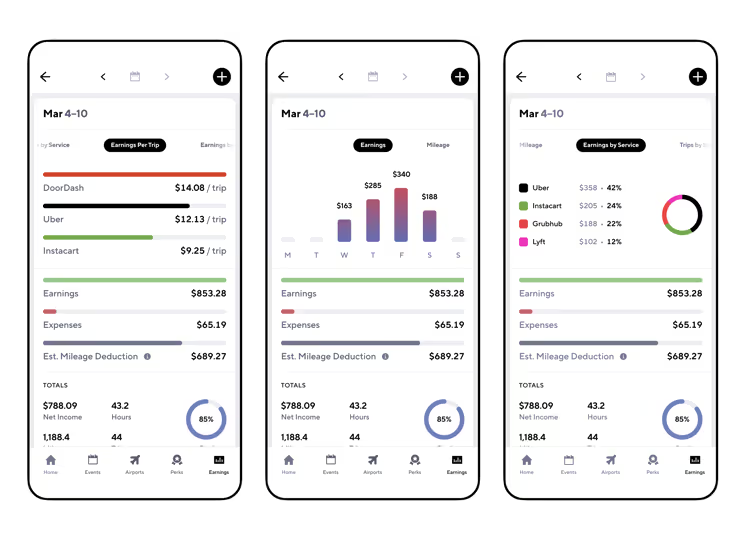
After you’re done checking out all these cool features, click on the Perks Tab. There’s where you’ll find deals and discounts for drivers, easy access to the blog and news from the Gridwise YouTube channel. You’ll be an even happier Lyft driver when you use this app, so download it now!
Also, be sure to become part of the driver community when you join us on Facebook. We’re holding great Gridwise gas card giveaways all the time. And, please send us all your questions and comments about this article or the gig economy in general, right here in the section below. We love to hear from our drivers, and hope you’ll enjoy the cool community Gridwise has brought together, too.
Everything you need to know about driving for Uber and Uber Eats
“Uber” is one of those words that has evolved into a descriptor of an entire industry, rather than just one company in the industry. Upon arriving at a gathering, for instance, it’s common for people to say, “I took an Uber,” even if they used a different app like Lyft, Turo, or Zipcar. Indeed, Uber is the biggest name in rideshare, and it has a strong foothold in food delivery, too. It’s the company with the most drivers (8 million globally), and it operates in 83 countries and at least 853 cities. You could say that Uber … gets around.
Depending on your point of view, the fact that Uber is so huge might make you either more inclined, or less interested, in driving for this huge company. Only you know what a good fit would be for you. So, in this article, we’re going to go through the pros and cons of being an Uber driver so you can make an informed decision. We’ll cover:
- What Uber does
- What an Uber driver’s shift is like
- A few words about Uber Eats
- What you need to qualify as a driver
- How to apply to be a driver
- One more thing
What Uber Does
According to its corporate statements, Uber is a technology company that, through its app, offers the opportunity for drivers and riders to connect. Uber allows drivers to work with just rideshare, meaning only taking passengers from their pickup points to their destinations, and also offers other services. For instance, drivers for Uber are automatically qualified to take requests through Uber Eats, which is a service that delivers prepared food.
Uber is a gigantic company. Without going into too much detail here, we’ll add that in addition to rideshare and Uber Eats, Uber has package delivery systems, Uber helicopters in select cities, and even self-driving (autonomous) vehicles. This is definitely a company that thinks even bigger than it already is. And Uber’s recent acquisition of Postmates is further evidence that it's a major force in the gig economy.
So, what’s it like to drive for the biggest gig driving company out there?
What an Uber driver’s shift is like
Driving for Uber is fairly straightforward. You open the app, and wait for a passenger to request a ride. A map will pop up to show you where the passenger is. You can either use Uber’s navigation system, or set your app to go to another (most likely better) one, such as Waze or Google Maps. Once you arrive at the pick-up location, you’ll find out where your passenger is going. Again, the app will help you navigate to the destination. Once the passenger is dropped off, you’re done. With luck, you’ll even get a tip.
It’s common for you to get a request while you are driving with another passenger. You can accept the ride, but always be careful about using your phone while driving. Most drivers have their phones mounted, either on the dashboard or windshield, to make it easier to manage them while they’re on a shift. Check your state laws to see what types of mounting are legal. You never want to obstruct your view.
Rides are worth more money at certain times of day and in certain parts of town. Uber has what are known as “surges.” During those times, when there are more riders than there are drivers, or when there’s a major event going on, prices will go up and you’ll get paid more.
There are also other bonuses, like goal-setting promotions known as Quests. These are times when you get extra money for completing a certain number of rides, either Monday through Thursday, or Friday through Sunday. You can also earn extra through consecutive rides promotions. At a busy time, for example, you might get $3, $7, or $9 extra for taking three rides in a row.
The amount of money you see as your earnings is only a portion of what Uber charges the passengers. Uber has what is known as a “take rate,” and it is aptly named. That’s the percentage the company retains from the full fee for bringing you and your customers together, plus everything it takes to make that happen.
As an Uber driver, your hours are totally flexible. No one tells you what time you have to be at work, or how long of a shift you have to put in. The only one you have to report to in this regard is … you. That’s great, as long as you’re disciplined about getting out to work, and staying there long enough to make the amount of money you want and/or need.
Once you’re done with a shift, you shut down the app and your earnings will be posted to your account. Your ability to manage yourself, and of course, the level of demand for drivers in your area, will determine how much you earn.
Uber will automatically deposit your earnings in your bank account once per week. If you need the money sooner, you can cash out immediately for a minimal charge (about fifty cents).
How much you’ll make as an Uber driver varies by location, season, time of day, available bonuses, and other factors. In general, Uber drivers make anywhere between $13 and $20 per hour. Earnings can be less, and even more, especially when promotions and surges are taken into account.
Keep in mind that when we talk about earnings, it doesn’t include tips, promotions, or bonuses. In addition, it doesn’t take into account the costs involved with doing business.
As an Uber driver, you’re an independent contractor. This means you’re responsible for withholding money for taxes, as well as expenses such as fuel, depreciation, and maintenance. You’ll also have to purchase your own health and disability insurance.
When you’re planning your shifts for the week, think about how much you need to make in order to satisfy your income requirements, taking all these expenses into consideration. While these expenses are considerable, they’re also legitimate tax deductions, so there’s something to be gained at tax time.
A few words about Uber Eats
We mentioned earlier that Uber drivers have the option of being Uber Eats delivery drivers. A setting in the app allows you to accept Uber Eats requests. Uber Eats driving entails taking a call from a customer, picking up the food at a restaurant or other establishment, and delivering it to the hungry person on the other end of the request.
While Uber Eats doesn’t always pay as much as rideshare driving for Uber, it can be a worthwhile way to make money when rider requests are hard to come by, or when you simply feel like dealing with food rather than people. The beauty of working for Uber is you can do either or both, as long as you qualify to be a rideshare driver. (Uber Eats drivers don’t always qualify for rideshare.) Let’s look at the requirements for driving now.
What you need to qualify as a driver
Here are the criteria for becoming an Uber rideshare driver.
Requirements for you:
- Be the minimum age required to drive in your city
- Have at least one year of licensed driving experience in the U.S., or three years of licensed driving experience is you’re under 23 years old
- Pass a background check
- Have a valid U.S. driver’s license
- Present proof of residency in the state where you plan to drive
- Have proof of auto insurance, if you choose to use your own vehicle
- Have a smartphone capable of handling the Uber app (iOS 8 or higher, Android 4.0 or higher)
Requirements for your vehicle:
- Must have four doors, and able to transport a minimum of four passengers
- Can be a car, truck, SUV, or minivan
- Vehicle must be 10 to 15 years old or newer (check your city for exact requirements)
Additional vehicle requirements (can vary by city)
- Five factory-installed seats and seat belts
- Working windows and air conditioning
- No vans, box trucks, or similar vehicles
- Cannot have any cosmetic damage, missing pieces, commercial branding, or taxi paint jobs
- No salvaged or rebuilt vehicles
- No aftermarket seating modifications, such as installed seats, seat belts, or BedRyder systems
These requirements apply mainly to UberX, which is the basic Uber service. There are higher levels of Uber services, such as Uber XL, Uber Premium, Uber Comfort, and Uber Premier. You can learn more about those levels of service here. In most cases, your vehicle will have to meet even higher standards.
For Uber Eats the requirements will be slightly different, depending on your city. If you’re in a designated area, you may be able to make Uber Eats delivery by bicycle or scooter.
If you don’t want to use your own vehicle (for rideshare or Eats), you may be able to rent a vehicle through Uber. Even though you can't drive for Uber with a car you rent on your own behalf, they will rent or lease vehicles that meet their requirements, usually through a car rental company that has an agreement with Uber. Vehicle programs vary from one city to the next.
Check the Uber website for details about your location. You’ll get this opportunity if and when you apply to be a driver. Check on “I need a car,” and you will be sent to the appropriate web page.
Before you apply to be an Uber driver, there are a few more details you’ll want to investigate. One of them is the background check. This blog post tells you all about it, including how long it will take, and what you can do if it takes longer than you expect.
Insurance is the other item that drivers need to attend to. Uber will provide some level of protection for you, but you’re also required to have your own policy on your car. Furthermore, you need to let your insurance company know that you’re working as a rideshare driver, and pay an extra amount for a commercial rider. Don’t try to sidestep this; the risk isn’t worth it. If you don’t tell the company that you’re driving for Uber, and you have an accident, they have the right to waive your policy—which could have disastrous results. Read more about insurance in this Gridwise blog post.
How to apply to be a driver
Although the process isn’t complicated, it does take some effort. You’ll need to be at least somewhat savvy with your smartphone. Assuming that you are, the first step is to download the Uber driver app, which you’ll find in the app store on your phone.
Once you do that, you’ll need to gather the following documents:
- Driver’s license
- Vehicle registration (temporary is acceptable)
- Proof of Insurance
- Picture of you
- Permission and information for the background check
You’ll provide the documents (including your photograph) to Uber by taking screenshots and uploading them to the app. Follow the system prompts to input the background check information.
Once you apply, it can take a day or two for all the documents to be approved, and in many cases, additional time for the background check to clear. Remember, they are checking your criminal record and your driving record. If you want to read more about Uber’s background check, here’s a previous Gridwise article about it.
Once all the documents and the picture are approved, and the background check clears, you’ll be ready to roll!
One more thing
As you may already know, Uber and Uber Eats drivers aren’t employees; rather, they’re independent contractors. If you want to read more about a battle over this designation that’s going on in California, here’s a Gridwise blog post about it.
As an independent contractor, you are responsible for most benefits that an employer would usually provide if you were an employee. These include:
- Health insurance
- Workers compensation insurance
- Disability insurance
- Minimum wage protection (except in a few cities)
- Paid time off (vacation, sick days, and holidays)
- Pension plan
- Tax withholding
There’s an ongoing struggle between the gig economy companies and government jurisdictions in the many locations where the companies operate. Government officials in some of these areas, along with many gig workers, would like to see drivers be classified as employees. It’s a huge controversy, and both sides of the argument have good points to make. This article will help you get a grasp of what’s going on, and give you enough information to decide how you feel about the issue.
Don’t go it alone
Whether you decide to drive with Uber, or decide to go with another rideshare or delivery company, the one thing that will consistently be a big help is Gridwise. You can track your earnings on all the platforms you use, and keep a record of your total mileage so you know how much to deduct at tax time.
The information is presented in easy-to-read, graphic format like this:
And that’s not all. On the Perks tab you’ll find deals and discounts for drivers, easy access to the blog, and news from the Gridwise YouTube channel. You won’t want to leave home without this amazing app, so download it now!
To get a flavor for the Gridwise community, join us on Facebook, where the great Gridwise gas card giveaways are going on all the time. Finally, if you have questions or ideas about this article or the gig economy in general, leave us your comments below, and get a great community convo started.
Trabaje de forma más inteligente. Gane más.
Ya sea que conduzcas, entregues o recojas turnos, Gridwise te ayuda a hacer un seguimiento de las ganancias, el kilometraje y el rendimiento para que puedas mantener el control de tu trabajo. Descarga la aplicación y toma las riendas hoy mismo.
