Blog de Gridwise
¡Lee el blog de Gridwise para obtener consejos y sugerencias sobre cómo ganar más dinero mientras conduces para Lyft, Uber, DoorDash, GrubHub y más!

The Gridwise Job Board: Find Your Ideal Job or Gig Work
Gridwise is an essential assistant app created by gig workers for gig workers. Our mission is to support those engaged in gig work in every way possible. We understand how challenging it can be to deal with income instability, a lack of benefits, and job insecurity that often comes with gig work. The Gridwise app tracks and organizes earnings and expenses, and offers a wide array of discounts, deals, and services that make the lives of independent contractors easier and more rewarding.
We firmly believe it’s possible to make a viable living and create a gig experience that offers flexible hours, variety, and excitement. With issues such as consistent earnings and job security in mind, Gridwise is proud to offer a centralized platform that shows you how to find gig work and secure reliable opportunities. We’re proud to introduce the Gridwise Job Board.
[elementor-template id="20891"]
The Gridwise Job Board: Key features
Because Gridwise is dedicated to serving the gig worker community, we’ve filled the Gridwise Job Board with useful features that won’t waste your precious time.
- Comprehensive listings. Find part-time, full-time, temporary, and per-task work. Drive or deliver with your vehicle, utilize an employer’s vehicle, or even find non-driving gig work.
- User-friendly interface. Find the jobs that are right for you with a tap of your screen.
- Verified opportunities. We vet the jobs before they are listed to ensure you’re getting high-quality job postings.
How to get more gig work, seasonal, part-time or full-time jobs with the Gridwise Job Board
Looking specifically for “gig work apps” or “gig jobs near me?” You’re in luck. Our filters and search functions send you directly to the listings you seek.
Here’s how it works.
- Access the Job Board via the Gridwise website.
- Search for jobs by type, location, and more.
- Select the job that interests you, and read all about it.
- Scroll through the description, and if it appeals to you, click “Apply for job.”
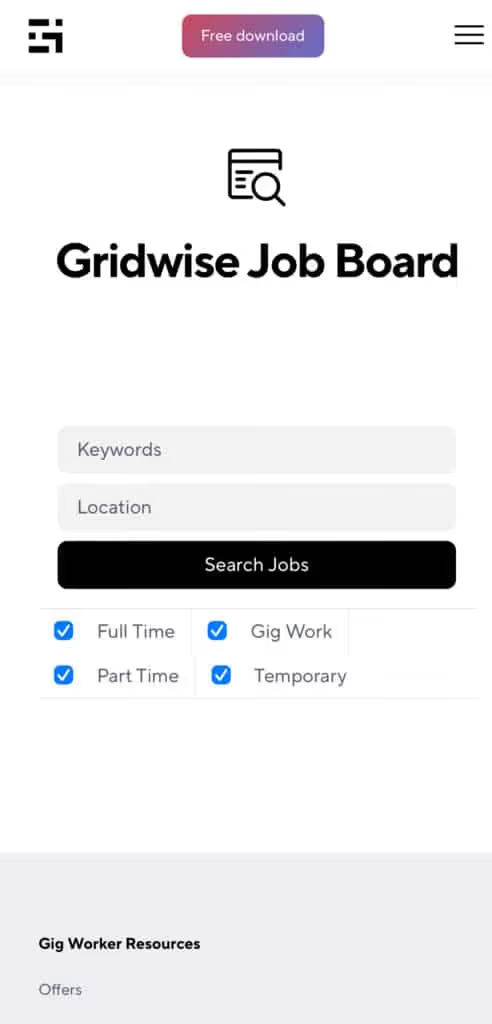
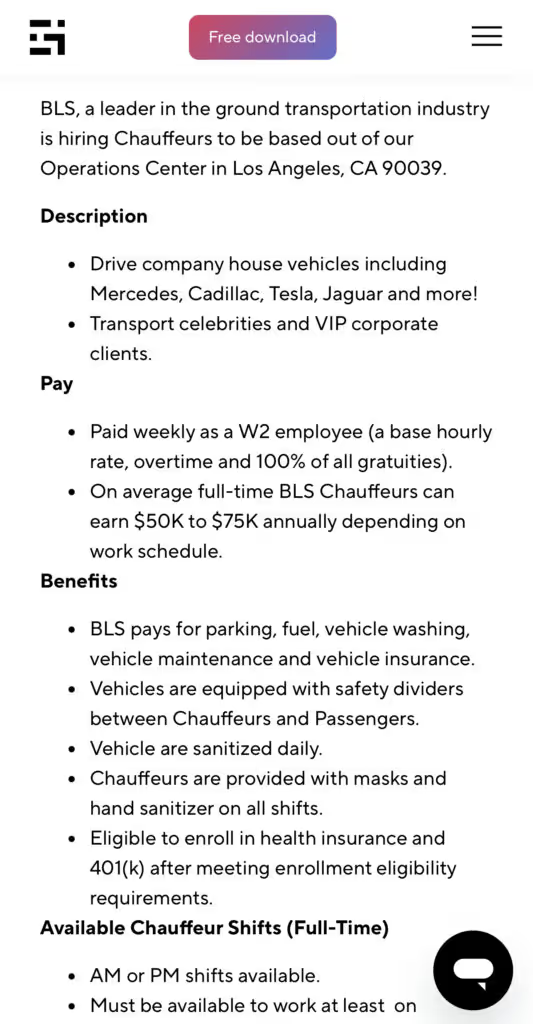
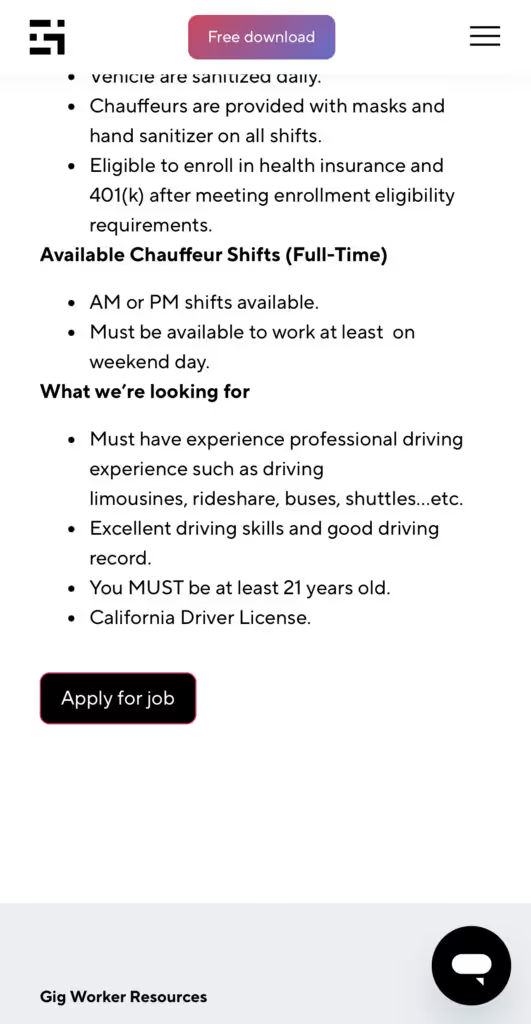
Many types of jobs are available. Adjust the search filter to see the full variety of opportunities that will let you cash in. Deliver food, set up catering, do rideshare driving, get paid for doing package delivery, and much more. You’ll find short-term gigs, long-term contracts, and part-time positions.
Perks of the Gridwise Job Board for gig workers
Gig workers who know how to make extra money will appreciate how the Gridwise Job Board lets you multiply your chances of bringing in big earnings. Here’s how:
- Increased stability. Use the Gridwise Job Board to find part-time or permanent jobs in addition to the part-time gigs you already have. Always keep a steady stream of earning opportunities flowing toward you.
- Flexibility and autonomy. Choose jobs that fit your schedule, work around other jobs and family duties, and still leave room for some fun in your life. Discover side hustles to supplement your full-time job, permanently or just for the season.
- Skill development. Find part-time work that lets you use a skill you already have, or try your hand at something new. It’s a smart way to develop a portfolio to showcase what you can do, or even to find permanent employment.
Get Gridwise and stay up to date on the Gridwise Job Board
Gig workers need plenty of information and assistance, and Gridwise is here to give it to you. Download the app and get essential features such as
- seamless earnings tracking
- mileage tracking
- expense recording, including notes
- low-cost and no-cost insurance benefits
- access to affordable medical, dental, vision, mental health, and alternative care
- professional services including legal and financial help
- deals and discounts
- weather, events, and traffic reports
- inside information on where and when to drive
[elementor-template id="20936"]
More to know about gig work:

5 Best Mileage Trackers For Gig Drivers
Many drivers ask, “Do I really need a mileage tracking app?” The answer is simple: only if you want to have an accurate count of all the miles you can legally deduct from your taxable income! You might think your rideshare or delivery driving app has got you covered. After all, they do quite a good job of logging the miles you drive while you’re on a trip or delivery. But, if you want to have the best app to track mileage for Uber, Lyft, Doordash, Instacart, or the other apps you may use, you need more. Why is that?
Without a separate tracker, you’re missing the miles you drive in between pings. Did you realize that all the miles you drive, from the moment you begin your shift until it’s over (as long as you don’t drive several miles on a break to hang with your friends), are tax deductible! That means you need something besides your driving app to keep an accurate count of your travels. Read this Gridwise post to see how important it is to keep track of every deductible mile.
You won’t be surprised to hear that there’s an app for tracking miles. In fact, there are several of them. Here, we’re going to tell you about five top mileage tracking apps, and help you figure out which one is best for you.
Before we get to the list and identify the best mileage tracker app, let’s clarify what exactly a mileage tracking app is. According to G2.com’s technology glossary, mileage tracking is done for the purpose of keeping a log of mileage that is either reimbursable or tax deductible.
And yes, of course you can track your miles simply by taking readings on your odometer. But are you really prepared to account for how many miles you drove for personal reasons and subtract them from the total to get your business mileage? Even if you can remember all that and do the arithmetic, if you want an accurate reading of the miles you drive for business, and can therefore deduct, a mileage tracking app will save you a lot of trouble and prevent you from making costly errors.
Plus, as a gig driver, you have specific needs when it comes to a mileage tracker. Ideally, you’d be able to handle mileage tracking and several other functions all in one app. It can be maddening enough to deal with driving apps, particularly if you’re an avid multi-apper. You would want your mileage tracker app to help you keep account of other aspects of your business, including income, expenses, and inside information about the art of gig driving.
Not all mileage apps are equal, to be sure! Let’s look at five of the best apps to track mileage and figure out which is the best app to track mileage with Uber and Lyft, or what mileage tracker app is best for DoorDash.
[elementor-template id="20891"]
1. Zoho Expense
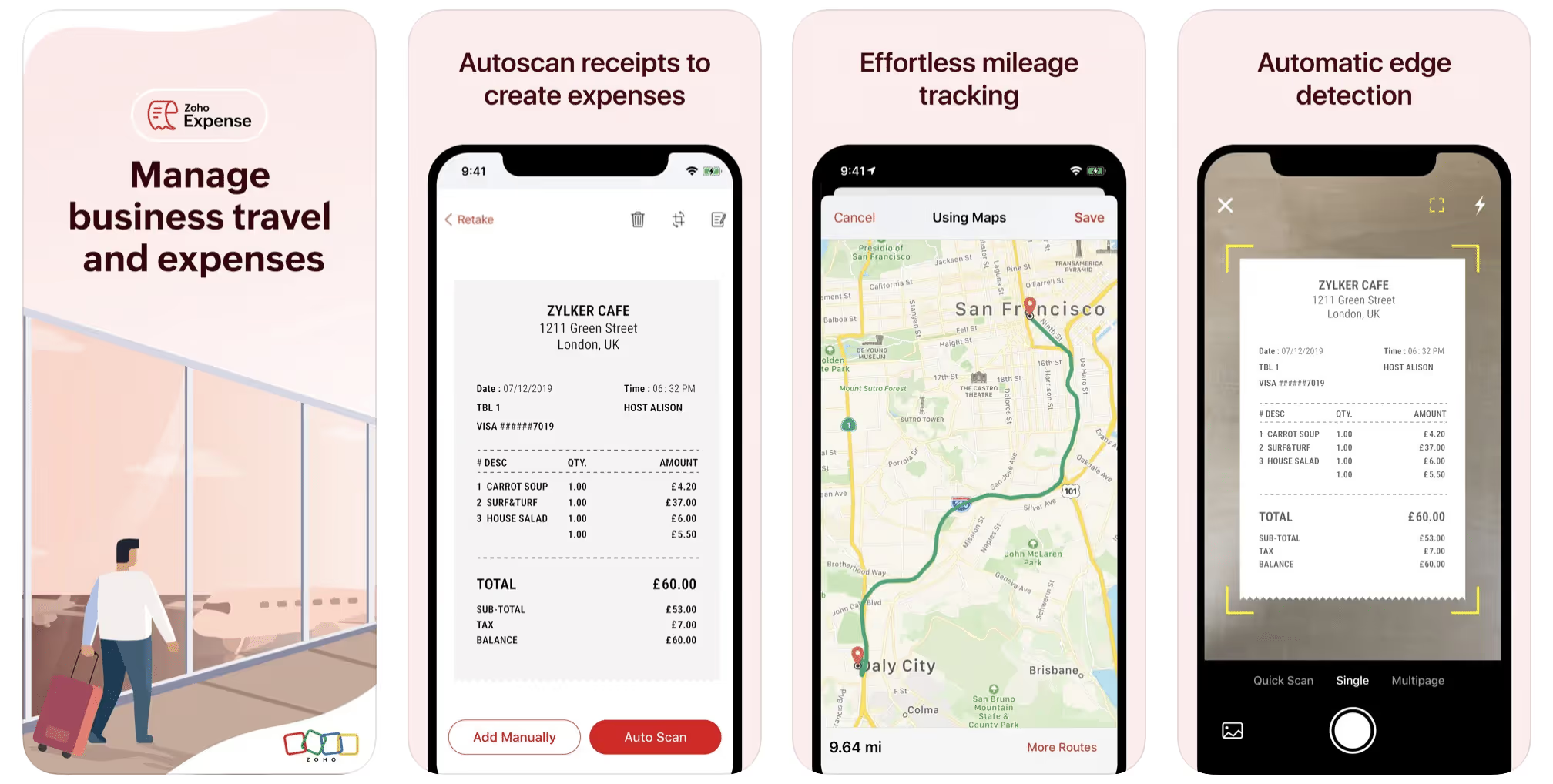
First up is Zoho Expense, which does exactly what its name says. This app is designed to allow companies to give employees a uniform way to create and submit expense reports. It can be used by individuals, including gig drivers, as well.
It includes a mileage tracker, as well as features that let you track other deductible expenses, including the ability to scan and record receipts.
Available on Android and Apple: Yes
Ratings: 4.8 stars on App Store, 4.7 stars on Google Play
Free Version: Yes
Subscription price: $3 per month, billed annually
Created specifically for gig drivers: No
2. Quickbooks Online
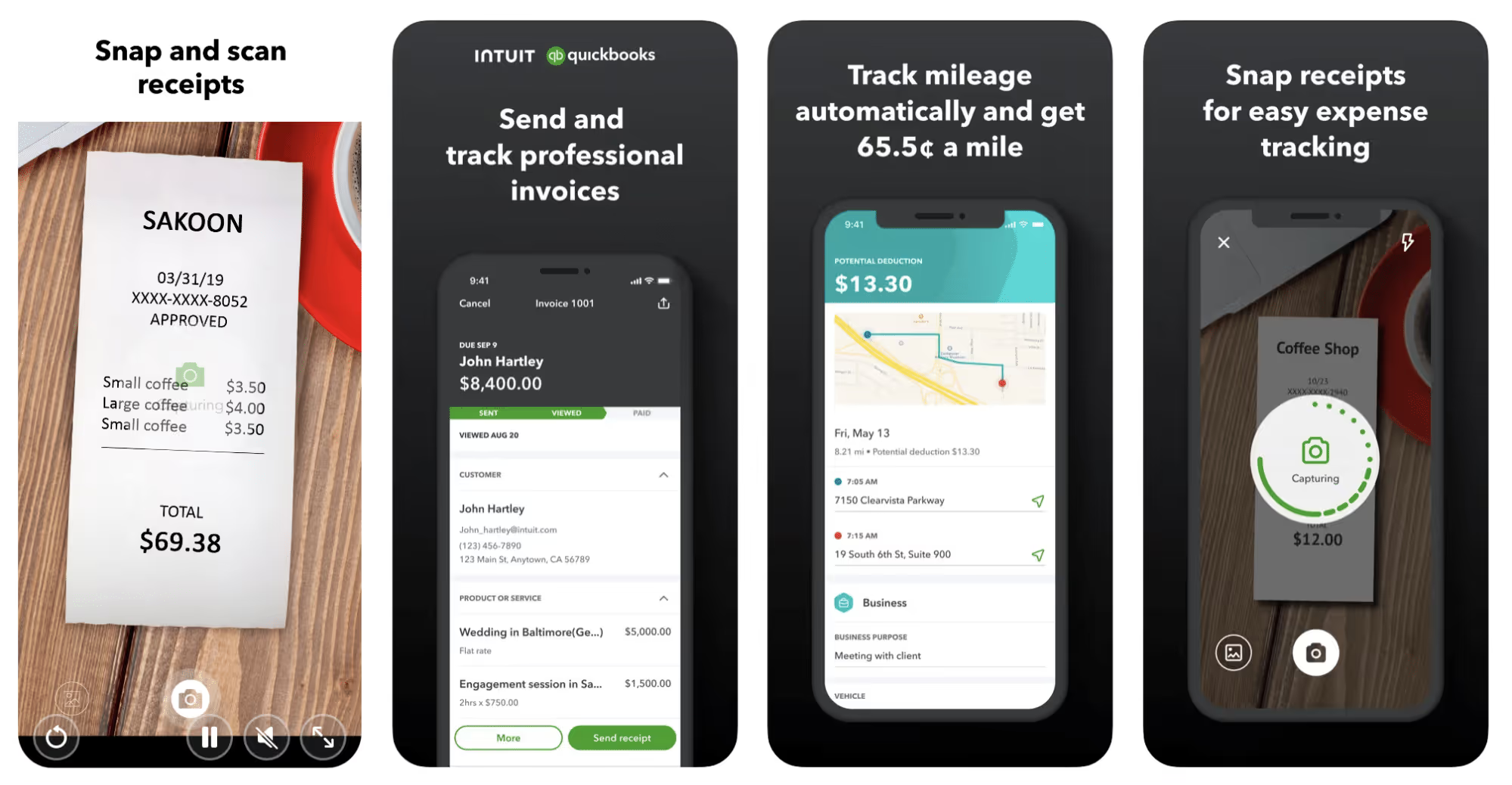
Quickbooks Online is a cloud-based app that allows you to track your mileage, earnings, and expenses. The information you enter can then be used to generate various reports that prepare you for tax time. It also allows you to create graphs that illustrate your cash flow, and includes a receipt scanner so you can instantly record deductible expenses. Quickbooks is popular, highly reliable, and designed mainly to help people keep track of their small businesses.
Available on Android and Apple: Yes
Ratings: 4.7 stars on App Store, 4.4 stars on Google Play
Free version: 30-day free trial
Subscription price: $15 per month for basic version if purchased for 3 months or more
Created specifically for gig drivers: No
Source: quickbooks.intuit.com
3. Shoeboxed
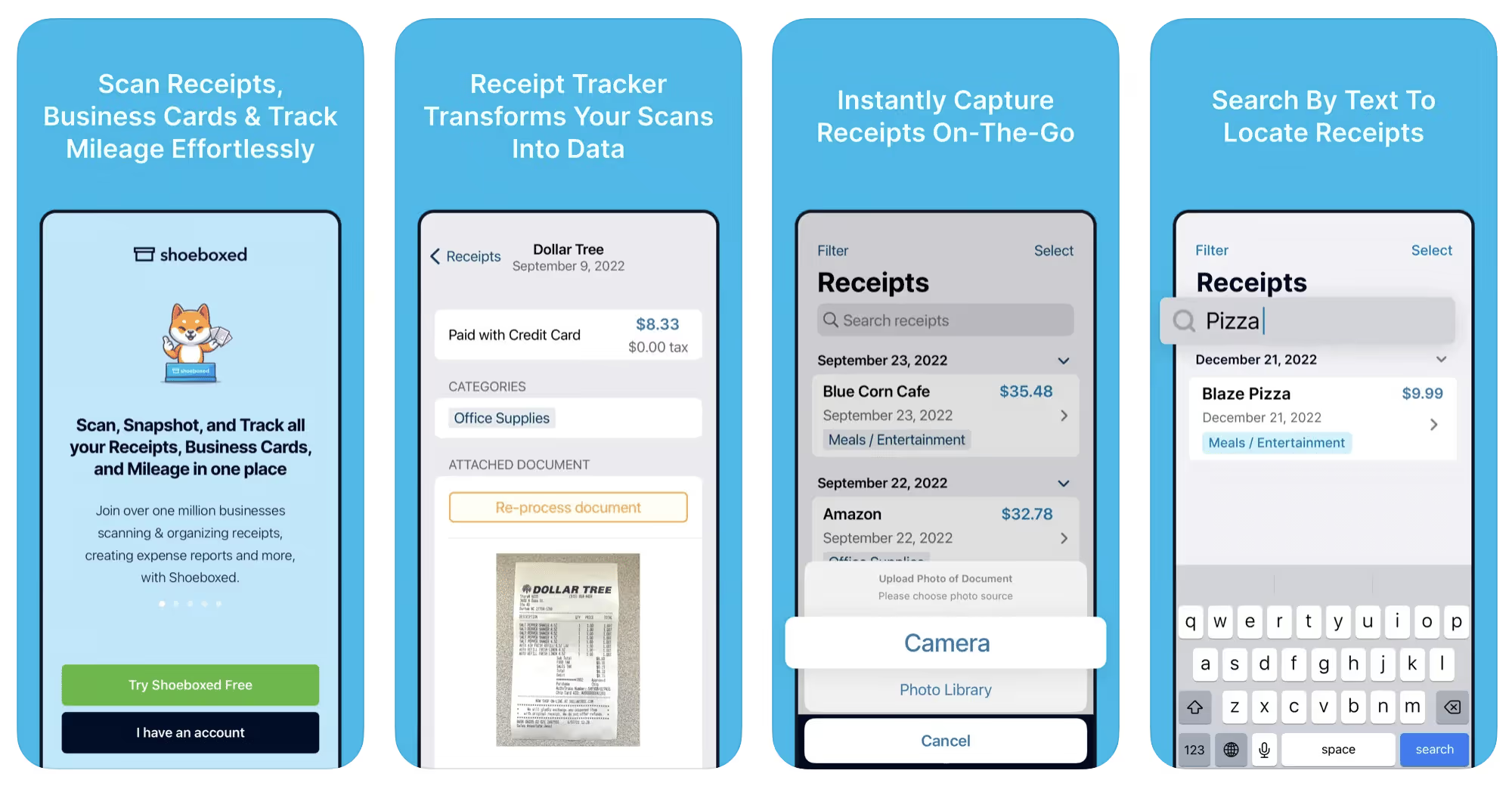
Shoeboxed started in 2007 as a service for scanning paper receipts into digital form. Now the app offers a free mileage tracker and has enabled users to scan receipts directly. It touts itself as the best mileage tracking app for DoorDash, but there are some elements missing that Dashers might like to have. While it provides features that record your expenses and prepare you for tax season, it doesn’t automatically track your earnings. The mileage tracker has a system where you can drop pins along your routes to make the tracking more precise, identifying those legs of a trip that you make for business purposes. The mileage tracker is “free” once you sign up for the basic version.
Available on Android and Apple: Yes
Ratings: 4.5 stars on App Store, 2.3 stars on Google Play
Free version: No
Subscription price: $18 per month for basic version
Created specifically for gig drivers: No
Source: blog.shoeboxed.com
4. Stride
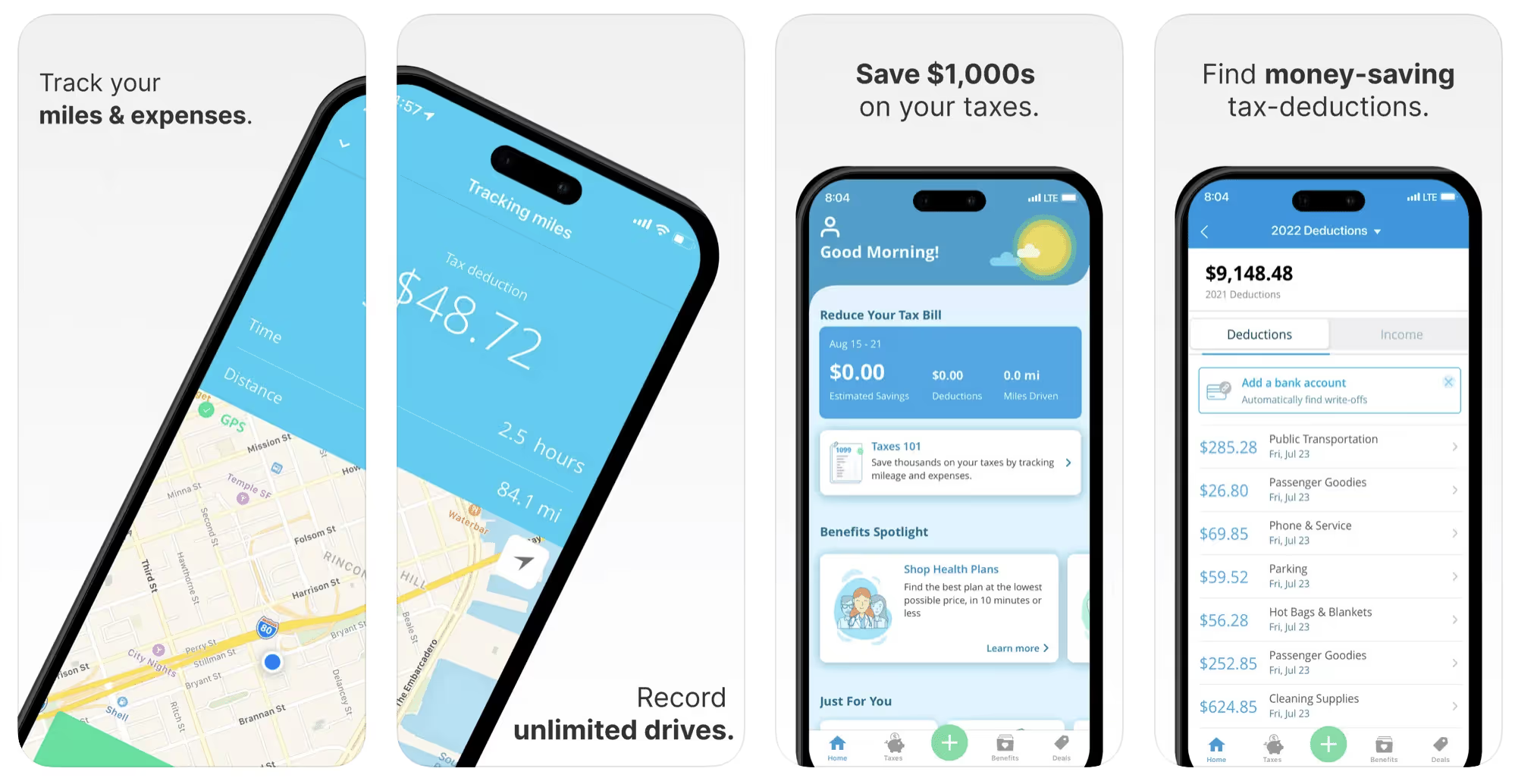
This free mileage tracker does a fair job of keeping track of the distances you rack up while gig driving, but it doesn’t automatically track earnings. It can be a big help, though, in tracking your expenses. You can link Stride to your bank account, and it will automatically scan your expenses to identify items you can potentially deduct. The app is totally free. This could make it the best free mileage tracker app, but there is a small price to pay. The app will persistently push you to consider various insurance plans that they are affiliated with. If you don’t mind that, this is a solid mileage tracker, even if it doesn’t track your earnings.
Available on Android and Apple: Yes
Ratings: 4.8 stars on App Store, 4.6 stars on Google Play
Free version: Yes
Subscription price: None. The app is free.
Created specifically for gig drivers: No
5. Gridwise
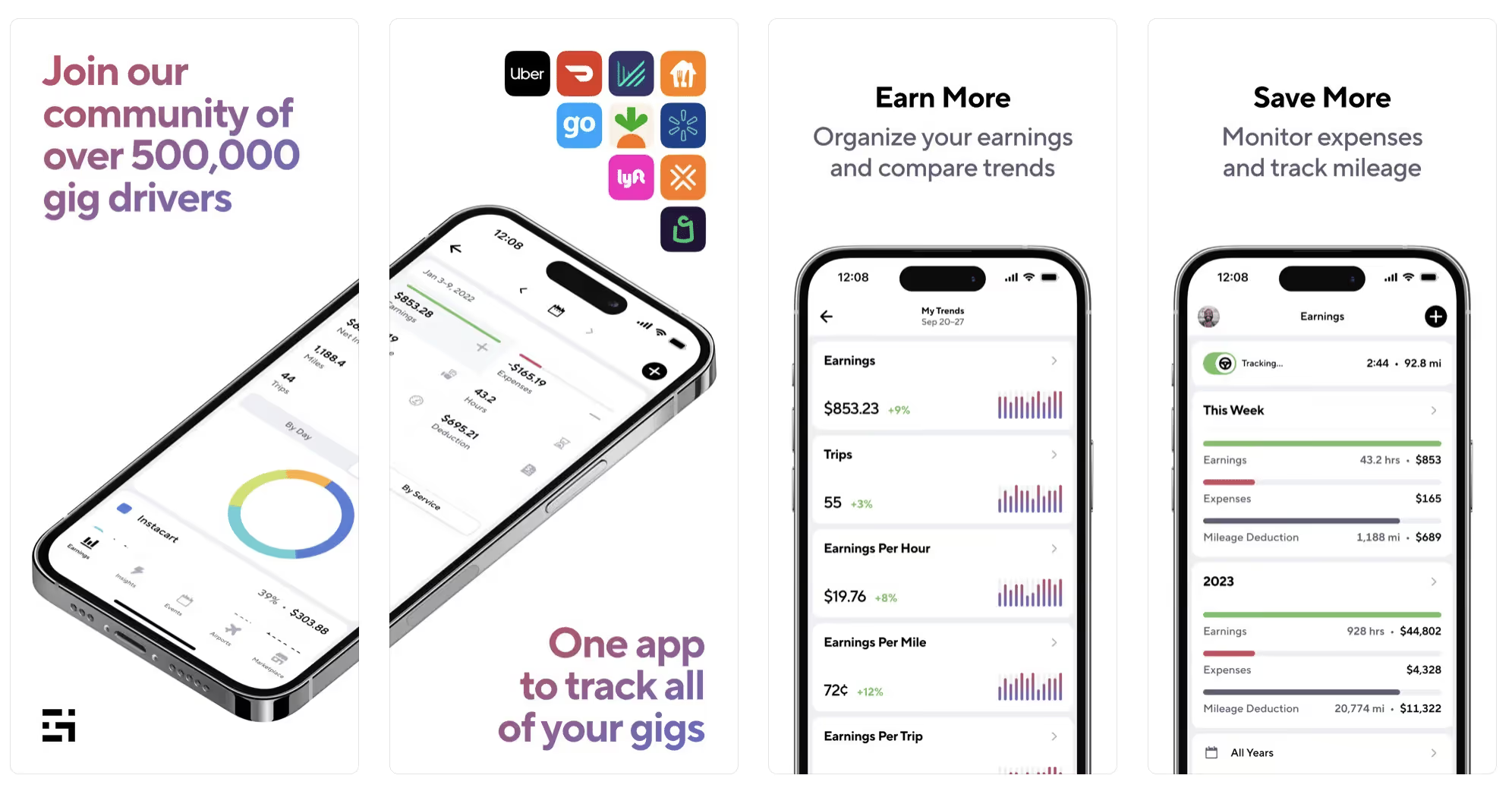
Gridwise has a free mileage tracker and free features that record your income and expenses. It gives you access to insurance and benefits, as well as insights about the best times and places to make the most money while gig driving. The Gridwise mileage tracker captures all the miles you drive while you’re on your driving shift, and it can be used if you have other trips you need to make which qualify as business travel.
Drivers love it because it is geared toward the needs of rideshare and delivery workers, providing free information about airport departures and arrivals, event start and let out times, weather, traffic, and more. The Gridwise Plus subscription adds value by providing additional insights and reports, discounts on benefits, the ability to export data in .csv format,, and more.
Available on Android and Apple: Yes
Ratings: 4.9 stars on App Store, 4.6 stars on Google Play
Free version: Yes
Subscription price: $9.95 per month for Gridwise Plus, or $95.99 per year (a $23.41 savings)
Created specifically for gig drivers: Yes!
What is the best mileage tracking app?
Now that we’ve checked them all out, we’re positive about the answer to that. Hands down, it’s Gridwise. Are we biased? You bet we are! But drivers love it too. Gridwise is the best mileage tracker app—and so much more. So many of the features are free, and the subscription to Gridwise Plus will pay for itself with additional insights to boost your earnings and deeper discounts on products and services.
Most important, Gridwise is designed specifically for gig drivers by experts who were once gig drivers themselves! Knowing what gig drivers need is a crucial step in creating an app that rideshare and delivery drivers can really use! Here are a few of the features, besides mileage tracking:
- seamless earnings tracking
- automatic, on/off toggle and manual mileage tracking
- mileage categorization
- airport, traffic, weather, and events information
- insights into where to drive and when to drive
- reports showing earnings across the platforms you use
- discounts on countless products and services for drivers
- additional resources for finding side gigs
- an informative and comprehensive blog
- affordable benefits, including insurance, medical, dental, and alternative practitioner discounts
- a community of drivers just like you
Don’t settle for just any app. Get the best mileage tracker, and so much more, from Gridwise!
[elementor-template id="21599"]

What Records Do Gig Drivers Need To Keep Track Of For Taxes?
* Gridwise does not provide tax, legal, or accounting advice. This material has been prepared for information purposes only, and is not intended to provide, and should not be relied on for tax, legal, or accounting advice. You should consult your own tax, legal, and accounting advisors before filing your return.
Record keeping? Who signed up for that? As a gig driver, it’s part of what you need to do to keep your business running. Don’t worry. It’s not as complicated as you might have been led to believe. This post will show you what you need to keep track of and the best ways to gather and preserve your tax-related records. We will cover
- How record keeping can help reduce income tax for freelancers
- Taxes and freelance work: Record keeping requirements
- Mileage tracking: Motives and methods
- More deductions and records to keep
- Make tax time easier
How record keeping can reduce income tax for freelancers
Tax time is not “fun time” for rideshare and delivery drivers. It’s easy to get used to watching your earnings pile up and come to believe they are all yours. Unfortunately, that isn’t the case. Gig work taxes can be especially painful because no one takes them out of your earnings for you, until the tax authorities insist that you do it for yourself.
You will need to show the tax authorities your income records, and they will gladly tell you to send them what they determine to be their fair share. Think that’s not fair? You’re not alone, but that doesn’t mean you’re going to get out of paying gig work taxes.
But you can find ways to pay the smallest amount that is legal and possible. The best way to defend yourself against having to pay astronomical amounts when you file your return is to know what expenses you can deduct from your gross income. When you subtract deductible expenses from your gross income, there is less left over to be taxed. This reduces the amount they can hit you with gig worker taxes. and can make your tax bill substantially lower.
While you want to keep good records so as to be in compliance with taxation entities such as the IRS, you also want to ensure you have proof of every last deductible expense you have accrued during the year. There are other records you must keep as well. Let’s look at some of the considerations you have, realizing that you now need to know how to do taxes as a freelancer.
Taxes and freelance work: Record keeping requirements
So many gig drivers fail to understand the responsibilities they have as independent contractors. Those who work part time for very few hours may even believe they don’t have to report the income they get from their driving gig payments. That would be a big mistake!
The company or companies you work for report your income to the IRS and state tax authorities. If you fail to report that income, you will risk some rather painful penalties. The IRS taxing side hustles is as much of a thing as the IRS taxing income from any other job. Your best bet is to report what you’ve earned, honestly and completely, and comply with other record keeping requirements such as
- gross income
- deductions and credits
- purchases (items you purchase and resell, such as snacks or bottled water)
- a log of all your mileage (or vehicle expenses, if greater)
- a list of all expenses and assets, such as utilities and other expenses associated with having a home office and equipment
- machinery and furniture you own, including when it was acquired, how much it cost, whether you previously took deductions on it, and selling price, if applicable (this includes your vehicle)
More things to consider:
- Pay attention to the retention of your records. You’ll need to keep all tax-return-related items— including income, deductions, and any tax credits reported— until the period of limitations runs out (3 years from date you filed, or 2 years from when you paid tax. If you have employees, keep your records for at least 4 years.)
- If you want to avoid paying self-employed taxes, you may want to set up a corporation or Limited Liability Corporation (LLC) for your business. This allows you to separate all your gig driving earnings from personal income, and permits you to take advantage of the additional advantages of working through a corporation. This includes exemption from self-employment taxes. You can learn more about how to pay self-employment taxes, if you opt for that, in this post from Keeper.
- You should always keep a separate checking account for your business, for convenience as well as clarity. While this is not a legal requirement, it is a smart move if you want to have an easier time managing your business.
- You are required, as an independent contractor, to file your taxes quarterly. Check out this Gridwise blog post for more information about quarterly tax payments and other matters that make filing delivery, Lyft and Uber taxes easier.
Mileage tracking: Motives and methods
Why you need to be meticulous about mileage
Mileage deduction, or the costs of operating your vehicle, will be the most important item to account for when you consider how to file taxes as a freelancer. While mileage is an important deduction for all independent contractors, as you might imagine, it’s even more essential for rideshare and delivery drivers.
There are two ways of keeping track of your mileage deduction. One is to use the IRS’ standard mileage deduction, which for 2022 is 58.5 cents per mile. This number takes into account the costs of operating your vehicle, from fuel and maintenance to registration, insurance, and depreciation. Alternatively, you can calculate all your own vehicle operating costs, but only after your first year of using the vehicle. You may discover that this second option allows you to have more money deducted from your taxable income. Learn more about the options for deducting your mileage in this Gridwise post.
No matter which way you decide to calculate the deductions for your mileage, you need to know what mileage you can and cannot deduct.
You can deduct
- miles driven to and from home when you go out to drive or deliver
- miles you accrue during your trips
- miles you drive on any other trips you make that are necessary as part of your business.
Examples:
- driving to return a lost cell phone or to an Uber Hub or another physical location where your company might make driver support available
- driving to pick up supplies, to get gas, or to have your car cleaned, serviced, or detailed, etc.
You cannot deduct
- miles you drive for personal trips
- miles for any trips you take that do not directly affect your business
Note: If imagining yourself becoming the not-so-proud owner of a shoebox filled with paper receipts gives you nightmares, stop worrying. Electronic records of purchases will satisfy reporting requirements. If you use cash, you can scan copies of your receipts, in some cases, right into your recording software or app. Gridwise and Keeper give you a simple to use interface that keeps all your receipts recorded without the messy pile of paper.
Mileage tracking methods
By now, you’re probably convinced that tracking mileage is important, despite all the other things drivers have to do. Now, let’s look at your options for keeping accurate records.
- Manual tracking: You can keep a logbook where you list every trip you make, starting and ending mileage, the date, and purpose of the trip. While this would work, it’s certainly not convenient. Besides, if that logbook gets lost, your plans for having a nice, fat tax deduction will go by the wayside.
- Spreadsheet: This is a bit more convenient and sophisticated way of tracking your business mileage. You’d need to be meticulous about making your entries, though. Even if you keep a spreadsheet app on your phone, it could be time consuming and inconvenient to keep doing it with all the other things going on in a rideshare or delivery driver’s day to day life.
- GPS-based mileage tracking apps: There are a bunch of apps that track mileage based on your GPS location, and most of them are pretty accurate and far more convenient than taking constant readings of your odometer. Your driving apps, such as Uber, Lyft, DoorDash, or Instacart, may also track your mileage, but be careful here. They will only track the miles you drive while you’re on a trip or delivery. They don’t count the miles you drive going to pick up a customer or when you make your move toward a restaurant or store.
Gridwise, on the other hand, will track all the miles you clock while you’re on your shift. All you need to do is make sure you start tracking the minute you leave home, and every gig driving mile will be logged. - OBD-II mileage tracking systems: There are plug-in modules that assess your vehicle’s mechanical health and track your miles. However, many authorities question the ability of OBD-II mileage tracking systems to get get accurate odometer readings. Insurance companies don’t consider them to be accurate enough gauges of odometer readings.
While mileage is a crucial deduction when you’re preparing your Uber, Lyft, or DoorDash taxes, it isn’t the only expense you’ll want to record.
More deductions and records to keep
Expenses you can deduct
You’re entitled to include the cost of other expenses that are directly related to your driving business. These include
- vehicle expenses
- equipment for your car and home office
- extra services and subscriptions
- business tools, including apps and software
You can learn much more about gig driver expenses that are eligible for deduction in this Gridwise article.
Ways to track and preserve deductible expenses
- The manual method: Just like you can with mileage, it’s possible to use a manual method, but in addition to logging each expense into a ledger, you would also need to keep physical receipts.
- Spreadsheets: You can record your expenses on a spreadsheet. This is somewhat less awkward than manually logging mileage, but there still will be plenty of room for failing to remember the case of water you bought for your customers, or losing the receipt from the thermal bag you purchased.
- Accounting software: You can use software that helps you track your expenses. This method usually interfaces well with any tax preparation software you or your tax professional might use.
- Gridwise: There are other apps that help you track your expenses, but Gridwise is designed specifically for gig drivers. It automatically tracks earnings and mileage, and lets you record your expenses the minute they come up. Gridwise’s partnership with Keeper gives you the ability to scan receipts and access a tax professional. This is a seamless way to record your expenses and a big help in learning how to file Uber taxes. Gridwise even provides .csv output, so you can feed your Gridwise data directly into tax preparation software. Check out what Gridwise and Keeper will do to super-charge your tax filing powers.
Organizing and categorizing expenses
Before you even begin to record expenses, you’ll want to set up categories for them. You can start by reviewing the categories listed above and checking out the Gridwise post that lists possible deductions.
If you’d like to learn more about how to categorize expenses, there is additional information available. This article from Motley Fool lists all possible categories any freelancer might use and also gives tips on how to customize them for your driving business.
One last tip
Using Gridwise, particularly for tracking mileage, is the easiest way to be in compliance with the IRS’ rules for deductible mileage. Gridwise tracks all the miles you drive for your gig, beyond what your company’s app might record. At the same time, you can log on and off Gridwise when you start and end your shift, so personal miles won’t be recorded. This eliminates confusion while capturing every deductible mile.
Gridwise Tax Help, a partnership with Keeper, has been created specifically to serve gig drivers. It provides affordable and easy ways to record expenses, scan receipts, and find deductions by analyzing your expenditures. Read about free resources from Keeper you can use to be fully prepared for tax season, and get all your earnings and expenses on the record.
Get the world’s best assistant for rideshare and delivery drivers, and tax help too.
Make tax time easier now!
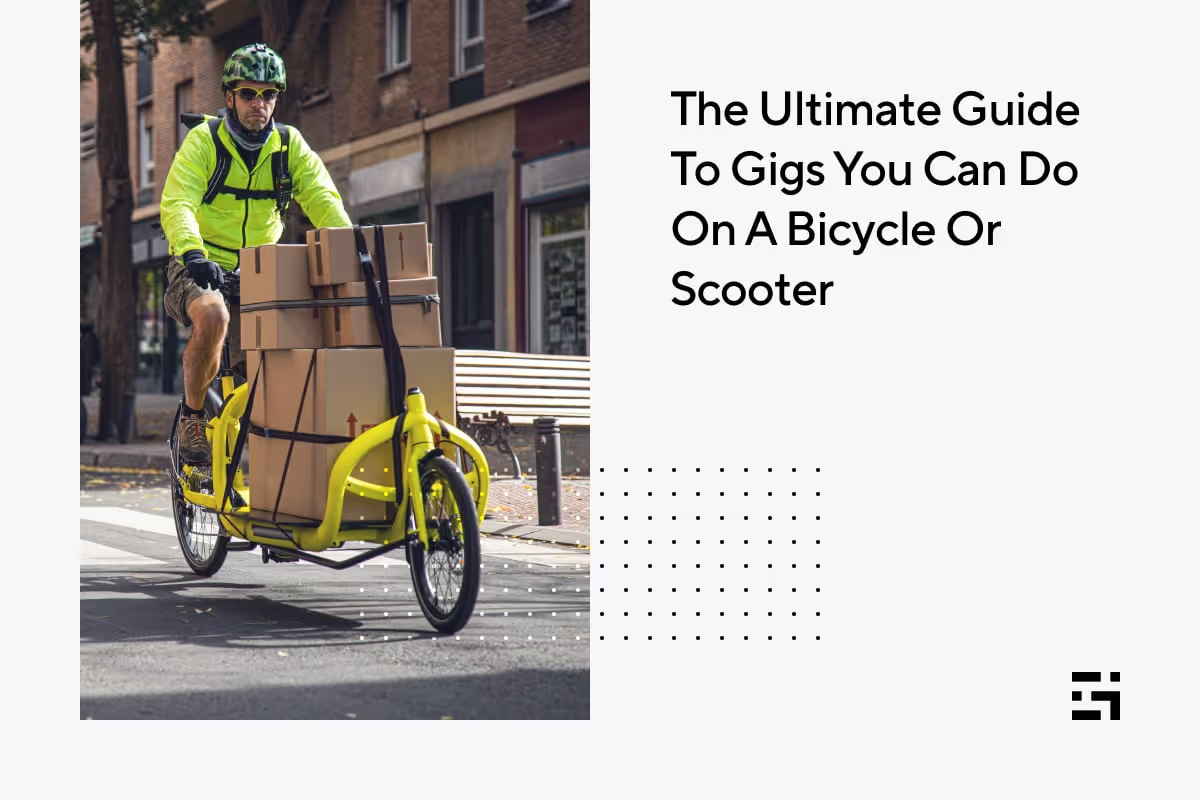
The Ultimate Guide To Gigs You Can Do On A Bicycle Or Scooter
Are you looking for bicycle delivery jobs? Bicycle delivery, as well as use of e-bikes and scooters, is getting more popular with gig workers all the time. Eco-friendly, less costly, and easier to park, bicycles and scooters are viable ways for food delivery people to get their jobs done.
[elementor-template id="20891"]
Why would you want to deliver with a bicycle or scooter?
On top of helping to save the environment and almost completely eradicating parking problems, delivering without a car gives you the freedom to earn money minus the huge expenses of car payments, insurance, charging costs, and gasoline. Even if you already own a car, using a bike or scooter instead can save you big bucks—and besides, you’ll get a great cardio workout!
Bike delivery apps give people who don’t want to own a car, or can’t afford one, the ability to participate in the thriving gig economy world. Bicycles, and even e-bikes, are not overly expensive. Scooters are usually acceptable alternatives to bicycles, and are also reasonably priced. If you want to deliver with a scooter, check with your company because there may be restrictions and requirements.
Delivery jobs that don’t require a license are hard to find. You’ll probably need a driver’s license, or at least a government ID, to qualify as a delivery worker. Always make sure you meet company requirements before setting your heart on delivering with a bicycle or scooter for a particular platform.
If riding a motorcycle is your jam, delivery jobs motorcycle riders can do are available, in most cases, from bicycle delivery apps. Check with the individual company’s requirements to make sure that you’re eligible.
Where are the best places to use bikes and scooters?
Cities are the best places for food delivery on a bicycle or scooter. These densely populated areas make it possible to pedal or ride short distances and still rack up a fair number of deliveries.
Delivering by scooter or bicycle in a suburban or rural area usually isn’t practical, but some less heavily populated areas can yield earning opportunities. These might include larger suburban hubs with thriving restaurant areas near to offices and housing, particularly multi-story apartment buildings.
Gigs you can do on a bicycle or scooter: Gig company policies
Can you Instacart without a car? Can you deliver Uber Eats on a bike? Instacart bike delivery is not a thing, but Uber Eats does welcome bicycle and scooter riders in some areas.
When a delivery app states that you can deliver by “bike,” this refers to a bicycle or e-bike. “Scooter” refers to small vehicles with a platform you can ride on. These can be powered by small electric motors.
“Motorbikes,” including motor scooters and motorcycles, are in a different vehicle class. You will need to check with the apps to determine if motorbikes qualify, and what the requirements are.
Let’s get back to bicycles, e-bikes, and scooters, because there are lots of important things to know.
Just because you know how to deliver food on a bike doesn’t mean it’s always possible. Don’t try to trick the apps because pretending you’re in a car while delivering by bicycle could be disastrous. Companies that allow bicycle delivery send only those orders that are close by and small enough to transport without a car. If you don’t make it clear that you’re on a bike or scooter, you could get orders that are either too large or too far away—or both.
Check out this chart to see which gigs accommodate delivery people who want to work without a car. Policies can vary depending on where you live. Examine the company app to see if it caters to bicycle and scooter delivery service in your area.
ServiceBicycles or scooters allowed?CommentsDoorDashYesBicycle and scooter delivery are allowed in most major cities.GrubhubYesBicycles and scooters are allowed in select urban areas. Uber EatsYesCheck your Uber driver app, and if bicycle delivery is allowed, indicate that you’ll be using your bike.GetirYesGetir issues e-bikes and smartphones for delivery people to use while working their shifts.InstacartNoInstacart ran a trial on bicycle delivery in 2022, but current requirements stipulate the need for a car. Look into becoming an in-store shopper instead.ShiptNoShipt requirements state that a car is needed, in addition to the ability to carry 50 pounds—not easy to do on a bicycle or scooter. Shopping for Shipt is still an option, though!GopuffYesMany Gopuff delivery workers use bicycles and scooters.Amazon FlexNoAt this time, delivering for Amazon Flex is restricted to cars and trucks.Roadie NoYou can ship a bicycle with Roadie, but you can’t ride one to deliver for this UPS company.
Bicycle, e-bike, or scooter: Which works best?
What are the advantages and disadvantages of these eco-friendly ways to zip around town?
Bicycles
Non-motorized bicycles are, in most cases, the most economical choice. They don’t require gas or expensive maintenance, but little breakdowns often happen at the most inconvenient times. It’s a good idea to consider keeping a spare bike on hand, just in case you’re stuck without a way to do DoorDash bicycle delivery. Consider also that your bike will be powered by human muscle power, so the time and distance you can cover is limited.
E-bikes
The extra oomph of e-bikes makes them very popular and gives your biking chops a boost. You can use your e-bike like a regular bicycle, and then deploy the electric battery-powered motor to help you keep up with traffic or climb steep hills. The battery range might not cover a lot of territory, though, so keep that in mind before you trust your e-bike to deliver for you all day or night.
Scooters
Although they don’t use a lot of it, many scooters need gasoline to run. In some cases, they operate on fully electric motors. These vehicles are more expensive, but offer greater power than bicycles and e-bikes. Delivery apps often place limits on scooters, so make sure the one you want to use meets requirements.
All these modes of transportation are, of course, easier to deal with in dry, moderate weather. Without snow tires, an air conditioner, or even a roof, your plans for earning delivery money could be destroyed by inclement weather.
Best bicycles, e-bikes, and scooters for delivery gigs
Choices abound when it comes to selecting bicycles, e-bikes, and scooters for delivery gigs. If you’re looking at a nonmotorized option, a mountain bike would make more sense than a racing bike, because tougher tires and stronger structure will stand up to uneven city streets. Several features make certain bicycles suitable for food delivery, including durability, reliability, and cargo capacity.E-bikes, as we mentioned, are an increasingly popular option, as are scooters.
The list that follows is a good place to start your search for the perfect delivery bicycle, e-bike, or scooter.
Yuba
Pizza delivery can be awkward on most bicycles, but the Yuba Compact Cargo Bike changes all that! Equipped with a carrier for those big square boxes and designed for food deliveries of all kinds, this nonmotorized bicycle is also extremely economical. You can get this solid delivery bicycle for about $999. Yuba also offers a line of e-bikes.
Icicle Tricycles
You can’t exactly zip around town with one of these, but if you want to deliver large orders over short distances, these e-assisted trikes can do the job. Popular with vendors, these tricycles have a larger price tag. A nonmotorized trike will run you around $2,700, and if you want e-assistance, be prepared to pay at least $3,950.
The Xpedition, Lectric’s latest e-bike model, features cargo space delivery drivers have to love. The single battery model, with a range of about 75 miles, starts at $1,475, while the dual-battery Xpedition is priced at $1,699 and has a range of approximately 150 miles. Add on extra equipment to get space to accommodate all your orders.
Not sure you’re ready to invest in buying your own e-bike? You can get a sweet deal by renting one through Zoomo. It’s an economical way to deliver when you want, without the worry of where your e-bike will be parked when you’re not working. The battery has an 8-hour range, which is perfectly adequate for your delivery shifts. Deals for delivery people, especially in NYC, make this option very appealing.
Tough bikes and a 55-mile range make Dirwin e-bikes a solid choice. Variety adds to Dirwin’s appeal. There’s a fat-tire e-bike, one that’s suitable for commuting, and one that even folds. All would make great options for your delivery gig. Prices range from $1,399 to $2,299.
The EMOVE Electric Cruiser gives you maneuverability, dual suspension, a top speed of 33 mph, and a range of 62 miles. Headlights, taillights, turn signals, and brake lights ensure safe riding. Priced at $1,195, this electric scooter comes in six colors.
The Hawk is Yume’s flagship electric scooter. Its sleek design comes with a 43-mile range and a top speed of 43 mph. For added utility and safety, the Hawk comes equipped with an LCD control panel, a thumb throttle, and a horn. You can own it for about $1,380.
Delivery tools you will need
Plan to handle your deliveries and any emergency with tools that make delivering by bicycle or scooter safer and easier. The delivery companies usually provide that thin, flimsy thermal bag that isn’t very effective, and you can’t carry it on a bicycle. Pack along the right kinds of hands-free carrying bags, and don’t forget safety equipment.
Thermal backpack
Get a good, solid thermal backpack that keeps food at the right temperature and doesn’t interfere with your ability to pilot your bicycle or scooter safely.
High-visibility gear
Cities are perfect areas for bicycle delivery, but car and bus drivers won’t necessarily see you. Ride in the bike lanes where you can, and always wear and equip your bicycle or scooter with reflective and/or self-illuminating accessories.
Bike lock
You love your bicycle, and thieves are out there who would like to take it from you! Invest in a strong bike lock that’s easy for you to operate, and almost impossible for someone to break.
Helmet
Helmets protect one of your greatest assets—your brain! Use your noodle and wear protective headgear. Consider adding pads for knees and elbows, in case you tip or get nudged in a traffic mishap.
Tire repair kit and pump
Glass, nails, and even rough grates can eat your bicycle’s tires for lunch. Be prepared with a way to patch your tire or replace a tire tube, and always keep an air pump on board. Learn how to change a flat before you actually need to.
Phone mount
If you don’t have one already, the moment you decide to do bicycle delivery is the time to buy a phone mount. “Hands-free” takes on a whole new meaning when you deliver with a bike or scooter. Ride safe and don’t drop your phone in a filthy city puddle.
Multi-apping and other smart strategies: Gridwise can help
Work smart! Don’t sit around waiting for just one app to ping you for a delivery. Sign up with two, three, or four and see who notifies you first and most often. Using more than one app at a time allows you to make more money in far less time.
Color within the lines, and don’t let time lapse on your first delivery while you go to get another. Your ratings will be based on how fast you serve your customers. There’s an art to multi-apping. Learn it and increase your income exponentially.
Boost your bicycle delivery earnings even higher with Gridwise!
Your delivery gig is a business. Run it so it makes money for you. Report your earnings and itemize your deductible expenses like a pro—with Gridwise! You can track your earnings from all your apps,and enter expenses as you encounter them.
Benefits are a big issue when you’re a gig worker. Gig companies don’t have much to offer in terms of insurance or healthcare plans, so you have to be resourceful. Deals and discounts become more important than ever when you’re running your own business, too.
Is there a way to keep track of your earnings and expenses, get information about running your gig, find benefits you can afford, and score deals that reduce your operation costs?
There sure is! It’s all in one mighty app—Gridwise!
Gridwise helps you
- track your earnings
- record expenses
- get connected with tax, financial, and legal advisors
- obtain no-cost and low-cost insurance and benefits
- grab up deals and discounts you need
You’ll also get updates on traffic, weather, and events that help you manage your time so you make the most money possible. When to Drive and Where to Drive are features that show you where the most activity is in your area at different times of day, ensuring you hit the most profitable spots.
.

Download Gridwise for free, or get Gridwise Plus to receive the full suite of features designed for gig workers, by gig workers!
[elementor-template id="20936"]
Find out more about delivery gigs!

Lyft And Uber Driver Skills: 5 Ways To Improve Your Customer Service
“I love this job,” said one rideshare driver. “Where else can I meet 20 or 30 new people every night? People that I’ve never met before. I hear the most amazing stories and meet the most amazing people every time I drive.”
Rideshare, restaurant food and grocery delivery are people jobs, and many drivers enjoy that interface. They love providing good Lyft and Uber customer service. On the other hand, passengers and customers can also be a driver’s biggest headache. They can be abusive, argumentative, rude, unreasonable in their demands, and leave scathing complaints on the app that affect a driver’s rating.
Providing excellent customer service is essential advice for new Lyft drivers and Uber drivers, as well as food and grocery delivery drivers. Even if you are a veteran gig driver, you will find these tips helpful. Topics we discuss include
- why gig drivers should be concerned about customer service
- creating the atmosphere for a positive encounter
- the five tips for great customer service
- additional things you can do
- making Gridwise part of your customer service formula
Why gig drivers should be concerned about customer service
Two words immediately come to mind: tips and ratings. For rideshare drivers, the latest numbers from Gridwise reveal that tips through the app average about 10% to 11% of earnings, and that does not count the cash gratuities passengers give during a shift. If your average is inching higher, you can likely attribute it to good customer service.
Good customer service also improves your ratings and cannot go overlooked in Lyft and Uber advice for drivers. High customer ratings are often a prerequisite for participating in rewards programs for both companies, and the same is true for restaurant food and grocery delivery. For more information about the value of ratings, see the recent Gridwise post How to Improve Your Rideshare Driver Ratings.
There is also a more important principle beyond your ratings and tips as a gig driver. Customer experience is the new battlefront, as they say in marketing. As the front line of rideshare and food and grocery delivery, you are the face of the industry. How you treat people and the memories you create remain long after the ride or delivery ends. It’s on the customer’s mind when they consider ordering their next rideshare or meal delivery.
So if customer service for gig drivers is vital, how can you achieve it every time you get behind the wheel?
Creating the atmosphere for a positive encounter
When you start gig driving, the respective companies are concerned that you understand how the app works and know their policies. Aside from a lot of generalities, Lyft and Uber tips for new drivers don’t include much customer service information. They do have driver ratings, though, so it is obvious that they expect you to deliver excellent service.
Before you get a passenger into your car, pick up a delivery or drop it off, there are things you can do to set the tone for your interface with the passenger or delivery customer. This is as true for rideshare as it is for restaurant food or grocery delivery.
A clean car
Especially in major metropolitan areas, your car says something about you. A cluttered, dirty car with empty plastic water bottles rolling around makes a statement—and it’s not a good one. A shiny car with a freshly vacuumed interior makes a different statement: that you value the impression you make.
If food delivery is your gig, restaurant workers see you pull up to those special parking spaces with a clean car, and they know you take yourself seriously, and that you take them seriously. Translation: they’ll be more inclined to give you quick service with the correct meals (no missing side dishes) and all the condiments the customer expects; grocery store employees will go out of their way to help you find those elusive products; and delivery customers will be pleased to see a clean car pull up to their house.
Dressing for respect
How often have you been at the airport and seen another rideshare driver in gym shorts, a sleeveless sweatshirt, and sandals? It makes you wince. Slacks and a button-down shirt command respect. The restaurant may have messed up the order, and you’re running 45 minutes late, but a customer is less likely to dump all the blame on you if you are well-dressed, as opposed to wearing cut-offs and a faded T-shirt from a concert you attended ten years ago.
Good music
This next one is a rideshare-only tip: passengers appreciate good music. Construct a unique playlist using Amazon Music or Spotify. Even young passengers enjoy jazz, big band, and doo-wop. Setting the mood in your car with music often puts passengers into a great frame of mind. They are more likely to tip well and rate high.
The five tips for great customer service
The reality, however, is that dressing well and having a clean car takes you only so far. At some point, you need a plan. Here are some tips.
- Have a communication strategy
Names. As a rideshare driver, you have the advantage. Thanks to the apps, you know the passenger’s name. Use it freely, whenever appropriate. Most people love to hear the sound of their name.
Positivity. Maybe you spent the previous week’s earnings on new brakes for your car, but sharing that with a passenger, restaurant worker, or customer only invites them to remember their own sob stories. Soon everyone is in a bad mood. Use the weather, the smell of a freshly mowed lawn, or even last night’s home team victory to keep the mood upbeat during a ride or while dropping off food.
Exude calmness. Neil Armstrong and Buzz Aldrin, the first humans to step on the moon, named their landing spot Tranquility Base. The name came from their landing point in the Sea of Tranquility, where they landed. But it also sent a message to the world that was watching them. Despite the danger of what they were doing, everything would be okay. You can send the same message to your passengers and customers. They might be late, on their way to divorce court, or looking through a food order that is entirely wrong, but your calm demeanor can set the stage for whatever comes next.
- Learn how to read people
The signs. There are passengers who outright tell you they don’t want to talk, but others don’t. If someone is speaking on their phone, wearing earbuds, or giving curt, one-word answers to your questions, they’re likely making the same statement—they prefer not to talk or are busy. Respect their silence.
Enforce the rules. Make sure that passengers have their seat belts buckled. If they grumble about it or say, “But we’re only going a few blocks,” this might be a sign that they will be a problem. The same goes for asking if they can smoke in the car. Enforcing the rules of the car early on sends a message to passengers who are thinking about being a problem.
- Late-night driving and recognizing a problem
Dealing with intoxicated passengers. Late-night driving means dealing with the bar crowd and passengers who have been drinking. If they have friends with them, those friends probably know how to handle them better than you do. Let the friends step in first.
Canceling on passengers who look like a problem. It’s happened to lots of drivers. You pull up to a popular nightclub and see your would-be passenger vomiting in the gutter, arguing, or looking as though they were in a fight. Lyft and Uber's terms of service allow you to cancel any ride you feel uncomfortable with. Take advantage of that option, and send a follow-up text through the app.
Learn more about dealing with troublesome passengers in a Gridwise blog post titled How to Deal With Drunk Uber or Lyft Passengers. You can also check out another Gridwise blog post on problem passengers, How to Protect Yourself as a Rideshare Driver.
- Learn how to create positive interactions
Play games. A Lyft driver in Los Angeles, prior to the pandemic, found the dynamics created by a shared ride frustrating. “I could be having a great conversation with the first passenger,” he said, “and as soon as the second passenger got in, all talk stopped. It was like no one wanted to be judged.” His solution was an icebreaker he learned in a previous job, called Two Truths and a Lie. Each person in the car would tell three things about themselves: two true and one a lie. Everyone else in the car got a chance to identify the lie. “My most interesting person was a young lady who spoke six languages,” the driver recalled. “She was legit, too. Another passenger in the car spoke three languages. That was a memorable ride for everyone, and I got tips all the way around. That’s rare in a shared ride.”
Be a good listener. One of the interesting things about being a Lyft driver is the anonymity. Passengers don’t expect to see their rideshare driver again, so they’ll often reveal their most intimate secrets. “I’ve been married long enough,” said one driver, “that I know when my wife tells me her problems, about either friends or work, she doesn’t want me to solve them. She just wants me to listen. I do the same with my passengers.”
- Create memorable experiences
Sometimes it’s a matter of thinking fast on your feet.
Develop problem-solving skills. This ability is handy for restaurant food delivery drivers and, to a lesser extent, grocery delivery drivers. What do you do when the restaurant makes a mistake on the order, or the deli worker at the grocery store gives you turkey pastrami instead of beef pastrami? Remember Tranquility Base. If you are an oasis of calm in a sea of chaos, you can discover solutions no one has considered. Maybe the restaurant needs to correct their error and send an employee out with the replacement order. Both restaurants and supermarkets understand the value of customer service. They too want to please the customer.
People always remember the last thing you do for them. As a gig driver, even if everything went wrong with a passenger or a delivery—you had a flat tire right after you picked them up, the food was cold—if the last thing the passenger saw was you trying to cobble together a solution, it makes a positive impression.
Additional suggestions
Here are some more tips for Uber drivers and Lyft drivers about how you can create a lasting memory of a memorable rideshare or food delivery.
- For rideshare drivers, charging cords are always good for passengers whose cell phone battery has run down. Always keep a few extra, too. These items have a habit of growing legs and walking away.
- Candies and mints are also popular with rideshare passengers. When you pick up a business traveler at the airport, they will thank you for mints to cut the breath they have from those airline peanuts. You get extra points, by the way, for toothpicks. You won’t get many requests for them, but a passenger with a piece of food stuck between their teeth will remember you.
- Don’t forget water and hand sanitizers.
- Drivers who service major airports can make a positive impression by helping with luggage.
- As a rideshare driver, you also discover the secrets of your local airports, positioning you to give passengers general directions on where to go.
- Helping to load groceries when you pick up a passenger at the supermarket, and then helping to unload them when you get to their home, is another service that doesn’t go unnoticed, and it also gets you back on the road and to your next ride quicker.
- The best grocery delivery drivers understand that their market is primarily women. They express their thanks to these online users by including thank-you notes along with their deliveries. Some staple a packet of seeds to the note or slip in a small box of crayons when they see that kids are in the home.
- Whatever gig you are involved in, remember that clothes make the person and get you noticed. Robert Woldhuis earned more than $100,000 as a Shipt grocery shopper in the Detroit area, and part of his schtick was wearing wacky costumes. Wearing red on Valentine’s Day, a touch o’ green for St. Patrick’s Day, or festive colors for Christmas or other holidays makes an impression.
Make Gridwise part of your customer service formula
Gridwise helps you to provide great customer service to passengers and food and grocery delivery customers. The app removes so much of the busy work of gig driving off your shoulders so that you can focus on priving a great service.
The Gridwise mileage tracker allows you to keep exacting records of the miles you have traveled, a great thing to have when it’s time to determine your maximum tax deductions.
The Gridwise app also allows you to monitor all your gig driving activities and quickly determine which are most profitable. You can also see vital data such as
- event information, including starting and let-out times
- an up-to-date schedule of flight departures and arrivals
- an expense tracker that, like the mileage tracker, helps you keep accurate records
- deals and discounts on everything from gas to car maintenance, healthcare, and insurance—and many other benefits that are difficult to come by as a self-employed gig driver
Visit the Gridwise website today and see everything available to you.
And have fun out there.
The Best Delivery Service to Work for 2023
At Gridwise know that drivers look to us for current industry information, and we’ve got the numbers you want. We broke down the data from over 200,000 Gridwise drivers across the United States to analyze what type of delivery jobs (food, groceries, or packages) and which platforms were the most lucrative for drivers in 2023. We then used that data to develop recommendations for the current year.
Here is what we will cover:
- What is the best food delivery service to work for in 2023?
- What is the best grocery delivery service to work for in 2023?
- What is the best package delivery service to work for in 2023?
- How do these earnings compare to advertised earnings?
- Earnings data key takeaways
- Quick Tips: How to make more money from delivery jobs
What is the best food delivery service to work for in 2023?
Food delivery is the most common and popular gig for delivery drivers. Due to its low entry cost and easy-to-meet eligibility requirements, thousands of gig workers sign-up for food delivery jobs to make a living.
With so many delivery platforms to choose from, it’s natural to wonder which is the best food delivery app to work for, or what food delivery app pays the most. Let’s address those questions by looking at the 2021 earnings data from the three most popular food delivery platforms in the US: Grubhub, Uber Eats, and DoorDash.
- Grubhub paid the most to drivers for food delivery in 2021. Drivers’ median earnings per trip ranged from $10.60 to $11.88, nearly $1.00 – $3.50 higher (depending on the month) than Uber Eats and DoorDash during the same period. The median earnings per work hour ranged from $15.38 to $20.26.
- Uber Eats ranks second in driver pay for food delivery in 2021. Its median earnings per trip ranged from $9.07 to $11.02. On the other hand, the median earnings per work hour were in the range of $15.04 to $19.01. Uber Eats did better than Grubhub on the per-hour metric for a few months, though. Uber Eats drivers (like many) made more money during the first half of the year during the driver shortage.
- DoorDash placed last in this category with drivers making considerably less compared with competitors. DoorDash’s lowest median earnings per trip were recorded in July at $7.68, while the highest was in January at $8.11. Median earnings per work hour for DoorDash were also lower, just brushing $17.34 in March and dropping to $14.71 in July.
What is the best grocery delivery service to work for in 2023?
Now, let’s take a look at grocery delivery services. It’s a bit challenging to pick apps here since some food and package delivery platforms also deliver groceries in select markets. So, we chose Instacart and Shipt to keep it simple.
- Instacart is the market leader in the grocery delivery space. Yet, earnings are a mixed bag with Shipt drivers making more money during some months of the year. Instacart’s median earnings per trip were in the range of $15.20 to $17.69, while the earnings per hour were $14.80 to $26.40.
- Our earnings data from Shipt breaks the pattern we have seen so far with other services. Driver earnings on Shipt were scattered and don’t show any clear downward trend throughout the year. Its median earnings per trip were between $15.45 (October) and $18.82 (November), while earnings per hour landed between $17.27 and $19.79.
What is the best package delivery service to work for in 2023?
Lastly, we have driver earnings data from package delivery services Roadie, Amazon Flex, and the new kid on the block, Curri.
- Roadie is an “on the way” delivery platform that matches gig drivers with shipments whose delivery locations are on routes they already intend to travel. The company was acquired by UPS in the last quarter of 2021. Despite the big name, the app ranked last in driver earnings with a recorded median earnings per trip of $12.82 to $15.11 and earnings per work hour of only $13.93 to $17.49.
- Amazon Flex is one of the most versatile package delivery platforms out there. It supports multiple delivery types, products, and vehicles, attracting a wider range of gig drivers. Our data show per-hour driver earnings on Amazon Flex in 2021 were in the range of $19.21 to $23.96. The per-trip earnings are a wildly different story, though, likely due to how Amazon pools multiple nearby deliveries into a single trip. Median earnings per trip were significantly lower, ranging from $4.94 to $7.40.
- Curri is a logistics platform for delivering building and industrial materials from suppliers to construction sites. Because it’s a newer delivery service, we only have driver earnings data for the last six months of 2021. Median earnings per trip ranged from $40.00 to $82.50 (seriously!) while earnings per work hour were $27.65 to $43.64. These numbers are substantially higher than competitors due to the nature of Curri’s business.
How do these earnings compare to advertised earnings?
It’s difficult to compare advertised earnings to actual earnings as some companies tend to cherry-pick data points to better market their platforms to drivers. Our data, pulled directly from Gridwise drivers, hopefully gives you a better idea of what you could (or should) make.
Food delivery
- Grubhub doesn’t say exactly how much drivers can expect to make, but the job listings portal Indeed.com says Grubhub drivers can earn an average of $14.16 per hour. According to our data, the actual earnings for 2021 show that drivers made an average of $17.06 per hour.
- Uber Eats also won’t mention any per-hour earnings, but they do state the minimum drivers can make in different cities when they complete 200 deliveries. In New York City, for example, that number is $1500, or $7.50 per trip/delivery. Thankfully, the actual earnings were an average of $2.27 higher than the minimum guaranteed by Uber Eats. On Indeed.com, Uber Eats driver pay stands at $19.06 per hour, but our data show that earnings were closer to $16.56 per hour in 2021.
- DoorDash claims Dashers nationally make $25 per hour including tips. Unfortunately, that’s much higher than what drivers actually made in 2021 according to our data. Even the best month recorded fell short from advertised earnings by as much as $7.65. Indeed puts DoorDash’s per-hour pay at $15.07. Either way, that’s well short of their advertised earnings.
Grocery delivery
- Instacart shoppers earn $13.75 per hour according to Indeed.com, while our data puts that number at $17.04.
- Shipt promises an average of $22 per hour to drivers who shop and deliver groceries, but the actual earnings from our driver reports never touched $22/hour. They fell short anywhere from $2.20 to $4.75 depending on the month. The company does mention “experienced shoppers” while touting the $22/hour pay, so it’s possible that number applies to only a select group of drivers on the platform.
Package/supplies delivery
- Roadie claims drivers can make an average of $15 on local deliveries and up to $650 on long-distance trips. However, the actual earnings were short by roughly $1.25 per trip on average in 2021.
- Amazon Flex promises $18–25 per hour to drivers – which means the advertised earnings mostly match what Gridwise drivers actually made in 2021. Even on Indeed.com, drivers claim to have made roughly $20.49 per hour, so at least one app is in the ballpark.
- Curri doesn’t say anything about how much drivers can make on its platform, but does mention that larger vehicles and longer trips get higher pay. Even job portals don’t have much to offer here since Curri is a new platform.
Note: Have you experienced different earnings on these platforms? Share your takeaways with our exclusive driver network.
Earnings data key takeaways
- Grubhub and Curri were the best apps for gig drivers in 2021.
- Drivers on most of these platforms made more money during the first half of 2021, which can be attributed to the acute driver shortage. As the situation eased, earnings dipped in the latter half of the year.
- Actual Flex driver earnings deviated the least from officially advertised earnings. DoorDash and Shipt drivers made significantly less than reported earnings.
Quick Tips: How to make more money from delivery jobs
Gridwise data is based on median earnings, which means there are outliers on both ends. Is there a way delivery drivers can join the pool of best performers? Are there any ways drivers can make more money on these platforms? Yes!
While these strategies may not be foolproof, they work more often than not.
- Referral bonuses: Referral bonuses are among the most credible and effortless ways to make extra money on delivery platforms (and are often forgotten). The newer the platform, the higher the referral bonus tends to be. For example, Curri is currently the only package delivery platform to have an active referral bonus program. Uber Eats, DoorDash, and Instacart also offer referral programs for drivers.
- Multi-apping: One of the most effective ways to earn more on delivery platforms is to use more than one ride share app at once. Busy time slots differ by category of apps and several local factors. Understanding the patterns and logging into more than one app can reduce your waiting time and improve your earnings.
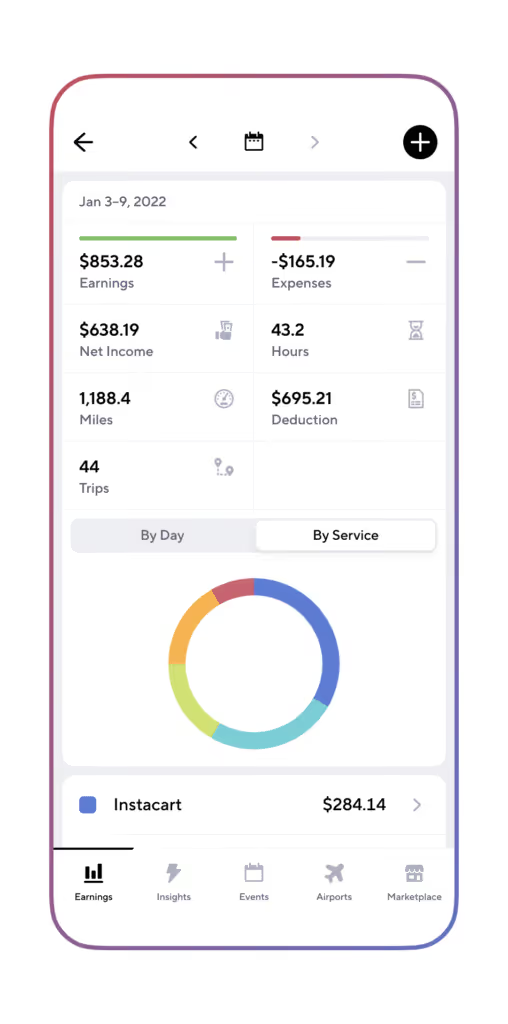
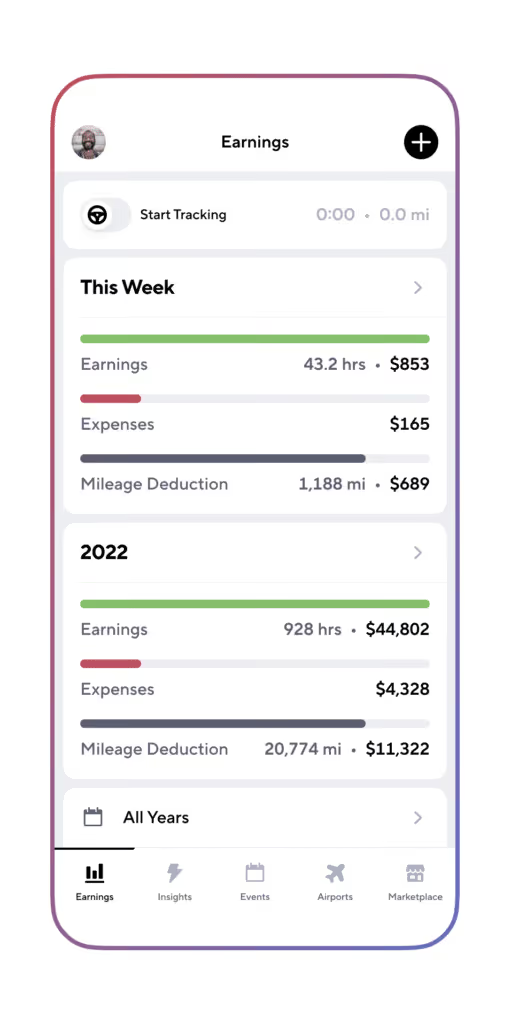
Track how much you earn across all gig apps with Gridwise

- Choose your orders carefully: Remember, you don’t have to accept all orders that come your way. Some platforms do reward higher order acceptance rates, but there will always be room to reject a few low-value orders without adversely affecting the inflow of high-earning offers.
- Tips: Earning tips is a great way to substantially improve your earnings with very little effort. Being attentive, proactive, polite, and punctual increases the likelihood of customers paying higher rideshare tips.
- Rewards programs: Many delivery apps have programs to reward their best-performing drivers. For example, DoorDash’s Top Dasher program offers a plethora of benefits to top drivers on its platform.
- Download Gridwise: Our gig driver assistant app helps you earn more from your time in the driver’s seat. This free app allows you to score discounts, save at tax time, find hotspots, compare your earnings across apps, and more.
Here are more delivery app articles you might enjoy:
Gig Car Rental: A Guide To Car Rentals For Gig Workers
A significant drawback to gig driving is that drivers are on the hook for fuel. You can implement measures to lessen the impact of your fuel consumption, including Gridwise Gas, and use driving tips to help you save money, such as those revealed in a recent Gridwise blog post, 13 Ways to Save Money on Gas as a Rideshare or Delivery Driver.
Another drawback, a larger one, is the miles you put on your car. Some gigs are kinder than others to your odometer. Rideshare is the most mileage-intensive gig driving activity. Full-time drivers can put 250 to 300 miles a shift on their rideshare cars, and sometimes more. That's over 60,000 miles a year.
That kind of mileage accelerates the depreciation of your car.
There are other drawbacks, which we’ll discuss later in this blog.
Is there an alternative? Car rental for gig workers is an option to consider. That’s the subject of this blog post. Topics include
- rideshare car rental
- delivery driving car rental
- a brief look at the gig car rental landscape
- other details
- Gridwise helps you achieve the income that supports a rideshare rental
Rideshare car rental
Is rideshare rental worth it for Lyft and Uber?
Good question. Suppose that as a full-time rideshare driver, you fall into the category of a top performer. You have a strategy, know how to work the bonuses and incentives, make decent tips because you provide excellent customer service, collect an occasional referral bonus, and incorporate Gridwise into your gig driving. It's possible to average $1,000 to $1,200 a week. Remember, though, this is as a top-performing rideshare driver.
Renting a car, however, costs you between $250 and $300 a week, possibly more. What do you save with a gig car rental?
The first is miles on your car. Worse yet, most of those miles are stop-and-go, which is brutal on a car. If you put 60,000 miles a year on your odometer in two years, it’s time to look at a new car. You save a lot of miles and depreciation on your vehicle by using a rideshare rental.
Secondly, with most rental agreements, maintenance ceases to be your problem. If you need a new set of tires, call the rental company. When the brakes start to squeal, call the rental company. If the transmission emits a loud CLUNK and falls into the road, your first call should be to the rental company. These issues are no longer your concern. (BTW, for some cosmic reason, most rental cars for rideshare drivers come with worn windshield wipers, something you just have to live with.)
Some rental deals allow you to put personal miles on the car. This is a nice perk. You might not even have to own a car at all.
There is another benefit to driving a rental. The rental companies typically provide insurance. That’s another saving.
For a more detailed look at renting a car for rideshare, check out the Gridwise blog post, Gig Driver Guide: Renting a Car for Rideshare or Delivery.
What do the rideshare companies say about rideshare rental cars?
Both Lyft and Uber are open to you driving a rideshare rental car. They are so open to the idea, in fact, that both companies maintain rental programs. It’s their way of saying, “These are the best rideshare rental companies.”
Both Lyft and Uber make it easy, too. You can sign up over the app, and the weekly rideshare rental comes from your weekly earnings before you are paid. You never see it.
Considerations
Choices are limited. Lyft and Uber limit drivers to rental companies on their approved list. Uber car rental companies comprise Hertz, Avis, Kinto, and Getaround. You can’t use a car rented from another service.
For Lyft, your choices are more narrow. Hertz and Flexdrive are the two approved companies for Lyft Express Drive, and they are not available in all cities. Like Uber, you cannot use a rental car for Lyft rideshare that is not obtained through Lyft Express Drive.
Your best option is to review your app and see what is available in your rideshare region.
You may not be able to multi-app. Verify if you rent through Uber or Lyft whether you are covered if you multi-app. It is unclear whether either rental program will cover you if you are driving for another gig at the time of an accident.
Delivery driving car rental
This is the best info we have on the requirements of the most prominent delivery companies.
ServiceAllows rentalsCommentsDoorDashYesWebsite says that drivers can use “any car.” GrubhubYesRequirements make no specification about a vehicle. Uber EatsYesYou can rent a car outside of Uber’s partner companies, but “the insurance and registration must be in your name.” InstacartYesWebsite only requires “consistent access to a vehicle.”ShiptYesWebsite says that you do not need to own a car to drive for Shipt, only that whatever car you use has insurance that covers you as the driver. Amazon FlexYesWebsite does not address rental vehicles. Only requires that “you have a mid-sized or larger vehicle.”Roadie YesWebsite makes no requirement that you own a vehicle.
Rental cars are a shifting landscape
Keep in mind that the relationships between providers of rideshare rental cars and the companies that use gig drivers are constantly in flux. Expect things to change. Roadie, at one time, had an arrangement with Fetch Truck Rentals. Fetch has a nationwide presence, but the agreement covered only the Atlanta area. It's unclear whether Roadie required drivers in that region to use only Fetch for truck rentals, or whether the program has since been extended to other regions. As of press time, an email to Roadie was unanswered.
A brief look at the gig car rental market
In case you haven't been paying attention, the rental car market is no longer relegated to Hertz and Avis (although these companies are eager to provide car rentals for gig workers). Smaller ones are out there, and many are specially tailored to gig drivers. This article looks at just a smattering of what’s available.
One more detail
Before we look at the companies, there is another item frequently not mentioned until the last minute. The prices you're quoted for car rental are subject to local taxes. Hertz quotes you $214 a week for a rideshare rental, briefly mentioning local taxes. The truth is, those local taxes average about $50 a week. Now you’re paying $264 for your rideshare rental car. This charge is standard, varying a few dollars from city to city. We have not discovered a way around it. Some agencies listed here match privately owned cars with gig drivers. Payment is handled online. Gridwise cannot substantiate that all these rental companies are subject to local taxes and fees; some may have figured out a loophole.
Hertz
Despite a recent bankruptcy, Hertz is still in the business of gig car rental. The firm is part of the Uber rental program. You order the car through your app.
- Rentals are renewed weekly.
- Liability insurance is included.
- A $200 security deposit is required.
- A credit check is involved, but the rumor is that the restrictions are lower than usual.
COST: Weekly prices start at $214.
Avis
Avis is part of the Lyft rideshare rental car program. Rental terms are by the week and automatically renew. Terms include unlimited mileage, but Avis is unclear about whether this pertains only to miles driven while on the app or personal miles, too. If it includes personal miles, that’s a good deal.
- You must be at least 25 years old to rent.
- You must possess a valid credit card or debit card.
- A soft credit check is required if you use a debit card.
COST: Weekly prices start at $260.
HyreCar
HyreCar matches drivers with private owners interested in making an extra car available for gig car rental. The firm is part of the Uber rental program. Agreements start at daily rates and go up from there (there may be discounts for longer periods). This is a flexible arrangement. You may drive a five-passenger sedan as your rideshare car most of the time, but you can upgrade to a seven-passenger SUV to drive Uber XL for special events like a music festival or sports event and command a higher rate.
- Download the HyreCar app.
- Terms vary by owner and can include mileage.
- Verify with the owner that the car is being used for gig driving.
COST: Prices vary by owner. Hyre adds a 15% handling fee to the listed rate. Insurance is also extra. All prices are computed online.
KINTO Share
KINTO Share is another one of the Uber car rental companies. They maintain a fleet of cars, all of which are for rideshare and other gig driving. KINTO is a Southern California company, and at this time is limited to that region, though it does have plans to expand.
- Deposit required
- Rental terms are for four weeks and can automatically roll over.
- Extensions are available on the length of the term.
- Hybrid cars are available.
COST: Weekly prices start at $260.
Getaround
Getaround is like HyreCar, part of the peer-to-peer sharing economy and one of the companies Uber selected for its gig car rental program. You get insurance and unlimited mileage (again, unclear whether that includes personal miles or only those incurred on the app).
- Drivers under 25 pay a premium for car insurance.
- 28-day rental agreements are available.
COST: Not stated, but probably similar to other programs offered by Uber.
FlexDrive
Lyft acquired Flexdrive in 2020 for $20 million and the assumption of all debt. Before that, Flexdrive was a partner in the Lyft Express Drive Program, so the two companies have a history.
- Drivers must be at least 25 years old.
- Drivers must have a debit card or credit card.
- Drivers must use the car for rideshare purposes only.
- A refundable security deposit is required.
COST: Not available, but probably similar to other programs offered by Lyft.
Zipcar
If you drive Uber Eats in Atlanta, Chicago, Denver, Los Angeles, Philadelphia, Portland, San Francisco, and Washington, DC, Zipcar offers you an option if your car is out of commission for a day or two. Reserve a Zipcar through the mobile app, travel to the car's location, and unlock it with the app. You’re ready to go.
- Uber Eats drivers get special discounts.
- Stay under 180 miles a day.
Cost: Rates start at $10 an hour.
Fast Track Mobility
Fast track mobility is an example of a regional program Uber and Lyft offer for rideshare rental cars, available only in the New York City metro area.
- Rental agreements include insurance.
- Pick from mid- and full-size sedans as well as SUVs, including SUV models that seat seven (for those drivers who like Lyft Lux and Uber XL).
- No limit on mileage.
- Accepts drivers as young as 21.
COST: $400/weekly and up. Prices depend on the model chosen.
Other Details
Does renting work for you?
We said this before, but make sure that your gig driving income supports the cost of a gig rental car. Otherwise, you might get yourself into a financial hole.
Buyer beware
There are many more gig car rental companies out there. Make sure the car you select is acceptable for the gig in question. It’s your responsibility. Double-check everything you're told, including insurance. Verify mileage caps and any other limitations. Salespeople can be overzealous and promise things that might not be completely true, or they may not understand the requirements of the gig driving industry.
Don’t be surprised if you see different rates than those quoted here
Both Uber and Lyft experiment with varying rates for rideshare rental in different regions. You might also see a rental company available for Lyft or Uber rideshare drivers other than those listed here. These, too, are often test programs.
Keep a clean driving record
Rental companies do look at driving records. A recent DUI will probably exclude you, as will a poor history with too many citations.
Pay attention to rental agreements
Most rideshare rental cars are on a week-to-week agreement. Many renew automatically, while others require you to make a phone call. Ensure you stay on top of this, particularly if you're in a peer-to-peer arrangement. At the end of the agreed period, the owner may want their car returned. If you did not prepare for this, you could find yourself scrambling to find another vehicle.
Cars come and go
Part of the business model of the car rental industry is selling their cars. There is a sweet spot where they can unload these cars for the maximum dollar. If you have a car for any length of time, expect a call where they’ll want to trade you for a car with fewer miles.
Going on vacation?
Weekly rent is charged whether you drive that week or not. If you go on vacation or you’re not driving for some other reason, make arrangements with the rental company to return the car. Provided that you adhere to all the rules, you should have no problem getting a car when you’re ready to drive again.
Deposits
Many rental companies charge a deposit. Don’t be surprised if it's close to the weekly cost of the car. These deposits are generally refundable, but make sure.
How do you pay for your gig car rental?
If you rent a car through the Lyft or Uber program for $260 weekly, the first $260 you make on the app covers the rideshare rental cost. Some drivers schedule a marathon day early in the work week with the goal of paying for the car by the time they finish that evening. That way, they drive for the rest of the week, knowing it’s all profit.
Service
Limit yourself to rental agreements in which service is the responsibility of the rental agency or owner (in a peer-to-peer sharing arrangement). The bigger companies such as Hertz and Avis will let you know when service is due but don’t take this for granted. A vehicle that is well cared for is reliable and will have a longer lifespan.
Insurance
Review the coverage and watch for areas where you might be exposed. Often your personal auto insurance can give you protection at minimum cost.
Be kind
This is always good advice, especially if you find yourself repeatedly working with the same office of a rental company. Be nice to the people behind the desk. They can take care of you and work miracles in a pinch.
Gridwise helps you achieve the income that supports a rideshare rental
Gridwise has everything rideshare drivers need in one place; a mileage tracker, earning and expense tracker, insights into hot spots, and a carefully hand picked list of discounts just for you.
In the market for a rental? Gridwise has partnered with HyreCar to offer an exclusive 15% off your first car rental!
Try Gridwise for free and claim your 15% off
And have fun out there.
Which Rideshare Service Should You Drive For In 2023?
Among gig driving jobs, rideshare continues to be one of the highest-paying. Drivers regularly average $20 an hour and often more.
Additionally, the time window for restaurant food delivery and grocery delivery is much smaller than for rideshare. Peak hours for restaurant food delivery are between 4:30 pm and 9:00 pm, with some business at the lunch hour. For grocery delivery, peak hours are typically daytime, with some later hours, although rarely past 9:00 pm.
Conversely, rideshare is almost a 24/7 job if you live in the choice markets or know where to drive. There is always a demand for rides.
Then comes the inevitable question: Lyft vs. Uber, which is better to work for? In this blogpost we will review
- Who pays more, Uber or Lyft?
- What is the signup process for Uber vs. Lyft?
- Lyft vs. Uber: the driving experience.
- Uber vs. Lyft: What incentives do the companies offer?
- Bonuses and rewards programs.
- Referral programs.
- Can’t decide between Lyft vs. Uber? Try multi-apping.
- It might be Uber vs. Lyft, but Gridwise is here to help.
Who pays more, Uber or Lyft?
Let’s start things off with what drivers want to know the most.
According to nationwide data from Gridwise for median driver earnings, these are the figures for 2022:
Uber and Lyft driver pay
ServiceBase earnings per tripGross earnings per hourGross tips per hourGross earnings per monthLyft$8.97$19.90$1.71$787.56Uber$9.99$21.14$2.16$1,040.79
As you can see from the table, when it comes to Lyft and Uber driver pay, Uber paid drivers more in 2022. Consider, however, that these numbers take in both full-time and part-time drivers. Based on anecdotal evidence from various online postings, full-time drivers can make as much as $4,000 a month—sometimes more.
What is the signup process for Uber vs. Lyft?
Signing up to be a Lyft driver: Lyft driver requirements
Lyft is often looking for new drivers, so there’s little worry about being placed on a waiting list. There are, however, requirements you must meet. You can view these on the Lyft website. As you’ll see under Lyft’s state and city requirements, these can vary from region to region. So here we’ll give you a just general idea of what’s needed:
- a valid driver’s license
- Active duty military applicants and their dependents can have out-of-state documents and driver's license. Please visit Lyft at your local hub to apply.
- to meet the minimum age requirement (from 21–25, depending on the city and state requirements)
- one year of driving experience and be 25 or older
- any smartphone that can download and run the Lyft app
- passing a background check (criminal and DMV)
A four-door vehicle that
- has a minimum of five seatbelts, maximum eight
- has no body damage
- is not a taxi, stretch limousine, or rental vehicle from Lyft’s Express Drive program
- is not titled as salvage, non-repairable, rebuilt, or any other equivalent classification
Required documents
- valid car registration
- proof of current insurance
- proof of inspection
If you don’t own a vehicle, you can rent one, but only through Lyft’s Express Drive program.
What vehicles does Lyft not accept? Taxis and stretch limousines don’t qualify on the Lyft platform. There was a time that certain subcompacts were not allowed, but as long as there are five seatbelts, subcompacts are permitted (be prepared to get some complaints from passengers, though). To check for additional Lyft vehicle requirements, check your app, which reflects the most local requirements.
Signing up to be an Uber driver: Uber driver requirements
If you decide on driving for Uber vs. Lyft, here are the requirements:
- be at least 21 years of age
- have at least one year of licensed driving experience in the US (three years if you are under 23 years old)
- have a valid driver’s license
- pass a driving record and criminal history check
- possess a cell phone capable of operating the Uber app
Vehicle requirements include
- an eligible four-door vehicle
- no older than 16 years (may differ in some markets)
- no body damage and not salvaged
Some cosmetic features may prevent vehicles from being used, including
- holes in the exterior
- taxi decals or taxi-style paint
- significant interior damage (torn seats, large permanent stains, strong permanent odors)
- paint oxidation
- different colored doors and hoods
- aftermarket modifications
- window tinting that violates acceptable standards in that state
Documentation requirements include proof of
- vehicle insurance if you plan to drive your car (rental cars include insurance)
- car registration
- passed inspection
You can rent a car to drive for Uber, but only if you obtain it through a designated rental partnership. Check the Uber rental car guidelines to see what’s available in your area.
You’ll need to provide a profile picture, forward-facing, with just your head in the photo.
Lyft vs. Uber: the driving experience
Driving for Lyft
Lyft refers all its drivers to the Lyft Driver Guidebook, containing many finer points about signing up and driving with Lyft. The guidebook also acquaints you with the Lyft app.
Throughout the guidebook, you’ll find many tutorials. Some are mandatory for viewing, while others are for extra help. Get familiar with the app so you won’t be frustrated once you’re using it on the road.
When you get a ping, the passenger’s picture comes up on your screen, along with their star rating. You can accept or decline the ride—but be careful about declining. Doing so can affect your eligibility for bonuses and other pay incentives.
Accept the ride within a few seconds; if you miss it, it counts as though you declined it. If you take a break, turn off the Lyft app. Ride requests you missed while absent will count against your acceptance rate.
When you accept the ride, you’ll see a photo of the passenger and be guided to your pickup point by the app. Once the passenger gets in, click or swipe again to verify that you’re on the way to the destination. The navigation system will guide you there, step by step. Navigation is almost identical to using a GPS and should pose little problem.
Locating your passenger is typically easy, but sometimes it can be more difficult. The Lyft app allows you to text or phone the passenger to find their exact location. If they do not show up within the allotted five-minute period, you can cancel the ride and get paid a nominal fee. This doesn’t happen often though.
Once you drop the passenger off, you end the ride on the app. The amount you earned and any tip show up on the screen. You’ll also get a chance to rate your passenger.
Lyft layers its navigation system over Google Maps, so it will be familiar if you’re used to that way of getting around. If you prefer to use WAZE, which also tells you about everything from the fastest route to a police presence or pothole in the road, you can change your preferred navigation to WAZE under settings.
Ease of driving with the Lyft app. The Lyft app is state of the art, visually appealing, easy to use, and not the least bit confusing. Also, the map is clear and exceptionally detailed.
Lyft rating system. You can rate your passengers, and they, in turn, can rate you. Lyft uses a star system from one to five, and you need to keep your ratings up. Tips for doing this are in the Lyft Driver Guidebook. If you are polite and friendly with your passengers, maintaining a five-star rating, or close to it, is easy. Occasionally you will have that problem passenger, but if you do your best, even a bad rating will be canceled out by an outstanding one. If you decide to decline a passenger because of their Lyft rating, it’s a good idea to text support through the app that you did so. This might encourage support to overlook the decline, preventing your acceptance rate from being affected. One Lyft veteran said, “It takes a few bad ratings to get a passenger below four stars. If your fellow drivers gave a passenger a bad rating, there is a reason.”
Lyft Support. Before the pandemic, Lyft support operated through Hubs, where you could go to get in-person help. Many of the Lyft Hubs are no longer operating. Assistance mostly now comes through the Lyft app. You’ll get responses within reasonable time frames, but this may vary depending on where you live and how busy it is. You’ll find many answers to your questions as a Lyft driver in the Lyft Driver Guidebook. Look on the website or the Lyft app for a Hub in your area.
Driving for Uber
When you drive for Uber, you’ll find tutorials on driver safety and community standards that you need to take. The Uber app is not much different from the Lyft app. When you get a ping, the passenger’s name appears on the screen, as well as how long it will take to get to the pickup (and if you have Uber Pro status, how long the ride will be). The passenger’s rating also appears, and then you can accept or decline the ride.
If you don’t accept soon enough, you’ll lose the ride and it will count as though you declined it. Again, this is something you want to avoid because you have to keep a high acceptance rate to receive specific incentives.
The navigation system on the Uber app allows you to set up Google Maps or WAZE, similar to the Lyft app.
As with Lyft, you’ll want to familiarize yourself with the Uber app before going out to drive. The website can help, but it’s best to review the app yourself.
The ride portion works the same as with Lyft. You navigate to the pickup point and start the ride once the passenger is in your vehicle. Tap “Navigate” on the ride screen.
Being activated on the Uber app means that you can also deliver for Uber Eats. Check your settings to see if you’re open for Uber Eats deliveries. Whether you want to deliver, do rideshare, or both on the same shift is up to you. Make sure your settings reflect your preference. Usually, the app defaults to leaving you available for both. If you don’t want to deliver though, you can turn off deliveries.
Uber rating system. Like the Lyft app, the Uber app rating system goes both ways, and it pays to do what it takes to keep your rating high. It will affect not only your ability to keep driving for Uber but how the Uber rewards program, Uber Pro, will treat you (more about that in a bit).
Uber Support. Like Lyft, Uber used to have in-person support at their Greenlight Hubs, though much has changed in the last year. Online and phone help is available, but the priority your emails and calls receive depends on your Uber Pro status.
Uber vs. Lyft: What incentives do the companies offer?
Lyft and Uber offer three types of incentives: driver rewards, premiums and bonuses, and referrals.
Lyft Rewards
Lyft has a driver score for all drivers, which is based on their acceptance rate, star rating, and any red flags appearing on their record.
Points vary by market and depend on earnings. Eligible earnings include the base fare, time and distance rates, shared ride pickups, and tips earned during your market’s busy hours. The designated busy hours vary by market and are found on your app under Lyft Rewards. If you don’t see the Lyft Rewards tab on your Lyft app, the program has not launched in your market.
Lyft Rewards Incentive Programs
RequirementsSilverGoldPlatinumMinimum pointsVaries by marketVaries by marketVaries by marketMin. driving score60%80%80%Driver rating (star rating)Not considered4.904.90BenefitsExtra destination mode settings (daily)Not available12Cash back on fuel and EV charging2%3%7%Streak bonus privilegesNot availableNot availableYes24-hour phone supportNot availableNot availableYes24-hour roadside assistanceFreeFreeFreeSave on auto maintenance and repairs with GoodyearYesYesYesSave on EV charging/EXGoYesYesYesTurbo Tax Self-EmployedUp to 25% offUp to 25% offUp to 50% offSave on Mango LanguagesYesYesYesCash back on gas/UpsideUp to 25 cents/gallonUp to 27 cents/gallonUp to 32 cents/gallon
Drivers start with a blank slate on the first day of each month. When they attain the requirements for a level, that level unlocks for the remainder of that calendar month and the next month. This means drivers can maintain or increase their level each month if they meet the requirements.
Uber Pro
Uber’s Uber Pro rewards system also works in tiers: Blue, Gold, Platinum, and Diamond.
Uber Pro Program
LevelBlueGoldPlatinumDiamondRequirementsVaries by marketVaries by marketVaries by marketVaries by marketDiamond Cash RewardNot availableNot availableNot availableYes,varies by marketCostco membership for the first yearNot availableNot availableYesYesCash back on gas and EV chargingUp to 6% gas; 4% EV chargingUp to 7% gas; 6% EV chargingUp to 8% on bothUp to 10% gas; 12% EV chargingAccess to Area Preferences (select cities)Not availableNot availableYesYesUp to 25 cents off per gallon (Upside)YesYesYesYesDiscounts at 7-Eleven storesYesYesYesYesShell Fuel rewards5 cents/gallon5 cents/gallon6 cents/gallon7 cents/gallon100% tuition at Arizona State University (online)Not availableYesYesYesDiscounts at BP and Amoco5 cents/gallon5 cents/gallon7 cents/gallon7 cents/gallonAverage savings of 35% on car maintenance at CarAdviseYesYesYesYes24/7 roadside assistance with Urgently20% offFreeFreeFreeTurboTax Self-Employed discountUp to 25%Up to 25%Up to 25%Up to 50% offEligible for faster pickups at airportsNot availableNot availableNot availableYesPriority customer supportNot availableYesYesYesDiamond VIP customer supportNot availableNot availableNot availableYesGet $1,000 when you go electric from TrueCarYesYesYesYesHealth insurance plans through StrideYesYesYesYesRosetta Stone language lessonsNot availableYesYesYesEVgo discounts on fast chargingUp to 15%Up to 45%Up to 45%Up to 45%Extra destination featureNot availableNot availableYesYesRestore Uber Pro statusNot availableNot availableYesYesFree health savings account through StarshipYesYesYesYesQuickBooks Self-Employed discountsYesYesYesYesRecognition badges in the rider’s appNot availableYesYesYes$200 off Wallbox Pulsar home charger and installationYesYesYesYesCaribou Auto Refinance (Calif. only)$399 processing fee$399 processing fee$399 processing fee$0 processing fee
The requirements vary for attaining the various levels, depending on the region you drive in. Information for your specific area is available on your Uber app. Whereas Lyft is month-to-month, Uber tiers award drivers per quarter, calculating their star ratings, acceptance rate, and cancellation rate. Some rides are worth one point, while those accepted during busy hours are worth as much as three.
You can look at your profile on the Uber app to see how many points you need to reach a specific tier. It will tell you which tier you are in and what you must do to make it to the next one. You can find all the details in the Introducing Uber Pro publication.
Bonuses and reward programs
Lyft
Lyft offers drivers a wide range of bonuses and rewards.
Streak bonus. This sets a dollar amount for a certain number of rides given in a busy period—for instance, three rides from 6:00 pm to 7:00 pm. Streak bonuses can be interesting because you can complete your three rides in that hour and then start another streak. Some of the streak bonuses only require that you start your first ride in that hour. Streak bonuses typically appear on your app a few days before they are available, making it easy to plan for them.
Personal Power Zones. This promotion, indicated by a heat overlay on your Lyft app, offers incentives for drivers who start rides in specific areas. Personal Power Zones are profitable, but they can appear and disappear quickly. Unless you are very close when a zone appears or you find yourself in the middle of one, it doesn’t make sense to chase them.
Lyft’s program is extensive, and like most program features, what you get will vary depending on where you live.
Uber
Uber promotions work on a similar model to Lyft, with some tweaks.
Surge pricing. Surges increase the amount a driver earns in hot areas on the map. These are similar to Lyft’s Personal Power Zone.
Quests promotions. Quests allow drivers to earn extra for completing a certain number of rides over a period of days, usually Monday to Thursday and Friday to Sunday.
Consecutive rides. This promotion rewards drivers with a set bonus for taking three consecutive trips. For example, you get a bonus if you start your first ride in the designated zone and complete two more trips after that without turning off your app or declining a ride.
Uber’s bonuses range from $3 to $25, depending on where you live and how much Uber wants to incentivize drivers on a given day.
Referral programs
Lyft referrals
With Lyft’s referral rewards program, you can make extra money referring drivers. When you sign up to drive, you’ll get a referral code. If you invite someone to sign up for Lyft and the person starts driving, you’ll receive a referral fee. The new driver must complete a certain number of rides within 30 days of signing up with Lyft.
This usually takes the form of a “guaranteed earnings” agreement. If the new driver completes the requirements, Lyft guarantees they make a certain amount. If actual earnings are lower, Lyft pays the difference. Once the driver has completed all the requirements, you get the referral fee. Actual referral fee amounts vary by region.
Lyft is trying to lure back drivers who have left in the last few years, so they are allowing active drivers to refer former drivers who have been inactive for a while. So, at least for now, the person you refer to Lyft doesn’t have to be a total newbie. It could be someone who’s taken time off from driving, as long as they weren’t deactivated. Again, this program is not available in all markets, and the particulars differ from region to region.
Uber referrals
Uber’s referral program is not as elaborate as Lyft’s, but that doesn’t mean you’ll be left without an opportunity for referral bonuses.
You’ll also see that Uber isn’t precise about its exact terms because, like Lyft, they vary from time to time. The app is the best way to find out what’s offered in your area. Go to your Earnings tab and scroll down to the referral program information.
Business cards
Printing some inexpensive business cards for the rideshare company you work with is always a good idea. Pass them out to anyone who inquires. Along with including your contact information and referral code, listing a handful of cash apps on your business card is prudent, too. The service departments of many car dealerships, some health plans, and other entities have arrangements with rideshare companies to transport customers or patients. Although these passengers are not paying for the ride, they may want to tip you, which they can do through one of your cash apps.
Can’t make a decision between Lyft and Uber? Try multi-apping
The question of Uber vs. Lyft, which is better for drivers? isn’t necessarily easy to answer. The companies are similar in how they operate, and there are some regions where Uber may pay more, but Lyft has a stronger presence.
Another option is multi-apping, running two apps at the same time. Gridwise revealed some strategies for multi-apping in a recent blog post titled The Art of Multi-apping: How-tos and Strategies for Gig Drivers. It’s a good idea to try multi-apping only after you’ve been driving rideshare for a few months, have worked with both apps separately, and understand how they operate.
There are drivers for whom multi-apping is a vital part of their strategy. Others find it challenging. Some drivers will use one app or another, depending on which company offers better incentives that week. One of the other advantages of multi-apping is that you have a backup. If you encounter a problem passenger and get deactivated due to a complaint, you can immediately switch to the other app until you have resolved the issue.
Gridwise helps rideshare drivers earn more
The real secret to success as a rideshare driver might not be choosing between Lyft vs. Uber but using the most essential tool for any gig driver—the Gridwise app. The Gridwise app can link to the gig driving apps you use. It allows you to track and analyze earnings, maintain more accurate mileage records, and monitor other gig-related expenses. Tax time is a breeze with Gridwise.
Gridwise also makes you a more efficient driver. Features such as When to Drive and Where to Drive allow you to be at the right place at the right time. Check out peak airport arrival/departure times so you know when to be there. Gridwise also informs you when sporting events and concerts are letting out, with all those fans needing rides home.
Oh, and Gridwise is the first app to provide affordable benefits specifically for gig workers. We know what you need and we've carefully hand picked providers to give you valuable benefits at a fraction of the cost.
Download Gridwise now
Not a rideshare driver? Gridwise still keeps all your gig work earnings, expenses, and mileage in one place to make tax season stress-free.
And have fun out there!
IRS Mileage vs. Actual Expenses: How To Choose
*Gridwise does not provide tax, legal, or accounting advice. This material has been prepared for information purposes only and is not intended to provide, and should not be relied on for tax, legal, or accounting advice. You should consult your own tax, legal, and accounting advisors before filing your return.
Every gig worker wants to keep the largest portion of earnings as possible. One excellent way of doing this is to take advantage of the many tax deductions available to you.
The biggest of these, by far, is the expense you incur by using your vehicle for your business. There are two ways to calculate this deduction. One is by using the IRS mileage deduction allowance, and the other is by calculating all your vehicle-related expenses.
In this post, we examine both methods, giving you the information you need to choose which one will work best for you. Here’s what we’ll cover:
- Maximizing tax benefits
- Why use the standard mileage deduction?
- What does it take to track actual vehicle expenses?
- Choosing your best option
Maximizing tax benefits
There are many legal ways to maximize tax benefits and minimize the amount of money you owe in taxes. Before you can even begin to tally up your deductions, you will need to keep precise records that show what you claim as expenses in ways tax authorities understand: facts, figures, and receipts.
Whether you use the IRS standard mileage deduction or calculate your actual vehicle-related expenses, you’ll need to track your mileage and/or other costs associated with operating your vehicle. The deduction method you choose will dictate how closely you need to track these outlays, but one thing is for sure: you will need to track your mileage no matter which method you select.
Many drivers believe the apps they use accurately track all the work-related miles they drive, but this isn’t the case. Driving and delivery apps track the mileage you travel from the time you receive a ride or delivery request until you complete it—but that’s not every mile you drive for work. Your driving app doesn’t take into account the other deductible miles you drive, such as the costs you incur just going to work.
What type of expense is an example of the cost to drive to and from work? For starters, there are the miles you rack up while driving in between requests, and those long rides from your regular parking spot to places where you can expect to get some action on your apps. As a rideshare or delivery driver, you can deduct these miles as well.
To track every mile you drive, you need a sophisticated mileage tracker like Gridwise. Gridwise begins tracking mileage from the moment you “tell” the app to track your shift. Simply click on the button, and you’re on your way!
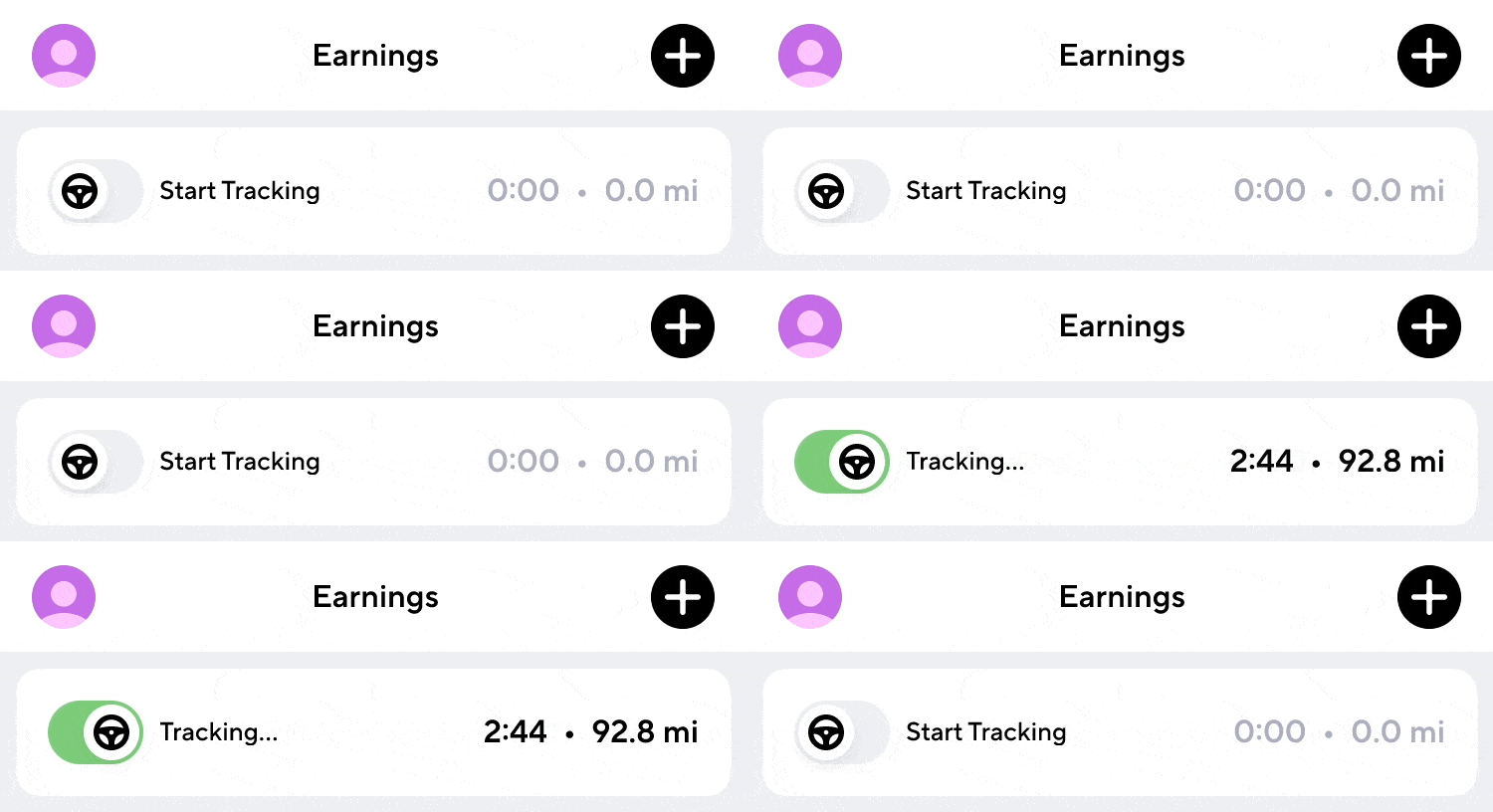
Every mile you drive—whether it’s to, from, or in between actual assignments—is logged in Gridwise’s mileage tracking software, which you can pull up at any time.
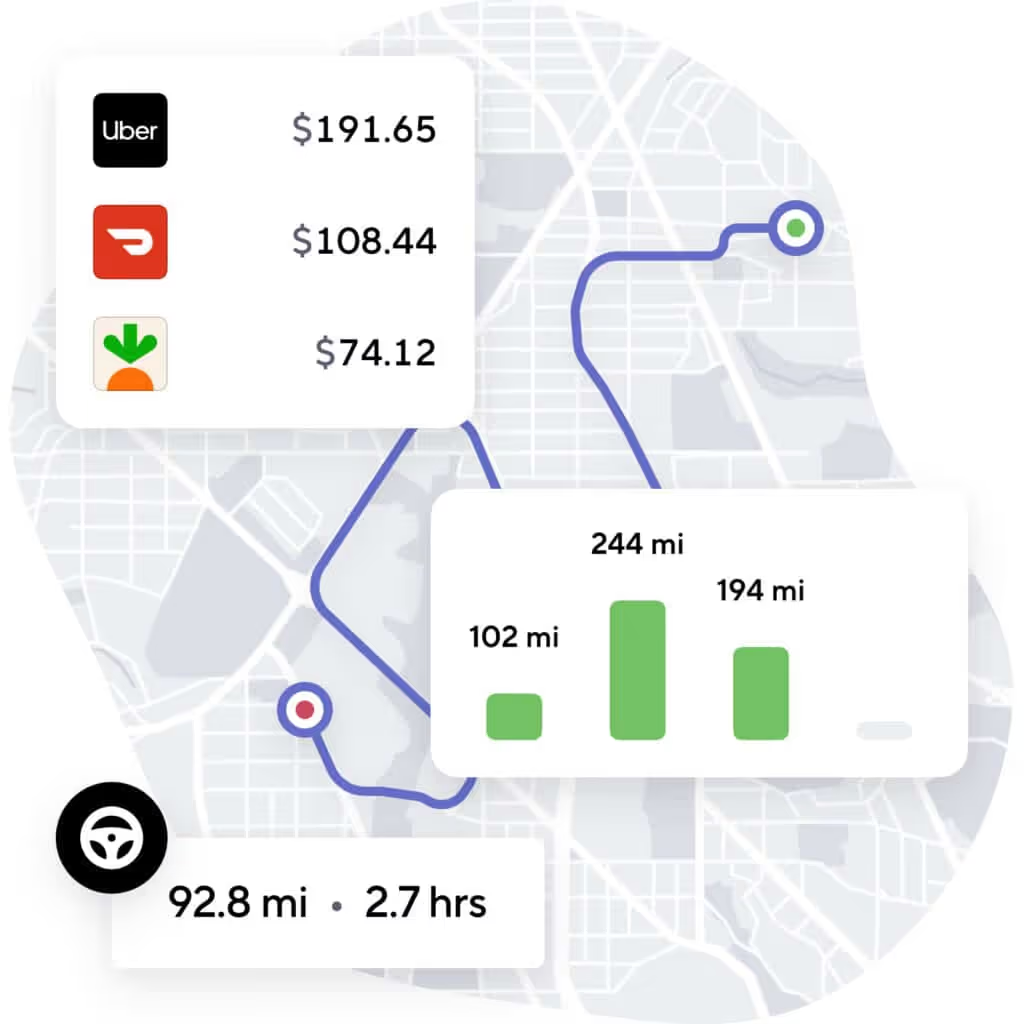
You will also want to make sure you begin the practice of tracking your mileage right away. While it’s possible to reconstruct your mileage records, as shown in this Gridwise blog post, using Gridwise to track your miles is far more convenient. Missing out on counting all your miles can be rather costly, as you’ll discover from these details about the IRS standard mileage deduction.
Tracking with Gridwise also means you'll get reports every time you drive. You'll see your total miles driven, expenses, and earnings all in one spot.
Why use the standard mileage deduction?
The IRS standard mileage deduction is designed to provide those who use their vehicles for work with a simple way to calculate the costs of doing so. Rather than enumerating each and every vehicle-related expense, drivers who use the standard mileage method simply apply the IRS standard deduction rate to their actual mileage. The result is the total deductible amount they can use for vehicle-related expenses.
For 2023, the IRS standard mileage deduction rate is $0.655. This figure estimates a driver’s operating costs and includes items such as fuel and depreciation. While you cannot claim those expenses when you use this method, there are others you can continue to deduct and add on to the amount you claim as your standard mileage deduction. These include
- parking fees
- tolls
- car washes and detailing
- registration fees
There might be other gig-related expenses as well, including water for your passengers, delivery bags and gear, electronics such as a phone or dashcam, etc. Use Keeper to go through all your expenses, and the app will produce a list of all the items you can deduct. This makes finding and enumerating your deductions clear and simple!
One more note: If this is your first year of driving for a rideshare or delivery app, the IRS wants you to use the standard deduction method. Following your first year, you can choose to switch to the actual expenses method. Let’s take a look at what that might be like, and if there’s any reason to shift gears, if you’ll pardon the expression, after your first year.
What does it take to track actual vehicle expenses?
While it isn’t impossible to track all your actual vehicle expenses, you will need to set up a system to make sure you capture them all. You will also need to know the guidelines for calculating depreciation, be clever about adding all your expenses together, and then determine what percentage of the time your car was used for business.
Here is a list of deductible expenses, according to Keeper:
- fuel
- insurance
- maintenance
- oil changes
- lease payments
- depreciation
As noted above, parking, tolls, car washes, and registration can also be deducted.
Keeping track of all these expenses used to be complicated, but with a slick app like Keeper, it’s easy. You can track these expenses with the app, and set up the Keeper app to search for others that you might have neglected or didn’t know about. Simply link Keeper to the bank account(s) you use to pay for your driving expenses, and the app will keep all your expense records for you.
See the Keeper website to discover more details about how this works.
Choosing your best option
Most tax experts will tell you that the actual expenses method yields a higher deductible income figure than the IRS standard mileage method. This is true, but only for drivers who use their cars for business to drive 10,000 miles a year or less. Unless you’re a very part-time gig driver, it’s likely that you drive more than that, in which case, listing your actual expenses might not be your best bet.
Let’s take a look at some calculations to illustrate the differences between the two methods.
Many drivers average 100 miles per day, according to posts on a popular Uber driver forum. Working five days per week, let’s say 50 weeks per year, the average full-time gig driver would clock 25,000 miles. Multiply that by the standard mileage deduction rate of $0.655 per mile, and the deductible income would amount to $16,375.
The same driver might find quite a difference when comparing actual expenses vs. mileage deductions. Totaling gas, insurance, registration, roadside service, maintenance, and other expenses is unlikely to yield a number anywhere near as high as the standard mileage deduction rate.
However, a part-time driver who clocks around 10,000 miles per year, with half (5,000) for work, could benefit from using the actual expenses method, if only slightly. The calculations in this post from Keeper show the following deductions (adjusted for 2023 gas prices) for a driver claiming 10,000 miles driven during the tax year, with 5,000 of those miles used for work.
Gas: $1765.00 (based on 500 gallons @$3.53 per gallon (per AAA)
Depreciation: $3,000 (based on a $20,000, three-year-old car)
Insurance: $1,500 (approximated average)
Repairs: $400
Oil: $100 (if driver does the oil changes)
Misc: $160 (registration, roadside assistance, etc.)
TOTAL: $6,925
Work-use ratio of 50%: $3,462.50
The same low-mileage driver, using the standard mileage deduction, would only be able to deduct $3,275 (5000 miles x $0.655). Because the IRS recently raised the standard deduction rate, the two figures are rather close. However, if that changes, the actual expenses method might make more sense for a low-mileage driver.
So is it better to write off gas or mileage?
The right choice for you depends on how much you use your car for your driving gig. The best way to decide is, after your first year, to calculate both methods and compare the results. (Remember, the IRS wants to see you use the standard mileage deduction for the first year you use your car for business.)
The key takeaway from when comparing actual expenses vs. mileage is that you need to track your expenses on each and every shift. Lucky for you, there’s Gridwise and Gridwise Tax Help, powered by Keeper. Get 30% off Gridwise Tax Help's expense tracking and tax help services simply by using Gridwise. Gridwise Plus members get 50% off!
Put these powerful apps to work for you, and let your record keeping stress become a thing of the past. You don't have to take us at our word though - here's what other gig workers say about Gridwise and Keeper:
"After trying so many mileage app's for delivery drivers- this has been my fave! Easily navigable & keeps track of lots of data- all for free! manages expenses, mileage, income, taxes."
fastdasherKim
Download Gridwise for easy mileage and expense tracking
Back Pay For California Gig Drivers: What Does This Mean For Rideshare and Delivery Drivers?
Are drivers in California really getting back pay? Apparently, they are, thanks to a driver whose sharp eye and math skills discovered lines in the law leading to more compensation.
In this post, we’ll tell you exactly why California drivers are receiving months of back pay due to a stipulation in Proposition 22, and what that might mean for the future of drivers there and in other places where similar laws are being proposed. Here’s what we’ll cover:
- What were drivers promised in Proposition 22?
- Did drivers get everything that was promised?
- What’s happening now?
- What Uber news and Lyft news can we expect in other parts of the country?
What were drivers promised in Proposition 22?
When Proposition 22 was passed in November 2020, and became law in 2021, drivers for Transportation Network Companies (TNCs), such as Uber, Lyft, DoorDash, and Shipt, would be exempt from another California law that entitled gig workers to the benefits given to employees. Read more about what Proposition 22 contains in this Gridwise blog post.
While drivers gave up the full benefits of being employees, qualifying drivers did get benefits such as a healthcare subsidy and a minimum earnings guarantee for the time they were actively on a rideshare or delivery run. A reporter named Pablo Gomez studied the law in detail and discovered a provision that many drivers might not have noticed. After comparing notes with driver Servio Avedian, some very interesting information came to light.
According to the law, any drivers who were making the bare minimum would receive a small reimbursement for vehicle expenses. In 2021, the rate for this was 30¢ per each mile driven while engaged in rideshare or delivery trips. This benefit might not sound like a lot, but for drivers who are earning the minimum rate, which is calculated at 120% of the applicable minimum wage, it can add up.
This is especially true for delivery drivers who depend on tips to boost income. With a greater likelihood of failing to meet the minimum hourly wage, they certainly benefit from this provision. For the past two years, the benefit has been paid out by the TNCs at the 30¢ per-mile rate to qualifying drivers, but that isn’t what was supposed to happen, according to the law.
Did drivers get everything that was promised?
Within the law is a provision for an inflation increase on the 30¢ per-mile compensation. The increase was never allocated to the drivers who qualified for it, so they didn’t get exactly everything that was promised.
Drivers should have received, based on the inflation rate of 6.8% in 2022, 32¢ per mile. As inflation has continued in 2023, the rate should now be 34¢ per mile. It turns out that these increases were never accounted for in the sums that were paid to drivers to compensate for vehicle use.
Meanwhile, customers have been paying a fee of $0.75–$1.00 for California driver benefits on top of what they already pay for each ride or delivery. TNCs collect this money to cover items such as compensation for vehicle use when drivers make the bare minimum or less while driving.
Drivers and others who question the TNCs’ diligence wonder how much they have made by investing the money that was owed to drivers rather than paying it to them. The TNCs claim they were not responsible for arbitrarily raising the per-mile rate.
Indeed, according to the law, the California treasurer’s office was responsible for calculating and publishing the new rate each year, and had not done so. The TNCs point this out as the reason why they didn’t change it. No matter which party is at fault, this resulted in 18 months’ worth of missed inflation adjustment on drivers’ per-mile compensation.
What’s happening now?
Once Gomez contacted the state treasurer’s office, and after a rather long exchange of phone calls and posts on Twitter, the treasurer’s office insisted they had indeed posted the rates, but the TNCs dispute this. The rates were posted for 2023, but 2022 was skipped over entirely.
The treasurer’s office says they didn’t post the rates right away because of the controversies surrounding Proposition 22. Read this Gridwise post to get the details about the latest outcome of court battles surrounding the law. The TNCs maintain that the law stipulates the treasurer’s office is responsible for posting the rates; and in the law, it clearly states that is the case. You can read the portion of the law that pertains to the mileage compensation here.
Whether the rates were posted on time or not, and regardless of the disputes surrounding it, Proposition 22 states that drivers are entitled to that inflation adjustment. Most TNCs jumped on doing the right thing once the adjustments were finally posted and it was clear money was owed.
Some drivers, especially those who do delivery full time, can expect to get as much as $1,000 as a result of this situation, according to Avedian’s calculations. Furthermore, the TNCs’ total payout could come to something like $100–200 million. So far, Uber and Lyft, along with DoorDash, have been sending drivers back pay, but there are other TNCs that have yet to comply.
The treasurer’s office has promised to publish the adjustments every January from now on, despite the disputes that might continue in the courts. Those who are not big fans of Proposition 22 are quick to point out that the law is confusing, and that this stipulation about the treasurer’s office could have been deliberately put in to make the process surrounding these payments somewhat less than clear.
Whether this is true or not, the experiences California is having with Proposition 22 will affect drivers there and wherever people are making their money with driving gigs.
What Uber news and Lyft news can we expect in other parts of the country?
California isn’t the only place in the country where driver pay has become a bone of contention for the TNCs and government entities to gnaw on. New York City was among the first to enact minimum wages for drivers, and Seattle has similar stipulations. Massachusetts has seen some attempts at making minimum payment for drivers the law, and you can read in this Gridwise post about legislation in MInnesota. which was vetoed by the governor when Uber threatened to leave the state.
It seems that the battles between governments and TNCs will continue, but the experience in California will cause other states to change their strategies. For example, is it easier to approach the idea of a minimum wage than to address the issue of classifying drivers as employees? They might have thought so in Minnesota, but the power of the TNCs, largely due to people’s dependence on them, thwarted the government’s attempt to push them too far.
Let’s face it. People everywhere depend on rideshare and delivery services, and changing the way they do business anywhere would be a big deal. Drivers also depend on the TNCs for a flexible and comparatively easy way to earn money. Read this Gridwise article to see what it might mean if drivers were to be classified as employees. There are benefits, but drivers would have to give up some of the things they like about their gigs, too.
We’ll keep watching as more developments in this saga erupt around the country and ensure you stay informed.
If you’re a California driver, we hope you’ve been tracking your mileage! You could stand to get quite a chunk of change if you have solid records. The best way to make sure you’re keeping track of every mile you drive for your gig is to get Gridwise! Simply sign in when you start your shift, and your miles will be logged seamlessly as you hold on to each precious bit of potential for making more and getting more out the miles you drive.
Download Gridwise now!

Aryv: A New Gig For Rideshare Drivers
As a rideshare driver you sometimes yearn for a break from freeways and rush hour clutter. You ponder taking a weekend night off from carting around barhopping groups of young people or navigating the pickup line at a concert or sporting event. Maybe you just want a complete change of scenery.
Sound familiar? Then Aryv might be your ticket.
Aryv (pronounced uh·rive), founded in 2015, specializes in NEMT (nonemergency medical transport), taking people to and from doctor’s appointments, the hospital, chemotherapy, dialysis, or other medical appointments. Payment for the rides is typically covered by Medicare or the patient’s insurance carrier. The rides are often an enjoyable change of pace for both driver and passenger. Drivers like the rides because of the reward of doing something nice for someone. They often find that just being there and listening is important to people who are experiencing a medical challenge.
Patients are grateful because the rides are shorter than if they were to take public transportation. They are often far easier, too. Buses can be challenging if you are not physically 100%.
Driving for Aryv requires that you sign up through their website. Drivers are also required to be CPR-certified and have basic first-aid training, although most Aryv passengers are able to get around and not likely to have medical emergencies.
Read on as we address topics about Aryv and NEMT driving, including
- a look at how Aryv works
- are passengers at risk for medical emergencies?
- how do you sign up for Aryv?
- a look at Aryv earnings
- why you should consider Aryv over regular rideshare driving
- how Aryv drivers can take advantage of perks from Gridwise
A look at how Aryv works
Aryv works with Medicare, Medicaid, medical insurance companies and facilities, all of which have patients needing transportation to medical-related appointments. By nature, these appointments are planned well in advance, allowing transportation scheduling in advance, too.
As a driver, you inform Aryv of the schedule you want to drive. Aryv can then preassemble a batch of rides for that period. When it is time to drive, log on to the app and see your day. For a closer look at the Aryv app, see their video on YouTube, or watch it below.
https://www.youtube.com/watch?v=6JqN0YZn2po
Are passengers at risk for medical emergencies?
The patients handled by Aryv are typically at low risk for medical emergencies. Rideshare drivers with any experience have no doubt driven a patient to kidney dialysis or physical therapy or some other regular appointment. These are similar rides.
Drivers occasionally have to help someone get into the car or get out, but this is the exception rather than the rule. Also remember that Aryv requires drivers to have CPR and first aid training as an emergency precaution.
Aryv also has a US-based team of dispatchers to help drivers, should a difficulty or question arise. The most oft-encountered problems are passengers who are not at their pick-up point or when there is a discrepancy between the destination on the app and where the passenger believes they are heading.
How do I sign up for Aryv?
The process is similar to becoming a rideshare driver. Log on to the Aryv website and follow the steps. The entire certification process can take up to 7 days.
Like other rideshare gigs, drivers are responsible for providing their own car, gas, and maintenance. Aryv asks drivers to have a four-door sedan or SUV, a requirement for all rideshare gigs.
The most significant barrier to participation is that Aryv operates in only 80 cities across 10 states: Arizona, Connecticut, Florida, Georgia, Michigan, Nevada, New Hampshire, Rhode Island, Texas, and Wisconsin. Aryv has attracted some venture capital money, so look for them to expand operations.
A look at Aryv earnings
Aryv pays their drivers a per-mile rate when they have a passenger in the car and a fee for each completed ride. Aryv’s website cites the national average of $29 an hour for contract drivers.
Aryv also knows that drivers like timely access to their earnings, which is why they make their funds available to drivers twice a week.
If you want to check out Aryv for driver satisfaction, you can look at reviews on their Facebook site.
Whether you're driving for Aryv or considering driving for Aryv, make sure you track your Aryv earnings and mileage with Gridwise!
Why consider Aryv over traditional rideshare driving?
Predictability
When Aryv drivers log on, they find the day planned out for them. Medical appointments are typically scheduled well in advance, so Aryv knows when the rides are needed. When a driver gets in the car, they know their schedule, where they will be going, and when they will be there. They also know when they can schedule a break or meal.
Better Hours
Making an appreciable amount of money as a rideshare driver can involve involves tough hours. Drivers work late nights shuttling people from concerts and special events, then move on to the bar crowds; and if the driver knows the after-hour places, it can be even later. Aryv trips are almost always during daylight hours, although you might occasionally have an early morning pick-up.
Safety
Rideshare driver attacks are infrequent, but they are well-publicized, as Gridwise as reported in the past. Driving for Aryv, however, ensures a different type of passenger, one less likely to cause you problems. Aryv and the whole NEMT category of driving is much safer.
Aryv drivers can take advantage of perks from Gridwise
As a gig driver, Gridwise benefits are also extended to NEMT drivers. This includes access to Gridwise’s free mileage tracker app, widely regarded as the best mileage tracker app for gig drivers. You also get access to the Gridwise Gas discount, which gives you as much as $50 off per month.
Are you looking for a change of pace as a rideshare driver? Check out Aryv. They may be coming to a city near you soon.
Start driving with Aryv!
Trabaje de forma más inteligente. Gane más.
Ya sea que conduzcas, entregues o recojas turnos, Gridwise te ayuda a hacer un seguimiento de las ganancias, el kilometraje y el rendimiento para que puedas mantener el control de tu trabajo. Descarga la aplicación y toma las riendas hoy mismo.
