Blog de Gridwise
¡Lee el blog de Gridwise para obtener consejos y sugerencias sobre cómo ganar más dinero mientras conduces para Lyft, Uber, DoorDash, GrubHub y más!

The Gridwise Job Board: Find Your Ideal Job or Gig Work
Gridwise is an essential assistant app created by gig workers for gig workers. Our mission is to support those engaged in gig work in every way possible. We understand how challenging it can be to deal with income instability, a lack of benefits, and job insecurity that often comes with gig work. The Gridwise app tracks and organizes earnings and expenses, and offers a wide array of discounts, deals, and services that make the lives of independent contractors easier and more rewarding.
We firmly believe it’s possible to make a viable living and create a gig experience that offers flexible hours, variety, and excitement. With issues such as consistent earnings and job security in mind, Gridwise is proud to offer a centralized platform that shows you how to find gig work and secure reliable opportunities. We’re proud to introduce the Gridwise Job Board.
[elementor-template id="20891"]
The Gridwise Job Board: Key features
Because Gridwise is dedicated to serving the gig worker community, we’ve filled the Gridwise Job Board with useful features that won’t waste your precious time.
- Comprehensive listings. Find part-time, full-time, temporary, and per-task work. Drive or deliver with your vehicle, utilize an employer’s vehicle, or even find non-driving gig work.
- User-friendly interface. Find the jobs that are right for you with a tap of your screen.
- Verified opportunities. We vet the jobs before they are listed to ensure you’re getting high-quality job postings.
How to get more gig work, seasonal, part-time or full-time jobs with the Gridwise Job Board
Looking specifically for “gig work apps” or “gig jobs near me?” You’re in luck. Our filters and search functions send you directly to the listings you seek.
Here’s how it works.
- Access the Job Board via the Gridwise website.
- Search for jobs by type, location, and more.
- Select the job that interests you, and read all about it.
- Scroll through the description, and if it appeals to you, click “Apply for job.”
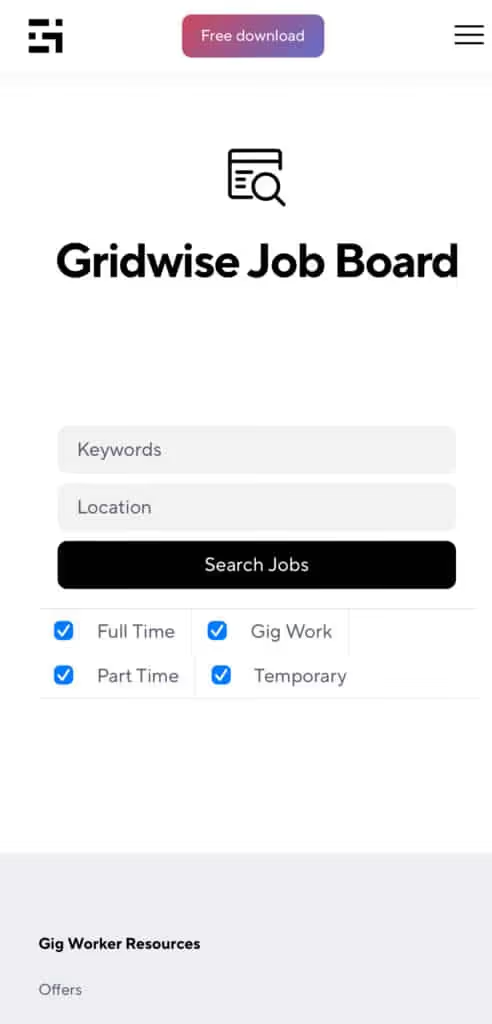
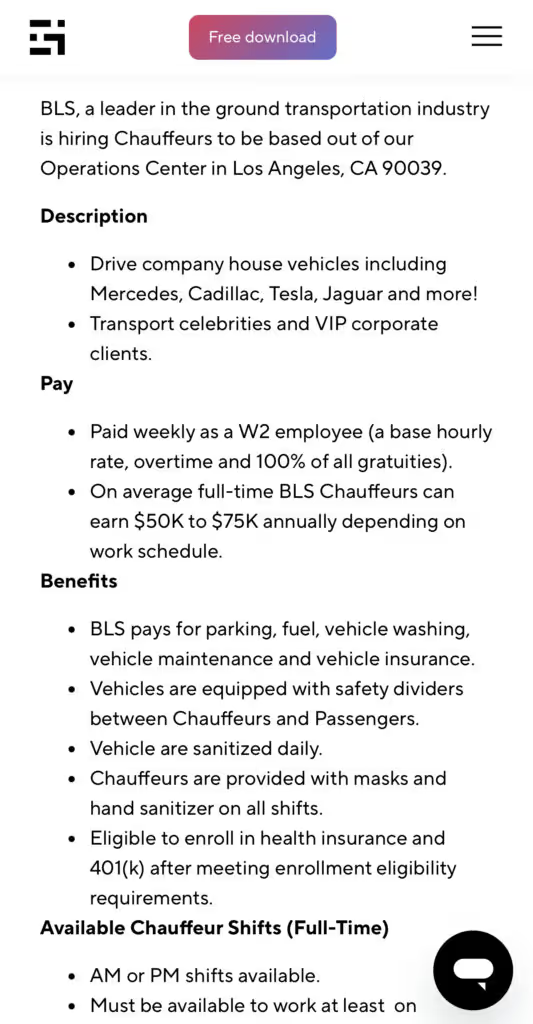
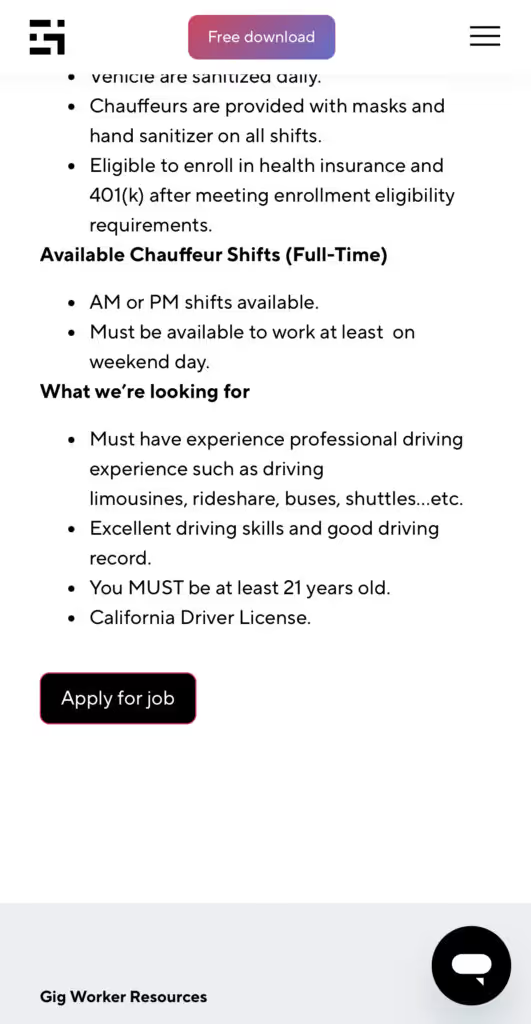
Many types of jobs are available. Adjust the search filter to see the full variety of opportunities that will let you cash in. Deliver food, set up catering, do rideshare driving, get paid for doing package delivery, and much more. You’ll find short-term gigs, long-term contracts, and part-time positions.
Perks of the Gridwise Job Board for gig workers
Gig workers who know how to make extra money will appreciate how the Gridwise Job Board lets you multiply your chances of bringing in big earnings. Here’s how:
- Increased stability. Use the Gridwise Job Board to find part-time or permanent jobs in addition to the part-time gigs you already have. Always keep a steady stream of earning opportunities flowing toward you.
- Flexibility and autonomy. Choose jobs that fit your schedule, work around other jobs and family duties, and still leave room for some fun in your life. Discover side hustles to supplement your full-time job, permanently or just for the season.
- Skill development. Find part-time work that lets you use a skill you already have, or try your hand at something new. It’s a smart way to develop a portfolio to showcase what you can do, or even to find permanent employment.
Get Gridwise and stay up to date on the Gridwise Job Board
Gig workers need plenty of information and assistance, and Gridwise is here to give it to you. Download the app and get essential features such as
- seamless earnings tracking
- mileage tracking
- expense recording, including notes
- low-cost and no-cost insurance benefits
- access to affordable medical, dental, vision, mental health, and alternative care
- professional services including legal and financial help
- deals and discounts
- weather, events, and traffic reports
- inside information on where and when to drive
[elementor-template id="20936"]
More to know about gig work:

5 Best Mileage Trackers For Gig Drivers
Many drivers ask, “Do I really need a mileage tracking app?” The answer is simple: only if you want to have an accurate count of all the miles you can legally deduct from your taxable income! You might think your rideshare or delivery driving app has got you covered. After all, they do quite a good job of logging the miles you drive while you’re on a trip or delivery. But, if you want to have the best app to track mileage for Uber, Lyft, Doordash, Instacart, or the other apps you may use, you need more. Why is that?
Without a separate tracker, you’re missing the miles you drive in between pings. Did you realize that all the miles you drive, from the moment you begin your shift until it’s over (as long as you don’t drive several miles on a break to hang with your friends), are tax deductible! That means you need something besides your driving app to keep an accurate count of your travels. Read this Gridwise post to see how important it is to keep track of every deductible mile.
You won’t be surprised to hear that there’s an app for tracking miles. In fact, there are several of them. Here, we’re going to tell you about five top mileage tracking apps, and help you figure out which one is best for you.
Before we get to the list and identify the best mileage tracker app, let’s clarify what exactly a mileage tracking app is. According to G2.com’s technology glossary, mileage tracking is done for the purpose of keeping a log of mileage that is either reimbursable or tax deductible.
And yes, of course you can track your miles simply by taking readings on your odometer. But are you really prepared to account for how many miles you drove for personal reasons and subtract them from the total to get your business mileage? Even if you can remember all that and do the arithmetic, if you want an accurate reading of the miles you drive for business, and can therefore deduct, a mileage tracking app will save you a lot of trouble and prevent you from making costly errors.
Plus, as a gig driver, you have specific needs when it comes to a mileage tracker. Ideally, you’d be able to handle mileage tracking and several other functions all in one app. It can be maddening enough to deal with driving apps, particularly if you’re an avid multi-apper. You would want your mileage tracker app to help you keep account of other aspects of your business, including income, expenses, and inside information about the art of gig driving.
Not all mileage apps are equal, to be sure! Let’s look at five of the best apps to track mileage and figure out which is the best app to track mileage with Uber and Lyft, or what mileage tracker app is best for DoorDash.
[elementor-template id="20891"]
1. Zoho Expense
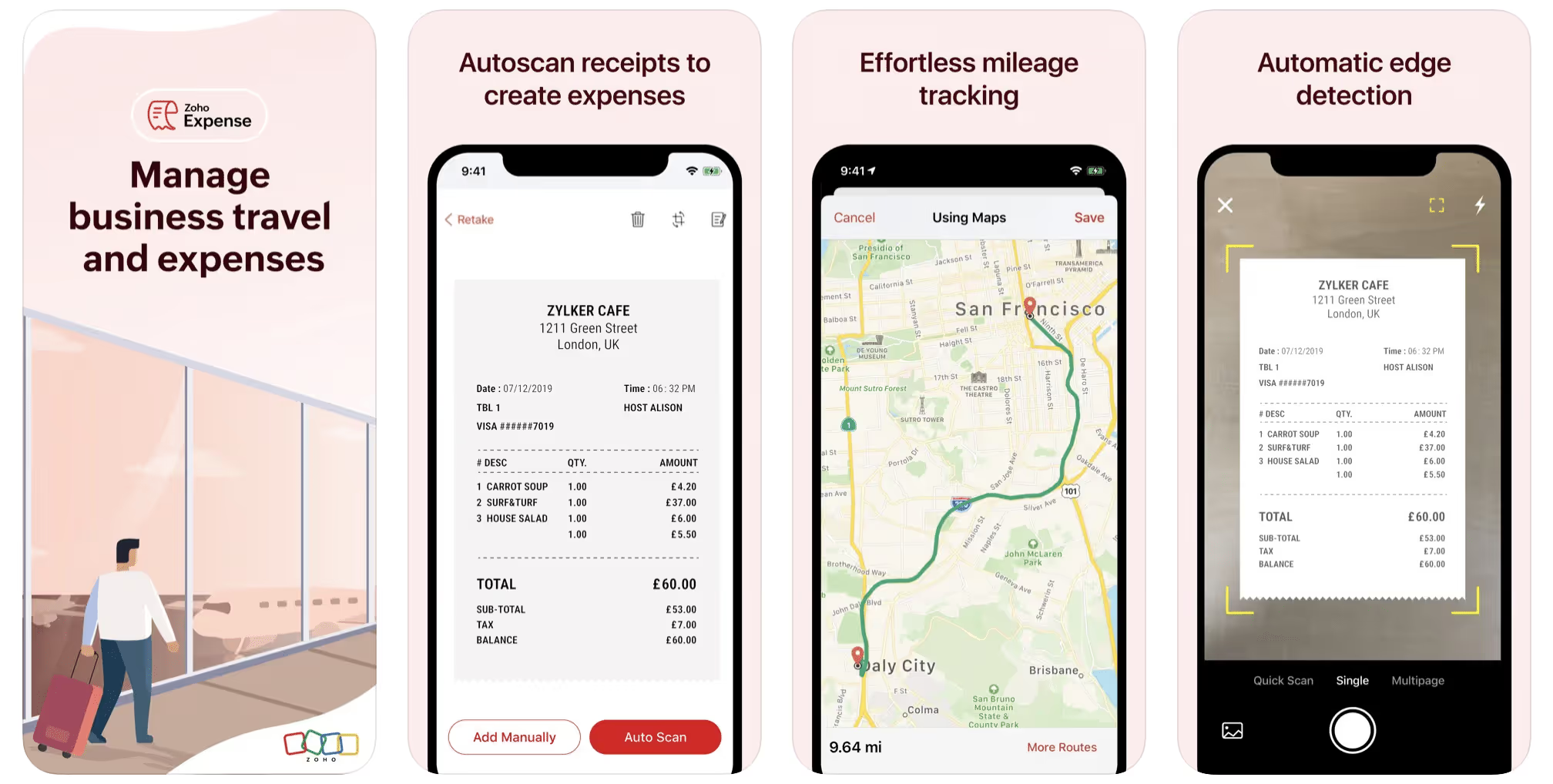
First up is Zoho Expense, which does exactly what its name says. This app is designed to allow companies to give employees a uniform way to create and submit expense reports. It can be used by individuals, including gig drivers, as well.
It includes a mileage tracker, as well as features that let you track other deductible expenses, including the ability to scan and record receipts.
Available on Android and Apple: Yes
Ratings: 4.8 stars on App Store, 4.7 stars on Google Play
Free Version: Yes
Subscription price: $3 per month, billed annually
Created specifically for gig drivers: No
2. Quickbooks Online
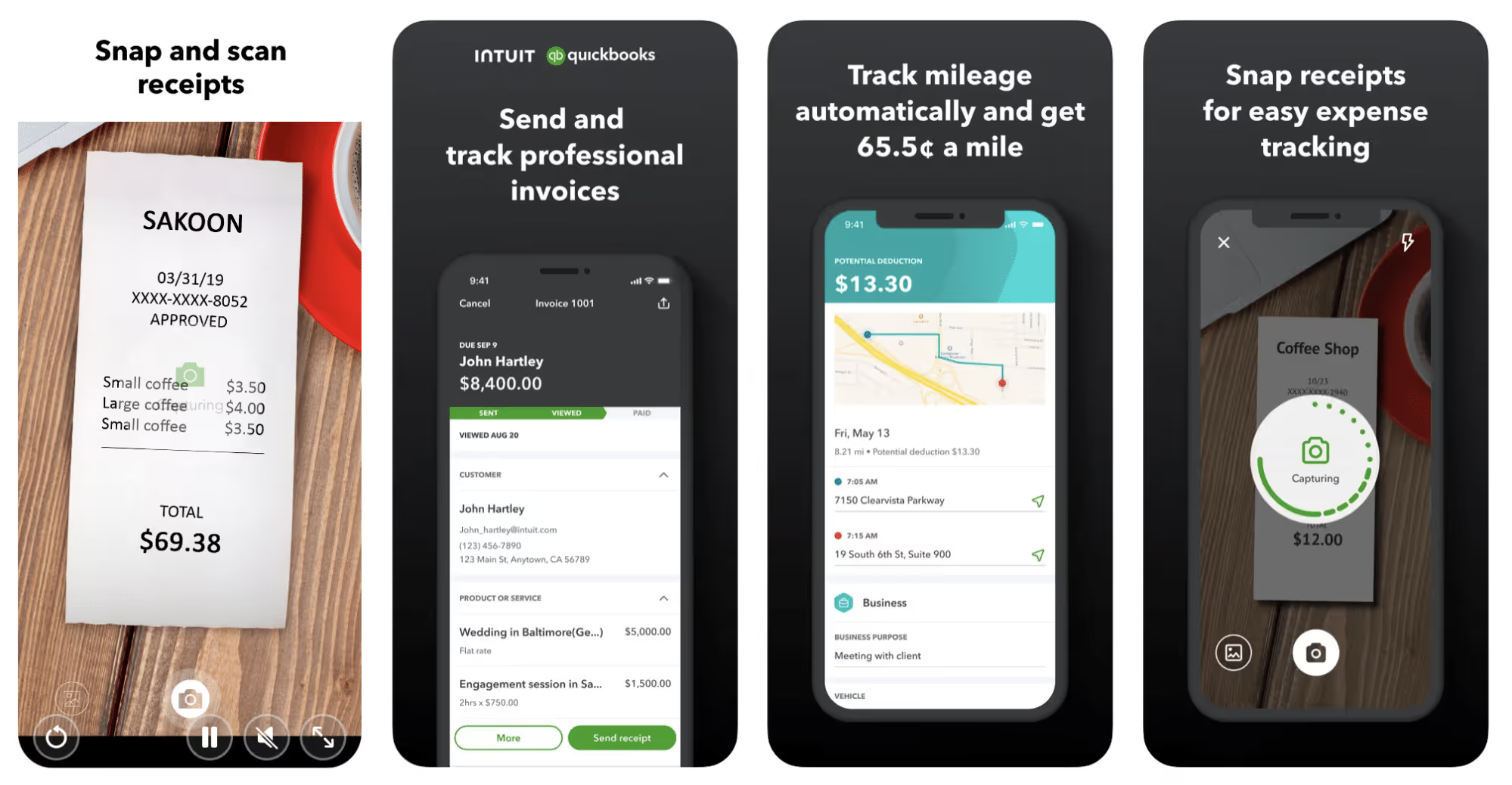
Quickbooks Online is a cloud-based app that allows you to track your mileage, earnings, and expenses. The information you enter can then be used to generate various reports that prepare you for tax time. It also allows you to create graphs that illustrate your cash flow, and includes a receipt scanner so you can instantly record deductible expenses. Quickbooks is popular, highly reliable, and designed mainly to help people keep track of their small businesses.
Available on Android and Apple: Yes
Ratings: 4.7 stars on App Store, 4.4 stars on Google Play
Free version: 30-day free trial
Subscription price: $15 per month for basic version if purchased for 3 months or more
Created specifically for gig drivers: No
Source: quickbooks.intuit.com
3. Shoeboxed
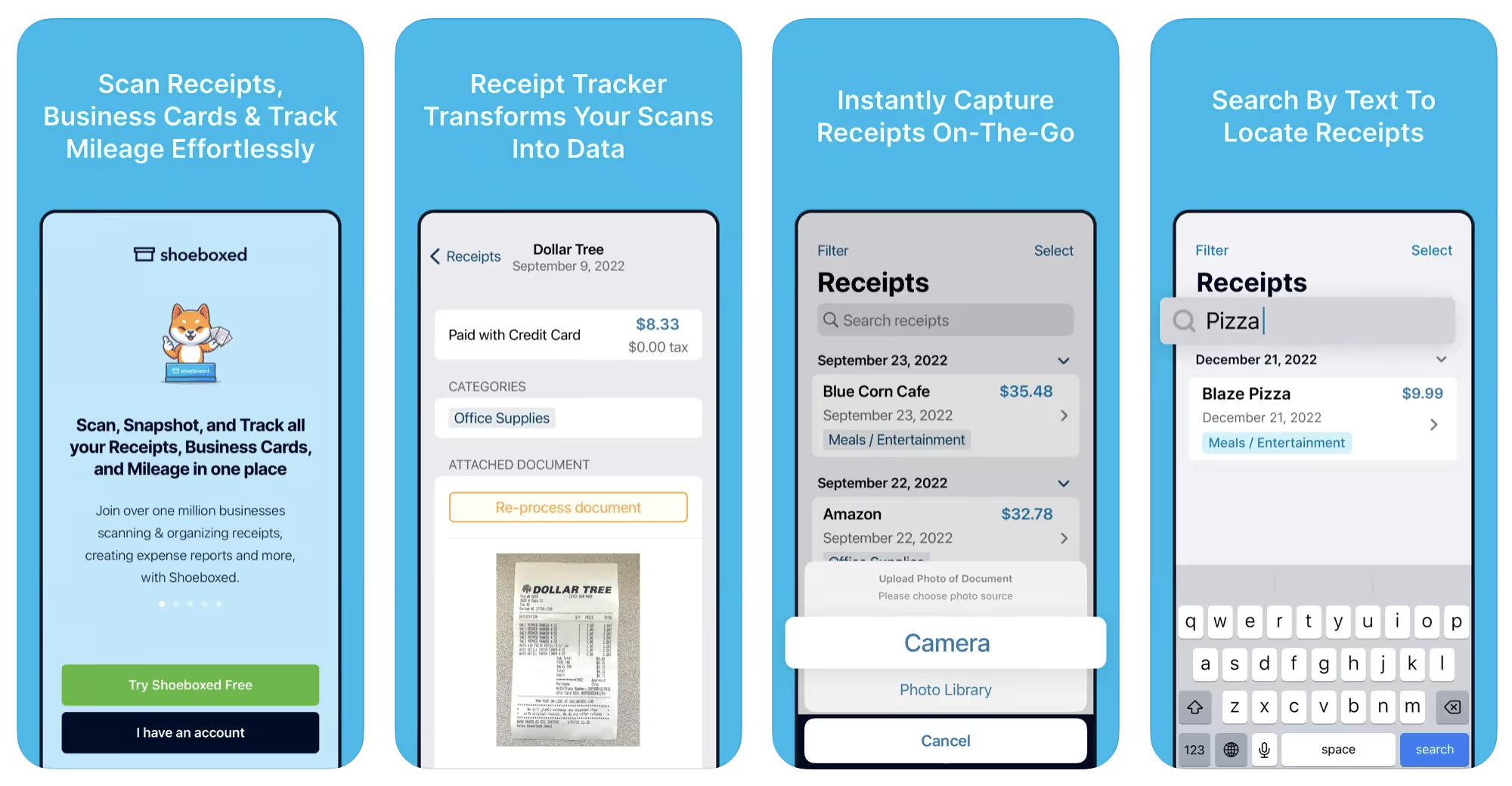
Shoeboxed started in 2007 as a service for scanning paper receipts into digital form. Now the app offers a free mileage tracker and has enabled users to scan receipts directly. It touts itself as the best mileage tracking app for DoorDash, but there are some elements missing that Dashers might like to have. While it provides features that record your expenses and prepare you for tax season, it doesn’t automatically track your earnings. The mileage tracker has a system where you can drop pins along your routes to make the tracking more precise, identifying those legs of a trip that you make for business purposes. The mileage tracker is “free” once you sign up for the basic version.
Available on Android and Apple: Yes
Ratings: 4.5 stars on App Store, 2.3 stars on Google Play
Free version: No
Subscription price: $18 per month for basic version
Created specifically for gig drivers: No
Source: blog.shoeboxed.com
4. Stride
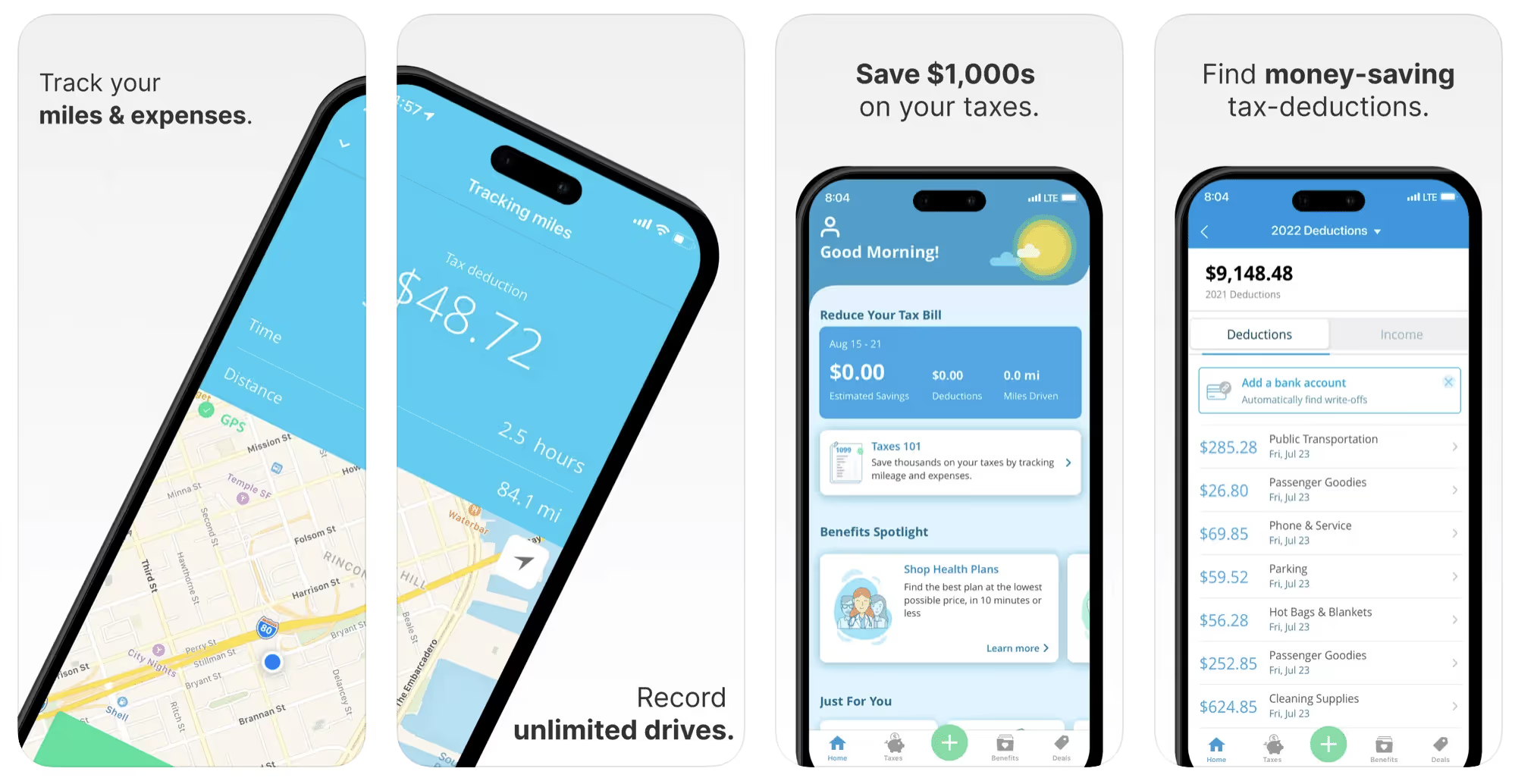
This free mileage tracker does a fair job of keeping track of the distances you rack up while gig driving, but it doesn’t automatically track earnings. It can be a big help, though, in tracking your expenses. You can link Stride to your bank account, and it will automatically scan your expenses to identify items you can potentially deduct. The app is totally free. This could make it the best free mileage tracker app, but there is a small price to pay. The app will persistently push you to consider various insurance plans that they are affiliated with. If you don’t mind that, this is a solid mileage tracker, even if it doesn’t track your earnings.
Available on Android and Apple: Yes
Ratings: 4.8 stars on App Store, 4.6 stars on Google Play
Free version: Yes
Subscription price: None. The app is free.
Created specifically for gig drivers: No
5. Gridwise
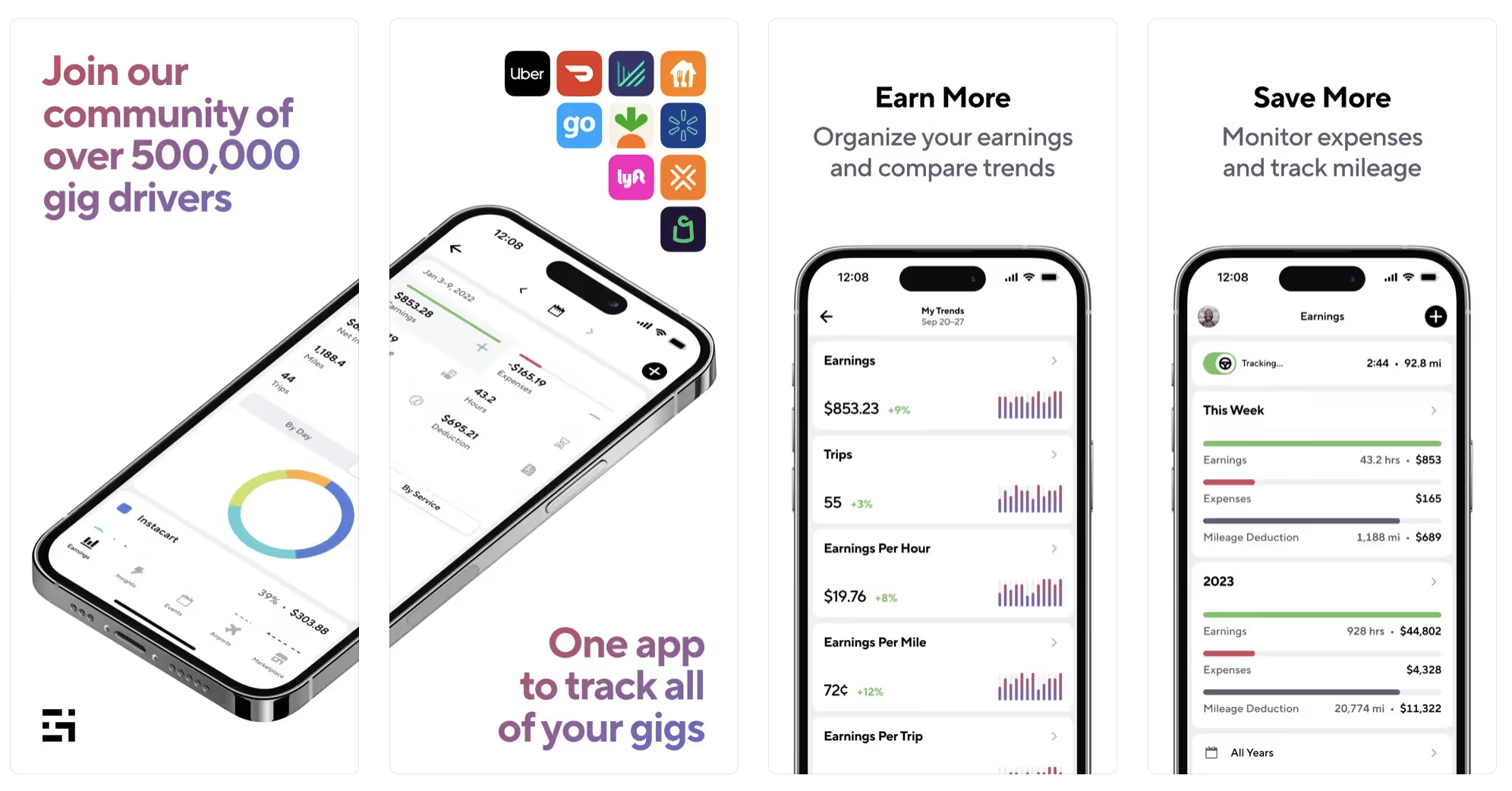
Gridwise has a free mileage tracker and free features that record your income and expenses. It gives you access to insurance and benefits, as well as insights about the best times and places to make the most money while gig driving. The Gridwise mileage tracker captures all the miles you drive while you’re on your driving shift, and it can be used if you have other trips you need to make which qualify as business travel.
Drivers love it because it is geared toward the needs of rideshare and delivery workers, providing free information about airport departures and arrivals, event start and let out times, weather, traffic, and more. The Gridwise Plus subscription adds value by providing additional insights and reports, discounts on benefits, the ability to export data in .csv format,, and more.
Available on Android and Apple: Yes
Ratings: 4.9 stars on App Store, 4.6 stars on Google Play
Free version: Yes
Subscription price: $9.95 per month for Gridwise Plus, or $95.99 per year (a $23.41 savings)
Created specifically for gig drivers: Yes!
What is the best mileage tracking app?
Now that we’ve checked them all out, we’re positive about the answer to that. Hands down, it’s Gridwise. Are we biased? You bet we are! But drivers love it too. Gridwise is the best mileage tracker app—and so much more. So many of the features are free, and the subscription to Gridwise Plus will pay for itself with additional insights to boost your earnings and deeper discounts on products and services.
Most important, Gridwise is designed specifically for gig drivers by experts who were once gig drivers themselves! Knowing what gig drivers need is a crucial step in creating an app that rideshare and delivery drivers can really use! Here are a few of the features, besides mileage tracking:
- seamless earnings tracking
- automatic, on/off toggle and manual mileage tracking
- mileage categorization
- airport, traffic, weather, and events information
- insights into where to drive and when to drive
- reports showing earnings across the platforms you use
- discounts on countless products and services for drivers
- additional resources for finding side gigs
- an informative and comprehensive blog
- affordable benefits, including insurance, medical, dental, and alternative practitioner discounts
- a community of drivers just like you
Don’t settle for just any app. Get the best mileage tracker, and so much more, from Gridwise!
[elementor-template id="21599"]

What Records Do Gig Drivers Need To Keep Track Of For Taxes?
* Gridwise does not provide tax, legal, or accounting advice. This material has been prepared for information purposes only, and is not intended to provide, and should not be relied on for tax, legal, or accounting advice. You should consult your own tax, legal, and accounting advisors before filing your return.
Record keeping? Who signed up for that? As a gig driver, it’s part of what you need to do to keep your business running. Don’t worry. It’s not as complicated as you might have been led to believe. This post will show you what you need to keep track of and the best ways to gather and preserve your tax-related records. We will cover
- How record keeping can help reduce income tax for freelancers
- Taxes and freelance work: Record keeping requirements
- Mileage tracking: Motives and methods
- More deductions and records to keep
- Make tax time easier
How record keeping can reduce income tax for freelancers
Tax time is not “fun time” for rideshare and delivery drivers. It’s easy to get used to watching your earnings pile up and come to believe they are all yours. Unfortunately, that isn’t the case. Gig work taxes can be especially painful because no one takes them out of your earnings for you, until the tax authorities insist that you do it for yourself.
You will need to show the tax authorities your income records, and they will gladly tell you to send them what they determine to be their fair share. Think that’s not fair? You’re not alone, but that doesn’t mean you’re going to get out of paying gig work taxes.
But you can find ways to pay the smallest amount that is legal and possible. The best way to defend yourself against having to pay astronomical amounts when you file your return is to know what expenses you can deduct from your gross income. When you subtract deductible expenses from your gross income, there is less left over to be taxed. This reduces the amount they can hit you with gig worker taxes. and can make your tax bill substantially lower.
While you want to keep good records so as to be in compliance with taxation entities such as the IRS, you also want to ensure you have proof of every last deductible expense you have accrued during the year. There are other records you must keep as well. Let’s look at some of the considerations you have, realizing that you now need to know how to do taxes as a freelancer.
Taxes and freelance work: Record keeping requirements
So many gig drivers fail to understand the responsibilities they have as independent contractors. Those who work part time for very few hours may even believe they don’t have to report the income they get from their driving gig payments. That would be a big mistake!
The company or companies you work for report your income to the IRS and state tax authorities. If you fail to report that income, you will risk some rather painful penalties. The IRS taxing side hustles is as much of a thing as the IRS taxing income from any other job. Your best bet is to report what you’ve earned, honestly and completely, and comply with other record keeping requirements such as
- gross income
- deductions and credits
- purchases (items you purchase and resell, such as snacks or bottled water)
- a log of all your mileage (or vehicle expenses, if greater)
- a list of all expenses and assets, such as utilities and other expenses associated with having a home office and equipment
- machinery and furniture you own, including when it was acquired, how much it cost, whether you previously took deductions on it, and selling price, if applicable (this includes your vehicle)
More things to consider:
- Pay attention to the retention of your records. You’ll need to keep all tax-return-related items— including income, deductions, and any tax credits reported— until the period of limitations runs out (3 years from date you filed, or 2 years from when you paid tax. If you have employees, keep your records for at least 4 years.)
- If you want to avoid paying self-employed taxes, you may want to set up a corporation or Limited Liability Corporation (LLC) for your business. This allows you to separate all your gig driving earnings from personal income, and permits you to take advantage of the additional advantages of working through a corporation. This includes exemption from self-employment taxes. You can learn more about how to pay self-employment taxes, if you opt for that, in this post from Keeper.
- You should always keep a separate checking account for your business, for convenience as well as clarity. While this is not a legal requirement, it is a smart move if you want to have an easier time managing your business.
- You are required, as an independent contractor, to file your taxes quarterly. Check out this Gridwise blog post for more information about quarterly tax payments and other matters that make filing delivery, Lyft and Uber taxes easier.
Mileage tracking: Motives and methods
Why you need to be meticulous about mileage
Mileage deduction, or the costs of operating your vehicle, will be the most important item to account for when you consider how to file taxes as a freelancer. While mileage is an important deduction for all independent contractors, as you might imagine, it’s even more essential for rideshare and delivery drivers.
There are two ways of keeping track of your mileage deduction. One is to use the IRS’ standard mileage deduction, which for 2022 is 58.5 cents per mile. This number takes into account the costs of operating your vehicle, from fuel and maintenance to registration, insurance, and depreciation. Alternatively, you can calculate all your own vehicle operating costs, but only after your first year of using the vehicle. You may discover that this second option allows you to have more money deducted from your taxable income. Learn more about the options for deducting your mileage in this Gridwise post.
No matter which way you decide to calculate the deductions for your mileage, you need to know what mileage you can and cannot deduct.
You can deduct
- miles driven to and from home when you go out to drive or deliver
- miles you accrue during your trips
- miles you drive on any other trips you make that are necessary as part of your business.
Examples:
- driving to return a lost cell phone or to an Uber Hub or another physical location where your company might make driver support available
- driving to pick up supplies, to get gas, or to have your car cleaned, serviced, or detailed, etc.
You cannot deduct
- miles you drive for personal trips
- miles for any trips you take that do not directly affect your business
Note: If imagining yourself becoming the not-so-proud owner of a shoebox filled with paper receipts gives you nightmares, stop worrying. Electronic records of purchases will satisfy reporting requirements. If you use cash, you can scan copies of your receipts, in some cases, right into your recording software or app. Gridwise and Keeper give you a simple to use interface that keeps all your receipts recorded without the messy pile of paper.
Mileage tracking methods
By now, you’re probably convinced that tracking mileage is important, despite all the other things drivers have to do. Now, let’s look at your options for keeping accurate records.
- Manual tracking: You can keep a logbook where you list every trip you make, starting and ending mileage, the date, and purpose of the trip. While this would work, it’s certainly not convenient. Besides, if that logbook gets lost, your plans for having a nice, fat tax deduction will go by the wayside.
- Spreadsheet: This is a bit more convenient and sophisticated way of tracking your business mileage. You’d need to be meticulous about making your entries, though. Even if you keep a spreadsheet app on your phone, it could be time consuming and inconvenient to keep doing it with all the other things going on in a rideshare or delivery driver’s day to day life.
- GPS-based mileage tracking apps: There are a bunch of apps that track mileage based on your GPS location, and most of them are pretty accurate and far more convenient than taking constant readings of your odometer. Your driving apps, such as Uber, Lyft, DoorDash, or Instacart, may also track your mileage, but be careful here. They will only track the miles you drive while you’re on a trip or delivery. They don’t count the miles you drive going to pick up a customer or when you make your move toward a restaurant or store.
Gridwise, on the other hand, will track all the miles you clock while you’re on your shift. All you need to do is make sure you start tracking the minute you leave home, and every gig driving mile will be logged. - OBD-II mileage tracking systems: There are plug-in modules that assess your vehicle’s mechanical health and track your miles. However, many authorities question the ability of OBD-II mileage tracking systems to get get accurate odometer readings. Insurance companies don’t consider them to be accurate enough gauges of odometer readings.
While mileage is a crucial deduction when you’re preparing your Uber, Lyft, or DoorDash taxes, it isn’t the only expense you’ll want to record.
More deductions and records to keep
Expenses you can deduct
You’re entitled to include the cost of other expenses that are directly related to your driving business. These include
- vehicle expenses
- equipment for your car and home office
- extra services and subscriptions
- business tools, including apps and software
You can learn much more about gig driver expenses that are eligible for deduction in this Gridwise article.
Ways to track and preserve deductible expenses
- The manual method: Just like you can with mileage, it’s possible to use a manual method, but in addition to logging each expense into a ledger, you would also need to keep physical receipts.
- Spreadsheets: You can record your expenses on a spreadsheet. This is somewhat less awkward than manually logging mileage, but there still will be plenty of room for failing to remember the case of water you bought for your customers, or losing the receipt from the thermal bag you purchased.
- Accounting software: You can use software that helps you track your expenses. This method usually interfaces well with any tax preparation software you or your tax professional might use.
- Gridwise: There are other apps that help you track your expenses, but Gridwise is designed specifically for gig drivers. It automatically tracks earnings and mileage, and lets you record your expenses the minute they come up. Gridwise’s partnership with Keeper gives you the ability to scan receipts and access a tax professional. This is a seamless way to record your expenses and a big help in learning how to file Uber taxes. Gridwise even provides .csv output, so you can feed your Gridwise data directly into tax preparation software. Check out what Gridwise and Keeper will do to super-charge your tax filing powers.
Organizing and categorizing expenses
Before you even begin to record expenses, you’ll want to set up categories for them. You can start by reviewing the categories listed above and checking out the Gridwise post that lists possible deductions.
If you’d like to learn more about how to categorize expenses, there is additional information available. This article from Motley Fool lists all possible categories any freelancer might use and also gives tips on how to customize them for your driving business.
One last tip
Using Gridwise, particularly for tracking mileage, is the easiest way to be in compliance with the IRS’ rules for deductible mileage. Gridwise tracks all the miles you drive for your gig, beyond what your company’s app might record. At the same time, you can log on and off Gridwise when you start and end your shift, so personal miles won’t be recorded. This eliminates confusion while capturing every deductible mile.
Gridwise Tax Help, a partnership with Keeper, has been created specifically to serve gig drivers. It provides affordable and easy ways to record expenses, scan receipts, and find deductions by analyzing your expenditures. Read about free resources from Keeper you can use to be fully prepared for tax season, and get all your earnings and expenses on the record.
Get the world’s best assistant for rideshare and delivery drivers, and tax help too.
Make tax time easier now!
How To Boost Rideshare Driver Earnings and Earn Bigger Tips
Rideshare driving has its challenges, and the biggest, most important one is keeping earnings high. It’s hard to control all the many factors involved in the way drivers make money, especially with inflation taking a bite out of everyone’s wallet. Even those big company bonuses don’t always help when you have no idea how much more you’ll have to pay for gas, car maintenance, or energy to charge your EV.
Meanwhile, if you’re among the drivers just getting back on the road after the pandemic, you’ll have to hustle to get back up to speed. It’s a whole new world out there, but if you play it right, you can make the money you need to make a living, even with inflation and changing passenger patterns. Your first step is to get a handle on what aspects of your earning power you can control.
Fortunately, there are a few aspects of gig driver earnings that you can easily influence, and push your earnings skyward. The most flexible and powerful of these is tips. In this blog post, we’ll present some strategies to help you move your earnings upward with suggestions about how you can make more and get more tips. Here’s how we’ll cover the topic:
- Tips: how they factor into earnings
- Driving strategies: a road to better tips and bigger earnings
- Surefire tip getter: Play Octopus
- Get your tip-grabbing tentacles on your very own Play Octopus
Tips: how they factor into earnings
Not all rideshare customers are used to tipping their drivers. In the early days of gig driving, Lyft encouraged tipping, but Uber didn’t even offer riders an invitation or opportunity to give tips. Since then, that’s changed. Both Lyft and Uber make drivers eligible for tips. Still, when it comes to passenger behavior, evidence supports the timeworn adage: old habits die hard. In other words, drivers need to work hard at inspiring customers to give them tips.
When we leave a gratuity, say, in a restaurant, we usually plunk down at least 15% of the total. Other service providers, such as massage therapists, barbers, or hair stylists, might inspire most of us to tip around 20%. Sadly, when it comes to rideshare, drivers are not getting as much green. Anonymized data collected by Gridwise shows that tips from rideshare customers amount to just under 9% of driver earnings.
This is due in large part to the fact that not all passengers tip, and this discouraging piece of data could arise from a few factors. Companies are charging more to incentivize gig workers to come back to work and end the continuing driver shortage. Recently, they’ve added even more surcharges to cover higher gas prices. With the rising cost of rides, many customers may be more hesitant than ever to compensate drivers for all they do.
That’s why you need to work harder and put in lots of extra effort. Strive to give your passengers reasons to reach deeper into their pockets and come up with the tips you deserve.
Tip-worthy behavior for drivers begins with sending advance messages to your riders, telling them what direction you’re coming from, and while you’re at it, adding that while tips aren’t mandatory, you do appreciate them. Add to your coffers by being sensitive yet engaging with your customers, offering advice on how to have fun in your town and thanking them for riding with you.
They’re likely to pay you extra to carry shopping bags and luggage, or for offering kindly help with a stroller or wheelchair. If you’ve already mastered these tip-grabbing techniques, that’s fabulous. But there’s even more you can do to add to your basic earnings and get even more tips.
Driving strategies: a road to better tips and bigger earnings
Because tips are a percentage of your earnings, you need to make as much money as possible on every ride. While it’s nice to get those long, juicy airport runs and intercity trips, you can’t do them all the time. A solid driving strategy is essential if you want to give yourself a good running start toward a better income. This blog post on optimizing your rideshare driving strategy lists 5 ways you can improve your earnings in general.
We’ve established that if you want bigger tips, you’ll want to step up and be conscious of the way you interact with passengers and cater to them as much as possible. Before you can do that, though, you’ll have to know where to find passengers and how to spend as little time as possible riding around looking for them.
You need to be aware of where passengers are likely to be and at what times of day most of them will be looking for rides. You can conduct your own experiments, if you have the time, trying out different places and times of day to observe various traffic patterns. You can look at your company’s app for places where there might be high volume, but by the time you get to those surge zones, you could be out of luck.
Gridwise, the best mileage tracker app, provides solutions that put you right where the action is. Where to Drive gives you live data from fellow drivers on where the big money is in your area, while When to Drive clues you in on the times when funds are high in certain spots on your gig driving beat. Armed with this information, you can make the most of every minute you’re out there on the road.
Use Gridwise to track mileage and other expenses, too. Recording your financial transactions produces sizable returns at tax time. Those deductions add up and keep your tax bill to a minimum. As you can see, Gridwise is the best free mileage tracker app, and so much more.
Another part of a smart driving strategy is multi-apping, or moving from one service to another to take advantage of bonuses, including which company seems to attract the biggest tippers. Because Lyft has always had tips as part of the passenger routine, that might be a good place to start. There’s much to consider when it comes to driving for Uber vs. Lyft. This side-by-side comparison shows that Lyft lets drivers make more per ride overall, but that’s only part of the picture.
Much will depend on your area and how well each company has done at marketing their services to the public. Doing your own research by testing all your options is a really good way to see which company is going to bring home the most bucks for you.
No matter which company you drive for more often, you’re going to get more and bigger tips when you put together a positive rider experience.
Surefire tip getter: Play Octopus
If you want to create a rider experience your passengers will never forget, you need Play Octopus! Play Octopus is a F R E E (yes, that’s right) tablet that you mount onto your back seat. It’s designed specifically to entertain and fascinate your passengers. They can play free games, receive special offers from top brands, and because they see some short ads…YOU get paid for having Play Octopus in your car.
Play Octopus shares ad revenue with drivers, and that can add up to as much as $100 per month. Better yet, the tablet helps you to build relationships with your passengers. Playing the games opens them up, and while they’re playing they’ll start to talk to you. Before you know it, they can’t help but like you. Not surprisingly, when people like their drivers, they’re more likely to give them big tips. Whether they get the high score of the day playing their Uber game or not, you both win. They get to have fun on their ride, and you get more tips!
Even better, you get cash rewards every time your passengers play a game. As long as you log 100 trips per month, or drive while you’re online with your driving app for 40 or more hours per month with the Octopus tablet on board, you will get paid! Add on the extra tips you’ll get, and you’ve got an inflation-beating, conversation-starting, fun and engaging feature your passengers are sure to love.
You’ll also be pretty fond of the referral cash Play Octopus has to offer. Get a $25 bonus for every driver you turn on to this amazing way to earn more money and get bigger tips. Sweet, right? Before you start to tap your list of driver friends, though, you’d best get one of your own.
Get your tip-grabbing tentacles on your very own Play Octopus
No worries, you don’t have to dive into the deep blue sea to get your hands on one of these money-making machines. All you have to do to get your Octopus tablet is apply here.
Approval from the Octopus team will take about 3–5 days, but once you get the Octopus OK, your tablet will be mailed to you. Then, you simply mount it, let your passengers play with it, and start watching the money roll in. In case you’re wondering, the data plan you need for the tablet will be set up for you, and it too is free.
Great news for drivers that stopped driving due to the pandemic! Reapply for Octopus as soon as you’re ready to get back on the road! Getting into the post-pandemic groove can be challenging. Play Octopus is a must-have when you’re going back out there. Why not start with not just one, but eight, legs up? The Play Octopus tablet will instantly help you make more money and bring in bigger tips.
We can’t imagine how you could wait this long to get your own Octopus, the free tablet for Uber drivers, but in case you haven’t yet…
Sign up now to get your free Play Octopus tablet!
What Are Grubhub Drivers Earning
For food delivery drivers, Grubhub was the biggest delivery service in the US a few years back—but things have changed.
Grubhub conceded significant market share to DoorDash and Uber Eats, now placing third. Their reputation also suffered due to their treatment of partner restaurants.
In 2020, Grubhub sold to Europe’s Just Eat for $7.3 billion. But that didn’t change the trajectory. Grubhub has been unable to overtake DoorDash or Uber Eats.
Still, many drivers choose to drive for Grubhub as part of their business. Is that the right choice?
We wanted to know how much drivers are making and whether driving for Grubhub is worth it in 2022. To find the answer, we took a look at the real data from 250,000+ drivers using the Gridwise app. Here’s what we found:
How much does Grubhub pay?
Grubhub pay is based on the distance traveled, time spent on the road, customer tips, and any special offers on the order.
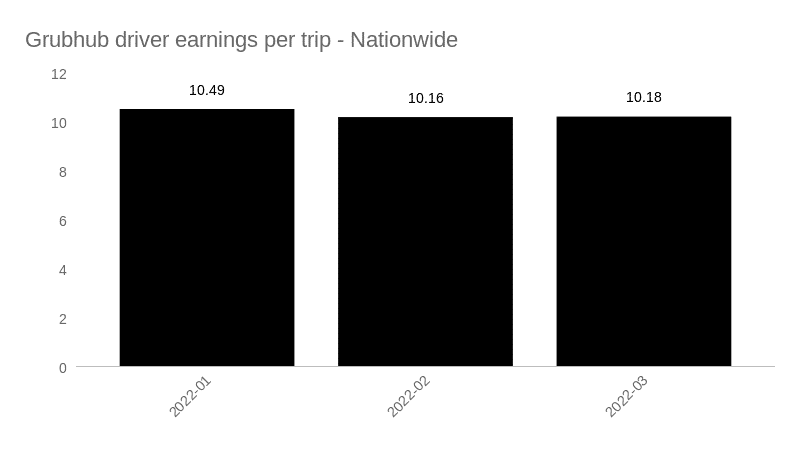
According to our data, Grubhub drivers earned an average of $10.28 per trip between January and March 2022. That’s the highest among all the food delivery apps on the list.
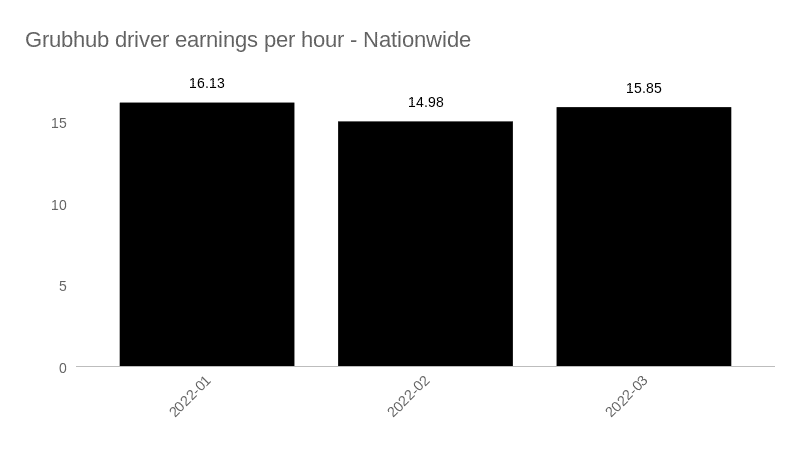
However, compared to DoorDash and Uber Eats' hourly pay, Grubhub driver earnings per hour were the lowest at $15.65.
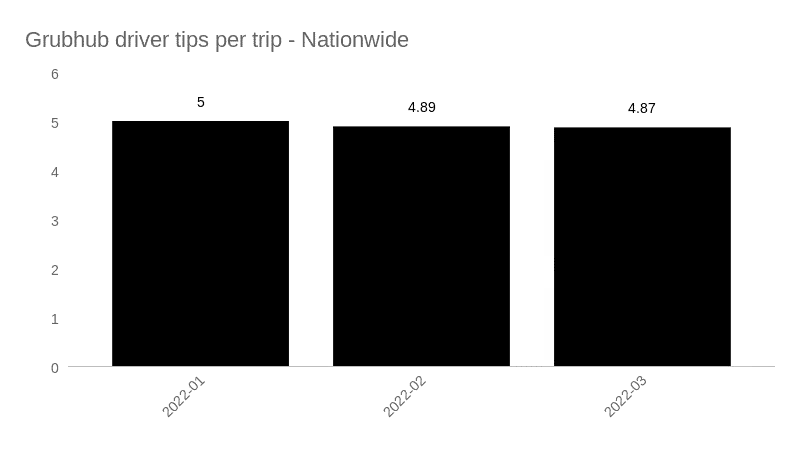
On average, Grubhub drivers received $4.92 in tips per trip, the highest among all food delivery apps.
Across all platforms, food delivery earnings were slightly better than rideshare and noticeably worse than the grocery delivery service Instacart.
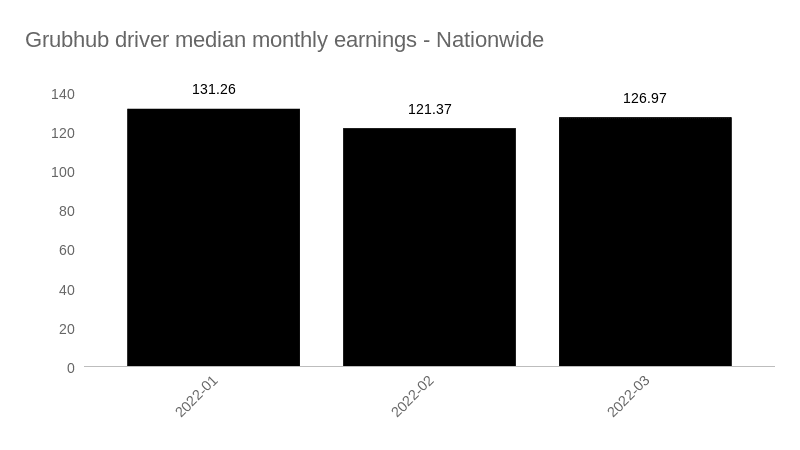
The average monthly gross earnings for Grubhub drivers was $126.53 for Q1 2022.
It’s worth noting that Grubhub driver activity was also significantly lower than other platforms, including a weekly decline in the total trip count throughout March. Could this be due to the sharp rise in gas prices around the same time? We will explore that later in the article.
So, what’s the big picture? In the Grubhub vs. DoorDash and Grubhub vs. Uber Eats comparisons, here are the three clear conclusions we can draw from this Q1 data:
What factors impact Grubhub driver earnings?
- Location: Do you drive in an area where many people order food online? Is it a city with a high population and more restaurants? Dense, urban areas typically offer the best opportunity for higher earnings.
- Driver Promotions: Grubhub runs a lot of driver promotions (called Missions) that boost earnings for completing different milestones. You can unlock these Missions in the Earnings tab of the Grubhub drivers app.
- Driver Level: Your Grubhub driver level (Partner, Pro, or Premier) affects the quantity and quality of orders you receive. Higher levels unlock more opportunities for higher earnings.
- Schedule: Food delivery demand is typically limited to a few windows throughout the day. If you can adapt your schedule to deliver orders during busy hours, you can both deliver more and earn more per order through incentives.
What are the biggest expenses for Grubhub drivers?
Most driver pay reports you find online focus on gross earnings, but what really matters is how much you take home after deducting all your expenses.
That’s why knowing and tracking all the expenses is vital to deciding whether driving for a certain platform is worth it. Here’s a list of common expenses you should be tracking:
- Vehicle depreciation
- Fuel costs
- Maintenance and repairs
- Insurance
- Taxes
Other expenses
- Phone bill
- Self-employment tax and compliance expenses
- Medical expenses
Among these, the biggest are those related to your vehicle. According to a yearly analysis from AAA (American Automobile Association), the average annual cost of owning a new car was $9,666 in 2021.
On average, vehicle depreciation accounts for 40% of total ownership expenses, followed by fuel at 17%, maintenance at 15%, insurance at 14%, taxes at 7%, and car financing at 7%. Since delivery drivers use their vehicles more on average than regular car owners, yearly expenses could be much higher.
Tracking and deducting all the above expenses from your gross earnings helps you to know your actual income (and save at tax time). Failing to do so can result in an inaccurate picture of your earnings, meaning you’re losing out on cash in your pocket.
Many drivers in the gig economy don’t account adequately or at all for depreciation, resulting in vastly under estimated expenses.
Have the rising gas prices impacted driver earnings?
According to AAA, the national average price for regular gas went up from $2.863/gal a year ago to $4.073/gal in mid-April this year.
That represents a yearly increase of 42.26%. However, the average price was $4.316/gal a month ago, so the prices seem to be easing in the last few weeks.
To address the adverse impact of gas prices on driver earnings, Grubhub announced a nationwide unspecified increase in per mile distance pay from March 9.
The company said the pay increase will be sufficient enough to offset the average cost increase per mile due to gas prices. This is a welcome change, but you can further reduce the impact of gas prices on your earnings by:
- joining the Gridwise Gas program and getting get cash back on gas from GasBuddy
- following these tips on lowering fuel costs
How can Grubhub drivers earn more?
- Multi-apping: As the earnings data shows, there is no clear winner when it comes to food delivery driver pay. It's better to use more than one app simultaneously to get a steady flow of orders with minimal waiting time.
- Rewards Programs: Grubhub runs a Driver Recognition Program to reward its best-performing drivers. Based on your attendance rate, order acceptance rate, and block drop rate, you can be placed in Partner, Pro, or Premier Grubhub driver levels. Higher levels offer more flexibility and access to larger orders.
- Drive with Gridwise: We built Gridwise to help drivers in the gig economy. Our app is filled with useful features for Grubhub drivers:
- Earnings and performance comparisons across different apps to see what’s working best for you
- Expense tracker and mileage tracker for Grubhub to save on taxes
- Information about when and where to drive for the best hours and neighborhoods
- Special discounts and offers from Gridwise partners
- Traffic, weather, events, and other alerts
Download the free Gridwise app to boost your driver income
So, is it worth driving for Grubhub in 2022?
Grubhub is in significantly fewer US cities when compared to DoorDash and Uber Eats. While its driver earnings are mostly on par with other food delivery services, the company has a smaller market share and, meaning fewer orders overall.
However, since it has marginally better earnings per trip and tips per trip, Grubhub is a good choice for drivers who want to deliver only a few orders and make as much as they can. We’d love to hear your experience as a driver. Join and share with our driver community on Facebook!
Instacart Shopper Earnings For Q1 2022
If you’re an Instacart shopper, you already know how hard you need to work for your pay. Shopping and driving isn’t as easy as it sounds, especially when you want to make the most money in the least time. Working without insight and information can be difficult and confusing.
Since you’re looking for some tips and ideas, you probably have lots of questions. We put this post together to help enlighten you about Instacart first-quarter earnings, to look at the factors that affect how much you can make, and to learn about techniques and tools that will help you make more—and hold on to it. Here are the queries we’ll cover:
- How much do Instacart shoppers make?
- What outside factors eat into Instacart shopper pay?
- What are the basic costs of being an Instacart shopper?
- How can Instacart shoppers reduce expenses and make more money?
How much do Instacart shoppers make?
The first quarter of 2022 was good to Instacart shoppers. Even though the world has opened up more this year, there has been no discernible drop in consumer online grocery shopping activity. In fact, a study conducted by Power Reviews revealed that 71% of customers across the US ordered groceries online in the first quarter of 2022. In 2021, when people were more entrenched in the pandemic lifestyle, that figure was 72%.
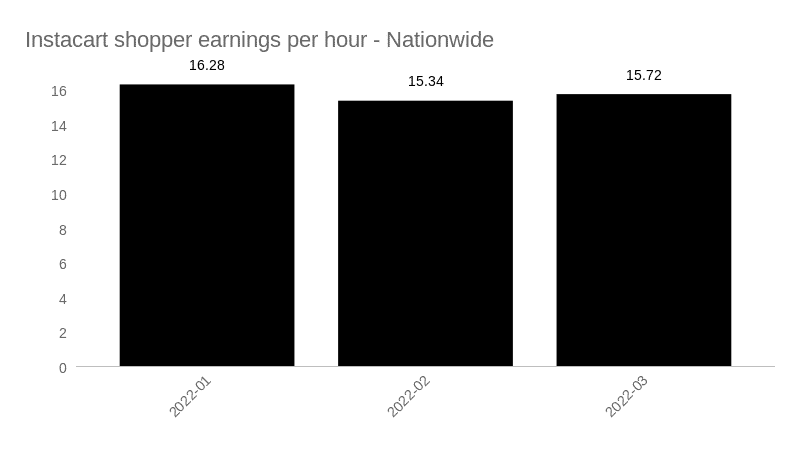
Earnings for Instacart shoppers held steady throughout the first quarter of 2022. Gross earnings per hour started at $16.28 in January and fell just a little to $15.34 in February, but showed signs of a slight rebound in March, when Instacart shopper hourly pay edged back up to $15.72.
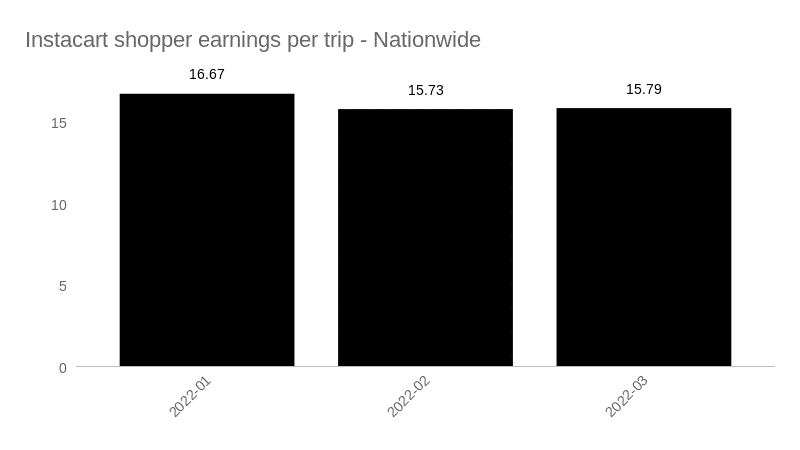
Earnings per trip followed this trend. Beginning at $16.67 in January, per trip earnings slid to $15.73 in February, but then crept back up to $15.79 by the end of March. This brought the average Instacart shopper earnings per trip to $16.06 for the first quarter.
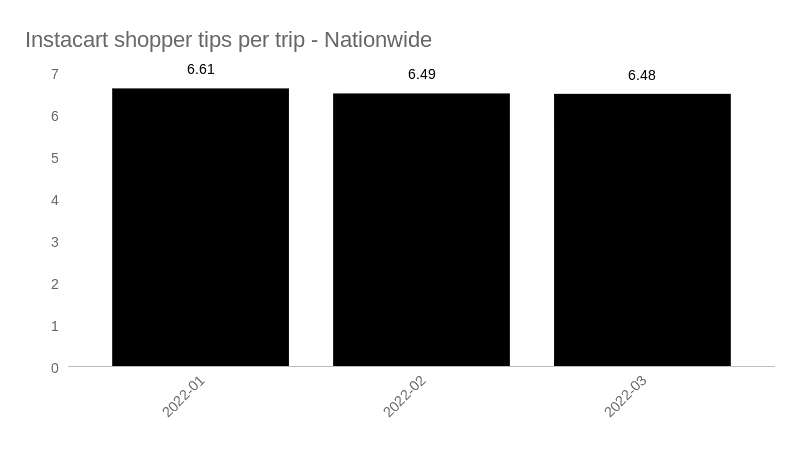
The same steady trend we see in earnings per hour and earnings per trip held for tips per trip. Beginning at $6.61 in January, tip earnings fell slightly to $6.49 in February.
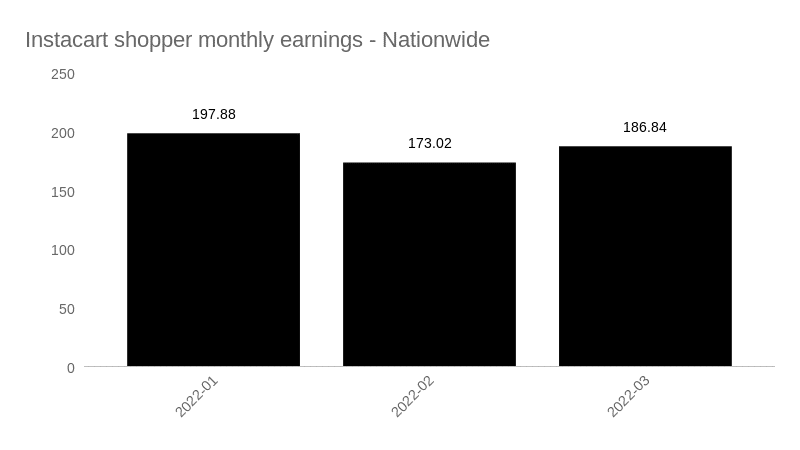
It follows that median monthly earnings for Instacart shoppers would form a pattern similar to the ones established by the other categories. January earnings amounted to $197.88. In February they went down to $173.02, then recovered in March rising to $186.64.
We did note, though, when we compared earnings for Instacart vs. Shipt, Instacart lags behind. Median monthly earnings for Shipt drivers averaged $259.22 over the three month period. Even Doordash monthly earnings outpaced those of Instacart shoppers. The average median earnings for Dashers in the first quarter of 2022 was $229.00.
Instacart has some catch-up to play with the other services. As a company, though, it does offer a range of possible experiences. Pay varies for Instacart workers depending on the type of job they choose.
The three possible Instacart roles are:
Full service shoppers
These workers drive to the grocery store, select the customer’s order, and then deliver it. They are independent contractors and do not receive employee benefits. The upside about this role is that it offers a great deal of flexibility in terms of working hours. Also, these shoppers are eligible to receive tips from customers.
In-store shoppers
Instacart does employ a select number of workers as non-full-service shoppers. They are Instacart employees and receive hourly wages, but not tips. They choose items for the customers, but the orders are picked up at the curb rather than delivered to the door. The positive point here for many is that this role doesn’t require the use of a vehicle, except to get to the store where they work.
Delivery-only drivers
These workers simply gather up pre-picked orders and deliver them to the customers. They, too, are independent contractors and do not receive employee benefits. They may be able to deliver more batches per hour, but their minimum payment per batch is less than what full-service shoppers receive.
For all these roles, there are certain factors entering in to answer the question, Is driving for instacart worth it in 2022? Let’s look at those factors now.
What outside factors eat into Instacart shopper pay?
As the world goes through the process of trying to come back to what we used to call “normal,” new problems have appeared. Many of them impact grocery delivery driver pay, and of course, the earnings of all three types of Instacart workers. Here’s a short list:
Gas prices
The astronomical increase in gas prices over the last few months makes driving anywhere much more expensive than before. When a person drives for a living, the price of filling up at the pump takes a huge bite out of earnings. Read more about the impact of rising gas prices in this Gridwise blog post.
Inflation
Inflation affects everyone, but Instacart drivers might feel it more than most other gig drivers. Grocery stores have raised prices to cover the rising cost of food, and Instacart may have to raise its service charge to cover increased operating costs as well. This could result in a less robust customer demand and less work for Instacart shoppers.
As we noted earlier, there is good news in that customers are ordering their groceries online now as much as ever. They too, however, may want to cut their costs, which might mean they get less generous about tipping Instacart shoppers.
Instacart pay structure
Recent changes in Instacart’s pay structure will very likely improve earnings for shoppers and drivers. No one outside corporate management knows for sure how the payment per batch algorithm for Instacart shoppers is calculated, but it’s clear that it’s made up of several components. They include the number of items, how difficult items may be to choose or carry (think vegetables and heavy items), how far away the delivery point is, batch incentives, quality bonuses, peak boosts, and customer tips.
Obviously, it’s complicated. It used to be even more so until Instacart began using the batch incentive method of paying shoppers. This is a base pay calculation based on the factors we just listed.
The good news for Instacart shoppers is that recent changes have yielded a much higher minimum per batch figure than there has ever been before. For example, there was a time when the minimum was $3.00. Now full-service batches have a minimum of $7.00–$10.00, which represents a hefty hike. Delivery only batches have a minimum of $5.00 each.
Another correction was made to Instacart’s payment structure when they stopped including the tips within the minimum per batch figure. Now drivers keep 100% of all tips, and they are dispersed over and above the minimum per batch figure.
Instacart also recently added a feature that allows shoppers to cash out as soon as two hours after completing a batch. Customers have been notified to add (or subtract) their tips within that time frame, which makes this smaller cash-out window feasible.
Gas surcharge
Instacart was slightly late to the party when it came to offering support to drivers paying way more than usual for fuel. A surcharge of $0.40 per order was announced on March 18. This is being passed on to customers in hope of helping drivers handle high gas prices. It’s hard to say whether this will provide the help needed, but the amount is in line with most other rideshare and delivery services who have passed on similar charges to their customers.
While these factors are somewhat unique to this particular moment in history, there are others that Instacart shoppers are, and always will be, faced with.
What are the basic costs of being an Instacart shopper?
No matter what’s going on in the world, there are certain operating costs that are constant in the lives of gig drivers. You simply have to deal with them if you want to do this or any driving gig. They include
Gas
We’ve already mentioned that gas prices have skyrocketed, and now they’re coming down a little. On April 13, the nationwide average price for a gallon of regular gas went down to $4.15, from a high of $4.33 in mid-March. Even if gas prices go down more, there’s no reason why Instacart shoppers should pay full price at the pump. With Gridwise Gas, you’ll always save. Sign up for free, and cash in on discounts that are available from 95% of the service stations you might visit.
Maintenance
Data we anonymously collect from Gridwise drivers show they spend an average of $163 on maintenance every month! This is a cost you can definitely cut back, and Gridwise + CarAdvise will help you do that. Sign up for free, and you’ll gain access to information about all the service centers in your area. You can talk to experts, shop around for the best prices, and benefit from 10–40% discounts on maintenance and repair costs.
Depreciation
This cost is a kind of silent killer in that it erodes your vehicle’s value despite your best efforts at driving it safely and taking good care of it. The value of the average car depreciates by 40% within five years! That will really get you wondering whether major investments in your older vehicle, in the form of replacement parts or upgrades, are worth making. The Gridwise Auto-Buying Program, powered by TrueCar, lets you browse, compare, and save big when the time comes to purchase a new vehicle.
How can Instacart shoppers reduce expenses and make more money
As you can see, there are ways to reduce your expenses and even stave off the unnerving invasion of inflation. In addition to these, there are ways to continue cutting your costs and pumping up your earnings, such as these:
Driver discounts and benefits programs
You can save on everything from equipment for your car to health coverage and life insurance. Click on the Benefits tab of your Gridwise app, and see all the great deals and discounts you can get.
Use gas rewards programs
Use Gridwise Gas, of course, and pay attention to other fuel cost-reducing prizes and perks. For example, did you know there are frequent Gridwise Gas Card Giveaways in our Facebook group? Join the Gridwise group now, and you could be our next winner!
Maximize earnings
Strive to be more than just an average Instacart shopper. When you do, you benefit through
Increasing the number of batches you process
Why wander around the store, wondering where they keep the heirloom tomatoes? Discover your store layout with this new tool Instacart has rolled out. It gives shoppers an interactive map of the store, making it much easier to find the items on your customer’s list. They’ve also added additional shopper support and safety features to the app. Don’t be bashful! Use these app enhancements to boost your earning power!
Working harder for tips
Tips might not come as easily as they used to, but if you work harder for them, you’re bound to get more. You’ll score points with your customers when you communicate with them as you shop and while you’re on the way to deliver their groceries.
Alert them to the possibility of making swaps, or tell them there’s traffic on the road to their house that will make you a few minutes late. You’ll be amazed how generously people will respond when you treat them with extra special care.
This goes for carrying the goods to them, too. Use bags and boxes that prevent fragile items from getting crushed and help to make unpacking their orders much easier.
Scooping up bonuses and incentives
Excellent service usually gets you great reviews. That smile and the extra care you show can add up when you make top-notch performance your basic standard.
Peak boost pay can be yours for shopping during intense, high-volume time periods. You’ll be able to see the total you’ll get for an order, including the peak boost pay, when the order comes in.
Get assertive about making more by using Instacart referral codes. Depending on where you live, you and the friends you refer could each earn from $400–$750 extra! With the way the economy is changing, you probably have friends who’d like to make some extra cash like that.
Minimize your tax bill by tracking your deductions
Tax time is rarely the happiest time of year, but if you’re diligent about keeping records all year long, you can avoid paying more than you really have to. Use Gridwise to record all your deductible expenses and track your mileage. You won’t believe how fast these expenses pile up, and when you record them consistently, you can knock a tidy sum off your taxable income.
Set up Gridwise to manually record every expense as it comes along. And, as the best mileage tracker for Instacart shoppers, it logs your mileage automatically. Simply download the free app and sign on every time you’re driving for Instacart. Sync your Instacart app with Gridwise, and your earnings and tips will be tracked, too!
With all these benefits, it’s no wonder Gridwise is known as the best assistant for rideshare and delivery drivers!
Download the free Gridwise app today!
How Much Do Uber Drivers Make: Uber Driver Pay in 2022
Rideshare’s reboot is well underway, and the numbers for the first quarter of 2022 are in. We’ll get granular with data in this post and cover issues that have helped to paint the Uber pay picture over the past few months. Then, we’ll explore how you can keep your earnings high, even in the face of any rough weather that might lie ahead. Here’s how we’ll do it:
- Uber driver pay: the numbers
- the gas price factor
- the impact of changing customer patterns
- maximizing your Uber driver pay
Uber driver pay: the numbers
Gross rideshare driver pay has been decent in 2022. Companies are still using incentives to coax drivers back to their rightful place behind the wheel, and passengers are showing up in greater numbers. This has led to steadily climbing gross earnings for drivers over the first few months of 2022.
How much does Uber pay an hour? The average hourly rate for the first quarter went up steadily. Hourly earnings started at $19.47 in January, rose through $22.10 in February, and wound up at $24.57 at the end of March. We see Uber vs. Lyft 2022 driver pay, thus far, being in a nose-to-nose tie. Uber pay came in at $22.04 per hour, while Lyft drivers made an average of $21.97. Literally, the average hourly gross rates are just pennies apart.

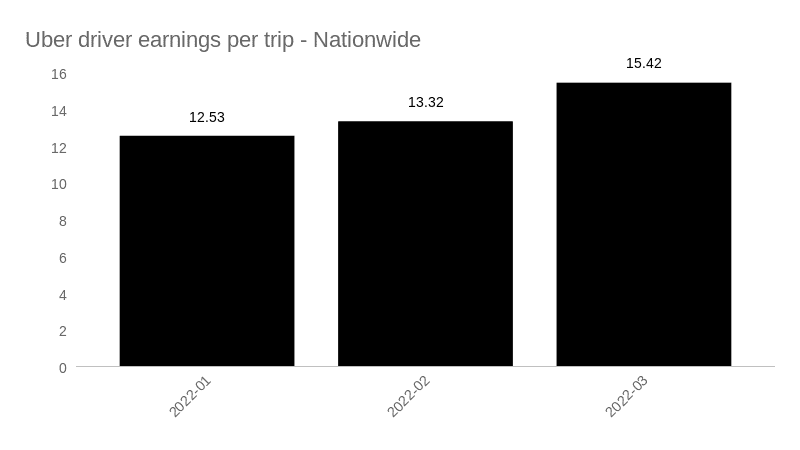
We see the same Uber vs. Lyft picture when we look at earnings per trip. Uber drivers earned an average of $13.76 per trip in the first quarter, while Lyft drivers brought in $13.03 per trip. Once again, gross earnings steadily went up over the first three months of 2022. Uber drivers earned $12.53 per trip in January, and $13.32 in February. A little jump up to $15.42 made the quarter end on a sweet spot.
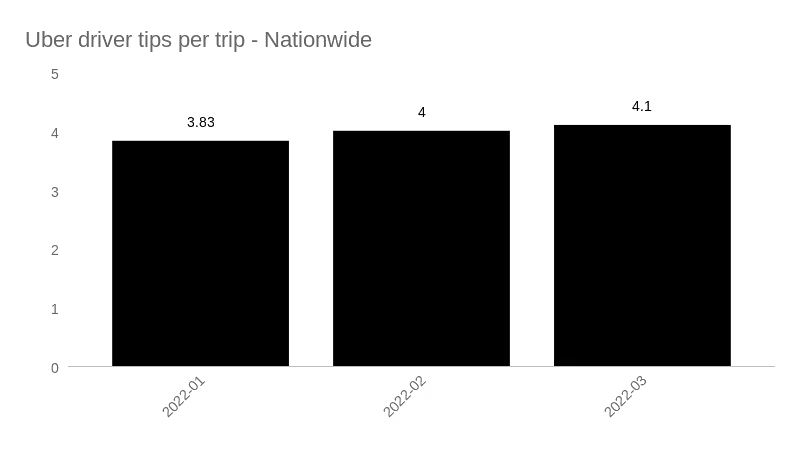
Tips, as well, were up for Uber drivers as they drove their way through the first few months of the year. The average tip per trip for the first quarter amounted to $4.90. The tips per trip figure started off at $3.83 in January, then went up a little to $4.00 in February, and $4.10 in March. This isn’t a huge leap, but it does follow the general upward earnings trend.
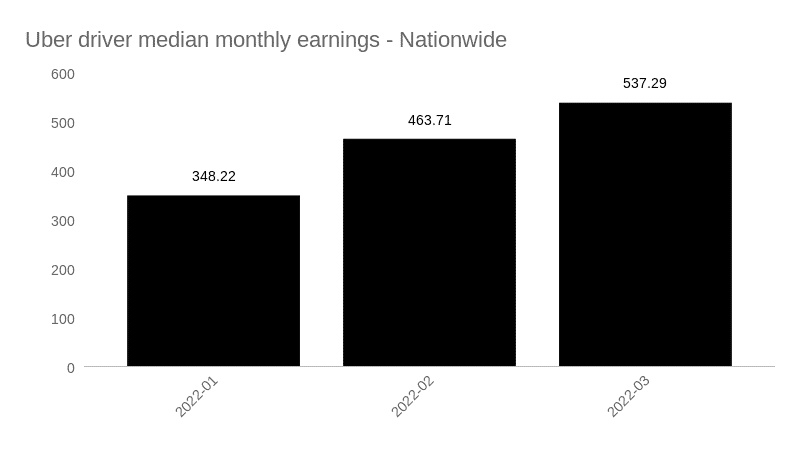
The last number we’ll look at closely is the one that matters most, because it’s the best way to answer the question: How much does Uber pay? The monthly earnings figure is always a good indicator of the bottom line for drivers. Gridwise figures show that Uber drivers brought in an average of $449.74 per month in the first quarter of 2022. Median rates went up from $348.00 in January to $463.71 in February. Then, they rose again in March to $537.29. This looks pretty good for Uber drivers, as it represents a 54% increase from January to the end of March.
Is this what drivers are really seeing though? Now let’s look at what’s behind these numbers to see if they’re as promising as they seem.
The gas price factor
Before getting too excited over the way earnings rose so far this year, we’ll need to take a look at the way gas prices have affected driver earnings. This time last year, the national average for a gallon of gas was $2.87. While prices peaked in mid March, gas was still priced at $4.12 just as the first quarter was ending. That means that gas prices increased by 43% year over year. A rise in gas prices like this one certainly takes a big bite out of Uber driver pay.
Drivers’ reluctance to tolerate the high gas prices shows up in the number of trips drivers took once gas prices peaked in March. Trip volume fell by 4.88% for the week ending March 21 and dipped another 5.29%, week over week, for the period ending March 28. With more countries releasing oil reserves, prices seem to be stabilizing, and in some cases are coming down a bit. Prices like these make lots of drivers question whether driving for Uber is worth it right now.
Uber is acutely aware of how gas prices affect drivers, so they did hit passengers with a gas surcharge on Uber trips. The surcharge was first applied on March 18 and will run for 60 days. The extra charge ranges from 45 to 55 cents per ride, depending on regional gas prices. Uber will also offer incentives to drivers who use EVs, in hopes of encouraging less dependence on gas-powered vehicles.
If the gas surcharge is making up for the extra expense drivers have at the pump, could it be that the decrease in trip volume is due to something else, such as passengers not wanting to pay so much? It’s hard to say, but it’s likely that both factors have played a part in the declining number of rides.
It’s evident that drivers don’t believe the surcharge is enough to cover the 43% rise in the price of gas. A survey of Gridwise drivers indicates that 70% of drivers believe that the few extra pennies per ride is not very helpful in covering their extra costs.
Uber may have noticed a need to sweeten the pot even more for drivers by adding bonuses. Uber drivers in Pittsburgh started smiling when they got a ping telling them there was a $100 bonus for completing eight trips between March 16 and March 28. Still, there’s no doubt that the high price of gas is going to continue to be a major issue for Uber drivers and passengers.
The impact of changing customer patterns
The recent resurgence of business and social activity has brought rideshare back to life, but the playing field is different than it was back in 2019. Drivers need to study the market for rideshare and use smart strategies to make as much money as possible—and hold on to it.
Being aware of passenger patterns is a must in this environment. Let’s look at some of the activities passengers partake in, how well they’re recovering as the world regroups after the pandemic shutdowns, and the ways it affects Uber drivers.
Air travel
Airport passengers are coming back! By early April 8, the TSA reported 2,318,977 people passed through checkpoints. On that same date in 2021, only 1,549,181 went through the gates. While that’s not quite up to 2019’s number of 2,590,499, airport traffic is definitely showing promising signs of recovery. There is a change, though: in 2022, more travel is oriented toward pleasure than business.
Companies have learned that online meetings can be highly effective and far less expensive than those cushy business trips. In fact, many believe business travel may never return to pre-pandemic levels. This means you have to adjust your mindset about airport driving and cater to the pleasure crowd rather than banking on the business traveler.
Events
Business events are coming back, but not as strongly as rideshare drivers might like. There are conferences and conventions, but many of them are either retaining an online presentation format, or creating a hybrid option, which combines live gatherings and virtual experiences. Much like business travel, corporate events may be taking on new forms that were inconceivable before the events of 2020 changed the ways people gather.
Fortunately, the picture is brighter for entertainment. According to morningconsult.com, crowds are coming back to public events, from the movies to consumer showcases and hockey games. Concerts are back in business in a big way. Live Nation stated that 2022 is on track to be a record year. This is great news for rideshare drivers. While there will still be many virtual entertainment events, trends show that there will be crowds again—and that they will be in need of rideshare services.
Higher rideshare prices
While it’s clear that passengers are coming back, they may not be as easy to find as they have been in times past. Higher prices for rideshare will keep some of them away. If you live in a bigger city, this creates more competition among a large population of drivers for what’s bound to become fewer rides. You’ll need to be more aware than ever about where passengers might be and at what times.
Gridwise tips
With Gridwise, you’ll be able to track airport traffic volume and get up to the minute information about all the events in your town. What’s more, Where to Drive gives you data from real drivers, showing you the locations where more money can be made. Gridwise gives you all the insight you need to keep your earnings up where you need them to be. Download Gridwise to get all these features and more.
Maximizing your Uber driver pay
Sound driving strategies include all the above tips about earning more, but there’s another side to the equation. You not only want to make as much money as possible; you also need to hold on to what you earn. The key to this is limiting your expenses. Most gig driving expenses are hard to eliminate, but they can be minimized. Here’s a short list of the major costs of driving and suggestions for how to keep them down.
Gas
The cost of gas is something you can’t control, but you can surely take advantage of effective ways to save at the pump. Gridwise Gas is an excellent way to slash your gas expenses. Sign up for free and get easy access to discounts at service stations near you. Your Gridwise Gas Card card will be accepted at 95% of the places you stop to fuel up.
Maintenance
You depend on your car to make a living, so giving it good maintenance is not an option. The problem is, upkeep isn’t cheap. You probably have found this out, especially if you drive an older car. Breakdowns and repairs become more common the longer your car is on the road, especially when you’re piling up the mles with your driving gig.
Gridwise has two ways to keep your maintenance costs down:
Gridwise + CarAdvise: Wouldn’t it be great to check out different auto shops, talk to different experts, compare prices, and schedule your car’s service appointment online? With Gridwise + CarAdvise, you get that—plus discounts of up to 40% on maintenance and repair services.
Gridwise Auto-Buying Program: Okay. You’ve had about enough of nurturing your car into its older age, and it’s time to buy a new one. You’re in luck! With the Gridwise Auto-Buying Program powered by TrueCar, you’ll search for the vehicle you want, compare prices, and save big. You could wipe off as much as $3,500 from the MSRP and find great deals on used vehicles, too.
Depreciation
This is one of these expenses you don’t necessarily notice—until you do. Depreciation slashes the value of your vehicle, just because you’re driving it. When you use your car for Uber driving, this cost can skyrocket. AAA estimates that depreciation contributes to 40% of all the costs of owning a vehicle. How can you make this hurt a little less?
Use Gridwise to treat your Uber driving gig for what it is: your business! Gridwise is a great Uber mileage tracking app, but it does so much more. With Gridwise, you can
- track all your expenses
- keep tabs on your earnings
- make note of your profits and losses
- see which routes make you the most money
See? You might have thought Gridwise was just another mileage tracker for Uber drivers, but with these and other features such as airport and event info, weather and traffic alerts, plus When to Drive and Where to Drive, you can see why Gridwise is the world’s best rideshare and delivery assistant.
Now that you know the different things that it involves, is driving for Uber worth it in 2022? You can make sure it’s worth it when you use Gridwise.
Download the free Gridwise app now!
How Much Can You Earn as a DoorDash Driver in 2022
DoorDash undoubtedly one of the market leaders in the on-demand food delivery space in the US and is available in over 7,000 cities.
This makes it one of the biggest players in the gig economy, providing employment to thousands of part-time and full-time Dashers—but is Dashing worth it in 2022?
Who comes out on top in the DoorDash vs. Grubhub and DoorDash vs. Uber Eats battles for driver pay?
With Q1 in the books, we are here to answer the call for data with earnings collected from over 250,000 Gridwise drivers in the country. Plus, we’ll take a look at the costs and expenses of working as a DoorDash driver for a more comprehensive analysis.
How much does DoorDash pay?
Let’s first look at how DoorDash driver pay is calculated.
Your earnings from each delivery on the platform include base pay, tips from customers, and promotions such as Peak Pay and Challenges.
So how much does DoorDash pay per hour and per trip?
Our data shows Dashers made an average of $7.90 per trip and $15.72 per hour from January to March 2022. These numbers are lower than the rivals, with Grubhub drivers earning more per trip and Uber Eats drivers earning more per hour.
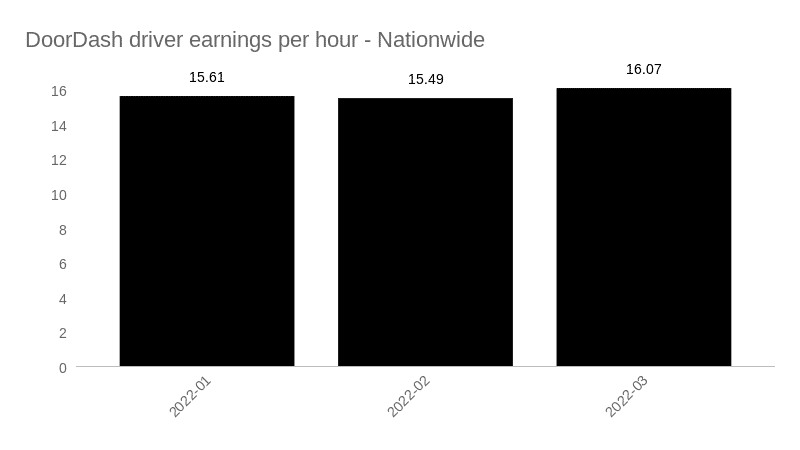
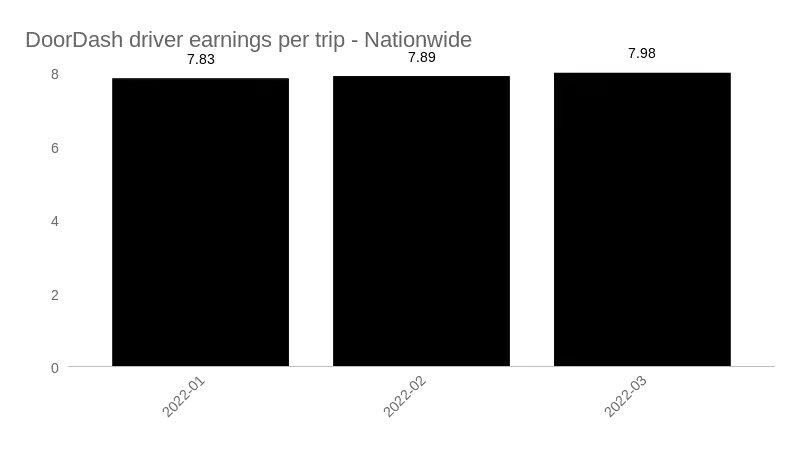
Keeping with expectations, package delivery services and rideshare delivery drivers fared much better in terms of earnings than food delivery drivers.
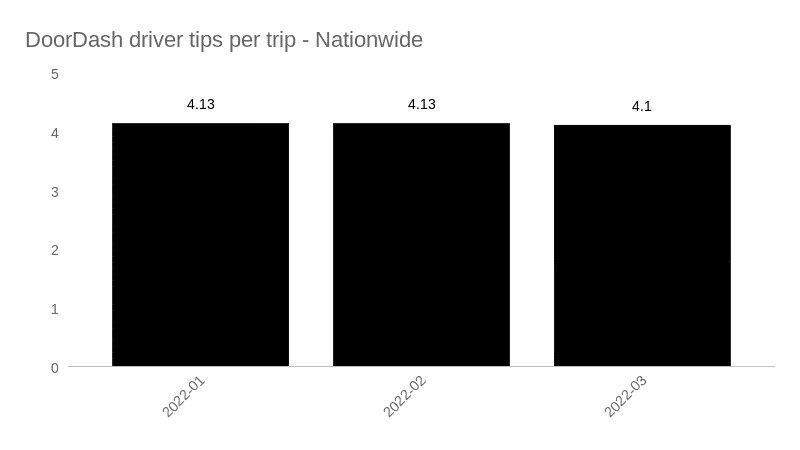
Next, tips. DoorDash again failed to beat its rivals, although the differences are small.
Tips on DoorDash hovered around the $4 mark per trip during each of the three months, netting an average of $4.12. That’s lower than Uber Eats and Grubhub but actually better than rideshare services in the same period.
We also took a look at monthly earnings across these services. Interestingly, here DoorDash performed significantly better than Uber Eats and Grubhub, averaging monthly earnings of $229.76.
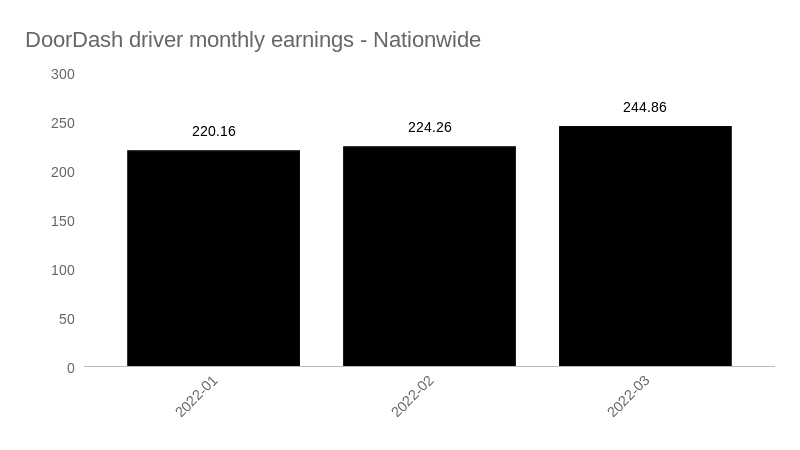
But overall, DoorDash drivers made less per trip, less per hour, and less in tips than drivers on other services.
What factors impact DoorDash driver earnings?
- Supply and demand - Fewer Dashers on the road means driver earnings go up. We saw this play out last year during the driver shortage. Earnings went up significantly due to more orders, higher pay per trip, and generous incentives.
- Peak Pay - This is a standard and frequent incentive used by DoorDash. Peak Pay is a bonus paid by DoorDash on each delivery during busy hours to entice more drivers to hit the road.
- Challenges - Apart from Peak Pay, DoorDash promotions also include Challenges to motivate Dashers to fulfill more orders. Challenges pay drivers extra money for delivering a certain number of orders in a specified time. Sometimes it pays to hustle.
- Top Dasher – Top Dasher is a rewards program designed to identify and reward the best Dashers on the platform. Drivers with high customer ratings, high order acceptance rate, and a high delivery completion rate qualify for this program and enjoy a host of exclusive benefits that can all improve earnings.
- Tips - As we mentioned, DoorDash drivers received an average tip of $4.12 per trip, making tips a significant component of total earnings.
What are the biggest expenses for DoorDash drivers?
To get the big picture on driver earnings, expenses need to be factored as well. Listed below are some of the biggest expenses that apply DoorDash drivers:
- Vehicle costs
- Maintenance and repairs
- Depreciation - The value of your vehicle depreciates over time due to age and wear and tear. While often overlooked, this is a key expense for understanding how much of your earnings actually make it to your pocket.
- Recurring expenses like your phone bill, taxes, and insurance also need to be factored in and can potentially help you save come tax time.
Have rising gas prices impacted driver earnings?
According to AAA, the national average price for regular-grade gas was $2.872/gal a year ago. As you’ve experienced, by April 2022, that price surged by a whopping 44.60% to reach $4.153/gal.
To help weather this dramatic increase in gasoline prices, many rideshare and delivery platforms have taken steps to boost driver earnings. For example
- Grubhub increased its per mile distance pay nationwide in March
- Instacart started levying a temporary fuel surcharge of $0.40 on customer orders
- DoorDash launched a Gas Rewards Program that offers 10% cashback on gas and a weekly gas bonus
- Uber and Lyft started adding a temporary fuel surcharge to their fares
Drivers can also take advantage of our Gridwise Gas program for exclusive discounts on fuel.
How can DoorDash drivers reduce expenses?
Unfortunately, the geopolitical and macroeconomic forces driving the gasoline prices up are beyond your control. However, you can reduce your overall expenses by following various proven cost-cutting techniques and by taking advantage of the many benefits programs available to you, such as:
- Cashback and discount offers from DoorDash on gas
- Download Gridwise to take advantage of exclusive partner offers designed for drivers
- Gridwise’s mileage tracker for DoorDash to maximize tax deductions
So is it worth driving for DoorDash in 2022?
While overall pay was lower for Dashers to start 2022, earnings still remain competitive with other apps.
Deciding on the right platform for your business comes down to three things:
- your location
- your vehicle
- your objectives
At least so far, there’s no clear best delivery app to drive for in 2022 other than the one that fits your needs.
We’d love to hear your experience as a driver! Join and share with our driver community on Facebook!

Everything You Need To Know To Drive For Uber and Uber Eats
Uber is the biggest name in rideshare, and it has a strong foothold in food delivery, too. It’s the company with the most drivers (8 million globally), and it operates in 83 countries and at least 853 cities. You could say that Uber … gets around.
Depending on your point of view, the fact that Uber has such a large presence might make you either more inclined, or less interested, in driving for this huge company. Only you know what a good fit would be for you. We'll go through the requirements, responsibilities, and pros and cons that come with driving for Uber so you can make an informed decision. We’ll cover:
- What an Uber driver’s shift is like
- What to expect as an Uber Eats driver
- What you need to qualify as a driver
- How to apply to be a driver
- Essential information for Uber drivers
What an Uber driver’s shift is like
Starting an Uber shift
Driving for Uber is fairly straightforward. You open the app, and wait for a passenger to request a ride. A map will pop up to show you where the passenger is. You can either use Uber’s navigation system, or set your app to go to another (most likely better) one, such as Waze or Google Maps. Once you arrive at the pick-up location, you’ll find out where your passenger is going. Again, the app will help you navigate to the destination. Once the passenger is dropped off, you’re done. With luck, you’ll even get a tip.
It’s common for you to get a request while you are driving with another passenger. You can accept the ride, but always be careful about using your phone while driving. Most drivers have their phones mounted, either on the dashboard or windshield, to make it easier to manage them while they’re on a shift. Check your state laws to see what types of mounting are legal. You never want to obstruct your view.
Uber driver pay (hourly and per trip)
Uber will automatically deposit your earnings in your bank account once per week. If you need the money sooner, you can cash out immediately with Uber Instant Pay for a minimal charge (about fifty cents) up to 5 times a day. Only drivers who have met certain requirements can use Instant Pay. You can learn more about becoming eligible for Uber Instant Pay here.
How much you’ll make as an Uber driver varies by location, season, time of day, available bonuses, and other factors.
In 2021, Uber drivers received an hourly pay of $20-26. Early 2021 saw the highest earnings, as Uber was offering hefty incentives to get drivers back on the road. While those incentives have decreased, late 2021 still brought drivers between $21-22 per hour.
Looking at pay per trips completed last year, Uber drivers made between $14-16. Keep in mind that when we talk about earnings, it doesn’t take into account the costs involved with doing business.
Rides are worth more money at certain times of day and in certain parts of town. Experienced drivers refer to these as “surges.” During those times, when there are more riders than there are drivers, or when there’s a major event going on, prices will go up and you’ll get paid more.
There are also other bonuses, like goal-setting promotions known as Quests. These are times when you get extra money for completing a certain number of rides, either Monday through Thursday, or Friday through Sunday. You can also earn extra through consecutive rides promotions. At a busy time, for example, you might get $3, $7, or $9 extra for taking three rides in a row.
The amount of money you see as your earnings is only a portion of what Uber charges the passengers. Uber has what is known as a “take rate,” and it is aptly named. That’s the percentage the company retains from the full fee for bringing you and your customers together, plus everything it takes to make that happen.
Uber driver hours
As an Uber driver, your hours are totally flexible. No one tells you what time you have to be at work, or how long of a shift you have to put in. The only one you have to report to in this regard is … you. That’s great, as long as you’re disciplined about getting out to work, and staying there long enough to make the amount of money you want and/or need.
Once you’re done with a shift, you shut down the app and your earnings will be posted to your account. Your ability to manage yourself, and of course, the level of demand for drivers in your area, will determine how much you earn.
Doing taxes as an Uber driver
As an Uber driver, you’re an independent contractor. This means you’re responsible for withholding money for taxes, as well as expenses such as fuel, depreciation, and maintenance. You’ll also have to purchase your own health and disability insurance.
When you’re planning your shifts for the week, think about how much you need to make in order to satisfy your income requirements, taking all these expenses into consideration. While these expenses are considerable, they’re also legitimate tax deductions, so there’s something to be gained at tax time.
What should you expect as an Uber Eats driver?
We mentioned earlier that Uber drivers have the option of being Uber Eats delivery drivers. A setting in the app allows you to accept Uber Eats requests. Uber Eats driving entails taking a call from a customer, picking up the food at a restaurant or other establishment, and delivering it to the hungry person on the other end of the request. A dedicated driver will go the extra mile (sometimes literally!) to communicate with customers when delays or mistakes happen.
Uber Eats driver pay (hourly and per trip)
In 2021, Uber Eats drivers were paid an hourly rate of between $15-19.01. While Uber Eats doesn't guarantee a minimum hourly wage, its driver job postings on Indeed have claimed that drivers earn around $19.06. Uber Eats driver pay does vary from location to location, but most drivers seem to make less than the $19/hr advertised.
On a per trip basis, Uber Eats drivers were paid between $9-11 per delivery. While this may seem like a low number, remember that efficient Uber Eats drivers can make multiple trips per hour, getting them closer to that $19/hr wage we just mentioned. Additionally, this per trip wage is on par with Grubhub's pay, and is higher than DoorDash's per trip pay, according to this article on the best delivery service to work for.
While Uber Eats doesn’t always pay as much as rideshare driving for Uber, it can be a worthwhile way to make money when rider requests are hard to come by, or when you simply feel like dealing with food rather than people. The beauty of working for Uber is you can do either or both, as long as you qualify to be a rideshare driver. (Uber Eats drivers don’t always qualify for rideshare.) Let’s look at the requirements for driving now.
What you need to qualify as a driver
Here are the criteria for becoming an Uber rideshare driver.
Requirements for you:
- Be the minimum age required to drive in your city
- Have at least one year of licensed driving experience in the U.S., or three years of licensed driving experience is you’re under 23 years old
- Pass a background check
- Have a valid U.S. driver’s license
- Present proof of residency in the state where you plan to drive
- Have proof of auto insurance, if you choose to use your own vehicle
- Have a smartphone capable of handling the Uber app (iOS 8 or higher, Android 4.0 or higher)
Requirements for your vehicle:
- Must have four doors, and able to transport a minimum of four passengers
- Can be a car, truck, SUV, or minivan
- Vehicle must be 10 to 15 years old or newer (check your city for exact requirements)
Additional vehicle requirements (can vary by city)
- Five factory-installed seats and seat belts
- Working windows and air conditioning
- No vans, box trucks, or similar vehicles
- Cannot have any cosmetic damage, missing pieces, commercial branding, or taxi paint jobs
- No salvaged or rebuilt vehicles
- No aftermarket seating modifications, such as installed seats, seat belts, or BedRyder systems
These requirements apply mainly to UberX, which is the basic Uber service. There are higher levels of Uber services, such as Uber XL, Uber Premium, Uber Comfort, and Uber Premier. You can learn more about those levels of service here. In most cases, your vehicle will have to meet even higher standards.
For Uber Eats the requirements will be slightly different, depending on your city. If you’re in a designated area, you may be able to make Uber Eats delivery by bicycle or scooter.
If you don’t want to use your own vehicle (for rideshare or Eats), you may be able to rent a vehicle through Uber. Even though you can't drive for Uber with a car you rent on your own behalf, they will rent or lease vehicles that meet their requirements, usually through a car rental company that has an agreement with Uber. Vehicle programs vary from one city to the next.
Check the Uber website for details about your location. You’ll get this opportunity if and when you apply to be a driver. Check on “I need a car,” and you will be sent to the appropriate web page.
Before you apply to be an Uber driver, there are a few more details you’ll want to investigate. One of them is the background check. This blog post tells you all about it, including how long it will take, and what you can do if it takes longer than you expect.
Insurance is the other item that drivers need to attend to. Uber will provide some level of protection for you, but you’re also required to have your own policy on your car. Furthermore, you need to let your insurance company know that you’re working as a rideshare driver, and pay an extra amount for a commercial rider. Don’t try to sidestep this; the risk isn’t worth it. If you don’t tell the company that you’re driving for Uber, and you have an accident, they have the right to waive your policy—which could have disastrous results.
How to apply to be an Uber/Uber Eats driver
Although the process isn’t complicated, it does take some effort. You’ll need to be at least somewhat savvy with your smartphone. Assuming that you are, the first step is to download the Uber driver app, which you’ll find in the app store on your phone.
Once you do that, you’ll need to gather the following documents:
- Driver’s license
- Vehicle registration (temporary is acceptable)
- Proof of Insurance
- Picture of you
- Permission and information for the background check
You’ll provide the documents (including your photograph) to Uber by taking screenshots and uploading them to the app. Follow the system prompts to input the background check information.
Once you apply, it can take a day or two for all the documents to be approved, and in many cases, additional time for the background check to clear. Remember, they are checking your criminal record and your driving record. If you want to read more about Uber’s background check, here’s a previous Gridwise article about it.
Once all the documents and the picture are approved, and the background check clears, you’ll be ready to roll!
Essential information for Uber drivers
As you may already know, Uber and Uber Eats drivers aren’t employees; rather, they’re independent contractors.
As an independent contractor, you are responsible for most benefits that an employer would usually provide if you were an employee. These include:
- Health insurance
- Workers compensation insurance
- Disability insurance
- Minimum wage protection (except in a few cities)
- Paid time off (vacation, sick days, and holidays)
- Pension plan
- Tax withholding
There’s an ongoing struggle between the gig economy companies and government jurisdictions in the many locations where the companies operate. Government officials in some of these areas, along with many gig workers, would like to see drivers be classified as employees.
But that discussion is still ongoing, and in the meantime, rideshare and delivery drivers need benefits. If you drive for Uber or Uber Eats and lack proper coverage for things like health insurance or accident protection, read this blog post about a benefits program tailored to gig drivers' needs.
How to get ahead of other Uber or Uber Eats drivers
Whether you decide to drive with Uber, or decide to go with another rideshare or delivery company, the one thing that will consistently be a big help is Gridwise. You can track your earnings on all the platforms you use, and keep a record of your total mileage so you know how much to deduct at tax time.
The information is presented in easy-to-read, graphic format like this:
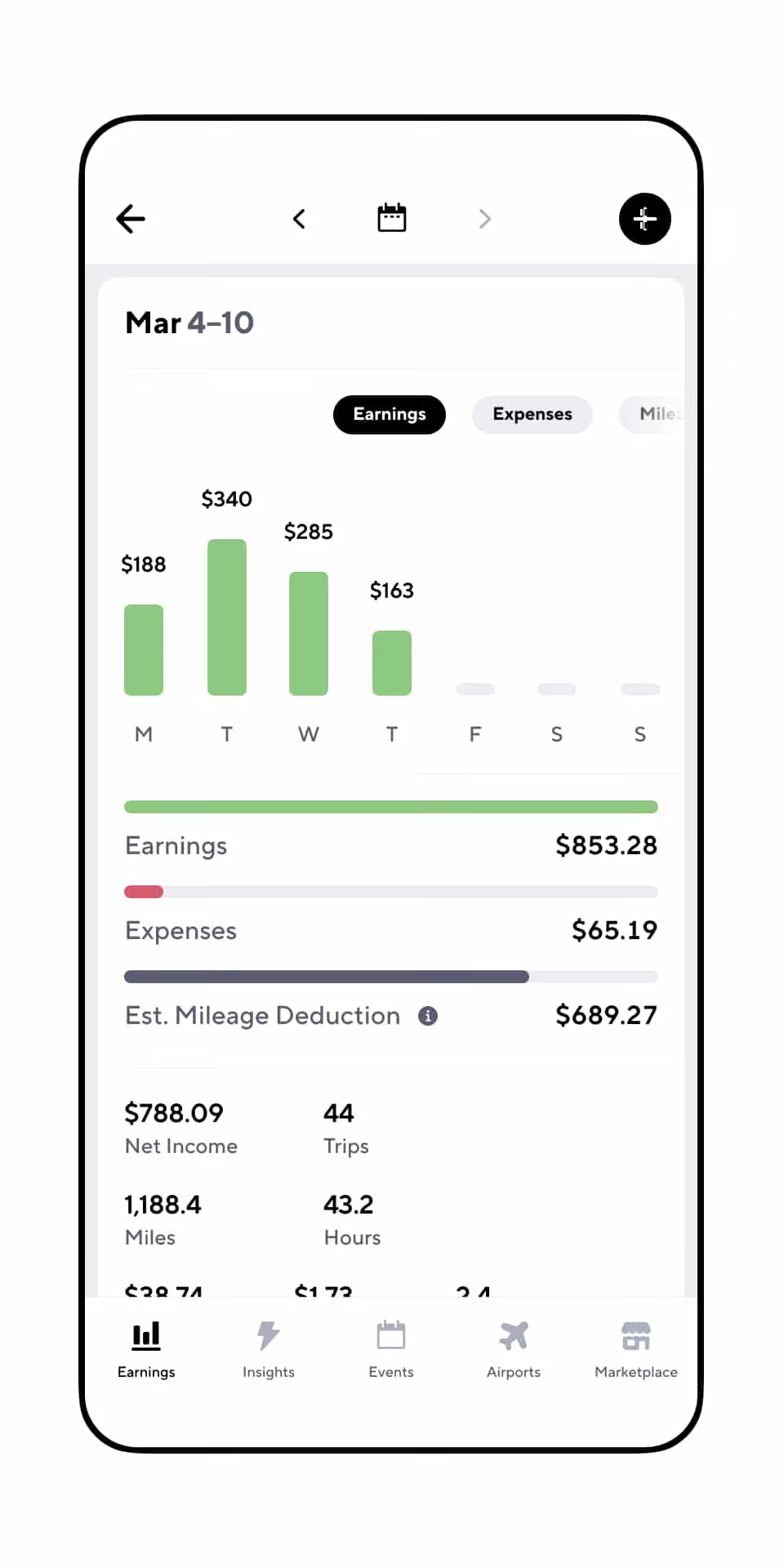
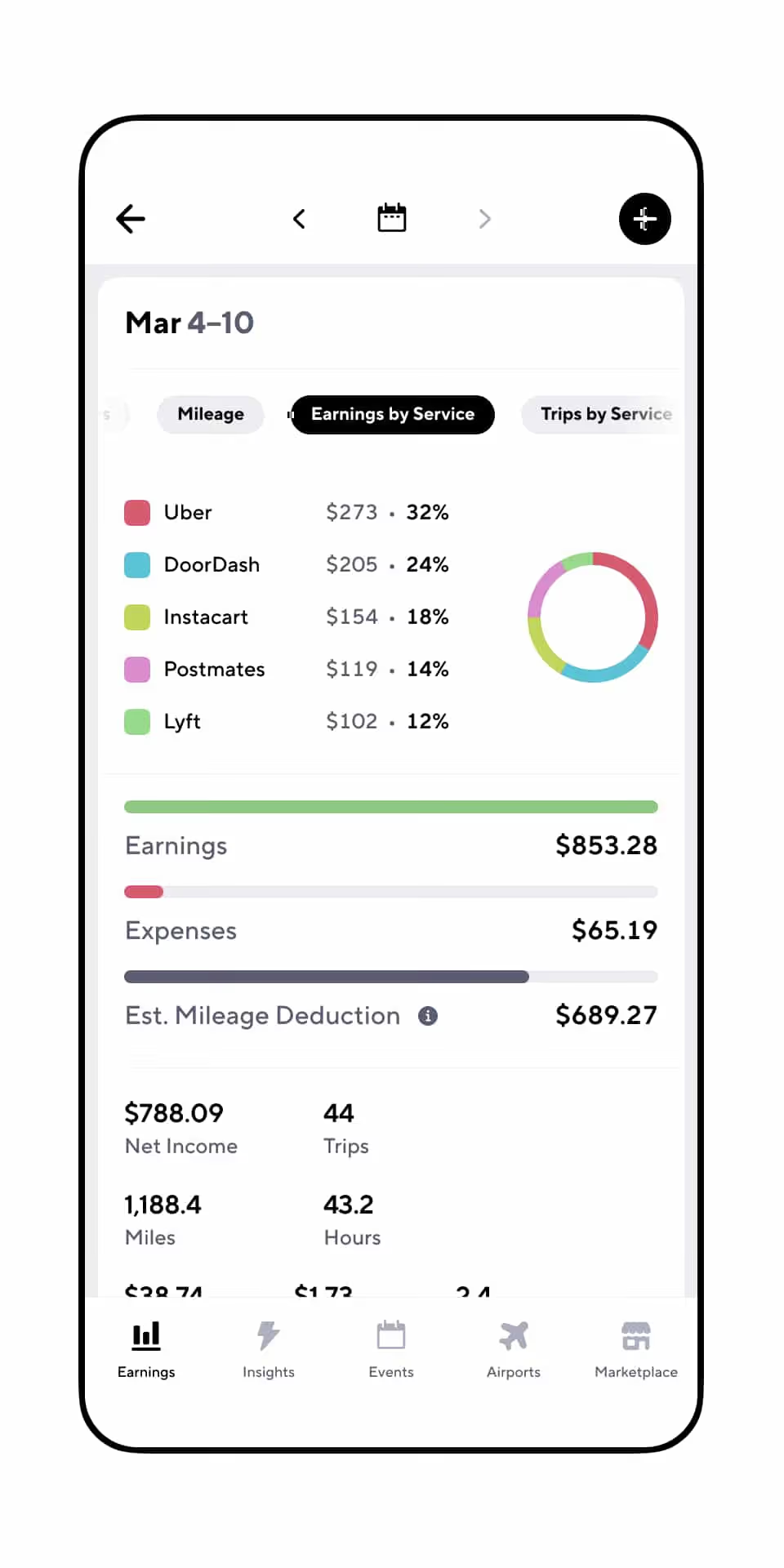
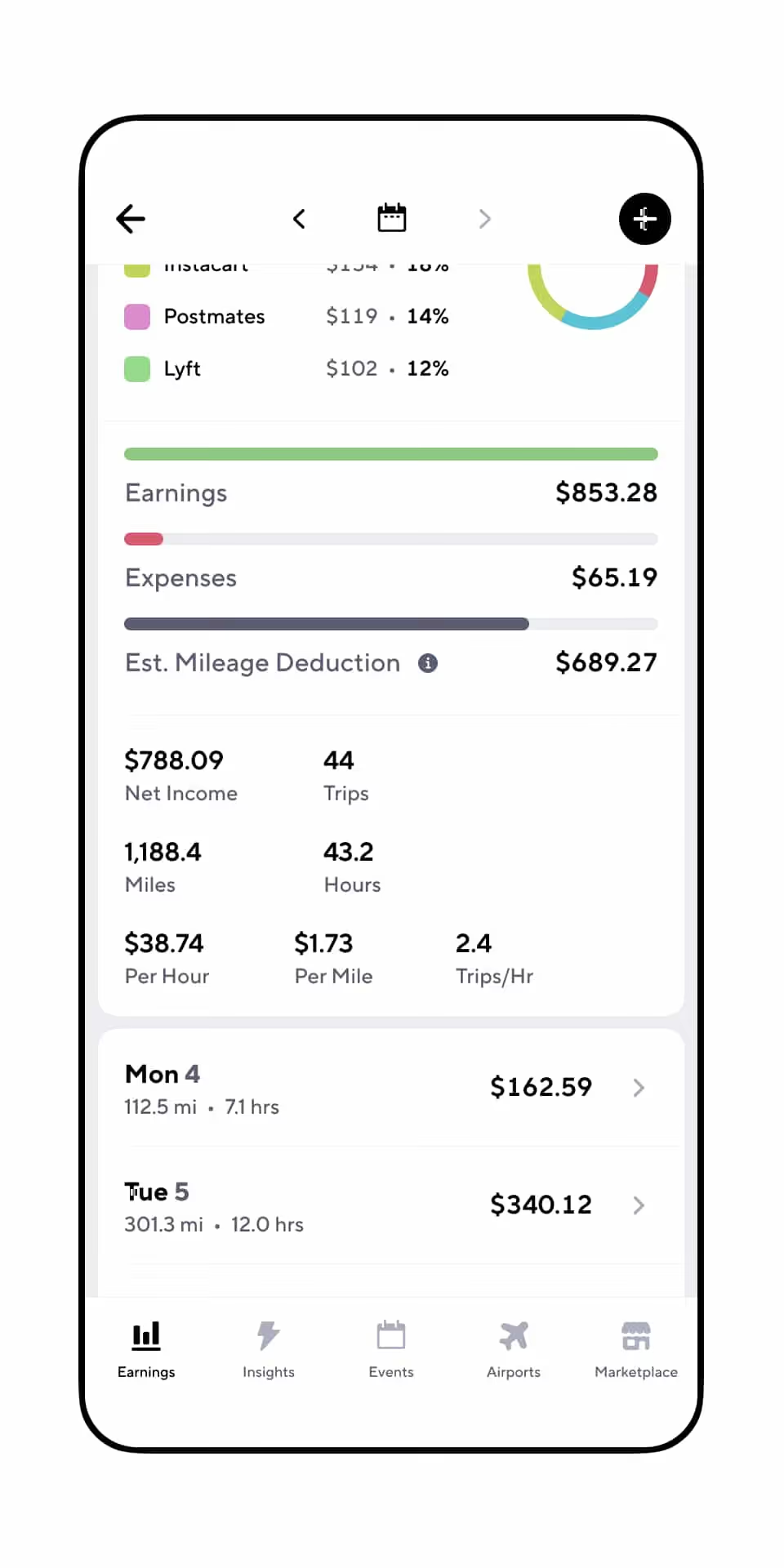
And that’s not all. In the Gridwise app, you’ll find deals and discounts for rideshare and delivery drivers and easy access to the Gridwise blog. You won’t want to leave home without this amazing app, so
Download the best free mileage tracker app for Uber drivers
Interested in joining a driver community to learn more tips and tricks of the trade? Join us on Facebook, where Gridwise hosts great gas card giveaways every 2 weeks! As always, if you have questions or ideas about this article or the gig economy in general, leave us your comments below.
4 Hacks To Earning More As a Rideshare Or Delivery Driver
We know you don’t live under a rock, so you’re aware of a scary fact of life: the cost of driving is going up. Worse yet, expenses such as gas, food, and other basics are slated to keep escalating. While this is very much the reality, there’s no reason to allow rising prices to keep you off the road.
In this article, we’ll go through some facts about what’s going on and why, but we’re not going to pontificate and whine about it – there are ways to maximize your earnings in the face of any kind of economic weather. We’re hitting you with four hacks that will let you earn more no matter how much costs go up. Here’s what we’ll cover:
- The whats and whys behind the rising costs of driving
- How companies are helping
- Hacking your way out of the hole
- Driving strategy
- Smooth economic moves
- Up your game to get more tips
- Shuffle over to a side hustle
- Keeping your head above water
The whats and whys behind the rising costs of driving
If media coverage of the rising price of gas, food, and other items isn’t enough, surely your recent experience reveals that you’re paying more for your purchases. Drivers everywhere are watching their take-home pay evaporate due to higher prices at the pump, at food stores, and elsewhere.
According to March 30, 2022 data from AAA, the average price of regular gasoline has risen 32.4 percent since this time last year. (To learn more about why, check out this Gridwise blog post.) And unfortunately, rising fuel prices are not all we have to contend with.
The costs of insurance and vehicle maintenance are also much higher than they were a year ago. Insurance companies, like most operations, face a rise in the cost of doing business. It’s no surprise that they’ll be passing the extra burden on to their customers, namely, us drivers.
In a February 2022 article, Bankrate cites the following reasons for upping the prices of premiums:
- Inflation
- Supply chain disruptions
- Labor shortages
- Changing driving habits (return to pre-pandemic driving patterns)
It looks like we all need to prepare for when those auto insurance policies come up for renewal this year.
Vehicle maintenance is another driver necessity that’s going up in price. Have you stopped by to see your favorite mechanic for regular service, inspection, or repair lately?
First, you’ll likely be waiting longer than usual to get your vehicle scheduled.
A repair tech shortage has struck the industry, according to this recent Forbes article. The reasons behind the thinner population of skilled mechanics are waves of retirement and resignations due to the pandemic. Most likely, that “cost of doing business” factor also plays into the high cost of parts, as does the supply chain disruption.
Speaking of the supply chain, the price of food is rising, too – and not just in the United States. Global food prices have risen 20.7 percent this year so far, according to statistics from the United Nations Food and Agriculture Organization, reported by the New York Post.
Looking at all this, it’s easy for a driver to get depressed. After all, Uber driver pay and Instacart shopper pay can only go so far to cover costs like these. How can you possibly keep your net earnings up in the face of all these financially draining factors?
How companies are helping
In an effort to help drivers cope with rising fuel costs, Uber added a gas surcharge to fares in mid-March, and was the first company to do so. Since then, others have followed suit.
Lyft tacked on a surcharge similar to Uber’s, as did Instacart. Meanwhile, DoorDash, Grubhub, and some other food delivery companies have taken a different approach. They are offering bonuses for drivers who deliver most, as well as a cash-back program drivers can cash in on at the pump.
Although these efforts might offer a sliver of help, there’s no doubt that drivers are going to need more. There’s no sign of soaring prices retreating in the foreseeable future, so drivers who want to earn more will need to make major changes.
Hacking your way out of the hole
There’s no reason to wallow in the misery of rising prices. There’s a lot you can do to change the equation and get your bank balance back to where it needs to be. Here are four hacks to get you going.
Hack #1: Driving strategy
So many of our friends and relatives seem to think making a living at gig driving is as simple as jumping into your vehicle and heading out – which, as we all know, is far from the truth. Every successful gig driver knows you need to have a good driving strategy. There’s a lot of tactical effort that goes into a high-quality strategy, so let’s look at the components that will do you the most good.
Track your mileage as well as your earnings
Everyone looks at the bottom line; e.g., “How much have I made so far on this shift?” But the figure flashing on your app’s screen doesn’t tell the whole story. You need to know how many miles you’ve driven for your apps, for two important reasons:
- To see how much you make per mile, and
- To deduct your annual mileage from your income, and reduce your taxes.
This Gridwise article offers more tips and tricks to help you keep your tax bill down. It also shows you that if you want the best Uber mileage tracker, or slickest DoorDash mileage tracker, you need Gridwise. Here’s what it can do:
Monitor your earning trends
When you examine how much you’re making, week over week and month over month, you can see how profitable your business is. Moreover, you can tweak your strategy to ensure that you maximize your effectiveness and your earnings.
Keeping track of these facts and figures isn’t that easy – unless you use Gridwise.
When you sync your driving apps with Gridwise, you get:
- Weekly earning reports that show where you’ve driven and how much you’ve made for all the services you drive for.
- The ability to go back in history to find out how much you made in the past, predict seasonal trends, and base your budget on what you can expect to earn during different time periods.
Use the art of multi-apping to cash in on bonuses
In an effort to get as many drivers working as they can, the companies are offering all sorts of incentives. Take advantage of this situation by keeping a close eye on what bonuses are out there, and then jump on them when they come up. For instance, if Lyft is offering incentives for new drivers, and you’re normally on Uber, switch it up for a week and collect the extra cash.
In the same vein, if the food delivery companies show more generosity with support for higher fuel costs, try that out and see how it goes. You can keep doing this to get the most out of each company as offers come up.
Gridwise can be invaluable for this multi-apping strategy, too. All your earnings, for every app you use, are consolidated in concise and colorful graphs like these:
With Gridwise, it’s super easy to see how your Instacart or DoorDash driver pay compares to what you get from your other apps. When you make Gridwise part of your driving strategy, you’ll see how much you’re earning, and which app is giving you the most cash for your efforts.
Hack #2: Slash your expenses
We’ve already acknowledged how hard it’s become to keep up with costs. Now, let’s look at what we can do to keep them under control. Of course, paying for the expenses that keep your gig business rolling is not an option – but there are steps you can take to keep costs down. Let’s look at some that are obvious, and others we want you to learn about.
Save on gas
There are ways to save on gas even when you’re not at the pump, such as avoiding hard acceleration when you don’t need to zip around so fast. You’ll also save your brakes, not to mention your passengers’ nerves, if you drive with the goal of giving a smoother ride.
When it’s time to fill up, though, you’re going to need even more help, and we don’t mean the family credit card. Here’s something that will definitely be there for you when you have to pay at the pump.
This gas discount deal, in partnership with GasBuddy, saves you cash at a time when you need it most. Join for free and automatically save 2 cents per gallon, then work your way up to saving 25 cents per gallon on each fill-up. Gridwise Gas works like a credit card, and is accepted at up to 95 percent of service stations nationwide, so it’s easy to find places where you can save.
And, if you join Gridwise Plus, you automatically get a 10-cent per gallon discount on up to 50 gallons per month. Simply check the GasBuddy app for discounts before filling up, go to the service station to do your thing, and the rest is automatic.
Minimize repair and maintenance costs
You drive – a lot. Your mechanic can tell by looking at your vehicle, and that’s why you can’t afford to not get your car the care it needs. Smooth-running vehicles get timely and complete vehicle maintenance. And, as we noted earlier in this post, costs are going up. You need a discount program you can depend on, which is why Gridwise offers you a special partnership.
With this deal for Gridwise drivers, you get from 10–40 percent off repair and maintenance costs. You can choose from thousands of auto service centers. The app lets you find shops in your area and compare them to ensure you’re getting the best price. When you do all this, then apply the discount, those “spa days” for your vehicle won’t feel like a big splurge.
Even if you do everything possible to save money, you can still get stuck with supersized repair bills – and if that happens, you won’t be driving at all. That’s why there’s also a way to protect yourself from unexpected and much bigger expenses.
This great Gridwise partnership can help protect you from a wallet-crushing blow when you encounter major repairs. Gridwise + ForeverCar provides you with a protective policy at a 44% discount on a vehicle service plan.
Don’t let food and drink expenses creep up on you
We’ve all got to eat, of course, and drivers also need to stay hydrated. It’s tempting to pick up all the snacks we like to indulge in at the local bodega or other convenience store, but with the way food costs are exploding, that’s not the best idea. Instead, consider …
- Packing a homemade sandwich instead of buying burgers and fries;
- Buying snacks in bulk so you can save and almost never run out of pretzels and nuts;
- Filling up your water bottle with a gallon jug you keep in the trunk;
- Picking up beverages you like at a discount, and keeping extras with you.
Who knows? If you become more conscious about the snacks and beverages you imbibe while on the road, your wallet might not be the only beneficiary of this healthy change.
Be smart about insurance
Insurance may seem like an expense you can live without, but it isn’t. You need coverage for those times when (often unexpected) things happen that affect your health or your livelihood.
Insurance costs vary widely, so do some research and put together a package that works for you. Gridwise has insurance plans that cater to drivers. They cover all that drivers need and can be obtained for a very low price. For instance, with Gridwise Dollar Benefits you can choose from …
No-cost life insurance. Get up to $10K of life and AD&D insurance just for signing up. Then, you can pick and choose from affordable plans like these, starting at only $1 per week:
- Telemedicine: A $0 copay and unlimited virtual doctor’s visits, available 24/7.
- Dental coverage: Dental procedures can be costly, and this policy saves you from 20 to 50 percent on most of them.
- Vision insurance: Big discounts on everything from exams and eye care to slick eyewear.
- Medical coverage for accidents: After a major wreck, you could have major doctor bills. This program gives you $1,000 for medical expenses and deductibles to help you hold it all together.
- Roadside assistance: Sometimes you need a tow, a tire change, battery service, fuel delivery, and help when you’re locked out of your car. This policy covers it all so you can feel safe and protect yourself from unexpected expenses.
- Phone protection: It’s no joke – for drivers, our phone is our life. Get coverage on up to three devices for damage and theft.
- Teletherapy: Drivers have a lot to stress about, too. This policy offers weekly 30-minute teletherapy visits with a $0 co-pay.
- Life insurance: Add on to the no-cost plan to make sure your loved ones have everything they need should you leave this life.
- AD&D insurance: If you have a catastrophic accident, you or your family members need emergency cash. This policy offers $20,000 of coverage.
- Critical illness insurance: Should a critical illness strike and make work impossible, you get $2,500 cash for covered illnesses.
These low-cost policies have a high impact on your level of protection, can save you money, and offer you peace of mind. Read more about Gridwise Dollar Benefits here.
Hack #3: Use your tools and hone your skills
You know it and we know it – gig driving is not just about sitting behind the wheel. There are things drivers do that make this job part skill and part creativity, and taking these aspects seriously will help you boost your earnings.
Going that extra mile applies to rideshare and delivery drivers, too. There are steps you can take to stand out from the rest of the fleet, improve your customers’ experiences, and pump up your ability to earn tips. Some of these suggestions involve small investments, which will definitely pay off. Others … well, they just happen to be free.
Rideshare drivers can …
- Be courteous and engaging: Gauge a customer’s penchant for conversation, honor it, and if they want to talk, have a friendly exchange.
- Open doors and carry bags: If you notice someone struggling to balance a baby and several grocery bags or a suitcase, put the car in park, get out, and lend a hand.
- Offer amenities: Give your passengers the option to have some water or a light snack while they’re in your car.
- Cater to customer tastes: Ask riders what kinds of tunes (if any) they like to roll with. Inquire about their temperature preferences, too. Then, give the people what they want.
- Offer ideas: If a customer seems conflicted about choosing the best place to eat or have a few drinks, offer up your knowledge of the local scene.
Food and package delivery drivers can …
- Be a human thermos. Keep hot things hot and cold things cold by using the right bags, boxes, and other equipment.
- Use compact crates and extra boxes to protect packages from being damaged.
- Use a dolly or small cart to easily deliver multiple packages or heavy loads.
- Communicate! If you’re stuck in traffic, can’t find an item you were supposed to bring in the grocery load, or the restaurant is several minutes behind, let your customer know. They’ll be glad you did and are likely to make sure you get a tip for your trouble.
Additional free help
Find the hot spots to work and the busiest times of day with Where to Drive and When to Drive from Gridwise. You really need these features now that you have to make every mile you drive more profitable.
Hack #4: Shuffle over to a side hustle
If you take the advice we’ve offered so far, you’re bound to earn more and save on expenses. But … if you want to make even more cash, there are ways to do it without driving. You don’t have to work yourself to death to keep up with a side hustle, either. Many give you a chance to set yourself up with every freelancer’s financial fantasy: passive income.
- nUVo is a high-tech way to keep the air in your car fresh and up to 99 percent germ-free. This innovative company has partnered with Gridwise to help you earn as much as $500 per month simply for referring your customers. Get more details on this when you click on the “Offers” tab in the Gridwise app.
- Get money just for offering your opinion and testing products with American Consumer Opinion (ACOP). Sign up through Gridwise and get started right away.
- Got extra space? Neighbor puts you in touch with people who’ll happily pay you to store their stuff. From an extra car in the garage to a closet full of NIB Star Wars figures from the ‘90s, you can let your spare stashing space make money for you while you do … whatever else you want.
- With Play Octopus you’ll earn money while you drive. Rideshare customers will dig gaming – and maybe even win prizes – while you safely whisk them to their destination. You get cash rewards and referral bonuses; and when you help people have more fun, you may get bigger tips.
- There’s one more sure way to earn extra money. When you’re not using your car, rent it out to someone else. With Gridwise Rental, you can earn up to $720 per month by renting out your car.
Keeping your head above water
Now that you’ve learned about all these great ways to cut back costs and boost your gig driving earnings, maybe you won’t feel so upset over the economy’s ups and downs. Using smart strategies, multi-apping, saving on necessities, and considering side gigs can definitely help you keep your head above water, even in times like these, when it feels like we’re all treading for our lives in the deep end.
Whatever you do, be sure to take advantage of the numerous benefits available to you through Gridwise. In these tough times, it’s a resource you literally can’t afford to be without.
Download Gridwise now!

Hello Dolly: A New Delivery Gig for Drivers
At Gridwise, we talk to drivers all the time. And along with making more money (who doesn’t want that?), drivers often express their interest in diversifying their gigs and, in turn, their earnings. If you’re one of them, Dolly may be just what you’re looking for.
Dolly is an on-demand start-up that specializes in small-scale moves. The company connects customers who need the service with contractors who can provide it. In July 2021, when Dolly was acquired by major moving services provider Updater, this solidified the start-up’s place as a viable option for users who need one specific kind of help: moving larger items such as furniture.
But is Dolly a good option for drivers?
What is Dolly?
Dolly's furniture delivery service lets users request help from drivers, whom they call “Helpers,” with trucks, cargo vans, or trailers for a number of services around moving, storage, and even retail store delivery.
Dolly’s service list also includes:
- Labor-only moves: Help customers with loading, unloading, and moving without using your own vehicle;
- Donation pick-up and drop-off: Complete donations for customers;
- Online marketplace pick-up and delivery: Transport items customers purchase on marketplaces like Craigslist, Facebook Marketplace, and others;
- Small business moves: Support local businesses by helping them get settled in a new office;
- Junk removal: You get the idea.
Users submit their job in the app and Helpers request as many jobs as their equipment and time allow. Dolly Helpers can see the final payout before accepting jobs and get to keep 100 percent of any tips they earn.
If a job requires more than one Helper, multiple people can be approved to work on it. Once connected, Helpers can share jobs with others they’d like to work with. Who says self-employment has to be lonely?
Currently, Dolly is operating in 45 U.S. cities and has plans to expand. See a full list of the company’s current markets here.
Is it hard to become a Dolly Driver?
Dolly operates a little differently than other delivery services like Amazon Prime or Roadie because of the services offered.
There are two separate ways to join Dolly as a gig worker: Helper or Hands.
Dolly Helpers are the “truck + muscle” of the platform. These are workers who are willing to put their body and their vehicle to work. Here are the requirements for Dolly Helper:
- 21+ years of age
- Valid driver’s license and insurance
- Access to a pickup truck, cargo van, box truck, or vehicle with trailer, none of which is older than model year 2000
- Android or iOS smartphone
- Able to pass background check
- Able to consistently lift and move large items (75+ lbs.)
- PayPal account for payouts
Those who are interested in getting work with Dolly but who don’t have access to an appropriate vehicle can work as Dolly Hands. Requirements include:
- 18+ years of age
- Valid driver’s license
- Able to get to and from Dolly locations
- Pass background check
- Lift 75+ lbs
There is also a third option for those who’d like to work regularly with a Helper as a Dolly Assistant. To get assigned as a subcontractor, email Dolly with the name of the Helper you’d like to work with.
How much do Dolly Drivers make?
One advantage of the Dolly platform is consistent hourly pay, which makes Dolly a great option for drivers looking for delivery platforms that pay well.
As stated on the Dolly website, Dolly Helpers are paid $40/hour or more, and Dolly Hands make $25/hour or more. The top performing Helpers can average around $60-$90/hr., and top performing Hands can even average between $40-$60/hr. All Dolly workers are paid weekly via PayPal. This puts Dolly driver earnings above the average for Amazon Flex drivers in 2021.
As with any gig job, hourly earnings can be deceptive since there’s no guarantee for consistent work. According to Comparably, the national average for Dolly drivers is $33,103 per year – but no two drivers, and no two markets, are the same.
The best way to track your earnings and spend more of your time working the gigs that actually pay is to download Gridwise. Automatically track and report earnings from all your apps so you can see what’s making the most money and when.
Costs of driving for Dolly
As with any self-employed gig, driving for Dolly means you’re responsible for the costs of completing jobs.
Because of the larger deliveries, the wear and tear on your vehicle (and your body) is likely to be higher with Dolly than other small-item delivery or rideshare gigs.
Dolly drivers might want to invest in additional equipment to complete their jobs, including:
- Straps
- Protective mats and tarps
- Gloves and other PPE
As a Dolly driver, you also need to consider the health risks associated with your work. Thankfully, Dolly offers help in the form of OAI (occupational accident insurance) for Helpers and Hands who might be injured on the job.
Even with on-the-job coverage, it’s smart to consider all of your options for health insurance as a gig driver. And remember that Gridwise is not an insurance advisor; always consult with a licensed professional.
Driving for Dolly in 2022
With its high hourly earnings and growing place in the market for delivery services, Dolly is a great option for drivers who own larger vehicles and want a more active gig. You can apply here to become a Dolly Helper or Dolly Hand.
Many cities in the U.S. are experiencing new highs in moving rates – both in and out. This could pose a great opportunity for new and existing Dolly drivers to start or expand their business.
Do you think it’s a good time to get into the delivery business? Let us know on our driver community page, and download Gridwise today to keep up with the latest.
Trabaje de forma más inteligente. Gane más.
Ya sea que conduzcas, entregues o recojas turnos, Gridwise te ayuda a hacer un seguimiento de las ganancias, el kilometraje y el rendimiento para que puedas mantener el control de tu trabajo. Descarga la aplicación y toma las riendas hoy mismo.
