Gridwise blog
Tips, insights, and advice to help you earn more and work smarter, whether you do gig work, hourly, or shift work.
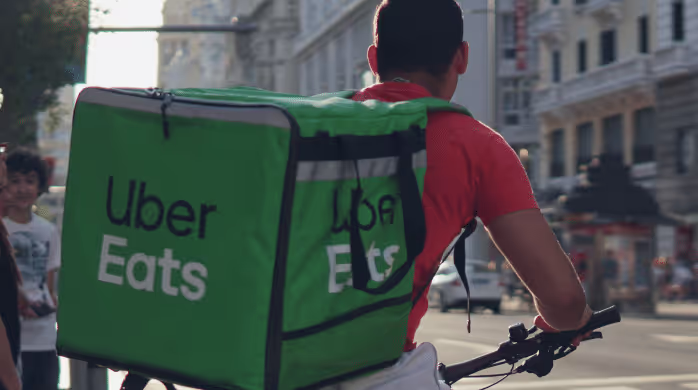
How to Make $1,000 a Week With Uber Eats in 2026 (Tips + Hourly Data)
In this blog, we'll explore the strategies and techniques that can show you how to earn $1000 per week as an Uber Eats delivery driver. We'll cover everything from optimizing your delivery zones and schedules to maximizing your tips and customer satisfaction. Whether you're a seasoned Uber Eats driver or just starting out, this guide will provide you with the insights and actionable steps to take your Uber Eats driver earnings to the next level.
Becoming an Uber Eats delivery partner can be a lucrative opportunity, especially if you're able to consistently earn $1000 a week. By understanding the platform, optimizing your delivery strategies, and focusing on customer satisfaction, you can maximize your earnings and turn Uber Eats into a reliable source of income.
We’ll cover the following topics to provide coaching and ideas to help you push your earnings up to that $1000 per week level:
What do Uber Eats drivers do?
Uber Eats drivers deliver prepared food most of the time, but they also might shop for and deliver goods from convenience outlets and grocery stores. The job is pretty simple. You get a request for an order, you drive to the restaurant or store to pick it up, and then you deliver it to the customer. If you already drive for Uber, you can choose to take orders for Uber Eats delivery any time.
If you’re not an Uber Eats driver yet, it’s pretty easy to become one. This Gridwise post tells you what you need to do if you want to sign up and start making money Uber Eats style. Many rideshare drivers welcome the chance to deliver food rather than people. This article from Nerdwallet covers the Uber Eats gig from that angle.
There are some sweet advantages to working with Uber Eats. In lots of cities you don’t even need to have a car. You can use a bike or a scooter, or even walk, to make your rounds. If you do use a car, Uber Eats’ requirements are a lot easier to meet than they are for Uber rideshare driving.
You also have a lot of flexibility. You can shop and deliver convenience items and groceries, but you don’t have to. And, like most driving gigs, you can choose your own hours, and map out the locations where you want to work.
Use Gridwise features When to Drive and Where to Drive to help you figure out what work hours and which specific areas will be the most profitable for you. Real data from real delivery people will show you earning patterns for drivers in your town.
How much can you earn doing Uber Eats?
The honest answer to this question is: basically, as much as you want! It all depends on how many hours you put in and how strategic you are about your gig. Earnings vary from one area to another, as this article from Entrepreneur points out. To give you a baseline, let’s look at the earnings of Uber Eats drivers who tracked their earnings with Gridwise.
Remember that these numbers show us only average earnings. To make $1,000 a week with Uber Eats, you’re going to have to be better than average, and we’ll show you how. For now, though, it’s good to have these figures so you get a ballpark number of where to start.
How much do Uber Eats drivers make?
Gridwise data tell us the following:
- Monthly earnings average around $444.00 per month.
- Gross earnings per trip are between $9.00 and $10.00.
- Tips make up about 50% of most Uber Eats drivers’ income, which amounts to about $225.00 per month.
Is Uber Eats good money? It can be. While there are other gigs that pay more per trip, if you drive for Uber Eats, you’ll always be pretty busy.
https://datawrapper.dwcdn.net/HPAz8/3
You can also see that, unlike many other gigs, tips play a huge role in Uber Eats earnings.

With these numbers as a baseline, what can we say about how to earn $1,000 a week with Uber Eats? As we said in the introduction, it’s going to be a hustle, but it’s really possible. To figure out how to make the most money with Uber Eats, let’s start by looking at how many trips these “average” drivers made each month.
We know that average gross earnings were $444.00 per month, and drivers got around $10.00 per trip. That means they took 44 or 45 trips per month, which breaks down to 11 trips per week. That’s not a lot of Uber Eats delivery, is it?
The fact that Uber Eats drivers averaged so few trips shows us that many drivers use more than one app at the same time. This is called multi-apping, and you can learn more about it in this Gridwise post. If you want to answer the question of how much you can make with Uber Eats, then you need to stick with the app and keep plugging away at those orders. You also need solid strategies, as well as some inside tips and tricks.
How to make the most money on Uber Eats: Delivery driving tactics
Getting to that $1,000 a week with Uber Eats isn’t so hard when you remember that the drivers we saw making about $111 a week were only taking around 11 trips in the same time period. That’s not much at all! If you work the Uber Eats app like a boss, you’ll soon have many more trips than that, easily reaching the number needed to get you to $1,000 a week. Now, let’s get to some tactics you’ll need to make that kind of bank.
- Stay with the Uber Eats app, and track your earnings. Gridwise can easily do that for you. Simply sync your Uber Eats app with Gridwise, and you’ll be able to see how much you’ve earned with Uber Eats, what times were most profitable, and your average hourly pay. Racking up trips with Uber Eats has other benefits, including perks and bonuses that are awarded to top drivers.
- Leverage surge pricing and promotions. Surge pricing is applied when there is a lot of demand. When surge pricing is in effect, many of the trips you make will pay more than usual. Promotions are offered to drivers who complete a given number of trips in a certain time period. High traffic volume days, nights, and times give you these chances to get extra earnings. Challenging yourself to complete the right number of trips for promotions will add to the number of trips you can count on for big bucks, too. Learn more about Uber Eats surge pay, boosts, and promotions in this Gridwise blog post.
- Say yes to doubling up on orders. With Uber Eats, you can get back-to-back orders or receive batched orders. Back-to-back orders happen when you receive a new request while you’re on the way to deliver an original order. The Uber Eats app routes these trips automatically, so you won’t be sent out of your way.
Batched orders are Uber Eats’ way of bundling together orders from either the same restaurant, or two nearby eating establishments. You get money, and trip count credit, for all the orders you complete, plus customer tips, without having to make a bunch of separate trips.
- Turn on the charm and get bigger tips. Being nice really is part of the Uber Eats driver’s job, and getting tips is one way people who drive for Uber Eats make money beyond their basic pay.. Bring along those extra napkins and condiments, use equipment that keeps food and drinks at the right temperatures and prevents spilling, and consider your customers’ needs. If you deliver groceries, be extra careful with delicate items such as bread and eggs.
And, most important, follow your customers’ directions, and stay in communication with them if you are going to be delayed, or if you have questions about their order. This Gridwise post will tell how to get bigger tips as a delivery driver.
- Use even more charm to keep your ratings high. As an Uber Eats driver, you will be rated by the restaurant or store where you pick up the orders as well as the customers who are waiting for the deliveries. This two-way rating system is designed to keep you on your toes, so Uber can keep people satisfied with your service. Don’t worry, you get to rate them, too.
There’s another reason why your rating as a driver is important. It not only keeps you in good standing with Uber; it helps you to qualify for the Uber Eats Pro incentive program. To learn more about Uber Eats Pro, and what it takes to earn perks such as preferred services, discounts, and deals, check out this Gridwise blog post.
Smart business moves that seal the deal
Now that you know how to gobble up the deliveries you need to make $1,000 a week with Uber Eats, it’s going to be a breeze to get there. Let’s make it even easier, with business moves that boost your earnings and shrink your expenses. If you use these, it will also be easy to say yes when people ask, “Can you make good money with Uber Eats?”
Minimize expenses. Avoid racking up big fast-food bills by bringing your own food and beverages. You might not think you’re hungry when you first start your Uber Eats run, but once the aroma of pepperoni pizza, premium cheeseburgers, and piping hot fries start wafting through your car, that might change. Bring a sandwich or other healthy food from home, and buy bottled water in bulk to save tons of cash compared to what it costs to buy single servings.
Maximize tax deductions. Another way to minimize your expenses is to maximize your tax deductions. Start by tracking mileage with Gridwise.
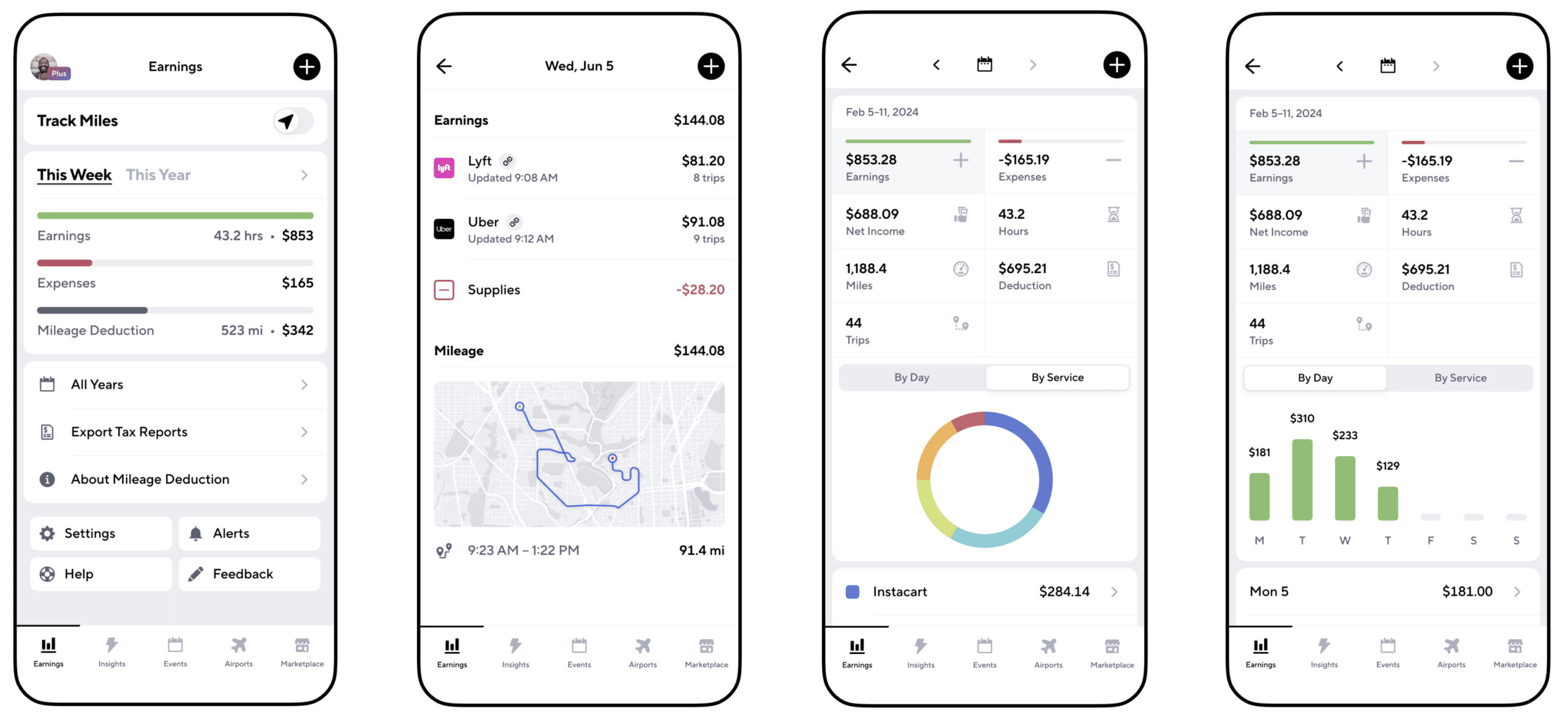
Gridwise App
Gridwise captures every deductible mile you drive, including the distance you cover between the trips your driving app records. Know what expenses you can deduct, and put them to work for you when tax time comes. Learn more about tax deduction strategies in the Gridwise Tax Guide for drivers.
Boost earnings with referrals
As an independent contractor, you’re probably looking for ways to make even more money than you can with Uber Eats. And most gig workers like you enjoy getting passive income. With Uber Eats, there’s a really easy way to do that, referrals!
All you need to do is find friends and encourage them to deliver for Uber Eats. If they make a certain number of deliveries within a specified time, you will get paid for doing nothing more than having them sign up under your referral code! Rates of pay vary by city, so check your Uber Eats app to find out what the current deal might be, and learn more about the referral program on the Uber Eats website.
Also remember: “friends” don’t have to be your best buds. Many delivery people carry cards with a QR code linking to their referral information, so just about anyone you encounter can join Uber Eats and boost your earnings. You could meet a source of passive income at the gas station, on social media, or at your high school reunion. The more you hustle, the more there is to gain, right?
Master the art of self-employment
As an Uber Eats driver, you’re an independent contractor. That means the company isn’t going to withhold your taxes, provide insurance, keep track of your earnings, or tell you about tax deductions. You’ll have to do all these things for yourself.
If you want to maximize your tax advantages, open an official business entity. You can incorporate (create a corporation) or you can work as a limited liability corporation (LLC). You can also work with a DBA (Doing Business As) arrangement, but the corporation or LLC will do a better job of protecting you from liability.
Establishing a corporation or LLC offers better tax advantages than being a sole proprietor. For instance, if you simply collect your earnings into your private account, you’ll be charged self-employment taxes in most states. And paying extra taxes is something we all want to avoid, within legal limits, as much as possible.
Every Uber Eats driver needs to learn about self-employment, and there are some great resources you can review. Check out the CareerOneStop website about self employment which will help explain the basics. You can also check with a professional tax accountant, or look other websites to learn more about actually creating a business.
Scope out your market
Look at the area around you to see where you’re likely to get the most deliveries. Where are all the restaurants? Where might people be more inclined to order deliveries? What hours do you want to drive? What activities might be going on around those times? Think about late-night and after-school times as well as breakfast, lunch, and dinner times.
Be realistic about the potential for your area and aware of new services opening up. For example, in New York, there is already a tab on the Uber Eats app that allows customers to order groceries. In our article about the best food delivery service to work for you’ll see that Uber Eats stacks up well against other delivery companies, mainly because of its potential for expanded opportunities for drivers to earn.
So, is Uber Eats good money? As we said, it isn’t an automatic guarantee that everyone will make $1,000 a week with Uber Eats. Trying out the suggestions we give you here, though, should put you on the right track! Go out there and start stacking up those orders and raking in some impressive earnings!
Get more inside information on Uber Eats in these posts from the Gridwise blog:
- The delivery driver guide: Using the Uber Eats app
- Everything you need to know about driving for Uber Eats
- Uber Eats Pro: What drivers need to know
- Looking for a different gig, part-time or full time job? Check out the Gridwise Job board.
Uber Eats FAQ
How does the Uber Eats platform work for drivers?
Uber Eats is a food delivery service that connects customers with local restaurants and independent delivery partners. As an Uber Eats driver, you'll receive notifications of nearby delivery requests, which you can accept and complete. The platform provides flexibility, allowing you to work on your own schedule and earn money based on the number of deliveries you complete.
What are the requirements to become an Uber Eats delivery partner?
To become an Uber Eats delivery partner, you'll need to meet certain requirements, such as having a valid driver's license, a registered vehicle, and passing a background check.
How can I choose the right delivery zone to maximize my earnings?
Selecting the right delivery zone can significantly impact your earnings, as some areas may have higher demand and better-paying orders. It's important to research and identify the zones in your area that tend to have the most consistent and lucrative delivery opportunities.
How can I take advantage of peak delivery hours and surge pricing?
Understanding peak delivery hours, such as mealtimes and weekends, and taking advantage of surge pricing can boost your earnings. Be aware of when demand is highest in your area and adjust your schedule accordingly to capitalize on these peak periods.
What are some tips for maximizing tips and customer satisfaction?
Providing excellent customer service and going the extra mile to ensure a positive experience can lead to more tips and repeat business. Prioritize communication, timeliness, and attention to detail to keep your customers happy and satisfied.
How can I set realistic weekly goals to reach my $1000 target?
To make $1000 a week with Uber Eats, it's essential to set realistic weekly goals and track your earnings and expenses. Start by determining your target earnings and breaking it down into achievable daily or weekly goals. This will help you stay on track and make adjustments as needed.
What are some strategies for efficient route planning and navigation?
Effective route planning and navigation can save you time and fuel, allowing you to complete more deliveries. Utilize mapping apps and take advantage of features like real-time traffic updates and turn-by-turn directions to find the quickest routes.
How can I balance my Uber Eats deliveries with other commitments?
Develop a schedule that allows you to capitalize on peak delivery hours while still maintaining a healthy work-life balance. Consider using tools like calendar apps to plan your availability and track your hours to ensure you're maximizing your earning potential without sacrificing your personal life.
What are the key considerations for maintaining my vehicle as an Uber Eats driver?
Keeping your car clean and well-maintained is crucial for maximizing your Uber Eats earnings. Regularly scheduled oil changes, tire rotations, and other preventive maintenance can help extend the life of your vehicle and minimize downtime. Additionally, budgeting for vehicle-related expenses, such as fuel, insurance, and repairs, will ensure you're accounting for these costs and maximizing your net earnings.
What are the tax obligations and legal considerations for Uber Eats drivers?
As an Uber Eats delivery driver, it's essential to understand the tax obligations and legal considerations that come with being an independent contractor. This includes properly reporting your earnings, deducting eligible business expenses, and making quarterly estimated tax payments. Additionally, you'll need to ensure you have the appropriate insurance coverage, such as personal auto insurance and possibly commercial auto insurance, to protect yourself and your vehicle while on the road making deliveries.

The Gridwise Job Board: Find Your Ideal Job or Gig Work
Gridwise is an essential assistant app created by gig workers for gig workers. Our mission is to support those engaged in gig work in every way possible. We understand how challenging it can be to deal with income instability, a lack of benefits, and job insecurity that often comes with gig work. The Gridwise app tracks and organizes earnings and expenses, and offers a wide array of discounts, deals, and services that make the lives of independent contractors easier and more rewarding.
We firmly believe it’s possible to make a viable living and create a gig experience that offers flexible hours, variety, and excitement. With issues such as consistent earnings and job security in mind, Gridwise is proud to offer a centralized platform that shows you how to find gig work and secure reliable opportunities. We’re proud to introduce the Gridwise Job Board.
The Gridwise Job Board: Key features
Because Gridwise is dedicated to serving the gig worker community, we’ve filled the Gridwise Job Board with useful features that won’t waste your precious time.
- Comprehensive listings. Find part-time, full-time, temporary, and per-task work. Drive or deliver with your vehicle, utilize an employer’s vehicle, or even find non-driving gig work.
- User-friendly interface. Find the jobs that are right for you with a tap of your screen.
- Verified opportunities. We vet the jobs before they are listed to ensure you’re getting high-quality job postings.
How to get more gig work, seasonal, part-time or full-time jobs with the Gridwise Job Board
Looking specifically for “gig work apps” or “gig jobs near me?” You’re in luck. Our filters and search functions send you directly to the listings you seek.
Here’s how it works.
- Access the Job Board via the Gridwise website.
- Search for jobs by type, location, and more.
- Select the job that interests you, and read all about it.
- Scroll through the description, and if it appeals to you, click “Apply for job.”
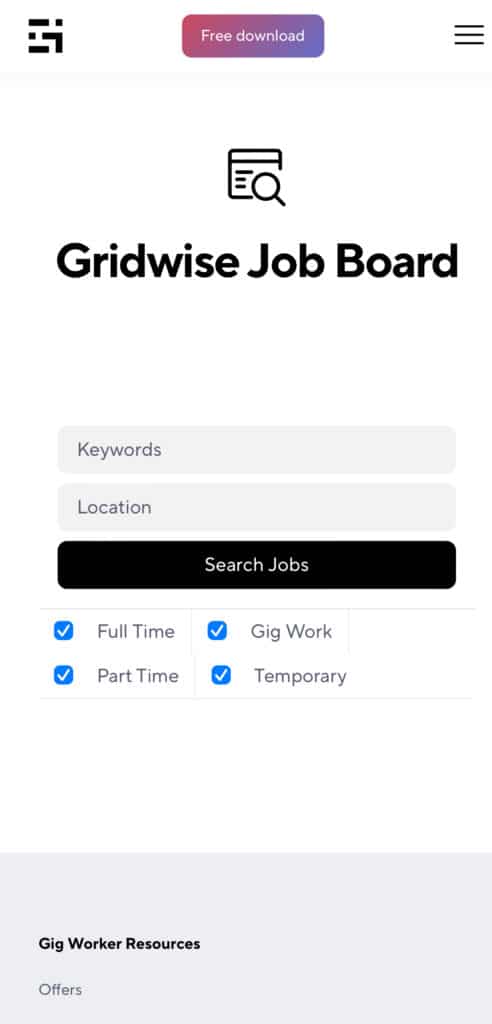
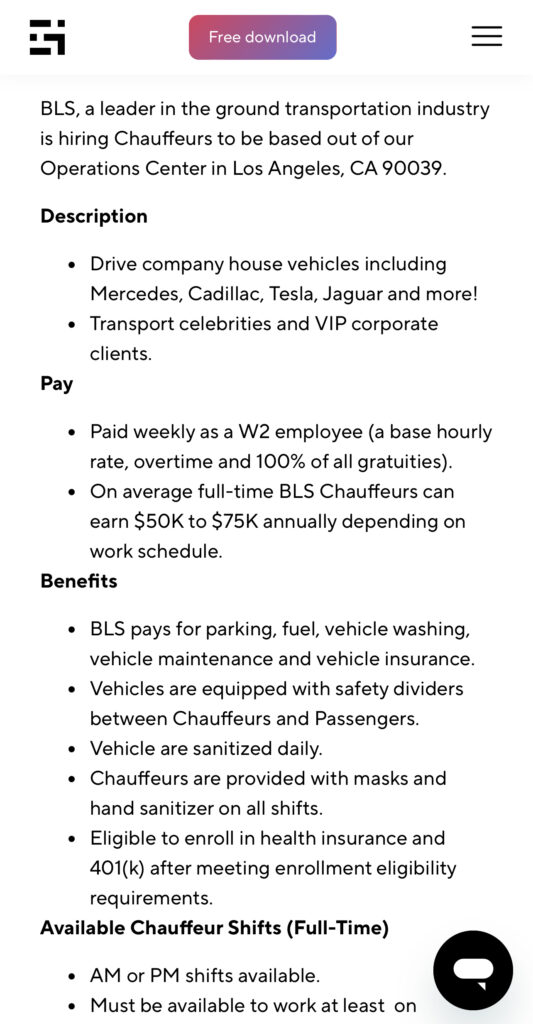
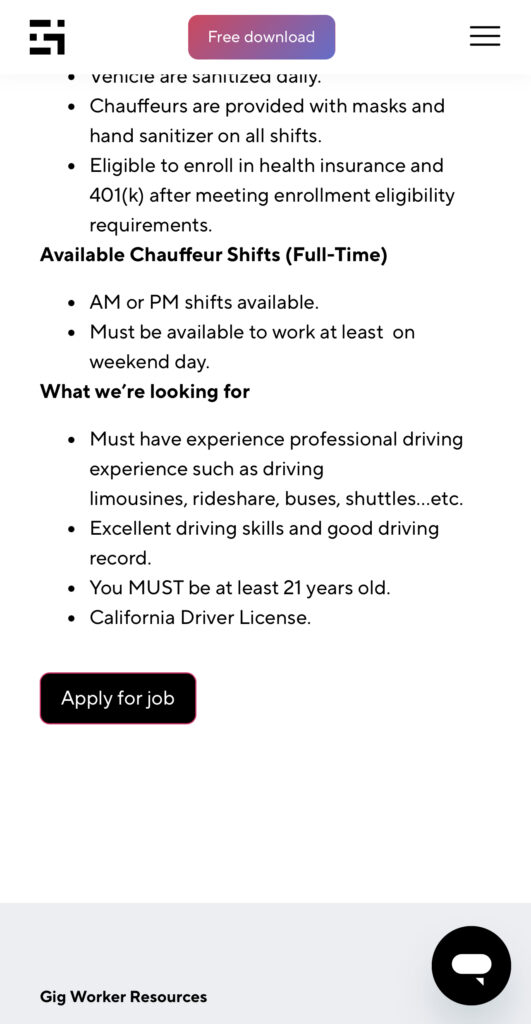
Many types of jobs are available. Adjust the search filter to see the full variety of opportunities that will let you cash in. Deliver food, set up catering, do rideshare driving, get paid for doing package delivery, and much more. You’ll find short-term gigs, long-term contracts, and part-time positions.
Perks of the Gridwise Job Board for gig workers
Gig workers who know how to make extra money will appreciate how the Gridwise Job Board lets you multiply your chances of bringing in big earnings. Here’s how:
- Increased stability. Use the Gridwise Job Board to find part-time or permanent jobs in addition to the part-time gigs you already have. Always keep a steady stream of earning opportunities flowing toward you.
- Flexibility and autonomy. Choose jobs that fit your schedule, work around other jobs and family duties, and still leave room for some fun in your life. Discover side hustles to supplement your full-time job, permanently or just for the season.
- Skill development. Find part-time work that lets you use a skill you already have, or try your hand at something new. It’s a smart way to develop a portfolio to showcase what you can do, or even to find permanent employment.
Get Gridwise and stay up to date on the Gridwise Job Board
Gig workers need plenty of information and assistance, and Gridwise is here to give it to you. Download the app and get essential features such as
- seamless earnings tracking
- mileage tracking
- expense recording, including notes
- low-cost and no-cost insurance benefits
- access to affordable medical, dental, vision, mental health, and alternative care
- professional services including legal and financial help
- deals and discounts
- weather, events, and traffic reports
- inside information on where and when to drive
More to know about gig work:

5 Best Mileage Trackers For Gig Drivers
Many drivers ask, “Do I really need a mileage tracking app?” The answer is simple: only if you want to have an accurate count of all the miles you can legally deduct from your taxable income! You might think your rideshare or delivery driving app has got you covered. After all, they do quite a good job of logging the miles you drive while you’re on a trip or delivery. But, if you want to have the best app to track mileage for Uber, Lyft, Doordash, Instacart, or the other apps you may use, you need more. Why is that?
Without a separate tracker, you’re missing the miles you drive in between pings. Did you realize that all the miles you drive, from the moment you begin your shift until it’s over (as long as you don’t drive several miles on a break to hang with your friends), are tax deductible! That means you need something besides your driving app to keep an accurate count of your travels. Read this Gridwise post to see how important it is to keep track of every deductible mile.
You won’t be surprised to hear that there’s an app for tracking miles. In fact, there are several of them. Here, we’re going to tell you about five top mileage tracking apps, and help you figure out which one is best for you.
Before we get to the list and identify the best mileage tracker app, let’s clarify what exactly a mileage tracking app is. According to G2.com’s technology glossary, mileage tracking is done for the purpose of keeping a log of mileage that is either reimbursable or tax deductible.
And yes, of course you can track your miles simply by taking readings on your odometer. But are you really prepared to account for how many miles you drove for personal reasons and subtract them from the total to get your business mileage? Even if you can remember all that and do the arithmetic, if you want an accurate reading of the miles you drive for business, and can therefore deduct, a mileage tracking app will save you a lot of trouble and prevent you from making costly errors.
Plus, as a gig driver, you have specific needs when it comes to a mileage tracker. Ideally, you’d be able to handle mileage tracking and several other functions all in one app. It can be maddening enough to deal with driving apps, particularly if you’re an avid multi-apper. You would want your mileage tracker app to help you keep account of other aspects of your business, including income, expenses, and inside information about the art of gig driving.
Not all mileage apps are equal, to be sure! Let’s look at five of the best apps to track mileage and figure out which is the best app to track mileage with Uber and Lyft, or what mileage tracker app is best for DoorDash.
1. Zoho Expense
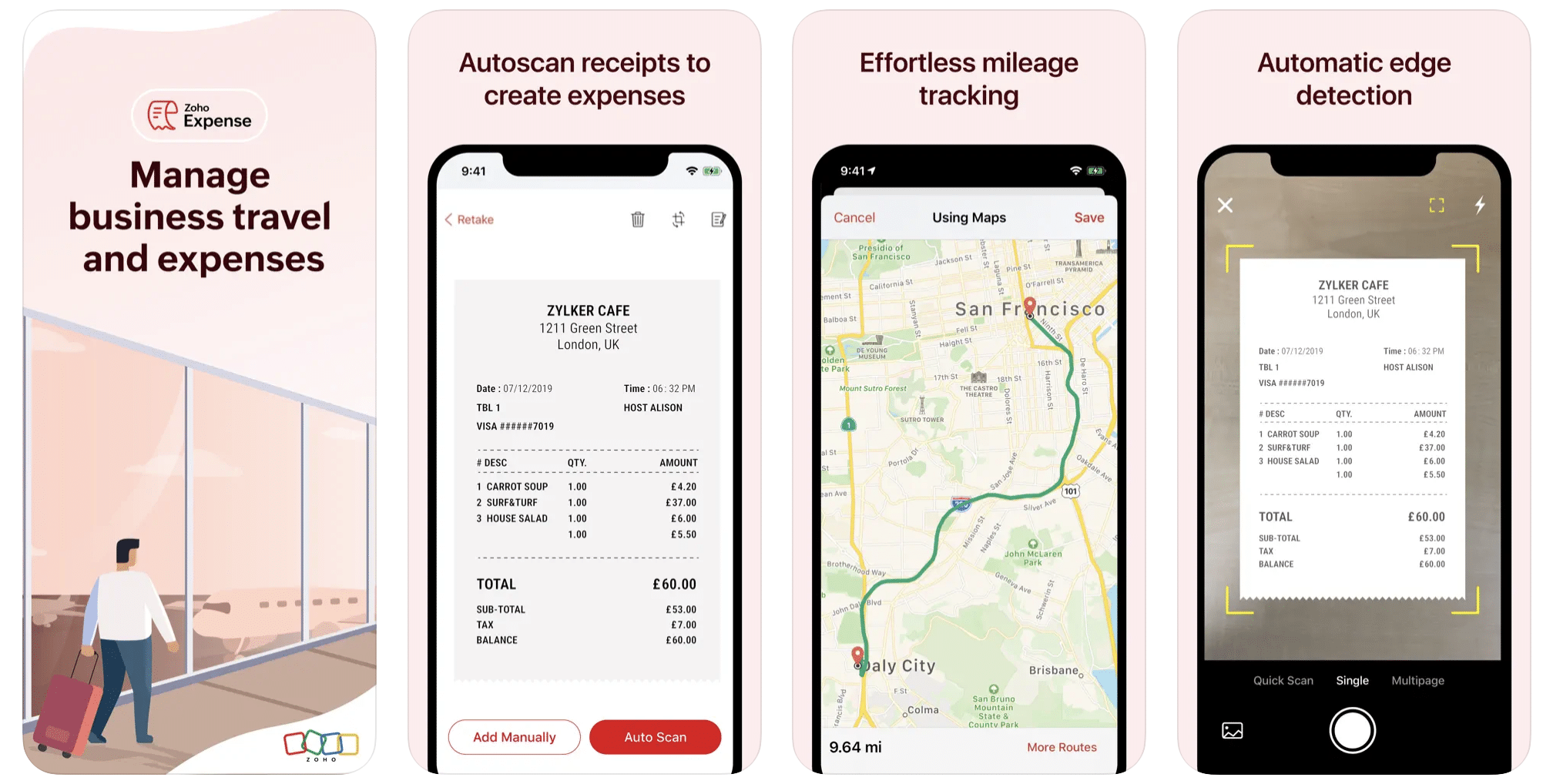
First up is Zoho Expense, which does exactly what its name says. This app is designed to allow companies to give employees a uniform way to create and submit expense reports. It can be used by individuals, including gig drivers, as well.
It includes a mileage tracker, as well as features that let you track other deductible expenses, including the ability to scan and record receipts.
Available on Android and Apple: Yes
Ratings: 4.8 stars on App Store, 4.7 stars on Google Play
Free Version: Yes
Subscription price: $3 per month, billed annually
Created specifically for gig drivers: No
2. Quickbooks Online
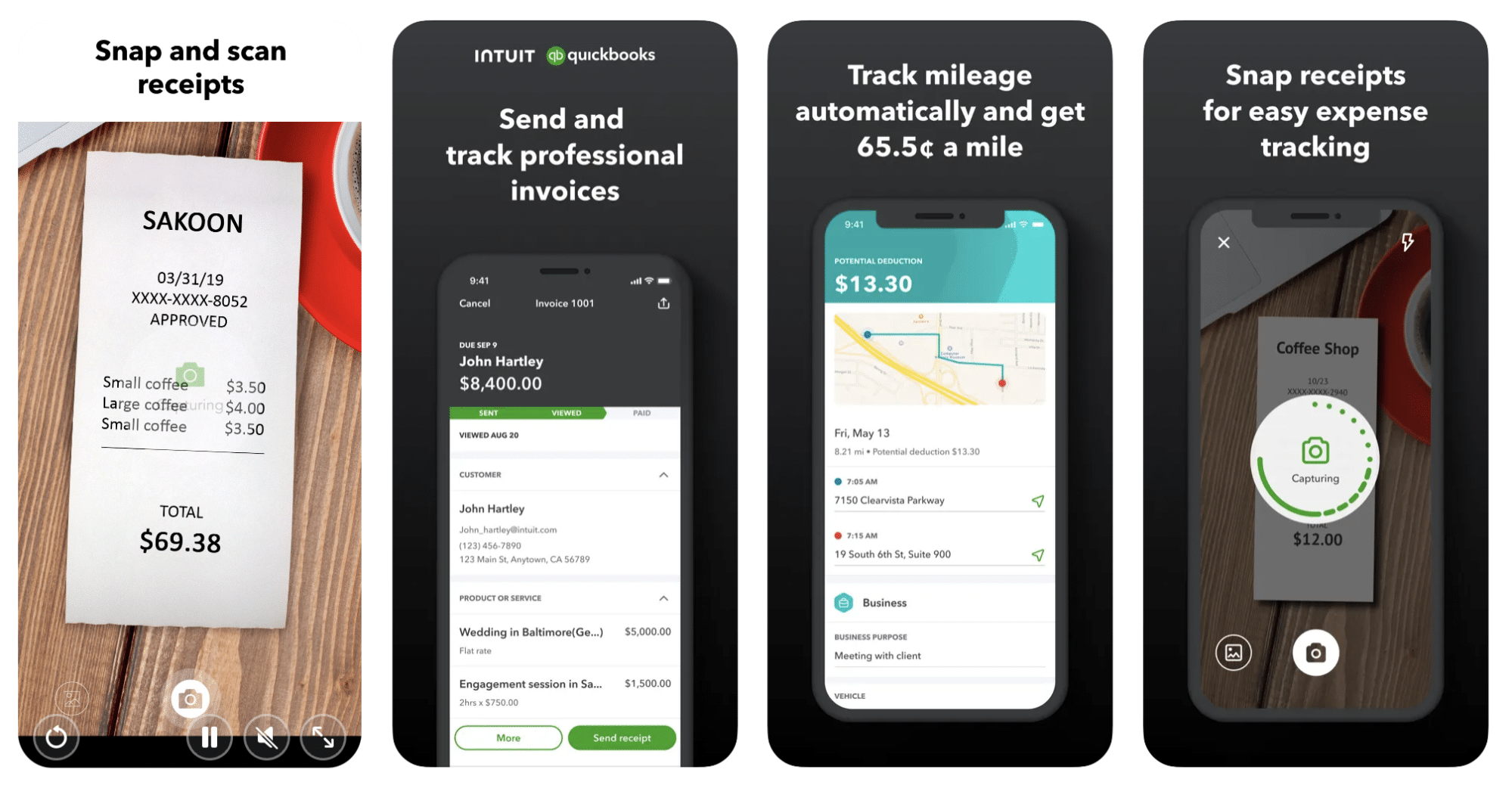
Quickbooks Online is a cloud-based app that allows you to track your mileage, earnings, and expenses. The information you enter can then be used to generate various reports that prepare you for tax time. It also allows you to create graphs that illustrate your cash flow, and includes a receipt scanner so you can instantly record deductible expenses. Quickbooks is popular, highly reliable, and designed mainly to help people keep track of their small businesses.
Available on Android and Apple: Yes
Ratings: 4.7 stars on App Store, 4.4 stars on Google Play
Free version: 30-day free trial
Subscription price: $15 per month for basic version if purchased for 3 months or more
Created specifically for gig drivers: No
Source: quickbooks.intuit.com
3. Shoeboxed
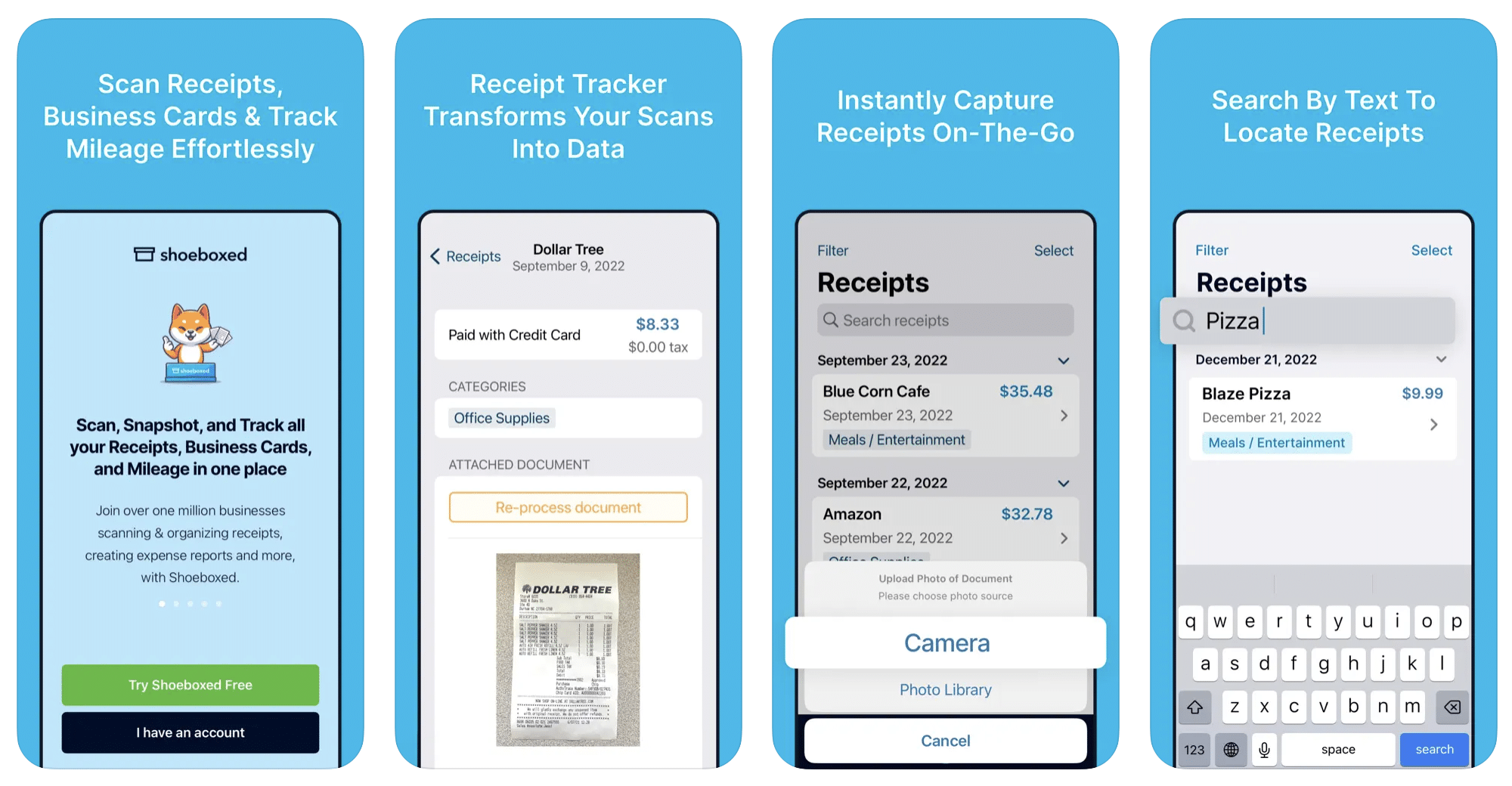
Shoeboxed started in 2007 as a service for scanning paper receipts into digital form. Now the app offers a free mileage tracker and has enabled users to scan receipts directly. It touts itself as the best mileage tracking app for DoorDash, but there are some elements missing that Dashers might like to have. While it provides features that record your expenses and prepare you for tax season, it doesn’t automatically track your earnings. The mileage tracker has a system where you can drop pins along your routes to make the tracking more precise, identifying those legs of a trip that you make for business purposes. The mileage tracker is “free” once you sign up for the basic version.
Available on Android and Apple: Yes
Ratings: 4.5 stars on App Store, 2.3 stars on Google Play
Free version: No
Subscription price: $18 per month for basic version
Created specifically for gig drivers: No
Source: blog.shoeboxed.com
4. Stride
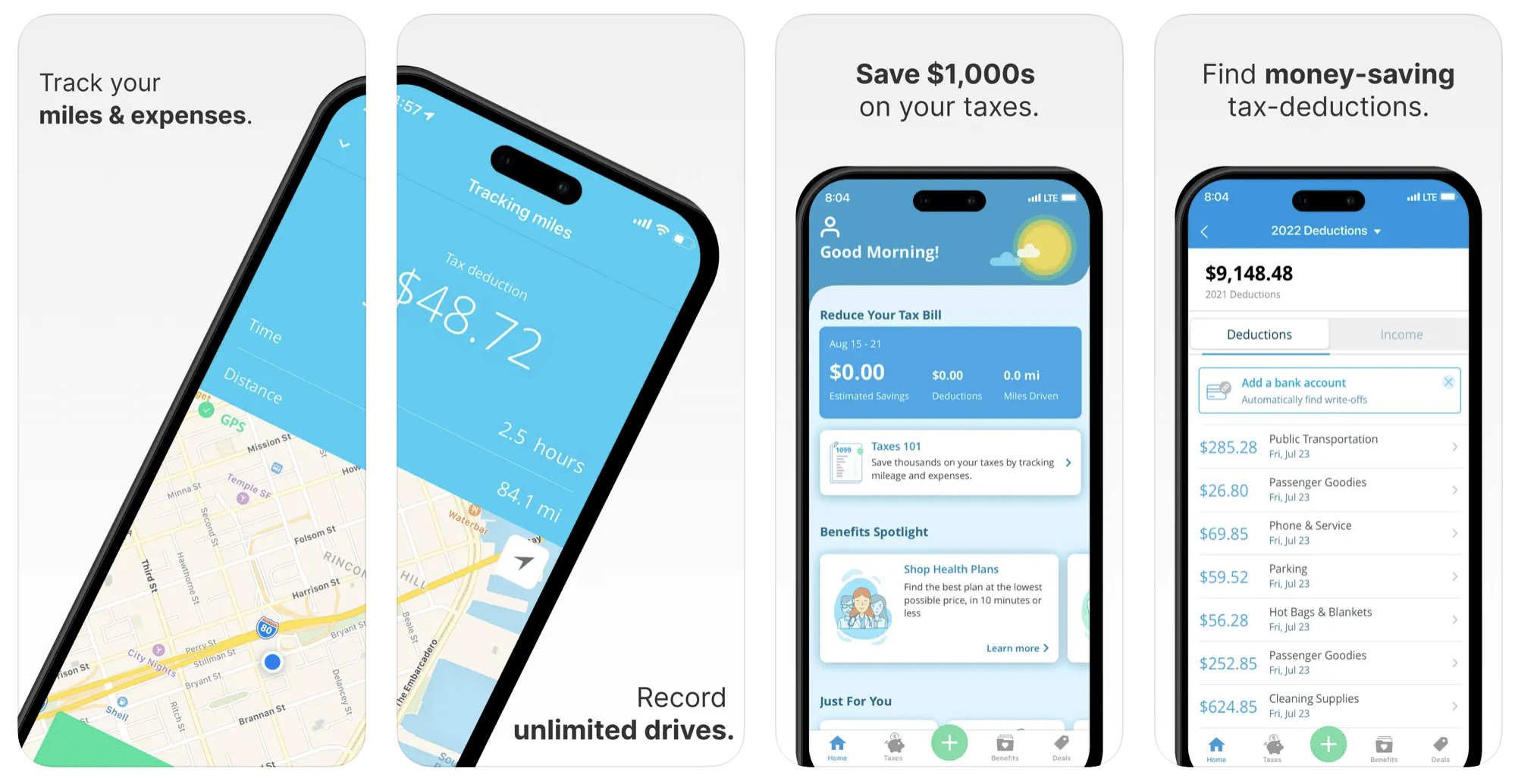
This free mileage tracker does a fair job of keeping track of the distances you rack up while gig driving, but it doesn’t automatically track earnings. It can be a big help, though, in tracking your expenses. You can link Stride to your bank account, and it will automatically scan your expenses to identify items you can potentially deduct. The app is totally free. This could make it the best free mileage tracker app, but there is a small price to pay. The app will persistently push you to consider various insurance plans that they are affiliated with. If you don’t mind that, this is a solid mileage tracker, even if it doesn’t track your earnings.
Available on Android and Apple: Yes
Ratings: 4.8 stars on App Store, 4.6 stars on Google Play
Free version: Yes
Subscription price: None. The app is free.
Created specifically for gig drivers: No
5. Gridwise
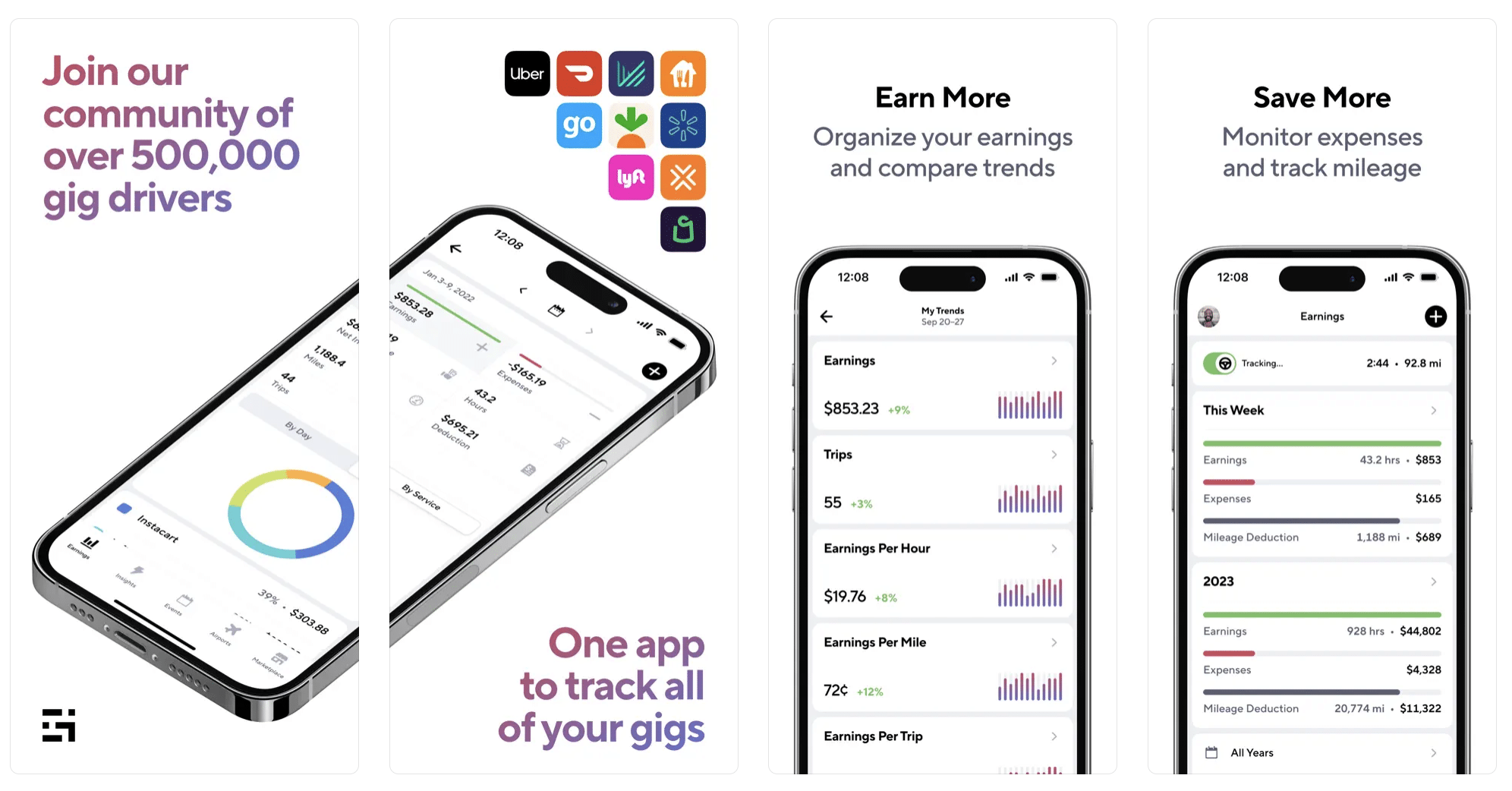
Gridwise has a free mileage tracker and free features that record your income and expenses. It gives you access to insurance and benefits, as well as insights about the best times and places to make the most money while gig driving. The Gridwise mileage tracker captures all the miles you drive while you’re on your driving shift, and it can be used if you have other trips you need to make which qualify as business travel.
Drivers love it because it is geared toward the needs of rideshare and delivery workers, providing free information about airport departures and arrivals, event start and let out times, weather, traffic, and more. The Gridwise Plus subscription adds value by providing additional insights and reports, discounts on benefits, the ability to export data in .csv format,, and more.
Available on Android and Apple: Yes
Ratings: 4.9 stars on App Store, 4.6 stars on Google Play
Free version: Yes
Subscription price: $9.95 per month for Gridwise Plus, or $95.99 per year (a $23.41 savings)
Created specifically for gig drivers: Yes!
What is the best mileage tracking app?
Now that we’ve checked them all out, we’re positive about the answer to that. Hands down, it’s Gridwise. Are we biased? You bet we are! But drivers love it too. Gridwise is the best mileage tracker app, and so much more. So many of the features are free, and the subscription to Gridwise Plus will pay for itself with additional insights to boost your earnings and deeper discounts on products and services.
Most important, Gridwise is designed specifically for gig drivers by experts who were once gig drivers themselves! Knowing what gig drivers need is a crucial step in creating an app that rideshare and delivery drivers can really use! Here are a few of the features, besides mileage tracking:
- seamless earnings tracking
- automatic, on/off toggle and manual mileage tracking
- mileage categorization
- airport, traffic, weather, and events information
- insights into where to drive and when to drive
- reports showing earnings across the platforms you use
- discounts on countless products and services for drivers
- additional resources for finding side gigs
- an informative and comprehensive blog
- affordable benefits, including insurance, medical, dental, and alternative practitioner discounts
- a community of drivers just like you
Don’t settle for just any app. Get the best mileage tracker, and so much more, from Gridwise!
Getting schooled: 5 things drivers need from career training bootcamps
As drivers, we constantly get pummelled with recruitment materials and ads for training academies of all different kinds. Why do these companies want to get our attention?
Maybe because they know that being a full-time driver isn’t easy, and most of us don’t intend to drive forever. It’s just something we do until the next big thing comes along.
For many of us, training in a new field makes a lot of sense, and right now the most popular kinds of training academies are coding bootcamps. In this blog post, we’ll focus on these bootcamps, and talk about what drivers should look for when they choose one. We’ll also learn more about the decision process from one of our drivers, Jim, who recently chose a school and enrolled in a program.
Here’s how we’ll break it down:
- Why coding?
- Jim’s story
- 5 things drivers need in a coding bootcamp
- Coding Dojo: the winning choice
Why coding?
Coding, or the art and science of creating the software and apps that run the engine of today’s economy, covers a lot of ground. You can learn everything from how to make an app more pleasant to use, to how to design a database and make it easier for a company to contact its customers.
People who know how to code are very popular with job recruiters these days – and are also well-paid. According to a July 2020 report on Career Karma, coders earned an average annual salary of $63,903 during 2020. Beginning coders got an average of $50,000, and experienced coders pulled in around $85,000. And of course, there’s always room to earn even more.
You don’t have to be a natural-born computer genius to make coding your new profession. All you need is an ability to focus, a desire to solve problems, and the determination to see projects through. It also helps if you like to work with others, because most projects that coders work on require a lot of cooperation.
If you’re reading this while you’re on a break from driving passengers or making food deliveries, you might think there’s a big leap between what you’re doing now and becoming a full-fledged IT professional. While it won’t happen overnight, it’s definitely something many drivers can do. A conversation with a real driver-turned-coder might show you that this kind of game-changing career switch is truly within your reach.
Jim’s story
Jim drives and delivers for Uber, and began doing so straight out of college. He studied psychology in a four-year program, but shortly after graduation he discovered that his career prospects weren’t good. He didn’t want to go on to grad school to become a therapist, and he didn’t see how he could make a lot of money in his field. Just about the only jobs available were research assistant spots at the university he attended, and they paid about $10 per hour.
Driving for Uber made sense because he didn’t like the other options he had – sales and customer service – and he could make more as a driver. Plus, he could choose his hours and get his pay in his pocket within minutes of finishing his shift.
After four years of driving, though, Jim got tired of the grind. He also saw that his income was stuck at a level that wasn’t going to rise unless he worked 50 or 60 hours a week.
Also, he missed the intellectual challenge of being in school, working on group projects and solving problems. He was looking for something exciting, a new path that would lead him toward a career he could count on.
Jim heard about coding through ads he saw for various coding bootcamps. He knew there were a lot of different options and it took some time to figure out which one was right for him, his skillset, and his talents. Also, he wanted a school that would give him the training he needed to jump into a career right away and to be the best at what he does.
There are schools that offer training in user interface, graphics, data management, and software engineering. Many of them provide access to top-notch training, employers, and six-figure salaries. Some require full-time, onsite attendance, while others allow students to study online, and in some cases at their own pace.
Jim’s situation, like that of many drivers, had its limitations. He couldn’t really manage to work full-time and go to school full-time, and he also needed to consider the costs involved. Ideally, he would find a school that allowed him to continue driving when he wasn’t in class or completing assignments.
From our talk with Jim, a real driver, we gained firsthand insight into what to look for in a coding bootcamp. He honed in on the major points that you can utilize for any search for the right bootcamp.
5 things drivers need in a coding bootcamp
Here’s what Jim looked for in his bootcamp search and what you might want to look for, too. These suggestions are not in any particular order, so you can decide for yourself which are most important to you.
- Focus on marketable skills. There are many functions coding professionals can perform in a company, and some schools address all of them. Jim wanted to attend a school that was less concerned about theories, history, or other tertiary topics. He wanted a school that taught him applicable and marketable job skills, as well as one that would give him the ability to be among the best in his field.
- Affordable. Tuition is never cheap, whether at a full-time college or a bootcamp. Since Jim had already gone through college and was still paying off hefty student loans, he needed to go to a school that was reasonably priced, and offered scholarships and/or payment plans.
- Real-world orientation. Jim didn’t want to get stuck in a school that was lost in an academic cloud, with little or no real connection to the real world. While he thought it would be fun to design programs with futuristic or idealistic aspects, he knew that if he wanted to work right away, he’d need something different. He needed a school that knew what employers wanted, and also had connections to people who could get him a real job.
- Fast and flexible. Jim didn’t have another four years of his life to spend in school; he had to have a program that gave him fast results. At the same time, he wanted to continue driving while he was in training so he could still pay his bills. That meant the program of his choice would have to allow him the flexibility to attend class and work at the same time.
- A balance of personalized training and collaboration with other students. While Jim met plenty of people when he was out on his driving gigs, it had been a long time since he’d been involved in a meaningful group project. He missed the days of gathering together with others who were passionate about what they were learning, and who enjoyed sharing their findings.
He also knew he’d need personalized attention from time to time because coding would be so new to him. It would be great if he could have access to instructors in case he got lost at sea while navigating his way through the program.
Coding Dojo: the winning choice
There are numerous coding bootcamps, but few really offer everything drivers need. We’ve looked through the offerings of a ton of bootcamps, and we can see that Coding Dojo is the one school that hit all five of the basic requirements for drivers, and offers even more.
Coding Dojo was founded by Michael Choi, whose entrepreneurial projects in Silicon Valley revealed to him how hard it was to find top-notch software engineers. He opened Coding Dojo because he knew how much he needed skilled professionals. He knew that other companies were looking for them too. He designed the Coding Dojo curriculum around the goal of giving students what they needed to be as competent and successful as possible, with his real-world knowledge of what makes good software engineers.
Choi used scientifically based learning technologies to build Coding Dojo. This makes this coding bootcamp one that not only provides information, but also teaches students in ways they can truly learn and apply the teachings. Here’s how Coding Dojo measured up to the rest of the items on what we see as the driver’s must-have list:
Coding Dojo has a software engineering focus. Coding Dojo is oriented toward the more technical end of the coding continuum. Programs give graduates expertise in three stacks, which are combinations of programming skills that ensure familiarity with the front and back ends of a program, as well as the database. Students are taught what each has to offer, how they differ, how they are similar, and most importantly -- how to use them to create digital products, which makes it possible for students to apply their knowledge in the real world. Coding Dojo’s programs in software engineering and data science are dedicated to keeping the focus on the high-tech, in-demand skills drivers need to create new careers.
Coding Dojo is affordable. At a price of $7,700, Coding Dojo’s 2-stack online program is within reach for most drivers. Available onsite options go into even deeper depth, but starting with the online option and then later investing in more training might make sense for many drivers. It’s easier to know what you need to learn once you get into the field and start making money. Also, with scholarships and payment plans, there’s no need to pile on student debt in order to pay for tuition.
Coding Dojo is oriented toward the real world. With real-world experience driving the design and execution of the Coding Bootcamp program, Coding Dojo students learn skills that are applicable in the workplace, and also in high demand. In fact, 89.1% of Coding Dojo graduates find relevant jobs within six months, and 95.3% find relevant jobs within one year.
Coding Dojo is fast and flexible. With on-campus and immersive online programs that teach three stacks in 14 weeks, full-time bootcamp students can get done in just a few short months. The online flex program goes for 28 weeks is a great one for drivers, too, because they would only need to be in classes for 10–15 hours per week. With the online flex program, you could continue driving, and making money, while you’re in training.
Coding Dojo offers personal attention and group interaction
Even in the online program, it’s always possible to get one-on-one attention from an instructor whenever it’s needed. Also, the program assigns students to teams as they set out to solve problems they are sure to encounter in the real-world, team oriented workplace.
Change your life with Coding Dojo!
Could it be that you’re growing weary of the driving routine? If so, take action now. Jump into coding bootcamp with Coding Dojo. It’s definitely a winning choice.
Get a course packet here, and before long, you could be on your way toward a lucrative, challenging, and fulfilling coding career that will get you out of the gig driving grind - and change your life.

The best insurance options for rideshare (Uber and Lyft) and delivery drivers
Are you an Uber or Lyft driver looking for car insurance?
Or, perhaps you’re a food delivery driver working for DoorDash, Uber Eats, Postmates, or Instacart, and need car insurance?
No matter which applies to you, there’s a lot about insurance that drivers need to know.
We at Gridwise want to make sure you get information in a way that’s honest, balanced, and focused on you, the rideshare and delivery drivers who keep the world moving, well-fed, and amply equipped.
That’s why in this post, we’ll help you understand the best auto insurance options by talking through the following points:
- What is basic insurance?
- Is basic insurance enough?
- What about rideshare insurance?
- What should drivers demand from an insurance company?
- How can drivers find the right insurance company?
- How much drivers can expect to pay for insurance and 10 top companies
- Are there other add-ons that can help drivers?
What is basic insurance?
The term “basic requirements” refers to the minimum amount of insurance required by your state. The basics almost always consist of two types of liability: bodily harm and property damage. For instance, according to a June 2020 article by Michelle Megna, editorial director of carinsurance.com, this requirement is expressed in the following format: 20/40/10. The first two numbers refer to bodily injury liability limits, and the third number indicates property damage liability.
The example shown translates to $20,000 liability per person per accident, $40,000 maximum coverage per accident for bodily injury, and $10,000 for property damages.
In some states, such as Kentucky, drivers are required to carry Personal Injury Protection (PIP), which is coverage for your personal injuries and lost wages regardless of who is at fault. You may want to investigate including PIP coverage in your policy, even if your state doesn’t require it.
Depending on where you live, you may also need insurance to cover losses in case you’re involved in an accident with an uninsured motorist. Twenty-two states require this coverage, which is aptly named Uninsured Motorist (UM) coverage. It might be something worth considering, in light of an alarming fact: Even though driving without insurance is illegal in nearly every state, according to the Insurance Research Council, 1 in 8 drivers are not insured.
if you have an accident caused by an uninsured motorist, you could get stuck paying your own medical and vehicle repair bills. Being hurt is bad enough; being caught without coverage for the costs of your care could be catastrophic.
This article shows you the minimum (aka, basic) liability coverage for each state.
Is basic insurance enough?
In most cases, the state minimum will provide enough insurance to take care of your needs. To determine if this is true for you, take an honest look at your vehicle, consider how much it would cost to replace, and how much you might really need to cover your medical expenses, and those of others in the accident, should you get involved in a bad mishap.
Also, if you finance your vehicle, it’s a smart idea to purchase gap insurance, which takes care of the difference between the vehicle’s book value and the amount you owe on the loan. Suppose, for example, two years after you buy the car you’re in an accident and total it. The insurance company will write it off and reimburse you for what it’s worth. It’s entirely possible for your car to be worth $15,000, whereas you owe $20,000 on the loan. You will be responsible for paying that balance, even if you no longer have a car. That’s where gap insurance can be a godsend because it will cover that $5,000.
These are some of the concerns that relate to you as an individual driver and auto insurance policyholder. When considering your rideshare and/or delivery business, things become even more complex.
What about rideshare or delivery insurance?
When you’re a rideshare driver, you have passengers in your car much of the time. You’ll want to make sure you have coverage for your passengers that includes bodily injury. This protects you from having to dig deeply into your pockets in order to compensate them after a lawsuit. If you deliver, you have to make sure that your policy will cover losses incurred in the course of your work.
Fortunately, most rideshare and delivery platforms provide extra insurance, but it only works while you’re online with the app. If you have an accident while you are on the app, coverage provided by your rideshare or delivery company will kick in. This covers you as well as your passengers and third parties who might be involved.
Here are three scenarios to illustrate how insurance coverage typically works:
Period 1: You’re not on the app, meaning you’re driving for personal reasons. There is no coverage from your rideshare or delivery company; rather, your personal auto insurance applies.
Period 2: You’re on the app, but have not accepted a trip. You’re covered for third-party liability, but only if your personal policy doesn’t apply. You’re not covered for collision.
Period 3: You’re on the app and either riding with a passenger or in the process of executing a delivery: Your company covers you for personal injury, 3rd party liability, and collision. Note: The collision aspect may be covered only if you carry personal insurance on the vehicle that covers you while you’re not on the app.
Please note, the companies are notorious for their high deductibles. Both Uber and Lyft set theirs at $2,500, with the exception of vehicles offered through their marketplace.
You can learn a lot more about exactly what coverage companies offer through our informative rideshare insurance article.
Delivery companies offer coverage similar to what’s offered by rideshare platforms. Amazon Flex, DoorDash, Postmates, and Uber Eats all offer generous policies that cover you at varying levels, depending on the phase of delivery you’re in if and when you have a loss, at a maximum of $1 million in benefits. At this time, neither Grubhub nor Instacart offers an insurance policy for drivers, so you’ll want to make sure your personal policy can provide adequate coverage.
On the subject of that personal policy … if you use your vehicle for rideshare or delivery, you must inform your insurance company that you are doing so. If you neglect to notify them, and they find out you’re using your vehicle for gig driving, and you’re in an accident, your personal auto insurance may not cover you—even when you’re not on the app.
To ensure that you’re covered under all circumstances, you’ll need to purchase a rideshare and/or delivery endorsement to add to your basic auto insurance policy. Not all companies offer endorsements; many will simply refuse to cover you if you are a rideshare or delivery driver. In some cases, you may be required to carry commercial insurance, which applies to drivers in New York City and in certain other areas of the country.
Why would you need this? Remember, insurance companies, when they agree to sell you coverage, calculate risk. As a gig driver, you’re out and about far more than you would be otherwise, and you’re accruing more mileage and wear and tear than vehicles that are not being used for rideshare or delivery. For those reasons, they want you to pay for the possibility of extra loss of value on the vehicle, as well as the enhanced risk of carrying passengers and making all the extra trips that are required of delivery drivers.
Rideshare and delivery endorsements are not typically that expensive. Some cost as little as $20 per year, with an average of $94 for six months.
Two other extras you’ll want to consider are reimbursement for a rental car and towing, and road assistance. Many companies include these extras in the price, while others consider them add-ons. Even if you already belong to a separate service, it does no harm to have an extra source of roadside help to call upon in an emergency.
What should drivers demand from an insurance company?
Now that we’ve reviewed the various types of coverage, here are some factors to consider when deciding on an insurance company:
- Adequate coverage. Make sure the company can provide a policy with enough coverage to meet your needs.
- Endorsements for gig drivers. Although many companies accommodate gig drivers, not all of them do, so be sure to ask.
- Ease of communication. You want a company that will be responsive to you, whether it’s a question about your coverage or a claim you need to make. If you have an accident, you’ll need immediate attention—along with some verbal reassurance. Make sure your company offers abundant support.
- Solid financial standing. Insurance companies come and go, so don’t fall for the cheap outfit that goes belly up when you need it. Most companies are reputable; if you run into an insurer that is not mainstream, be sure to examine the company’s financial situation.
- Reasonable price. Choose a company that isn’t going to overcharge you for premiums, and offers a deductible you can manage—and remember, the biggest companies aren’t necessarily the best. Because they spend so much money on corporate overhead and large-scale ad campaigns, they often pass the cost on to their customers.
How can drivers find the right insurance company?
It’s probably obvious that you have to shop around to get the right insurance policy, but how do you do that? There are three main ways:
- Do your own research. Online services, such as The Zebra, Coverage.com, and Insurance Panda, offer instructions on how to research insurance policies on your own. They even provide price comparisons. Most of the listings offered by these companies do not cater to drivers, so you’ll have to be persistent about learning more from the individual companies.
- Call an insurance company directly. Of course, this will put you in touch with someone who is motivated to sell you on their company’s policies. But if you have your facts straight, and you’ve done some comparison shopping, this can be a good way to evaluate a company’s responsiveness and compatibility with your needs.
- Contact an insurance broker. An insurance broker is a professional who can sometimes save you money and always save you headaches. Not only can your broker assess what you need and do comparison shopping on your behalf, this type of pro can also serve as your liaison in the event you need to file a claim or change policies or providers. Brokers work on commission, so if this results in an extra cost you’ll have to decide if it’s worth it for you.
How much drivers can expect to pay for insurance and 10 top companies
The most important thing you need to know about shopping for insurance is this: The companies, policies, rates, and coverage vary by state. You also need to remember that your premiums will be calculated based on your driving record, your age, the value of your car, and other metrics that tell the company how risky it might be to insure you.
With all those factors in mind, we’ll share our ten top companies that have all of the attributes we listed above: adequate coverage, endorsements for rideshare and delivery, ease of communication, solid financial foundation, and reasonable price. They are listed in alphabetical order, along with the advantages and disadvantages of each. Click on the company name to learn about the features each one has to offer.
Remember, you’ll have to investigate which of these companies is available in your state, and how costs vary based on your location and other factors. The costs shown, where available, are average costs calculated by The Zebra.
- AAA (average 6-month premium with endorsement: $1,042). This is a very well-known and established company with a wide variety of benefits. While GPS has made many of its services obsolete, the company still has a great app, good customer service, and coverage in many states. Its rates, however, are on the high side.
- Allstate/Esurance (average 6-month premium with endorsement: $920). Allstate owns Esurance, and although the company sells endorsements in only three states, this is expanding rapidly. Allstate covers drivers with endorsements in most states. On the higher end cost-wise, but also well-established with a huge corporate infrastructure to support its operations.
- Erie (average 6-month premium with endorsement: available with quote). Erie offers coverage in just a few states, but its premiums and deductibles are reasonable. You’ll deal with an independent agent, which can be convenient when you need an advocate.
- Farmers (average 6-month premium with endorsement: $1,104). Farmers is another well-endowed insurance company. While it serves rideshare and delivery drivers with endorsements in about 30 states, its prices are rather high. Still, you’ll probably get a lot of good coverage for your dollar.
- GEICO (average 6-month premium with endorsement: available with quote). GEICO offers a hybrid policy. Rather than offering the endorsement, the company gives you a policy that covers you whether you’re on-app or not. GEICO claims it won’t cost you much more than a regular auto policy, but you’ll have to check with a rep to find out the exact amount.
- Kemper (average 6-month premium with endorsement: available with quote). This is not a widely known insurance carrier, but it’s a pretty solid one. Its biggest advantage is a willingness to insure those of us who might have problems in our financial or driving histories. A February 2021 review from Coverage.com explains more about that. Kemper offers a rideshare endorsement, but note that it does not include delivery.
- Mercury (average 6-month premium with endorsement: available with quote). Mercury is popular in areas with dense concentrations of drivers, such as California, Nevada, and Illinois. Rideshare insurance is sold as an add-on to an existing Mercury auto insurance policy.
- Nationwide (average 6-month premium: available with quote; usage-based rideshare policy). Nationwide is just beginning to roll out its rideshare and delivery insurance so it can, true to its name, eventually go nationwide. It is different from most other rideshare insurance coverage since it’s based on usage. You log into the Nationwide app while you’re driving for your gig, and it charges you based on how far and for how long you drive.
- Progressive (average 6-month premium with endorsement: $958). You’re undoubtedly familiar with this company, at least partly due to its fictional salesperson, Flo. The premium isn’t as high as some others, and the endorsement covers both rideshare and delivery.
- State Farm (average 6-month premium with endorsement: $777). State Farm falls under the category of “old reliable,” and it is available in most states. Its attitude toward handling accidents while you have passengers seems comforting. For example, if your deductible for State Farm is less than the one your TNC requires (and it usually is), you pay the lower amount.
Are there other add-ons that can help drivers?
Yes, there are. For example, your TNC may offer additional benefits. Uber, for instance, offers Optional Injury Protection for driver medical expenses, temporary total disability, continuous total disability, accidental death, survivor benefit, and accidental dismemberment. Drivers can enroll in the program and will be charged $0.15 per trip.
Gridwise Protection is another option for drivers who want coverage that’s more comprehensive than their auto policies alone provide. This plan provides protection against lost income due to hospitalization, collision repair, and unfair deactivation; 24/7 telehealth services; sick leave; and access to a rideshare legal team, all for as little as $7 per month.
Your insurance needs will vary depending upon your life situation and your personal preferences. We at Gridwise want to ensure that you’re well-informed about your options, and protected against any kind of catastrophic loss that could cause you to fall through the cracks of the system.
We hope you’ll use this post as a point of departure for your journey into a full discovery of your insurance needs, and that you get them filled as completely and inexpensively as possible.
The ultimate assistant for rideshare and delivery drivers has got you covered, too
Insurance is only one way to make sure you’re protected against all kinds of losses so you can keep working and earning a living.
And speaking of earning, you also have Gridwise watching out for you. Track your earnings automatically by linking your gig apps to Gridwise. Every trip, tip, mile, and minute will be tracked from the moment you go online at the beginning of each shift.
When you want to see how much you’re earning by the hour and mile, as well as which app is making you the most money (and when), the Gridwise app creates gorgeous and informative graphs like these.
Life after gig driving: 4 exit options for drivers
So… you’re sick of the gig driving life. You’re finding it too much work for too little money, or business just isn’t what it used to be. Maybe you’re road-weary from the miles and miles you travel on a daily basis, or just plain tired of working your tail off and not having benefits like worker’s comp and health insurance.
You can probably list at least a dozen more reasons for being sick of gig driving, but no matter what your reasons are, when you’ve finally had it, you’re done and you need some exit options.
But before you permanently delete your driving app and toss your Dasher bag in the dumpster, you’ll need to do some pondering.
First, if there is life after gig driving, what does it look like?
In this blog post, we’ll share info from some brave drivers who’ve made their way out from behind the wheel. Hearing their stories might help you examine some options that would work for you. Here’s how it will break down:
- Is there life after gig driving? What’s it like?
- Craig: Muscle in motion
- Chelsea and Tom: The joy of caregiving
- Matt and Brenda: Hard work and big pay
- Jasper: From coffee runs to coding
Is there life after gig driving? What’s it like?
First, you’ll be relieved to know that life after gig driving does indeed exist. As for what it looks like, that will be entirely up to you. There are numerous opportunities for work, even in an economy that’s crawling back from a major economic slowdown.
If you decide to stop gig driving, you’ll need to ask yourself what you’ve liked about it and what you don’t like about it. For example, do you like the flexible hours? Then you won’t like being tied to a desk or standing in one spot, the way an office worker or security guard would be.
You’ll also have to decide if you want a full-time job or one that’s part-time. With full-time jobs you often get benefits, whereas working part-time offers the benefit of flexibility for family time, studies, and/or another job.
When we spoke to people in our driver community, we found that they had different ideas about what their life after gig driving was going to look like. Let’s see what they had to say.
Craig: Muscle in motion
Craig hails from L.A., and he’s spent a lot of time and a small fortune working out so he can succeed on a national scale as a competitive bodybuilder. He used to like gig driving because he could make money and still have time to fit in workouts with his favorite coach, almost whenever he wanted.
What he hated about driving was that he was stuck behind the wheel all the time. He could almost feel his deltoids atrophy as he sat stuck in traffic. Then when he’d get breaks, he’d grab a bite—usually of something disgusting enough to undo all the nutritional effort he was putting into building muscle.
When Craig looked around for a job, he found that most of them kept his body still and his mind idle. He absolutely wanted to keep the work-when-you-want schedule gig driving offered him. He was getting tempted to bench press extra-heavy orders from Grubhub when he came across a job that rang all his bells: being a mover.
Now, working for a moving company isn’t always that flexible. Sometimes there are long hauls, and you don’t get a choice about which job you’re willing to take. But with gig work becoming so common, Craig was able to find a moving job he could deal with through an app that lets him choose his moving jobs.
Today he can set his own schedule and has time to follow his passion as a bodybuilder. He’s using his muscles while he works, and is developing great business skills at the same time. Craig is in an urban area, where people are typically moving short distances, so when he puts his available hours in the schedule, he can almost always find work.
The downside is that it’s still not a gig with benefits, and he only makes about $15 to $20 per hour. Still, it gets him away from the driving grind and allows him to use his weightlifting skills while he’s working—a win-win.
Chelsea and Tom: The joy of caregiving
Chelsea and Tom live together in Manassas, Virginia. Both have been gig driving for the last seven years, ever since the afterschool program they ran for the public schools shut its doors due to lack of funding.
Driving in the D.C. area used to be easy and fun—until the pandemic and the current precarious situation in the nation’s capital put a damper on business.
Chelsea and Tom love children and have years of experience working with them. They have two of their own, and until recently their driving schedules allowed them to alternate shifts watching the kids and doing the gig driving. It worked well when they could depend on office commuting and business travel to feed their driving work, and when they could work while the kids were in school or were otherwise occupied.
Now, with homeschooling and only virtual afterschool activities, parental duties have doubled. Someone has to be at home all the time, so they had to cut back on their driving hours. That also meant the hourly rates they were earning for driving, from $15 to $20 per hour, just weren’t cutting it anymore.
Chelsea and Tom needed a gig that gave them the same flexibility as gig driving, but at much higher hourly rates. They looked around, but most jobs didn’t offer the schedule or the rates they needed. Then … they discovered a caretaker service.
Now, they work as highly paid sitters for children in such diverse settings as Airbnb accommodations, hotel rooms, and even their own home. Like Craig, Chelsea and Tom use an app-based company, and technology matches them with children in their areas.
They get to choose their jobs, and when it’s a last-minute assignment, they can name their rates. A bonus for Chelsea was being chosen as a “favorite” with one of the families, meaning they call her at least twice or three times a week.
Even though they face some challenges, like having to purchase their own insurance and work that isn’t always steady, they’ve fared pretty well.
Matt and Brenda: Hard work and good pay
Matt and Brenda fall somewhere between the other driver scenarios we’ve covered so far. Neither is big on brawn, but they both like working with their hands.
Driving just wasn’t working out for them once the pandemic set in. Living in the outer suburbs of Oklahoma City, they relied on business travel and commutes to the city to feed their driving gigs, and that all but dried up. Matt drove for Lyft and Brenda drove for Uber until she switched to Uber Eats.
While the switch to delivery let Brenda continue to earn close to what she made before, it was still not enough. She and Matt wanted to have a nice wedding and buy a house, so they needed to make far more money than they ever could from gig work.
They also wanted more action in their lives, and to be able to roll up their sleeves and put in really hard work. Driving around all the time seemed boring and like a dead-end. Their solution? To get some trade training, which they financed using some of their stimulus money and Matt’s unemployment supplement. After seven months Matt became a welder. Brenda took up a career as a pastry chef, and now works for a local boutique bakery chain.
The great thing about this career combo is that once they decide to start a family, they can work opposite shifts so one of them will always be able to take care of their children.
The tough part? They’re stuck with quite a bit of debt. Matt’s accelerated welding training, and Brenda’s stint in culinary school racked up quite a bill.
With the high salaries they’re earning, though, they should be able to make it. Brenda will pull in around $50K each year, while Matt stands to make around the same. As long as they can both work full time, as they do now, they have awesome company benefits so they won’t have to buy their own insurance. The downside is paying off the tuition for both of them and less flexibility in their schedules.
Jasper: From coffee runs to coding
Working for Grubhub and DoorDash was never Jasper’s dream job, but it covered his rent and let him have a decent life. He always had enough cash to hang with his friends and buy the gaming equipment he craved, and his flexible hours allowed plenty of time to tinker with his motorcycle.
Still, he felt that while driving deliveries around his hometown of Charlotte, North Carolina, carrying those double-shot Americanos and Teavana Oprah’s Chai Teas to customers, he was just driving in circles.
Jasper wanted a bigger life, a real career that would let him use his brain without making him sit through four years of college, taking courses he’d never need. He also wanted a job that matched his interests in technology and problem-solving.
Jasper didn’t see a lot of places where he could get this kind of training without tearing him away from the city he loved. Then he heard about Kenzie Academy from Southern New Hampshire University, and he knew he’d found the right avenue to take.
Kenzie offers programs in user experience design and software engineering online. In less than a year, he could learn coding, software engineering, and all the hot skills that would put him in one of the most in-demand fields on the planet. Rather than just playing video games and appreciating entertaining apps, he could learn how to develop them—and make a great living too.
Jasper enrolled at Kenzie, and after completing the program, he got a great job right away: working from home for an app developer that’s one of Kenzie’s employer partners. Kenzie helped match him with a job he has come to love—one with a salary that’s 250 percent more money than he earned as a delivery driver.
Jasper says the tuition for his training at Kenzie was one of the best investments he’s ever made. With his new salary, and Kenzie’s generous payment plan, he’ll have it all paid off in no time.
Instead of driving in circles, Jasper has now got it all: a dynamic new career that lets him use his brain power, a secure income, benefits, and the ability to work as a freelancer if he ever feels confined working a full-time job for one company.
His training at Kenzie has empowered Jasper, so he now has a career that offers upward mobility on top of challenge and intrigue. In his first six months, his state-of-the-art training helped him earn a promotion. Now it’s Jasper who’s ordering those double-shot Americanos … and when the Grubhub driver drops it off, Jasper gladly adds on a generous tip.
So, if you’re scanning for the exits that will get you out of the driving grind… check out Kenzie Academy. As Jasper will tell you, it’s worth every penny you spend and the rewards are awesome.

How to set and achieve goals as a rideshare or delivery driver
Everything we do, inside and outside of our roles as rideshare and delivery drivers, is more successful when we are following a plan. It’s so easy to stop what we’re doing when we get distracted or discouraged, or when we get in a rut. What can we do to keep going until we reach the success that we want, and need?
Most successful people will tell you that before they got to where they are now, they had a goal in mind. You’ve undoubtedly thought about where you’d like to be in a year, or five, or ten years. Even though you might be perfectly happy as a driver right now, it’s always a good idea to have a plan that lets you look beyond the view from the driver’s seat.
At Gridwise, we want to help drivers be as successful as you can possibly be. That’s why we’ve gathered what we know about setting and achieving goals and have shared it in this blog post. Here’s what we’ll discuss:
- How to set goals—and why it’s a good idea
- 4 goals to up your driving game
- 1 goal that takes you beyond the driver’s seat
How to set goals—and why it’s a good idea
Early in the 20th century, an author named Napoleon Hill wrote books such as The Law of Success and Think and Grow Rich. Although these books were published a long time ago, the ideas in Hill’s works are still very relevant, and helpful, to anyone who wants to be successful.
Hill gathered the elements of his theory of success from some of the most noted giants of industry during his era. Henry Ford and Andrew Carnegie are just two of the extraordinary people Hill interviewed in his effort to come up with a formula for success. One of the many lessons he learned from them is the importance of goal-setting.
Hill summarized the process of setting goals as a six-step process, and listed them in his book, Think and Grow Rich. His goals were specifically related to earning more money—and most of us will undoubtedly relate to that. But because not all goals are money-related, we’ve used Hill’s basic concepts to create a more general six-step process:
- Get clear on what it is you want.
- Determine what you’re willing to do to achieve it.
- Set a deadline when you expect to accomplish this.
- Create a definite plan, and start working on it immediately.
- Write out a clear concise statement of the above four steps.
- Read your statement aloud twice daily: first thing in the morning, and before retiring at night; attempt to see, feel, and believe that you already possess it.
There’s a big difference between saying you want something and actually putting a plan in motion to get what you want. So, while you might visualize how to make more money, buy a better car, or buy your first home, none of these dreams are likely to come true unless you set goals, develop a plan, and follow it—just as Hill’s process suggests.
By setting goals to improve our lives, we create milestones for our progress toward those goals. We’re also motivated to do more, and to do better.
You have your own unique goals, of course, depending on what you want from life. Here are four goals we put together that might interest you.
4 goals to up your driving gig game
1. Make more money
While this is something every driver wants to do, few of us actually set out with the right kind of plan. That’s where Hill’s prescribed goal-setting process can help. So try this exercise, inserting your own numbers and dates into the plan:
- I want to make more money while driving – $(x) per week.
- In order to accomplish this, I will work more hours and/or pick up a second rideshare or delivery gig.
- I will accomplish this in (x) weeks, by (MM/DD/YYYY).
- I will set a schedule whereby I’m driving a (x) hours each day, at times when I will get a lot of passengers and/or food and other delivery orders.
- My written statement: By (MM/DD/YYYY) I will be making $(x) per week. I will make this happen by expanding my earning opportunities with additional driving gigs, and keeping to a schedule that has me driving at least (x) hours a day during times when I can make the most money in the least amount of time.
- Write this down and read it aloud to yourself … first thing in the morning and last thing at night, every day.
You can easily see that by specifying certain numbers, for the amount of earnings or the number of work hours, how you can easily set up a plan that will lead you to your goal of making more money. We’re willing to bet you can make this work.
2. Be a better conversationalist while gig driving
This may not seem terribly important, or something that could impact your driving life, but in fact it does. For one thing, being more sensitive and engaged with your passengers will get you better ratings … and more tips. But remember, being a better conversationalist doesn’t necessarily mean you talk a lot.
Mastering the right interaction with your passengers also includes gauging their moods, and paying attention to whether they’re already busy talking on the phone or just want to be left alone. This skill is important for delivery too, especially if you want to get on the good side of the people who work in a restaurant or store you work with all the time. Now, let’s take this goal through the basic six-part process, giving you a month (or a timeframe that works for you) to do it:
- I want to be a better conversationalist so I can get more respect and rewards, including tips, from rideshare passengers, delivery customers, and service personnel.
- I will be conscious and aware of what other people need in terms of engagement, and wherever possible and with appropriate interpersonal boundaries, express my genuine interest in them.
- I will accomplish this by (MM/DD/YYYY), which is one month (or your established timeframe) from today.
- I will use the training resources in my gig driving app to learn more about how to relate to my customers and service personnel, and practice techniques with each and every interaction, no matter how brief.
- My written statement: I will become a better conversationalist while gig driving by being sensitive to the needs of my customers and others I work with, setting appropriate interpersonal boundaries, and expressing my genuine interest in people, using resources available to me through my driving app.
- When you read this twice a day, every day, it will be easier to reach your goal.
3. Be a better bookkeeper for your driving business
It’s hard enough to keep track of where we’re going and what or whom we’re carrying with us when we’re driving, so bookkeeping often falls between the cracks. But keeping track of your earnings and expenses is good not only for determining how close you are to achieving your goals. It will also make planning for and paying your taxes at the end of each quarter much easier.
It’s not that difficult to keep track of your income and expenses, especially when there are tools you can use to track them automatically. One of those tools is Gridwise, an incredible app that you can learn about here. Still, even a handy tool like this won’t do you any good unless you use it; so let’s look at your goal-setting process on this task, setting a reasonable deadline for completion:
- I will be a better bookkeeper for my driving business.
- I will do this by recording my earnings and expenses for all the apps I use, and all potential tax deductions.
- I will accomplish this by (MM/DD/YYYY), which is one week from today.
- I will either record my information daily on a spreadsheet, or use a tool such as Gridwise to do the calculations for me every time I go online to drive.
- My written statement: I will be a better bookkeeper for my driving business within one week, by recording all income and expenses on a spreadsheet or with the help of a tool that assists me in this process.
- When you read this out loud twice a day, you’ll find it hard to forget to keep good records.
4. Create a better balance between your driving gig and your personal life
Being a driver offers a lot more flexibility than a full-time 9 to 5 job, but it often encroaches on the time you want to spend with your partner, family, and friends. How can you go out to dinner when you’re driving people out and about on their dates? If you’re driving and working full-time, then the balancing act gets even more complicated. For all drivers, that “three more rides until I get the bonus” trap can often leave our loved ones at home, waiting for us, feeling frustrated and neglected.
Creating a healthy balance between gig driving and your personal life is possible, however. You simply have to look at your needs, be able to structure your work schedule, and also know when it’s time to take a break. Let’s see how you can apply Hill’s method to this very important effort. We’ll give you a week, but if you can do it in less time, or need longer, use your discretion.
- I want to create a better balance between my driving gig and my personal life.
- I will do this by structuring my driving time, and sticking to a schedule, and by setting time aside when I am not working so I can have a personal life.
- I will accomplish this by (MM/DD/YYYY), which is one week from today.
- I will set a realistic work schedule, and avoid the temptation to extend my driving time to make a few extra dollars. I will honor the commitments I make to myself and the significant others who are part of my personal life.
- My written statement: I will have a better balance between my driving gig and my personal life in one week by structuring my driving time, sticking to a schedule, and setting time aside to cultivate and enhance my private life.
- When your loved ones hear you say this out loud twice a day, like clockwork, you’ll probably hear a lot of “woot-woot’s” coming your way.
1 goal that takes you beyond the driver’s seat
Like we’ve said before, being a driver is great, but there are other endeavors that can take you beyond the gig life. What if you could jump in and catch the wave that’s carrying people like you into a stable, stimulating, and lucrative tech career?
That can happen right now, through a training academy called Galvanize. More than just a coding bootcamp, Galvanize is made for drivers like you. In fact, Gridwise has partnered with Galvanize to offer rideshare and delivery drivers a way to score a six-figure salary through their industry-leading Hack Reactor Software Engineering program.
You can make your move from driver to coder in 12 weeks. Or, if you’d rather study part-time, continue to earn with your driving gig while learning to code in 9 months. Take classes online or at a Galvanize campus in your town. There are so many ways to cash in on this opportunity to get upskilled with Galvanize and Gridwise… how could Napoleon Hill not approve?
There’s only one thing left to do; let’s put this goal through Hill’s process:
- I will earn a six-figure income by becoming a coder.
- I will achieve this by enrolling in the Hack Reactor Software Engineering program offered by Galvanize and Gridwise.
- I will accomplish this goal by 9/10/21, which is 12 weeks after the next program start date of 6/14/21.
- I will apply to the Galvanize program, complete it, and use their networking and community resources to secure a job in the software engineering field.
- My written statement: I will be upskilled from driver to coder, and earn a six-figure salary, in as little as 12 weeks by enrolling in the Hack Reactor Software Engineering program offered by Galvanize and Gridwise.
- Recite this goal first thing in the morning and before falling asleep at night (and as many times in between as you think of it). You’ll be amazed at how fast you can put your old life behind you and embark on an exciting new career path.
10 tools every rideshare (Uber and Lyft) and delivery driver needs
For both rideshare (Uber and Lyft) and delivery (DoorDash, Postmates, Uber Eats), driving is pretty straightforward. You get into your vehicle, turn on your app, and away you go. Everything can go smoothly as long as you have a reliable cell phone, some decent tunes, and, if you need it, a nice thermal bag for delivery, which is usually provided by your company.
But once you reach the point where you’re spending more time in your car, you begin to see the need for tools and gadgets that can help you do your job better. In this post, we’ll share with you some of those essential (and nice to have) accessories that will make your driving life more comfortable, efficient, and profitable. Here’s what you’ll read about:
- How can tools and gadgets make your driving life easier?
- 10 cool tools and gadgets for rideshare (Uber and Lyft and delivery (DoorDash, Postmates, and Uber Eats) drivers
- Being practical about buying more stuff
How can tools and gadgets make your driving life easier?
This question requires you to tap into how you feel while you’re out there driving. For rideshare drivers, how comfortable are you? Can your car be ready in a minute to go out in all kinds of road conditions? What do you do when you can’t see well due to the sun’s glare or car lights? Does your body hurt when you’ve been out on a long shift?
DoorDash, Uber Eeats, Postmates, and other delivery drivers might have other issues to address. How can you keep your containers, particularly those filled with liquids, right side up? If you carry groceries around, how can you keep orders separate, or organize the bags so they don’t tip over in transit? What about getting in and out of the car in nasty weather? Do you have the right gear to keep you, and your precious cargo, safe from the elements?
These are some of the problems we hope you’ll be able to solve with the great tools and gadgets we’ve pulled together for you. The first few are especially for delivery drivers, and the rest will serve rideshare as well as delivery drivers. Because so many of you are ferrying packages as well as passengers, we’re pretty sure you’ll like all of them.
10 cool tools and gadgets for rideshare (Uber and Lyft and delivery (DoorDash, Postmates, and Uber Eats) drivers
1. A delivery bag that really works
Most delivery companies provide a delivery bag, but does it really work for all situations? In most cases, no. For one thing, the bags are tiny. They barely hold a normal-sized order, and they don’t do so well at keeping food at the right temperatures, either. So how can you really keep food warm in a container that has enough room for the meals you carry in it? With all the technology we have in 2021, there has to be a solution.
Enter the USB bag. Yep, you can plug a bag like this one into your USB port, and let it not merely insulate, but also keep the food warm. This can be especially useful on long rides, and on any trip when the inside of your car is cold. That’s the case in winter weather, for sure, but also in extreme heat when you have the AC turned up to refrigeration levels.
There are other bags that don’t plug in, but give you plenty of room to work with; here’s a selection you can look over. Some are kind of pricey but remember: Anything you buy to help make your job easier is an investment in your business, which means it’s tax-deductible.
2. Carriers to keep your beverages upright
It’s difficult to keep those tall paper cups filled with soda (or cocktails) from falling over, especially if your trips involve hills and valleys, or the starts and stops that come with urban driving. There are two kinds of potential problems with carrying beverages: One, they make a mess when spilled in your car. Have you ever tried to clean up iced tea or coffee from a light tan car carpet? It’s not pretty. And two, you might have to keep the liquids cold or hot when the food is of the opposite temperature.
To prevent these beverage-related struggles, be the professional you are and get the right equipment.
You might have seen some food bags that include space for drinks in the link above. But what about those deliveries that involve trips to the barista bar? Why carry a gigantic bag that could fit food to feed four, when you can simply balance the beverages with simple and cool carriers like these?
3. Keeping your stuff with you—hands-free
There are some garments, like jackets and utility vests, that have lots of pockets, but few are designed quite like the Scott eVEST. Here you’ve got a pocket for everything, with zippers and waterproof features to protect your phone and other electronics. There’s even an extending keychain attached to one pocket so you never have to wonder where you stuck your keys again.
Whether you’re doing deliveries or driving rideshare, it’s super-convenient to avoid carrying a bag—or even sitting on your keys, glasses, or wallet for hours, should you shove them in the pockets of your pants. And no driver really wants to carry a bag of any kind in the car. It takes up room, and could possibly be pilfered by the wrong kind of passenger. This one garment lets you keep your stuff close to the vest, so to speak, and it’s just cool. Another advantage: It’s lightweight enough to wear in warm weather, and can be layered with other coverings when it’s cold outside.
We admit that Scott brand eVESTs aren’t cheap, and if they’re too expensive for your budget you can get less-expensive versions. Look for vests that are lightweight with lots of pockets.
4. Rough weather gear
A thin little vest is great, but when it’s pouring rain or spitting sleet or snow—and you have to get in and out of your vehicle 20 times a shift—you need to stay covered. On top of that, you have enough to carry; so an umbrella isn’t your best choice. It could be time to head to the outdoor store or another reasonable purveyor to grab up wearable gear you can use to protect yourself.
Just how much protection you need depends on the gig. If you’re doing delivery only, you may want to go all out and consider full suits. After all, you’ll be walking back and forth from your car, a lot.
It’s probably wise to choose a jacket that has some reflective elements. When it’s cloudy and rainy, you need to be visible to motorists who might otherwise miss seeing you.
Although rideshare drivers aren’t in and out of the car as often delivery drivers, you’ll still want protection for those times when you are outside. A compact umbrella will probably be fine since you won’t want your gear to take up too much space. But if you want some more coverage, consider getting a packable jacket (or pouch jacket) that rolls up to about the same size as a tiny umbrella. It might even fit in the pocket of your utility vest.
5. Take care of those feet!
So we’ve got the top part of your body covered, but what about your feet? Hours of driving, not to mention getting in and out of your vehicle for deliveries, can be tough on your feet. A good driving shoe can be a lifesaver when it comes to beating fatigue, and also maintaining a firm yet agile mastery of the foot pedals.
In bad weather you’ll probably be stuck with boots, but if you’re not planning to leave the car much, or the weather’s fine, you can look for shoes that are light and tight. You’ll want a fit that won’t allow your foot to flop in and out of the shoe. Driving with flip-flops to the corner store may be okay—but try driving an eight-hour shift in them, and you’ll wish you had shoes that are more like these.
You’ll also want a sole that won’t slide too much, and that’s why many driving shoes have those bubbles on the soles. A sticky sole makes it almost impossible to slip off the pedal, which is great for your comfort, and even better, your safety.
6. A hands-free flashlight
We know. You already have a flashlight. There’s your phone and the Maglite, maybe on your keychain or in your glove box, isn’t that enough? Well, picture this. It’s pitch dark and sleeting outside. Because you can’t see the road very well, you slam right into a massive pothole.
Did your tire blow out? Did it deflate? You have a tire gauge to figure that out, but you just dropped off your passenger … which means, there’s no one to hold the flashlight while you check out your tire. That’s when you’ll be really glad to have a headlamp that provides high visibility and hands-free ease, like this one.
Having one of these headlamps onboard would provide you with peace of mind, and would be a godsend when you’ve checking out a flat tire on a lonely country road, or trying to carry a delivery through a dark yard with no paved path. Here’s a selection of handy headlamps to choose from.
7. Snow removal in a hurry
On the topic of dealing with nasty weather, what snow removal equipment do you have onboard? Standard scrapers and brushes work fine most of the time, but when it’s icy, or the snow is especially heavy, wouldn’t it be great to have a tool that’s more heavy-duty? Take a look at this cool device.
The SnoShark has awesome snow removing power. The next time you have to clean a major snowfall off your car, you’ll be out on a shift much faster if you’ve got this device working for you. Even better, the whole thing folds up into a sleek little pouch that takes up almost no real estate in your vehicle. If you live in a climate where snow is an issue, it could save you the time, money, and trouble that could come with a road service call, making it well worth the investment.
8. Stop the glare
While everyone loves sunshine and bright lights, when you’re driving, they can become a hazard. Ever suddenly lose your vision for a few seconds when you drive into a spectacular sunset at the wrong angle? And who hasn’t been nearly blinded at night by an oncoming driver’s megawatt halogens?
Seeing, obviously, is essential to safe driving, and when there’s too much light, you need something to tone down the glare. We have two solutions to this problem for you to consider. You can use tactical glasses; if you can’t wear them, visors like these are designed to make high-intensity light a little easier on the eyes.
You’ll want to find solutions that work for both day and night, and that are compatible with any eyecare prescription you might need in order to drive.
9. The cushy tush
Driving has its physical risks, and one of them is pain in the posterior region. No matter how young and nimble you feel when starting your shift, sitting for hours can make you stiff and sore. Also, pains that begin in the butt can quickly progress into the hips and back, creating almost constant misery for those who drive all the time.
For a small investment, a driving comfort cushion can keep you safe from injury, as well as more comfortable. And you could also be cooler. No more sticking to a sweaty seat when you’re sitting on one of these cushions. Here are some that are rated the “best,” so find the shape and size that’s right for you.
You may have thought these were exclusively for the old or injured, but once you drive with one, you’ll see it’s a real game-changer that’s great for all ages.
10. Sorting the junk in your trunk
If you’ve been driving for a while, you’ve undoubtedly realized the need for order in your cargo space. Whether you’re taking passengers to the airport or delivering multiple bags of groceries, space-saving inventions that keep your cargo upright are a must.
What’s the best trunk organizer out there? You can decide for yourself, but this article from Auto Quarterly will get you started on your search for the perfect one.
The two features that seem most important are stability, i.e., the ability to keep it from sliding around; and stowability, particularly for rideshare. When the organizer isn’t needed, you’ll want to fold it up and stash it somewhere to make room for suitcases, strollers, walkers, etc. that your passengers bring with them.
Being practical about buying more stuff
If you’re new to driving, you might be tempted to buy all this gear. While that’s your choice, of course, you probably should try driving for a while before deciding what you actually need. Give it about a month before you make any major investments.
The other temptation, even for veteran drivers, is to pay more than you should for an item just because it’s cool. But before spending top dollar the latest, greatest version of a particular gadget, shop around. You might be able to find a less trendy version that does the same thing, just as well, for a smaller price.
Finally, beware of over-stocking your ride. If you have too many items in there at one time, you’ll run out of room for passengers or packages. For just that reason, we’ve tried to keep “compact” in mind with most of our suggestions.
One more must to keep onboard - Gridwise
You can’t get anything that’s more practical and useful than the Gridwise app. Gridwise is the ultimate assistant for rideshare and delivery drivers, and it’s free. Track your earnings for all your apps and log your mileage automatically, and record your expenses as they occur. Then, let Gridwise produce slick, informative charts like these that tell you how your driving gig is going.
The Perks tab gives you handy links to all the latest news for drivers through our blog and the Gridwise YouTube channel. And join us on Facebook, where you can be part of our amazing driver community and win big in our gas card giveaways. Whaaat? You don’t have Gridwise yet? Well download the app now!
5 insurance mistakes drivers can’t afford to make
Rideshare and delivery drivers have a slew of things to worry about, largely due to your status as independent contractors. Without the cushion of corporate benefits, drivers often have to pursue options for necessities, with insurance at the top of the list.
Insurance is something that drivers may not realize they need… until they do. There’s nothing sadder than getting your car totaled and still being stuck with the remaining payments… except, perhaps, a family that’s left with no source of income after a driver’s death.
Who wants to think about that, right? There are many concerns drivers might have about their insurance status. In this post we review those by describing 5 mistakes you don’t want to make, including:
- Assuming, “It will never happen”
- Not comparing policies
- Buying too much insurance
- Not buying enough insurance
- Neglecting the big picture
We’ll also discuss an option for protecting you and your family from the ultimate loss, with coverage you can count on and afford.
Insurance: What price for peace of mind?
When you signed up to drive and/or deliver for your company, you were required to prove that you had basic insurance on your vehicle.
In fact, before you can even drive a vehicle, you have to have basic insurance. This protects you, and it also shields other drivers who might be involved in an accident with you.
Your basic insurance covers your vehicle, and to some extent, bodily injuries that might occur as the result of an accident. But what about other aspects of engaging in day-to-day life? You may not think about it much, but your insurance needs go far beyond basic automobile coverage.
For example, do you have health insurance? What about homeowners’ insurance, or renters’ insurance if you rent a house or apartment? Do you have a plan for how you’ll survive if you can’t work for an extended period of time? And, especially important, what will your dependents do if the worst should happen?
With all these (and other) considerations, insurance can get pretty complicated. To make it even more confusing, insurance companies generally specialize in a certain type of coverage and/or policy. For example, if you have a medical insurance policy, you wouldn’t be able to add a rider for valuables in your home.
Because insurance is so complex, it’s easy to make mistakes when we buy it. Let’s look now at some of the errors drivers need to avoid, and some ways of not spending too much money while still getting everything you need.
The 5 mistakes you can’t afford to make
Mistake #1: Assuming “It will never happen”
Considering the expense that insurance can represent, it’s reasonable for people to weigh the likelihood of something catastrophic happening against the odds of going through life without such an incident.
But this can be a big mistake. Let’s say you just don’t think it makes sense to pay for health insurance. You might be a reasonably healthy person, someone who exercises regularly and eats a balanced diet. But suppose you’re out for a jog one morning, when your foot hits a divot in the dirt, and you take a spill. You might come out of it totally unscathed… or, you could suffer anything from a broken bone to a closed head injury.
The cost of medical treatment for something like that could easily escalate into thousands of dollars. Do you have that kind of money stashed away to cover such a calamity? The truth is, few people have that kind of money to spare. That’s why it’s smart to be reasonable and take precautions against sustaining huge financial losses even from minor injury.
Mistake #2: Not comparing policies
The ubiquitous, often humorous, ads for insurance that appear online and on TV are designed to convince the public that the funniest character is going to offer the best prices and coverage—which, of course, isn’t necessarily true.
It always pays to compare policies, for cost and for coverage. This applies to car insurance as much as liability insurance for your business. It always pays to shop around. If you purchase from a broker, ask for a chance to compare the policies under consideration, so you know you’re getting the best deal.
Mistake #3: Buying too much insurance
This is what can happen when you’re not careful about reading the fine print. While those policies can be long and arduous to read, you need to read them anyway. It’s important to know what you’re getting and how much you’re going to pay for it.
How could you end up buying too much insurance? One way is inadvertent duplication; you might forget that you already have roadside service through your auto club or your car dealer, and end up paying extra for it inside a car insurance policy. Or, you might get talked into buying insurance against water damage to your home, even though that’s already covered in your basic homeowner’s policy.
Mistake #4: Not buying enough insurance
This is one of the most common mistakes people make. A glaring example is “gap insurance,” which kicks in when your car gets totaled, even in a minor accident. Many people don’t bother with gap insurance—and that can be a huge mistake. Here’s why...
Your basic insurance policy will cover the resale value of the car, but it won’t cover the difference between that and the amount you owe on the loan for the vehicle. Let’s say your $20,000 car just got totaled. It’s easy to assume that the insurance company would pay what it’s worth, but it won’t. It’s likely to be more like $10,000 or $12,000. Do you think the financial institution that gave you the loan is just going to forgive and forget the $8,000 to $10,000 difference? No, they’re not.
Gap insurance would cover you in such an instance. The policy pays off the loan, so you won’t be stuck making payments on a car that’s in the junkyard. And though a policy like this might seem like a luxury when you first insure your car, it will more than pay for itself if you find yourself in this type of crisis situation.
Mistake #5: Neglecting the big picture
When you look at your life, you might think all your insurance needs all taken care of. You have health insurance, you’ve insured your vehicle and your home, and if you have a separate business, you’ve bought liability insurance. It’s true that you probably have most of the bases covered, but something crucial could be missing: life insurance.
Although it may be uncomfortable to think about your own death, it’s a fact that we’re all going to die eventually. So if you died tomorrow, what about those who are left behind? That’s where many people fail in terms of being responsible about insurance, and their long-term planning in general.
Life insurance makes up for the money you would ordinarily bring in to support your family. In the event of your untimely death, your family (or whoever you designate as your beneficiary) would have a set amount of money that they could count on until they could generate some other source of income.
This money could be used to pay for burial expenses, as well as other items your beneficiary would need. If you think about it, life insurance is the most important kind of insurance you can buy. And, you can get a life insurance policy for an affordable price.
This company “Bestows” the protection you need
When you shop for term life insurance, you’ll want to know that the company you choose is going to offer you the most protection for as little money as possible.
First, focus on what you need. You’ll want to provide your beneficiary with protection that will replace your income for as long as possible. You might have a job besides your driving gig that provides life insurance, but it probably won’t offer much. Most policies you get from an employer replace your income for a year or two.
What if you have dependents, like children or older adults who are unable to make money of their own? How well will they survive on one or two years’ worth of your annual salary? They’re probably going to need a lot more than that—which is why you’ll need a term life insurance policy such as the 10- and 20-year policies available from Bestow.
The terms of the policy, measured in years, indicate the amount of time the policy is in effect. For example, if you apply and are approved for a policy when you’re 40, the 10-year term gets you to age 50, and the 20-year term will last until you turn 60. As long as you continue to pay your premiums on time, the policy can provide, in the event of your death, and your beneficiaries will be well taken care of.
Bestow stands out for offering solid term life insurance policies, because they work with an A+ rated carrier. This means you can be very certain the company is capable of paying your benefits, again, as long as you pay your premiums.
There are details you’ll want to know, like how soon the coverage might kick in, and under what circumstances it might not pay. Check out the Bestow website to get all these answers and more.
You’ll find that Bestow makes getting and managing your policy extremely simple. Bestow handles everything from your application to your payments, and any changes you might want to make to your policy as time goes on.
So, please don’t get hung up by any of the mistakes drivers make when they purchase insurance, and by all means, get insurance that protects your loved ones, in case the very worst thing happens. Bestow is here to offer you solid policies, reasonable prices, and the most precious thing of all… peace of mind.

Bestow terms and conditions
Life insurance quotes provided by Bestow Agency, LLC dba Bestow Insurance Services in CA, who is the licensed agent. Term Life Insurance Policies offered by Bestow are issued on policy form LS181 and LS182, or state version including all applicable endorsements and riders, by North American Company for Life and Health Insurance®, Administrative Office, One Sammons Plaza, Sioux Falls, SD 57193. Products or issues ages may not be available in all jurisdictions. Limitations or restrictions may apply. Not available in New York. North American is rated A+ (Superior) by A.M. Best. Limitations or restrictions may apply. A+ (Superior), the second-highest rating out of 15 categories, was affirmed by A.M. Best for North American Company for Life and Health Insurance as part of Sammons Financial Group on August 19, 2020. A.M. Best is a large third-party independent reporting and rating company that rates an insurance company on the basis of the company’s financial strength, operating performance and ability to meet its ongoing obligations to policyholders. Our application asks about your lifestyle and health to avoid requiring a medical exam.
Make money off the road with surveys focus groups and product panels
Early in 2021, we are seeing a reemergence of rideshare and a continuation of the growth of food and grocery delivery.
Still, times like these are not the easiest for rideshare and delivery drivers who want to earn good money, as states struggle to reopen, and stay open, in the midst of a still worsening pandemic.
That’s why it’s important for rideshare and delivery drivers to have a way they can earn money both on and off the road.
We’ve found a great way to do just that through a company called Curion, a highly respected consumer insight company that is paying drivers an average of $50/hr to help companies understand what consumers think of their products.
We’ll tell you all about it in this article, by answering these questions:
- How can drivers make money by helping companies understand what consumers think of their products?
- How can drivers participate in consumer panels?
- How much do drivers get paid?
- Who can participate?
- Should drivers do consumer panels?
How can drivers make money helping companies understand what consumers?
Companies everywhere are looking for ways to please the people who might purchase their products.
Before they can be sure they’re hitting the mark, they test their products on people through surveys, test panels, and focus groups. Most large corporations hire consulting companies to test their products and services with test groups that match their target customer group. You may have heard about this before, but paid little attention to it because your rideshare and/or delivery business was booming.
You may want to take a closer look at consumer panels now, especially if the lingering effects of the pandemic have you looking for ways to bring in extra cash.
Curion is positioned in an excellent spot to provide opportunities to drivers. They need people who are willing to spend time rating products and services, and then Curion compensates these people for their time.
All you have to do is offer your time, observations and opinions. You might be presented with an idea for a new product line, a new menu item, or a new household product. Then, you will be asked to use the product, offer feedback, and answer a number of questions. There could also be a written survey involved. Sessions typically last anywhere from 30 minutes to an hour, while some can go a bit longer.
Curion offers an average earning of $35 for a 30-minute study and $50 for a 1-hour study for people who are available for focus groups and panels, though incentives can potentially even go up as high as $300+ depending on the study.
How can drivers participate in consumer panels?
Participating in product testing and focus groups can definitely beef up your lower-than-usual income, or provide money in lieu of what you’d earn from driving and/or delivering. There are lots of companies out there, and of course you want to work for one that’s dependable and trustworthy. Curion Insights is just that.
Curion is a sophisticated and well-respected market research firm, which also happens to be the largest in the US. It has state-of-the-art facilities for in-person panels and focus groups, and the company follows safety protocols for COVID-19.
Curion also offers online experiences for panelists and product testers. Their clients include corporations that produce food and beverages, personal care and home care products, and other items. The onsite panels can take 30 minutes to an hour to complete, and will leave plenty of time for you to continue your driving or delivery gig, if you choose. If by chance the panels take a little longer, they will typically be split up into multiple sessions on different days.
You can join and apply to get on Curion’s consumer panels through the Curion website.
How much do drivers get paid?
Drivers, like all panelists, will be paid according to the amount of time they spend working on a panel. Unlike many other survey-oriented companies, Curion pays decent money. Payment starts at $50 for a one-hour focus group, or $35 for a 30-minute session. If you do product testing from home, you’ll also receive compensation that is definitely worth your time — though you will have to swing by and pick up your products to test.
Who can participate?
If you are a consumer of food, personal, and home use products, there is likely a study for which you qualify. Once you apply, Curion will try to match you with a qualifying panel. Those who are chosen fit into consumer groups that would potentially use or purchase the product or service. As long as you have the availability and fit the right consumer profile, you could be eligible.
And here’s something interesting: Let’s say you’re stuck home with the kids because their schools are closed. Curion looks for consumers aged 13 and up, so if you want, you can make product testing, and earning, a family affair.
Should drivers do consumer panels?
It goes without saying that you’ll have to decide this for yourself, based on your individual preferences.
But - if you want to make some extra money, potentially meet like-minded people, and get some ideas of what new products and services are about before they even come to market - consumer panels, if you work with the right company, can be fun, beneficial, and profitable.
We believe you’ll like working with Curion, because the company respects your time, values your opinion, and caters to your needs. Click here to apply to become a panelist. Let your good taste help shape the future of consumer goods and services, and work with a well-established company you can trust—Curion!

The best phones for rideshare (Uber and Lyft) drivers
There once was a time when cell phones were considered anextravagance, or even frivolous—but that time is long gone. These phonesare now a necessity for people in many professions, including ridesharedrivers, for whom a good cell phone is every bit as important as areliable vehicle. Without it, you’d have no way of getting riderequests, navigating, or even making money. But when seeking out a newcell phone, a huge array of options can either make us drool at thebright, shiny screens, or pull our collective hair out in utterexasperation.
We decided to help you out a bit by bringing the process of finding,and buying, the best cell phone for drivers into focus. Here’s whatwe’ll consider:
- One phone or two?
- Cell phone features: The basics for drivers
- Top phones for drivers: best of the brands
- The best deals
- Must-have accessories
One phone or two?
If figuring out how to buy one cell phone is already an issue for you, it might be hard to imagine why you might want two*.* But some drivers have good reasons for having more than one cell phone.
Some prefer to keep their business cell phone completely separatefrom their personal cell phone, while others find that having two phonesmakes working with more than one driving platform easier to manage.It’s your choice, of course, but it’s one you’ll want to consider beforeyou start to shop. Cell phones aren’t cheap, but there are deals thatoffer an extra phone for almost no additional cost.
There are good reasons to keep your private phone use separate fromyour driving business. For one, you can avoid dealing with thedistractions of personal communication while you’re driving. Also,you’re able to keep your driving-related expenses completely separatefrom personal expenses.
If you’re working for more than one platform, a second phone can helpmake it easier to avoid missing calls. For instance, you might be inthe process of accepting a ride when the other app you had open beginsto ping you. It’s impossible to take two rides at once, of course, andthen … when you don’t respond to that second ping, your acceptance rategoes down the tubes.
Having two phones would allow you to see what’s going on with bothapps, and quickly turn one off as soon as you pick up the call on theother. For some of us, this might be even more complicated, but again,personal preference rules. Whether you want one or two phones is justone decision you should make before you go phone shopping.
Cell phone features: The basics for drivers
The gig driving platforms don’t really require a whole lot from theirdrivers’ cell phones. You’ll need a smartphone capable of running thesoftware, with its own designated SIM card. No dual-card phones areallowed.
Both Uber and Lyft specify the phones that will work best with theirapps. For example, Uber advises drivers to use iPhones with iOS 11.0 orhigher, and Android version 5 or higher. Lyft’s software will run on iOS10 or higher, and Android 5 or higher. Check out these links to getspecific “do’s and don’ts” for iOS and Android for Uber, and both operating systems for Lyft.
Contrary to popular opinion, not all phones run on iOS or Androidsoftware, and those that don’t cannot be used by the driver apps. Hereis a list, put together by Hyrecar, of phones you may not use with Uber:
- Motorola Moto E (Dual SIM – XT1022)
- Motorola Moto G
- Samsung Core 2 Duos (SM-G355H)
- Samsung Galaxy Grand Prime
- Samsung Galaxy Core Prime
- Samsung Galaxy E5
- Samsung Entire J Series
- Samsung Galaxy S Duos 3 VE
- Samsung Galaxy Star 2 Plus (SM-G350E)
- Sony Devices
- Xiaomi Devices
Although this may be disappointing, especially if you own one ofthese phones and planned to use it for driving, there are plenty ofother options.
When you first purchase a phone, you’ll want to get one that’s easyto update and has a decent lifespan. Sometimes, buying an older modelbecause it’s cheap could end up costing you more, should you have to buya new phone again in a year or less.
Screen size is a personal preference, butthere are limits. Most drivers will want a screen that’s 4.5 inches(measured diagonally) or larger. Consider factors such as the size ofyour hands, determining whether or not your fingers or thumbs canquickly and accurately hit the right area of a touchscreen. A largerscreen will give you the ability to swipe between apps and read messagesmore easily, but could also be cumbersome and more costly.
You can buy a phone that’s locked or unlocked,depending on the level of commitment you want to a provider. With anunlocked phone, you can change carriers and keep the same phone. It’salso convenient if you travel out of the country. Always check to seewhich cellular service providers are compatible with your unlocked phonebefore buying.
In terms of “nice to have,” 5G is similar. Do you need5G? For rideshare, probably not— at least for now. But if you’relooking for a phone that will stream data at faster speeds and continueto be supported in the future, you might want to consider 5G phones.This is true even though 5G service is still sparse in the UnitedStates. Of all the phones available, 5G are among the newest, andwhether you choose to get one will depend largely on how much you wantto spend.
If you’re really looking to the future, ***you’ll want your phone to have ***C-Band***C-Band compatibility.In essence, C-Band is a way to get 5G to work more effectively andcover greater distances than it can now. Currently, the iPhone 12s arethe only phones that are C-Band compatible, but that will changethroughout this year. Other companies will be developing the hardwareand will apply for FCC certification. Again, this isn’t a “must-have,”but if you’re investing in a high-end phone you’d like to keep for a fewyears, C-Band compatibility is a feature you’ll want to consider.
Battery life is another importantconsideration. You’ll probably connect your phone to a charger whileyou’re driving, but when you’re spending time parked, waiting atairports or other passenger-rich areas, or mixing in deliveries (andrestaurant wait times) with your driving, you’ll need a battery you candepend on.
Durability matters—a lot. The most honestamong us will admit to dropping our phones or splashing some kind ofliquid on them at least once or twice a shift. So, you’ll want a phonethat isn’t so fragile that its screen will shatter on impact. No matterhow durable your phone is, you’re smart to get a protective case. And tobe fully protected, you might want to look into insurance that wouldcover mishaps or loss.
Economy is a key phone feature for mostdrivers. While it’s nice to have the brightest, shiniest gadget outthere, it doesn’t make sense to over-extend your budget when youprobably won’t be using four camera lenses capable of capturing theintricate patterns in a fly’s wing while you’re doing your ridesharedriving. Don’t be cheap, but do be practical.
Considering all that you’ve read so far, here are the basic qualities you’ll be looking for in a phone:
- Compatible operating system
- Reasonable lifespan
- Screen size that’s comfortable for you
- Reliable battery life
- Durability
- Affordable price
Top phones for drivers: Best of the brands
In this section, we’ll look at the top five phone companies (inalphabetical order) and explore what each has to offer. We’ll then passalong our recommendations for drivers.
Apple iPhone
This mega-company’s offerings are often considered the gold standardfor smartphones, but are they worth the price? If you want the newestiPhone (the 12), prices start at about $730 for the iPhone Mini.
The iPhone 12 Pro Max has a huge screen and all the bells andwhistles you could ever hope for, including an amazing camera, but italso sports a price tag of $1,000 and up. There are other models pricedbetween these two, and cost varies based on screen size, storage, andmemory size.
Really, the iPhone 12 mini has everything a driver needs, and it’spacked with features. “Apple has managed to stuff every iPhone 12feature into this phone,” says a November 2020 article in Wired. You get a 5.4-inch, high-density screen, 4GB of RAM, and pocket-sized convenience.
If the Mini’s $730 price tag is a bit steep for you, consider the iPhone SE.Built in an iPhone 8 body, the 4.7-inch screen is good enough fordriving and so is the RAM, at 2.0 GB, but there’s no 5G capability. TheSE is priced at around $400 and is considered to be the best value formoney of all the Apple phones. It compares favorably with other popularbrands too.
Best of brand for drivers: Apple iPhone 12 Mini. It has all the latest features, and room for more. It’s also partially waterproof and can be charged wirelessly.
Google Pixel
As the creator of the Android operating system, Google knows what aphone needs to make its software run at its best. So, when you buy aPixel, you’re getting the same kind of uniformity you’d achieve bybuying an Apple phone—in both cases, the hardware and software aredeveloped by the same company, which means the phone and operatingsystem are going to work at optimum levels.
The most inexpensive Pixel phone can be yours for as little as $115,with the highest-price models around $700. Most reviewers recommend youchoose a phone somewhere in the mid-range, such as the popular andhighly functional Pixel 4a.It features 6GB of RAM, a 5.8-inch screen, and can be configured for aslittle as $349. If you want extra memory (128 MB), the phone will runabout $500.
The Google Pixel 4ais a solid phone with some great features, like selective battery powerallocation. The phone notices which apps you use the least and directspower away from them, so you can have all the juice you need for thoseyou use all the time, like your rideshare platform. It comparesfavorably with the iPhone SE, at least in its most basic form. For alittle more (about $600), you can buy a Google Pixel 4XL model, which has a 6.3-inch screen. Both of these phones have a reputation for only average battery life.
There are cheaper models but they will be (if they’re not already)incapable of running the latest versions of Android software. If youwant to go with an older model, make it the Pixel 3a, because it still stands a chance of lasting another year or two.
Best of brand for drivers: Google Pixel 4a. It’sa budget-friendly, reliable, and durable phone that will serve youwell. If you want to have 5G, the 4a 5G is available, and it comes with afaster processor and a price tag of about $500.
LG
This company’s initials don’t really stand for “Life’s Good,” but youmight think that when you see its innovative products. LG’s newestoffering, the LG Wing (around $1,000), has a T-shaped dual-screen design, while another, the LG GBX ThinQ(about $400), has two screens facing each other. You can also detachone and use the phone on a single screen, or buy a single screen versionfor about $200.
All of this is interesting, and kind of cool, but do drivers really need two screens?
Well … maybe. If you want to see your music screen while you’renavigating, this phone will do that. You could keep two driving apps upat the same time too. The problem might be finding a way to mount thesephones in your vehicle since both, when used with both screens, are veryheavy and are not shaped to fit in standard mounts.
Also, with one or two exceptions, the reviews on these and other LGphones aren’t as glowing as phones from other companies. Complaintsrange from “flimsy” design to “sluggish” performance. Neither of theseattributes would endear these phones to a driver’s heart, but if you’rewilling to give up performance and durability for two screens and sleekdesign, you might like an LG phone.
There are other, cheaper LG models, ranging from $175 to $250, butthe reviews describe them as less than reliable. Some improvement hasbeen made with the new 5G model, the **LG V60 ThinQ 5G.** A faster processor and longer battery life make it more appealing, and at about $429 retail, the price is good too.
The deals on LG phones are very tempting, especially if you acquireone through your carrier. You’ll have to decide if it’s worth putting upwith the shortcomings of this brand. And even though the professionalreviewers are not impressed, we see tons of LG phones on the road, soobviously someone is happy with them.
Best of brand for drivers: Both the LG V60 ThinQ 5G and the LG GBX ThinQ wouldserve you well. Don’t let the prices on these phones put you offbecause many of the carriers are throwing them in with servicecontracts.
Nokia
If you want to buy a solid phone that’s affordable, Nokia is a greatbrand to explore. These phones are known for their ability to performwell, without necessarily placing a focus on the fanciest features. Foraround $250, you can get the Nokia 6.2,which will fill most of your basic needs for driving. You can get itwith either 3 or 4 GB of RAM, and it comes equipped with Android 9.Camera quality on this one is a negative, but for $250, you can’t expecta Hasselblad.
If you like the idea of that phone, you might like hearing about the Nokia 5.3even more. You can go up to 6 GB of RAM, and it has a 6.55-inchdisplay. It comes with Android 10, and you’ll get two free upgrades.There is no 5G potential here, but it will carry you through yourdriving gigs quite well. It even has a built-in FM radio and a headphonejack, but just like the 6.2, its camera quality is not all thatimpressive. The price, on the other hand, is stunning—only about $200.
Best in brand for drivers: For economy and function, the Nokia 5.3 has everything you need at an incredibly reasonable price. However, be aware that Nokia phones, as a rule, do not work well on the Verizon network.
Samsung
Like Apple, Samsung is really proficient at producing high-quality,stunningly beautiful phones with lots of bells and whistles. You can geta Samsung Galaxy S21 Ultra,with a dazzling display, rapid refresh rate, and dual telephoto lenses,but it’s priced at more than $1,100. Or, you might want to look at a Samsung Galaxy X21, with a slightly smaller, 6.2-inch screen and a price of about $800.
Samsung has so many fascinating and innovative phones, includingmodels that fold in half, and a modified flip phone that’s also asmartphone. It’s unlikely you’re going to need anything that out of theordinary, which is why you might want to consider some of the more basicSamsung models. For example, the Samsung Galaxy A51 sells for around $400 and is upgradeable to 5G capability. If you want to go more upscale to a 5G phone, consider the Samsung Galaxy A71 5G, which sells for around $800.
Best of brand for drivers: Samsung phones are builtfor camera quality more than anything, which could be why they’re on thecostly side. For function and reasonable price we like the Samsung Galaxy A51, and we think you will too.
The best deals
Before you invest in any phone, you’ll want to shop around. Theprices we provided here are in the ballpark of what you’ll pay, butthere are deals everywhere. The first place to look is your cellularprovider; many are giving away phones with contracts and upgrades toyour plan. Also, different retailers sell the phones for varying prices.You might notice wild variations depending on memory size or otherfeatures, such as 5G or C-Band compatibility.
You might also be surprised by the affordability of payment plans.You could be the proud owner of a high-end phone for a relatively lowcost, so check with your retailer or cellular service provider. Youcould end up with a fabulous phone for as little as $40 per month.
Re-examine the minimum requirements for your driving platform, and ofcourse, make sure any phone you buy meets those standards and is not onthe “Forbidden Phones” list. Also, think about what you want in aphone. For instance, if you want to use it for gaming, you’ll want to gowith a faster processor and larger RAM capacity. Factor that in whenyou make your purchase too.
If you want to use your phone for serious photography, get a goodone. You’ll have to pay for it, but if taking photos is important toyou, it’s better to make the investment than to have pixelated memories.
Must-have accessories
Once you get your phone, you’ll want to take good care of it and findsafe ways to use it while you’re driving. There are two basicaccessories that we believe are absolute must-haves.
A good case. There’s no question that phones getbumped around more than average when you use them for your driving gig.Even if you insure your phone, the hassle of getting it repaired can putyou out of business for a few days. Good, solid cases are worth everypenny you spend on them. (Consider a screen guard too.)
A secure mount. You already know how important it isto have constant access to your phone. The very best way to achievethis is to get a secure mount, either for your windshield or your dash.You don’t want to take your eyes off the road to accept, reject, start,end, and navigate rides! A good mount will place your phone within reachand at eye level while you’re driving. Check with your state about lawsconcerning windshield mounts, which are intended to protect you from anobstructed view.
Google Fi. Google Fi is a different kind of cellphone plan that is ideal for drivers. It’s flexible, reasonably priced,and operates on tech’s cutting edge. You don’t have to rely on just oneservice’s coverage; Google Fi works with three different carriers tobring you the best quality. You can purchase a data plan, or getunlimited data. And what we really like about this deal is, Google Fi gives back your money if you don’t use all your data.
Plus, as a Gridwise driver, you can get $25 toward your first month of Google Fi service. How cool is that?
Learn more about Google Fi today! Also, while you’re in the learning mood, check out the Gridwise and Google Fi partnership offering discounts to rideshare and delivery drivers.
The essential app
Once you get your phone powered up and ready to go for your rideshare gig, there’s one more thing left to do: Download the Gridwise app,which allows you to track your earnings and mileage automatically.Simply connect your driving app to Gridwise, and we’ll calculate yourearnings and trips for you. You can also enter your expenses so you’llget a full picture of what you’re earning in sleek, clear graphs likethese:
Gridwise is the ultimate assistant for rideshare and delivery driversbecause the app provides so much valuable information. You’ll find outhow many people are at the airports, what events are happening in yourtown, and what traffic and weather alerts you need to be aware of.
The Perks tab offers you even more. Get deals and discounts, direct access to the Gridwise blog, and links to the incredible Gridwise YouTube channel. Join us on Facebook to get in on the driver-centered conversation, and enter our great gas card giveaways. Download the app now, and let Gridwise make your shiny new cell phone work magic on your rideshare driving life.
Google Pixel
As the creator of the Android operating system, Google knows what aphone needs to make its software run at its best. So, when you buy aPixel, you’re getting the same kind of uniformity you’d achieve bybuying an Apple phone—in both cases, the hardware and software aredeveloped by the same company, which means the phone and operatingsystem are going to work at optimum levels.
The most inexpensive Pixel phone can be yours for as little as $115,with the highest-price models around $700. Most reviewers recommend youchoose a phone somewhere in the mid-range, such as the popular andhighly functional Pixel 4a.It features 6GB of RAM, a 5.8-inch screen, and can be configured for aslittle as $349. If you want extra memory (128 MB), the phone will runabout $500.
The Google Pixel 4ais a solid phone with some great features, like selective battery powerallocation. The phone notices which apps you use the least and directspower away from them, so you can have all the juice you need for thoseyou use all the time, like your rideshare platform. It comparesfavorably with the iPhone SE, at least in its most basic form. For alittle more (about $600), you can buy a Google Pixel 4XL model, which has a 6.3-inch screen. Both of these phones have a reputation for only average battery life.
There are cheaper models but they will be (if they’re not already)incapable of running the latest versions of Android software. If youwant to go with an older model, make it the Pixel 3a, because it still stands a chance of lasting another year or two.
Best of brand for drivers: Google Pixel 4a. It’sa budget-friendly, reliable, and durable phone that will serve youwell. If you want to have 5G, the 4a 5G is available, and it comes with afaster processor and a price tag of about $500.
LG
This company’s initials don’t really stand for “Life’s Good,” but youmight think that when you see its innovative products. LG’s newestoffering, the LG Wing (around $1,000), has a T-shaped dual-screen design, while another, the LG GBX ThinQ(about $400), has two screens facing each other. You can also detachone and use the phone on a single screen, or buy a single screen versionfor about $200.
All of this is interesting, and kind of cool, but do drivers really need two screens?
Well … maybe. If you want to see your music screen while you’renavigating, this phone will do that. You could keep two driving apps upat the same time too. The problem might be finding a way to mount thesephones in your vehicle since both, when used with both screens, are veryheavy and are not shaped to fit in standard mounts.
Also, with one or two exceptions, the reviews on these and other LGphones aren’t as glowing as phones from other companies. Complaintsrange from “flimsy” design to “sluggish” performance. Neither of theseattributes would endear these phones to a driver’s heart, but if you’rewilling to give up performance and durability for two screens and sleekdesign, you might like an LG phone.
There are other, cheaper LG models, ranging from $175 to $250, butthe reviews describe them as less than reliable. Some improvement hasbeen made with the new 5G model, the **LG V60 ThinQ 5G.** A faster processor and longer battery life make it more appealing, and at about $429 retail, the price is good too.
The deals on LG phones are very tempting, especially if you acquireone through your carrier. You’ll have to decide if it’s worth putting upwith the shortcomings of this brand. And even though the professionalreviewers are not impressed, we see tons of LG phones on the road, soobviously someone is happy with them.
Best of brand for drivers: Both the LG V60 ThinQ 5G and the LG GBX ThinQ wouldserve you well. Don’t let the prices on these phones put you offbecause many of the carriers are throwing them in with servicecontracts.
Nokia
If you want to buy a solid phone that’s affordable, Nokia is a greatbrand to explore. These phones are known for their ability to performwell, without necessarily placing a focus on the fanciest features. Foraround $250, you can get the Nokia 6.2,which will fill most of your basic needs for driving. You can get itwith either 3 or 4 GB of RAM, and it comes equipped with Android 9.Camera quality on this one is a negative, but for $250, you can’t expecta Hasselblad.
If you like the idea of that phone, you might like hearing about the Nokia 5.3even more. You can go up to 6 GB of RAM, and it has a 6.55-inchdisplay. It comes with Android 10, and you’ll get two free upgrades.There is no 5G potential here, but it will carry you through yourdriving gigs quite well. It even has a built-in FM radio and a headphonejack, but just like the 6.2, its camera quality is not all thatimpressive. The price, on the other hand, is stunning—only about $200.
Best in brand for drivers: For economy and function, the Nokia 5.3 has everything you need at an incredibly reasonable price. However, be aware that Nokia phones, as a rule, do not work well on the Verizon network.
Samsung
Like Apple, Samsung is really proficient at producing high-quality,stunningly beautiful phones with lots of bells and whistles. You can geta Samsung Galaxy S21 Ultra,with a dazzling display, rapid refresh rate, and dual telephoto lenses,but it’s priced at more than $1,100. Or, you might want to look at a Samsung Galaxy X21, with a slightly smaller, 6.2-inch screen and a price of about $800.
Samsung has so many fascinating and innovative phones, includingmodels that fold in half, and a modified flip phone that’s also asmartphone. It’s unlikely you’re going to need anything that out of theordinary, which is why you might want to consider some of the more basicSamsung models. For example, the Samsung Galaxy A51 sells for around $400 and is upgradeable to 5G capability. If you want to go more upscale to a 5G phone, consider the Samsung Galaxy A71 5G, which sells for around $800.
Best of brand for drivers: Samsung phones are builtfor camera quality more than anything, which could be why they’re on thecostly side. For function and reasonable price we like the Samsung Galaxy A51, and we think you will too.
The best deals
Before you invest in any phone, you’ll want to shop around. Theprices we provided here are in the ballpark of what you’ll pay, butthere are deals everywhere. The first place to look is your cellularprovider; many are giving away phones with contracts and upgrades toyour plan. Also, different retailers sell the phones for varying prices.You might notice wild variations depending on memory size or otherfeatures, such as 5G or C-Band compatibility.
You might also be surprised by the affordability of payment plans.You could be the proud owner of a high-end phone for a relatively lowcost, so check with your retailer or cellular service provider. Youcould end up with a fabulous phone for as little as $40 per month.
Re-examine the minimum requirements for your driving platform, and ofcourse, make sure any phone you buy meets those standards and is not onthe “Forbidden Phones” list. Also, think about what you want in aphone. For instance, if you want to use it for gaming, you’ll want to gowith a faster processor and larger RAM capacity. Factor that in whenyou make your purchase too.
If you want to use your phone for serious photography, get a goodone. You’ll have to pay for it, but if taking photos is important toyou, it’s better to make the investment than to have pixelated memories.
Must-have accessories
Once you get your phone, you’ll want to take good care of it and findsafe ways to use it while you’re driving. There are two basicaccessories that we believe are absolute must-haves.
A good case. There’s no question that phones getbumped around more than average when you use them for your driving gig.Even if you insure your phone, the hassle of getting it repaired can putyou out of business for a few days. Good, solid cases are worth everypenny you spend on them. (Consider a screen guard too.)
A secure mount. You already know how important it isto have constant access to your phone. The very best way to achievethis is to get a secure mount, either for your windshield or your dash.You don’t want to take your eyes off the road to accept, reject, start,end, and navigate rides! A good mount will place your phone within reachand at eye level while you’re driving. Check with your state about lawsconcerning windshield mounts, which are intended to protect you from anobstructed view.
Google Fi. Google Fi is a different kind of cellphone plan that is ideal for drivers. It’s flexible, reasonably priced,and operates on tech’s cutting edge. You don’t have to rely on just oneservice’s coverage; Google Fi works with three different carriers tobring you the best quality. You can purchase a data plan, or getunlimited data. And what we really like about this deal is, Google Fi gives back your money if you don’t use all your data.
Plus, as a Gridwise driver, you can get $25 toward your first month of Google Fi service. How cool is that?
Learn more about Google Fi today! Also, while you’re in the learning mood, check out the Gridwise and Google Fi partnership offering discounts to rideshare and delivery drivers.
The essential app
Once you get your phone powered up and ready to go for your rideshare gig, there’s one more thing left to do: Download the Gridwise app,which allows you to track your earnings and mileage automatically.Simply connect your driving app to Gridwise, and we’ll calculate yourearnings and trips for you. You can also enter your expenses so you’llget a full picture of what you’re earning in sleek, clear graphs likethese:
Gridwise is the ultimate assistant for rideshare and delivery driversbecause the app provides so much valuable information. You’ll find outhow many people are at the airports, what events are happening in yourtown, and what traffic and weather alerts you need to be aware of.
The Perks tab offers you even more. Get deals and discounts, direct access to the Gridwise blog, and links to the incredible Gridwise YouTube channel. Join us on Facebook to get in on the driver-centered conversation, and enter our great gas card giveaways. Download the app now, and let Gridwise make your shiny new cell phone work magic on your rideshare driving life.
Work smarter. Earn more.
Whether you drive, deliver, or pick up shifts — Gridwise helps you track earnings, mileage, and performance so you stay in control of your work. Download the app and take charge today.
