Gridwise blog
Tips, insights, and advice to help you earn more and work smarter, whether you do gig work, hourly, or shift work.
How to Make $1,000 a Week With Uber Eats in 2026 (Tips + Hourly Data)
In this blog, we'll explore the strategies and techniques that can show you how to earn $1000 per week as an Uber Eats delivery driver. We'll cover everything from optimizing your delivery zones and schedules to maximizing your tips and customer satisfaction. Whether you're a seasoned Uber Eats driver or just starting out, this guide will provide you with the insights and actionable steps to take your Uber Eats driver earnings to the next level.
Becoming an Uber Eats delivery partner can be a lucrative opportunity, especially if you're able to consistently earn $1000 a week. By understanding the platform, optimizing your delivery strategies, and focusing on customer satisfaction, you can maximize your earnings and turn Uber Eats into a reliable source of income.
We’ll cover the following topics to provide coaching and ideas to help you push your earnings up to that $1000 per week level:
What do Uber Eats drivers do?
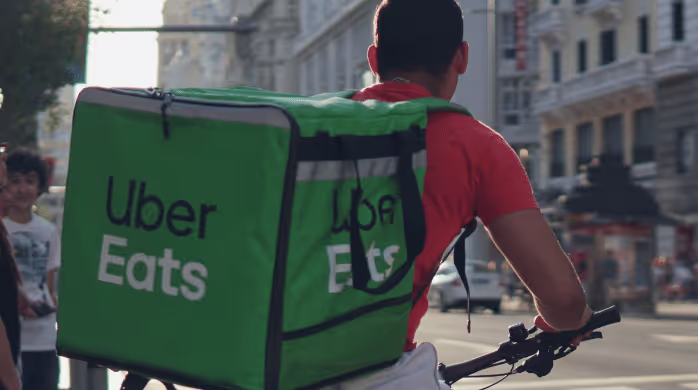
Uber Eats drivers deliver prepared food most of the time, but they also might shop for and deliver goods from convenience outlets and grocery stores. The job is pretty simple. You get a request for an order, you drive to the restaurant or store to pick it up, and then you deliver it to the customer. If you already drive for Uber, you can choose to take orders for Uber Eats delivery any time.
If you’re not an Uber Eats driver yet, it’s pretty easy to become one. This Gridwise post tells you what you need to do if you want to sign up and start making money Uber Eats style. Many rideshare drivers welcome the chance to deliver food rather than people. This article from Nerdwallet covers the Uber Eats gig from that angle.
There are some sweet advantages to working with Uber Eats. In lots of cities you don’t even need to have a car. You can use a bike or a scooter, or even walk, to make your rounds. If you do use a car, Uber Eats’ requirements are a lot easier to meet than they are for Uber rideshare driving.
You also have a lot of flexibility. You can shop and deliver convenience items and groceries, but you don’t have to. And, like most driving gigs, you can choose your own hours, and map out the locations where you want to work.
Use Gridwise features When to Drive and Where to Drive to help you figure out what work hours and which specific areas will be the most profitable for you. Real data from real delivery people will show you earning patterns for drivers in your town.
How much can you earn doing Uber Eats?
The honest answer to this question is: basically, as much as you want! It all depends on how many hours you put in and how strategic you are about your gig. Earnings vary from one area to another, as this article from Entrepreneur points out. To give you a baseline, let’s look at the earnings of Uber Eats drivers who tracked their earnings with Gridwise.
Remember that these numbers show us only average earnings. To make $1,000 a week with Uber Eats, you’re going to have to be better than average, and we’ll show you how. For now, though, it’s good to have these figures so you get a ballpark number of where to start.
How much do Uber Eats drivers make?
Gridwise data tell us the following:
- Monthly earnings average around $444.00 per month.
- Gross earnings per trip are between $9.00 and $10.00.
- Tips make up about 50% of most Uber Eats drivers’ income, which amounts to about $225.00 per month.
Is Uber Eats good money? It can be. While there are other gigs that pay more per trip, if you drive for Uber Eats, you’ll always be pretty busy.
https://datawrapper.dwcdn.net/HPAz8/3
You can also see that, unlike many other gigs, tips play a huge role in Uber Eats earnings.

With these numbers as a baseline, what can we say about how to earn $1,000 a week with Uber Eats? As we said in the introduction, it’s going to be a hustle, but it’s really possible. To figure out how to make the most money with Uber Eats, let’s start by looking at how many trips these “average” drivers made each month.
We know that average gross earnings were $444.00 per month, and drivers got around $10.00 per trip. That means they took 44 or 45 trips per month, which breaks down to 11 trips per week. That’s not a lot of Uber Eats delivery, is it?
The fact that Uber Eats drivers averaged so few trips shows us that many drivers use more than one app at the same time. This is called multi-apping, and you can learn more about it in this Gridwise post. If you want to answer the question of how much you can make with Uber Eats, then you need to stick with the app and keep plugging away at those orders. You also need solid strategies, as well as some inside tips and tricks.
How to make the most money on Uber Eats: Delivery driving tactics
Getting to that $1,000 a week with Uber Eats isn’t so hard when you remember that the drivers we saw making about $111 a week were only taking around 11 trips in the same time period. That’s not much at all! If you work the Uber Eats app like a boss, you’ll soon have many more trips than that, easily reaching the number needed to get you to $1,000 a week. Now, let’s get to some tactics you’ll need to make that kind of bank.
- Stay with the Uber Eats app, and track your earnings. Gridwise can easily do that for you. Simply sync your Uber Eats app with Gridwise, and you’ll be able to see how much you’ve earned with Uber Eats, what times were most profitable, and your average hourly pay. Racking up trips with Uber Eats has other benefits, including perks and bonuses that are awarded to top drivers.
- Leverage surge pricing and promotions. Surge pricing is applied when there is a lot of demand. When surge pricing is in effect, many of the trips you make will pay more than usual. Promotions are offered to drivers who complete a given number of trips in a certain time period. High traffic volume days, nights, and times give you these chances to get extra earnings. Challenging yourself to complete the right number of trips for promotions will add to the number of trips you can count on for big bucks, too. Learn more about Uber Eats surge pay, boosts, and promotions in this Gridwise blog post.
- Say yes to doubling up on orders. With Uber Eats, you can get back-to-back orders or receive batched orders. Back-to-back orders happen when you receive a new request while you’re on the way to deliver an original order. The Uber Eats app routes these trips automatically, so you won’t be sent out of your way.
Batched orders are Uber Eats’ way of bundling together orders from either the same restaurant, or two nearby eating establishments. You get money, and trip count credit, for all the orders you complete, plus customer tips, without having to make a bunch of separate trips.
- Turn on the charm and get bigger tips. Being nice really is part of the Uber Eats driver’s job, and getting tips is one way people who drive for Uber Eats make money beyond their basic pay.. Bring along those extra napkins and condiments, use equipment that keeps food and drinks at the right temperatures and prevents spilling, and consider your customers’ needs. If you deliver groceries, be extra careful with delicate items such as bread and eggs.
And, most important, follow your customers’ directions, and stay in communication with them if you are going to be delayed, or if you have questions about their order. This Gridwise post will tell how to get bigger tips as a delivery driver.
- Use even more charm to keep your ratings high. As an Uber Eats driver, you will be rated by the restaurant or store where you pick up the orders as well as the customers who are waiting for the deliveries. This two-way rating system is designed to keep you on your toes, so Uber can keep people satisfied with your service. Don’t worry, you get to rate them, too.
There’s another reason why your rating as a driver is important. It not only keeps you in good standing with Uber; it helps you to qualify for the Uber Eats Pro incentive program. To learn more about Uber Eats Pro, and what it takes to earn perks such as preferred services, discounts, and deals, check out this Gridwise blog post.
Smart business moves that seal the deal
Now that you know how to gobble up the deliveries you need to make $1,000 a week with Uber Eats, it’s going to be a breeze to get there. Let’s make it even easier, with business moves that boost your earnings and shrink your expenses. If you use these, it will also be easy to say yes when people ask, “Can you make good money with Uber Eats?”
Minimize expenses. Avoid racking up big fast-food bills by bringing your own food and beverages. You might not think you’re hungry when you first start your Uber Eats run, but once the aroma of pepperoni pizza, premium cheeseburgers, and piping hot fries start wafting through your car, that might change. Bring a sandwich or other healthy food from home, and buy bottled water in bulk to save tons of cash compared to what it costs to buy single servings.
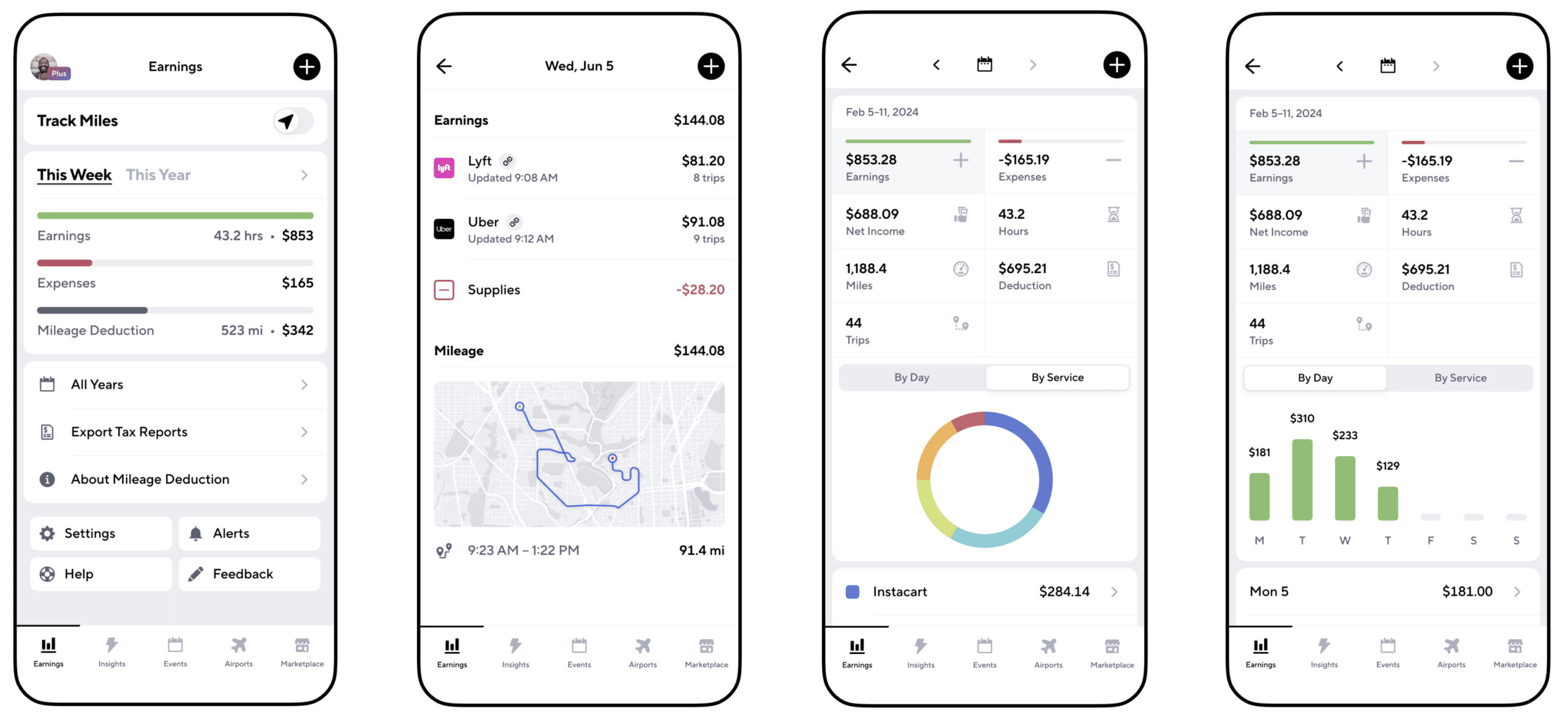
Maximize tax deductions. Another way to minimize your expenses is to maximize your tax deductions. Start by tracking mileage with Gridwise.
Gridwise App
Gridwise captures every deductible mile you drive, including the distance you cover between the trips your driving app records. Know what expenses you can deduct, and put them to work for you when tax time comes. Learn more about tax deduction strategies in the Gridwise Tax Guide for drivers.
Boost earnings with referrals
As an independent contractor, you’re probably looking for ways to make even more money than you can with Uber Eats. And most gig workers like you enjoy getting passive income. With Uber Eats, there’s a really easy way to do that, referrals!
All you need to do is find friends and encourage them to deliver for Uber Eats. If they make a certain number of deliveries within a specified time, you will get paid for doing nothing more than having them sign up under your referral code! Rates of pay vary by city, so check your Uber Eats app to find out what the current deal might be, and learn more about the referral program on the Uber Eats website.
Also remember: “friends” don’t have to be your best buds. Many delivery people carry cards with a QR code linking to their referral information, so just about anyone you encounter can join Uber Eats and boost your earnings. You could meet a source of passive income at the gas station, on social media, or at your high school reunion. The more you hustle, the more there is to gain, right?
Master the art of self-employment
As an Uber Eats driver, you’re an independent contractor. That means the company isn’t going to withhold your taxes, provide insurance, keep track of your earnings, or tell you about tax deductions. You’ll have to do all these things for yourself.
If you want to maximize your tax advantages, open an official business entity. You can incorporate (create a corporation) or you can work as a limited liability corporation (LLC). You can also work with a DBA (Doing Business As) arrangement, but the corporation or LLC will do a better job of protecting you from liability.
Establishing a corporation or LLC offers better tax advantages than being a sole proprietor. For instance, if you simply collect your earnings into your private account, you’ll be charged self-employment taxes in most states. And paying extra taxes is something we all want to avoid, within legal limits, as much as possible.
Every Uber Eats driver needs to learn about self-employment, and there are some great resources you can review. Check out the CareerOneStop website about self employment which will help explain the basics. You can also check with a professional tax accountant, or look other websites to learn more about actually creating a business.
Scope out your market
Look at the area around you to see where you’re likely to get the most deliveries. Where are all the restaurants? Where might people be more inclined to order deliveries? What hours do you want to drive? What activities might be going on around those times? Think about late-night and after-school times as well as breakfast, lunch, and dinner times.
Be realistic about the potential for your area and aware of new services opening up. For example, in New York, there is already a tab on the Uber Eats app that allows customers to order groceries. In our article about the best food delivery service to work for you’ll see that Uber Eats stacks up well against other delivery companies, mainly because of its potential for expanded opportunities for drivers to earn.
So, is Uber Eats good money? As we said, it isn’t an automatic guarantee that everyone will make $1,000 a week with Uber Eats. Trying out the suggestions we give you here, though, should put you on the right track! Go out there and start stacking up those orders and raking in some impressive earnings!
Get more inside information on Uber Eats in these posts from the Gridwise blog:
- The delivery driver guide: Using the Uber Eats app
- Everything you need to know about driving for Uber Eats
- Uber Eats Pro: What drivers need to know
- Looking for a different gig, part-time or full time job? Check out the Gridwise Job board.
Uber Eats FAQ
How does the Uber Eats platform work for drivers?
Uber Eats is a food delivery service that connects customers with local restaurants and independent delivery partners. As an Uber Eats driver, you'll receive notifications of nearby delivery requests, which you can accept and complete. The platform provides flexibility, allowing you to work on your own schedule and earn money based on the number of deliveries you complete.
What are the requirements to become an Uber Eats delivery partner?
To become an Uber Eats delivery partner, you'll need to meet certain requirements, such as having a valid driver's license, a registered vehicle, and passing a background check.
How can I choose the right delivery zone to maximize my earnings?
Selecting the right delivery zone can significantly impact your earnings, as some areas may have higher demand and better-paying orders. It's important to research and identify the zones in your area that tend to have the most consistent and lucrative delivery opportunities.
How can I take advantage of peak delivery hours and surge pricing?
Understanding peak delivery hours, such as mealtimes and weekends, and taking advantage of surge pricing can boost your earnings. Be aware of when demand is highest in your area and adjust your schedule accordingly to capitalize on these peak periods.
What are some tips for maximizing tips and customer satisfaction?
Providing excellent customer service and going the extra mile to ensure a positive experience can lead to more tips and repeat business. Prioritize communication, timeliness, and attention to detail to keep your customers happy and satisfied.
How can I set realistic weekly goals to reach my $1000 target?
To make $1000 a week with Uber Eats, it's essential to set realistic weekly goals and track your earnings and expenses. Start by determining your target earnings and breaking it down into achievable daily or weekly goals. This will help you stay on track and make adjustments as needed.
What are some strategies for efficient route planning and navigation?
Effective route planning and navigation can save you time and fuel, allowing you to complete more deliveries. Utilize mapping apps and take advantage of features like real-time traffic updates and turn-by-turn directions to find the quickest routes.
How can I balance my Uber Eats deliveries with other commitments?
Develop a schedule that allows you to capitalize on peak delivery hours while still maintaining a healthy work-life balance. Consider using tools like calendar apps to plan your availability and track your hours to ensure you're maximizing your earning potential without sacrificing your personal life.
What are the key considerations for maintaining my vehicle as an Uber Eats driver?
Keeping your car clean and well-maintained is crucial for maximizing your Uber Eats earnings. Regularly scheduled oil changes, tire rotations, and other preventive maintenance can help extend the life of your vehicle and minimize downtime. Additionally, budgeting for vehicle-related expenses, such as fuel, insurance, and repairs, will ensure you're accounting for these costs and maximizing your net earnings.
What are the tax obligations and legal considerations for Uber Eats drivers?
As an Uber Eats delivery driver, it's essential to understand the tax obligations and legal considerations that come with being an independent contractor. This includes properly reporting your earnings, deducting eligible business expenses, and making quarterly estimated tax payments. Additionally, you'll need to ensure you have the appropriate insurance coverage, such as personal auto insurance and possibly commercial auto insurance, to protect yourself and your vehicle while on the road making deliveries.

The Gridwise Job Board: Find Your Ideal Job or Gig Work
Gridwise is an essential assistant app created by gig workers for gig workers. Our mission is to support those engaged in gig work in every way possible. We understand how challenging it can be to deal with income instability, a lack of benefits, and job insecurity that often comes with gig work. The Gridwise app tracks and organizes earnings and expenses, and offers a wide array of discounts, deals, and services that make the lives of independent contractors easier and more rewarding.
We firmly believe it’s possible to make a viable living and create a gig experience that offers flexible hours, variety, and excitement. With issues such as consistent earnings and job security in mind, Gridwise is proud to offer a centralized platform that shows you how to find gig work and secure reliable opportunities. We’re proud to introduce the Gridwise Job Board.
The Gridwise Job Board: Key features
Because Gridwise is dedicated to serving the gig worker community, we’ve filled the Gridwise Job Board with useful features that won’t waste your precious time.
- Comprehensive listings. Find part-time, full-time, temporary, and per-task work. Drive or deliver with your vehicle, utilize an employer’s vehicle, or even find non-driving gig work.
- User-friendly interface. Find the jobs that are right for you with a tap of your screen.
- Verified opportunities. We vet the jobs before they are listed to ensure you’re getting high-quality job postings.
How to get more gig work, seasonal, part-time or full-time jobs with the Gridwise Job Board
Looking specifically for “gig work apps” or “gig jobs near me?” You’re in luck. Our filters and search functions send you directly to the listings you seek.
Here’s how it works.
- Access the Job Board via the Gridwise website.
- Search for jobs by type, location, and more.
- Select the job that interests you, and read all about it.
- Scroll through the description, and if it appeals to you, click “Apply for job.”
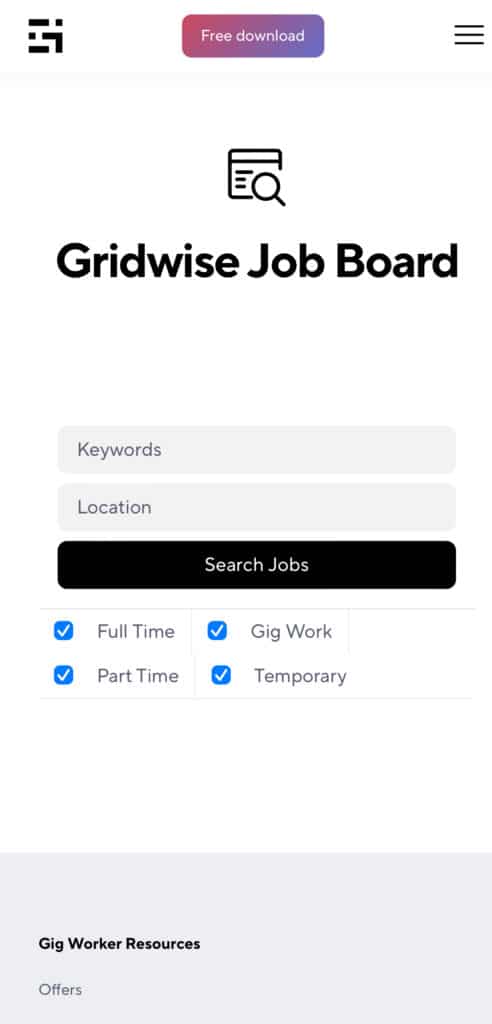
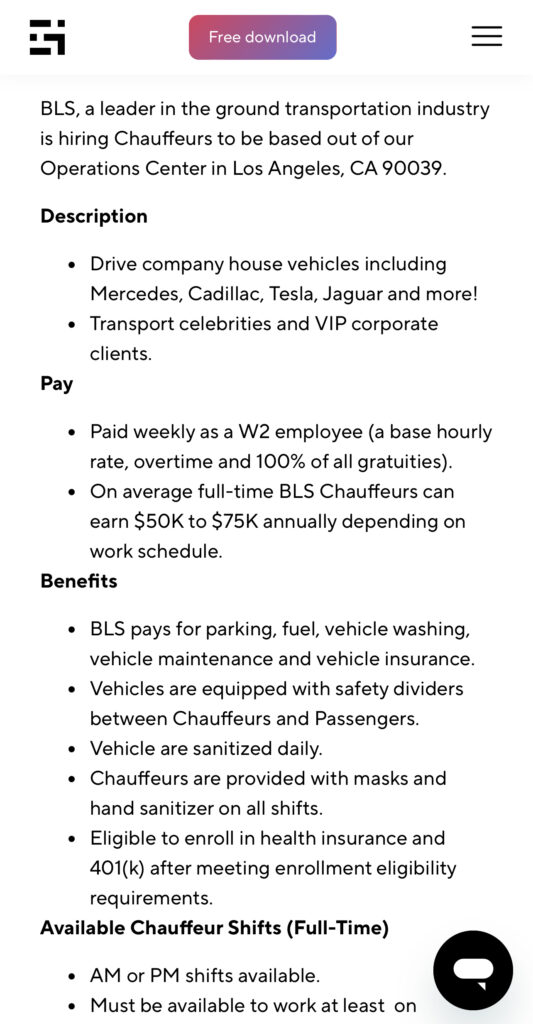
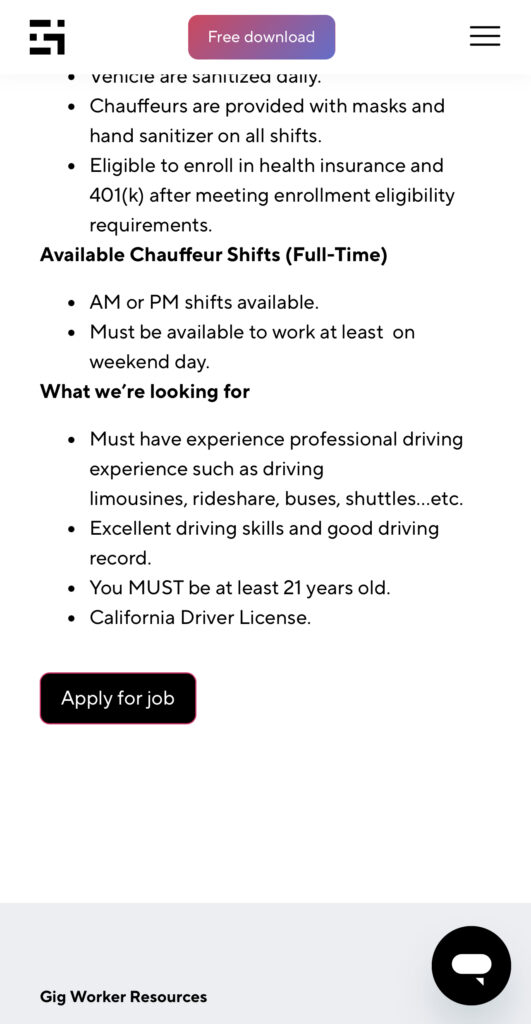
Many types of jobs are available. Adjust the search filter to see the full variety of opportunities that will let you cash in. Deliver food, set up catering, do rideshare driving, get paid for doing package delivery, and much more. You’ll find short-term gigs, long-term contracts, and part-time positions.
Perks of the Gridwise Job Board for gig workers
Gig workers who know how to make extra money will appreciate how the Gridwise Job Board lets you multiply your chances of bringing in big earnings. Here’s how:
- Increased stability. Use the Gridwise Job Board to find part-time or permanent jobs in addition to the part-time gigs you already have. Always keep a steady stream of earning opportunities flowing toward you.
- Flexibility and autonomy. Choose jobs that fit your schedule, work around other jobs and family duties, and still leave room for some fun in your life. Discover side hustles to supplement your full-time job, permanently or just for the season.
- Skill development. Find part-time work that lets you use a skill you already have, or try your hand at something new. It’s a smart way to develop a portfolio to showcase what you can do, or even to find permanent employment.
Get Gridwise and stay up to date on the Gridwise Job Board
Gig workers need plenty of information and assistance, and Gridwise is here to give it to you. Download the app and get essential features such as
- seamless earnings tracking
- mileage tracking
- expense recording, including notes
- low-cost and no-cost insurance benefits
- access to affordable medical, dental, vision, mental health, and alternative care
- professional services including legal and financial help
- deals and discounts
- weather, events, and traffic reports
- inside information on where and when to drive
More to know about gig work:

5 Best Mileage Trackers For Gig Drivers
Many drivers ask, “Do I really need a mileage tracking app?” The answer is simple: only if you want to have an accurate count of all the miles you can legally deduct from your taxable income! You might think your rideshare or delivery driving app has got you covered. After all, they do quite a good job of logging the miles you drive while you’re on a trip or delivery. But, if you want to have the best app to track mileage for Uber, Lyft, Doordash, Instacart, or the other apps you may use, you need more. Why is that?
Without a separate tracker, you’re missing the miles you drive in between pings. Did you realize that all the miles you drive, from the moment you begin your shift until it’s over (as long as you don’t drive several miles on a break to hang with your friends), are tax deductible! That means you need something besides your driving app to keep an accurate count of your travels. Read this Gridwise post to see how important it is to keep track of every deductible mile.
You won’t be surprised to hear that there’s an app for tracking miles. In fact, there are several of them. Here, we’re going to tell you about five top mileage tracking apps, and help you figure out which one is best for you.
Before we get to the list and identify the best mileage tracker app, let’s clarify what exactly a mileage tracking app is. According to G2.com’s technology glossary, mileage tracking is done for the purpose of keeping a log of mileage that is either reimbursable or tax deductible.
And yes, of course you can track your miles simply by taking readings on your odometer. But are you really prepared to account for how many miles you drove for personal reasons and subtract them from the total to get your business mileage? Even if you can remember all that and do the arithmetic, if you want an accurate reading of the miles you drive for business, and can therefore deduct, a mileage tracking app will save you a lot of trouble and prevent you from making costly errors.
Plus, as a gig driver, you have specific needs when it comes to a mileage tracker. Ideally, you’d be able to handle mileage tracking and several other functions all in one app. It can be maddening enough to deal with driving apps, particularly if you’re an avid multi-apper. You would want your mileage tracker app to help you keep account of other aspects of your business, including income, expenses, and inside information about the art of gig driving.
Not all mileage apps are equal, to be sure! Let’s look at five of the best apps to track mileage and figure out which is the best app to track mileage with Uber and Lyft, or what mileage tracker app is best for DoorDash.
1. Zoho Expense
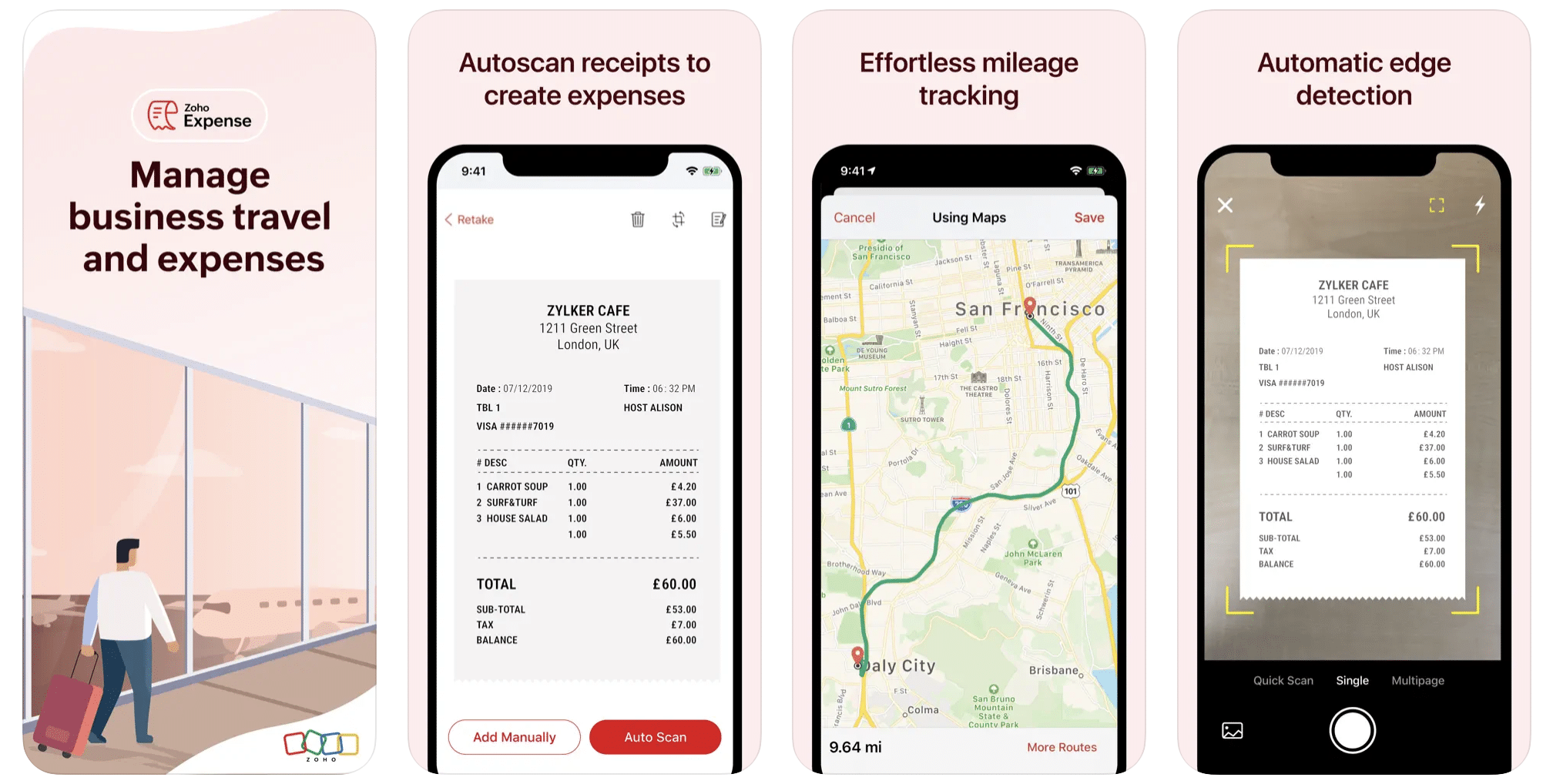
First up is Zoho Expense, which does exactly what its name says. This app is designed to allow companies to give employees a uniform way to create and submit expense reports. It can be used by individuals, including gig drivers, as well.
It includes a mileage tracker, as well as features that let you track other deductible expenses, including the ability to scan and record receipts.
Available on Android and Apple: Yes
Ratings: 4.8 stars on App Store, 4.7 stars on Google Play
Free Version: Yes
Subscription price: $3 per month, billed annually
Created specifically for gig drivers: No
2. Quickbooks Online
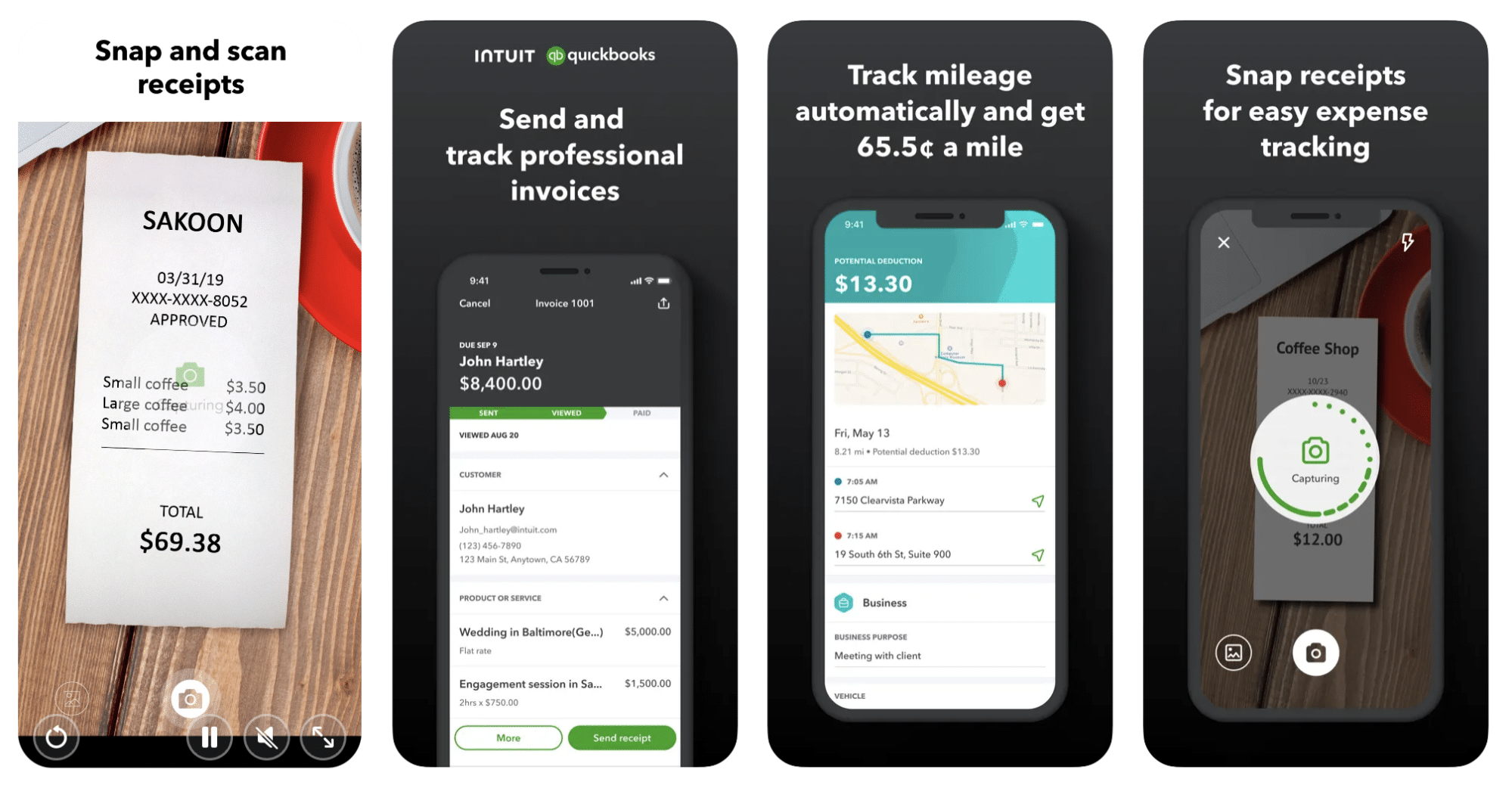
Quickbooks Online is a cloud-based app that allows you to track your mileage, earnings, and expenses. The information you enter can then be used to generate various reports that prepare you for tax time. It also allows you to create graphs that illustrate your cash flow, and includes a receipt scanner so you can instantly record deductible expenses. Quickbooks is popular, highly reliable, and designed mainly to help people keep track of their small businesses.
Available on Android and Apple: Yes
Ratings: 4.7 stars on App Store, 4.4 stars on Google Play
Free version: 30-day free trial
Subscription price: $15 per month for basic version if purchased for 3 months or more
Created specifically for gig drivers: No
Source: quickbooks.intuit.com
3. Shoeboxed
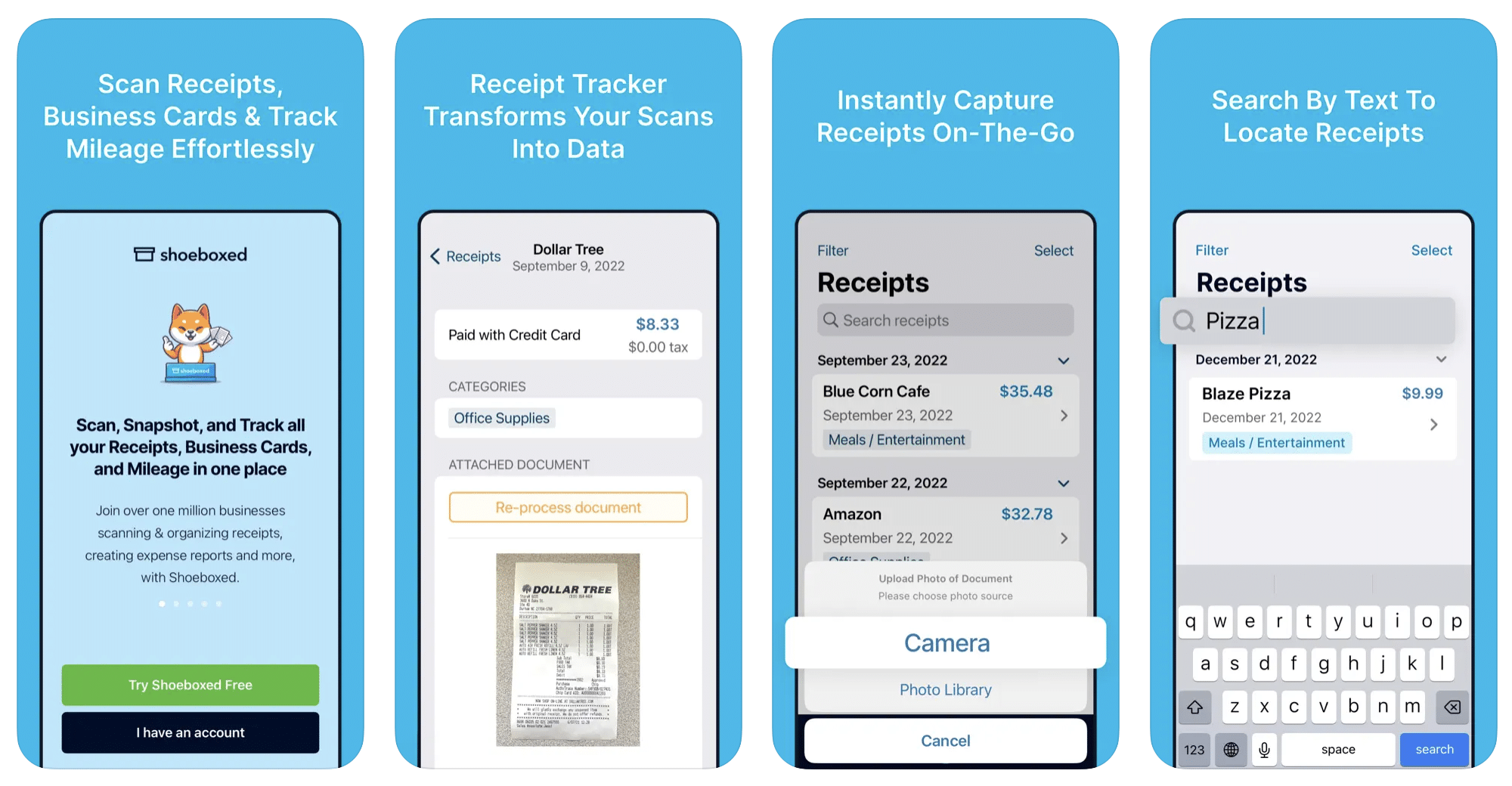
Shoeboxed started in 2007 as a service for scanning paper receipts into digital form. Now the app offers a free mileage tracker and has enabled users to scan receipts directly. It touts itself as the best mileage tracking app for DoorDash, but there are some elements missing that Dashers might like to have. While it provides features that record your expenses and prepare you for tax season, it doesn’t automatically track your earnings. The mileage tracker has a system where you can drop pins along your routes to make the tracking more precise, identifying those legs of a trip that you make for business purposes. The mileage tracker is “free” once you sign up for the basic version.
Available on Android and Apple: Yes
Ratings: 4.5 stars on App Store, 2.3 stars on Google Play
Free version: No
Subscription price: $18 per month for basic version
Created specifically for gig drivers: No
Source: blog.shoeboxed.com
4. Stride
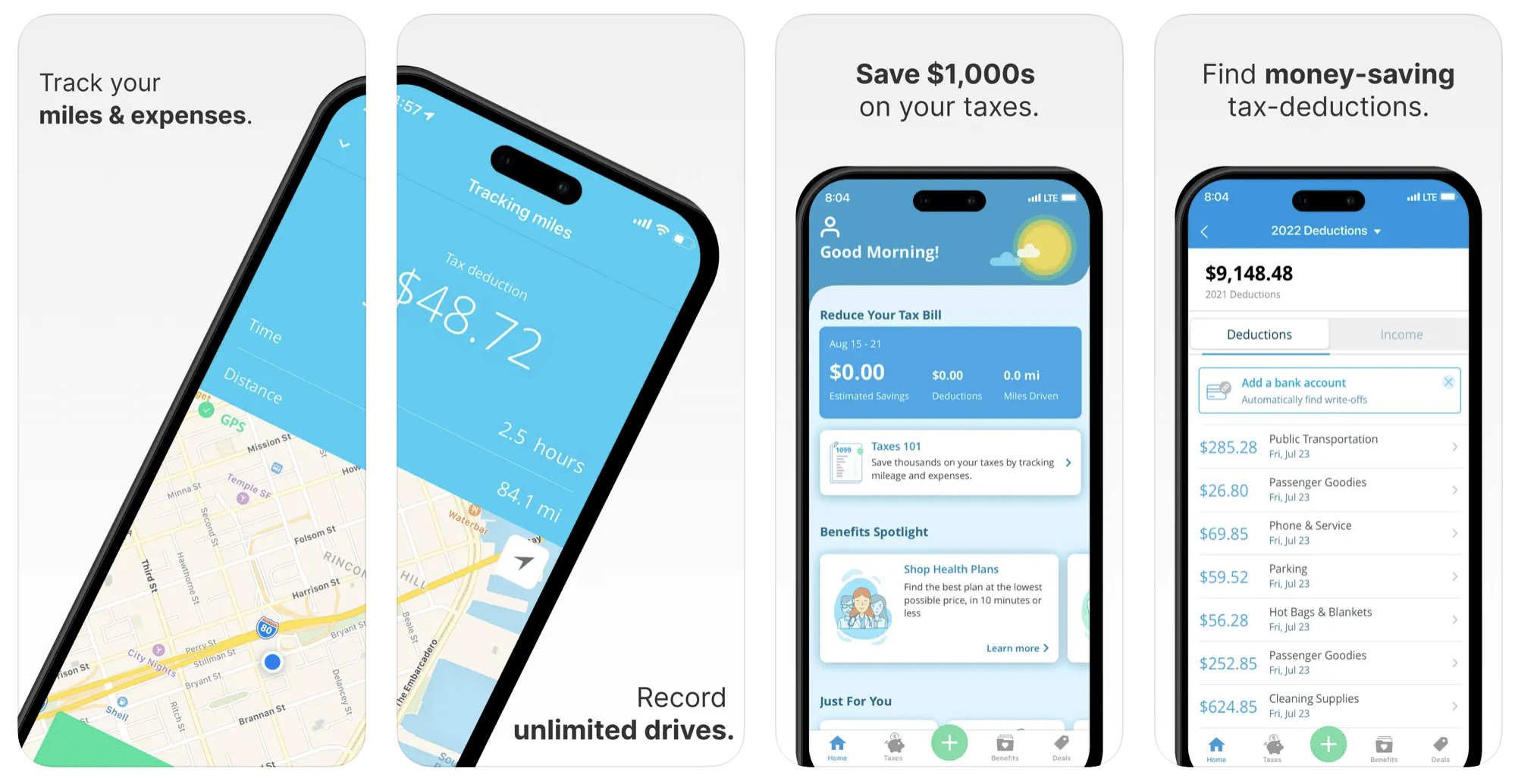
This free mileage tracker does a fair job of keeping track of the distances you rack up while gig driving, but it doesn’t automatically track earnings. It can be a big help, though, in tracking your expenses. You can link Stride to your bank account, and it will automatically scan your expenses to identify items you can potentially deduct. The app is totally free. This could make it the best free mileage tracker app, but there is a small price to pay. The app will persistently push you to consider various insurance plans that they are affiliated with. If you don’t mind that, this is a solid mileage tracker, even if it doesn’t track your earnings.
Available on Android and Apple: Yes
Ratings: 4.8 stars on App Store, 4.6 stars on Google Play
Free version: Yes
Subscription price: None. The app is free.
Created specifically for gig drivers: No
5. Gridwise
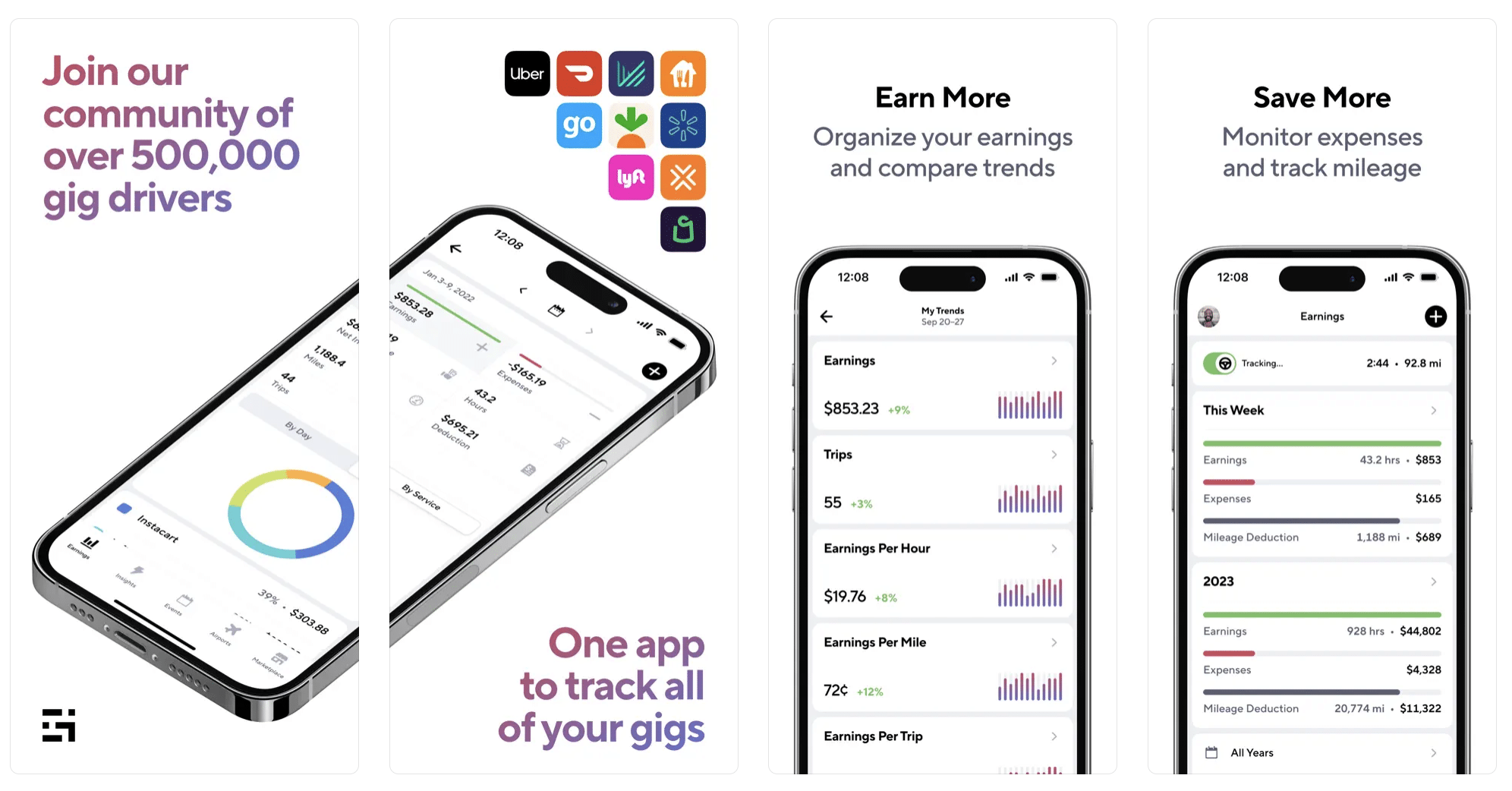
Gridwise has a free mileage tracker and free features that record your income and expenses. It gives you access to insurance and benefits, as well as insights about the best times and places to make the most money while gig driving. The Gridwise mileage tracker captures all the miles you drive while you’re on your driving shift, and it can be used if you have other trips you need to make which qualify as business travel.
Drivers love it because it is geared toward the needs of rideshare and delivery workers, providing free information about airport departures and arrivals, event start and let out times, weather, traffic, and more. The Gridwise Plus subscription adds value by providing additional insights and reports, discounts on benefits, the ability to export data in .csv format,, and more.
Available on Android and Apple: Yes
Ratings: 4.9 stars on App Store, 4.6 stars on Google Play
Free version: Yes
Subscription price: $9.95 per month for Gridwise Plus, or $95.99 per year (a $23.41 savings)
Created specifically for gig drivers: Yes!
What is the best mileage tracking app?
Now that we’ve checked them all out, we’re positive about the answer to that. Hands down, it’s Gridwise. Are we biased? You bet we are! But drivers love it too. Gridwise is the best mileage tracker app, and so much more. So many of the features are free, and the subscription to Gridwise Plus will pay for itself with additional insights to boost your earnings and deeper discounts on products and services.
Most important, Gridwise is designed specifically for gig drivers by experts who were once gig drivers themselves! Knowing what gig drivers need is a crucial step in creating an app that rideshare and delivery drivers can really use! Here are a few of the features, besides mileage tracking:
- seamless earnings tracking
- automatic, on/off toggle and manual mileage tracking
- mileage categorization
- airport, traffic, weather, and events information
- insights into where to drive and when to drive
- reports showing earnings across the platforms you use
- discounts on countless products and services for drivers
- additional resources for finding side gigs
- an informative and comprehensive blog
- affordable benefits, including insurance, medical, dental, and alternative practitioner discounts
- a community of drivers just like you
Don’t settle for just any app. Get the best mileage tracker, and so much more, from Gridwise!

McDonalds and Burger King: QSR Delivery Insights June 2024
Data is key in the fast-paced world of quick-service restaurants (QSRs). As giants like McDonald's and Burger King vie for dominance in the delivery space, understanding the nuances of their performance across different platforms can provide crucial insights.
This mini-blog presents two quick takeaways on delivery data that show how these QSRs are faring in the digital ordering landscape. These bite-sized insights offer a taste of the valuable information that can be gleaned from delivery analytics, potentially reshaping strategies in the competitive fast-food market.
McDonald’s and Burger King Delivery Data Insights
In Los Angeles, McDonald's accounts for a more significant share of Uber Eats deliveries than their share on Doordash.
On the other hand, Burger King deliveries are longer in duration and over a slightly longer distance.
Insights from Gridwise Analytics benefit QSR’s
Gridwise Analytics is a game-changer for gig platforms. It offers a unique understanding of market dynamics for quick-service restaurants (QSRs) striving to enhance their market share. By delving into specific data points, such as delivery patterns, this tool enables platforms to optimize routes, predict demand, and fine-tune marketing strategies with precision.
The level of insight provided by Gridwise Analytics is not just about enhancing operational efficiency. It's about identifying lucrative opportunities that can boost driver and consumer satisfaction. This, in turn, leads to superior service delivery and a competitive edge in the fast-paced gig economy.
Discover more gig mobility insights
Uber Intercity: Guide For Drivers
Do you enjoy taking passengers on longer rides? Do you like travelling from town to town in your region? Uber has a new service will let you end the constant start-and-stop, gas-and-brake routine of city and suburban driving and start making big money driving down the highway. There’s lots to like about Uber Intercity.
What is Uber Intercity?
Passengers who need to go from one city to another by car like having a driver all to themselves. Maybe it was the atmosphere of the COVID-era that made people less interested in taking buses and trains to neighboring cities. Or a reluctance to do their own driving and avoid paying for city parking might make it more appealing for passengers to get an Uber driver to take them from one urban area to another.
Uber Intercity is a way to cater to these customers. With this feature, passengers book rides that get them where they’re going in safety and comfort, and as quickly as traffic patterns will allow.
Drivers everywhere love this idea because longer trips pay more and take less effort than regular rides. However, at least for now, Uber Intercity is available only for trips between certain cities in select locations.
US options include trips between:
- Los Angeles and Orange County
- Los Angeles and Palm Springs
- Los Angeles and Inland Empire
- Orlando and Central Atlantic Coast, FL
Canadian drivers can make trips between these locations:
- Toronto and Hamilton
- Toronto and Kitchener Waterloo
- Toronto and Niagara
- Toronto and London (Ontario)
- Kitchener Waterloo and Hamilton
- Niagara and Hamilton
- Vancouver suburbs and downtown Vancouver
What does Uber Intercity offer drivers?
Uber Intercity is a sweet deal for passengers, but what is Uber Intercity for drivers like? Turns out that there are lots of advantages. Long trips mean not as many passenger personalities to manage with conversations of greater depth and quality with the riders you do take onboard. You can also expect:
Increased earnings
- Longer trips yield higher earnings per trip.
- Out-of-town surcharges are added to driver earnings on most intercity trips.
- Passengers tip better after spending more time with you.
- Promotions apply to intercity trips.
- You are free to drive in the destination city after discharging your passenger(s).
- You will be prioritized for a return trip to your city of origin.
Improved driver experience
- Enjoy a break from urban traffic jams.
- Get better gas mileage due to more highway driving.
- Experience driving in different cities.
- Determine if a trip is worth your time and energy with up-front pricing.
How does Uber Intercity work?
If you want to take these long rides, and Uber Intercity is available in your area, you can opt in to accepting rides by going to your Preferences setting in the app. Switch on INTERCITY, and you’ll start getting requests for Uber Intercity rides. You can choose to accept or reject them based on the information on the trip card.
If you decide to accept a trip, keep in mind that Uber won’t guarantee you a return passenger. But, as we said earlier, you can either drive around in the new city, or allow the app to prioritize you for a return ride.
Uber Intercity isn’t for everyone, and even if you use it, there are times when you’ll want to stay close to home. Let’s say you have to go offline at a certain time, or you’re tired and don’t want to be out much longer. Or if a lot of profitable short rides are popping up in your area, you might want to keep driving right where you are. In these cases a trip to another city won’t be on your agenda.
If the app has you pegged as an Intercity Uber, meaning to send you to another city, and you don’t want to leave your area, you can decline the ride and change your settings by deselecting INTERCITY. You would also naturally do this when you’re ready to finish the Uber Intercity portion of your shift.
How can drivers make the most of all their trips and other gigs?
The short answer is, use Gridwise! Gridwise is the app every gig worker needs to boost earnings and organize a gig-centric business.
Track your tax deductible mileage, get discounts, deals, weather, traffic, and event updates, plus
- earnings tracking
- expense recording and reporting
- graphs to compare what you’re earning for all your gigs
- insights into where and when to drive for best earnings
- access to no- and low-cost healthcare and insurance
More about bigger earnings with Uber

TaskRabbit: A Flexible Side Hustle Platform
Looking for a side hustle that’s totally flexible, easy, and pays well too? Taskrabbit could be your dream gig platform. Everybody has errands and odd jobs they either can’t or don’t want to do themselves. When you become a “Tasker” with TaskRabbit, you get to earn money while you make other people’s lives easier.
At Gridwise, we’re always on the lookout for ways to help gig workers make informed choices about which side hustles will fit them best. Knowing what matters most to gig workers allows us to answer any questions you have, and address concerns you might not have thought of yet.
How does TaskRabbit work?
TaskRabbit is a platform that matches customers looking for workers to do different jobs with people like you, who get paid for doing them. You might be able to offer your work and time to people without using an app like this one, but TaskRabbit makes it far easier to find clients and manage customers.
Customers know that TaskRabbit has cleared you and that hiring you gives them a safe and reliable option. You also can be assured that customers are trustworthy and are highly likely to pay you what they owe.
What’s it like to work for TaskRabbit?
Working for TaskRabbit is easy because you’re in control of when and how much you work, the kinds of jobs you’re willing to do, and how much you want to get paid. You choose whether to pursue your TaskRabbit gig full time or to use it as a side hustle.
TaskRabbit strives to maintain a safe, secure community that’s built on mutual trust. The rights and responsibilities of clients, as well as Taskers, are clearly defined by the company and agreed upon by all concerned parties. There are also procedures in place to address issues and concerns, should they arise. This reduces the amount of time you have to deal with customer problems, and erases the stress that comes with them.
Benefits of being a TaskRabbit worker
The biggest advantage of this or any side hustle is the fact that you can be your own boss. You’ll get to do things you like, and you can choose your own working hours. Of course, that means you’ll have to motivate yourself! TaskRabbit makes that easier by offering
- a wide variety of jobs and services, get paid for doing things you like.
- an established customer base, no marketing needed.
- interfacing with customers to ensure that you get paid, not having to chase down your cash.
- the ability to set your own rates, know what you’ll be paid!
- the opportunity to expand your business, getting more customers only helps your business to grow.
What kinds of jobs are available?
TaskRabbit has a pretty impressive variety of jobs for Taskers to do. You can also work in as many categories as you like, provided you have the skills needed. Whether you’re a hands-on craftsperson or an administrative type, TaskRabbit needs you.
- personal assistant, project coordinator, and organizer
- flooring and tiling help
- moving, full service and light packing
- furniture assembly
- heavy lifting and loading
- indoor and outdoor painting
- interior design
- landscaping help, yard work, and snow removal
- laundry and ironing
- light carpentry
- minor home repairs
- appliance installation and repairs
- pet sitting
- plumbing help
- sewing
- smart-home installation
Job categories might vary, based on where you live. As this complete list of categories shows, there are enough available job options to keep Taskers pretty busy!
How much and how will I get paid?
How much you get paid is largely up to you. As we said before, you get to set the rate that you’re willing to accept for your services, and how much you will work.
According to Glassdoor, the average Tasker earns around $17–$27 per hour, but the exact amount you make will depend on the task and the rate you charge, as well as where you live.. Big jobs such as furniture assembly, handyman services, and moving will pay more than yard work or sewing.
Once you complete the job, you invoice the customer. Everything that has to do with your payment is taken care of through the app.
Provide TaskRabbit with your direct deposit information when you sign up, and they send the payment, including tips, to your bank account. Taskers receive 100% of the amount they charge customers. TaskRabbit collects its fee as a percentage of the cost of the task(s) performed, and it is charged to the customer, over and above what they pay the Tasker.
Basics you need to know
By now you might be ready to ask, “How do I sign up to work for TaskRabbit?” but before you do, you’ll need some more information.
Just like with any side hustle, you work as an independent contractor with TaskRabbit. That means you are not an employee, and you don’t get company benefits from TaskRabbit. As a result, you’ll have a few responsibilities, such as
- building your reputation on TaskRabbit by getting good customer reviews
- developing a winning strategy for maximizing your earnings on TaskRabbit
- estimating and paying your own taxes
- tracking your mileage, earnings, and expenses
- securing your own healthcare and insurance programs
If this sounds like a lot, you’re right. There are many things you have to do as an independent contractor in order to manage your business. Fortunately, there is help. Gridwise handles all these issues. More about that later. First, let’s get you on board with TaskRabbit.
How do I sign up to work for TaskRabbit?
Registering with TaskRabbit
Before you sign up with TaskRabbit, make sure you meet the basic requirements:
- live in a city where TaskRabbit is available
- be 18 or more years of age
- clear a background check
- prove your eligibility to work, including a US-issued Social Security number
- have a valid checking account and credit card (to pay the $25 registration fee)
- own a smartphone capable of running the Tasker app
For some tasks, such as minor home repairs and IKEA furniture assembly, you need to develop the skills before you offer to do the job. There is no “on the job training” provided.
Once you are sure you meet the requirements, download the Tasker app and create your account. The app will take you through the steps to register. You’ll get a chance to set your skills, location, and distance you are willing to travel, and to verify your information. This is where you will need to pay the $25 registration fee.
The length of time you need to wait to find out if you’ve been accepted on TaskRabbit will vary depending on where you live. Most Taskers are cleared to start work within four business days.
Tips for setting up your profile
- Look good. There are a lot of Taskers out there, so you will want your profile to stand out. As superficial as it may sound, a good photo is crucial if you want to attract clients, clients who will want to see your face to get an idea of what you’re like.
- Communicate clearly. Write your quick pitch in plain language. Set your work area and skills to match your willingness to travel and your abilities to do certain tasks.
- Price yourself right. Pricing is crucial to your success as a Tasker. If you set your price too high, you won’t get as many jobs. If you price your work too low, you’ll feel cheated when you do a job for which you should have been paid more. Check out the competition, see what others are charging for the same or similar tasks, and choose your price based on how your skills compare to theirs, and set it accordingly.
- Add at least one available time slot for booking tasks. If you don’t have any times listed, clients won’t be notified of your availability. Choose your work times based on the times customers are likely to need your services as well as what is convenient for you.
- Draw your work area on the map provided in the Tasker app. Include the entire area you are willing to serve, but be aware of factors such as distance, traffic, and general road conditions. You’ll also want to include areas where your tasks will be in demand. For instance, an area where there are mostly renters won’t yield many clients looking for home repairs or exterior painting.
Once you are set up, give TaskRabbit about two working days to verify your profile and make it visible to the public.
Finding and accepting tasks
The Tasker app is very convenient to use. When a client wants to hire you to complete a task, you’ll receive a task invitation on the app. You then reply to it, and either accept or decline it.
You can also use the app to schedule availability, reset your map, send invoices, put your profile on “‘pause,” and more.
While you have total freedom of choice when it comes to accepting tasks, you should be aware that there are advantages to accepting and invoicing more of them.
TaskRabbit has an Elite Tasker program, which gives certain Taskers the privilege of being highlighted on the customer-side of the app. They also receive perks such as membership in the Elite Tasker Discord Group, an Elite badge on their profiles, one-on-one calls to discuss their business, and additional opportunities to provide feedback to TaskRabbit.
In most cities, Taskers reach Elite status by invoicing at least 10 tasks per month, invoice at least 50 tasks total in a particular category, place within the top 15% of Taskers for invitations to invoices ratio, and avoid any violations of TaskRabbit’s terms of service.
But, in certain cities, the requirements are more stringent. In addition to the above qualifications, Taskers must have gathered at least 200 total tasks under their belts from the time they joined the platform.
How to work for TaskRabbit and manage all your side hustles
The freedom, flexibility, and income potential that being a gig worker gives you are good reasons for working with TaskRabbit and other gig apps. But, as we noted earlier, you also have to be prepared to manage your business when doing gig work. In order to do this, you’ll need to know exactly how much you’re earning, and keep very close tabs on your potential tax deductions. You’ll also want to get your own healthcare and other insurance needs taken care of.
Gridwise is designed with a thorough understanding of what it takes to run side hustles, Gridwise gives you the support and opportunities that make it much easier to thrive as an independent contractor.
Track mileage
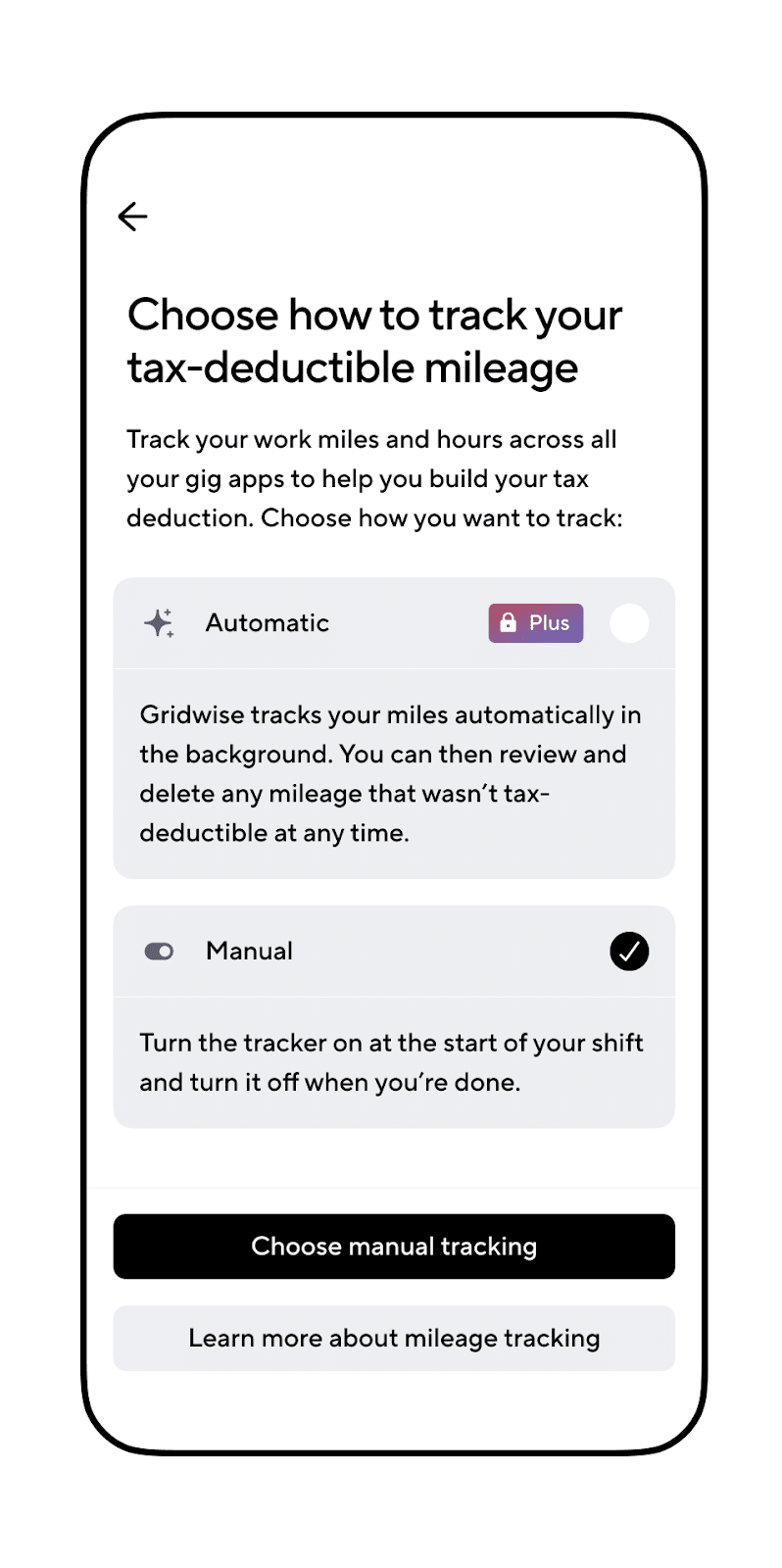
The mileage tracking feature of the Gridwise app is tailored to your needs. Rather than merely counting all the miles you drive, Gridwise allows you to turn the tracker on and off with ease, so you’re in control of accounting for deductible mileage.
Turn the tracker on when you’re going to a gig or shopping for materials, then turn it off when you end your work day. Gridwise Plus will allow you to automatically track your miles, turning the tracker on when you move your vehicle, and off when you stop for a period of time that you determine. And you can even enter and correct your mileage figures manually.
Track earnings and expenses
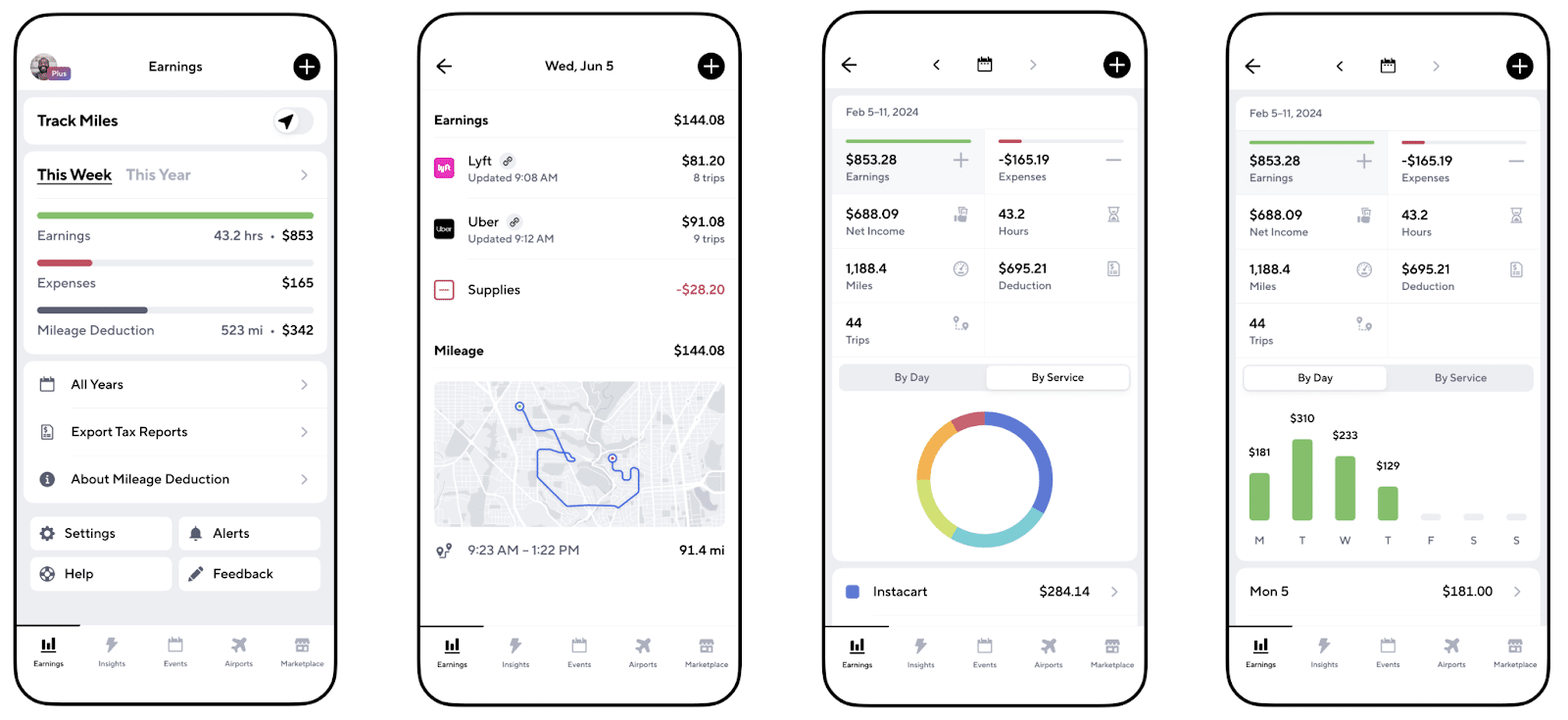
With Gridwise in your pocket you can track all your earnings and expenses, so you never have to worry about poring over piles of paper when tax time arrives. Gridwise automatically generates reports that give you the opportunity to view the financial health of your business at a glance.
Get gig worker benefits and perks
Gridwise provides so many of the services and conveniences you need to support TaskRabbit and all your side hustles. From price breaks on gas, and discounts on car maintenance, to low and no-cost insurance plans, Gridwise Benefits ties up all your benefits and perks into a neat package. Gridwise Plus members get deeper discounts and even more free perks.
Here are just some of the benefits offered by Gridwise:
- phone protection
- car insurance marketplace
- identity theft protection
- discounts on Keeper Tax
- alternative medicine and chiropractic benefits
- telehealth
- credit help
- housing counseling
- access to legal help benefits
The advantages of Gridwise let working for a side hustle like TaskRabbit provide you with the support you need as well as maximizing the money you make. See what it’s like to use an app designed specifically for gig workers like you.
More about great side gigs

Earn More: The Walmart Spark Driver Rewards Program
Whether you’re already a Walmart Spark Driver or you’re weighing adding a Spark gig to your side hustle repertoire, you need to learn more about the Spark Driver Rewards Program. Why is this so important?
Among the challenges of being a gig worker is not getting all the benefits of a full-time W-2 job. Gig workers must find ways to get medical benefits, dental coverage, life insurance, and other personal perks. There are many great things about being a gig worker; one is the fantastic array of advantages and discounts you get with extras, such as the Spark Driver Rewards Program. If you are looking for more information on how to earn more with Walmart Spark, take a look at this post too.
What is the Spark Driver Rewards Program?
Most gig apps offer workers perks and privileges based on performance. Incentive-based rewards programs benefit gig workers as much as the companies they work for. When Walmart Spark drivers make more trips, the company’s customers get faster service. And the more trips drivers make, the more perks, benefits, and privileges they receive.
Rewards programs are a good reason to keep loving gig work. They offer a win-win situation for both parties. But what you get from various rewards programs depends on many different factors. The Spark Driver Rewards Program, as far as we at Gridwise are concerned, is a rather impressive one.
What benefits can a Walmart Spark driver expect?
The Spark Driver Rewards Program recognizes drivers by offering all kinds of benefits. There are two tiers of membership. A Walmart Spark driver can qualify for Tier 1 benefits simply by being in good standing.
Tier 1 Spark drivers receive:
- Access to the One Financial App. This mobile banking app gives you access to services from Coastal Community Bank. With the One app, you get instant access to your earnings and can set up financial tools that make earning, spending, and saving your money a snap!
- Keeper Tax Filing and Expense Tracking Discount. Keeper Tax makes tracking expenses and filing taxes a total no-brainer. This powerful app will even search your expenses to make sure you’ve picked up every possible deduction. Walmart Spark drivers get a discount of up to 65%.
To get the extra perks offered at Tier 2, drivers must complete at least 20 deliveries in a calendar month and maintain a “green” customer rating in the Spark Driver app.
Tier 2 Spark drivers get these added benefits:
- Cheaper Wireless Plans. Who doesn’t want a break when it comes to paying for your cell service needs? With Spark Driver Rewards, discounts from major carriers include
- a $10 per month discount from AT&T
- unlimited data from T-Mobile
- $35 unlimited data, talk, text, and hotspot from Verizon
- Driver Technologies Dashcam and Telematics App: Turn your phone into a dashcam with this cutting-edge app. The Walmart Spark Rewards Program gives you six months on the Driver Premium Plan, plus a cool phone mount, all for $19.99!
- FREE Walmart+ Membership. This is every Spark Driver’s favorite perk. Valued at $98 per year or $12.95 per month, Walmart+ membership showers you with discounts and benefits such as
- free shipping
- discounts on gas
- huge price cuts on prescriptions
- Paramount+ subscription
- early-bird notice on Walmart deals
- free returns
These qualifications must be met each month for the benefits to continue. For example, if you’re on Tier 2 in October, but don’t make the 20 trips to qualify for November, you won’t get your benefits that month. The good news is, if you make 20 trips in November, you’ll be right back on Tier 2 again by the time the holiday shopping season rolls around, and all those great benefits will be restored.
Each month, if you qualify for Tier 2 benefits, an email will arrive announcing your eligibility. If you believe you’ve earned Tier 2 benefits, but don’t get an email, contact support to stake your claim. Walmart Spark offers great opportunities to earn more, we outline how you could earn $1000 per week with them here.
Keep benefits even when you don’t make Tier 2
Want to make sure you’re getting tons of gig worker benefits, even if you don’t make it to Spark’s Tier 2 in a given month? Use Gridwise, and you’ll receive plenty of perks, deals, and discounts. While we can’t give you Walmart+, you might be able to afford it easily, thanks to the ways Gridwise boosts your earnings.
With Gridwise, you’re guaranteed to get
- our free mileage tracker, plus weather, event, and airport alerts
- earnings and expense reporting
- deals and discounts, including low-cost wireless plans and 30% off Keeper Tax
- insights into when and where to drive to make the most money
- access to insurance, healthcare, and other benefits 1099 workers need
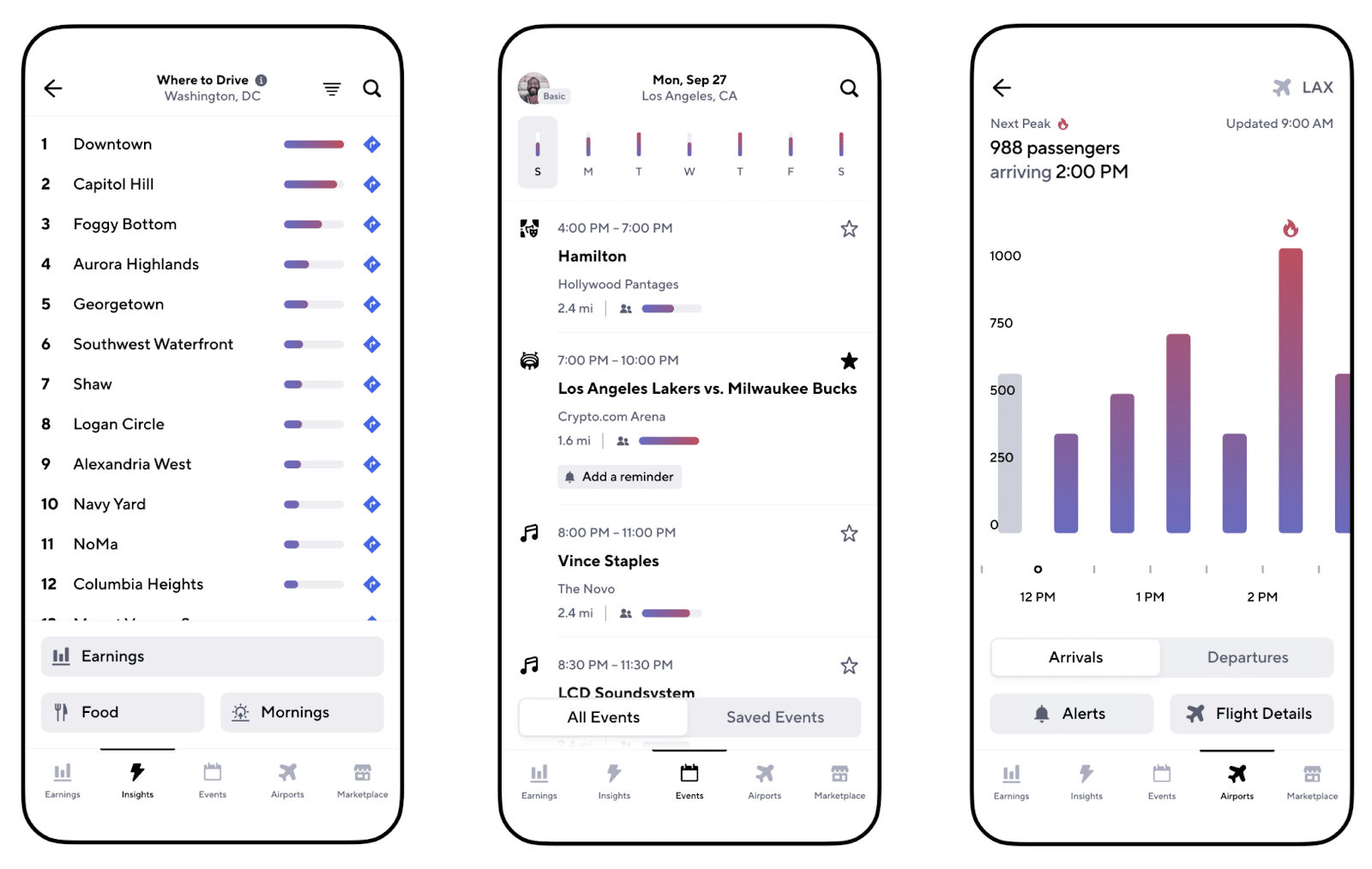
Gridwise’s easy-to-read screens place all the data and information you need at your fingertips.
Is the Spark Driver Rewards Program worth it?
Your driving habits, how much time you have for Spark, and whether you’re a regular Walmart shopper will combine to determine what the Spark Rewards Program is worth to you. This video from Rolling with Renia lays down the pros and cons in plain and honest language.
https://youtu.be/DSzo7G682KU?si=FNYMHv0q82lxb1xr
If you can consistently keep delivering 20 trips or more each month, and keep that “green” customer record Renia speaks to, there’s no doubt that the free Walmart+ membership alone is worth working toward. Go on and make the Spark Driver Rewards Program your cash cow!
But if you’re very part-time in your approach to Spark driving, or you work a bunch of different gigs and don’t have time to make the full quota of 20 trips, you may just want to let the Spark Driver Rewards Program mosey on by.
And if you opt-out or don’t make Tier 2, lucky for you, there’s always Gridwise!
Make more with all your gigs:
Gig Worker Compensation: How Data Can Lead to Fair Legislation
Objective mobility and food delivery data will play a pivotal role in the continuing struggle between equitable gig driver pay and the need for gig platforms to make a profit. Caught in the middle of this tug-of-war are the passengers and food delivery consumers who pay for these services and have come to rely upon them, as well as the cities and other jurisdictions trying to establish equitable laws that are fair to all participants.
There is no better example of this than the current situation in Seattle, WA. In 2020, Seattle implemented an ordinance known as Fair Share, establishing minimum compensation for rideshare drivers. In 2022, they followed up with another ordinance known as PayUp, which addressed food delivery drivers and took effect in January 2024.
While the measures were well intended, the results don’t please everyone, and many point out flaws in the legislation. It’s not just about how much Uber Eats drivers make in Seattle. The universe of gig drivers, gig platforms, policy decision-makers, and even Seattle restaurants are struggling for clarity and leadership.
This is where Gridwise Analytics prevails. We have real-time, ground truth data.
The gig driving landscape in Seattle
The tension between gig drivers and the gig platforms in Seattle resembles many large cities, with disagreements between platforms and drivers about fair compensation. Added to this, however, is a city government that is concerned about workers’ rights and equity in the workplace. According to TheStreet, a personal finance blog, Seattle has a minimum wage of $19.97 an hour, the highest in any major US city.
The Fare Share Law
In 2018 and 2019, Seattle saw increasing pressure from rideshare drivers who were concerned about low pay and unfair deactivations. The City Council unanimously passed Fare Share in 2020. Provisions of the ordinance mandated that drivers receive compensation of at least $0.57 per minute, $1.33 per mile, and a minimum of $5.00 a trip. There were also requirements for sick pay and protections against unfair deactivations.
To offset increased costs in the wake of Fare Share, Uber raised prices by 24%, reported Pymnts.com.
Interestingly, the ordinance was implemented simultaneously with the COVID-19 lockdown, making it difficult to determine how it affected the rideshare business. What is clear from the graph developed by Uber for a piece in The Medium is that the Seattle rideshare business, like rideshare across the US, cratered at the beginning of the pandemic. Rideshare in Seattle, however, has recovered at a slower pace than the national average and has yet to reach pre-pandemic levels.
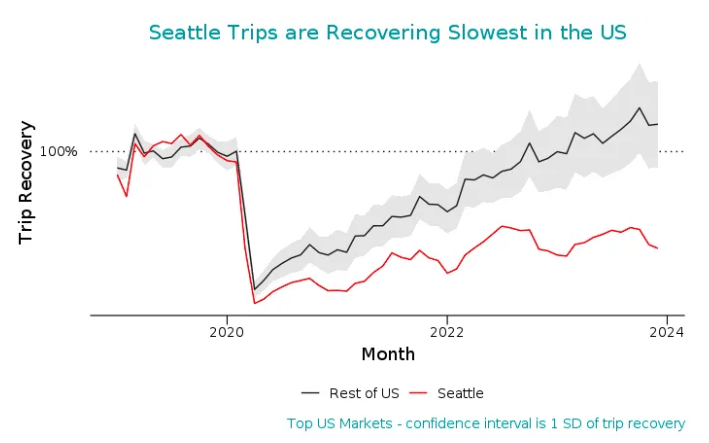
Source: Uber Under The Hood, Medium
The PayUp Law
The initial version of PayUp passed in 2022. As reported in the Seattle Times, the ordinance required gig platforms to compensate Seattle food delivery drivers at $0.44 a minute with a minimum per-mile amount of $0.74 while making a delivery or a minimum of $5 per order. The law applied equally to grocery delivery. Before the law took effect (but after it had passed), Shipt, the number two company in the grocery delivery market, suspended operations in Seattle with no comment on the reasons for the action.
Uber Eats and DoorDash added a $5 surcharge to Seattle orders, which they stated was necessary to maintain profit margins. They also warned that this would decrease order volume and driver income. DoorDash also responded by adjusting the suggested amount for tips in each order.
The following chart supplied by UberEats shows the aftermath of PayUp, with orders dropping almost 30%, starting when the law went into effect (signified by the vertical dashed line in early January 2024).
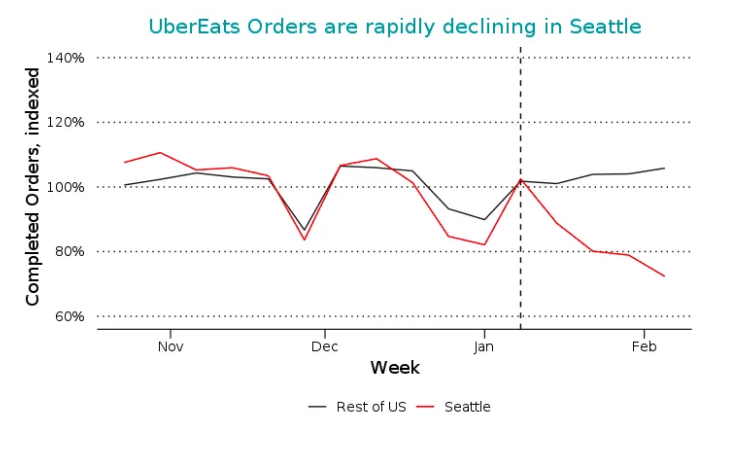
Source: Uber Under The Hood, Medium
Restaurants feel the effects of PayUp
Seattle restaurants are experiencing a drop in delivery business in the wake of PayUp, reports Geekwire. Uttam Mukherjee, co-owner of Indian street food restaurant Spice Waala, revealed that his restaurant experienced a 30% year-over-year decline in app-delivery orders this past January. In late February 2024, Uber Eats also reported a 30% decrease in food delivery orders.
Drivers are also feeling the effects of PayUp. The Geekwire article points out that although drivers make more per trip, the trip reduction means a lower net pay.
Carmen Figueroa, a veteran food delivery driver in Seattle and supporter of PayUp, told Geekwire, “I’m not making any more money.” She added that she’s getting fewer orders. Food delivery drivers all over Seattle report more pay-per-order but significantly fewer orders.
Drivers and allies call foul on price increases
Drivers and organizations allied with the drivers point to the $5 surcharge as part of a strategy the food delivery platforms use to prove that PayUp is a bad idea. As reported in another GeekWire article, nonprofit Working Washington, a previous PayUp supporter, said, “The new fees instituted by the delivery companies are a ‘clear attempt to distract from the fact that their business model is built on paying workers almost nothing while their CEOs and shareholders make millions.’”
Complicating matters even more, this past January, Uber released its earnings statement for 2023, revealing that for the first time, the company made a profit of $1.8 billion.
How can Gridwise Analytics data help solve the problem?
Developing a solution that is just and equitable to the gig platforms and drivers who make those platforms possible requires a clear picture of what is happening in the Seattle food delivery and rideshare market. Uber Eats, DoorDash, and the other gig platforms can and do provide data but often deny requests to look deeper into the information, citing proprietary concerns.
This leaves everyone with a clear need for accurate information so that legislation can reflect data-driven decisions.
Gridwise Analytics provides ground truth data on rideshare, food delivery, and grocery delivery activity. More than 500,000 drivers around the US, including in Seattle, use the Gridwise app to coordinate their gig driving activities by synching their gig platforms to the app. Gridwise Analytics anonymizes and aggregates the information from these drivers, turning it into raw data.
Gridwise Analytics can produce activity reports for specific dates and times, indicating increases and decreases in platform activity and driver earnings. It can also provide macro views of activity over a vast region and micro views of small market areas.
Precise, verifiable data from Gridwise means that all parties work from the same facts.
Gridwise provides comprehensive data on mobility and delivery services across the U.S., including food and grocery delivery. Data from Gridwise Analytics correlates up to 98% against quarterly metrics reported by the individual platforms.
Types of mobility and food delivery data from Gridwise Analytics
Comparing platforms
Gridwise Analytics can also compare order activity across various platforms for the same period, allowing decision-makers to see if policies affect all platforms similarly.
Gridwise Analytics can also view activity across platforms, allowing decision-makers to see if policies intended for one type of service, such as rideshare, affect food and grocery delivery.
In this case, the start of the PayUp Law is marked with a vertical black bar, giving viewers a clearer picture of its impact on activity before and after.
Driver earnings
DoorDash data can show how driver earnings break down over time, indicating how legislation and other factors affect base pay, bonus pay, incentives, and tips. Note again the vertical bar, indicating when PayUp went into effect.
How can this data be used?
Objective mobility and food delivery data, often called ground truth information, create a level playing field for all participants. As municipalities and other jurisdictions look to develop equitable regulations, they can use this data to guide their decision-making in several areas:
- Accuracy verification. By comparing data from individual parties with Gridwise Analytics, the information's accuracy can be verified, and conclusions can be based on factual data.
- Bias detection. News outlets may have certain biases that slant their reporting. Data from Gridwise Analytics provides an objective benchmark to identify and correct any potential biases or angles that the media might be promoting.
- Trend confirmation. Objective data allows all parties to identify food delivery and rideshare market trends. Are orders trending larger? Are they trending smaller? Are travel times getting longer? What areas of the city are generating rides or orders? Decision-makers can confirm or refute conclusions based on this and other data.
- Comprehensive analysis. Objective data allows for a more in-depth analysis, uncovering nuances and details that might not be evident otherwise.
- Policy impact assessment. It’s crucial to compare reported outcomes of new legislation (like Seattle's PayUp law) with actual data to assess the true impact of legislation on gig workers, gig platforms, and the economy.
- Market understanding. Objective data provides insights into market reactions that other sources may need to capture fully. This deeper understanding can guide strategic decisions for all parties in the gig economy.
- Crisis management. In times of crisis or controversy, the media can sensationalize events. A single comment from one driver becomes a story. Objective data helps all parties maintain a realistic stance. Responses reflect factual information.
- Data-driven decision-making. Objective data reinforces data-driven decision-making, ensuring reliable information guides strategies and actions.
- Trust. By demonstrating a commitment to factual data and transparency, all parties can agree on facts, paving the way toward equitable solutions.
Unbiased Data for Smarter Decisions
In over a decade, rideshare and food delivery have revolutionized transportation and dining habits, but this change comes with questions and challenges. Objective data is crucial as decision-makers develop solutions.
With access to Gridwise Analytics, companies gain a comprehensive view of mobility patterns across their competitive landscape. Regulators and researchers can explore pressing issues with robust, unbiased information. Municipal planners obtain insights guiding policies that support thriving gig economies and transportation systems optimized for the future.
Get in contact with our team to discover how Gridwise Analytics can sharpen your transportation and food delivery analytics.
Check out these articles to learn more about Gridwise Analytics:
Gridwise: The Best Business Mileage Tracking App
There is a term in business known as “sticky money.” It refers to how much of the money you earn sticks to you as opposed to having to pay it out in expenses and taxes. Some expenses you can control, but as a gig driver, taxes can decimate your earnings. Gig drivers are self-employed. In addition to the taxes on your earnings, there is a self-employment tax. Making matters more complicated, the gig companies don’t deduct these taxes for you. As a gig driver, you must discipline yourself to make those quarterly tax payments.
As a gig driver and a businessperson, one of the first questions you ask yourself, or another gig driver is, “How do I track my business mileage?”
This is easy if you have the wisdom and foresight to use the best business mileage tracking app—-Gridwise.
App-based gig work has become common
Before getting into the need for the best mileage tracking app for business, let’s address our use of the term “business.” An unbelievable number came out of the Pew Research Center back in 2021. Over 16% of US adults have earned money working on gig platforms. That number has likely increased since then, considering that the number came during the pandemic. In light of the Great Resignation, tens of thousands have flocked to gig driving. More are using gig driving to fill gaps in their budget or to fund the “revenge travel” we hear so much about. Their number one reason is the flexibility. Uber alone increased their number of drivers globally by 31% in 2022, according to a report by Business Insider.
For all these drivers, gig driving is a business. That’s why it’s necessary to treat it like one, including using Gridwise, the best business mileage tracking app.
The Gridwise business mileage tracking app also works for gigpreneurs, businesspeople who have discovered that they can also earn money on gig apps that don’t involve gig driving. Many gig drivers also work with these apps. They find it breaks the monotony and gives them options in the event of an unfair deactivation or some other issue with their gig driving (see the Gridwise blog post Sudden account deactivations on delivery platforms: What can you do?). These include apps such as Rover (pet care), Taskrabbit (handyman services), and others.
Business mileage tracking apps: What's all the fuss?
This past December, the IRS released an updated standard mileage deduction for miles incurred for business driving, with a1.5 cent increase, to 67 cents a mile. Full-time gig drivers can easily put 1,000 miles on their car weekly and 50,000 miles a year. At 67 cents a mile, you can deduct $33,500 miles from your taxable income. This kind of deduction makes a considerable difference for the tax bracket you fall into.
At the beginning of each year, gig drivers receive a report of their earnings for tax purposes. That report also includes the miles you covered as you earned that money. Most people don’t know that the gig platforms only track your mileage from the time you have received a ride request or food order, through the time you pick up the passenger or food, until you complete the ride or deliver the order. The gig platform apps do not record the time between rides or orders; they don’t track the miles you incur before your first order or ride request; and they don’t log the miles you cover when you go home at the end of your shift.
All those miles not counted by the gig app platforms are tax deductible. The Gridwise mileage tracker records all those miles. In many cases, that can add tens of thousands of business miles you can deduct.
Must-have features in an app for tracking business mileage
The question among drivers is, “What is the best app to track mileage for taxes?” The answer—Gridwise. It's the only business mileage tracking app designed for gig drivers by gig drivers. And since Gridwise understands that you're in business for yourself, the Gridwise app was developed to be the best app for tracking mileage for business gigpreneurs. Consider the features of the Gridwise app.
FeatureWhat it doesWhat you get out of itTracking exact mileageThe Gridwise mileage tracker links to the GPS on your cell phone. You get precise mileage,tracking every mile. Automatic reminder functionWhen you start to drive, the Gridwise mileage tracker senses movement and reminds you through your cell phone to activate your tracker. No more lost miles because you forgot to write down mileage at the beginning or end of your shift. Doesn’t interfere with other appsThe Gridwise mileage tracker works in the background. Gridwise doesn’t interfere with any gig app platforms you run on your phone, even if you're running two or three apps simultaneously. Easy setupIt takes just minutes to add all your apps to the Gridwise mileage tracker. Even if you multi-app several gig platforms, Gridwise quickly adapts, recording all the information needed to make you a better businessperson. Incorporates an expense trackerTake a photo of every receipt from every business expense related to your gig driving or other gig work, and add a quick description. The Gridwise mileage tracker saves it for tax time. All expenses are at your fingertips. View all your gigs at onceGridwise lets you view all your gigs at once, giving you a complete picture of your gig earnings. You can see trends and determine where your best jobs are coming from. Easily download informationDownload your mileage and expense records from the Gridwise mileage tracker into an easy-to-handle Excel file. Do calculations in minutes to come up with mileage totals. Without Gridwise, this is a daylong job.
The Gridwise mileage app is the best mileage tracking app for businesses. Download it today!
FAQs–taxes and business mileage
Am I better going with the standard mileage deduction or actual automobile expenses?
The IRS permits two ways of claiming mileage and automobile-related costs: actual expenses or the standard mileage rate. Both methods account for mileage and other auto expenses such as oil changes, tires, and repairs.
The standard mileage rate is easier. You determine the total miles you drive as part of your gig-driving job and write it off at 67 cents per mile (65.5 cents before January 1, 2024). In almost all cases, gig drivers and other business owners realize more significant savings using the standard mileage rate.
With method number two, deducting expenses only, you save all your receipts for fuel, repairs, and maintenance, and at the end of the year, you add them up. Businesspeople who use this deduction method typically do so in situations where they have less mileage, but drive an expensive car with significant maintenance costs.
Here’s another little jewel: the IRS allows you to compute your mileage at 67 cents per mile even if you drive an electric car.
What about claiming my fuel costs?
Your standard mileage rate includes fuel expenses. Claiming the standard mileage rate while at the same time claiming your gas expenses is a quick way to get audited.
What are the chances of a gig driver getting audited?
Estimates are that between 0.3% and 1% of all returns get audited. Remember, though, you're a self-employed businessperson, which increases your audit prospects. In addition, the gig industry is the newest area for IRS auditors to explore. It’s a bright, shiny thing for them, and they’re still trying to figure out how current IRS policies apply to the gig economy. Don’t take chances.
What if I didn’t keep a record of my mileage?
If you spent all of 2023 driving rideshare and didn’t keep a mileage log, your best option is to go with the report you received from Lyft or Uber. The same goes for meal and grocery delivery.
Another option is a technique the IRS calls “sampling.” After several false starts at keeping a mileage log, let's say you start using the Gridwise mileage tracker on October 1. For the year's final quarter, you must keep diligent mileage records. You can then extrapolate that report for the entire year. There is a good chance the IRS will accept that in an audit. Review Publication 463 (2021), Travel, Gift, and Car Expenses, for a full explanation of sampling. Look under Section 5, Recordkeeping.
Does the IRS require odometer readings as part of a mileage report?
Nothing in IRS policies says your records should include odometer readings.
The IRS instructs examiners to verify total miles for the year by requiring repair receipts or other records showing mileage at the beginning and end of the year. Take a photo of the odometer on the first and last day of the year and upload it to the Gridwise mileage tracker. That’s solid proof.
Can you round out your mileage numbers?
Stay away from rounded-off numbers. The IRS finds them a sign of less-than-stellar record keeping. Gridwise provides an accurate mileage reading. The more precise you can be in your information, the better you look in an audit.
The Gridwise mileage app is the best mileage tracking app for businesses. Download it today!
Gridwise provides the best business tools for gig drivers.
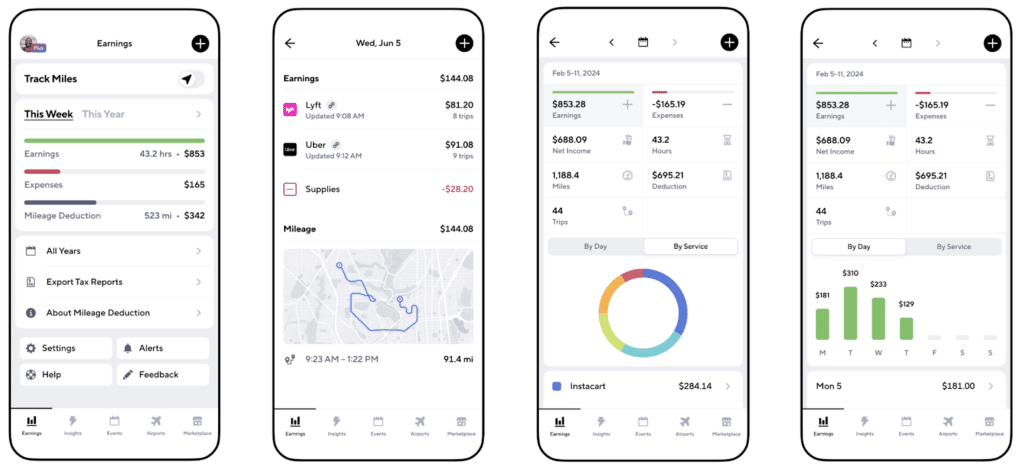
If you’re looking for an app for tracking business mileage, look no further than Gridwise. Veteran gig drivers developed the Gridwise mileage tracker specifically for other gig workers. They realized that gig driving was more than a way to make extra money. For many, it's a business, not just a side hustle.
Check out these Gridwise pages to learn more about the Gridwise mileage tracker:
- Download the Gridwise app for free (includes the Gridwise mileage tracker)
- Download the Gridwise Annual Gig Mobility Report
- The best mileage tracking app for DoorDash
- The best business mileage tracking app
- The best mileage tracking app for delivery drivers

How To Use Gridwise Features To Maximize Your Gig Worker Tax Deductions
What counts as gig worker tax deductions? How do mileage deductions work? Why do delivery drivers and other gig workers have to know about the mileage tax deduction? If you have questions like these or think you already have them covered, keep reading. You’ll not only learn why and how to track mileage for taxes, you’ll discover the best app for mileage tracking and how to use it so you keep more of your hard-earned money.
The power of Gridwise for tax management
Being a gig driver means you have more responsibilities than you would if you worked a job where your taxes are withheld for you. Not only do you have to pay your own taxes, you must find smart ways to maximize your deductions and simplify the tax filing process. This sounds rather straightforward, but in truth, you need help.
That’s where Gridwise comes in. Although Gridwise has a mileage tracker, it does much more! Gridwise is designed specifically for gig workers by people who have been gig workers. That’s why the app’s many features cater directly to the needs of rideshare and delivery drivers, as well as all sorts of gig workers across the board.
You’ll find this useful when it comes to managing your tax preparation needs and managing your gig worker tax deductions. Gridwise gives you tools that make it easy to record and compile the information you need to maximize your tax deductions.
- a customizable mileage tracker that records every deductible mile
- income information and analysis for all the driving apps you use
- expense logging
- professional tax software interface to identify gig worker tax deductions
- sleek reports that make tax time a no-stress, no-worry, no-brainer
Gridwise is an extremely powerful app that addresses the needs of gig drivers and can also help you keep track of your other side hustle tax deductions.
A guide to using Gridwise for tax management
Set up mileage tracking
What makes Gridwise such a cool tool for deducting mileage for business? You want to capture every mile you can legally deduct while you’re on your driving gig. The driving apps will indeed tell you how many miles you’ve clocked on the trips you make for them, but they leave a lot of mileage missing from their calculations.
You also need to log the miles you drive on the way to and from your gig and while waiting to get a ping for a ride or delivery. Your apps don’t count that mileage, but Gridwise does! In fact, Gridwise can log your miles automatically as soon as your car starts moving from its parking place.
Setting up automatic tracking is easy. First, you’ll have to download Gridwise and access Gridwise Plus to unlock this feature. Then, follow these simple steps. You can set a specific “idle time,” which tells Gridwise how long to wait before turning off automatic tracking. This makes your mileage tracking life loads easier.

You can also track your miles manually using Gridwise Plus, as well as the free version of Gridwise. Follow these instructions, and you’ll be all set. The manual shift tracker will let you catch all the miles you drive, so make sure you turn it off when you’re done for the day.
If you forget to turn the tracker off, or if you want to add to or adjust the miles you logged automatically, Gridwise makes it simple to edit your mileage figures. You can add mileage manually or make changes to your mileage whenever you need to do so.
With Gridwise, your mileage write-off will be accurate, and you’ll no longer have to worry about how to track mileage for taxes to add to your gig worker tax deductions. Gridwise does it for you!
Note that you can use Gridwise to track miles for all businesses that require the use of your vehicle. Whether you take short business trips or need your car to get from one client to another, Gridwise will help you capture each and every deductible mile.
Sync your earnings with gig apps
When you’re adding up all your gig income, you have choices. You can go through each and every app you drive for, and figure out the totals, or…you can use Gridwise to sync all your apps with your earnings records. Gig workers are busy people, and you can’t afford to spend hours manipulating figures (or missing gig worker tax deductions) and risking major math mistakes.
Streamline the process of adding up your earnings with Gridwise! All you need to do is sync your driving apps with Gridwise, and all your earnings will be recorded and retained. You’ll be able see, at a glance, how much each of the apps you use is earning for you.
Gridwise’s graphs and maps show you the details of your earnings by various factors. This makes it easy to prepare Uber taxes, Lyft taxes, Uber Eats taxes, DoorDash taxes, and taxes for all the apps you use.
You can enter your income figures manually. This and many of the income features are available in the free version, but as a Gridwise Plus driver you’ll enjoy the most number of features when it comes to syncing your apps and analyzing your earnings.

Log your expenses quickly and easily
Tax deduction for mileage isn’t the only delivery or rideshare tax-related item you can use to retain more of your income. Other expenses—from meals and phone costs to the equipment you buy to make your car more efficient for rideshare and delivery—can also be subtracted from your gross income.
You have to do more than take all the receipts you have and throw them in a shoebox so you can rifle through them at tax time. You need a tool with you at all times, one that gives you a place to record each and every expense you encounter. Gridwise is designed to be just that. Enter your expenses with the date and category, save them, and Gridwise will keep them impeccably organized.

Add, edit, or delete expenses using these directions. Later, you can view your total expenses on your earnings reports.
Generate and export tax reports
The real tax time magic happens when you generate and export your information to your or your tax preparer’s software program. From the earnings page, as shown in the screenshot above, simply tap on “Export Tax Reports.”
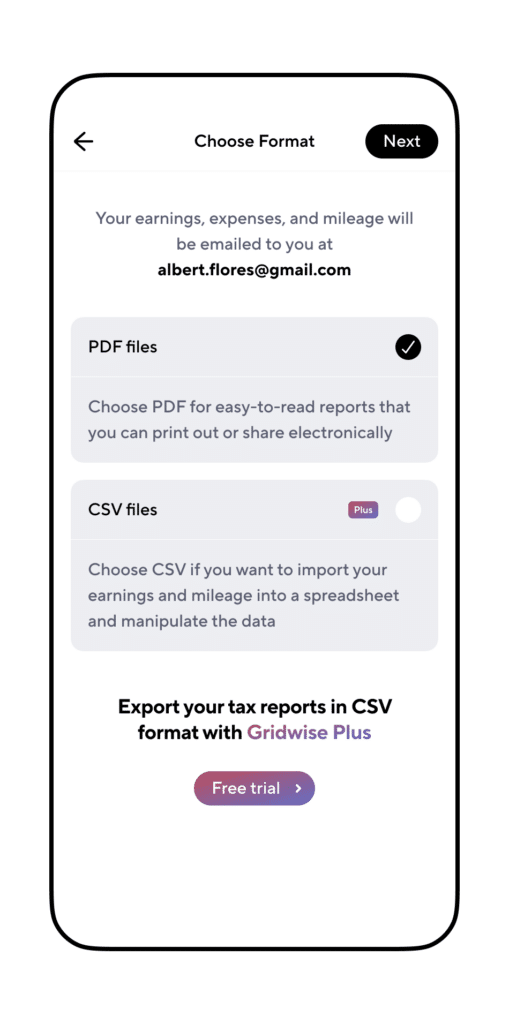
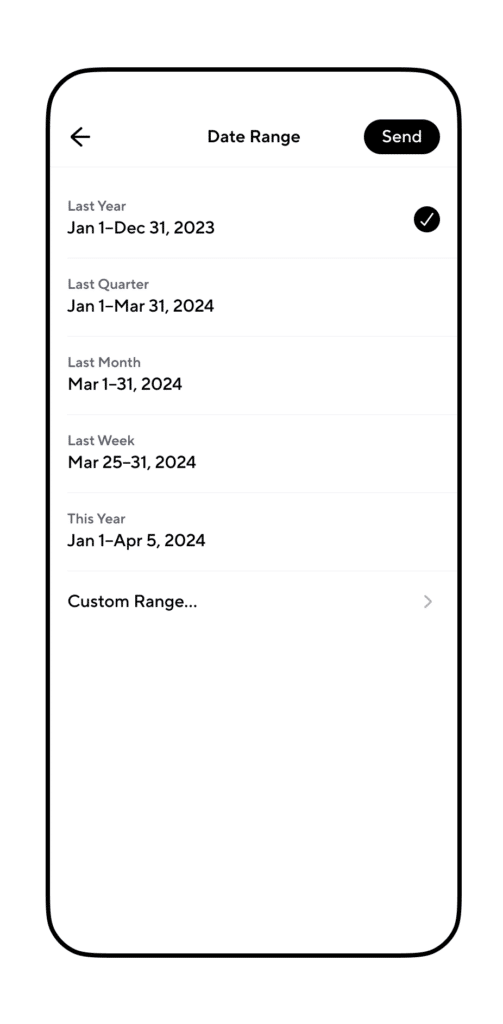
Gridwise Plus drivers can export their tax reports, which include accounting of all income from their various gigs as well as categorized expenses to .csv or .pdf formats. Free Gridwise app users can also export their information, but in .pdf format only.
Learn more about using Gridwise to generate tax reports and how to export them, so you can start using this convenient feature right away!
Advanced tax features for gig workers
You can get tax help with a tap. Keeper is a tax filing app that offers support for all your tax preparation and filing needs with a big discount.
Access to Keeper through Gridwise gives you
- automatic categorization of your tax-deductible expenses
- write-off detection that identifies all your deductible expenses
- tax pros on standby to answer your questions
- tax filing services
Keeper is designed for independent contractors with 1099 income and also handles any W2 or other wage forms you might have. Let Gridwise and Keeper sort out the income from all your gigs and handle all your tax preparation needs. Upload your information, and you’ll never have to agonize over tax time again.
How exactly do Gridwise and Keeper make tax management easier?
Let’s start with tracking your expenses. There are so many purchases and services that are tax deductible. As a gig driver, keeping track of all your expenses, pinpointing which ones can be deducted from your gross income, and making sense of it all can get really complicated. Things get easier when you enter your expenses into Gridwise and let Keeper search your purchases to detect any tax deductible items you might have missed.
Got questions? Get answers. Do you really know how to claim mileage on taxes? Without Gridwise and Keeper, you’re stuck poring over IRS and state tax rules and regulations all by yourself. When you unleash the power of Gridwise and Keeper, you get access to qualified tax professionals to answer all your questions and guide you through the process of preparing to file.
Filing made simple. Once you submit your forms through Keeper’s highly intuitive drag-and-drop interface, a professional will verify your return. You can review a report listing your estimated taxes, your total deduction amounts, and any refunds you might receive from your state and federal returns. A Keeper tax professional will sign off on your returns, and you can keep driving without worrying about whether you got it right.

Source: Keepertax.com
Real-world benefits of using Gridwise for tax management
With Gridwise and Keeper on your side to help you with tax management, you have everything you need to streamline your accounting process and simplify the ordeal of filing your taxes.
Use Gridwise to:
Maximize deductions. Gridwise captures every mile you drive for business. This includes the distances traveled while you’re working but not on the gig app, and when you’re waiting to get a ping. You can also use Gridwise to track mileage for business trips you make for your other side gigs.
Organize your accounting. Use Gridwise to record your expenses, and let Keeper seek out other freelancer tax deductions you might not have considered. Keeper will also categorize your expenses so they can easily be entered on your tax returns.
Streamline the tax filing process. With Gridwise and Keeper, you can take the daunting task of sending tax returns to the authorities off your plate. Recording mileage, earnings, and expenses as you drive along will make it easy to compile the information you need to file. Then, with a Keeper tax expert checking your return over, you can be sure that it’s in compliance and done right.
Save time and reduce errors. All your tax management solutions are on one app when you use Gridwise. You can keep the focus on your job, which is earning more money on your driving gig. Let Gridwise and Keeper handle the rest, and be confident that you’re maximizing your income and holding on to as much of it as possible while remaining in full compliance.
Start organizing your gig business with Gridwise now, and take the responsibility of tracking, recording, and filing off your shoulders so you can sit back, relax, and keep driving.
Learn about freelance tax deductions, Uber driver taxes, and more:
Lyft and Uber Pet Policy: A Guide for Drivers
You may love animals and want to welcome them into your car as much, or even more, than any other passenger, or you may not want to let them anywhere near your vehicle. In either case, you need to know the rules for carrying pets as passengers because those guidelines may be more important than you think. What about the Lyft and Uber pet policy?
Understanding pet transportation rules
It’s your car, and it’s your body that might have an allergic reaction or aversion to animals. Are there really instances when you have to take an animal into your car?
In the case of service animals, the answer is yes.
The requirement to accept service animals is not only a rule imposed by your gig service company, it’s the law. The Americans with Disabilities Act (ADA) requires all government offices and businesses (including rideshare drivers) to accept service animals.
According to the ADA, service animals include dogs of any breed or size that are trained to perform a task directly related to a person’s disability.
If you are reported by a potential passenger for refusing to allow a service dog into your car, and an investigation by your rideshare platform proves that you refused them, you can be immediately and permanently deactivated from the driving app, whether it’s Uber or Lyft.
How can you know for sure if a passenger’s dog is a service animal?
To be honest, you can’t. The passenger is not required to present any papers or put special tags or other designations on the dog to prove that it’s a service animal. You’re only allowed to ask the passenger two questions:
- Is the service animal required because of a disability?
- What work or task has the dog been trained to perform?
The consensus, and the expectation of rideshare platforms is that most people are honest about the roles their animals play in their lives. As a driver, you’re just going to have to trust them.
And, according to many people with disabilities, they expect you to understand and help by preparing to take them and their animals. After all, people with disabilities need rideshare services and depend on them to live a comparatively everyday life.
What about pets that aren’t service animals?
It makes sense to try to accommodate your passengers’ needs to transport their pets because you’ll be able to make their experience with you more pleasurable. That will most likely mean you get higher ratings and more significant tips.
Of course, each driver has different preferences, and you do have options. You decide if and under which circumstances you’ll agree to take a pet on board. Let’s look at the pet policies of both Uber and Lyft to see exactly what these options are.
Uber’s policy when it comes to pets on rides
Uber’s pet policy addresses both service animals and other pets. You always have the option of accepting passengers with pets. Now, though, there’s Uber Pet. With this service, your customer's requests will be marked similarly to UberX rides. You can opt to take the passenger and pet, depending on your wishes. Uber's customers are charged extra for Uber Pet rides, and you’ll get paid a little more for them! Opt into Uber Pet rides from the work hub in the Uber app.
What is the Uber policy when it comes to cats?
This is an Uber pet policy cat lovers can appreciate as well. Uber drivers are expected to accept feline friends as part of the Uber Pet arrangement. When it comes to more exotic pets, from ferrets and hamsters to monitor lizards and boa constrictors, you can make the call. You won’t be penalized for refusing these pets.
What is Uber's policy if a pet or service animal leaves a mess?
Cleaning fees can be applied if a passenger's pet soils your vehicle, and the passenger won’t be refunded, except in most cases involving service animals. Your rideshare company will still reimburse you, but your passengers with service animals will have their cleaning fees refunded if the only mess is caused by shedding. If a service dog’s excessive hair or bodily fluids are part of the mess, the rider will not be charged for the first two incidents, but after that, the cleaning fee will not be refunded.
When you decide to accept Uber Pet rides, you will want to carry a tarp or a blanket for your backseat to prevent your car from being covered in pet hair. If you are allergic, or if you just don’t dig dogs or care for cats, be sure you opt out of Uber Pet on the app’s work hub. You, as a driver, still are required to take service dogs in your vehicle, though, so taking along that tarp or blanket is always a good idea.
What are Lyft’s policies for pets, and cleaning up after them?
Lyft pet policy is similar to Uber’s, but there is no special pet-friendly option for passengers. In general, customers are asked to call and tell you that they have an animal with them. If you’re not willing to take their pet, you can cancel the ride and make yourself available for another one. In this case, the customer won’t be charged a cancellation fee.
If a pet makes a mess in your car, you’d report it like any other damage. Lyft doesn’t state any specific company policy about how you’d be reimbursed for cleaning up after animals, and there is no distinction between soiling or other damage caused by service dogs versus ordinary pets. If you have to deal with a major mess left by a rider’s animal, Lyft recommends that you report the damage and seek reimbursement.
Does Lyft’s pet policy leave room for your own service animal?
What if you need to have a service animal with you? Under the law, you’re permitted to have a service animal with you while you’re driving. It’s polite and a smart policy, though, to call or otherwise inform your passengers that they can expect to meet your friend when they ride with you. Some people are allergic to or afraid of animals, and being in a car with one could be very unpleasant for them.
For safety as well as the comfort of your customers, consider restraining or kennelling your service animal, at least while others are in the car with you. This way, your furry friend will be able to remain focused on you, and won’t be distracted by passengers’ adoring comments.
What about emotional support animals?
In case you’re wondering, emotional support animals are not classified under the law the same way service animals are. Lyft’s pet policy doesn’t require you to accept rides with animals other than service dogs.
Just like with any pet, you can accept the animal or let the rider find a driver willing to take the ride. Remember, riders are instructed to inform you when they request the ride that they have a pee.
You can’t bring your pet or an emotional support animal for your rides, though. You’ll have to settle for meeting the furry friends your passengers might bring in. Carry along some sort of covering for your back seat so they can ride comfortably and still let you keep your car looking clean and fresh.
How to maximize your rideshare efficiency and service quality
Your rideshare driving experience is better when you go out of your way to provide safe and friendly service to your customers. You have the right to set your boundaries, including whether you will agree to transport someone’s pet in your vehicle. Being honest and courteous about expressing your preferences is always a good bet.
You have lots of reasons to drive for Uber and Lyft, including more freedom, time, and additional earnings. Knowing policies about pets, providing honest and sincere customer service, and accommodating your passengers’ requests with kindness and courtesy will help you get bigger tips!
It’s also smart to have the tools you need with you at all times to run your rideshare gig right. Gridwise makes managing your business easy by giving you
- mileage tracking
- earnings tracking
- insights
- airport and events information
- benefits and discounts
- a community of like-minded gig workers
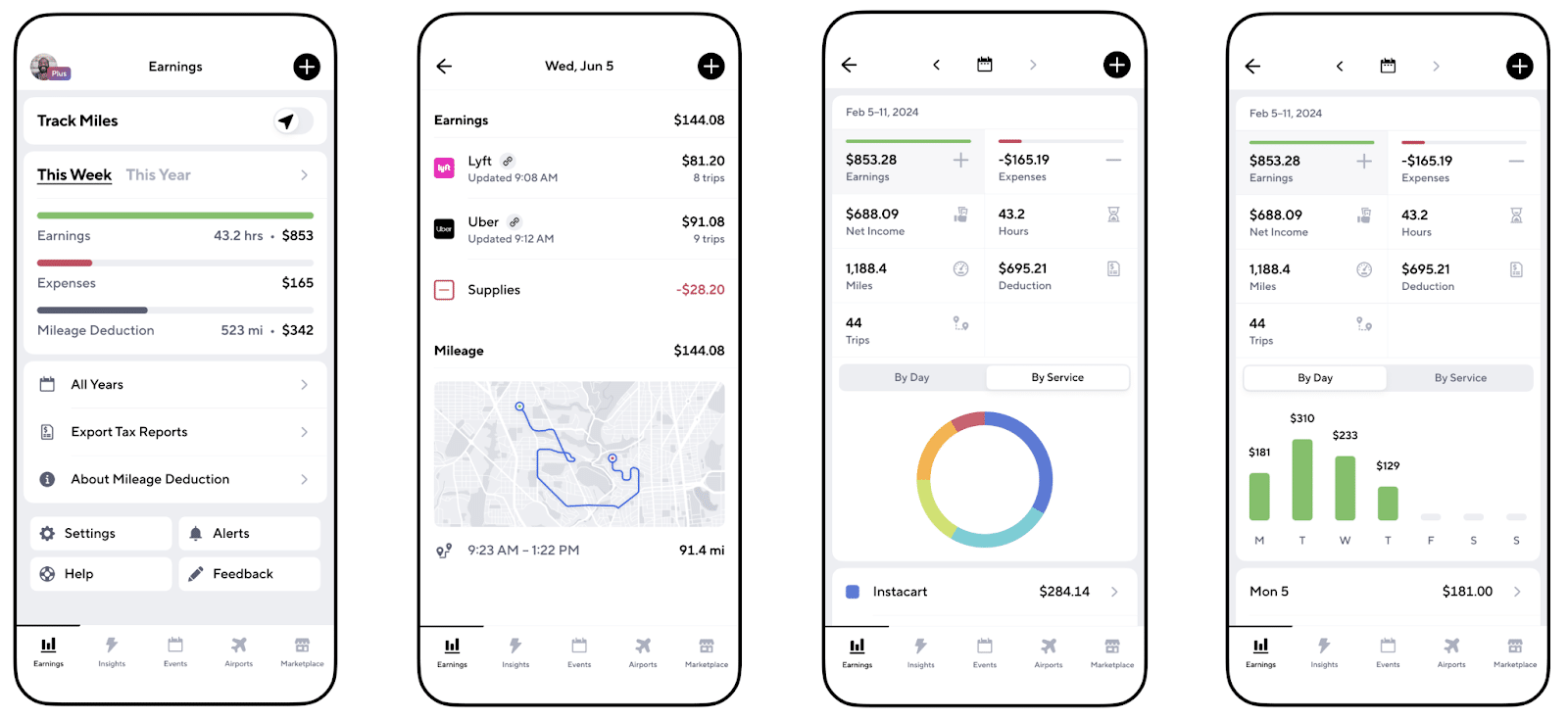
See the difference having a way to manage all your gigs in one place can make!
More about boosting your earnings:
Work smarter. Earn more.
Whether you drive, deliver, or pick up shifts — Gridwise helps you track earnings, mileage, and performance so you stay in control of your work. Download the app and take charge today.
