Gridwise blog
Tips, insights, and advice to help you earn more and work smarter, whether you do gig work, hourly, or shift work.
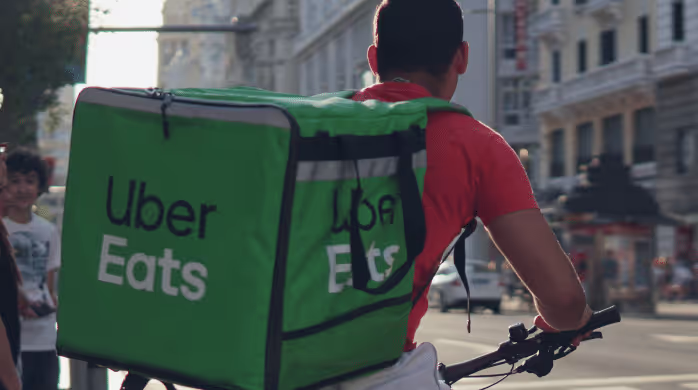
How to Make $1,000 a Week With Uber Eats in 2026 (Tips + Hourly Data)
In this blog, we'll explore the strategies and techniques that can show you how to earn $1000 per week as an Uber Eats delivery driver. We'll cover everything from optimizing your delivery zones and schedules to maximizing your tips and customer satisfaction. Whether you're a seasoned Uber Eats driver or just starting out, this guide will provide you with the insights and actionable steps to take your Uber Eats driver earnings to the next level.
Becoming an Uber Eats delivery partner can be a lucrative opportunity, especially if you're able to consistently earn $1000 a week. By understanding the platform, optimizing your delivery strategies, and focusing on customer satisfaction, you can maximize your earnings and turn Uber Eats into a reliable source of income.
We’ll cover the following topics to provide coaching and ideas to help you push your earnings up to that $1000 per week level:
What do Uber Eats drivers do?
Uber Eats drivers deliver prepared food most of the time, but they also might shop for and deliver goods from convenience outlets and grocery stores. The job is pretty simple. You get a request for an order, you drive to the restaurant or store to pick it up, and then you deliver it to the customer. If you already drive for Uber, you can choose to take orders for Uber Eats delivery any time.
If you’re not an Uber Eats driver yet, it’s pretty easy to become one. This Gridwise post tells you what you need to do if you want to sign up and start making money Uber Eats style. Many rideshare drivers welcome the chance to deliver food rather than people. This article from Nerdwallet covers the Uber Eats gig from that angle.
There are some sweet advantages to working with Uber Eats. In lots of cities you don’t even need to have a car. You can use a bike or a scooter, or even walk, to make your rounds. If you do use a car, Uber Eats’ requirements are a lot easier to meet than they are for Uber rideshare driving.
You also have a lot of flexibility. You can shop and deliver convenience items and groceries, but you don’t have to. And, like most driving gigs, you can choose your own hours, and map out the locations where you want to work.
Use Gridwise features When to Drive and Where to Drive to help you figure out what work hours and which specific areas will be the most profitable for you. Real data from real delivery people will show you earning patterns for drivers in your town.
How much can you earn doing Uber Eats?
The honest answer to this question is: basically, as much as you want! It all depends on how many hours you put in and how strategic you are about your gig. Earnings vary from one area to another, as this article from Entrepreneur points out. To give you a baseline, let’s look at the earnings of Uber Eats drivers who tracked their earnings with Gridwise.
Remember that these numbers show us only average earnings. To make $1,000 a week with Uber Eats, you’re going to have to be better than average, and we’ll show you how. For now, though, it’s good to have these figures so you get a ballpark number of where to start.
How much do Uber Eats drivers make?
Gridwise data tell us the following:
- Monthly earnings average around $444.00 per month.
- Gross earnings per trip are between $9.00 and $10.00.
- Tips make up about 50% of most Uber Eats drivers’ income, which amounts to about $225.00 per month.
Is Uber Eats good money? It can be. While there are other gigs that pay more per trip, if you drive for Uber Eats, you’ll always be pretty busy.
https://datawrapper.dwcdn.net/HPAz8/3
You can also see that, unlike many other gigs, tips play a huge role in Uber Eats earnings.

With these numbers as a baseline, what can we say about how to earn $1,000 a week with Uber Eats? As we said in the introduction, it’s going to be a hustle, but it’s really possible. To figure out how to make the most money with Uber Eats, let’s start by looking at how many trips these “average” drivers made each month.
We know that average gross earnings were $444.00 per month, and drivers got around $10.00 per trip. That means they took 44 or 45 trips per month, which breaks down to 11 trips per week. That’s not a lot of Uber Eats delivery, is it?
The fact that Uber Eats drivers averaged so few trips shows us that many drivers use more than one app at the same time. This is called multi-apping, and you can learn more about it in this Gridwise post. If you want to answer the question of how much you can make with Uber Eats, then you need to stick with the app and keep plugging away at those orders. You also need solid strategies, as well as some inside tips and tricks.
How to make the most money on Uber Eats: Delivery driving tactics
Getting to that $1,000 a week with Uber Eats isn’t so hard when you remember that the drivers we saw making about $111 a week were only taking around 11 trips in the same time period. That’s not much at all! If you work the Uber Eats app like a boss, you’ll soon have many more trips than that, easily reaching the number needed to get you to $1,000 a week. Now, let’s get to some tactics you’ll need to make that kind of bank.
- Stay with the Uber Eats app, and track your earnings. Gridwise can easily do that for you. Simply sync your Uber Eats app with Gridwise, and you’ll be able to see how much you’ve earned with Uber Eats, what times were most profitable, and your average hourly pay. Racking up trips with Uber Eats has other benefits, including perks and bonuses that are awarded to top drivers.
- Leverage surge pricing and promotions. Surge pricing is applied when there is a lot of demand. When surge pricing is in effect, many of the trips you make will pay more than usual. Promotions are offered to drivers who complete a given number of trips in a certain time period. High traffic volume days, nights, and times give you these chances to get extra earnings. Challenging yourself to complete the right number of trips for promotions will add to the number of trips you can count on for big bucks, too. Learn more about Uber Eats surge pay, boosts, and promotions in this Gridwise blog post.
- Say yes to doubling up on orders. With Uber Eats, you can get back-to-back orders or receive batched orders. Back-to-back orders happen when you receive a new request while you’re on the way to deliver an original order. The Uber Eats app routes these trips automatically, so you won’t be sent out of your way.
Batched orders are Uber Eats’ way of bundling together orders from either the same restaurant, or two nearby eating establishments. You get money, and trip count credit, for all the orders you complete, plus customer tips, without having to make a bunch of separate trips.
- Turn on the charm and get bigger tips. Being nice really is part of the Uber Eats driver’s job, and getting tips is one way people who drive for Uber Eats make money beyond their basic pay.. Bring along those extra napkins and condiments, use equipment that keeps food and drinks at the right temperatures and prevents spilling, and consider your customers’ needs. If you deliver groceries, be extra careful with delicate items such as bread and eggs.
And, most important, follow your customers’ directions, and stay in communication with them if you are going to be delayed, or if you have questions about their order. This Gridwise post will tell how to get bigger tips as a delivery driver.
- Use even more charm to keep your ratings high. As an Uber Eats driver, you will be rated by the restaurant or store where you pick up the orders as well as the customers who are waiting for the deliveries. This two-way rating system is designed to keep you on your toes, so Uber can keep people satisfied with your service. Don’t worry, you get to rate them, too.
There’s another reason why your rating as a driver is important. It not only keeps you in good standing with Uber; it helps you to qualify for the Uber Eats Pro incentive program. To learn more about Uber Eats Pro, and what it takes to earn perks such as preferred services, discounts, and deals, check out this Gridwise blog post.
Smart business moves that seal the deal
Now that you know how to gobble up the deliveries you need to make $1,000 a week with Uber Eats, it’s going to be a breeze to get there. Let’s make it even easier, with business moves that boost your earnings and shrink your expenses. If you use these, it will also be easy to say yes when people ask, “Can you make good money with Uber Eats?”
Minimize expenses. Avoid racking up big fast-food bills by bringing your own food and beverages. You might not think you’re hungry when you first start your Uber Eats run, but once the aroma of pepperoni pizza, premium cheeseburgers, and piping hot fries start wafting through your car, that might change. Bring a sandwich or other healthy food from home, and buy bottled water in bulk to save tons of cash compared to what it costs to buy single servings.
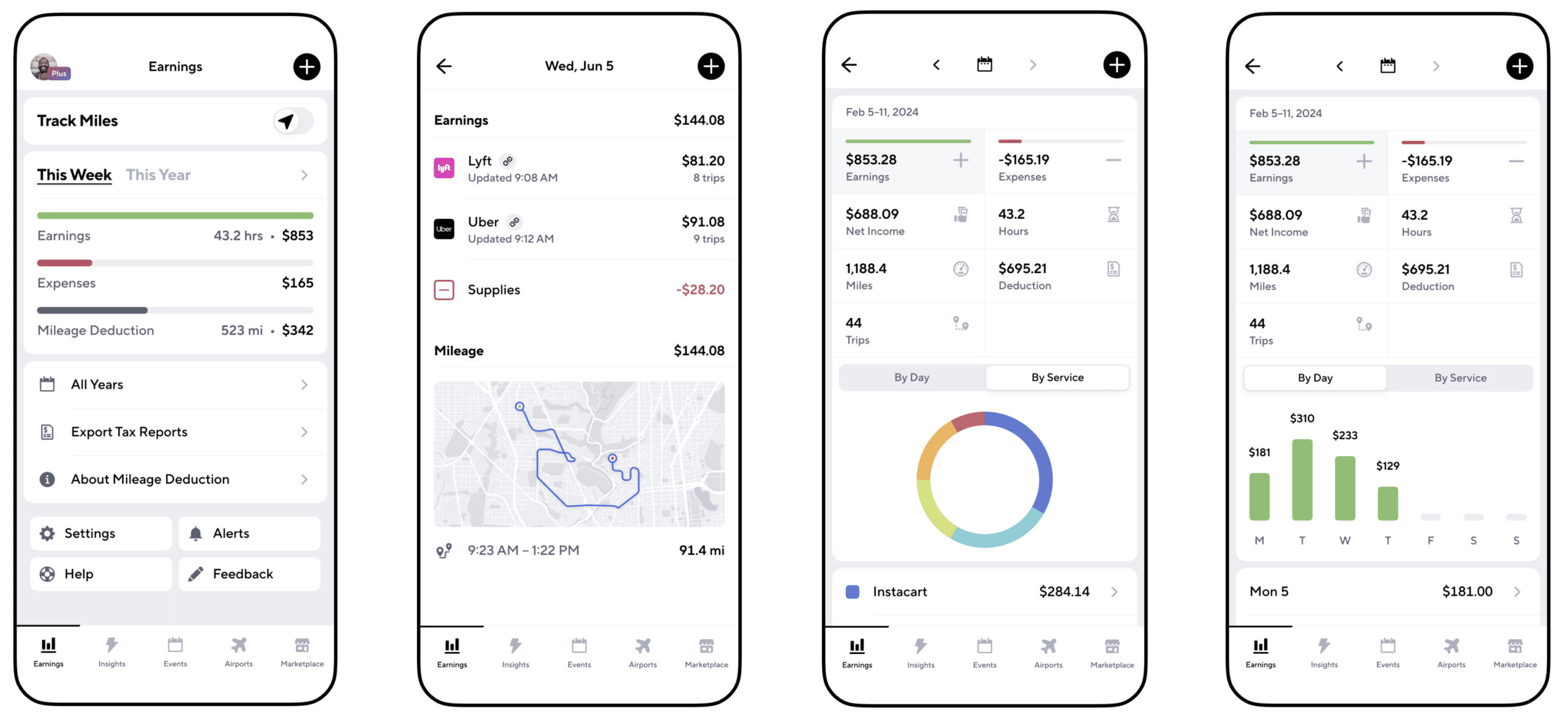
Maximize tax deductions. Another way to minimize your expenses is to maximize your tax deductions. Start by tracking mileage with Gridwise.
Gridwise App
Gridwise captures every deductible mile you drive, including the distance you cover between the trips your driving app records. Know what expenses you can deduct, and put them to work for you when tax time comes. Learn more about tax deduction strategies in the Gridwise Tax Guide for drivers.
Boost earnings with referrals
As an independent contractor, you’re probably looking for ways to make even more money than you can with Uber Eats. And most gig workers like you enjoy getting passive income. With Uber Eats, there’s a really easy way to do that, referrals!
All you need to do is find friends and encourage them to deliver for Uber Eats. If they make a certain number of deliveries within a specified time, you will get paid for doing nothing more than having them sign up under your referral code! Rates of pay vary by city, so check your Uber Eats app to find out what the current deal might be, and learn more about the referral program on the Uber Eats website.
Also remember: “friends” don’t have to be your best buds. Many delivery people carry cards with a QR code linking to their referral information, so just about anyone you encounter can join Uber Eats and boost your earnings. You could meet a source of passive income at the gas station, on social media, or at your high school reunion. The more you hustle, the more there is to gain, right?
Master the art of self-employment
As an Uber Eats driver, you’re an independent contractor. That means the company isn’t going to withhold your taxes, provide insurance, keep track of your earnings, or tell you about tax deductions. You’ll have to do all these things for yourself.
If you want to maximize your tax advantages, open an official business entity. You can incorporate (create a corporation) or you can work as a limited liability corporation (LLC). You can also work with a DBA (Doing Business As) arrangement, but the corporation or LLC will do a better job of protecting you from liability.
Establishing a corporation or LLC offers better tax advantages than being a sole proprietor. For instance, if you simply collect your earnings into your private account, you’ll be charged self-employment taxes in most states. And paying extra taxes is something we all want to avoid, within legal limits, as much as possible.
Every Uber Eats driver needs to learn about self-employment, and there are some great resources you can review. Check out the CareerOneStop website about self employment which will help explain the basics. You can also check with a professional tax accountant, or look other websites to learn more about actually creating a business.
Scope out your market
Look at the area around you to see where you’re likely to get the most deliveries. Where are all the restaurants? Where might people be more inclined to order deliveries? What hours do you want to drive? What activities might be going on around those times? Think about late-night and after-school times as well as breakfast, lunch, and dinner times.
Be realistic about the potential for your area and aware of new services opening up. For example, in New York, there is already a tab on the Uber Eats app that allows customers to order groceries. In our article about the best food delivery service to work for you’ll see that Uber Eats stacks up well against other delivery companies, mainly because of its potential for expanded opportunities for drivers to earn.
So, is Uber Eats good money? As we said, it isn’t an automatic guarantee that everyone will make $1,000 a week with Uber Eats. Trying out the suggestions we give you here, though, should put you on the right track! Go out there and start stacking up those orders and raking in some impressive earnings!
Get more inside information on Uber Eats in these posts from the Gridwise blog:
- The delivery driver guide: Using the Uber Eats app
- Everything you need to know about driving for Uber Eats
- Uber Eats Pro: What drivers need to know
- Looking for a different gig, part-time or full time job? Check out the Gridwise Job board.
Uber Eats FAQ
How does the Uber Eats platform work for drivers?
Uber Eats is a food delivery service that connects customers with local restaurants and independent delivery partners. As an Uber Eats driver, you'll receive notifications of nearby delivery requests, which you can accept and complete. The platform provides flexibility, allowing you to work on your own schedule and earn money based on the number of deliveries you complete.
What are the requirements to become an Uber Eats delivery partner?
To become an Uber Eats delivery partner, you'll need to meet certain requirements, such as having a valid driver's license, a registered vehicle, and passing a background check.
How can I choose the right delivery zone to maximize my earnings?
Selecting the right delivery zone can significantly impact your earnings, as some areas may have higher demand and better-paying orders. It's important to research and identify the zones in your area that tend to have the most consistent and lucrative delivery opportunities.
How can I take advantage of peak delivery hours and surge pricing?
Understanding peak delivery hours, such as mealtimes and weekends, and taking advantage of surge pricing can boost your earnings. Be aware of when demand is highest in your area and adjust your schedule accordingly to capitalize on these peak periods.
What are some tips for maximizing tips and customer satisfaction?
Providing excellent customer service and going the extra mile to ensure a positive experience can lead to more tips and repeat business. Prioritize communication, timeliness, and attention to detail to keep your customers happy and satisfied.
How can I set realistic weekly goals to reach my $1000 target?
To make $1000 a week with Uber Eats, it's essential to set realistic weekly goals and track your earnings and expenses. Start by determining your target earnings and breaking it down into achievable daily or weekly goals. This will help you stay on track and make adjustments as needed.
What are some strategies for efficient route planning and navigation?
Effective route planning and navigation can save you time and fuel, allowing you to complete more deliveries. Utilize mapping apps and take advantage of features like real-time traffic updates and turn-by-turn directions to find the quickest routes.
How can I balance my Uber Eats deliveries with other commitments?
Develop a schedule that allows you to capitalize on peak delivery hours while still maintaining a healthy work-life balance. Consider using tools like calendar apps to plan your availability and track your hours to ensure you're maximizing your earning potential without sacrificing your personal life.
What are the key considerations for maintaining my vehicle as an Uber Eats driver?
Keeping your car clean and well-maintained is crucial for maximizing your Uber Eats earnings. Regularly scheduled oil changes, tire rotations, and other preventive maintenance can help extend the life of your vehicle and minimize downtime. Additionally, budgeting for vehicle-related expenses, such as fuel, insurance, and repairs, will ensure you're accounting for these costs and maximizing your net earnings.
What are the tax obligations and legal considerations for Uber Eats drivers?
As an Uber Eats delivery driver, it's essential to understand the tax obligations and legal considerations that come with being an independent contractor. This includes properly reporting your earnings, deducting eligible business expenses, and making quarterly estimated tax payments. Additionally, you'll need to ensure you have the appropriate insurance coverage, such as personal auto insurance and possibly commercial auto insurance, to protect yourself and your vehicle while on the road making deliveries.

The Gridwise Job Board: Find Your Ideal Job or Gig Work
Gridwise is an essential assistant app created by gig workers for gig workers. Our mission is to support those engaged in gig work in every way possible. We understand how challenging it can be to deal with income instability, a lack of benefits, and job insecurity that often comes with gig work. The Gridwise app tracks and organizes earnings and expenses, and offers a wide array of discounts, deals, and services that make the lives of independent contractors easier and more rewarding.
We firmly believe it’s possible to make a viable living and create a gig experience that offers flexible hours, variety, and excitement. With issues such as consistent earnings and job security in mind, Gridwise is proud to offer a centralized platform that shows you how to find gig work and secure reliable opportunities. We’re proud to introduce the Gridwise Job Board.
The Gridwise Job Board: Key features
Because Gridwise is dedicated to serving the gig worker community, we’ve filled the Gridwise Job Board with useful features that won’t waste your precious time.
- Comprehensive listings. Find part-time, full-time, temporary, and per-task work. Drive or deliver with your vehicle, utilize an employer’s vehicle, or even find non-driving gig work.
- User-friendly interface. Find the jobs that are right for you with a tap of your screen.
- Verified opportunities. We vet the jobs before they are listed to ensure you’re getting high-quality job postings.
How to get more gig work, seasonal, part-time or full-time jobs with the Gridwise Job Board
Looking specifically for “gig work apps” or “gig jobs near me?” You’re in luck. Our filters and search functions send you directly to the listings you seek.
Here’s how it works.
- Access the Job Board via the Gridwise website.
- Search for jobs by type, location, and more.
- Select the job that interests you, and read all about it.
- Scroll through the description, and if it appeals to you, click “Apply for job.”
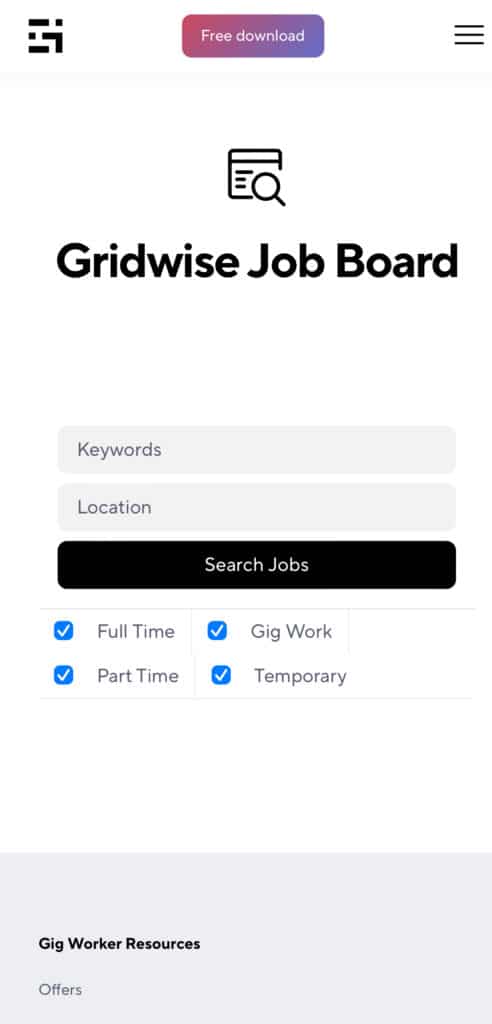
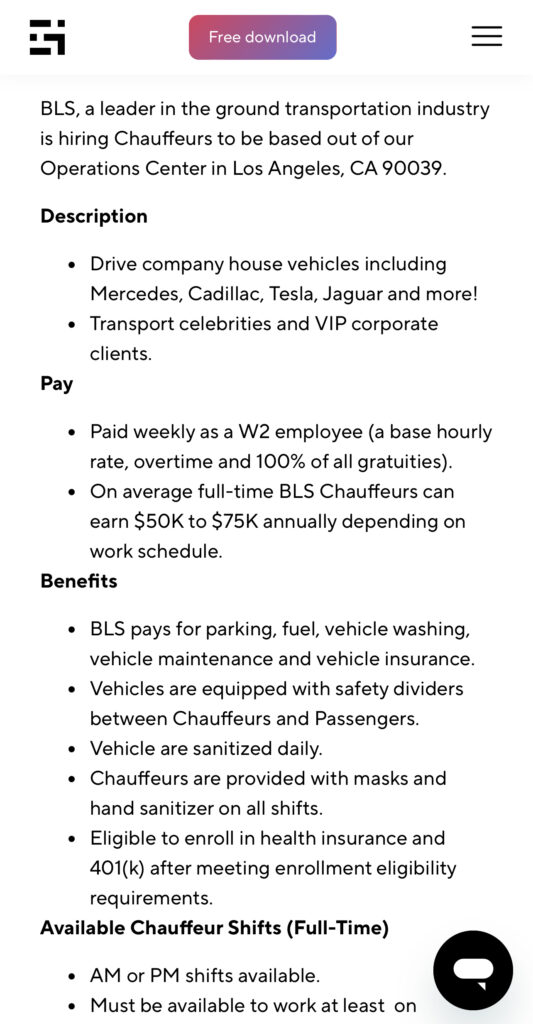
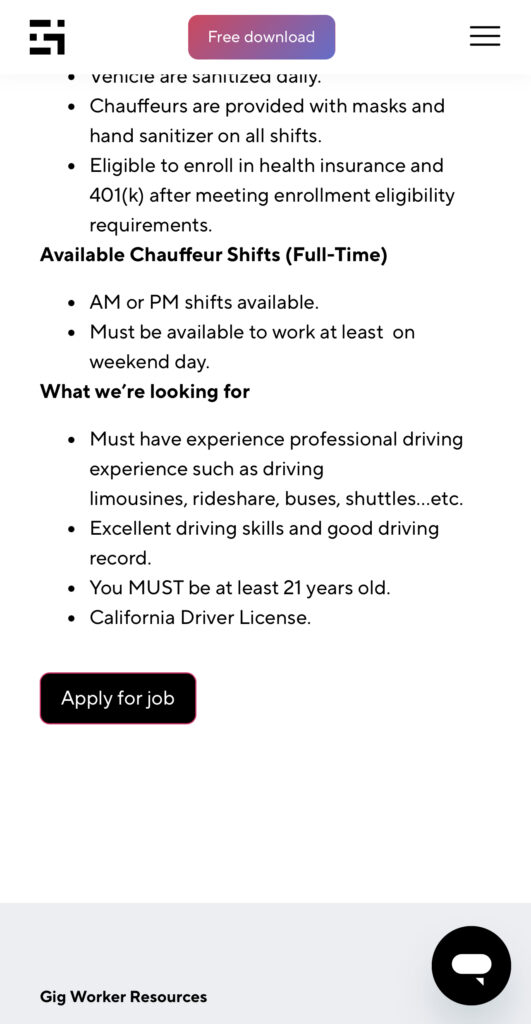
Many types of jobs are available. Adjust the search filter to see the full variety of opportunities that will let you cash in. Deliver food, set up catering, do rideshare driving, get paid for doing package delivery, and much more. You’ll find short-term gigs, long-term contracts, and part-time positions.
Perks of the Gridwise Job Board for gig workers
Gig workers who know how to make extra money will appreciate how the Gridwise Job Board lets you multiply your chances of bringing in big earnings. Here’s how:
- Increased stability. Use the Gridwise Job Board to find part-time or permanent jobs in addition to the part-time gigs you already have. Always keep a steady stream of earning opportunities flowing toward you.
- Flexibility and autonomy. Choose jobs that fit your schedule, work around other jobs and family duties, and still leave room for some fun in your life. Discover side hustles to supplement your full-time job, permanently or just for the season.
- Skill development. Find part-time work that lets you use a skill you already have, or try your hand at something new. It’s a smart way to develop a portfolio to showcase what you can do, or even to find permanent employment.
Get Gridwise and stay up to date on the Gridwise Job Board
Gig workers need plenty of information and assistance, and Gridwise is here to give it to you. Download the app and get essential features such as
- seamless earnings tracking
- mileage tracking
- expense recording, including notes
- low-cost and no-cost insurance benefits
- access to affordable medical, dental, vision, mental health, and alternative care
- professional services including legal and financial help
- deals and discounts
- weather, events, and traffic reports
- inside information on where and when to drive
More to know about gig work:

5 Best Mileage Trackers For Gig Drivers
Many drivers ask, “Do I really need a mileage tracking app?” The answer is simple: only if you want to have an accurate count of all the miles you can legally deduct from your taxable income! You might think your rideshare or delivery driving app has got you covered. After all, they do quite a good job of logging the miles you drive while you’re on a trip or delivery. But, if you want to have the best app to track mileage for Uber, Lyft, Doordash, Instacart, or the other apps you may use, you need more. Why is that?
Without a separate tracker, you’re missing the miles you drive in between pings. Did you realize that all the miles you drive, from the moment you begin your shift until it’s over (as long as you don’t drive several miles on a break to hang with your friends), are tax deductible! That means you need something besides your driving app to keep an accurate count of your travels. Read this Gridwise post to see how important it is to keep track of every deductible mile.
You won’t be surprised to hear that there’s an app for tracking miles. In fact, there are several of them. Here, we’re going to tell you about five top mileage tracking apps, and help you figure out which one is best for you.
Before we get to the list and identify the best mileage tracker app, let’s clarify what exactly a mileage tracking app is. According to G2.com’s technology glossary, mileage tracking is done for the purpose of keeping a log of mileage that is either reimbursable or tax deductible.
And yes, of course you can track your miles simply by taking readings on your odometer. But are you really prepared to account for how many miles you drove for personal reasons and subtract them from the total to get your business mileage? Even if you can remember all that and do the arithmetic, if you want an accurate reading of the miles you drive for business, and can therefore deduct, a mileage tracking app will save you a lot of trouble and prevent you from making costly errors.
Plus, as a gig driver, you have specific needs when it comes to a mileage tracker. Ideally, you’d be able to handle mileage tracking and several other functions all in one app. It can be maddening enough to deal with driving apps, particularly if you’re an avid multi-apper. You would want your mileage tracker app to help you keep account of other aspects of your business, including income, expenses, and inside information about the art of gig driving.
Not all mileage apps are equal, to be sure! Let’s look at five of the best apps to track mileage and figure out which is the best app to track mileage with Uber and Lyft, or what mileage tracker app is best for DoorDash.
1. Zoho Expense
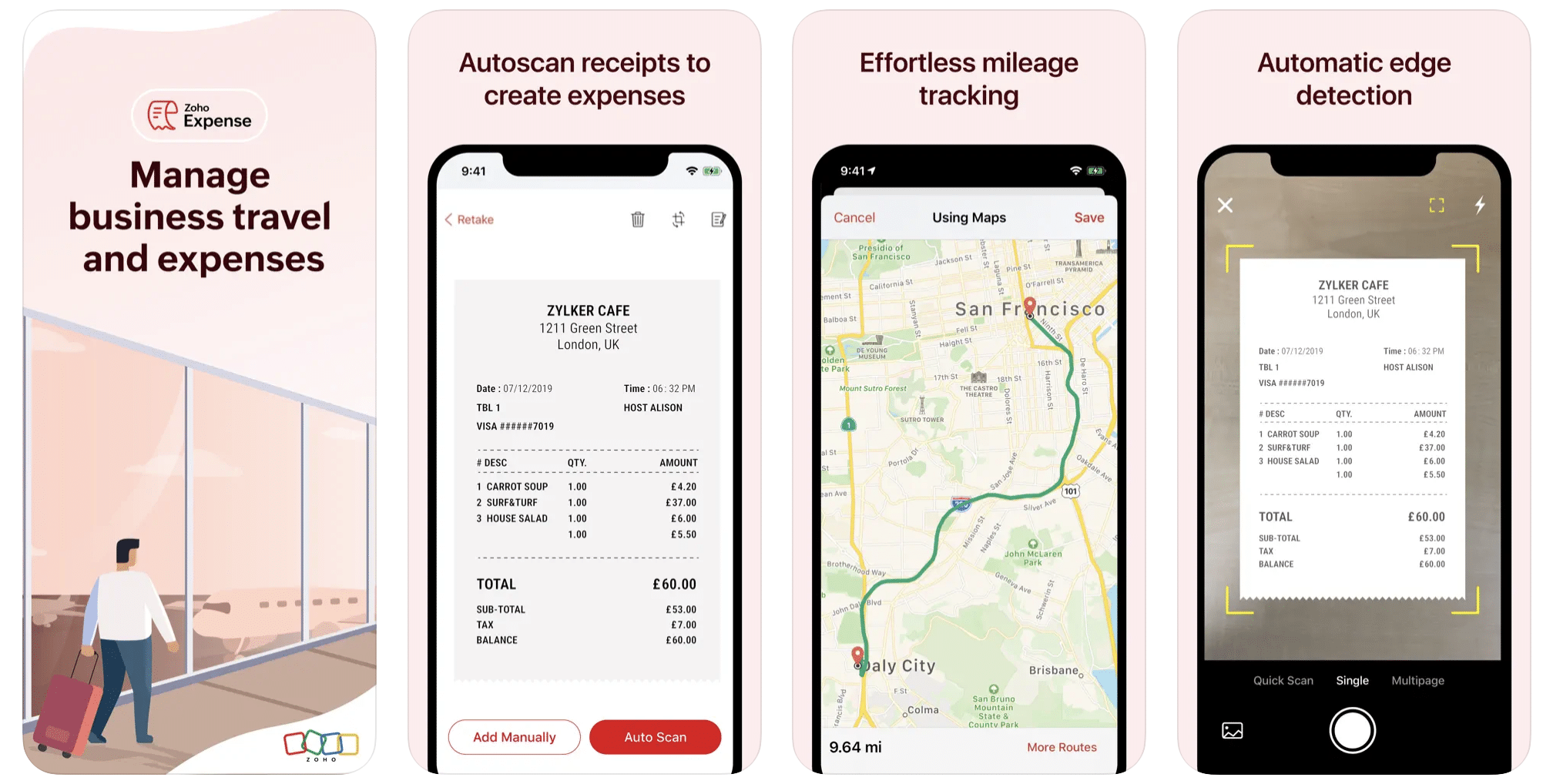
First up is Zoho Expense, which does exactly what its name says. This app is designed to allow companies to give employees a uniform way to create and submit expense reports. It can be used by individuals, including gig drivers, as well.
It includes a mileage tracker, as well as features that let you track other deductible expenses, including the ability to scan and record receipts.
Available on Android and Apple: Yes
Ratings: 4.8 stars on App Store, 4.7 stars on Google Play
Free Version: Yes
Subscription price: $3 per month, billed annually
Created specifically for gig drivers: No
2. Quickbooks Online
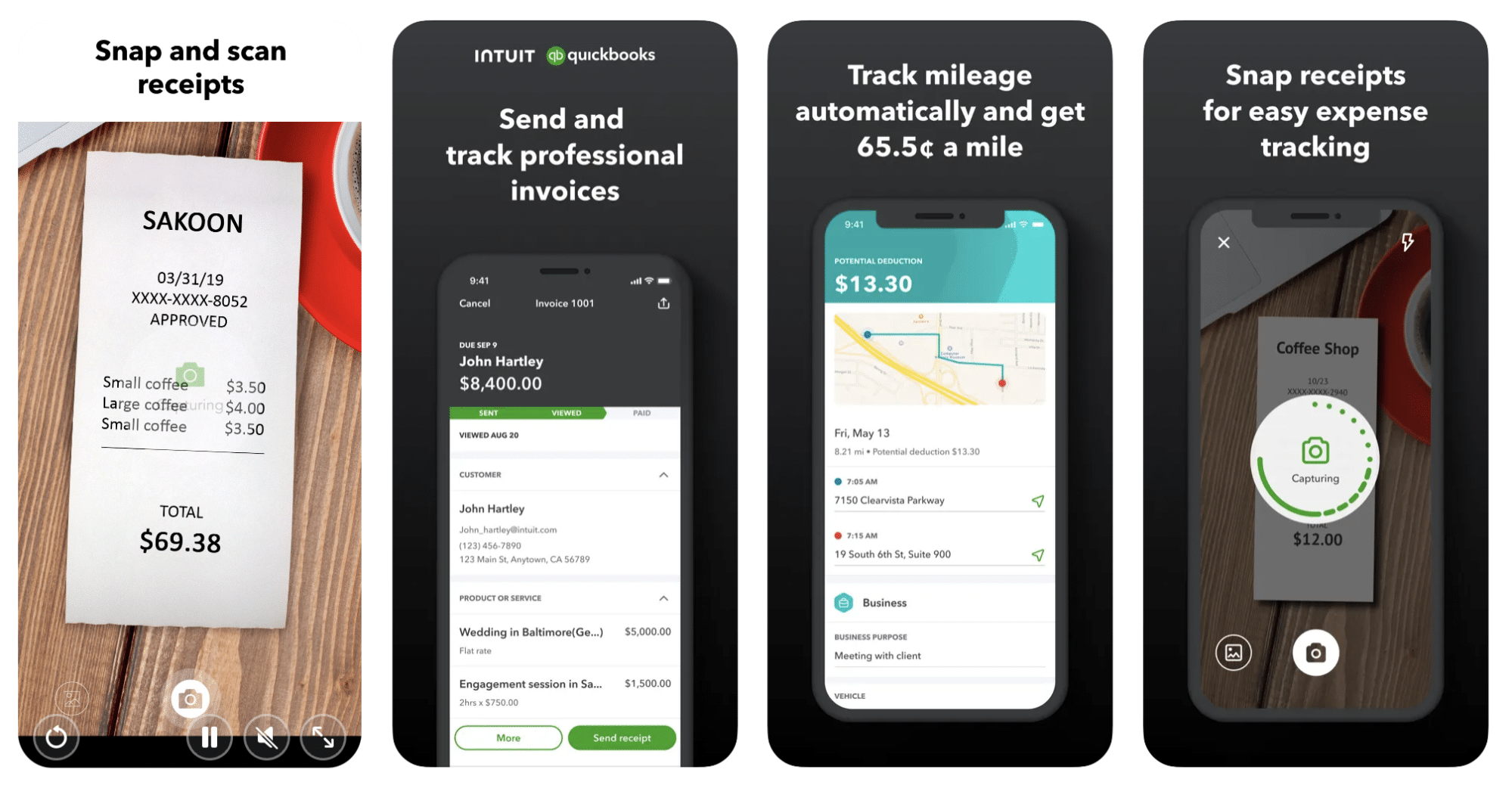
Quickbooks Online is a cloud-based app that allows you to track your mileage, earnings, and expenses. The information you enter can then be used to generate various reports that prepare you for tax time. It also allows you to create graphs that illustrate your cash flow, and includes a receipt scanner so you can instantly record deductible expenses. Quickbooks is popular, highly reliable, and designed mainly to help people keep track of their small businesses.
Available on Android and Apple: Yes
Ratings: 4.7 stars on App Store, 4.4 stars on Google Play
Free version: 30-day free trial
Subscription price: $15 per month for basic version if purchased for 3 months or more
Created specifically for gig drivers: No
Source: quickbooks.intuit.com
3. Shoeboxed
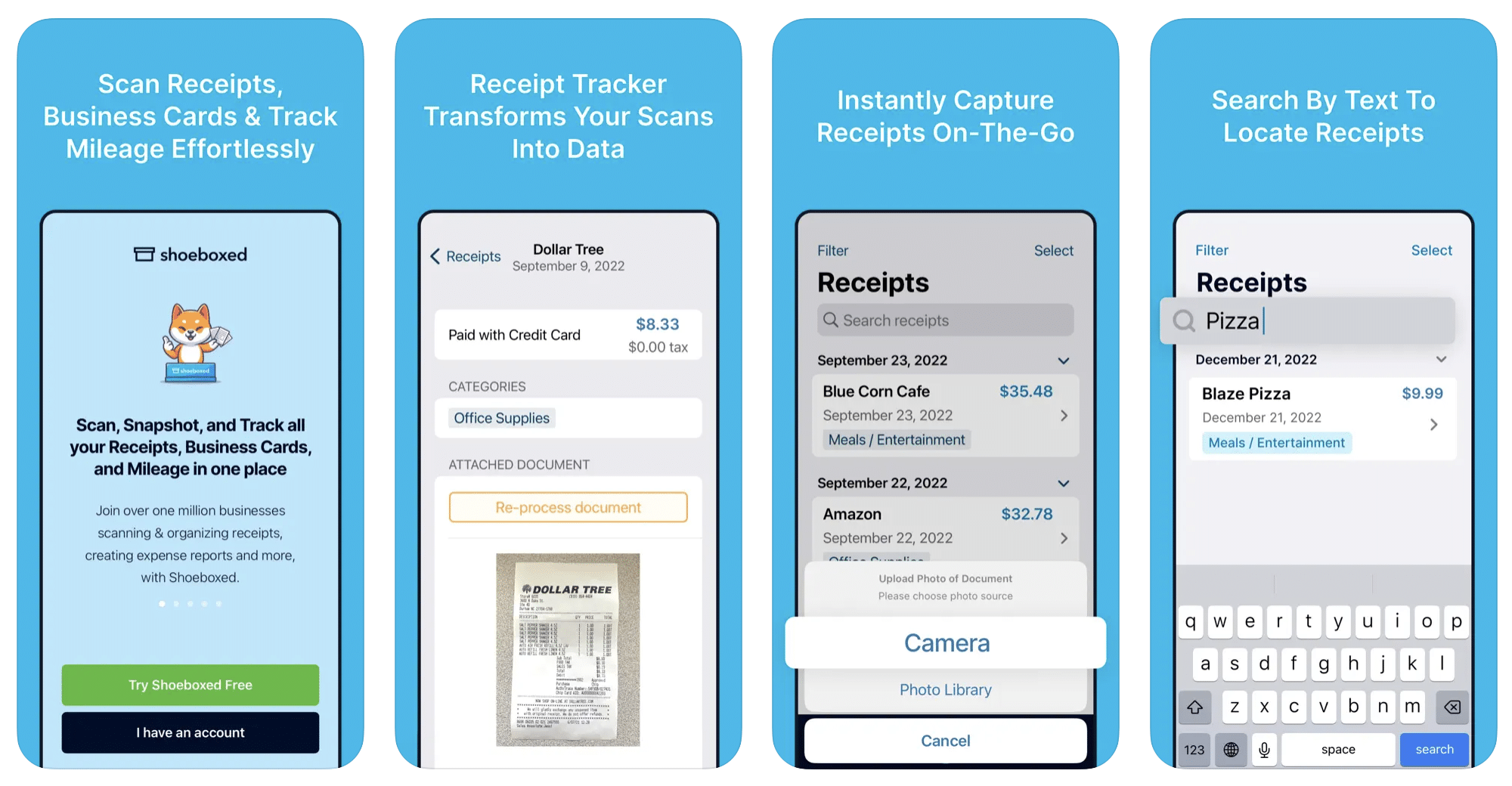
Shoeboxed started in 2007 as a service for scanning paper receipts into digital form. Now the app offers a free mileage tracker and has enabled users to scan receipts directly. It touts itself as the best mileage tracking app for DoorDash, but there are some elements missing that Dashers might like to have. While it provides features that record your expenses and prepare you for tax season, it doesn’t automatically track your earnings. The mileage tracker has a system where you can drop pins along your routes to make the tracking more precise, identifying those legs of a trip that you make for business purposes. The mileage tracker is “free” once you sign up for the basic version.
Available on Android and Apple: Yes
Ratings: 4.5 stars on App Store, 2.3 stars on Google Play
Free version: No
Subscription price: $18 per month for basic version
Created specifically for gig drivers: No
Source: blog.shoeboxed.com
4. Stride
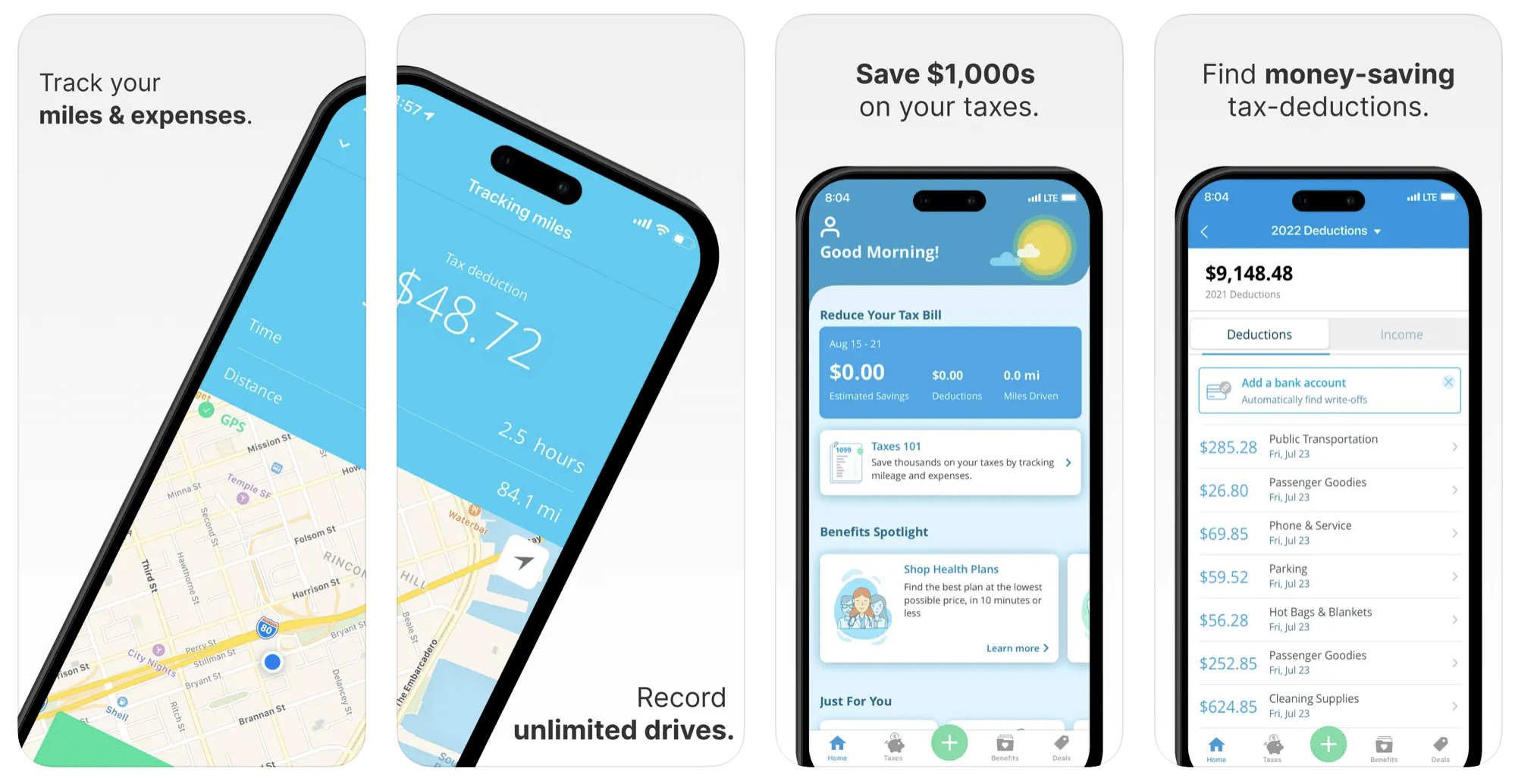
This free mileage tracker does a fair job of keeping track of the distances you rack up while gig driving, but it doesn’t automatically track earnings. It can be a big help, though, in tracking your expenses. You can link Stride to your bank account, and it will automatically scan your expenses to identify items you can potentially deduct. The app is totally free. This could make it the best free mileage tracker app, but there is a small price to pay. The app will persistently push you to consider various insurance plans that they are affiliated with. If you don’t mind that, this is a solid mileage tracker, even if it doesn’t track your earnings.
Available on Android and Apple: Yes
Ratings: 4.8 stars on App Store, 4.6 stars on Google Play
Free version: Yes
Subscription price: None. The app is free.
Created specifically for gig drivers: No
5. Gridwise
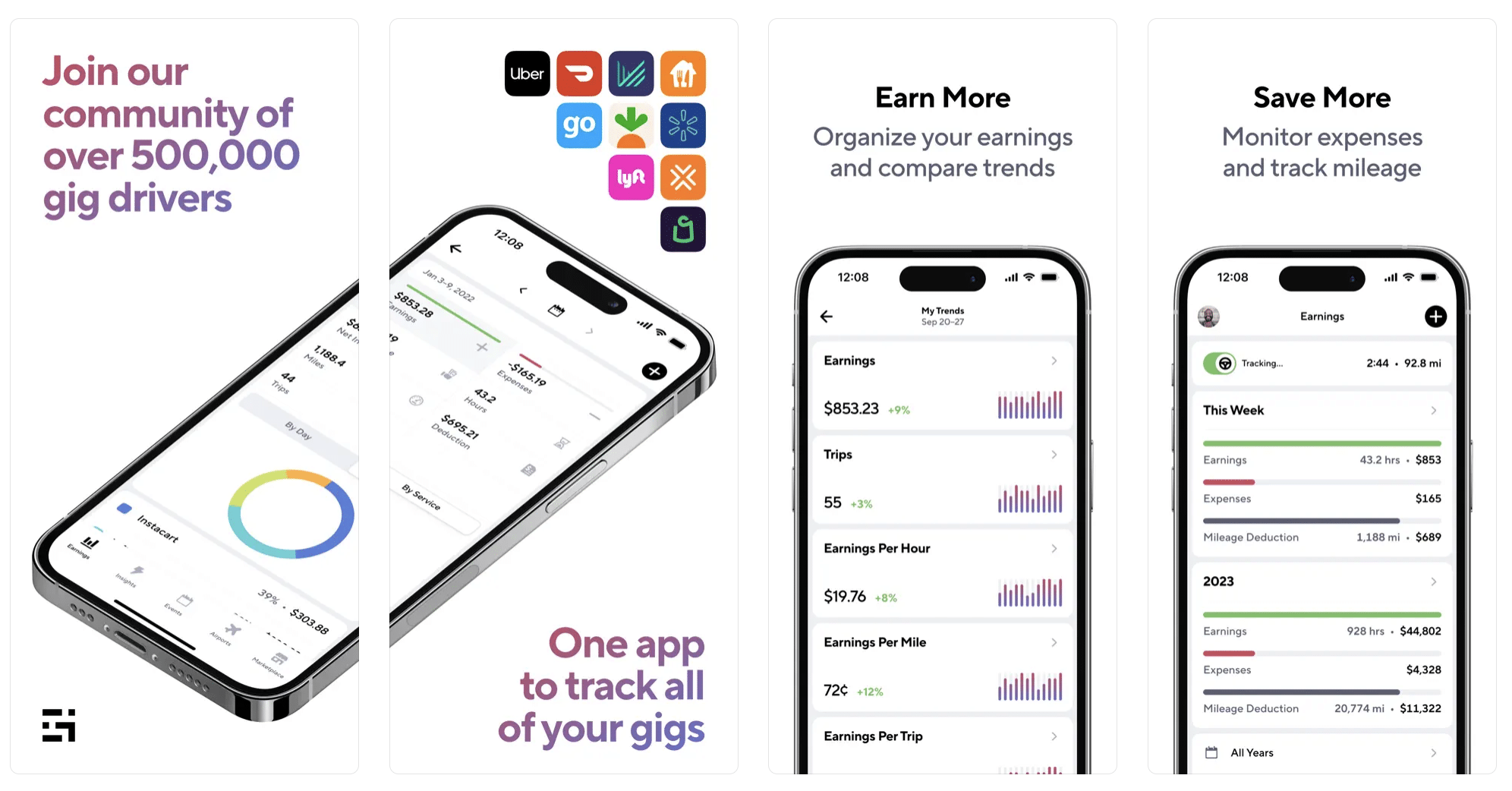
Gridwise has a free mileage tracker and free features that record your income and expenses. It gives you access to insurance and benefits, as well as insights about the best times and places to make the most money while gig driving. The Gridwise mileage tracker captures all the miles you drive while you’re on your driving shift, and it can be used if you have other trips you need to make which qualify as business travel.
Drivers love it because it is geared toward the needs of rideshare and delivery workers, providing free information about airport departures and arrivals, event start and let out times, weather, traffic, and more. The Gridwise Plus subscription adds value by providing additional insights and reports, discounts on benefits, the ability to export data in .csv format,, and more.
Available on Android and Apple: Yes
Ratings: 4.9 stars on App Store, 4.6 stars on Google Play
Free version: Yes
Subscription price: $9.95 per month for Gridwise Plus, or $95.99 per year (a $23.41 savings)
Created specifically for gig drivers: Yes!
What is the best mileage tracking app?
Now that we’ve checked them all out, we’re positive about the answer to that. Hands down, it’s Gridwise. Are we biased? You bet we are! But drivers love it too. Gridwise is the best mileage tracker app, and so much more. So many of the features are free, and the subscription to Gridwise Plus will pay for itself with additional insights to boost your earnings and deeper discounts on products and services.
Most important, Gridwise is designed specifically for gig drivers by experts who were once gig drivers themselves! Knowing what gig drivers need is a crucial step in creating an app that rideshare and delivery drivers can really use! Here are a few of the features, besides mileage tracking:
- seamless earnings tracking
- automatic, on/off toggle and manual mileage tracking
- mileage categorization
- airport, traffic, weather, and events information
- insights into where to drive and when to drive
- reports showing earnings across the platforms you use
- discounts on countless products and services for drivers
- additional resources for finding side gigs
- an informative and comprehensive blog
- affordable benefits, including insurance, medical, dental, and alternative practitioner discounts
- a community of drivers just like you
Don’t settle for just any app. Get the best mileage tracker, and so much more, from Gridwise!
Why every driver should have a no-fee cash card–and solid financial services
Whether you’re on a rideshare shift or a delivery route, there are times when you need cash in your hand. Finding places to get cash isn’t a problem. There are ATMs almost everywhere, from banks to convenience stores to airports to gas stations.
Since it’s not the best idea to carry large amounts of cash with you, you probably visit the ATM often to get $10 or $20 at a time. Unless you’re at your own bank, you typically discover that ATM withdrawals are going to cost you. Sometimes you can get charged as much as $3 per transaction… ouch.
If you’re thinking there must be a better way to bank, you’re right.
In this post, we’ll cover the benefits of branching out from your bank and exploring alternatives that may surprise you. Here’s what we’ll cover:
- What a cash card can do for drivers
- Evaluate the services you need
- How to choose the right financial services company
- A company with a conscience
What a cash card can do for drivers
Let’s remember: A driver’s cash card is more than just a prerequisite for using an ATM. Drivers have the option to use cash cards for multiple purposes, and consolidate financial activity in one place.
When it’s connected to your driving and delivery apps, your cash card becomes a link to the account where you keep all your earnings. It can also become an easy way to keep track of your work-related expenses. When tax time comes, keeping all your transactions (deposits and withdrawals) on one card can speed the process of keeping your financial records straight.
A cash card also provides security for drivers. The ability to make purchases with a card rather than cash reduces the risk of losing cash or getting it stolen. And, of course, it provides a record of all your fuel and maintenance costs.
Evaluate the services you need
Getting a cash card is only part of the picture, though. Banks offer a smorgasbord of features and services that you may or may not want or need.
Before you wind up paying high fees and hidden costs associated with many banks’ services, read the fine print. You might be agreeing to pay a monthly fee for having a checking account, or paying a per-transaction cost for activity at the ATM. You also might not need three separate accounts: one for checking, one for short-term savings, and one for long-term savings.
On the other hand, if you don’t get enough from your financial services company, you could end up lacking features you care about, or even protection of your assets. No matter how well a financial services company seems to cut costs, unless it is FDIC insured, you could suffer greatly if there is some kind of loss.
Also, if your institution offers you a credit card, be sure you’re not committing to an interest rate that’s far higher than the one you could get from another source. Really, unless you’re in need of having your own personal banker, there are many financial firms that could serve you without all the bells and whistles you’ll ultimately wind up paying for.
How to choose the right financial services company
The right financial services company for you depends on your personal and professional needs. Here are some services from which you’ll benefit and may want to consider:
- Low or no transaction fees: Although transaction fees might be small, they can add up. Don’t let them drain your account.
- FDIC insurance: This is a must. If the financial system has problems, you won’t lose your money.
- Cash back on purchases: This is a great perk. Imagine, getting an oil change or buying a new set of tires, and getting money back when you use your card for those purchases.
- Reasonable interest rates: These go two ways, of course. If you’re thinking about your savings account, you’ll want a rate that allows it to accrue some value over time. If you get a credit card, car loan, or mortgage through your institution, you’ll want to keep a close eye on the rates you’re offered.
- Easy access to account information: Great online services (including app-based) that make monitoring and managing your account easy. Phone service, in case you want to talk to a live person, is a nice plus.
- Portability: Because you’re on the move so much, you’ll want to carry your bank information with you. For drivers, app-based services would be especially important.
- Advanced financial options: You may feel comfortable knowing that you can get good rates on a long-term savings account or a retirement account. Room to grow is always a good feature to have in a financial company.
- Compassionate company culture: Most banks are bent on making the biggest profit possible. While that’s understandable, it’s still unpleasant to deal with companies that aren’t known for caring about the environment or their communities. See how your chosen institution measures up.
A company with a conscience
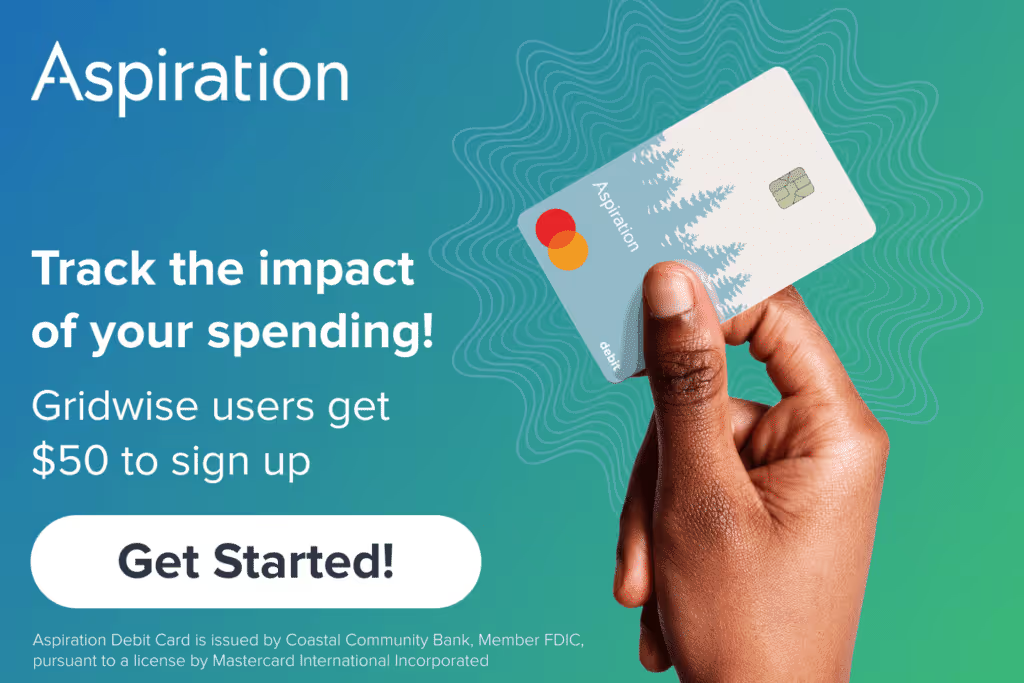
With all this in mind, Gridwise is excited to announce our partnership with Aspiration, a new kind of financial services company. Aspiration is cutting-edge, app-based, and oriented toward a business model that reflects conscience as well as ambition.
Aspiration’s divestment policy ensures that your deposited money will not be used as collateral for fossil fuel financing. Aspiration’s investment policy ensures that your transaction fees are invested in socially responsible ventures that support the environment. Also, the company gives you the opportunity to contribute to charities in ways that help you make a difference. You can donate to causes that help eradicate poverty, promote community development, finance education and health, and foster human rights and the environment.
Aspiration even lets YOU choose the amount you’ll pay for your account fee—and if you’re having hard times, you won’t have to pay one at all. These are just some of the advantages of signing up with Aspiration.
Now, here’s that deal we know is going to make you happy.
Drivers in the Gridwise community who sign up with Aspiration will get even more! Here are the contents of this special package just for Gridwise users:
Gridwise users receive
- Receive 10% back (up to $50) when you make at least $500 in purchases on your card;
- Get unlimited fee-free withdrawals at more than 55,000 ATMs nationwide;
- Earn up to 1.00% variable APY interest on your savings;
- Achieve peace of mind with FDIC-insured deposits (visit fdic.gov for more information);
- Keep more of your money with no hidden fees.
As you can see, Aspiration has a lot to offer, and as a member of the Gridwise community, you’ll get even more. Visit the Aspiration website to sign up, and get the best no-fee cash card, solid financial services, and the privilege of keeping your money with a company that has a conscience. Put the Aspiration + Gridwise deal to work for you now. You’ll be helping yourself, and helping to make the world a little better.

15 side hustles for rideshare and delivery drivers to make more money
We know. There was a time when you probably thought of rideshare or delivery work as just a side gig. Then, before too long it became your main source of income—until COVID-19 reared its ugly head.
Now we’re all waiting for the pandemic to back off so we can get our driving volume back up to where it used to be.
In the meantime, you might want to explore this list of side gigs that we pulled together for you. Who knows what might happen? Your side gig may be such a success that you’ll want to keep going with it even after things are back to the “old normal.”
We’ll talk a bit about strategy first, and then offer some suggestions that could work well for you. Here’s what we’ll cover:
- What makes a good side gig?
- How do you know what kind of side gig is best for you?
- 15 side gigs drivers can dig
- When you’re back to driving
What makes a good side gig?
In general, a good side gig will allow you to make decent money and work flexible hours while you’re using the talents and resources you already have.
Do you have a hobby that could turn into a job? Do you like to make or build things? Are you fluent in another language, or a math whiz who could help someone else master a skill at which you excel?
When you do what you enjoy, things go more smoothly. Remember, if you’re doing a side gig, you’ll most likely be out there promoting yourself as an expert in whatever it is you’ve chosen to pursue—which means you really do need to be an expert. Can you imagine becoming a caterer when you don’t know how to make hard-boiled eggs? Neither can we.
A good side gig will also not be a huge investment. Even if you can make really great hard-boiled eggs, along with a whole array of mouth-watering dishes, you won’t want to finance a large catering business. It’s always good to have the option of starting out small.
You might think it would be cool to own an auto store franchise, for instance, and that’s a great idea—but only if you have the money to invest. If you’re looking for that kind of side gig, you’ll undoubtedly have to spend some time saving up for it.
How do you know which side gig is best for you?
The first rule for deciding whether a side gig is for you is to find out all the facts. What does this line of work entail? How much will you earn? Are there expenses involved? If so, what are they and how much will they be? After expenses, what will your estimated net income be?
Once you get the facts, you’ll be able to make your choices using common sense and gut instincts. Is this something you have time for? How will you like doing the work? How will you promote your services? Will it be worth the money you make?
You’ll also need some sense of what business is like now, and its future outlook. For example, if you’re interested in being a children’s birthday entertainer, doing face painting or magic tricks or balloon sculptures, it will be challenging to get gigs under current COVID restrictions. Look for businesses that are booming in the COVID environment, and you’ll have more luck getting work.
And with a little creative thinking, you can modify what you like to do in order to market your skills safely and/or virtually. Paint colorful, whimsical faces on paper or cloth face coverings and sell them to a perplexed parent trying to make a COVID-era birthday party into a happy occasion. You could also do a magic show or create balloon sculptures on YouTube or another channel. You might demonstrate simple designs participants can do themselves, or invent other kinds of craft projects kids will love.
Of course, not all of us are blessed with the type of personality that lends itself to creating children’s parties, or cooking, or cleaning … but there are many side gigs that seem natural to most drivers.
15 side gigs drivers can dig
Here are some side gigs for you to consider, as well as information on how to get started. Click on “Getting Started” to get the details.
1 - Digital marketeer.
You may be thinking you can’t do this because you don’t know coding, but digital marketing is much broader than that. It involves everything from posting on the Facebook page of your favorite barber or beer distributor to creating a branding package for an up-and-coming website. You can charge per post, or a flat amount for designing a website or social media business page. To get this type of side gig, check with business people you know, or list yourself on a job forum. Business owners are always looking for people to handle this end of their operation.
Getting started: Create an online presence so you can show prospective clients what you can do. Link to websites you’ve designed for friends, or to your own eye-popping Instagram account. From there, get the word out through people you already know, or list your services with an online marketplace.
2 - Virtual assistant (VA).
Are you good with details? Can you take care of some tasks online, or even do a bit of shopping? Would you be willing to make some phone calls or manage a busy professional’s schedule? If so, you might be an ideal candidate for a VA position.
Getting started: Once you decide on your specialties, put together a marketing and networking program that works for you. Develop a profile and post it on LinkedIn, Upwork, or another jobs platform. Also, be sure to check with busy acquaintances you’ve heard complaining that they need an assistant.
3 - YouTuber or podcast personality.
Both of these require creativity, but knowing many of the drivers we hear from, there are lots of you out there. What are you passionate about? Customizing cars? Designing a man cave? Household hacks? Pick a topic that means a lot to you, turn on your camera and/or microphone, and put together your own show. For a small investment, you could create an awesome side gig. Remember, though, that if you want this to be successful enough to attract advertisers, you need to be unafraid of shameless self-promotion.
Getting started: Get the equipment you need, choose your audience, produce the content, and learn about Search Engine Optimization (SEO) and other aspects of attracting viewers—and hopefully, paying advertisers. Becoming a financially successful YouTuber isn’t exactly a snap, but if you pursue it with purpose, it could become a labor of love.
4 - Tutor.
We know our drivers are smart people, so there’s likely something you know well enough to teach others. Whether you’re an inspired creative writer, a math whiz, or an expert at teaching not-so-technically inclined people how to use their smartphones or laptops, you can find opportunities to teach what you know—and earn money doing it.
Getting started: You can register with an online company that does the kinds of tutoring you feel comfortable with, as well as promote yourself to your local community college, other social groups, and senior centers. Most tutors get paid around $20 per hour, making this a good way to bring in extra cash.
5 - Driving Instructor.
How can you say you don’t know a thing or two about driving? If you’re itching for more hours behind the wheel, this is one way to get them in. Being qualified as a driving instructor is surprisingly simple, and you can work as an independent contractor or for a driving school.
Getting started: Investigate what it takes to be certified in your locality, and go through what’s usually a fairly simple and inexpensive process. Then, you can take charge of shaping new drivers and making them road-ready. By educating good, courteous drivers, think of the great service you’ll do for the gig-driving community!
6 - Pet care.
This can take a number of different forms. You could gather your own pack with neighborhood pets, or work for a dog walking service like Wag or Rover. Cats and other inside pets need love too, and their humans may need someone to care for them from time to time. For instance, people may have disabilities or health issues that make it difficult for them to empty a litter box or clean a hamster cage. Pet owners may also need someone to take their pets to a vet or groomer. If you want to go solo, check around to see what others in your area charge for these types of services, and price yourself accordingly.
Getting started: First, try pet sitting for someone you already know, and then decide how big you want this business to get. Whether you decide to freelance or work with one of the services, you’ll need to set up your own business; but as a driver, you’re are probably familiar with that process.
7 - Odd jobs.
This is one of the most in-demand services, so you’re almost certain to find work. Think of a neighbor who broke her leg—how will she take out the garbage or change the batteries in her smoke alarms? Or, there might be someone who needs a deadbolt installed, or pictures hung, or weatherstripping put on the windows. Those people are out there … waiting for you to help them.
Getting started: Advertise yourself as a “household helper” on virtual boards that cater to your area, or put an ad in a community newspaper. You could also make some calls to see who needs you or knows someone who could use a hand. Another option is joining online listing services such as TaskRabbit, Craigslist, or Handy.
8 - Car care.
Here’s another skill you probably have down to a science by now. Think of the stressed-out parents in your area. They’re homeschooling their kids and also trying to handle their own jobs remotely, so they’d fully appreciate you for digging out the french fries from between the seats of their luxury SUVs. Or, you might have a neighbor who’s decided to shed one of their vehicles for extra cash. If you have the expertise and the equipment, your detailing work can add substantial value to that trade-in.
Getting started: Word of mouth could work for this, but if you’re really good, and you know how to market your skills, you could advertise on social media boards for your local area. Since this is a service almost everyone needs at some point, you could build a solid future for yourself.
9 - Voiceover for audiobooks.
If you have a knack for reading out loud, you can consider narrating for audiobooks. You don’t have to be a Tony Award-winning thespian; if you have a pleasant voice, good focus, and mental stamina, this gig can work for you. The explosion of audiobooks and the advent of self-publishing has created a huge demand. Plus, you can easily get set up with equipment for a comparatively low cost.
Getting started: Just try it out! Read some part of your favorite book into a voice recorder and play it back. What do you think? Will other people want to hear you read? If yes, you’ll need to get that equipment and more information about perfecting this art,. Once you’re all set up, give it a go!
10 - Home repair and installations.
Are you handy around the house? Many people aren’t, so you can make good money doing household repairs like replacing a ripped screen or installing closet doors or trim. Security is big these days too; people buy those doorbell systems but don’t know how to make them work. If you can get the word out around your neighborhood, or even sign on with a store or a brand that sells products you know a lot about, this could be a rewarding side gig for you.
Getting started: Start out with a word-of-mouth effort, and if you need a boost, think about signing on with a site such as Thumbtack or Angie’s List.
11 - Styling.
This one’s not for every driver, but we’re willing to bet some of you would be perfect for this job. You simply look at what kinds of clothing your customer might like to wear, make suggestions, and help them do their shopping—all online.
Getting started: You’ll need to learn some important fundamentals, so be sure to do some research before you start. You can sign up with a company such as Stitch Fix, and let them show you the ropes ropes and connect you with clients. You could also, if you’re a good marketer, get your own start-up going. Specialize in a certain population; think working parents, active kids, or seniors with style. If this is for you, gather up your confidence and creativity and make it happen.
12 - Hauling.
After working and learning from home for all these months, a great number of people have been inspired to clean out their attics and closets. That’s easy enough, but after they get that far, they have no idea how to get rid of their … stuff. If you have a large enough vehicle and the physical prowess to be able to haul away a bunch of discarded belongings, you could be the person they pay to do it. Whether you’re taking items for donation, or just dealing with potential trash, you can charge by the load or by the hour.
Getting started: It’s pretty simple to start a hauling business, but if you’d rather get referrals from a larger outfit, you can work for a company like 1-800-Got Junk? or one that’s near you. And, as long as they’re throwing stuff out, you could consider another side gig, namely…
13 - Reselling.
With the decline in people’s earning power, many are going through possessions they’ve accumulated over the years and deciding to sell them. They usually start out with lots of enthusiasm; but once they get down to the photographing, posting, tracing, and shipping part, they don’t do so well. That’s where you come in! Let them pay you to do all that for them. Maybe you’ll get a percentage of the sale, or you could buy selected items from them and resell the items at a much better price. This can quickly become fun for you if you specialize in items that involve one of your hobbies or special interests.
Getting started: While this is a fairly straightforward business, it pays to invest some time in learning more about the best things to sell and the best marketplaces to use. This article offers tips for the granddaddy of all e-commerce sites, eBay.
14 - Crafting or building.
These two specialties are not identical, but both require talent and creativity. You can make crafts—such as key chains for your fellow drivers, or cool leather belts that would make sweet biker gear. If you can build structures, like a garden gazebo or a small woodshed, or even install swing sets for families, you could be a builder. Be sure to look into any licensing requirements and assess your liabilities before you get too far into this. Once you’re ready to go, chances are good that you’ll find plenty of business with friends and neighbors who respect your talent and need your help.
Getting started: As with any other kind of business, be sure to consider aspects such as taxes, accounting, and marketing. Check local outlets that might sell your wares, or connect online with Etsy and other sites that will gladly sell your artistic and practical DIY creations.
15 - Virtual parties.
People everywhere are itching to get together, even if it’s only online. You could run down your playlists, get people dancing in their living rooms, and create a virtual party spirit right at home with your computer. You can even work with themes if you’d like; think trivia, sports betting, and watch parties for big games and new Netflix releases. Charge by the hour or for a special party package.
Getting started: This is a fairly new field, so learn more about it and start finding clients. You can begin with friends and family, and then expand from there. Medium-sized businesses, corporations, and other organizations are looking for ways to entertain people between meetings all the time, and they pay well, too.
After reading through these 15 suggestions, you’ve probably become aware of how important your creativity is to your success with a side gig. Never limit yourself to the ordinary or mundane; instead, think big and invent new ways to do old things. Even if you have to work around shutdowns and social isolation, you can invent new ways of keeping people safe and making the world a better place.
When you’re back to driving ...
Even with a solid side gig, you’ll probably want to continue driving, and Gridwise is here for you. Once you download the app, you can link your rideshare and delivery driver accounts, sign online to Gridwise whenever you drive, and your earnings and mileage will be logged automatically. When you’re all done, and you want to see how much you made with each driving gig, you can get the full story through these slick graphs.

And with our newest feature, you can even log all your expenses with Gridwise, which gives you an overall view of your net earnings once you consider gas, maintenance, and other automotive costs.
That’s not all Gridwise can do. We give you current airport departures and arrivals, event info, weather, and traffic reports. On our Perks tab, you’ll get easy access to the Gridwise blog and YouTube channel, plus great deals and discounts for drivers.
Join us on Facebook too, so you can get in on our great gas card giveaways and be a part of our fun and active driver community.
Oh, and don’t forget to leave us some comments below to let us know what you think about side gigs, and what kinds of cool and creative ideas you have.

Case Study: How targeted Gridwise ads helped a top consumer product testing company find precisely the right testers
“Working with Gridwise was a very smooth, very quick process. We wanted to attract a specific demographic to be product testers, and our Gridwise campaign successfully drew in exactly who we needed more efficiently than any other channel.” - Heather, Director of Digital Marketing, Curion
What is Curion?
Curion is an innovator in the field of market testing. This cutting-edge company combines fresh thinking with industry-defining methodologies and technologies, which results in a deeper understanding of the consumer and more successful products brought to market.
Curion sees itself as an industry disruptor, going beyond the usual scope of market research to encompass innovations such as applying science to packaging.
Curion conducts product testing by inviting consumers to sample various offerings, and then evaluate their experiences. In addition to sensory research such as taste-testing, Curion leads focus groups composed of the demographic groups customers wish to reach with their products and services.
At present, Curion works in five areas: Chicago, Redwood City, Central New Jersey, Dallas, and Atlanta. While some testing takes place remotely, most of it is held at Curion’s on-site facilities during business days.
The Challenge
Curion’s consumer population, the pool of people used for product testing, is predominantly female. Not all of Curion’s customers’ products are targeted at women, so Heather needed a way to bring in more males.
Most consumers come to Curion through referrals or through job listings on Career Advisor. Advertising is a secondary means of getting the right people, and initial efforts were not producing the desired results. Although Heather was using social media to attract more people to participate in studies, the population that responded and eventually became consumers was still lopsided. There were still a lot more females than males in the group of respondents.
Attracting a greater number of males was difficult while using the comparatively nonspecific reach of Facebook, Instagram, and Craigslist. Also, many of those responding to the ads were unable to participate during the business day, and didn’t always have reliable ways of getting to the testing sessions on time.
How could Heather find more male respondents? And once she did, how could she be sure their hours would be flexible, and that they’d be able to reliably transport themselves to the sessions?
During the fall of 2020, Heather found her answer. One of Curion’s corporate investors told her about Gridwise and the male-dominant rideshare and delivery driver population, and she was certain this would be the ideal way to find the people she needed.
Approach
Gridwise is deeply familiar with the gig-driver demographic, and knows how to speak to them in language that will catch their attention. Even more, the Gridwise app can target drivers by region and demographics, with banner ads as well as email and blog posts.
Along with her excitement over the prospects of attracting this population, Heather was thrilled with the experience of working with Alex and Clay of the Gridwise Brand Partnership team. They offered simple solutions, and came back with prices that were in the range Curion had hoped to spend. She was especially pleased that the whole package was ready before her scheduled launch date.
“I presented Alex and Clay with a brand kit, and they produced banner ads almost instantly. The email and blog post came soon after, and we were ready to roll before our launch date.”
After starting in the larger markets and finding great success, Heather is excited about rolling out the campaign to cover Curion’s other locations on the East Coast, West Coast, and in Atlanta.
Strategy
Banner ads were rolled out through the app to Curion’s two largest target markets: Chicago and Dallas. An email and blog post, which gave drivers more details about the opportunities at Curion, followed shortly thereafter.
As the campaign rolls out to Curion’s other locations, the ads will become more specific. Heather finds that the engagement rate is greater when people know the kinds of products they might be testing. For instance, an ad about opportunities to test an energy drink or a phone mount might appeal more than a more generic product.
Results
The results of working with Gridwise were immediate and impressive.
Not only did Heather report conversion rates that were comrable to Curion's other channels, but they were able to target and attract the demographic they needed most.
Heather and the Curion team believe that once they begin testing their offers they'll see even better results.
“Before we worked with Gridwise, it was difficult and expensive to attract the population we needed. With Gridwise, we were able to do so more efficiently than ever.

6 paths to a career in coding for rideshare and delivery drivers
Rideshare and delivery driving is a great way to make a living, but it has its disadvantages. Many drivers aren't completely satisfied with the work, the pay… or the volatility. Are you one of them?
Maybe you're between jobs right now. Maybe you've been driving for a long time, and wish you could do something more. Or, maybe you’ve simply concluded, with the COVID-19 shutdowns, that driving just isn't going to generate the amount of money you need.
For a variety of reasons, many drivers could feel motivated to seek out a different way to make a living. In this blog post we'll look at what that might be, and we will share with you how you could change your life for the better. Here's what we'll cover:
- Why making a career change can be easier for drivers
- Why coding is a great option for rideshare and delivery drivers
- Six paths to a career in coding
- Can you learn coding for free?
- The "Springboard" to success
Why making a career change can be easier for drivers
When you're fed up with driving, it can be hard to see what's good about it.
You work hard, but you don't get benefits from your employers. And just when you think you're getting ahead, a pandemic sweeps through and pulls your business out from under you.
But when adversity strikes—and it has certainly smacked us upside the head in 2020—we need to look at the advantages we have, and leverage them to make our lives better. So let's look at why, when you want to do something new, being a driver is an advantage.
The biggest plus for drivers is that you make your own schedule.
You're not tied to a desk, a showroom floor, or any other work environment for a set number of hours. You can take time out of your day to get the training you need to prepare for a new and more rewarding career. And, while you're getting your training, you can continue to earn money with your driving gig.
Also, as a driver you're certainly no stranger to smartphones and apps. You know how to multitask and use your resourcefulness and ambition to put your skills to work.
Why coding is a great option for rideshare and delivery drivers
You use apps all the time. Have you ever wished you could make the apps you use for driving more efficient and easier to deal with? And if your answer is yes, maybe you’ve wondered how you could get a job that lets you do that.
If the idea of making apps work better appeals to you, getting into coding could be the best career decision you could make. When you do, you'll enter a field that's in incredibly high demand, especially now.
With all the changes that have resulted from the pandemic, none is more obvious than the increased reliance on communication and commerce via apps and websites. Those apps and websites need clever people, like you, to design them and make them work.
Now that everything from grocery shopping to school to work interactions are too risky to be done in person, the need for new ways to conduct business online and/or via the smartphone has become more urgent.
Companies have been scrambling to find enough capable people who can get their systems and services moved to a format that allows business to be conducted online. Many companies advertise widely in a search for coders to fill this urgent need.
Let's dig a little deeper and explore what coding is.
What it means to “code”
In general, coding involves communicating with the working parts of electronic devices in a language they can understand. Coding uses an intermediate language to send complex instructions to the gadgets we use, from desktops to laptops to smartphones to smart homes.
Why is this necessary? Because computers only understand instructions in binary code: "on or off," or "0 or 1." As digital literacy/coding expert Chris Castiglione explains:
“Think about writing code like this. You don’t speak binary, and the machine can’t come close to understanding human languages. So, for you to tell the computer what to do, you need to design a translator that can act as an intermediary. This is the purpose of code.”
The computer programmers who work with devices at that level write instructions in machine language, also called machine code. They typically need extremely detailed training. And while they are also in high demand, their jobs require lengthy and expensive education.
Fortunately, there are coding jobs that don't require as much training. It's not as difficult to learn the intermediate languages that translate instructions into machine code, which makes it possible for those with the willingness to learn to become coders.
Writing code that can be used to design websites and apps is fairly straightforward. And as a driver, you've probably developed some ideas that would make working with an app or website a more pleasant experience for the people who use them. That's a highly marketable skill, and there are many jobs for people who have it.
6 paths to a career in coding
Because coders are in high demand, and will likely continue to be for some time, any training you get will be a great investment. Also, working as a coder is almost as flexible as driving.
There are many full-time job opportunities, but if you want to work part-time, or even as an independent contractor, you’ll have that option. It's also possible to score lucrative work-from-home gigs.
There are numerous types of jobs available to coders; here are six that we thought were especially interesting:
- Website developer: creates websites, front end or back end
- App developer: creates apps
- Product manager: leads a team of system developers
- Database developer: organizes and designs data retrieval systems
- Data analyst: designs programs for displaying data used in business
- Data scientist: develops models for data analysis
A career based on coding opens doors that can lead to success, job satisfaction, and much more money than you could make driving rideshare or delivery. The typical starting salaries for these jobs range from $45,000-$115,000 per year.
Can you learn coding for free?
If you do some web surfing, you’ll find many options for learning coding for free. There are online programs and tutorials that take you through basic design projects, step by step. Some of these include Codewars, Code Academy, Udemy, Coursera, and Code.org.
Some of these organizations give you the opportunity to develop live projects. For example, you might develop a website for a nonprofit organization. This is good practice, to be sure, but there are some drawbacks to getting your coding education from free services.
One drawback is the lack of interaction with teachers who are dedicated to you and your career goals. Another is that the programs are often designed to produce only rudimentary projects, such as simple retro video games, or one-page websites. Actually, many of these projects are directed toward children in elementary school and casual hobbyists.
Also, in many cases the courses you want to take won’t necessarily be free. The sites lure you in, and then you might find the course that teaches the language you need or want to learn will cost you a lot of money,
In general, while these free services sound attractive, you may not gain enough skills from them for a full and prosperous career in coding.
You’d also have to be extremely self-motivated, and somewhat pre-informed before embarking on the journey of learning code from a free site. Also, there is no one to guide you toward the kind of career, and training, that best suits your needs and goals.
One aspect of the free coding programs can benefit you, however—they give you a taste of coding so you can see if you enjoy it. This website lists many of the free coding programs. You could go through them, sample some of the lessons, and decide if you're ready to get serious about changing your life with a new career in coding.
The "Springboard" to success
If you happen to decide that coding is for you, and you're ready to get serious about it, Springboard is your next stop. It’s a boot camp that gets students into the job force right away, so its programs are job-focused. You'll get an overview of coding and the development field, which will help you choose the subjects you want to study, but your instructors will always be focused on jettisoning you into a new career.
Springboard offers three main paths that provide high-quality education for people who want to stand out in the coding and development field.
In the Software Engineering pathway, you'll learn front end development fundamentals and how the web works, and you’ll become skilled in languages and techniques such as Intermediate JavaScript, DOM Manipulation, and Event Driven Programming. If you're geared more toward the world of back-end development, Springboard's program offers opportunities to learn Python, FLASK, and SQL. Before long, you'll build an application using Python on the back end and JavaScript on the front end!
The Data path involves designing business-oriented programs for organizing, analyzing, and presenting data. Springboard even has offerings in AI, which allow you to enhance the way you build models for data analysis. You can also go a slightly different direction with Data Engineering. Your Springboard course will teach you how to develop systems designed to collect and extract data so that it can be packaged and presented. You'll get involved with exciting technologies such as cloud-based design and real-time streaming.
Design puts the focus on making life easier for the people who will use websites and apps. UI design creates the necessary nuts and bolts needed for users to input and extract information, while UX design goes a step further, placing emphasis on the user's experience of using a website or app.
There's more, so we suggest you visit the Springboard website to get more details on their curriculum. Meanwhile, we'll highlight some of the features of studying with Springboard that make its programs ideal for drivers who want to start a new career in coding or data engineering.
- The program is fully online, and you study at your own pace.
- Your course can be completed within six to nine months.
- You get a weekly one-on-one call with a mentor, a student coach, and unlimited calls in between sessions.
- The tuition is reasonably priced, and you don't have to pay until you get a job in your field.
- The program is job-focused and project-based, providing real-world experience, which is the absolute best preparation for a new career.
- A career coach will help you target your job search and prepare you for the hiring process.
- A network of graduates working in the field will give you easy access to top companies that are looking for people with your skills.
If you had to rub your eyes to believe what you read about the deferred tuition policy at Springboard, we don't blame you. For most of its programs, Springboard guarantees you a job, and will not make you pay tuition unless you find a job within six months. Also, unlike other boot camp-style coding schools, Springboard doesn’t take a percentage of your salary once you begin earning.
So… if you're fed up with the grind of trying to eke out a living with rideshare and delivery driving, spring into action! We think Springboard is a great deal, and that its programs can help drivers find reliable, high-paying jobs so we don't have to hustle so hard anymore.
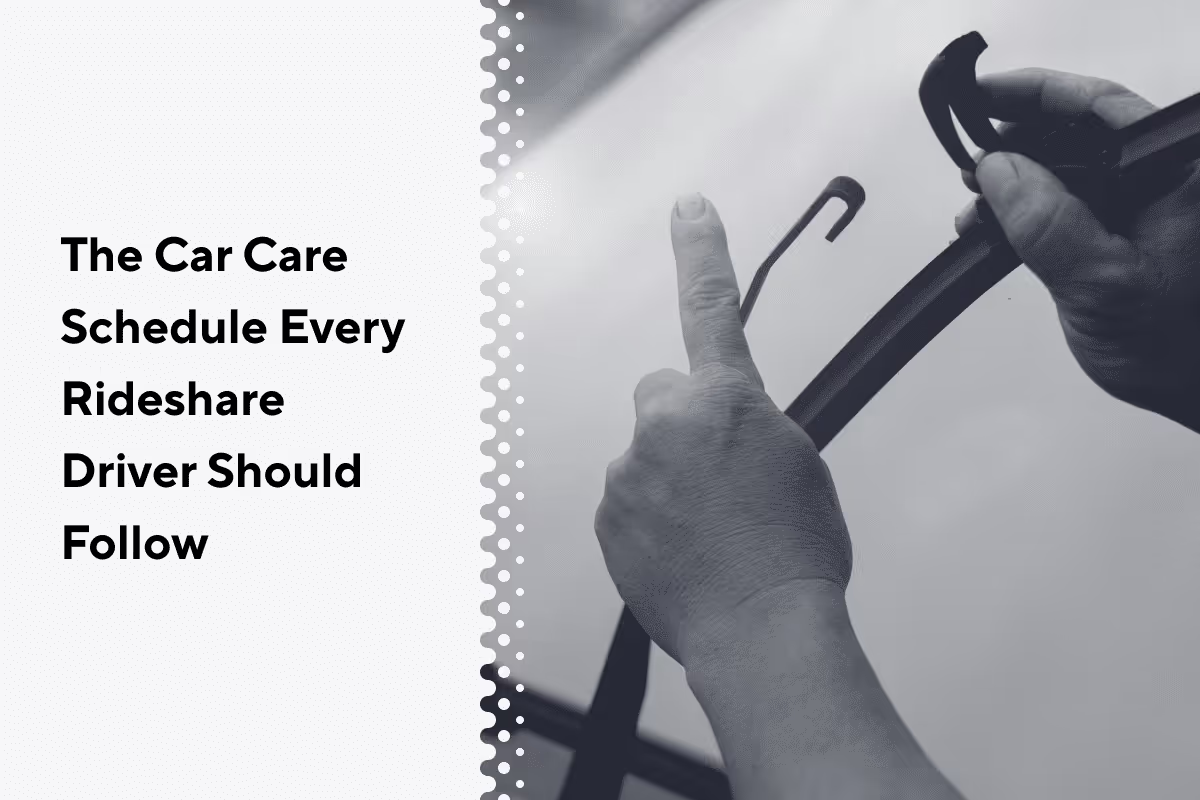
The Car Maintenance Schedule Every Rideshare Driver Should Follow
When rideshare or delivery driving is your business, your car is more than just a vehicle. It’s your most important business asset and your source of income. Without your car, it’s pretty difficult to keep your cash flow going.
Because you depend so heavily on your car, you need to keep it in good working order at all times. Sure, maintenance can cost some money, but over time, it’ll be worth it. Why? Because if you don’t take care of your car, you could soon find you’re stuck coming up with cash to pay for a major repair.
If and when you do, that $100 you should have spent on maintenance could turn into $1000 or more in fixing what went wrong. On top of that, you could also lose out on $100’s or $1,000’s in income as you sit on the sidelines waiting for your car to be drivable again.
We want you and your car to be together for as long as possible, with as few breaks as possible, so we’ve put together a maintenance schedule every rideshare or delivery driver should follow.
Why do I have to follow a car maintenance schedule?
Like we already said, being left without your car can be a real catastrophe.
And I say this from experience.
When I was a full-time driver, I had a breakdown that took me off the road for nearly 2 weeks.
That meant $2,500 in repair expenses for me AND a loss of at least $2,000 in income. That was bad enough, but the most painful part of the ordeal was that it didn’t have to happen. The whole thing could have been avoided, if only I’d been on top of my car maintenance.
After that experience, I did the smart thing, and began to follow the following maintenance schedule.
Weekly Checks
Windshield wiper blades: If you want to drive like a pro, you definitely need to be able to have a perfectly clear view of the road! Check your wipers frequently, and if they aren’t working up to snuff, replace them with high-quality, long-lasting windshield wipers, such as Bosch ICON™.
Windshield wiper fluid: There’s nothing more annoying than getting caught without windshield wiper fluid! That’s why it’s a good practice to check your wiper fluid every week and ensure it’s at least half full. 7
Tires: Check all 4 of your tires for punctures, gashes, scuffs, or bulges. Also, ensure no steel cord is visible at all. If you see any issues, it might be time for a tire change.
Tire pressure: As rideshare drivers, we’re out on the road constantly, so our tire pressure can rapidly decrease. Take a moment to check your tire pressure once a week to make sure they are inflated properly. Compare your tire pressure to what is recommended in your owner’s manual. If you don’t have your owner’s manual, don’t worry. Google it!
Body and bumper damage: It’s incredibly easy to get a few bumps and scratches without knowing it when you drive 8 – 12 hours a day, often in congested areas. So once a week, or more, have a quick walk around your car to inspect for any new damage, including bumps and scratches. Check closely for any signs of rust as well.
Brake lights and headlights: This one’s especially important for late-night drivers. Park your car in a safe spot, turn your headlights on and ensure all bulbs illuminate. To check your brake lights, back up to a wall, press and hold your foot brakes and use side and rear mirrors to see both brake lights reflected by the wall.
Dashboard warning lights: This is an easy one. When you start your car, simply check your dashboard for warning lights. If you see one pop up, you can simply check your car manual for any lights that come on. If you don’t have your car manual, or even if you do, you can always Google your specific issue as there is almost definitely someone that’s asked about the light on a forum somewhere. Don’t fall into the habit of ignoring these lights!
Leaking fluids underneath the vehicle: Use a flashlight to look under your car for power steering fluid, brake fluid, coolant, transmission fluid, anti-freeze or anything else that could be leaking.
Oil level: Most mechanics and dealerships will recommend oil changes as specified in your car’s owner’s manual which usually falls somewhere between every 2,000 and 6,000 miles. When you’re a rideshare or delivery driver, that mileage piles up rather fast. Check your oil levels every week to make sure they’re keeping your engine running cool and clean.
To check your oil levels, make sure that your engine has cooled down. Then, take the dipstick out and wipe it off with a rag. Put the dipstick back in and then pull it out and see if the oil levels are where they should be. If they aren’t, you may have a leak which you should get checked out by a pro.
Pro Tip: Always check your engine lights everytime you drive and do your best to take care of any issues as soon as possible.
Every 3,000 Miles
Oil Change: Always check your vehicle’s oil change schedule in your maintenance manual. In most cases, you’ll probably want to change your oil somewhere around every 3,000 miles. Clean oil is crucial. It keeps your car running now, and it also contributes to the longevity of your car. You could stretch the oil changes a bit farther, but it’s safest to try to change your oil at 3,000 miles unless your owner’s manual says otherwise.
Check belts and hoses: Your car’s belts and hoses are key to keeping your car on the road. So, you’ll want to check them out regularly to see if they need to be replaced. If your hoses appear to be brittle, are worn or are bulging, you will need to get new ones. If your belts are frayed or worn, then you’ll need to get replacements.
Air filter: Your air filter keeps harmful substances from getting into your engine, so If it’s damaged or dirty, nasty particles can enter your engine and really clog up the works. Check to ensure that it’s not dirty or blocked. If so, you’ll need to have it replaced.
Brake pads, rotors, and fluid: Your brake pads, rotors, and braking fluid make up your braking system, and if your braking system isn’t working correctly, you might get into serious trouble. Every time you change your oil, take a quick look at your pads, rotors, and fluid to ensure they’re in good working order.
Every 6,000 miles
Tire Rotation: Tires last longer if they’re evenly worn down, but your front tires typically get worn faster. That’s why it’s important to get your tires rotated frequently to prevent the need to replace them faster than you’d like, and spending lots of extra money.
Spark plugs and wires: Ensure that your spark plugs and wires are ready to get the party started. These usually only need to be changed every 30,000 miles or so, so you probably won’t find problems with them all that often.
Replace your cabin air filter: Installing a fresh cabin air filter is probably one of the easiest things you can do to keep your car comfortable. Most vehicles make the cabin air filter easily accessible, and replacing it is as easy as opening a box. The cabin air filter may not be critical to your car’s operation, but it makes riding in your car far more pleasant! This is something you can do for yourself, so if you keep your eye on it and replace it as needed, it won’t turn into a repair you have to pay someone else to do.
Windshield wipers: Like we said before, good windshield wipers are something you can’t afford to ride without. Don’t wait until you can barely see through your windshield to check and change your windshield wipers. Constantly check your wipers to ensure they aren’t getting overly worn. When you replace them, do it with a wiper that’s going to stand up to all kinds of weather and last a long time. Bosch ICON™ windshield wipers last up to 40% longer than other premium wipers, thanks to the bracketless design and materials that are both flexible and durable.
Every 15,000 miles – Find a Good Mechanic
At 15,000 miles you’ll need to check your battery, serpentine belt, timing belt, and wheel alignment, among other things. For these more sophisticated maintenance tasks, it’s best to find a great and trustworthy mechanic, and take your car in for a full inspection.
A good mechanic is like having a good doctor. They give you good recommendations, and allow you to make the final decisions. When you find a mechanic you know you can trust, you will have made a connection you’ll want to keep for as long as possible.
A trustworthy pro can be the difference between your car lasting just 100,000 miles and 300,000 miles, so don’t take this task lightly. How do you find one? Ask friends and family, check Yelp and other review sites, and make sure you do your due diligence.
If you maintain your car with full attention and care, it will serve you well, and be a fully reliable source of income now and in years to come.


Are coding bootcamps worth it for rideshare and delivery drivers
While COVID-19 hasn’t managed to wipe out the rideshare and delivery driving business, it surely has made it riskier, as well as more difficult. Because of that, many drivers are looking around for new career opportunities.
If you’re among them, and the right opportunity came along, would you be tempted to drop driving for a new career?
It would have to be something worth taking a shot at. It would need to deliver on the financial side, and not require that you spend a lot of money and time to get started. It would need to be an in-demand and marketable career. And of course, you’d want it to be challenging and enjoyable.
What kind of career would offer all that and make it worth giving up driving, or at least putting driving on the back burner while you get up to speed with a new career?
The answer: coding.
Coding bootcamps are extremely popular now. For many reasons, a growing number of drivers view coding as a career that can get them out of the driving and delivering rut in these tenuous times. In this post, we’re going to look at the pros and cons of coding bootcamps from the point of view of a driver. Here’s what we’ll cover:
- What coding bootcamp is
- Why drivers might want to consider coding bootcamp
- The benefits of bootcamps
- The not-so-great aspects of bootcamps
- Is bootcamp worth it?
What coding bootcamp is
Does the word “bootcamp” make you break out in a cold sweat? Don’t worry, it’s not that kind of bootcamp. You won’t have to prove your physical prowess or report for reveille every morning before dawn.
Being in coding bootcamp can be an intense workout for your brain, though. It is a high-intensity, fast-paced program that teaches students how to write programs, analyze data, and provide security for websites and apps.
At coding bootcamp, you’ll learn about the field of development. This will teach you about creating and supporting software-based platforms that are used by corporations, governments, and nonprofit organizations. By the time you’re done with coding bootcamp, you’ll have learned enough to get a job writing apps, curating user experiences, analyzing data, and ensuring the security of websites and apps.
Coding bootcamps give you specific, job-related skills. Instructors don’t focus on the broad view or history of the field you’re training to enter. Rather, you get down to the business of learning computer languages and trying your hand at creating programs right away.
Bootcamps last anywhere from three to nine months, depending on what you choose to study. Some bootcamps are full-time, but others are part-time, so you could still drive and make money while you’re going through training.
For the most part, coding bootcamps are conducted online—and this is not due to the COVID-19 pandemic. Many bootcamps have always been online, so any program you enter now won’t differ from what it was before March 2020.
There might be occasional class meetings, but they are mostly for social and networking purposes. Now, even these are conducted online, so you’ll still be able to interact with your classmates if your bootcamp includes group projects or gatherings.
Why drivers may want to consider coding bootcamp
The most obvious reason for drivers to consider coding bootcamp is money. While there’s still a possibility to make good money driving, getting into the development field is going to pay a lot more. The right bootcamp can make a huge difference in your life.
Let’s look at one example: Kenzie Academy
An especially popular bootcamp, Kenzie is designed for people from all walks of life. You don’t have to be a lifelong geek or rocket scientist to succeed, and the academy respects the experience you’ve already had in your work. After all, who could be a better designer for an app’s screens or user experience than someone who uses apps all the time?
In a bootcamp like Kenzie, you’ll find support for your desire to make your life better with a new career. Bootcamp training is intense, to be sure, but it’s designed for people who want to go from zero to sixty fast, and get to a more prosperous place in life.
Bootcamps might sound too good to be true, but an estimated 80 percent of people who attend them land a job in their field, with median salaries around $66,000. You’ll have to pay for your tuition, of course, but it is much more affordable than what you’d be charged to get a degree at a four-year college.
A fabulous advantage of this type of program is that coding jobs are comparatively secure. You can get full-time work with a company that pays benefits such as health insurance, unemployment compensation, and paid vacation.
If you’d prefer to keep working part-time, that’s possible too. You can put in a limited amount of hours with a company, or you might even work out of your home as an independent consultant. That allows you to choose your own schedule, and decide how much work you can handle based on your home, family, or other responsibilities.
Now, we’ll look at some other pluses of attending coding bootcamp.
The benefits of bootcamps
Bootcamps aren’t the only way to get into the development field. You could go to a four-year university and study computer science or website design. You might also attend community college and get some of the skills that could lead to a job in coding.
However, if you enroll in a bootcamp like Kenzie, your education is streamlined. Here are just a few of the benefits of bootcamp training over college or university schooling.
- Flexible hours: You won’t have to sit in a classroom during set times; rather, most programs allow you to work from home. Although you may need to attend a class from time to time. This leaves you time to keep driving, and earning money, if that’s what you want to do.
- Short program duration: Unlike a long-term program at a college or university, bootcamps range from as short as three weeks to 48 weeks. You can even take self-paced courses and stretch out your program for as long as is practical for you.
- Job-oriented skills development: You’ll waste little or no time learning anything besides what you need to know to get a job in your chosen field. There are no language courses, electives, or any other requirements other than your full attention to developing your coding and other skills.
- Career assistance: Most bootcamps offer guidance about available careers, and some even assist you when it’s time to get a job. Many bootcamps have an urgent incentive to get you into the workforce ... they won’t collect tuition from you until you’re actually employed.
- Networking: Other students can be a great resource for job leads, including those you attend with and those who attended before you. This is a good reason to lean toward a bootcamp that lets you interact with the other coders in your community.
- Reasonable cost/Flexible plans: No training school is cheap, but coding bootcamp isn’t outrageously expensive; the full cost can range from $7,800 to $21,000. There are loans, of course, as well as Income Sharing Accounts (ISAs). These programs allow you to pay a certain percentage of your income, once you get a job in the field, until your tuition is all paid off. Some also have deferred tuition, which allows you to hold off paying until after you’ve been working for a certain time period.
As the old saying goes, “There’s good and bad in everything,” and that’s the case with bootcamps. In that spirit, it’s wise to look at all aspects of these programs, including negatives as well as positives.
The not-so-great aspects of bootcamps
While most people who attend coding bootcamps give them positive reviews, there are some negatives to consider before you invest your time and money in one of them.
- Financial commitment. Even though bootcamps are much less expensive than the cost of a four-year college degree, they still aren’t cheap and can cause a financial strain for drivers.
- Time commitment. There’s no doubt that you’ll be dedicating a lot of time to bootcamp, for your classwork as well as the projects you’ll be required to develop.
- Lack of fundamentals and theory teaching. The job-specific skills that coding bootcamps focus on don’t always give students the background they need to understand the big picture. This can be a problem when on-the-job experiences, or even job interviews, wander into theoretical territory.
- Skill limitations. Bootcamps strive to be cutting-edge, so they typically teach modern programming languages only. This can create challenges for graduates because not all companies are state-of-the-art, and older website designs or apps might be written in older languages that bootcamp grads can’t code in.
- Exaggerated promises about job placement and networking. Schools will say they’ll hold your hand through the process of securing a high-paying job, but in many cases, you’ll still have to do much of the legwork. The same goes for networking. You are likely to find that an independent spirit is required to find the kind of job you wanted when you first decided to enroll in bootcamp.
Is bootcamp worth it?
Only you can answer that for yourself. But keep in mind ...
Even if you go through bootcamp and decide you don’t want to work full-time, you’ll have valuable skills that you can always use. If you find it too technical for you to do 40 hours a week, you can finesse a way to use those skills for a career in marketing or social media advertising.
But if you really take to your new coding career, and you’re willing to put in the effort it takes to find the right job and get on a great professional path, the investments you’ll make in bootcamp can definitely be worth it.
And remember, as a driver you always have the option of driving part-time, while you’re studying, and also if you decide to work as a part-time coder. With these considerations in mind, we think it’s definitely worth your while to try coding bootcamp.
Before you do, though, we have a few suggestions:
- Read about coding to learn what it really is, and what else coding bootcamps teach;
- Assess your skills, and be realistic about how well you think you’ll do at coding;
- Be honest about the time commitment, and take a hard look at whether you have the time to devote to bootcamp;
- Make sure you’re self-motivated so you don’t fall behind;
- Be pragmatic about the financials: Are you certain that you can handle the costs?
To learn more about coding bootcamps, check out this article by Course Report, which provides a comprehensive and impartial list you can use to begin your search. We also advise that you look closely at Kenzie Academy, because we know that one of their highest priorities is helping drivers like you make your life more rewarding and prosperous.
Kenzie caters to drivers
When you make the commitment to bootcamp, it’s important that the one you choose is geared toward someone like you. Here are some reasons why Kenzie Academy is a great choice:
- Simple, easy to understand programs: Kenzie offers web development, software engineering, and UX design;
- Choose how long to attend: Programs are six or nine months long;
- Both full-time and part-time programs: Even the full-time programs leave time for driving if you wish to continue to earn while you learn;
- All online classes: No need to visit campus, and long-established experience with online format;
- Job guarantee for User Experience (UX) students: Kenzie sets you up for a future-proof career, meaning one that’s unlikely to be obsolete;
- Personalized attention from instructors: Small classes and career coaching;
- Fully accredited program;
- Solid alumni network.
For all these reasons and more, if you want to make a move from your driving career into the exciting field of coding, web design, and development, a great bootcamp like Kenzie Academy is well worth your consideration. They know what you need to be successful, and they want to help guide you into a rewarding, challenging, future-proof career.
5 reasons rideshare and delivery drivers should use electric vehicles
Electric vehicles (EVs) are popping up everywhere these days. There are sleek, high-end EVs that evoke the oohs and aahs of those watching them drive by. There are also utilitarian EVs that range from subcompact runabouts to SUVs and heavy-duty trucks.
Newer EVs are every bit as powerful as gasoline-powered cars, so there’s no longer any reason to worry about them getting you where you need to go. Also, the range of EVs is growing wider, and charging stations are commonplace in many areas.
In a world that is becoming increasingly conscious about the effects of carbon-heavy fumes being spewed into the atmosphere, the advent of electric vehicles isn’t all that surprising. Something pretty astounding about them, though, is how affordable they’ve become.
With the Fair Financing Program by Forth, it is now incredibly easy for drivers to own EVs, and use them for rideshare and delivery driving. We’ll talk more about this later, but first, let’s explore five good reasons for driving an EV:
- No more high fuel bills
- Fewer visits to the mechanic
- Smaller carbon footprint
- High-quality ride
- Affordability
1. No more high fuel bills
It’s really true. When you drive an EV, you do not have to buy gasoline, diesel fuel, natural gas, ethanol, or any other kind of fuel to keep your car moving.
As the driver of a vehicle with an internal combustion engine, you probably spend at least 9 or 10 cents per mile on gas. Multiply that by the 100 or 200 miles you travel in just a few hours of gig driving, and you’re spending a lot of cash just keeping that engine running; at least $10.00 a day, and probably more.
According to Kelley Blue Book, the average EV owner who drives around 1,000 miles per month, would pay from $50 to $56 monthly to charge the vehicle. Here’s how the math works:
- 1-kilowatt hour = 3.5 driving miles (approximately)
- 1,000 miles = 286-kilowatt hours
- 286-kilowatt hours x 20 cents per kilowatt hour = $57.20
So, if you drive 1,000 miles per week as a full-time rideshare or delivery driver, you would pay at least $100 per week on gas, or $400+ per month. With an EV, your cost would be $14.30 per week or $57.20 per month. That’s a huge difference and a great reason to consider an electric vehicle.
2. Fewer visits to the mechanic
Electric vehicles are much easier and cheaper to maintain. Many don’t require as much maintenance as an internal combustion engine, and they have fewer moving parts. Your battery, rather than that complicated contraption that consists of belts and valves and gaskets, is the focus of most maintenance concerns.
It’s easy to care for a battery. Although some vehicles have trouble charging in extreme cold or heat, there isn’t much else you have to worry about to maintain your car’s battery. Most manufacturers offer a warranty on their batteries, and today’s modern batteries are expected to last 10-20 years.
You will still have to deal with coolant and brakes, of course, but overall, owning an EV is much less taxing on your maintenance bills than a conventional vehicle could ever be.
3. Smaller carbon footprint
EVs, at least those that are not hybrid engines, emit nothing into the air, which is a huge advantage. Not only can you, as an individual, be free of any guilt for belching out extra fumes into the atmosphere; you’ll also be setting an example of how easy and convenient it can be to drive a vehicle that’s powerful as well as environmentally sound.
Of course, energy is still being consumed and there is some pollution caused by charging these vehicles, but it’s far less than emissions from traditional gas cars. If you’re still concerned about the pollution, consider using solar panels, or some other alternative energy source, to power the charging station you use. In this article, a company called EnergySage provides instructions about doing that.
There’s also the matter of the battery itself, and what happens to it after it’s no longer usable in your vehicle. The industry is working on better ways to recycle batteries because the current methods are less than great. But there are innovative ways of repurposing batteries, which you can read about in this The Next Web article.
Another interesting article about repurposing batteries is this one by the Institute of Energy Research. The authors point out that once EV batteries can no longer be fully charged in order to propel a vehicle, they can be used to power street lights, elevators, home generators, and data centers. Once the batteries fully expire, they can be recycled to utilize metals such as lithium, cobalt, and nickel.
4. High-quality ride
As you drive your EV along a city street or county road, you’ll notice how quiet and smooth the ride is. The engine is almost silent. You’ll still hear the tires on the road, and maybe a few clicks here and there, but for the most part, the lack of engine noise is a welcome change from combustion engine vehicles. Your customers will appreciate the quiet too.
Also, because there are no gears in electric cars, you won’t notice shifting when you speed up or slow down. Everything runs smoothly, and yet also powerfully.
Also, the smooth and quiet nature of the EV’s ride will keep you more relaxed as a driver. When you take a test drive, you might find that the only question left is: “How can I afford an electric vehicle?”
5. The real shocker: affordability
You read that right. You don’t have to be a high-tech corporate mogul to make an EV your next ride—especially now. Thanks to Forth, and its Fair Financing Program, owning and driving an EV is well within reach for rideshare and delivery drivers.
The program was designed, in fact, to help offset the detrimental effects of rideshare on the environment. Forth’s pilot program in Portland, Oregon was launched in response to data from the Union of Concerned Scientists. This well-respected environmental organization found that rideshare trips are about 69 percent more polluting than the rides they replace.
Forth saw the need to transform the smoggy clouds from all those rideshare and delivery vehicles’ fumes into a cloudless, smokeless sky, thanks to EVs and their ability to operate with zero emissions. Forth’s Fair Financing Program is designed to help drivers buy high-quality used EVs—regardless of their income.
With this innovative program, drivers get low-interest loans capped at 9.9 percent, enabling them to enjoy the lower maintenance and fuel costs of EV ownership. With smaller loan payments and lower operating costs, owning an EV actually allows you to increase your gig driving income.
As of December 2020 Forth Mobility’s Fair Financing Program is available exclusively in the Portland area. But it could expand, as more drivers experience the difference driving an EV can make to their rideshare and delivery gigs.
Owning an EV and using it for rideshare and delivery could save you money and let you drive with a clear conscience about your impact on the environment. Now, with the help of Forth’s Fair Financing Program, it can be within your financial reach. Check out Forth’s Fair Financing Program, and you’ll see!
Work smarter. Earn more.
Whether you drive, deliver, or pick up shifts — Gridwise helps you track earnings, mileage, and performance so you stay in control of your work. Download the app and take charge today.
