Gridwise blog
Tips, insights, and advice to help you earn more and work smarter, whether you do gig work, hourly, or shift work.
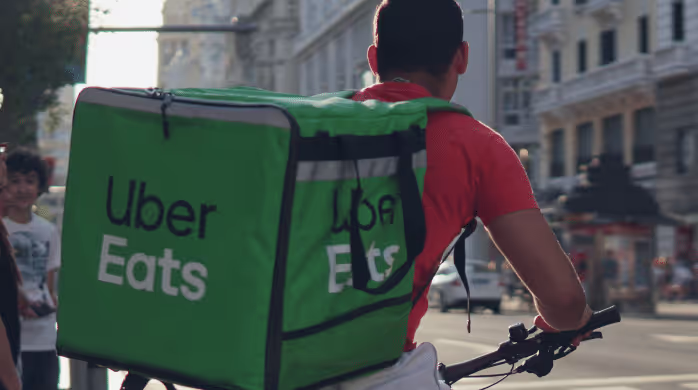
How to Make $1,000 a Week With Uber Eats in 2026 (Tips + Hourly Data)
In this blog, we'll explore the strategies and techniques that can show you how to earn $1000 per week as an Uber Eats delivery driver. We'll cover everything from optimizing your delivery zones and schedules to maximizing your tips and customer satisfaction. Whether you're a seasoned Uber Eats driver or just starting out, this guide will provide you with the insights and actionable steps to take your Uber Eats driver earnings to the next level.
Becoming an Uber Eats delivery partner can be a lucrative opportunity, especially if you're able to consistently earn $1000 a week. By understanding the platform, optimizing your delivery strategies, and focusing on customer satisfaction, you can maximize your earnings and turn Uber Eats into a reliable source of income.
We’ll cover the following topics to provide coaching and ideas to help you push your earnings up to that $1000 per week level:
What do Uber Eats drivers do?
Uber Eats drivers deliver prepared food most of the time, but they also might shop for and deliver goods from convenience outlets and grocery stores. The job is pretty simple. You get a request for an order, you drive to the restaurant or store to pick it up, and then you deliver it to the customer. If you already drive for Uber, you can choose to take orders for Uber Eats delivery any time.
If you’re not an Uber Eats driver yet, it’s pretty easy to become one. This Gridwise post tells you what you need to do if you want to sign up and start making money Uber Eats style. Many rideshare drivers welcome the chance to deliver food rather than people. This article from Nerdwallet covers the Uber Eats gig from that angle.
There are some sweet advantages to working with Uber Eats. In lots of cities you don’t even need to have a car. You can use a bike or a scooter, or even walk, to make your rounds. If you do use a car, Uber Eats’ requirements are a lot easier to meet than they are for Uber rideshare driving.
You also have a lot of flexibility. You can shop and deliver convenience items and groceries, but you don’t have to. And, like most driving gigs, you can choose your own hours, and map out the locations where you want to work.
Use Gridwise features When to Drive and Where to Drive to help you figure out what work hours and which specific areas will be the most profitable for you. Real data from real delivery people will show you earning patterns for drivers in your town.
How much can you earn doing Uber Eats?
The honest answer to this question is: basically, as much as you want! It all depends on how many hours you put in and how strategic you are about your gig. Earnings vary from one area to another, as this article from Entrepreneur points out. To give you a baseline, let’s look at the earnings of Uber Eats drivers who tracked their earnings with Gridwise.
Remember that these numbers show us only average earnings. To make $1,000 a week with Uber Eats, you’re going to have to be better than average, and we’ll show you how. For now, though, it’s good to have these figures so you get a ballpark number of where to start.
How much do Uber Eats drivers make?
Gridwise data tell us the following:
- Monthly earnings average around $444.00 per month.
- Gross earnings per trip are between $9.00 and $10.00.
- Tips make up about 50% of most Uber Eats drivers’ income, which amounts to about $225.00 per month.
Is Uber Eats good money? It can be. While there are other gigs that pay more per trip, if you drive for Uber Eats, you’ll always be pretty busy.
https://datawrapper.dwcdn.net/HPAz8/3
You can also see that, unlike many other gigs, tips play a huge role in Uber Eats earnings.

With these numbers as a baseline, what can we say about how to earn $1,000 a week with Uber Eats? As we said in the introduction, it’s going to be a hustle, but it’s really possible. To figure out how to make the most money with Uber Eats, let’s start by looking at how many trips these “average” drivers made each month.
We know that average gross earnings were $444.00 per month, and drivers got around $10.00 per trip. That means they took 44 or 45 trips per month, which breaks down to 11 trips per week. That’s not a lot of Uber Eats delivery, is it?
The fact that Uber Eats drivers averaged so few trips shows us that many drivers use more than one app at the same time. This is called multi-apping, and you can learn more about it in this Gridwise post. If you want to answer the question of how much you can make with Uber Eats, then you need to stick with the app and keep plugging away at those orders. You also need solid strategies, as well as some inside tips and tricks.
How to make the most money on Uber Eats: Delivery driving tactics
Getting to that $1,000 a week with Uber Eats isn’t so hard when you remember that the drivers we saw making about $111 a week were only taking around 11 trips in the same time period. That’s not much at all! If you work the Uber Eats app like a boss, you’ll soon have many more trips than that, easily reaching the number needed to get you to $1,000 a week. Now, let’s get to some tactics you’ll need to make that kind of bank.
- Stay with the Uber Eats app, and track your earnings. Gridwise can easily do that for you. Simply sync your Uber Eats app with Gridwise, and you’ll be able to see how much you’ve earned with Uber Eats, what times were most profitable, and your average hourly pay. Racking up trips with Uber Eats has other benefits, including perks and bonuses that are awarded to top drivers.
- Leverage surge pricing and promotions. Surge pricing is applied when there is a lot of demand. When surge pricing is in effect, many of the trips you make will pay more than usual. Promotions are offered to drivers who complete a given number of trips in a certain time period. High traffic volume days, nights, and times give you these chances to get extra earnings. Challenging yourself to complete the right number of trips for promotions will add to the number of trips you can count on for big bucks, too. Learn more about Uber Eats surge pay, boosts, and promotions in this Gridwise blog post.
- Say yes to doubling up on orders. With Uber Eats, you can get back-to-back orders or receive batched orders. Back-to-back orders happen when you receive a new request while you’re on the way to deliver an original order. The Uber Eats app routes these trips automatically, so you won’t be sent out of your way.
Batched orders are Uber Eats’ way of bundling together orders from either the same restaurant, or two nearby eating establishments. You get money, and trip count credit, for all the orders you complete, plus customer tips, without having to make a bunch of separate trips.
- Turn on the charm and get bigger tips. Being nice really is part of the Uber Eats driver’s job, and getting tips is one way people who drive for Uber Eats make money beyond their basic pay.. Bring along those extra napkins and condiments, use equipment that keeps food and drinks at the right temperatures and prevents spilling, and consider your customers’ needs. If you deliver groceries, be extra careful with delicate items such as bread and eggs.
And, most important, follow your customers’ directions, and stay in communication with them if you are going to be delayed, or if you have questions about their order. This Gridwise post will tell how to get bigger tips as a delivery driver.
- Use even more charm to keep your ratings high. As an Uber Eats driver, you will be rated by the restaurant or store where you pick up the orders as well as the customers who are waiting for the deliveries. This two-way rating system is designed to keep you on your toes, so Uber can keep people satisfied with your service. Don’t worry, you get to rate them, too.
There’s another reason why your rating as a driver is important. It not only keeps you in good standing with Uber; it helps you to qualify for the Uber Eats Pro incentive program. To learn more about Uber Eats Pro, and what it takes to earn perks such as preferred services, discounts, and deals, check out this Gridwise blog post.
Smart business moves that seal the deal
Now that you know how to gobble up the deliveries you need to make $1,000 a week with Uber Eats, it’s going to be a breeze to get there. Let’s make it even easier, with business moves that boost your earnings and shrink your expenses. If you use these, it will also be easy to say yes when people ask, “Can you make good money with Uber Eats?”
Minimize expenses. Avoid racking up big fast-food bills by bringing your own food and beverages. You might not think you’re hungry when you first start your Uber Eats run, but once the aroma of pepperoni pizza, premium cheeseburgers, and piping hot fries start wafting through your car, that might change. Bring a sandwich or other healthy food from home, and buy bottled water in bulk to save tons of cash compared to what it costs to buy single servings.
Maximize tax deductions. Another way to minimize your expenses is to maximize your tax deductions. Start by tracking mileage with Gridwise.
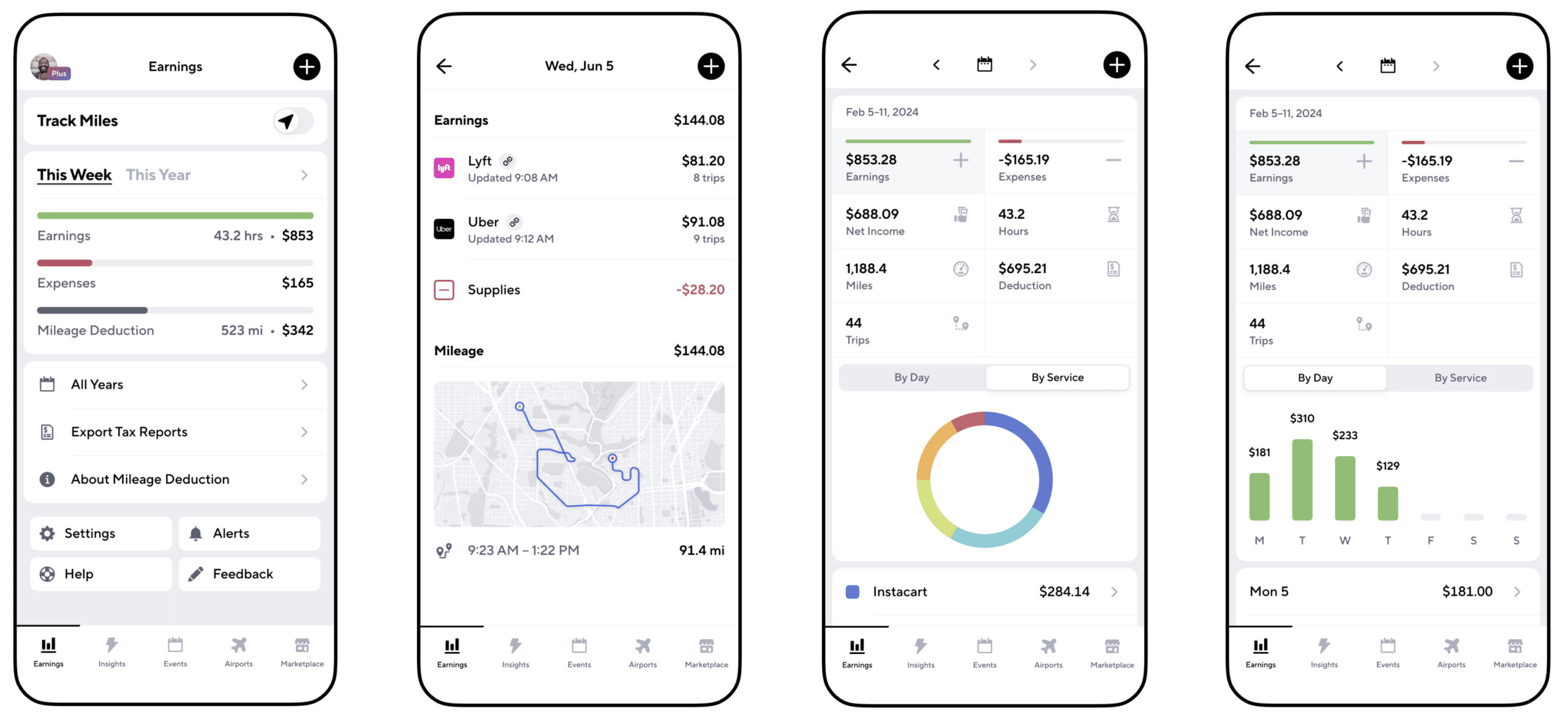
Gridwise App
Gridwise captures every deductible mile you drive, including the distance you cover between the trips your driving app records. Know what expenses you can deduct, and put them to work for you when tax time comes. Learn more about tax deduction strategies in the Gridwise Tax Guide for drivers.
Boost earnings with referrals
As an independent contractor, you’re probably looking for ways to make even more money than you can with Uber Eats. And most gig workers like you enjoy getting passive income. With Uber Eats, there’s a really easy way to do that, referrals!
All you need to do is find friends and encourage them to deliver for Uber Eats. If they make a certain number of deliveries within a specified time, you will get paid for doing nothing more than having them sign up under your referral code! Rates of pay vary by city, so check your Uber Eats app to find out what the current deal might be, and learn more about the referral program on the Uber Eats website.
Also remember: “friends” don’t have to be your best buds. Many delivery people carry cards with a QR code linking to their referral information, so just about anyone you encounter can join Uber Eats and boost your earnings. You could meet a source of passive income at the gas station, on social media, or at your high school reunion. The more you hustle, the more there is to gain, right?
Master the art of self-employment
As an Uber Eats driver, you’re an independent contractor. That means the company isn’t going to withhold your taxes, provide insurance, keep track of your earnings, or tell you about tax deductions. You’ll have to do all these things for yourself.
If you want to maximize your tax advantages, open an official business entity. You can incorporate (create a corporation) or you can work as a limited liability corporation (LLC). You can also work with a DBA (Doing Business As) arrangement, but the corporation or LLC will do a better job of protecting you from liability.
Establishing a corporation or LLC offers better tax advantages than being a sole proprietor. For instance, if you simply collect your earnings into your private account, you’ll be charged self-employment taxes in most states. And paying extra taxes is something we all want to avoid, within legal limits, as much as possible.
Every Uber Eats driver needs to learn about self-employment, and there are some great resources you can review. Check out the CareerOneStop website about self employment which will help explain the basics. You can also check with a professional tax accountant, or look other websites to learn more about actually creating a business.
Scope out your market
Look at the area around you to see where you’re likely to get the most deliveries. Where are all the restaurants? Where might people be more inclined to order deliveries? What hours do you want to drive? What activities might be going on around those times? Think about late-night and after-school times as well as breakfast, lunch, and dinner times.
Be realistic about the potential for your area and aware of new services opening up. For example, in New York, there is already a tab on the Uber Eats app that allows customers to order groceries. In our article about the best food delivery service to work for you’ll see that Uber Eats stacks up well against other delivery companies, mainly because of its potential for expanded opportunities for drivers to earn.
So, is Uber Eats good money? As we said, it isn’t an automatic guarantee that everyone will make $1,000 a week with Uber Eats. Trying out the suggestions we give you here, though, should put you on the right track! Go out there and start stacking up those orders and raking in some impressive earnings!
Get more inside information on Uber Eats in these posts from the Gridwise blog:
- The delivery driver guide: Using the Uber Eats app
- Everything you need to know about driving for Uber Eats
- Uber Eats Pro: What drivers need to know
- Looking for a different gig, part-time or full time job? Check out the Gridwise Job board.
Uber Eats FAQ
How does the Uber Eats platform work for drivers?
Uber Eats is a food delivery service that connects customers with local restaurants and independent delivery partners. As an Uber Eats driver, you'll receive notifications of nearby delivery requests, which you can accept and complete. The platform provides flexibility, allowing you to work on your own schedule and earn money based on the number of deliveries you complete.
What are the requirements to become an Uber Eats delivery partner?
To become an Uber Eats delivery partner, you'll need to meet certain requirements, such as having a valid driver's license, a registered vehicle, and passing a background check.
How can I choose the right delivery zone to maximize my earnings?
Selecting the right delivery zone can significantly impact your earnings, as some areas may have higher demand and better-paying orders. It's important to research and identify the zones in your area that tend to have the most consistent and lucrative delivery opportunities.
How can I take advantage of peak delivery hours and surge pricing?
Understanding peak delivery hours, such as mealtimes and weekends, and taking advantage of surge pricing can boost your earnings. Be aware of when demand is highest in your area and adjust your schedule accordingly to capitalize on these peak periods.
What are some tips for maximizing tips and customer satisfaction?
Providing excellent customer service and going the extra mile to ensure a positive experience can lead to more tips and repeat business. Prioritize communication, timeliness, and attention to detail to keep your customers happy and satisfied.
How can I set realistic weekly goals to reach my $1000 target?
To make $1000 a week with Uber Eats, it's essential to set realistic weekly goals and track your earnings and expenses. Start by determining your target earnings and breaking it down into achievable daily or weekly goals. This will help you stay on track and make adjustments as needed.
What are some strategies for efficient route planning and navigation?
Effective route planning and navigation can save you time and fuel, allowing you to complete more deliveries. Utilize mapping apps and take advantage of features like real-time traffic updates and turn-by-turn directions to find the quickest routes.
How can I balance my Uber Eats deliveries with other commitments?
Develop a schedule that allows you to capitalize on peak delivery hours while still maintaining a healthy work-life balance. Consider using tools like calendar apps to plan your availability and track your hours to ensure you're maximizing your earning potential without sacrificing your personal life.
What are the key considerations for maintaining my vehicle as an Uber Eats driver?
Keeping your car clean and well-maintained is crucial for maximizing your Uber Eats earnings. Regularly scheduled oil changes, tire rotations, and other preventive maintenance can help extend the life of your vehicle and minimize downtime. Additionally, budgeting for vehicle-related expenses, such as fuel, insurance, and repairs, will ensure you're accounting for these costs and maximizing your net earnings.
What are the tax obligations and legal considerations for Uber Eats drivers?
As an Uber Eats delivery driver, it's essential to understand the tax obligations and legal considerations that come with being an independent contractor. This includes properly reporting your earnings, deducting eligible business expenses, and making quarterly estimated tax payments. Additionally, you'll need to ensure you have the appropriate insurance coverage, such as personal auto insurance and possibly commercial auto insurance, to protect yourself and your vehicle while on the road making deliveries.

The Gridwise Job Board: Find Your Ideal Job or Gig Work
Gridwise is an essential assistant app created by gig workers for gig workers. Our mission is to support those engaged in gig work in every way possible. We understand how challenging it can be to deal with income instability, a lack of benefits, and job insecurity that often comes with gig work. The Gridwise app tracks and organizes earnings and expenses, and offers a wide array of discounts, deals, and services that make the lives of independent contractors easier and more rewarding.
We firmly believe it’s possible to make a viable living and create a gig experience that offers flexible hours, variety, and excitement. With issues such as consistent earnings and job security in mind, Gridwise is proud to offer a centralized platform that shows you how to find gig work and secure reliable opportunities. We’re proud to introduce the Gridwise Job Board.
The Gridwise Job Board: Key features
Because Gridwise is dedicated to serving the gig worker community, we’ve filled the Gridwise Job Board with useful features that won’t waste your precious time.
- Comprehensive listings. Find part-time, full-time, temporary, and per-task work. Drive or deliver with your vehicle, utilize an employer’s vehicle, or even find non-driving gig work.
- User-friendly interface. Find the jobs that are right for you with a tap of your screen.
- Verified opportunities. We vet the jobs before they are listed to ensure you’re getting high-quality job postings.
How to get more gig work, seasonal, part-time or full-time jobs with the Gridwise Job Board
Looking specifically for “gig work apps” or “gig jobs near me?” You’re in luck. Our filters and search functions send you directly to the listings you seek.
Here’s how it works.
- Access the Job Board via the Gridwise website.
- Search for jobs by type, location, and more.
- Select the job that interests you, and read all about it.
- Scroll through the description, and if it appeals to you, click “Apply for job.”
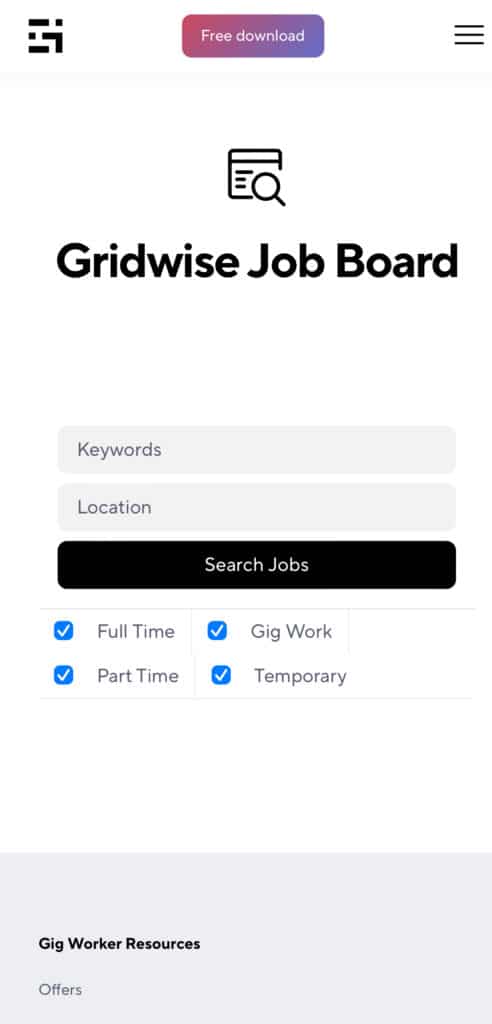
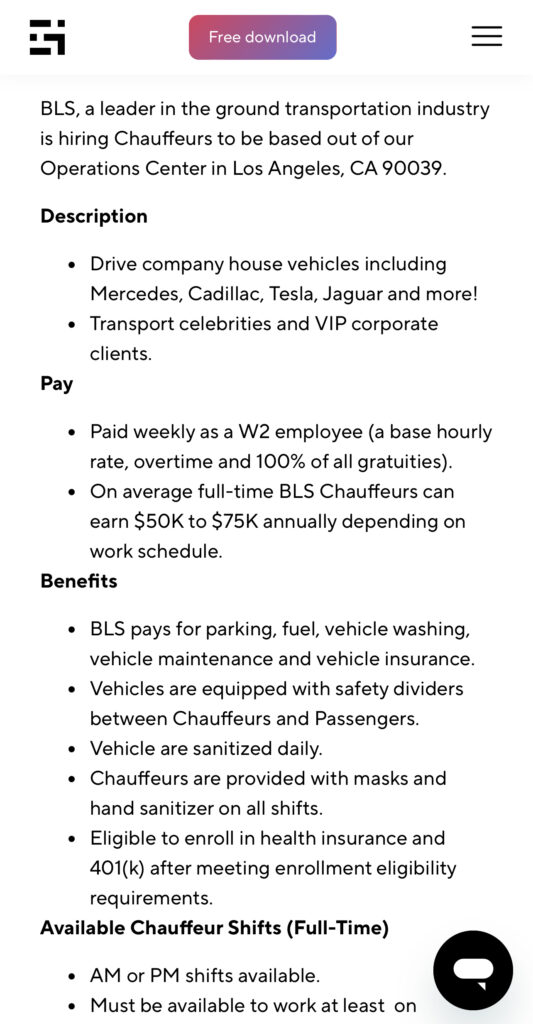
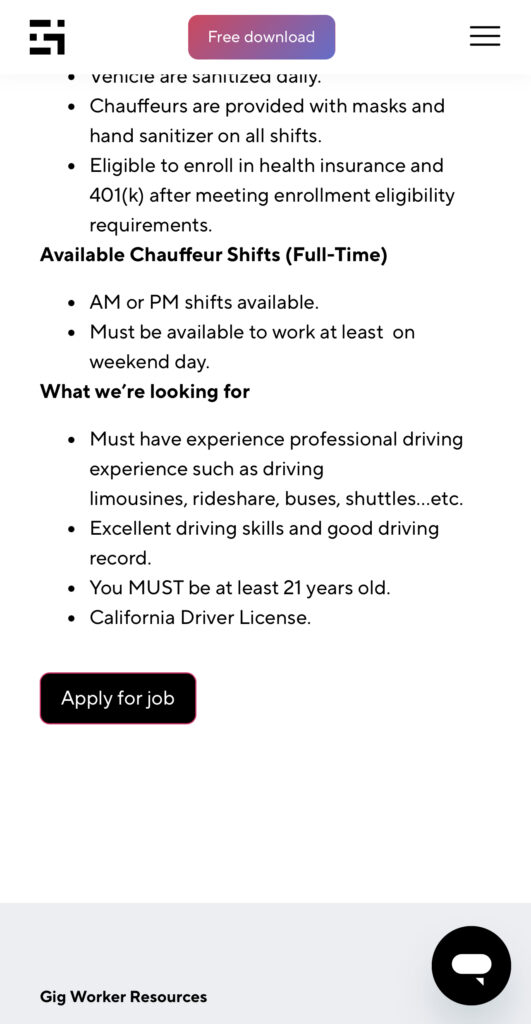
Many types of jobs are available. Adjust the search filter to see the full variety of opportunities that will let you cash in. Deliver food, set up catering, do rideshare driving, get paid for doing package delivery, and much more. You’ll find short-term gigs, long-term contracts, and part-time positions.
Perks of the Gridwise Job Board for gig workers
Gig workers who know how to make extra money will appreciate how the Gridwise Job Board lets you multiply your chances of bringing in big earnings. Here’s how:
- Increased stability. Use the Gridwise Job Board to find part-time or permanent jobs in addition to the part-time gigs you already have. Always keep a steady stream of earning opportunities flowing toward you.
- Flexibility and autonomy. Choose jobs that fit your schedule, work around other jobs and family duties, and still leave room for some fun in your life. Discover side hustles to supplement your full-time job, permanently or just for the season.
- Skill development. Find part-time work that lets you use a skill you already have, or try your hand at something new. It’s a smart way to develop a portfolio to showcase what you can do, or even to find permanent employment.
Get Gridwise and stay up to date on the Gridwise Job Board
Gig workers need plenty of information and assistance, and Gridwise is here to give it to you. Download the app and get essential features such as
- seamless earnings tracking
- mileage tracking
- expense recording, including notes
- low-cost and no-cost insurance benefits
- access to affordable medical, dental, vision, mental health, and alternative care
- professional services including legal and financial help
- deals and discounts
- weather, events, and traffic reports
- inside information on where and when to drive
More to know about gig work:

5 Best Mileage Trackers For Gig Drivers
Many drivers ask, “Do I really need a mileage tracking app?” The answer is simple: only if you want to have an accurate count of all the miles you can legally deduct from your taxable income! You might think your rideshare or delivery driving app has got you covered. After all, they do quite a good job of logging the miles you drive while you’re on a trip or delivery. But, if you want to have the best app to track mileage for Uber, Lyft, Doordash, Instacart, or the other apps you may use, you need more. Why is that?
Without a separate tracker, you’re missing the miles you drive in between pings. Did you realize that all the miles you drive, from the moment you begin your shift until it’s over (as long as you don’t drive several miles on a break to hang with your friends), are tax deductible! That means you need something besides your driving app to keep an accurate count of your travels. Read this Gridwise post to see how important it is to keep track of every deductible mile.
You won’t be surprised to hear that there’s an app for tracking miles. In fact, there are several of them. Here, we’re going to tell you about five top mileage tracking apps, and help you figure out which one is best for you.
Before we get to the list and identify the best mileage tracker app, let’s clarify what exactly a mileage tracking app is. According to G2.com’s technology glossary, mileage tracking is done for the purpose of keeping a log of mileage that is either reimbursable or tax deductible.
And yes, of course you can track your miles simply by taking readings on your odometer. But are you really prepared to account for how many miles you drove for personal reasons and subtract them from the total to get your business mileage? Even if you can remember all that and do the arithmetic, if you want an accurate reading of the miles you drive for business, and can therefore deduct, a mileage tracking app will save you a lot of trouble and prevent you from making costly errors.
Plus, as a gig driver, you have specific needs when it comes to a mileage tracker. Ideally, you’d be able to handle mileage tracking and several other functions all in one app. It can be maddening enough to deal with driving apps, particularly if you’re an avid multi-apper. You would want your mileage tracker app to help you keep account of other aspects of your business, including income, expenses, and inside information about the art of gig driving.
Not all mileage apps are equal, to be sure! Let’s look at five of the best apps to track mileage and figure out which is the best app to track mileage with Uber and Lyft, or what mileage tracker app is best for DoorDash.
1. Zoho Expense
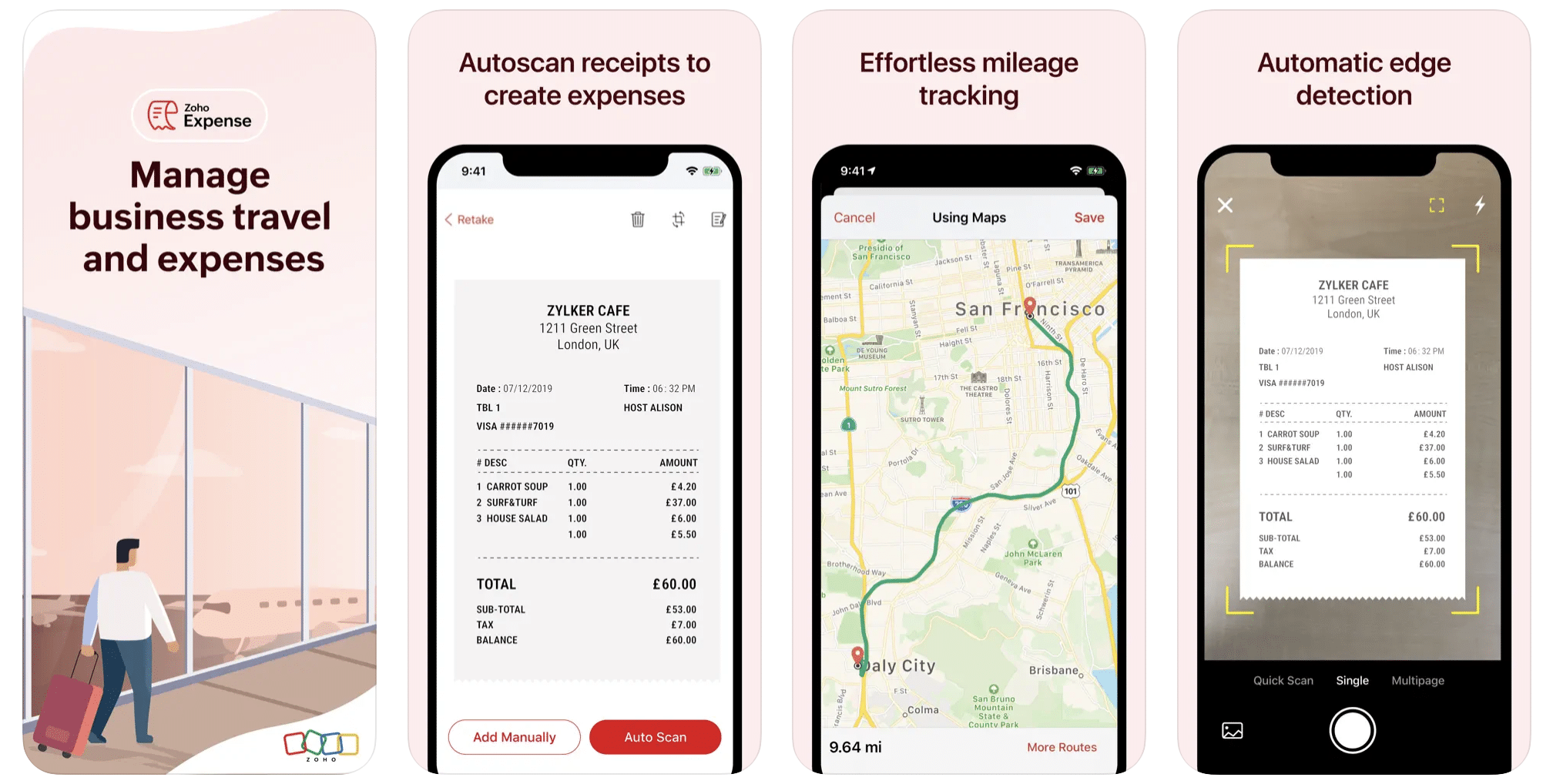
First up is Zoho Expense, which does exactly what its name says. This app is designed to allow companies to give employees a uniform way to create and submit expense reports. It can be used by individuals, including gig drivers, as well.
It includes a mileage tracker, as well as features that let you track other deductible expenses, including the ability to scan and record receipts.
Available on Android and Apple: Yes
Ratings: 4.8 stars on App Store, 4.7 stars on Google Play
Free Version: Yes
Subscription price: $3 per month, billed annually
Created specifically for gig drivers: No
2. Quickbooks Online
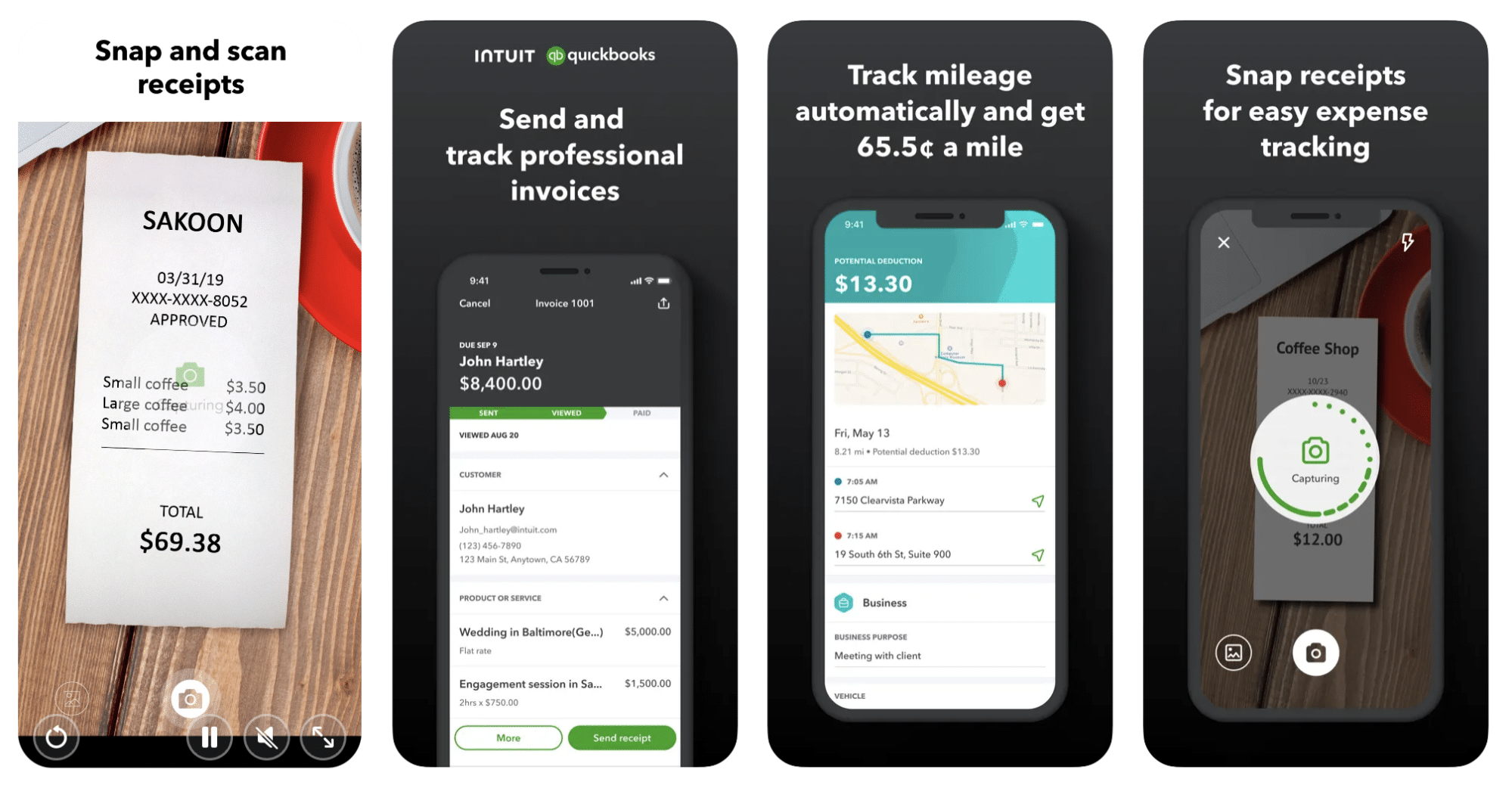
Quickbooks Online is a cloud-based app that allows you to track your mileage, earnings, and expenses. The information you enter can then be used to generate various reports that prepare you for tax time. It also allows you to create graphs that illustrate your cash flow, and includes a receipt scanner so you can instantly record deductible expenses. Quickbooks is popular, highly reliable, and designed mainly to help people keep track of their small businesses.
Available on Android and Apple: Yes
Ratings: 4.7 stars on App Store, 4.4 stars on Google Play
Free version: 30-day free trial
Subscription price: $15 per month for basic version if purchased for 3 months or more
Created specifically for gig drivers: No
Source: quickbooks.intuit.com
3. Shoeboxed
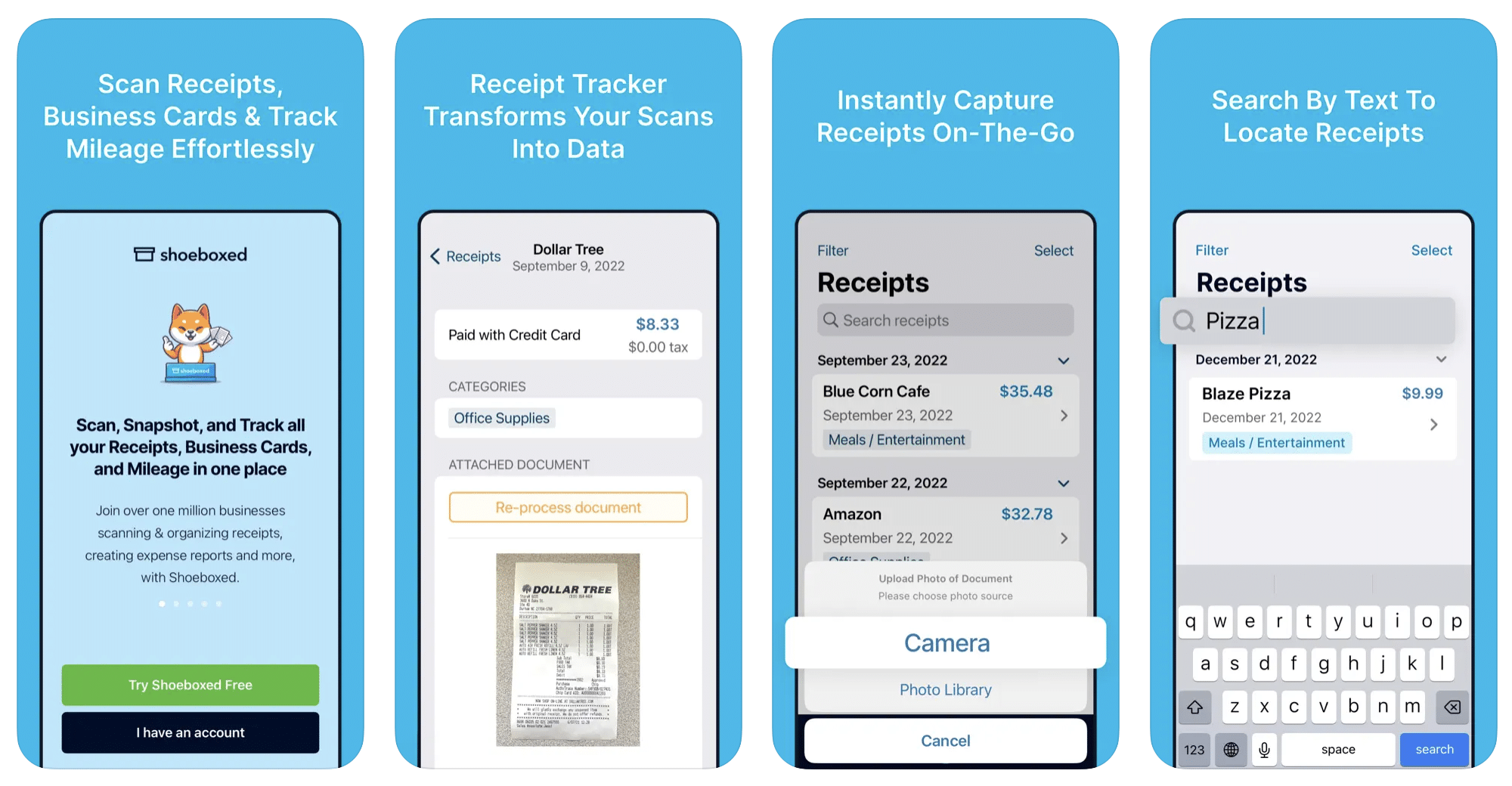
Shoeboxed started in 2007 as a service for scanning paper receipts into digital form. Now the app offers a free mileage tracker and has enabled users to scan receipts directly. It touts itself as the best mileage tracking app for DoorDash, but there are some elements missing that Dashers might like to have. While it provides features that record your expenses and prepare you for tax season, it doesn’t automatically track your earnings. The mileage tracker has a system where you can drop pins along your routes to make the tracking more precise, identifying those legs of a trip that you make for business purposes. The mileage tracker is “free” once you sign up for the basic version.
Available on Android and Apple: Yes
Ratings: 4.5 stars on App Store, 2.3 stars on Google Play
Free version: No
Subscription price: $18 per month for basic version
Created specifically for gig drivers: No
Source: blog.shoeboxed.com
4. Stride
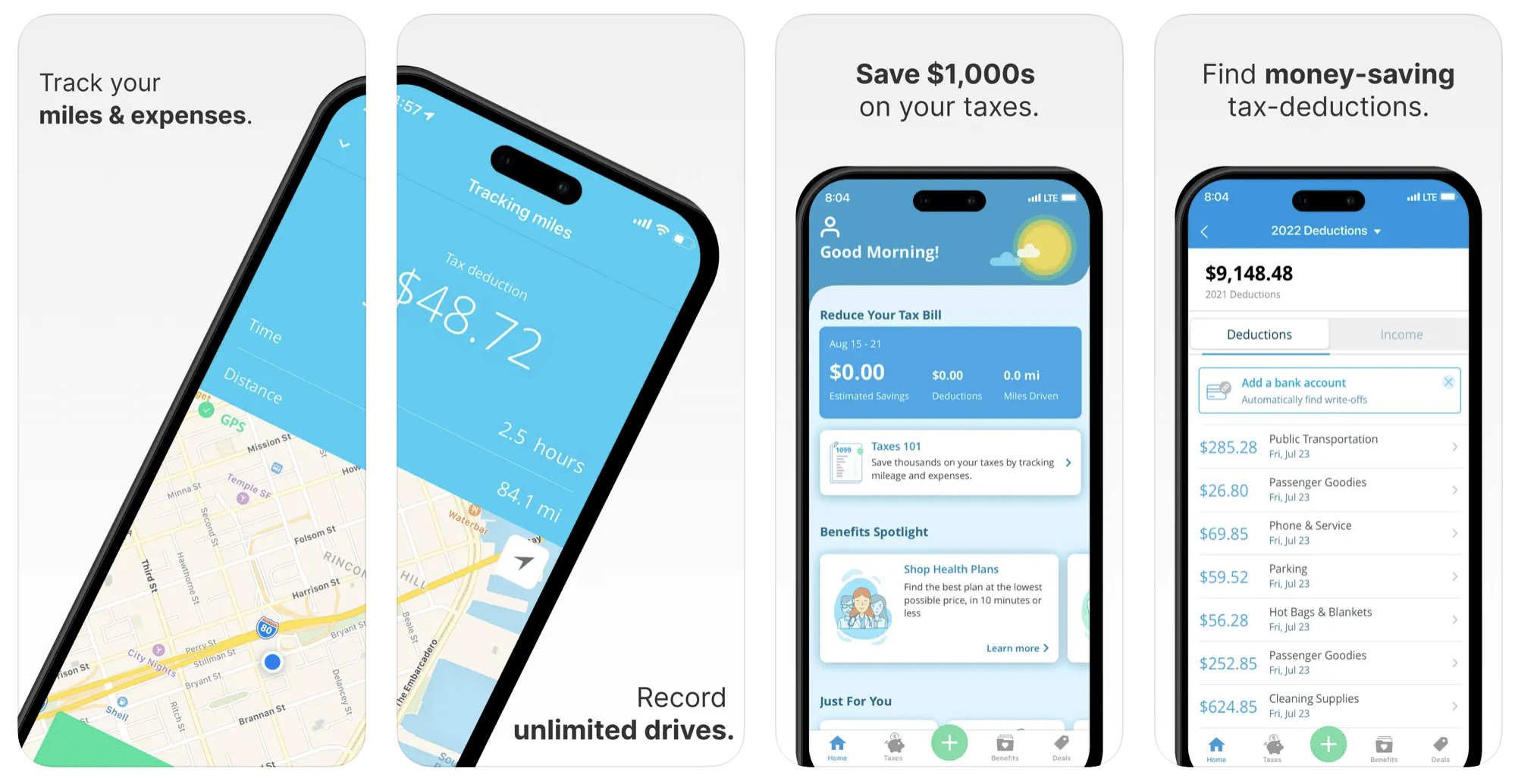
This free mileage tracker does a fair job of keeping track of the distances you rack up while gig driving, but it doesn’t automatically track earnings. It can be a big help, though, in tracking your expenses. You can link Stride to your bank account, and it will automatically scan your expenses to identify items you can potentially deduct. The app is totally free. This could make it the best free mileage tracker app, but there is a small price to pay. The app will persistently push you to consider various insurance plans that they are affiliated with. If you don’t mind that, this is a solid mileage tracker, even if it doesn’t track your earnings.
Available on Android and Apple: Yes
Ratings: 4.8 stars on App Store, 4.6 stars on Google Play
Free version: Yes
Subscription price: None. The app is free.
Created specifically for gig drivers: No
5. Gridwise
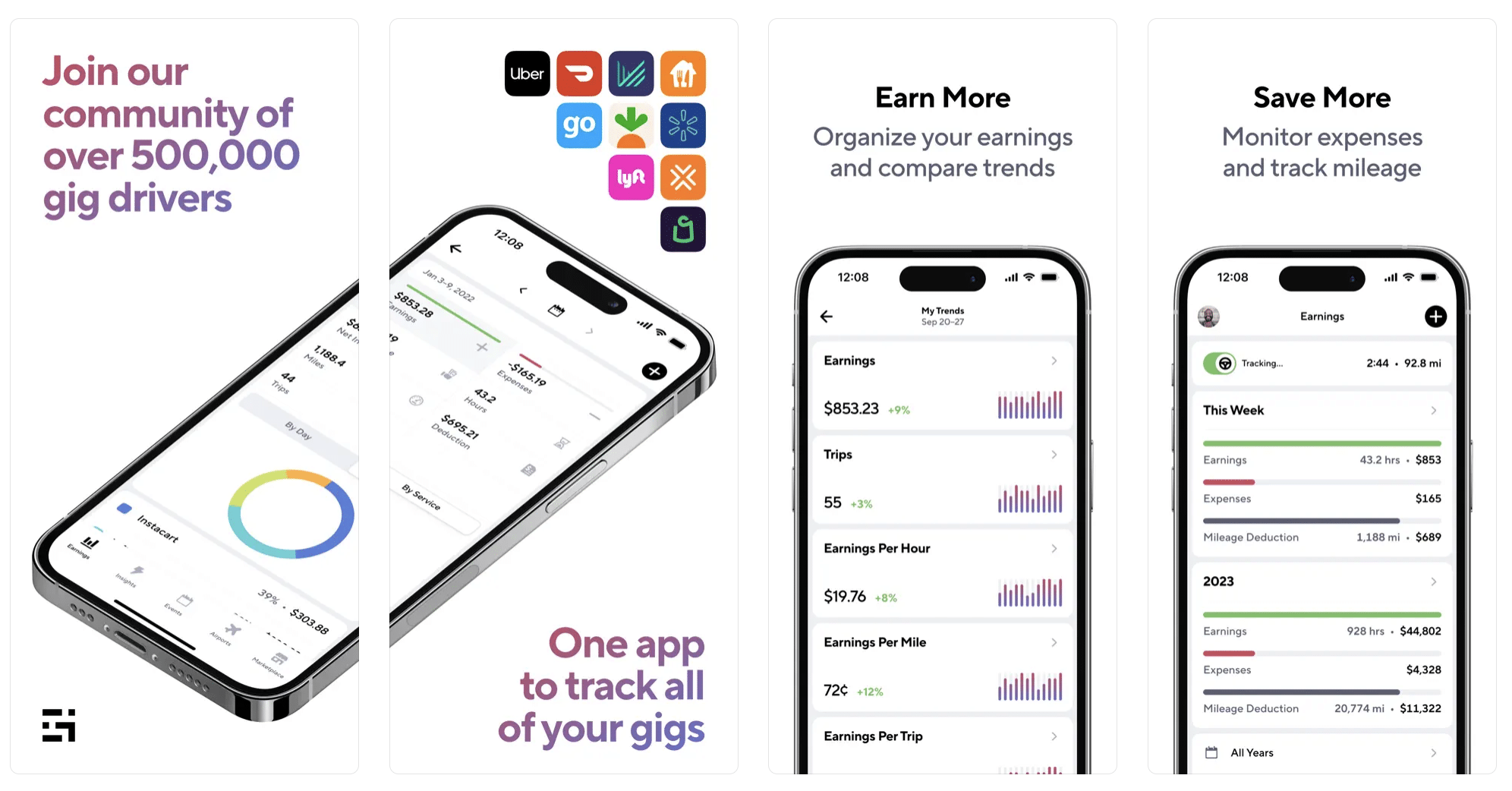
Gridwise has a free mileage tracker and free features that record your income and expenses. It gives you access to insurance and benefits, as well as insights about the best times and places to make the most money while gig driving. The Gridwise mileage tracker captures all the miles you drive while you’re on your driving shift, and it can be used if you have other trips you need to make which qualify as business travel.
Drivers love it because it is geared toward the needs of rideshare and delivery workers, providing free information about airport departures and arrivals, event start and let out times, weather, traffic, and more. The Gridwise Plus subscription adds value by providing additional insights and reports, discounts on benefits, the ability to export data in .csv format,, and more.
Available on Android and Apple: Yes
Ratings: 4.9 stars on App Store, 4.6 stars on Google Play
Free version: Yes
Subscription price: $9.95 per month for Gridwise Plus, or $95.99 per year (a $23.41 savings)
Created specifically for gig drivers: Yes!
What is the best mileage tracking app?
Now that we’ve checked them all out, we’re positive about the answer to that. Hands down, it’s Gridwise. Are we biased? You bet we are! But drivers love it too. Gridwise is the best mileage tracker app, and so much more. So many of the features are free, and the subscription to Gridwise Plus will pay for itself with additional insights to boost your earnings and deeper discounts on products and services.
Most important, Gridwise is designed specifically for gig drivers by experts who were once gig drivers themselves! Knowing what gig drivers need is a crucial step in creating an app that rideshare and delivery drivers can really use! Here are a few of the features, besides mileage tracking:
- seamless earnings tracking
- automatic, on/off toggle and manual mileage tracking
- mileage categorization
- airport, traffic, weather, and events information
- insights into where to drive and when to drive
- reports showing earnings across the platforms you use
- discounts on countless products and services for drivers
- additional resources for finding side gigs
- an informative and comprehensive blog
- affordable benefits, including insurance, medical, dental, and alternative practitioner discounts
- a community of drivers just like you
Don’t settle for just any app. Get the best mileage tracker, and so much more, from Gridwise!
Everything rideshare and delivery drivers should know about the upcoming elections
We know you know this, but here it is anyway: Tuesday, November 3, 2020 is election day in the United States.
You may have thought that drivers don’t have much to do with politics. But if you’ve been paying attention lately, your perspective has likely changed.
In just one state, a raging battle threatens to do one of two things: run the rideshare and delivery companies out of business, or force those companies to change their business models and make the people who work for them employees.
In this blog post, we’re going to tell you more about what’s going on in the biggest political battle being waged over the gig economy’s way of doing business. We’ll also discuss how this could affect all drivers, everywhere, depending on what happens and how the battle lines are drawn in other states.
We’re pro-driver here at Gridwise, but we’re also nonpartisan—meaning, we would never tell you who to vote for.
What we will do is make sure you get all the information you need to select the candidates and initiatives who truly represent your individual interests. With that in mind, here’s what we’ve got for you in this post:
- California’s showdown over driver classification: AB5 and Proposition 22
- What the outcome of the California election will mean to drivers everywhere
- Both sides of the story: How Democrats and Republicans are likely to view this issue
- What this means in your local (and the national) election
- Some cool election day happenings
California’s showdown over driver classification: AB5 and Proposition 22
About a year ago, California’s state legislature passed a law known as Assembly Bill 5, or AB5 for short. By precisely defining the differences between independent contractors and employees, the bill forced the rideshare and delivery companies to make their drivers employees.
In this blog post from June 2020, we discussed exactly what this means, and why the companies weren’t/aren’t willing to go along with the bill.
AB5 went into effect on January 1, 2020. The companies ignored it. State officials dragged the companies to court, and won. Then, there was an injunction against enforcing the law because the companies came up with a new plan.
California has what are known as ballot measures, or propositions. As long as virtually any group can get enough signatures to bring the measure to a vote, they can put forth a proposition. If it passes by a majority of California’s voters, it becomes law.
The companies gathered the necessary signatures, got the measure on the ballot, and have been campaigning for it all summer and into the fall. With ads and other persuasive tools, they have spent in excess of $184 million to get the measure passed.
Here is the breakdown, showing what each company contributed toward the cause, and the percentage of the entire amount :
Uber$51,701,769.00Lyft$48,652,082.00DoorDash$47,735,274.00Instacart$27,623,864.00Postmates$11,819,194.00Total$187,532,183.00
Proposition 22 will be on the California ballot on November 3, 2020. If it passes, AB5 will no longer apply to rideshare and delivery companies. Instead of the restrictions spelled out in AB5, the companies would abide by the policies described in Proposition 22. You can find out more about those policies in this blog article.
If Prop 22 doesn’t pass, the companies will have to abide by the law as defined in AB5. Drivers would become employees, and companies would have to pay benefits such as unemployment insurance, health insurance, paid time off, and disability insurance.
Obviously, this would be a massive expense for the gig companies. Would it be viable for them to continue to operate in California? When they were initially told they had to comply with AB5, they threatened to stop doing business in the state. If you want to know more about that situation, take a look at this blog article.
What is the likelihood of Proposition 22 passing? According to this September 2020 survey of likely voters, taken by UC Berkeley, 39 percent said they would vote yes, 36 percent said they would vote no, and 25 percent were still undecided.
What the outcome of the California election will mean to drivers everywhere
You may be curious about why we’ve been devoting so many blog posts to California, and the answer is this: because there is absolutely no doubt that whatever happens will have profound effects on the rest of the country.
California isn’t the only place where the government has intervened in the payment of drivers who work for gig economy companies. In New York City, a minimum wage of $17.22 per hour was set by the Taxi and Limousine Commission (TLC). That sounds like a great deal, right? For those who were already driving, yes.
But for people who might want to start driving in New York City, it wasn’t such a great deal. The TLC also restricted the number of Uber and Lyft drivers who could drive in the city. So, in the biggest market in the United States, many people were locked out of the gig economy.
Also, most drivers realized that even though they were finally getting a fair minimum wage, it wasn’t for the best of reasons.
Along with rideshare, the TLC oversees the Yellow Taxi and Black Car companies in New York. By restricting the number of drivers, and making Uber and Lyft pay a minimum wage, the TLC was protecting the other industries under its jurisdiction.
One city that has a minimum wage law in effect for drivers is Seattle. In this case, the city’s government officials researched what drivers were making, determined how much they should be making, and developed a policy that set the minimum wage to $16.39 per hour. This went into effect on October 9, 2020, with the mayor’s signature.
Many drivers liked this, for sure, but the companies? Not so much. Uber referred to what happened in New York, where prices for rides went up 30 percent and thousands of drivers could no longer work, and warned Seattle against taking this similar step.
No one knows how the Seattle situation will pan out quite yet since the law was enacted so recently. It shows, however, that while California is the biggest battle being waged, it’s not the only battle.
Drivers are divided on this issue. Many have said they prefer to remain independent contractors, while others would rather be employees. This blog post covers more details about that difference of opinion, and shows some interesting driver survey results.
It’s worth repeating that what happens in California is not limited to drivers in that state alone. It can happen anywhere—including where you live.
Both sides of the story: How Democrats and Republicans are likely to view this issue
In our starkly divided country, the attitude toward government intervention in business, including the rideshare and delivery industry, is almost always divided along party lines. California, New York (State and City), and Seattle (and the State of Washington) are currently governed by officials who are members of the Democratic Party.
Traditionally, that has been the party best known for defending workers’ rights. So, it makes sense that the first efforts to regulate the companies have come out of mostly cities and states governed by Democrats.
The Democrats’ history as the champion for unions goes back to the mid-nineteenth century. At that time, when it came to voting, most working class people automatically went along with what their Democrat-oriented unions told them to do. In general, Democratic Party leaders will tend to support government intervention to level the playing field in favor of workers.
Since California, Seattle, and New York are all governed by Democrats, it’s no surprise to see the measures that officials in those places have taken to regulate the companies.
As a matter of policy, these leaders are unhappy with how the rideshare and delivery companies treat their drivers and shoppers, so they would probably support efforts to form a drivers’ union. This article from May 2020 discusses how some drivers and driver advocates have been attempting to do just that.
At the very least, the Democratic Party’s tendency would be to have the government regulate the companies so drivers would be paid uniformly, as well as be supported by the safety net of company-provided benefits.
Republicans, conversely, tend to side with corporations in disputes like the one emerging between gig companies and workers. Republicans also emphasize the idea of individual achievement. They would argue that if government-imposed restrictions make it financially impossible for the companies to do business, this would hurt drivers and passengers. They would most certainly not support the formation of driver unions.
For the most part, Republicans believe the economy should be allowed to operate with as little government interference as possible. Republican policies lean more toward deregulation, which typically conflicts with the interests of proponents of fair labor practices and environmental protection. Yet these policies also have advocates among entrepreneurs and companies alike.
There are reasons why these groups tend to favor Republican policies. One is the theory that if the companies are not burdened by excessive regulations, then there will be more jobs, more business, and more economic growth.
The ideal, of course, is to strike a balance between the two extremes, which often happens once disputes between the two sides get hammered out.
The way you look at the employee/contractor controversy is likely to determine the way you want to vote. Remember that even local representatives can have a huge effect on the viability of the gig economy in your area. This is shown by the local policies enacted in New York City and Seattle. It’s likely that this controversy will be coming to your town, too, before very long.
What this means in your local (and the national) election
As mentioned earlier, we have no interest in telling you how to vote.
We’ve presented some facts that are likely to get you thinking about where you stand, or at least we hope you will consider them as fodder for contemplation. There are drivers with passionate beliefs about each side of the employee/contractor dispute, and other drivers whose political thinking is aligned with the beliefs of their chosen political party for other reasons.
So, if you were thinking about sitting this election out, please don’t. There’s a lot at stake, and it’s up to you to ensure that you’re fairly represented by candidates who will advocate for your interests.
Some cool election day happenings
How awesome would it be for the rideshare companies to offer discounted rides to the polls on election day? Well, they’re doing exactly that nationwide.
Now, depending on your perspective, that can be a really great thing. But...in California, news reports and website articles say Uber and Lyft are hyping Prop 22 to their riders, by mentioning in the app how important it is for riders to vote “yes.”
Instacart, not to be left out of this process, has shoppers delivering election materials along with the groceries they bring to customers’ doorsteps. “The whole thing is just very, very dystopian and absurd and alarming,” says Vanessa Bain, an Instacart shopper and cofounder of a nonprofit called Gig Workers Collective.

Let’s hope they won’t refuse rides to “no” voters, and that they’re not even going to actually ask how their customers are going to vote!
In addition, because voting in person often results in long lines outside polling places, Uber partnered with the nonprofit group, Pizza to the Polls to get free slices of pizza to hungry people who are waiting to vote (with Uber Eats performing the deliveries).
Yet another incentive to vote is being provided by Lyft, which has partnered with Starbucks to provide free one-way trips to the polls for its workers.
Let Gridwise support YOU
That’s right, we support you. And we’re not even asking for your vote; just a download, which brings you a boatload of great stuff. For starters, Gridwise will track all your earnings from the various companies you work for. Our new feature, now rolling out in Beta, will allow you to seamlessly link your accounts to Gridwise to input your earnings and mileage data.
No matter how the information comes into the Gridwise app, this is how slick and easy it is to decipher what comes out.

No other app gives you so much power, PLUS access to our Perks tab. That’s where you’ll find links to our super-informative blog, the unreal and wild Gridwise YouTube channel, and … deals and discounts for drivers you just won’t want to pass up.
We love our driver community, so please, don’t be shy. Send us comments below with your thoughts about this article or anything else you want us to know. Also join us on Facebook so you can be part of the great Gridwise gas card giveaways!
How HyreCar helped a Postmates driver stay afloat during the COVID-19 crisis
This driver survived the pandemic-related slowdowns thanks to HyreCar
At Gridwise, we love to hear from drivers.
After all, those conversations let us know what’s really going on in the world of rideshare and delivery driving all over the country. It’s a great way for us to discover new ideas that we can pass along to the driver community.
Recently, we had the pleasure of sitting down (via Zoom) with Donna Campbell, a D.C.-based Postmates driver.
She started driving during the COVID-19 crisis after losing much of her regular income. Although she had to overcome many obstacles, she was determined to find a way to make money with delivery.
The biggest obstacle? She didn’t have a car, or any vehicle she could use to deliver.
That’s when she discovered a company named HyreCar. With HyreCar, Donna was able to rent a car hassle-free, for a reasonable cost, in a way that was totally in compliance with all the rideshare and delivery companies’ requirements.
Her story is inspiring, and what she tells us about her experience is valuable for all drivers.
In this post, we’ll share what we learned from Donna, and fill you in on how her solution might benefit you.
We'll discuss:
- Donna’s story
- What HyreCar is
- How to get a vehicle from HyreCar
- The other side of HyreCar
- Donna’s thoughts about her HyreCar experience
Donna’s story
Like so many of us, Donna thought she was done in by the events of 2020.
The year was only a few months old when a brand-new strain of coronavirus struck the world—and in a frightfully short period of time, it changed the entire landscape of many people’s lives.
Donna Campbell was one of them. She lost two of the three jobs she’d been holding down prior to the shutdowns, and she needed to earn money fast.
She heard there was big demand for delivery drivers, and that was something she believed she could do. But there was a problem: Donna didn’t have a car, and she was not in a financial position to buy one.
Although that may sound like an impossible situation, she didn’t let it stop her. She seriously considered her options, and when she saw a Google ad for HyreCar, she knew she’d found the answer: a way to deliver without owning a car.
Here’s some information about the company Donna discovered—one that proved to be a game-changer for her.
What is HyreCar?
Founded in 2014 and headquartered in Los Angeles, HyreCar is officially known as a “carsharing marketplace.” As a company that rents vehicles to rideshare and delivery drivers, HyreCar can be a godsend for those who don’t own a vehicle (like Donna) or who are temporarily without a vehicle due to a breakdown or collision.
The cars HyreCar provides are rented out by owners who have an extra vehicle that isn’t being used. Owners can generate passive income by renting their vehicles to drivers on the HyreCar platform. (More on that later in the article.)
How to get a vehicle from HyreCar
If you want to rent a vehicle from HyreCar, you’ll have to meet a list of requirements. But because they’re basically the same requirements you already have to meet in order to drive for a rideshare or delivery company, you won’t find them foreign or difficult to achieve.
You must:
- Be at least 21 years old
- Have a valid, in-state driver’s license that you’ve held for at least one year
- Have a mobile phone in your name so HyreCar can communicate with you
- Have an existing account with a rideshare or food delivery service
- Not have major driving violations (DUI, reckless driving, etc.) for the past three years
- Not have more than two minor driving violations in the last three years
If you meet all these qualifications, you’re ready to set up your HyreCar account and pick up your car. Here’s how:
- Visit the HyreCar site and follow the instructions to set up your account.
- Start the process of booking a car, based on your location and the length of the rental period (minimum of two days).
- Browse available vehicles; pick at least five that would work for you, as they will be allocated based on availability. HyreCar will cancel any bookings you aren’t approved for.
- Fill out your payment information. A $200 deposit is necessary if you’re using a debit card. No deposit is required with a credit card.
- Undergo a background check (for your first rental only). The check is supposed to take only a few hours, but can actually take a day or two.
- If and when you get approved, you’ll be charged for the entire cost of the rental.
- After receiving documents from HyreCar (registration, inspection report, and rideshare insurance provided by HyreCar), upload the documents to your rideshare or delivery company.
- Pick up your car from the owner, being sure to check and record mileage, fuel level, vehicle condition (dents and scratches), and any unusual instructions about operating the vehicle.
Once you’ve picked up your car, and all the paperwork has been approved by your company, you can drive for the specified rental period. When you’re done, return the car to the owner. You can also extend your rental daily, weekly or monthly if you’d like to keep driving. If you decide to drop off the car, be sure to refuel it first, and let the owner inspect the vehicle to make sure it wasn’t damaged while you were driving it.
Here are answers to a couple more questions about HyreCar.
How much does HyreCar charge for rentals?
This varies by location, but the range is between $25 to $40 per day.
Does HyreCar provide long-term rentals?
In many cases, yes. Drivers can rent daily, weekly, or monthly and extend their rental for as long as they’d like to continue driving. The company also has programs that allow local car dealerships to rent out vehicles to rideshare and delivery drivers, giving drivers the opportunity to rent-to-own a vehicle as well.
It’s easy to see how this was a great solution for Donna. She could rent a vehicle, do her delivery driving, and avoid the expense and hassle of owning (and parking) a car in D.C. For her, HyreCar was fabulous.
Sign up to rent a car with HyreCar here.
And it can also be a great deal for car owners. Keep reading to find out how.
The other side of HyreCar
Let’s say you own a car. Maybe you’ve been sidelined from driving due to troubles of your own, such as illness, injury, or legal problems. HyreCar might be a way for you to earn extra money until you can drive again.
You can rent your car to drivers through HyreCar, and make money without putting in very much work at all. Merely be willing to meet up with prospective drivers who’ve already been vetted by the company, hand them the key when they take the car away, and get the key back when they return.
That’s a pretty easy gig, especially when it could bring you as much as $50-$60 per two-day rental period. If you want to learn more about being a renter rather than a rentee, check out this HyreCar Review for more info on that.
As mentioned above, fleet owners and car dealers can also rent out their idle or underutilized inventory to drivers on the HyreCar platform to create new revenue streams for their business.
Donna’s thoughts about her HyreCar experience
Any company can make itself look good on paper, but it’s what customers say that gives you the real picture—and Donna has great things to say about HyreCar. First, she had an amazing post-purchase experience.
She rented a few vehicles that were either dirty or smelly, and when she told HyreCar about it, they replaced the vehicle ASAP. As for customer service, she had this to say:
“I love Brad. He’s super-easy to talk to, and all of the customer service people are very helpful. If you have questions, they do what they can to help, and give you the answer. Everyone was wonderful, and I love it. I tell a ton of people about it. I definitely plan to expand the number of services I’m driving for, and will keep using HyreCar!”
Expand your services, and make more money, without the hassle and expense of owning a car
Donna’s story shows what can happen when a person takes the initiative, finds what she needs, and does what it takes to make it all work. Thanks to HyreCar, Donna didn’t have to stay on the sidelines just because she didn’t have a car.
HyreCar can open up a new world of flexibility and opportunity to you as well. If you’re like Donna, and don’t have a vehicle, renting from HyreCar can be the perfect solution for you. Even if you do have a vehicle, and don’t want to incur the costs of wear and tear and/or extra mileage, HyreCar can help you out.
Let’s say, for instance, you lease your car from a dealer, and driving for rideshare or delivery is eating up the miles you’re allowed on the lease. A HyreCar rental can help you keep driving for delivery without racking up the enormous cost of exceeding those limits.
Also, HyreCar helps drivers work around the disruptive effects breakdowns and collision damage can bring to your life. Time without your vehicle means lost work, on top of the inevitable expense of bailing your car out of the shop. Renting from HyreCar lets you keep working, so you can stack up enough cash to cover the repair bills.
And, if you want to let your car work for you without you in it, HyreCar offers the option to rent it to other drivers.
We know Donna is glad she found HyreCar, and we’re pleased she told us her story so we could share it with you. Ready to give it a try? Check out HyreCar today.

Uber launches mandatory mask verification for some passengers… But how much will this help drivers
Those of us who’ve chosen to keep driving during the pandemic are required to wear masks whenever a passenger is in our vehicles. We do this to help stop the spread of COVID-19, as well as to make our passengers feel safe.
Passengers are also required to wear masks, which is only fair since drivers need to be protected, too. But do all passengers have masks? Do they always keep them on?
Uber says that drivers have the right to refuse a ride if the passenger is without a mask, and the ensuing cancellation won’t affect driver ratings. After the ride is over, drivers can report a passenger for not wearing a mask.
In both cases, drivers do the reporting and the companies take it from there. They’ll contact the passengers to tell them they know the policy was violated, and that they could lose access to the app if they attempt to ride maskless again.
The reality for drivers is that it’s a burden to be charged with enforcing COVID-19 rules, including the mask policy because people do not always want to comply. Riders can become obnoxious when drivers take steps to cancel the ride because the passenger isn’t wearing a mask, or refuse to allow a passenger to sit in the front seat.
Uber is now taking measures to make drivers feel safer. One action they’ve taken is requiring passengers who have not worn masks in the past to prove they’re wearing one before they can ride again. Let’s take a look at what this does for the average passenger, and driver, by examining:
- The purpose of passenger mask check selfies
- The impact of bad ratings on passengers
- Whether the new mask check policy helps drivers
The purpose of passenger mask check selfies
If you drive for Uber, you can’t even open your app to be available for rides without first taking a selfie that proves you’re wearing a mask. It’s a pain, but we deal with it. Now that the companies are cracking down on riders, once a passenger has been reported for not wearing a mask, he or she will have to go through the same selfie routine.
That’s right. Uber is, in some sense, punishing riders who have failed to “mask up”. Now, they have to stop, put on the mask, take the selfie, and only then can they get on the app to call for a ride.
So how does this development make you feel? Do you think you’ll be safer if your customers are forced to do this? How would you feel if you were the passenger?
One of our drivers took a casual survey of the passengers she had on a busy afternoon, asking how they would feel if they were required to take a masked selfie to prove they were in compliance with the rules. Most thought that would be an invasion of privacy, or would prefer that wearing a mask be left to common sense and sticking to the honor system.
This new mask verification policy is one example of how passengers wield less power than in the past. We understand why they might feel imposed upon by these new rules, but if they’re worried about their privacy being invaded, it’s too late. They’ve already given the rideshare app their pictures, as well as a lot of information.
And now, along with being reported by drivers if they neglect to follow COVID-19 rules, passengers are also learning that they're be rated by drivers.
The impact of low ratings on passengers
Every driver knows what it means when a passenger gives out a low star rating. Not only can one’s standing with the company take a hit; there’s also the risk of deactivation, depending on the nature of the passenger’s complaint.
Now, the tables are turned.
Drivers have the ability (and responsibility) to report maskless passengers, and those passengers will learn firsthand how ratings affect their accounts. For the first time, they will know how drivers see them when they’re picked up for a ride.
Until recently, for instance, passengers didn’t realize that drivers could make or break their star rating with a low score exactly as they could do for drivers. And passengers were probably also unaware of the impact of having a low star rating.
The passenger rating is important to drivers because it alerts them about what to expect from the person they’re about to pick up: whether he or she is likely to be polite, obnoxious, or worse, a troublemaker of some kind. Until recently, only drivers (and the companies) could see the passenger ratings; thankfully, that has changed.
Now that passengers’ star ratings are posted in their profiles, riders are finding out what their drivers have said about them. And they often find it shocking. This article in the Sacramento Bee describes some passengers’ reactions to being rated at less than five stars. Of course, they don’t like it very much. Who wants to be told they’re not the perfect rider? Also, they have no way of knowing what they did that got under their driver’s skin.
Of course, people are sensitive about their passenger ratings. So just imagine what being asked to take a selfie to prove they’re wearing a mask might feel like to them. Let’s just say it probably won’t go over very well—but it’s being done anyway.
Does the new mask check policy help drivers?
Let’s give the companies an “E” for effort. They’re trying to get passengers to be courteous enough to help keep drivers safe. However, it doesn’t seem like this will do much to keep passengers from taking off their masks, or allowing the masks to droop down off their faces, if they’re inconsiderate enough to do either.
The companies seem to think it will enhance driver safety. In a September 1, 2020 article in MSN Money, Uber’s Global Head of Safety and Driver Product, Sachin Kansal, stated that he believes it will add another layer of safety, and he hopes this new feature empowers drivers because the company relies on their feedback. “Their feedback can help keep the platform safe for everyone,” said Kansal.
While it’s true that the company takes the driver complaint of an unmasked passenger seriously, it’s unclear how much (or whether) this benefits drivers. Suppose, for example, you drive in a small community. And suppose you have an encounter with that very same customer you reported after the person figured out you’re the driver who ratted on him or her for not wearing a mask. That could result in a confrontation most of us would definitely prefer to avoid.
Drivers might feel more secure if they were assured by the company that, at any point in the future, they will not be paired with the riders they’ve reported. It would be much easier on drivers if enforcement, and possible retribution for reporting someone for non-compliance, didn't have to land in their laps.
Although it isn’t perfect, we view the trend toward two-way ratings between drivers and customers in the rideshare and delivery business as a step in the right direction. Now, if we can only figure out a way to get them to tip more and backseat drive less…
Let Gridwise improve your mood
If you’re feeling a bit frustrated by all the things you have to do as a driver, let Gridwise take some of the pressure off you. Download the app to effortlessly log your mileage and track your earnings. You’ll also get airport, event, and weather information to help your journeys be safer, smoother, and infinitely more profitable.
Our Perks tab has deals and discounts for drivers, plus quick access to our driver-directed blog and the Gridwise YouTube Channel. Don’t miss out on the great Gridwise gas card giveaways, available all the time when you join us on Facebook. And please, if you have experiences, opinions, or anything you want to say about this article or whatever is on your mind, leave your comments below. We want to hear from you!
[2020 Update!] What’s the Best Rideshare Assistant/ Mileage Tracking App
As a rideshare driver, tracking mileage is crucial for maximizing your earnings and reducing your tax burden. The IRS can be very particular when it comes to taking a mileage deduction. At a minimum, they will require the total miles you drove, dates of each trip, locations you drove to, and the business purpose of the trip. A 2019 IRS publication explains these types of expenses in detail.To simplify the expense tracking process, many rideshare drivers utilize a mileage tracking app. These apps eliminate the old school practice of carefully logging odometer readings with pen and paper. Mileage tracking apps are convenient and helpful in maintaining an accurate record, which is imperative in case the IRS ever decides to audit you.Since there are so many mileage tracking apps out there, rideshare drivers are often uncertain which one to choose. At Gridwise, our goal is to help increase drivers’ performance on the road, and one way we accomplish that is by providing answers to common questions, like, “Which mileage tracking app is best for me?”We prepared this blog post to help drivers answer that question. We’ve compared popular mileage tracking apps based on the most important aspects: availability, cost, and features specific to rideshare drivers. Keep reading to see what we found out.
Gridwise Shift Tracker
Availability: iOS and AndroidCost: FreeFeatures:By starting a shift on Gridwise you will automatically track all the miles that you drive during your shift.As a driver, you now have a button at the very top of your screen in the Gridwise app that says “Go Online.” Pressing that button starts your driving session.Now you’ll see a “Shift Active” bar.Here you’ll get a real-time look at how far you’ve driven and how long you’ve driven for the current day, the previous day, and the entire week.Turn your shift status to “On” every time you start driving so your miles and time are automatically tracked.After you’ve finished a shift, you’ll be prompted to input your driving statistics for that session.And you’ll be able view your weekly and daily results on the Earnings tab. This will include your total earnings and total number of trips given.You’ll then receive a shift summary email with more detailed stats.Best of all, Gridwise isn't just for Rideshare (Uber and Lyft) drivers. Gridwise is also one of the best mileage tracfkers for:
MileIQ
Availability: iOS and Android. Also, the MileIQ Dashboard is available on your laptop, desktop, or tablet.Cost: Free if you take fewer than 40 drives per month. If you want unlimited drives per month, you’ll need to pay a monthly fee of $5.99 ($4.99 per month if billed annually).Features:MileIQ automatically logs your miles and works in the background without the need to press “start” or “stop” during your trips. It also integrates with Freshbooks and Excel. However, you’ll need to categorize each trip as either personal, charity, or professional by swiping left or right. Based on your miles recorded, MileIQ can create a complete record of all your tax deductible and reimbursable mileage—but doesn’t include accounting tools like expense calculation.Although MileIQ is reliable, it’s more suitable for business drivers who drive the same route every day rather than rideshare drivers with varying routes. Most rideshare drivers complete more than 40 drives per month, so you’ll likely have to pay the fee.
Hurdlr
Availability: iOS and AndroidCost: Basic version is free; full version $7.99/month or $58.99/yearFeatures:Hurdlr actively tracks your business mileage with an automatic start and stop. The free version includes expense and semi-automatic mileage tracking. Premium users get all features tracked automatically, plus real-time quarterly and year-end tax estimates.This app can generate graphs to show your net earnings and expenses over time. It also integrates with your Uber, Lyft, Airbnb, Square, and bank account. Another unique feature of Hurdlr is the in-app customer support, which provides you with help from a real human. However, some drivers find this app to be a bit of a battery hog, according to Harry Campbell, aka The Rideshare Guy, and others have reported it to be slow starting and not entirely accurate.
SherpaShare
Availability: iOS and AndroidCost: $5.99/month or $59.88/year (Super Premium starts at $10/month)Features:SherpaShare offers unlimited, automatic mileage tracking via GPS. It also allows you to track hourly revenue, chat with other drivers, see where other drivers are, and get driving recommendations.The drawback with SherpaShare is that there is no free version available, so you might want to try other apps first.
TripLog
Availability: iOS and Android; also, TripLog has a web platform with additional features.Cost: Free for up to five vehicles; there’s also a basic plan for $2/month or premium for $4/monthFeatures:TripLog’s free version includes standard features like GPS mileage tracking and Google Maps driving route.If you upgrade to a paid version of TripLog, you’ll have access to features like automatic mileage tracking, daily cloud backup, the ability to upload receipt photos for other driving expenses, and unlimited IRS-ready reports. Additionally, TripLog enables you to estimate your gas mileage and find the best gas prices. If you have multiple employees, the ability to install it on five different vehicles could come in handy.Unfortunately, the free version doesn’t include automatic tracking, so you’ll have to enter miles manually. You also won’t be able to test out the app’s mileage tracking features before you pay for the service.
Stride
Availability: iOS and AndroidCost: FreeFeatures:Stride enables drivers to track their mileage as well as other driving-related expenses. It uses smartphone GPS passive mileage tracking, which means you turn it on when you start the day’s driving, then turn it off when you’re done. All the mileage tracking will be done automatically in the background. Stride also tracks expenses like parking fees, car washes, and tolls.Aside from tracking mileage, you can also use Stride to file your receipts and expense records. This feature can be beneficial at tax time, since all your business deductions will be in one place.
Everlance Mileage Tracker
Availability: iOS and AndroidCost: Free up to 30 rides a month, then $8/month or $60/yearFeatures:The Everlance mileage tracker features clean design and intuitive interface, so it’s easy to use. It automatically generates IRS forms for mileage deductions, as well as tracks expenses through photo receipts (helpful for car details, gas purchases, and more). Although there is technically a free version, 30 rides a month doesn’t get you very far. Odds are you’ll end up with the paid version. Users have reported some faulty automatic tracking, so make sure you test a few times before committing to pay.
So what’s the best mileage tracking app?
Gridwise stands out as the only tracker created specifically for rideshare drivers and with enough features on the free version to benefit you in numerous ways. Gridwise offers free mileage tracking, driving stats, and analytics, in addition to airport and event insights. If you’re a rideshare driver tracking mileage and driving analytics for your taxes across multiple rideshare apps, then Gridwise is a great option.If you have more advanced needs and want to track more driver-related expenses, then you may want to consider something like Hurdlr, Stride, or Everlance.What do you think the best mileage tracking app is and why? Leave us your thoughts in the comments below!

The delivery BOOM: 3 companies with huge plans to hire drivers
So many things have changed in 2020, courtesy of COVID-19 and humanity’s desire to avoid getting it and spreading it.
Many people’s lives have been affected by the changes that have taken place, and rideshare and delivery drivers have especially felt the impact. Who would have dreamt, just 12 months ago, that delivery driving would not only become as popular and lucrative as rideshare work, but maybe even more so?
How has this happened?
Due to the coronavirus outbreak, and then the widespread stay-at-home orders and quarantines, the public became more accustomed to ordering goods online and having the orders delivered to their doors.
It’s now obvious that the trend toward delivery has taken hold, and will persist well beyond the dissipation of COVID-19.
How do we know this? Companies… BIG companies… are going out of their way to build armies of delivery drivers to get orders to online customers within the shortest time possible. At least three major companies, Walmart, Amazon, and 7-Eleven, are expanding their delivery services and issuing the call for delivery drivers.
What’s more, these companies are offering options for drivers to work as employees, both full- and part-time. This is interesting for two reasons: one, because it will supply more security to drivers who work for the companies; and two, it will be secure for the companies.
By not exclusively using independent contractors to make deliveries, these companies can avoid the wave of regulation that’s been chasing down the gig companies that supply rideshare and delivery services. If they already have their fleet of drivers designated as employees, government regulation is less likely to significantly change their business models.
What are these three companies doing, and what opportunities will they create for drivers like us? We hope to answer those questions in this blog post by covering:
- Delivering for Amazon
- Delivering for Walmart
- Delivering for 7-Eleven
- Weighing your options and maximizing your earnings
Delivering for Amazon
The 800-pound gorilla of retail is also the biggest monster in the delivery game.
As such, the company has built in a lot of flexibility with its business model. There are two ways you can drive for Amazon: as an Amazon Flex driver, or as a full-time employee of an Amazon Delivery Service Partner (DSP). Here are the details:
As an Amazon Flex driver, you:
- Use your own vehicle
- Choose blocks of time when you want to work
- Pick up packages at an Amazon distribution center
- Deliver packages to customers’ homes
- Earn an estimated $18 to $25 per hour (including tips)
- Remain an independent contractor (no company benefits)
Although Amazon isn’t yet offering opportunities to be employed by the company as a driver, they do use DSPs that hire drivers as employees. You can find out about these opportunities through Amazon Flex Driver Job postings or through websites such as indeed.com.
As a driver for an Amazon DSP, you:
- Drive an Amazon delivery van within your community
- Work 4 to 5 days per week (shifts are typically 10 hours long)
- Follow strict safety standards
- Receive competitive compensation (most drivers start at $15 per hour)
- Have employee benefits available
With Amazon, there’s a choice between being a freelance/independent contractor driver (Amazon Flex), or being employed by an Amazon DSP, and it’s up to you to decide what works best. As a Flex driver, obviously, you have no company benefits, but you’re also not locked into a 40- or 50-hour-per-week schedule.
Delivering for Walmart+
This retail behemoth is going toe-to-toe with Amazon in as many ways as possible. One way is through its new Amazon Prime-like service called Walmart+. For a monthly fee, customers receive free, same-day delivery on their orders from Walmart, plus discounts, a scan-and-go service through the app, and early access to new items.
Walmart continues to use DoorDash and Spark to supply drivers who keep their promises about those same-day deliveries, but lately they are taking a new approach. Walmart is now offering delivery drivers jobs as employees of the company.
As an employee driver for Walmart+, you:
- Drive a company vehicle
- Pick up and deliver merchandise from Walmart to the customer
- Have the option to be a personal shopper as well as a delivery driver
- Interact extensively with customers to make sure they are satisfied
- Work with the fulfillment team at the store
- Receive employee benefits (based on the number of hours you work)
As a driver for DoorDash or Spark in support of Walmart, you:
- Drive your own vehicle
- Work flexible hours
- Wait for the Walmart fulfillment staff to prepare your orders
- Receive a payment of about $9 per order, plus tips
- Remain an independent contractor (no benefits)
Because Walmart+ just had its inauguration on September 15 of this year, the waters around the employee/contractor issue are someone murky. However, Walmart is very serious about aggressively building its delivery capabilities, as we’ll see in the next section. First, let’s look at 7-Eleven.
Delivering for 7-Eleven
It’s not just the corner store anymore. Brand-new to the idea of rolling out a large delivery fleet, 7-Eleven is in the process of hiring 20,000 new workers, in addition to the 50,000 it has added since March of this year.
Also, the company has rolled out a delivery app called "7NOW." Its vast network of stores and the large array of goods offered put them in a position to slip right into the niche of delivering items to customers who’ve become accustomed to the convenience as well as the safety of this kind of service.
As a delivery associate for 7-Eleven, you:
- Drive a company vehicle
- Work a schedule set by the company
- Perform duties inside the store, as well as deliver
- Possibly also deliver for Jimmy John’s
- Make about $17 per hour
- Get employee benefits, based on whether you’re full- or part-time.
This is a brand-new announcement, so some of these items could be fluid. It will be interesting to watch how this develops, and at this point it sounds like a great possibility for drivers who are looking for a steady gig with benefits.
Weighing your options and maximizing your earnings
So, what do you think? Would you like to deliver for any of these companies? It looks like they all have options for you to work part-time as an employee, or as an independent contractor. Much depends on your needs, and of course, theirs. Check your local job listings to see what’s available. Just in case you’re not clear, we’ll recap your options:
- Work as an employee for one of the companies
- Work as an employee for a partnered delivery company
- Work for another company as a gig worker
- Work for one of the companies as an independent contractor
Before you decide, take a look at what you’re currently earning, and spending, as a driver for your favorite rideshare or delivery company. How can you do that? Just download Gridwise!
The Gridwise app lets you track earnings and mileage for multiple companies, and then it combines the data so you can see which one is making you the most money. You also get traffic, airport, and event information; easy access to our blog; and the informative and fun Gridwise YouTube Channel.
Don’t miss deals for drivers in the Perks tab, and join us on Facebook to get in on Gridwise gas giveaways and chat with an incredible community of drivers just like you.
And, as always, leave your comments below and tell us what you think of these big three companies going deep into delivery, and anything else you want us to know.
Is rideshare on the rebound Lyft says yes—but what about driver earnings
Can you feel it?
As more states start to open, and people regain their courage to emerge from their homes, rideshare drivers have begun to notice a definite uptick in business.
Restaurants and bars, albeit with limited capacity, are greeting customers once more. Many schools and universities are in session, with students and faculty looking for rides to and from their activities.
Even some workers are returning to the office.
There’s no doubt we all took a hit during the COVID-19 peak period, and we’re not back to normal yet. But many drivers are noticing a greater demand for rideshare, and improving earnings.
Lyft has recently confirmed our suspicions that rideshare is rebounding, and we’re using our data to track what’s happening with driver earnings.
In this blog post, we’ll cover:
- What Lyft is saying about rebounding passenger demand
- How much earnings have bounced back
- How rideshare driving has changed, and where are the rides?
- Why more drivers are getting back on the road
- What will happen next?
What Lyft is saying about rebounding passenger demand
In a September 8, 2020 financial report, Lyft provided the US Securities and Exchange Commission with an in-depth update on its business activities.
Lyft reported that during the first two months of the third quarter, rides on its rideshare platform were down more than 53 percent compared with the same period in 2019. In April, Lyft reported rides were down more than 80 percent when compared to the same period in 2019.
Lyft also reported that during the week ending September 6, 2020, rideshare rides reached a new high since April.
Also in the Lyft report: While recovery trends vary based on a number of factors, the company’s rideshare operations in Canada have been recovering more quickly than in the United States. For example, during the week ending September 6, 2020, rideshare rides were only down 20% year-over-year in Toronto, while weekly rides in Vancouver reached a record all-time high.
Based on what Lyft included in the report, it appears that trends are moving in the right direction.
That is progress … but is it for real?
How much earnings have bounced back
According to our Gridwise data, the story is encouraging. For instance, looking at the median income per hour for rideshare drivers, we can see an upward trend setting in over the summer months and into September:
It’s interesting to note that in our sample, the earnings per hour for rideshare drivers are higher now than before the pandemic started.
At the very least, this indicates that there’s still customer demand for rideshare. While it’s true that Uber has been laying the surges on thick to attract more drivers and lure them back to work, the earnings numbers wouldn’t be there if the passengers were not.
Probably the biggest factor boosting the earnings, even outside of surges, quests, and other premiums like those offered by Lyft, is a shortage of drivers.
In an effort to understand these numbers better, in August 2020 Gridwise conducted a survey of more than 750 rideshare and delivery drivers. We found that 37.2 percent of drivers had stopped driving altogether, while another 12 percent had stopped driving rideshare and switched to food and grocery delivery.
Comparatively, a May 2020 survey of more than 1,200 rideshare and delivery drivers found that 57 percent had stopped driving altogether, while 14 percent had stopped driving rideshare and switched to delivery.
Driver earnings were on the rise between March and July simply because there was more passenger demand than driver supply. While passenger demand was rising, drivers were still not getting back on the road.
Now, we are seeing driver earnings stabilize because more drivers are getting back behind the wheel, but passenger demand is still steadily rising.
How rideshare driving has changed, and where are the rides?
So where are all the drivers?
Many are still not back on the road, either due to fear of contracting the virus, or because they’re concerned about lack of business.
After all, many restaurants and bars, staples of the night drivers’ passenger pool, are not yet open; and most that are open are only at 25 or 50 percent operation capacity. While the hourly earnings might be even better than back in January, the fact remains that the nature of rideshare driving has drastically changed.
Drivers may find they have to change their normal work hours.
For instance, if driving at night isn’t going to work, then they’ll have to focus on the times of day that are busiest. These tend to be the mid- to late afternoon hours, when people are out shopping for food, and going to daytime appointments at the doctor, hair stylist, or physical therapist.
Some business can be found in office and hospital areas, mostly where essential workers are coming and going. Many universities are back up and running, too, and students will often opt for rideshare over the cramped and most likely unsanitized milieu of public transportation.
The reality is, until more businesses are allowed to open, rideshare drivers will need to continue changing their routines and diversifying their operations.
Many drivers who formerly dealt in rideshare alone have already converted to delivery, or have combined delivery with rideshare driving. While this is beneficial to the drivers, it probably cuts down on the number of drivers who are available for taking passengers from place to place.
For now, if you’re driving, you’re probably enjoying the nice, fat hourly rates we’ve shown in our data. But … what will happen when more drivers come back to work? Let’s see what’s keeping them home now, and how soon we can expect them to get back out on the streets.
Why are more drivers getting back on the road?
Why, a person might ask, would drivers go out to work if things are still shut down?
The biggest motivation is money. While unemployment for independent contractors, plus a generous $600 per week supplement got many of us through the most dismal moments of the pandemic, that well has run dry.
The supplemental payment is down to an additional $300 per week on top of regular state unemployment payments, and no one knows how long that will continue. It will probably be taken away entirely by the end of December 2020. There are some discussions stirring in Congress once again, but the outcome is uncertain.
On top of that, states have changed the conditions under which drivers can collect unemployment compensation.
In many cases, you must be directly affected by COVID-19; i.e., you have it, you’ve been exposed to it, or you live with someone who is at high risk of dying from it. You can no longer get away with claiming that you can’t work at your rideshare job because there isn’t enough business.
One other likely reason drivers are cleaning up their cars and getting ready to drive again is they are running out of money. Even with the unemployment payments, full-time drivers are probably taking in far less than they’re used to. They might decide that their only option is to return to driving.
When more drivers go out, of course, there will be more competition for passengers.There may be an initial downward slide in hourly earnings, but it’s doubtful that this will last long. There are signs that people are growing weary of the lockdown situation. In Pennsylvania, for instance, a federal judge declared some aspects of the state shutdowns of non-essential businesses to be unconstitutional.
The Big 10 college football conference has been cajoled into having a football season after all, and every day there are stories about more businesses opening, and more people coming back to their offices to work.
What will happen next is anyone’s guess. Provided there isn’t another wave of virus outbreak that’s big enough to crowd hospitals and panic the populace, our rideshare business may just be coming back.
So what’s business like for you? Are you driving yet, or not? Do your income figures come close to the earnings we shared from our data? Tell us in the comment section below; we always love to hear from you.
What’s next for drivers?
You’ll know a lot more about what you're making, and from which app, when you download Gridwise and use our slick earnings and mileage tracking features.
On the Perks tab, you’ll find deals and discounts for drivers, along with quick links to our awesome blog articles, and the Gridwise YouTube channel.
Check us out on Facebook, too, and you can take part in the great Gridwise gas card
Does being classified as employees mean drivers will lose flexibility
As we’ve all seen and heard, Uber, Lyft, DoorDash, Postmates, Grubhub, and other rideshare and delivery companies have been adamant about fighting driver reclassification. As they argue through lawsuits and put forth their campaign for a voter proposition on the California ballot, they insist that drivers wouldn’t want to be classified as employees.
The main reason they give, which we rarely hear contrarian opinions about, is that drivers like flexibility.
Many surveys, including one of our own, show that drivers want to hold on to the ability to work when they want and for as long as they are able.
But we’re being told that drivers would have to give up flexibility should they be reclassified as employees.
It does seem plausible that, if drivers are classified as employees, companies would try to keep minimum hours, and dictate the timing drivers can work.
But … is this really the case? We at Gridwise always want to investigate these types of situations so we can share the latest and most complete information with you. With that in mind, let’s look at what’s covered in this post:
- What do the companies say about driver classification and flexibility?
- How do drivers feel about flexibility?
- What do labor laws say about the rules for employee flexibility?
- Would drivers, if classified as employees, be limited to working for only one platform?
- How likely are the companies to allow flexibility and multiple platforms for employee drivers?
What do the companies say about driver classification and flexibility?
Companies tout working for the gig economy as a way for ordinary people to earn extra money, as well as a potential full-time opportunity to establish a driving business.
They also imply that, if forced to make all drivers employees, drivers will lose some of the things they love most about the gig.
As stated in the intro, companies put a lot of emphasis on flexibility. In this report, which was commissioned by Uber, the company presents its case for keeping independent contractor status. The report states: “73% of driver-partners would rather have a job where you choose your own schedule and are your own boss, than a steady 9-to-5 job with some benefits and a set salary.”
This verbiage implies that if drivers become Uber employees, they will have a steady 9-to-5 job with some benefits and a set salary.
Maybe that’s what the rest of us have been thinking too. But does that necessarily have to be the case?
How do drivers feel about flexibility?
One thing we know for sure: Our data show that drivers believe they will lose flexibility if they become employees. That could be why 64.9 percent of drivers we surveyed say they would prefer to remain as independent contractors.
Also notice that a full 9 percent of drivers we surveyed don’t know the difference between being an employee and being an independent contractor.
What does that mean? It means we can be really sure that not everyone knows or understands that if drivers become employees, they’ll lose their flexibility.
Because companies have so widely promoted flexibility as a key advantage to being an independent contractor, it’s likely that many drivers just assumed they would lose flexibility if their employment status changed. But is this truly the case?
In order to find out, we have to investigate a little further.
What do labor laws say about the rules for employee flexibility?
Labor laws are complicated, largely because they’re so comprehensive.
They often make accommodations for companies and employees to create flexible relationships, rather than necessarily fitting into one of two specific categories: ironclad, 40-hour per-week arrangements; or independent contractor agreements.
According to labor law experts, there is plenty of leeway for companies to allow for flexibility while also providing the benefits of being an employee.
When presented with the companies’ position that making drivers employees would remove flexibility from their arrangement, Benjamin Sachs, a Harvard professor of labor law, doesn’t hold back. “That is just untrue,” he says. “You can be an employee and have an entirely flexible work arrangement.”
One needn’t look very far to see how this model is in play already, in the form of the COVID-induced shift in office hours. Arun Sundararajan, a New York University business professor, points at all the full-time employees who have reconstructed their work arrangements as they grapple with the need to work away from their offices. While they work independently, they remain tethered to their companies. “The crisis that we’re going through now has wiped the slate clean,” he says.
Obviously, there are no labor laws that prevent this sort of arrangement. In fact, Sachs expands on his view of the company-employee relationship in the rideshare world in this article in the OnLabor blog. He sees the relationship in reverse; i.e., the more control a company exerts over a worker, the more the worker fits the defining factors that would earn “employee” designation.
If a company classifies drivers as employees, it can then exert as much or as little control over their work hours (within the law) as it wishes. However, there’s no law that says a company must exert this control. It can give drivers as much or as little flexibility as company officials deem acceptable, and of course, profitable.
Now that we’ve discussed the flexibility issue, let’s take a look at another important aspect of the gig driver’s life, and how it could change (or not) with reclassification.
Would drivers, if classified as employees, be limited to working for only one platform?
Just as companies have more discretion with flexibility than they often admit to in public statements, they would be the ones to decide the driver exclusivity issue. There are many cases where a worker must sign a non-compete clause in his or her employment contract.
Consider, for example, salespeople for a software firm. Let’s say they decide the corporate grass looks greener at the outfit across the street. Would the company they’re already working for want them to take their proprietary information, not to mention their clients and leads, with them? Obviously, the answer to that is a definite “no.”
That’s why the salespeople have to agree, in writing, to not work for a competing company within a certain period of time; usually around a year, sometimes longer.
In the case of rideshare and delivery companies, there might be some room for them to insert a non-compete clause into the employee agreement, meaning drivers could only work for one platform at a time.
Yet, there’s no law that says they have to do that, nor could drivers stop them from doing that. It would be totally up to the individual company.
Before we judge whether this might or might not be fair to drivers, let’s consider what the companies have to win and/or lose by changing their policies on flexibility and non-compete requirements.
How likely are the companies to allow flexibility and multiple platforms for employee drivers?
In a blog post from earlier this month, we covered how much it might cost for companies to classify their drivers as employees. If Uber, Lyft, et al. have to pay a lot of money for insurance, time off, and other benefits, they’ll want to see a return on their investment.
A law professor at Duquesne University, Seth Oranburg, has a very straightforward way of expressing how the companies might view part-time or flexible employee drivers. In an August 2020 article on Minnesota Public Radio’s Marketplace blog, Oranburg says: “An employee that brings in $500 a month and costs $1,500 a month just for health care doesn’t add up economically.”
Well. Since it’s hard to argue against that point, it’s easy to see why the companies aren’t going to be quick to allow drivers to pick and choose the work hours that would be convenient for them. Still, it’s possible they could still allow at least some flexibility.
For instance, they might let drivers select the number of hours of work, and then allow them to work the hours into their independent schedules. It would be very similar to the way many corporate employees are working from home these days.
In terms of multiple platforms, companies may view that with an eye toward taking more control. If, for instance, the company is paying for the benefits enumerated above, what would happen if a driver became an employee of another company at the same time?
Would it be possible, or even safe, for a driver to work a full 40 hours per week for two companies, adding up to a total of 80 hours on the road in seven days? Yeesh.
Although the rideshare and delivery companies may not be too worried about drivers working for more than one company, they surely could become concerned about drivers doubling up on hours, and “double dipping” with benefits. This could create the need for further expenses for the companies to implement performance standards.
The same could also be true under the independent contractor arrangement. But let’s also remember that with drivers working as independent contractors, the companies have far less liability than they would if drivers were employees.
The bottom line
That’s what companies, just like drivers, are always eyeing—the bottom line. But when it comes to settling the argument about whether drivers are better off as independent drivers or employees, we don’t yet know what the bottom line is.
What do you think? Now that we’ve delved into the story behind the flexibility argument that the companies are using to renounce reclassification, is it for real? We’ve got a long way to go before we’ll know for sure how this and other issues will affect driver reclassification.
In the meantime, remember to download the Gridwise app, so you can ride with the ultimate rideshare and delivery driver assistant. Track earnings, log mileage, and analyze your business across multiple platforms.
Use the Perks tab to keep current with our up-to-the-minute blog and the Gridwise YouTube channel, and cash in on driver discounts and deals. And, as always, Gridwise brings you insightful information on airports, events, and even the weather.
While the companies and the legal authorities continue to wrangle over what it’s going to take to change the way rideshare and delivery drivers are treated for the better, look out for your own bottom line. Like us on Facebook, and be instantly eligible for Gridwise gas card giveaways.
And most important of all, leave us your comments below, and let’s get a hot, community-wide convo/party started!

5 Things Rideshare Drivers Should Know About Coding Bootcamps
Want to increase your salary and move from the driver’s seat to the developer’s chair? Coding bootcamps and tech academies are perfect for rideshare drivers and others looking to break out of the gig economy. These programs are often between 12 weeks to 12 months in length and can be a cost-effective way to level up your career.
The best part? You can keep working as a rideshare driver while you earn your Software Engineering or UX Design certification. If you’re ready to make the switch from Uber or Lyft driver to tech professional, these are the 5 things rideshare drivers should know about coding bootcamps.
1 - Coding bootcamps can get you certified to work in tech
What exactly is a coding bootcamp? And, why should you learn to code? Coding bootcamps are certification programs that train you for a career in tech. These bootcamps usually offer a variety of specializations like UX Design, Software Engineering, Data Science, Cybersecurity, and Digital Marketing. At Kenzie Academy, we offer programs in UX Design and Software Engineering and arm our students with both the technical and soft skills needed to land a high-paying job in the industry. Many of our students come from service industry jobs—they find that coding programs allow them to up their earning potential and the ability to transition into in-demand positions.
2 - Learning to code can increase your salary
Ridesharing is a great gig but maybe you’re looking to bring in more cash and gain more mobility on the career ladder. If that’s the case, you may want to consider attending a coding bootcamp because working in tech is very likely to increase your salary. In the U.S., UX Designers have an average base pay of $85,277 per year while Software Engineers bring in an average base pay of $92,046 annually, according to Glassdoor. Kenzie Academy graduates report an average salary increase of 130%, a significant jump that can help one achieve upward economic mobility.
Over the last few months, amidst the pandemic, we’ve seen the ways tech has not only kept our world going but is continuing to grow and change the way we live and solve problems. This demand for innovation isn’t going away anytime soon, which means the demand for tech workers isn’t either. Getting trained for a tech career is a great way to boost your salary and set yourself up for an exciting, innovative career with job security and plenty of opportunities.
3 - You can keep working while doing a coding bootcamp
One of the biggest barriers keeping working adults from pursuing traditional degree programs is the full-time nature and cost of many of these programs. Thankfully, many coding bootcamps offer part-time options or more flexible hours that still allow you to work on your own schedule.
At Kenzie, we know you’re busy and rideshare driving is a full-time gig for loads of folks. That’s why we offer a 6-month, part-time UX Design program. It was created with working adults in mind so you can commit to fulfilling your future career goals and keep making money moves as a rideshare driver in the process. It’s a win-win in our book!
4 - Coding bootcamps are more affordable than traditional higher education
These programs are perfect for rideshare drivers because they allow you to keep making money while their cheaper price tag also means you’re saving it. Cost shouldn’t be a barrier to pursuing higher education and, thanks to the plethora of coding bootcamps out there nowadays, it no longer is. This is great news for those who are ready to go back to school as working adults but feel intimidated by the cost.
No matter what your educational background or tech experience is, a coding bootcamp could help you level up at a fraction of the cost. At Kenzie, our 12-month Software Engineering program is $24,000 while our 6-month UX Design program is $10,900. This is cheaper than associate’s, bachelor’s, and master’s degree programs.
5 - Coding bootcamps vary in length and quality
Not all coding bootcamps are created equal. For example, a 6-week program likely won’t be as in-depth as a 12-month program, so each serves a different audience and results in a different type of tech professional. Choosing the right coding bootcamp for you is important to ensure you receive a quality tech education catered to your specific lifestyle needs and career goals.
Before you choose a program, it’s essential to do your research to decide what program will work best for you and your current commitments as a rideshare driver. We encourage you to read reviews from current and former students. You’ll also want to speak to a representative from the school and ask about how graduates are performing in the job market after finishing the program. And finally, be sure to look into the bootcamp’s reputation in the news and on social media. These things can help make your decision-making process a little easier.
What are you waiting for? Drive into your new career by considering a coding bootcamp or tech academy today. Learn more about Kenzie Academy’s Software Engineering and UX Design programs here.
Work smarter. Earn more.
Whether you drive, deliver, or pick up shifts — Gridwise helps you track earnings, mileage, and performance so you stay in control of your work. Download the app and take charge today.
