Gridwise blog
Tips, insights, and advice to help you earn more and work smarter, whether you do gig work, hourly, or shift work.
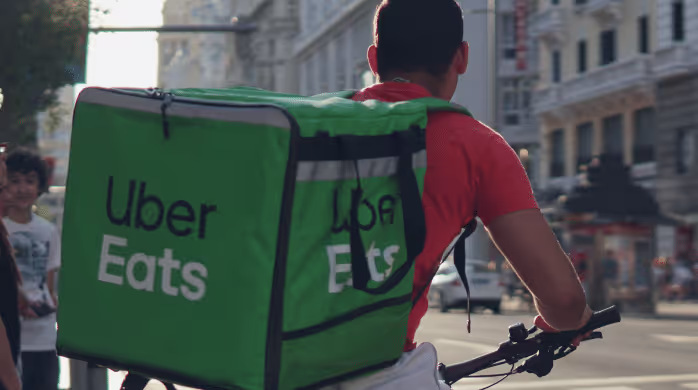
How to Make $1,000 a Week With Uber Eats in 2026 (Tips + Hourly Data)
In this blog, we'll explore the strategies and techniques that can show you how to earn $1000 per week as an Uber Eats delivery driver. We'll cover everything from optimizing your delivery zones and schedules to maximizing your tips and customer satisfaction. Whether you're a seasoned Uber Eats driver or just starting out, this guide will provide you with the insights and actionable steps to take your Uber Eats driver earnings to the next level.
Becoming an Uber Eats delivery partner can be a lucrative opportunity, especially if you're able to consistently earn $1000 a week. By understanding the platform, optimizing your delivery strategies, and focusing on customer satisfaction, you can maximize your earnings and turn Uber Eats into a reliable source of income.
We’ll cover the following topics to provide coaching and ideas to help you push your earnings up to that $1000 per week level:
What do Uber Eats drivers do?
Uber Eats drivers deliver prepared food most of the time, but they also might shop for and deliver goods from convenience outlets and grocery stores. The job is pretty simple. You get a request for an order, you drive to the restaurant or store to pick it up, and then you deliver it to the customer. If you already drive for Uber, you can choose to take orders for Uber Eats delivery any time.
If you’re not an Uber Eats driver yet, it’s pretty easy to become one. This Gridwise post tells you what you need to do if you want to sign up and start making money Uber Eats style. Many rideshare drivers welcome the chance to deliver food rather than people. This article from Nerdwallet covers the Uber Eats gig from that angle.
There are some sweet advantages to working with Uber Eats. In lots of cities you don’t even need to have a car. You can use a bike or a scooter, or even walk, to make your rounds. If you do use a car, Uber Eats’ requirements are a lot easier to meet than they are for Uber rideshare driving.
You also have a lot of flexibility. You can shop and deliver convenience items and groceries, but you don’t have to. And, like most driving gigs, you can choose your own hours, and map out the locations where you want to work.
Use Gridwise features When to Drive and Where to Drive to help you figure out what work hours and which specific areas will be the most profitable for you. Real data from real delivery people will show you earning patterns for drivers in your town.
How much can you earn doing Uber Eats?
The honest answer to this question is: basically, as much as you want! It all depends on how many hours you put in and how strategic you are about your gig. Earnings vary from one area to another, as this article from Entrepreneur points out. To give you a baseline, let’s look at the earnings of Uber Eats drivers who tracked their earnings with Gridwise.
Remember that these numbers show us only average earnings. To make $1,000 a week with Uber Eats, you’re going to have to be better than average, and we’ll show you how. For now, though, it’s good to have these figures so you get a ballpark number of where to start.
How much do Uber Eats drivers make?
Gridwise data tell us the following:
- Monthly earnings average around $444.00 per month.
- Gross earnings per trip are between $9.00 and $10.00.
- Tips make up about 50% of most Uber Eats drivers’ income, which amounts to about $225.00 per month.
Is Uber Eats good money? It can be. While there are other gigs that pay more per trip, if you drive for Uber Eats, you’ll always be pretty busy.
https://datawrapper.dwcdn.net/HPAz8/3
You can also see that, unlike many other gigs, tips play a huge role in Uber Eats earnings.

With these numbers as a baseline, what can we say about how to earn $1,000 a week with Uber Eats? As we said in the introduction, it’s going to be a hustle, but it’s really possible. To figure out how to make the most money with Uber Eats, let’s start by looking at how many trips these “average” drivers made each month.
We know that average gross earnings were $444.00 per month, and drivers got around $10.00 per trip. That means they took 44 or 45 trips per month, which breaks down to 11 trips per week. That’s not a lot of Uber Eats delivery, is it?
The fact that Uber Eats drivers averaged so few trips shows us that many drivers use more than one app at the same time. This is called multi-apping, and you can learn more about it in this Gridwise post. If you want to answer the question of how much you can make with Uber Eats, then you need to stick with the app and keep plugging away at those orders. You also need solid strategies, as well as some inside tips and tricks.
How to make the most money on Uber Eats: Delivery driving tactics
Getting to that $1,000 a week with Uber Eats isn’t so hard when you remember that the drivers we saw making about $111 a week were only taking around 11 trips in the same time period. That’s not much at all! If you work the Uber Eats app like a boss, you’ll soon have many more trips than that, easily reaching the number needed to get you to $1,000 a week. Now, let’s get to some tactics you’ll need to make that kind of bank.
- Stay with the Uber Eats app, and track your earnings. Gridwise can easily do that for you. Simply sync your Uber Eats app with Gridwise, and you’ll be able to see how much you’ve earned with Uber Eats, what times were most profitable, and your average hourly pay. Racking up trips with Uber Eats has other benefits, including perks and bonuses that are awarded to top drivers.
- Leverage surge pricing and promotions. Surge pricing is applied when there is a lot of demand. When surge pricing is in effect, many of the trips you make will pay more than usual. Promotions are offered to drivers who complete a given number of trips in a certain time period. High traffic volume days, nights, and times give you these chances to get extra earnings. Challenging yourself to complete the right number of trips for promotions will add to the number of trips you can count on for big bucks, too. Learn more about Uber Eats surge pay, boosts, and promotions in this Gridwise blog post.
- Say yes to doubling up on orders. With Uber Eats, you can get back-to-back orders or receive batched orders. Back-to-back orders happen when you receive a new request while you’re on the way to deliver an original order. The Uber Eats app routes these trips automatically, so you won’t be sent out of your way.
Batched orders are Uber Eats’ way of bundling together orders from either the same restaurant, or two nearby eating establishments. You get money, and trip count credit, for all the orders you complete, plus customer tips, without having to make a bunch of separate trips.
- Turn on the charm and get bigger tips. Being nice really is part of the Uber Eats driver’s job, and getting tips is one way people who drive for Uber Eats make money beyond their basic pay.. Bring along those extra napkins and condiments, use equipment that keeps food and drinks at the right temperatures and prevents spilling, and consider your customers’ needs. If you deliver groceries, be extra careful with delicate items such as bread and eggs.
And, most important, follow your customers’ directions, and stay in communication with them if you are going to be delayed, or if you have questions about their order. This Gridwise post will tell how to get bigger tips as a delivery driver.
- Use even more charm to keep your ratings high. As an Uber Eats driver, you will be rated by the restaurant or store where you pick up the orders as well as the customers who are waiting for the deliveries. This two-way rating system is designed to keep you on your toes, so Uber can keep people satisfied with your service. Don’t worry, you get to rate them, too.
There’s another reason why your rating as a driver is important. It not only keeps you in good standing with Uber; it helps you to qualify for the Uber Eats Pro incentive program. To learn more about Uber Eats Pro, and what it takes to earn perks such as preferred services, discounts, and deals, check out this Gridwise blog post.
Smart business moves that seal the deal
Now that you know how to gobble up the deliveries you need to make $1,000 a week with Uber Eats, it’s going to be a breeze to get there. Let’s make it even easier, with business moves that boost your earnings and shrink your expenses. If you use these, it will also be easy to say yes when people ask, “Can you make good money with Uber Eats?”
Minimize expenses. Avoid racking up big fast-food bills by bringing your own food and beverages. You might not think you’re hungry when you first start your Uber Eats run, but once the aroma of pepperoni pizza, premium cheeseburgers, and piping hot fries start wafting through your car, that might change. Bring a sandwich or other healthy food from home, and buy bottled water in bulk to save tons of cash compared to what it costs to buy single servings.
Maximize tax deductions. Another way to minimize your expenses is to maximize your tax deductions. Start by tracking mileage with Gridwise.
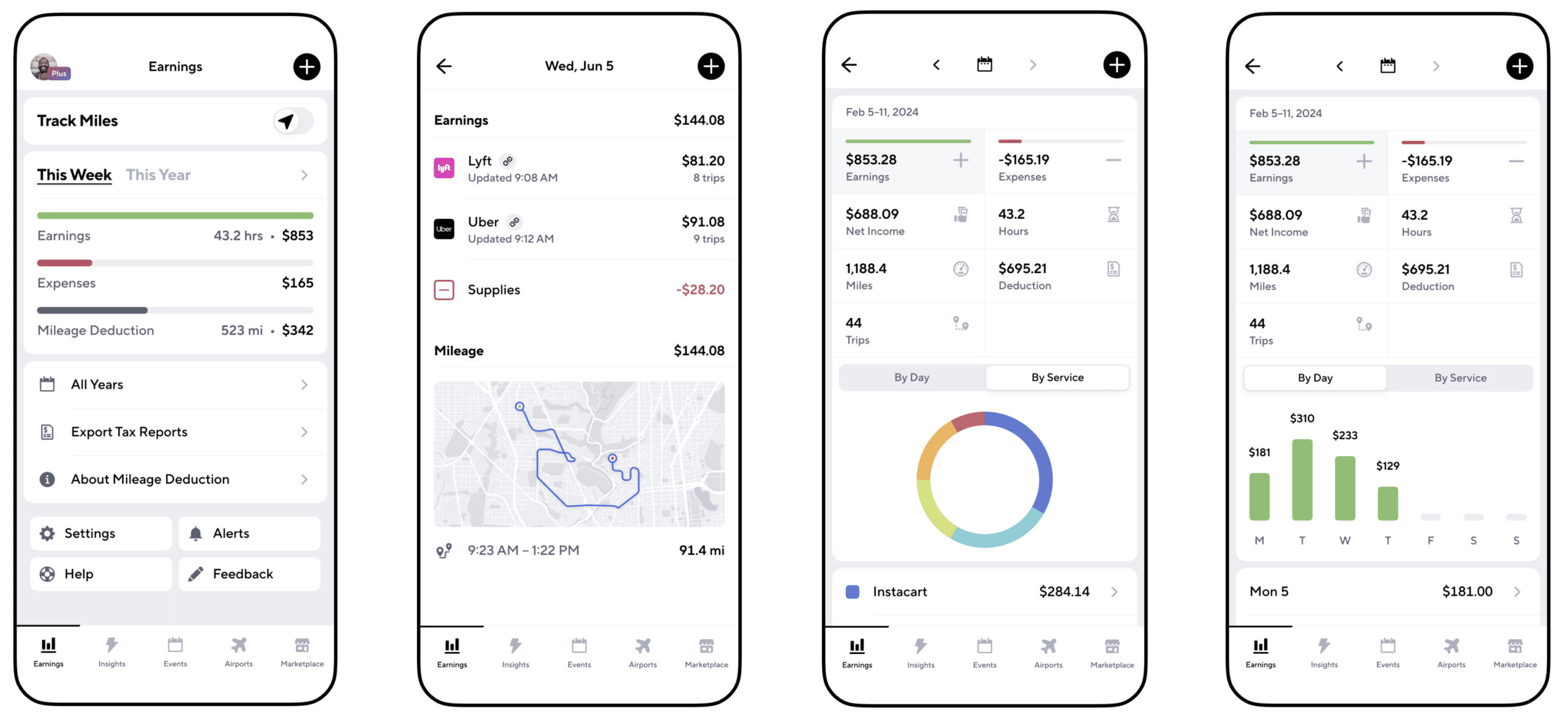
Gridwise App
Gridwise captures every deductible mile you drive, including the distance you cover between the trips your driving app records. Know what expenses you can deduct, and put them to work for you when tax time comes. Learn more about tax deduction strategies in the Gridwise Tax Guide for drivers.
Boost earnings with referrals
As an independent contractor, you’re probably looking for ways to make even more money than you can with Uber Eats. And most gig workers like you enjoy getting passive income. With Uber Eats, there’s a really easy way to do that, referrals!
All you need to do is find friends and encourage them to deliver for Uber Eats. If they make a certain number of deliveries within a specified time, you will get paid for doing nothing more than having them sign up under your referral code! Rates of pay vary by city, so check your Uber Eats app to find out what the current deal might be, and learn more about the referral program on the Uber Eats website.
Also remember: “friends” don’t have to be your best buds. Many delivery people carry cards with a QR code linking to their referral information, so just about anyone you encounter can join Uber Eats and boost your earnings. You could meet a source of passive income at the gas station, on social media, or at your high school reunion. The more you hustle, the more there is to gain, right?
Master the art of self-employment
As an Uber Eats driver, you’re an independent contractor. That means the company isn’t going to withhold your taxes, provide insurance, keep track of your earnings, or tell you about tax deductions. You’ll have to do all these things for yourself.
If you want to maximize your tax advantages, open an official business entity. You can incorporate (create a corporation) or you can work as a limited liability corporation (LLC). You can also work with a DBA (Doing Business As) arrangement, but the corporation or LLC will do a better job of protecting you from liability.
Establishing a corporation or LLC offers better tax advantages than being a sole proprietor. For instance, if you simply collect your earnings into your private account, you’ll be charged self-employment taxes in most states. And paying extra taxes is something we all want to avoid, within legal limits, as much as possible.
Every Uber Eats driver needs to learn about self-employment, and there are some great resources you can review. Check out the CareerOneStop website about self employment which will help explain the basics. You can also check with a professional tax accountant, or look other websites to learn more about actually creating a business.
Scope out your market
Look at the area around you to see where you’re likely to get the most deliveries. Where are all the restaurants? Where might people be more inclined to order deliveries? What hours do you want to drive? What activities might be going on around those times? Think about late-night and after-school times as well as breakfast, lunch, and dinner times.
Be realistic about the potential for your area and aware of new services opening up. For example, in New York, there is already a tab on the Uber Eats app that allows customers to order groceries. In our article about the best food delivery service to work for you’ll see that Uber Eats stacks up well against other delivery companies, mainly because of its potential for expanded opportunities for drivers to earn.
So, is Uber Eats good money? As we said, it isn’t an automatic guarantee that everyone will make $1,000 a week with Uber Eats. Trying out the suggestions we give you here, though, should put you on the right track! Go out there and start stacking up those orders and raking in some impressive earnings!
Get more inside information on Uber Eats in these posts from the Gridwise blog:
- The delivery driver guide: Using the Uber Eats app
- Everything you need to know about driving for Uber Eats
- Uber Eats Pro: What drivers need to know
- Looking for a different gig, part-time or full time job? Check out the Gridwise Job board.
Uber Eats FAQ
How does the Uber Eats platform work for drivers?
Uber Eats is a food delivery service that connects customers with local restaurants and independent delivery partners. As an Uber Eats driver, you'll receive notifications of nearby delivery requests, which you can accept and complete. The platform provides flexibility, allowing you to work on your own schedule and earn money based on the number of deliveries you complete.
What are the requirements to become an Uber Eats delivery partner?
To become an Uber Eats delivery partner, you'll need to meet certain requirements, such as having a valid driver's license, a registered vehicle, and passing a background check.
How can I choose the right delivery zone to maximize my earnings?
Selecting the right delivery zone can significantly impact your earnings, as some areas may have higher demand and better-paying orders. It's important to research and identify the zones in your area that tend to have the most consistent and lucrative delivery opportunities.
How can I take advantage of peak delivery hours and surge pricing?
Understanding peak delivery hours, such as mealtimes and weekends, and taking advantage of surge pricing can boost your earnings. Be aware of when demand is highest in your area and adjust your schedule accordingly to capitalize on these peak periods.
What are some tips for maximizing tips and customer satisfaction?
Providing excellent customer service and going the extra mile to ensure a positive experience can lead to more tips and repeat business. Prioritize communication, timeliness, and attention to detail to keep your customers happy and satisfied.
How can I set realistic weekly goals to reach my $1000 target?
To make $1000 a week with Uber Eats, it's essential to set realistic weekly goals and track your earnings and expenses. Start by determining your target earnings and breaking it down into achievable daily or weekly goals. This will help you stay on track and make adjustments as needed.
What are some strategies for efficient route planning and navigation?
Effective route planning and navigation can save you time and fuel, allowing you to complete more deliveries. Utilize mapping apps and take advantage of features like real-time traffic updates and turn-by-turn directions to find the quickest routes.
How can I balance my Uber Eats deliveries with other commitments?
Develop a schedule that allows you to capitalize on peak delivery hours while still maintaining a healthy work-life balance. Consider using tools like calendar apps to plan your availability and track your hours to ensure you're maximizing your earning potential without sacrificing your personal life.
What are the key considerations for maintaining my vehicle as an Uber Eats driver?
Keeping your car clean and well-maintained is crucial for maximizing your Uber Eats earnings. Regularly scheduled oil changes, tire rotations, and other preventive maintenance can help extend the life of your vehicle and minimize downtime. Additionally, budgeting for vehicle-related expenses, such as fuel, insurance, and repairs, will ensure you're accounting for these costs and maximizing your net earnings.
What are the tax obligations and legal considerations for Uber Eats drivers?
As an Uber Eats delivery driver, it's essential to understand the tax obligations and legal considerations that come with being an independent contractor. This includes properly reporting your earnings, deducting eligible business expenses, and making quarterly estimated tax payments. Additionally, you'll need to ensure you have the appropriate insurance coverage, such as personal auto insurance and possibly commercial auto insurance, to protect yourself and your vehicle while on the road making deliveries.

The Gridwise Job Board: Find Your Ideal Job or Gig Work
Gridwise is an essential assistant app created by gig workers for gig workers. Our mission is to support those engaged in gig work in every way possible. We understand how challenging it can be to deal with income instability, a lack of benefits, and job insecurity that often comes with gig work. The Gridwise app tracks and organizes earnings and expenses, and offers a wide array of discounts, deals, and services that make the lives of independent contractors easier and more rewarding.
We firmly believe it’s possible to make a viable living and create a gig experience that offers flexible hours, variety, and excitement. With issues such as consistent earnings and job security in mind, Gridwise is proud to offer a centralized platform that shows you how to find gig work and secure reliable opportunities. We’re proud to introduce the Gridwise Job Board.
The Gridwise Job Board: Key features
Because Gridwise is dedicated to serving the gig worker community, we’ve filled the Gridwise Job Board with useful features that won’t waste your precious time.
- Comprehensive listings. Find part-time, full-time, temporary, and per-task work. Drive or deliver with your vehicle, utilize an employer’s vehicle, or even find non-driving gig work.
- User-friendly interface. Find the jobs that are right for you with a tap of your screen.
- Verified opportunities. We vet the jobs before they are listed to ensure you’re getting high-quality job postings.
How to get more gig work, seasonal, part-time or full-time jobs with the Gridwise Job Board
Looking specifically for “gig work apps” or “gig jobs near me?” You’re in luck. Our filters and search functions send you directly to the listings you seek.
Here’s how it works.
- Access the Job Board via the Gridwise website.
- Search for jobs by type, location, and more.
- Select the job that interests you, and read all about it.
- Scroll through the description, and if it appeals to you, click “Apply for job.”
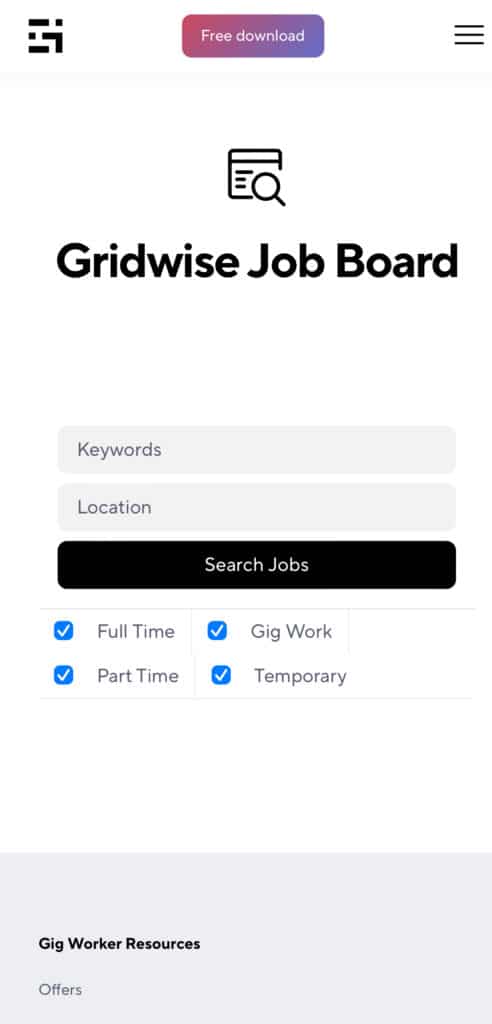
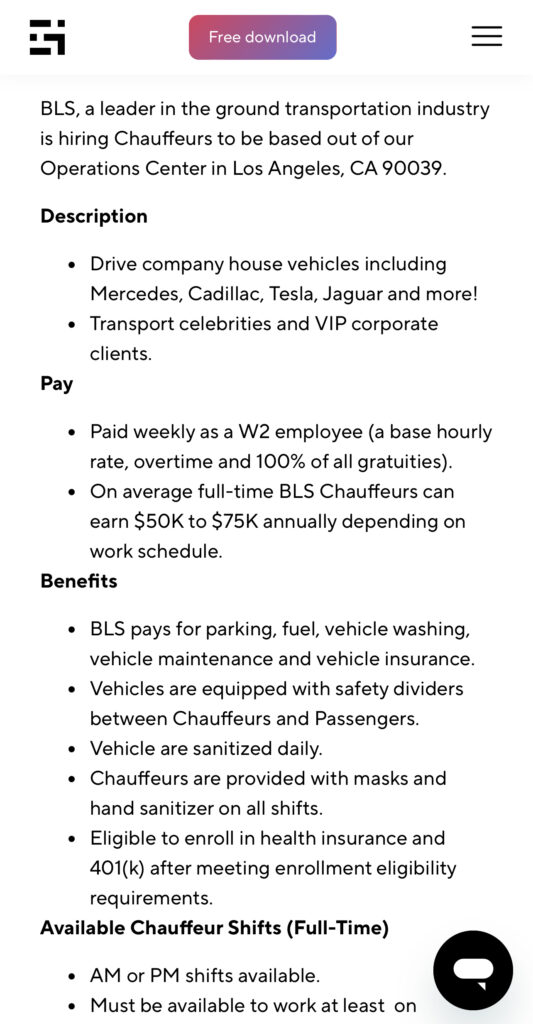
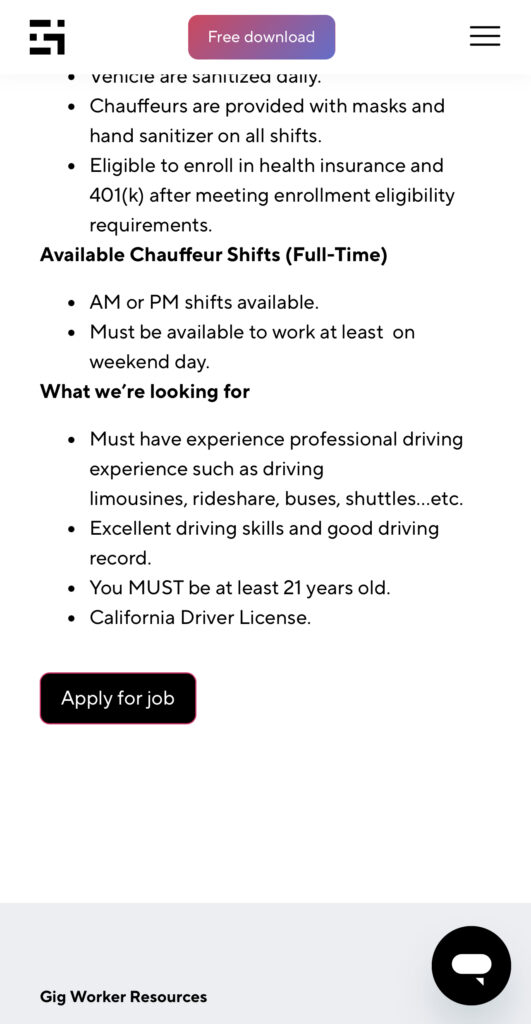
Many types of jobs are available. Adjust the search filter to see the full variety of opportunities that will let you cash in. Deliver food, set up catering, do rideshare driving, get paid for doing package delivery, and much more. You’ll find short-term gigs, long-term contracts, and part-time positions.
Perks of the Gridwise Job Board for gig workers
Gig workers who know how to make extra money will appreciate how the Gridwise Job Board lets you multiply your chances of bringing in big earnings. Here’s how:
- Increased stability. Use the Gridwise Job Board to find part-time or permanent jobs in addition to the part-time gigs you already have. Always keep a steady stream of earning opportunities flowing toward you.
- Flexibility and autonomy. Choose jobs that fit your schedule, work around other jobs and family duties, and still leave room for some fun in your life. Discover side hustles to supplement your full-time job, permanently or just for the season.
- Skill development. Find part-time work that lets you use a skill you already have, or try your hand at something new. It’s a smart way to develop a portfolio to showcase what you can do, or even to find permanent employment.
Get Gridwise and stay up to date on the Gridwise Job Board
Gig workers need plenty of information and assistance, and Gridwise is here to give it to you. Download the app and get essential features such as
- seamless earnings tracking
- mileage tracking
- expense recording, including notes
- low-cost and no-cost insurance benefits
- access to affordable medical, dental, vision, mental health, and alternative care
- professional services including legal and financial help
- deals and discounts
- weather, events, and traffic reports
- inside information on where and when to drive
More to know about gig work:

5 Best Mileage Trackers For Gig Drivers
Many drivers ask, “Do I really need a mileage tracking app?” The answer is simple: only if you want to have an accurate count of all the miles you can legally deduct from your taxable income! You might think your rideshare or delivery driving app has got you covered. After all, they do quite a good job of logging the miles you drive while you’re on a trip or delivery. But, if you want to have the best app to track mileage for Uber, Lyft, Doordash, Instacart, or the other apps you may use, you need more. Why is that?
Without a separate tracker, you’re missing the miles you drive in between pings. Did you realize that all the miles you drive, from the moment you begin your shift until it’s over (as long as you don’t drive several miles on a break to hang with your friends), are tax deductible! That means you need something besides your driving app to keep an accurate count of your travels. Read this Gridwise post to see how important it is to keep track of every deductible mile.
You won’t be surprised to hear that there’s an app for tracking miles. In fact, there are several of them. Here, we’re going to tell you about five top mileage tracking apps, and help you figure out which one is best for you.
Before we get to the list and identify the best mileage tracker app, let’s clarify what exactly a mileage tracking app is. According to G2.com’s technology glossary, mileage tracking is done for the purpose of keeping a log of mileage that is either reimbursable or tax deductible.
And yes, of course you can track your miles simply by taking readings on your odometer. But are you really prepared to account for how many miles you drove for personal reasons and subtract them from the total to get your business mileage? Even if you can remember all that and do the arithmetic, if you want an accurate reading of the miles you drive for business, and can therefore deduct, a mileage tracking app will save you a lot of trouble and prevent you from making costly errors.
Plus, as a gig driver, you have specific needs when it comes to a mileage tracker. Ideally, you’d be able to handle mileage tracking and several other functions all in one app. It can be maddening enough to deal with driving apps, particularly if you’re an avid multi-apper. You would want your mileage tracker app to help you keep account of other aspects of your business, including income, expenses, and inside information about the art of gig driving.
Not all mileage apps are equal, to be sure! Let’s look at five of the best apps to track mileage and figure out which is the best app to track mileage with Uber and Lyft, or what mileage tracker app is best for DoorDash.
1. Zoho Expense
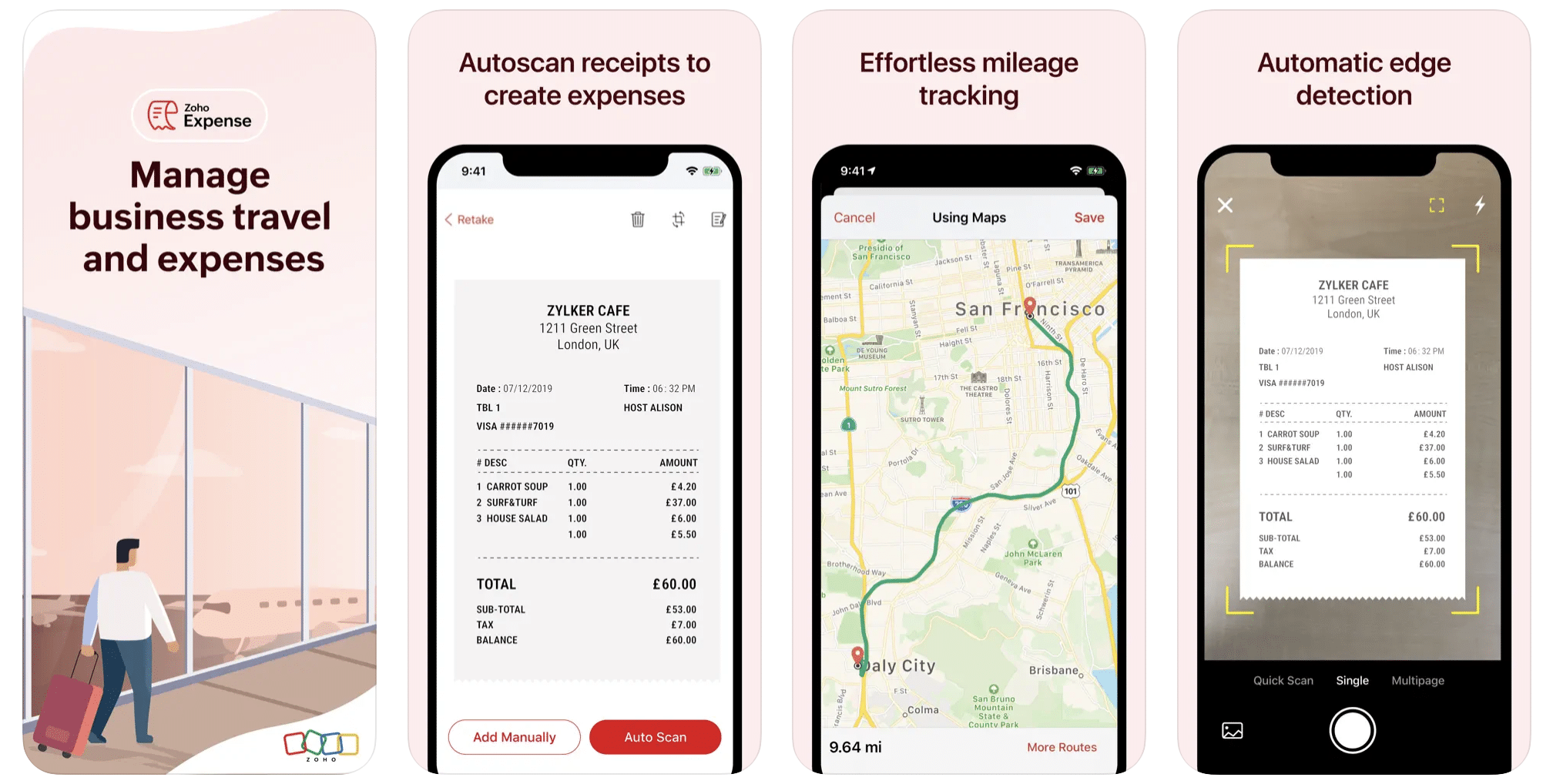
First up is Zoho Expense, which does exactly what its name says. This app is designed to allow companies to give employees a uniform way to create and submit expense reports. It can be used by individuals, including gig drivers, as well.
It includes a mileage tracker, as well as features that let you track other deductible expenses, including the ability to scan and record receipts.
Available on Android and Apple: Yes
Ratings: 4.8 stars on App Store, 4.7 stars on Google Play
Free Version: Yes
Subscription price: $3 per month, billed annually
Created specifically for gig drivers: No
2. Quickbooks Online
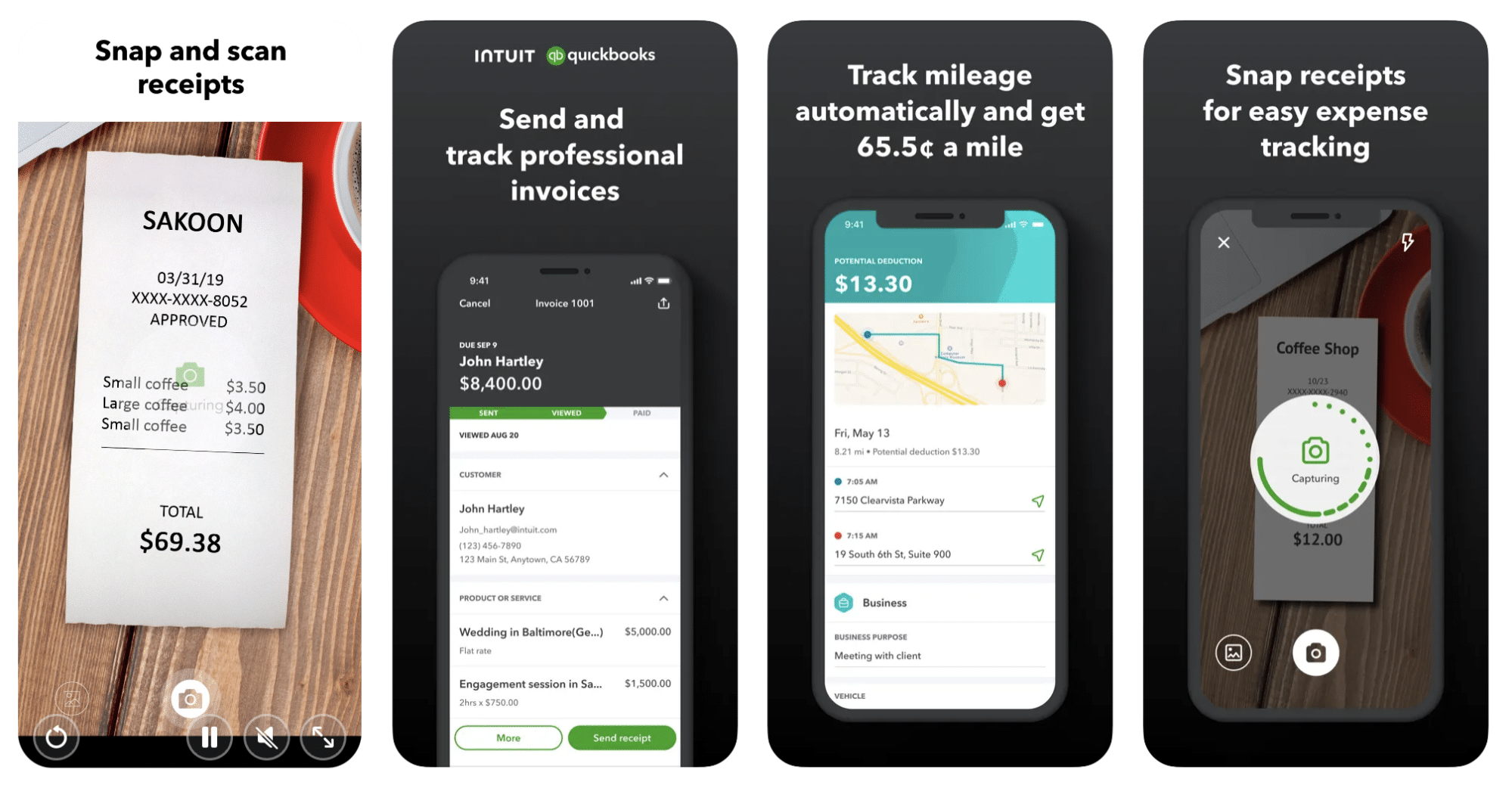
Quickbooks Online is a cloud-based app that allows you to track your mileage, earnings, and expenses. The information you enter can then be used to generate various reports that prepare you for tax time. It also allows you to create graphs that illustrate your cash flow, and includes a receipt scanner so you can instantly record deductible expenses. Quickbooks is popular, highly reliable, and designed mainly to help people keep track of their small businesses.
Available on Android and Apple: Yes
Ratings: 4.7 stars on App Store, 4.4 stars on Google Play
Free version: 30-day free trial
Subscription price: $15 per month for basic version if purchased for 3 months or more
Created specifically for gig drivers: No
Source: quickbooks.intuit.com
3. Shoeboxed
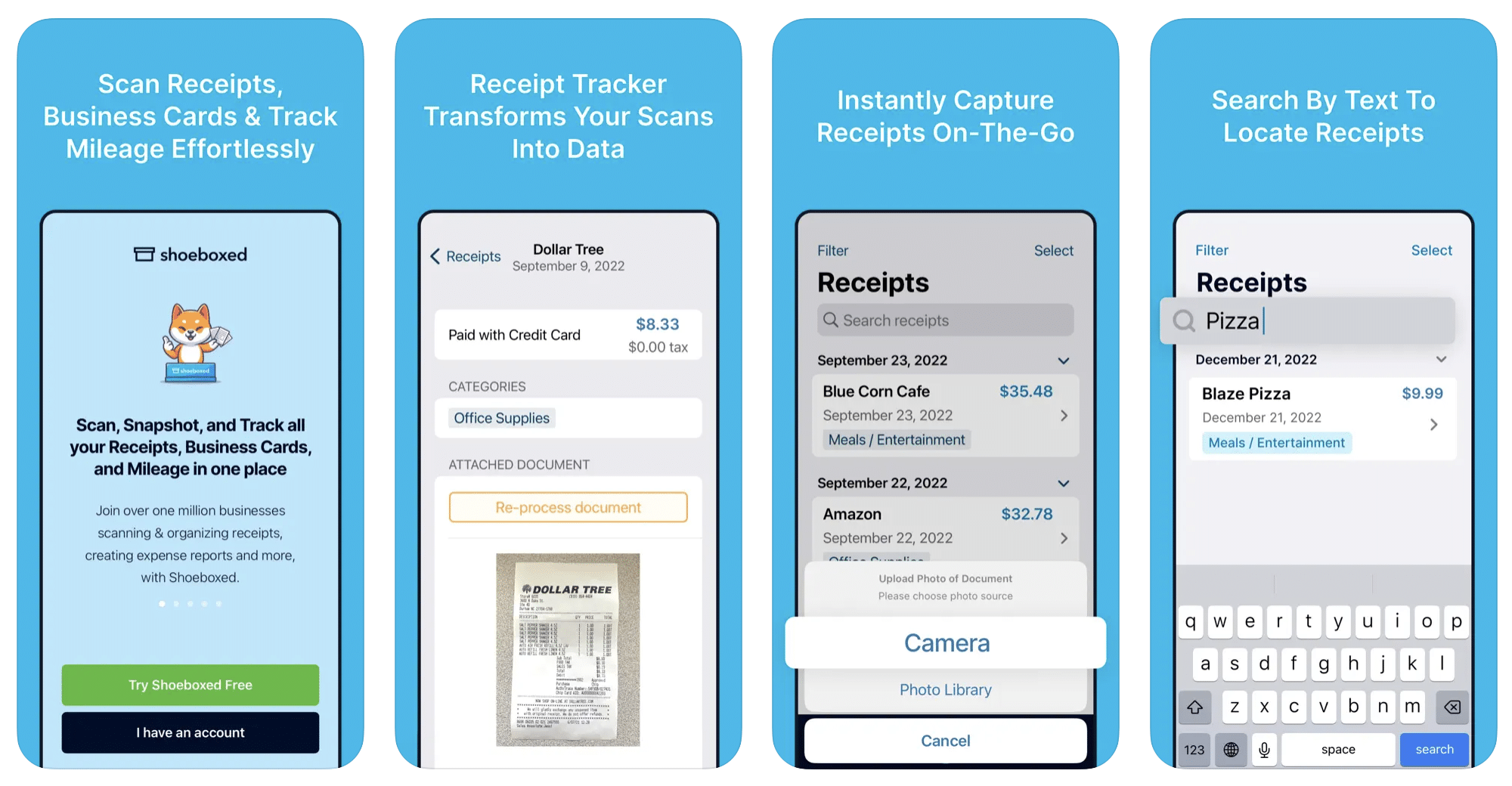
Shoeboxed started in 2007 as a service for scanning paper receipts into digital form. Now the app offers a free mileage tracker and has enabled users to scan receipts directly. It touts itself as the best mileage tracking app for DoorDash, but there are some elements missing that Dashers might like to have. While it provides features that record your expenses and prepare you for tax season, it doesn’t automatically track your earnings. The mileage tracker has a system where you can drop pins along your routes to make the tracking more precise, identifying those legs of a trip that you make for business purposes. The mileage tracker is “free” once you sign up for the basic version.
Available on Android and Apple: Yes
Ratings: 4.5 stars on App Store, 2.3 stars on Google Play
Free version: No
Subscription price: $18 per month for basic version
Created specifically for gig drivers: No
Source: blog.shoeboxed.com
4. Stride
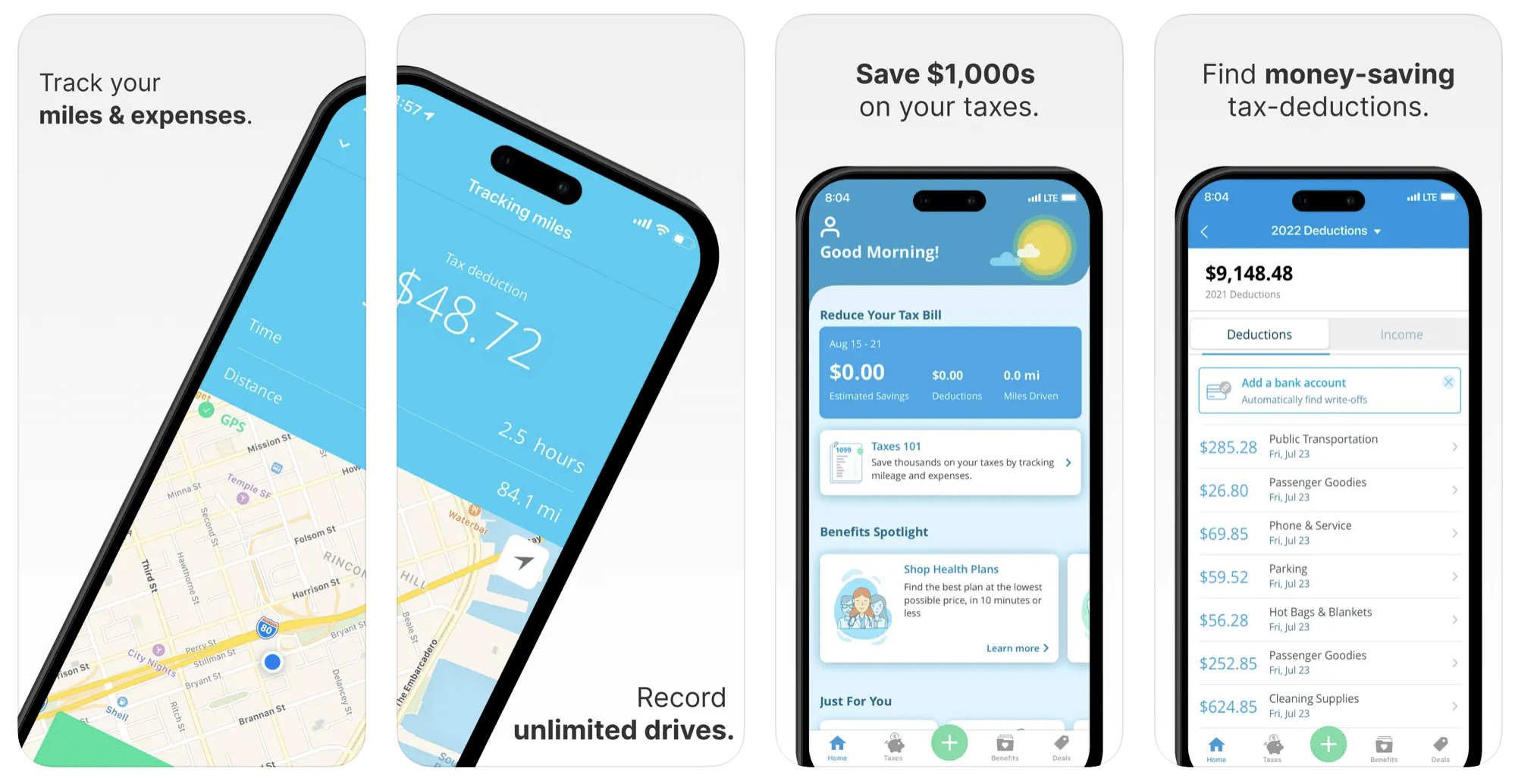
This free mileage tracker does a fair job of keeping track of the distances you rack up while gig driving, but it doesn’t automatically track earnings. It can be a big help, though, in tracking your expenses. You can link Stride to your bank account, and it will automatically scan your expenses to identify items you can potentially deduct. The app is totally free. This could make it the best free mileage tracker app, but there is a small price to pay. The app will persistently push you to consider various insurance plans that they are affiliated with. If you don’t mind that, this is a solid mileage tracker, even if it doesn’t track your earnings.
Available on Android and Apple: Yes
Ratings: 4.8 stars on App Store, 4.6 stars on Google Play
Free version: Yes
Subscription price: None. The app is free.
Created specifically for gig drivers: No
5. Gridwise
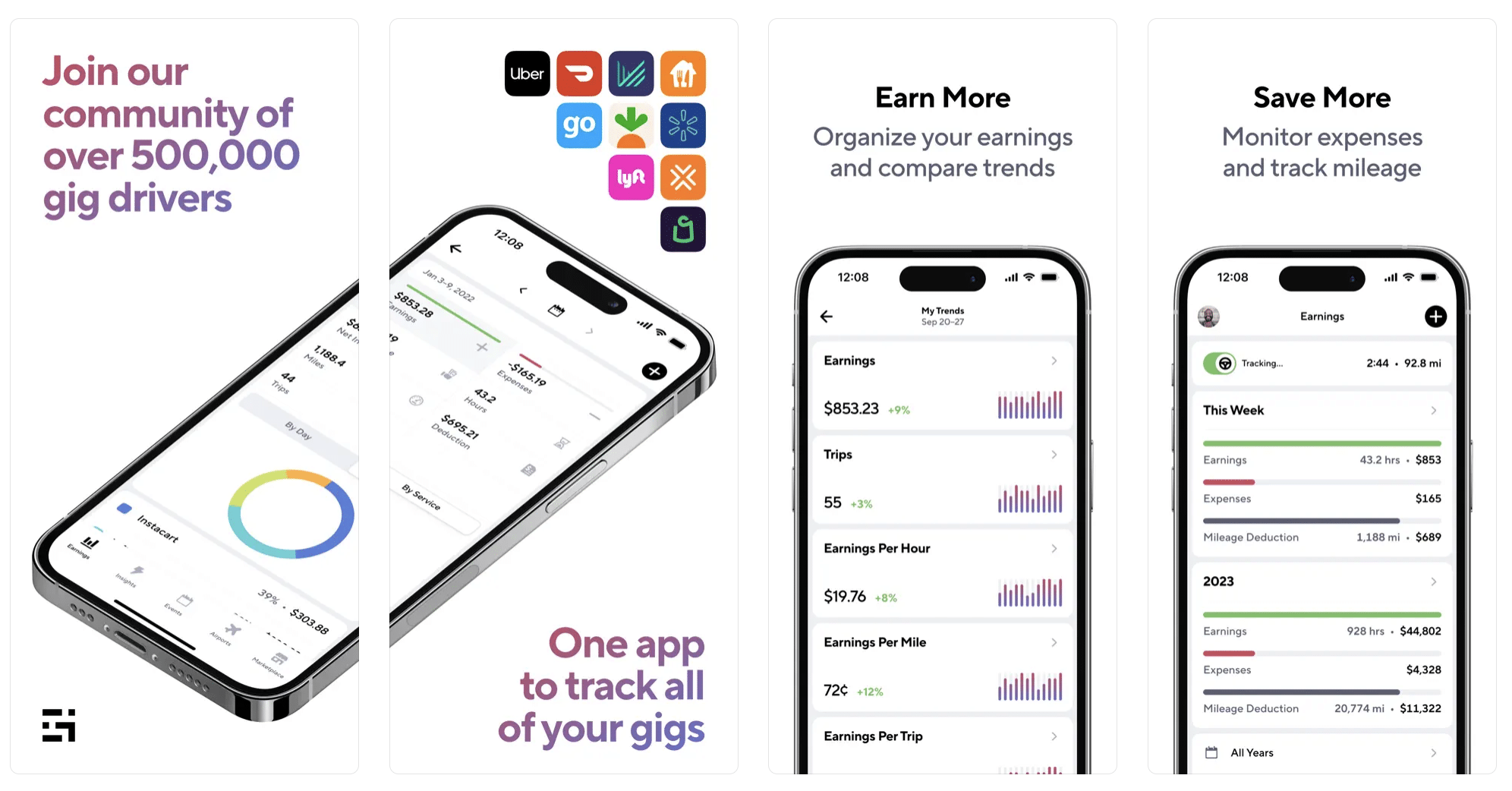
Gridwise has a free mileage tracker and free features that record your income and expenses. It gives you access to insurance and benefits, as well as insights about the best times and places to make the most money while gig driving. The Gridwise mileage tracker captures all the miles you drive while you’re on your driving shift, and it can be used if you have other trips you need to make which qualify as business travel.
Drivers love it because it is geared toward the needs of rideshare and delivery workers, providing free information about airport departures and arrivals, event start and let out times, weather, traffic, and more. The Gridwise Plus subscription adds value by providing additional insights and reports, discounts on benefits, the ability to export data in .csv format,, and more.
Available on Android and Apple: Yes
Ratings: 4.9 stars on App Store, 4.6 stars on Google Play
Free version: Yes
Subscription price: $9.95 per month for Gridwise Plus, or $95.99 per year (a $23.41 savings)
Created specifically for gig drivers: Yes!
What is the best mileage tracking app?
Now that we’ve checked them all out, we’re positive about the answer to that. Hands down, it’s Gridwise. Are we biased? You bet we are! But drivers love it too. Gridwise is the best mileage tracker app, and so much more. So many of the features are free, and the subscription to Gridwise Plus will pay for itself with additional insights to boost your earnings and deeper discounts on products and services.
Most important, Gridwise is designed specifically for gig drivers by experts who were once gig drivers themselves! Knowing what gig drivers need is a crucial step in creating an app that rideshare and delivery drivers can really use! Here are a few of the features, besides mileage tracking:
- seamless earnings tracking
- automatic, on/off toggle and manual mileage tracking
- mileage categorization
- airport, traffic, weather, and events information
- insights into where to drive and when to drive
- reports showing earnings across the platforms you use
- discounts on countless products and services for drivers
- additional resources for finding side gigs
- an informative and comprehensive blog
- affordable benefits, including insurance, medical, dental, and alternative practitioner discounts
- a community of drivers just like you
Don’t settle for just any app. Get the best mileage tracker, and so much more, from Gridwise!
Uber and Lyft pledge to reach 100% electric vehicles by 2030. What does this mean for drivers
Rideshare as a mode of transportation has revolutionized the art of getting around for most of the world, and its impact is huge. There are fewer impaired drivers on the road, families can travel to events without stressing over scarce parking spots, and grocery shopping is less cumbersome for people who don’t own a car.
Yes, for all these reasons and more, rideshare is wonderful… but it also means more cars are out there spewing emissions into the air.
So, when we consider the health of our environment, the introduction of rideshare as a common mode of transportation has had a devastating effect. According to a September 8, 2020 press release by the Sierra Club, rideshare has led to as much as a 70 percent increase in emissions over levels that were present before Uber, Lyft, and other companies began operations.
This is certainly not something the companies, or we drivers, would feel comfortable congratulating ourselves about.
To help alleviate this growing problem, both Uber and Lyft have committed to reaching zero emissions by 2030, through transitioning their respective fleets over to electric vehicles (EVs). Lyft made its pledge on June 17, and Uber seconded the commitment on September 8.
The goal of reaching zero emissions by 2030 is a formidable one. It inspires us to ask many questions, some of which we will consider in this article:
- What are the new Uber and Lyft programs?
- Why are the companies doing this?
- How do these programs benefit drivers and passengers?
- What cars are eligible for the green initiatives?
- What about the vehicles drivers have now?
What are the new Uber and Lyft programs?
Both Uber and Lyft have stated that the decision to “go green” emerged from the COVID-19 crisis. Lyft says it sees the move as a way to do something proactive, rather than remain stalled in hand-wringing mode during the shutdowns. Uber’s announcement paints the picture of how much cleaner the air became while people’s movement was restricted, and professes its desire to help keep it that way.
Whatever the motivations, both companies have made this pledge to achieve zero emissions by 2030. Here is what each proposes to do.
Lyft
Climate change seems to be the primary motivation behind this program, but the company sees other benefits arising from it as well.
Lyft’s partnership with the Environmental Defense Fund involves investing in clean energy, not only to reduce pollution, but also create new jobs. The hope was, and is, that Lyft’s initiative would set a standard for other tech and transportation leaders.
The transition Lyft has in mind is to shift to 100 percent all-electric or other zero-emission engines.
Not only will this involve rideshare drivers’ cars (and possibly, by then, autonomous vehicles), rental cars for drivers and riders will also be zero emission. Already, Lyft has instituted “Green Mode” in certain cities, which allows customers to request rides from drivers whose cars have a smaller carbon footprint.
For drivers, benefits are primarily the lower fuel and maintenance costs of EVs. Lyft admits that the cost of EVs is high, but expresses hope that the cost of batteries, and vehicles, will come down over time, as has been the case over the last ten years.
Lyft doesn’t totally put the onus on drivers for completing this goal. The company hopes to work with policymakers and business partners to drive down the cost of EVs, lobby for more incentives and EV infrastructure (namely, charging stations), and make it easy and economical for drivers to make the shift. The Environmental Defense Fund will be instrumental in assisting Lyft in this effort. The group already partners with businesses to help them embrace climate-friendly technologies that not only benefit the planet, but also add to their bottom lines.
In cities where the Express Drive car rental service is in operation, Lyft notes that drivers with EVs save an average of $50 to $70 per week in fuel costs. In Colorado, for example, the company lobbied for, and acquired, state tax incentives, and it seems their plan envisions further accommodations and subsidies along these lines.
Uber
Uber’s program, known as “Uber Green,” represents its commitment to a fully zero-carbon fleet by 2030 in the US and Canada, and worldwide by 2040. The company has committed to invest $800 million over the next five years to help drivers transition to electric vehicles by 2025. Uber will offer vehicle purchase assistance, discount rates to EV drivers through deals with charging networks, and higher per-trip premiums for drivers who operate green and electric vehicles.
In a September 7, 2020 conference call with a Forbes reporter, Uber CEO Dara Khosrowshahi said: “As our communities recover from COVID-19, we can rebuild them for people, not cars, we can add more green spaces and fewer parking spaces.”
Through its partnership with the World Resources Institute, Uber hopes to facilitate programs that are friendlier to the urban environment. This endeavor could also lead to public-private partnerships that benefit Uber and the cities in which it operates. Scooters and bicycles might play more major roles than they currently do in high-density areas.
General Motors is also working with Uber, and will extend employee discount pricing to Uber drivers on a popular EV, the 2020 Chevrolet Bolt. GM does this frequently as an incentive for people to buy their vehicles, but the relationship with Uber could become quite valuable to drivers in the future. Already, in Los Angeles and Denver, Uber Diamond Drivers can get discounted financing through GM Financial to go along with the corporate pricing offer.
To incentivize drivers to make the transition to a smaller carbon footprint, Uber will offer an additional 50 cents per ride for a “green car” (which includes hybrids), and an additional one dollar per ride for drivers with EVs.
Customers will be enticed to request Uber Green rides with triple the number of award points for each ride they request. Obviously, the success of the program will rest with how many green and/or electric cars are available. But customers do seem to be more conscious of the need for rideshare to reduce its carbon footprint. Even passengers who haven’t thought about that are likely to hear more about it soon.
Why are the companies doing this?
In their announcements about the new initiatives, Uber and Lyft have cited the COVID-19 crisis along with their growing environmental concerns. Yet it is also likely that other motivations come into play. Increasingly, both companies have come under scrutiny for their respective roles in the growing emissions problem.
The statistic cited by the Sierra Club (mentioned earlier) is indeed sobering, as the group says in its September 8 press release: “Right now, ride-hailing generates 70 percent more pollution than the trips it displaces in the United States.” Also, thanks to the pandemic, consider how many people have stopped using public transportation and are now rideshare passengers.
Another consideration: At the end of July, the California Air Resources Board (CARB) put forth a proposal requiring that 60 percent of the miles traveled by ride-hail customers be in electric vehicles by 2030.
Both Lyft and Uber have proposed more ambitious goals, of course, but could CARB’s recent actions be part of their motivation? Remember, Uber and Lyft are embroiled in a dispute with the State of California over employee classification. Perhaps getting on the good side of CARB could help avoid further pressure from state authorities.
After all, when an agency like CARB begins to look at the ride-hail business, they inevitably make some startling discoveries … like the fact that each rideshare trip puts off 50 percent more emissions than the average trip, because the driver must travel between drop-off and pick-up points.
It’s also worth noting that California’s regulations, once they are enacted, will also apply to autonomous vehicles. Lyft’s director of sustainability calls for government subsidies to assist the company in achieving its goals, and this could help Lyft finance the development of AVs as well as EVs.
Our review of the programs offered by Uber and Lyft reveals their intention to become more responsible toward the environment. From subsidies for charging stations to tax credits for adding EVs to their fleets, the companies will seek to benefit from partnering with the government and public utilities. It would behoove companies and drivers to make charging their EVs less expensive, and if the government wants to reduce emissions, this would be one way for them to help accomplish it.
How do these programs benefit drivers and passengers?
The first question drivers are probably thinking is, “What’s in it for us?” Well … the most noble reason for going along with the green initiatives of both companies is, of course, the health of our planet. We suspect, however, you might still be wondering how this will make you more money.
For Lyft, the compensation for drivers (along with a clear conscience) is a reduced fuel bill. For Uber, hybrid cars will receive 50 cents extra per ride; electric cars will receive that 50 cents plus another dollar, for a total of $1.50 per ride.
Passengers will also benefit from doing good things for the environment. Lyft doesn’t offer any particular option outside of that, but Uber is giving them reminders of why they should feel good, and then also tripling their rewards points. These factors may change as the programs mature and the passengers respond to changing conditions.
What cars are eligible for the green initiatives?
In the beginning, hybrids as well as fully electric vehicles will be eligible for both Uber’s and Lyft’s programs. No specific vehicle list is available yet, but this Forbes article about the “12 ‘Greenest’ Cars for 2020” will give you some ideas.
No one can say whether EVs will be the best, or maybe the only, alternative to the internal combustion, gasoline-fueled engine by 2030. More cars will likely be propelled by natural gas, and there may also be vehicles that run with other, yet-to-be-imagined technologies by then.
What about the vehicles drivers have now?
If you’re still driving a fully gasoline-powered vehicle, you’re still fine for now. If you don’t mind missing out on the extra 50 cents or $1.50 premium you’d get from Uber for driving a hybrid or an EV, your car will still be accepted by the rideshare platforms through 2025.
But if you’re just starting out, and you haven’t yet chosen a vehicle to use for rideshare driving, you may want to think about going green. If you hold on a little while longer, or if you’re already driving and want to make the switch to a new EV, you can wait for Uber’s program with GM to kick in. This will give you a financial break to help ease the sticker shock that comes with most EVs.
The bottom line
Knowing what we do about emissions and the effects of pollution on the environment, it’s hard to justify driving vehicles that belch out massive quantities of high-carbon exhaust for much longer. These programs may help all of us consider the plus side of owning a vehicle that is more environmentally friendly. If you can’t buy a new car right away, at least start to think about making your next vehicle more compatible with these growing trends toward zero emissions.
If you’re still up in the air on this issue, take a serious look at how well your current vehicle performs, and then you can make a sound decision based on facts.
How can you track your earnings and keep account of your mileage? Use Gridwise on every shift. Our app will take the data from your rideshare and delivery gigs, and then create reports that you can use to evaluate your earnings and mileage information. Don’t wait—download the app now.
You won’t want to miss our other features either, including airport and weather information, events, and the Perks tab, where you’ll get access to our insight-filled blog and the slick Gridwise YouTube channel. The Perks tab also has deals and discounts drivers can really use.
Comment below to let us know what you think about the zero-emission initiatives from Uber and Lyft, and be sure to join us for gas card giveaways when you like us on Facebook.
Everything rideshare (Uber and Lyft) and delivery (DoorDash Postmates Instacart) drivers need to know about Prop 22
You’ve undoubtedly heard about the brouhaha in California since the state legislature passed Assembly Bill 5, better known as AB5. It’s the legislation that would require Uber, Lyft, DoorDash, Instacart, and many other companies and operations, to make their independent contractors employees.
If you’re not up to speed with all that, you can catch up by reading this blog post we published a few weeks ago.
After the companies refused to comply with AB5, the state sued, and the companies lost. They filed an appeal and continue to operate, at least for now, under the terms of that appeal.
The decision should come through around the time of Election Day on November 3. That’s when citizens in California will decide whether Proposition 22, the companies’ effort to exempt drivers from the terms of AB5, will get an up or down vote.
If you don’t live in California, please understand that this can still affect you. What happens in Cali on Election Day and afterwards will have a reverberating effect—and not the kind that comes wailing out of a California surf guitar. This kind of tumult, and the existential threat to the gig economy, happens to be in California now; but it could be coming to your state before too long.
If Proposition 22 gets enough “yes” votes, the companies will not have to classify their drivers as employees. There are a few different perspectives on this issue, and our goal with this post is to present them to you, examine what’s at stake, and discuss what might happen if it does or doesn’t pass. Here’s what we’ll cover:
- What is Proposition 22?
- What companies are doing to back Proposition 22
- Impact on drivers
- Impact on companies
- Impact on customers
- If Proposition 22 gets voted down ...
What is Proposition 22?
Proposition 22, officially the App-Based Drivers as Contractors and Labor Policies Initiative, is a measure developed by the companies (primarily Uber and Lyft), that’s intended to exempt rideshare and delivery drivers from AB5.
Because Proposition 22 would classify app-based drivers as independent contractors and not employees, California employment-related labor laws would not cover them. If the legislation passes, it would lead to the enactment of certain labor and wage policies specific to app-based drivers and companies, including:
- A payment schedule that’s based on the difference between a worker's net earnings (excluding tips) and a net earnings floor (120 percent of minimum wage applied to a driver's engaged time, meaning the time between accepting a service request and completing it, plus 30 cents), adjusted for inflation after 2021, per engaged mile;
- Limiting app-based drivers from working more than 12 hours during a 24-hour period, unless the driver has been logged off for an uninterrupted six hours;
- For drivers who average at least 25 hours per week of engaged time during a calendar quarter, companies would be required to provide healthcare subsidies equal to 82 percent of the average Covered California (CC) monthly premium;
- For drivers who average between 15 and 25 hours per week of engaged time during a calendar quarter, companies would be required to provide healthcare subsidies equal to 41 percent of the average CC monthly premium;
Also under Prop 22, companies would be required to provide or make available:
- Occupational accident insurance to cover at least $1 million in medical expenses and lost income resulting from injuries suffered while a driver was online, meaning using the app and able to receive service requests but not engaged in personal activities;
- Occupational accident insurance to provide disability payments of 66 percent of a driver's average weekly earnings during the previous four weeks before the injuries were suffered (while the driver was online but not engaged in personal activities) for upwards of 104 weeks, or approximately two years;
- Accidental death insurance for the benefit of a driver's spouse, children, or other dependents when the driver dies while using the app.
In addition, says the political encyclopedia, Ballotpedia, Proposition 22 would require the companies to “develop anti-discrimination and sexual harassment policies; develop training programs for drivers related to driving, traffic, accident avoidance, and recognizing and reporting sexual assault and misconduct; have zero-tolerance policies for driving under the influence of drugs or alcohol; and require criminal background checks for drivers. The ballot initiative would criminalize false impersonation of an app-based driver as a misdemeanor.”
What companies are doing to back Proposition 22
As you might imagine, the companies are 100 percent behind this ballot proposition because, after all, it was their idea. They view it as a compromise between hiring independent contractors with absolutely no benefits, and employees with benefits but far less flexibility.
In the measure (as previously explained) companies state they will pay drivers above minimum wage, plus an additional 30 cents per mile. They’ll also make provisions for health insurance for drivers who work more than 15 hours per week, and will pay for injuries suffered on the job.
Company efforts to persuade people to vote in favor of Prop 22 include emails to customers urging a “yes” vote, as well as prolific television and online ads. At the heart of the companies’ appeal to customers is their claim that they may not be able to operate in California anymore if they are forced to classify drivers as employees.
The most highly circulated ad for “Yes on 22” states that if and when drivers are classified as employees, many would lose their jobs. See the ad for yourself below.
The ad, funded by part of the $100 million raised by Uber, Lyft, DoorDash, and Instacart, discusses the rideshare and delivery business as a source of income for many people who really need the income they get from their driving gigs.
In the ad, the companies allude to the complications brought on by COVID-19. The video montage of drivers’ cars with masks dangling from the rearview mirror are voiced over with a somber reminder of how high the unemployment rate already is, and how much worse it would be without Proposition 22.
And there’s more persuasive rhetoric where that came from. With just two months until election day, the companies will pull out all the stops. They don’t hesitate to use scare tactics to make customers imagine what their lives would be like if Uber, Lyft, DoorDash, Instacart, and other rideshare and delivery companies would have to stop operating in California.
The recent threat by Uber and Lyft to do exactly that, when they were denied a stay on a decision unfavorable to their case, resulted in a higher court taking their appeal. The companies have a lot of money to lose if they are forced to classify drivers as employees; it would mean a total overhaul of their entire business models. If Proposition 22 gets voted down, they might believe they have no choice but to end their California operations.
Impact on drivers
Many drivers and groups have been fighting to be classified as employees for a long time. This blog post from several months ago tells you about a few of them. They believe drivers should have a guaranteed minimum wage and benefits, which would certainly be good for drivers.
Yet not all drivers are interested in being classified as employees.
Let’s take a look at some of the benefits for drivers if Proposition 22 passes:
- Companies providing additional benefits (some insurance, some additional compensation);
- Freedom to choose your work hours;
- Background checks remaining the way they are now;
- Freedom to work elsewhere and for other apps;
- Fewer limits on the number of drivers allowed to work;
- Flexibility to tend to family and social responsibilities.
If Proposition 22 doesn’t pass, and drivers must be classified as employees, they will receive a set minimum wage and benefits. But these criteria will also take effect:
- More restrictions on hours;
- Limits on the number of drivers permitted to work;
- Stricter background checks;
- Fixed work hours;
- Inability to work for a competing company;
- Possibility the companies will no longer be in operation.
Impact on Companies
It would not be an exaggeration to say that if Proposition 22 passes, the companies will most likely be ecstatic. In truth, they would probably be even happier if they didn’t have to deal with this issue at all, and simply continue operating as they have thus far. They might have also avoided paying $100 million to get Proposition 22 on the ballot and hiring companies to promote their case.
Here are some specific aspects of the bill that they will likely consider beneficial:
- Exemption from many of AB5’s restrictions;
- Ability to continue operating without the immense financial burdens of AB5;
- Capacity to attract drivers to their platform with low compensation;
- Flexibility of having as many drivers as needed;
- Market-driven pricing can largely stay in place.
If Proposition 22 doesn’t pass, the companies will be responsible for paying a very large bill. The Center for Labor Research and Education at UC Berkeley estimates that, if Uber and Lyft had paid into the state unemployment insurance fund from 2014 to 2019, they would have owed the state $413 million. That gives us some idea, should the companies be mandated to do so, of how much they would have to pay into the unemployment insurance fund.
Also if Prop 22 doesn’t pass, the companies will need to make huge investments to restructure the way they pay drivers and run their businesses. All this will come on top of the fact that so far, they have yet to make a profit.
Some specific problems they might face if Proposition 22 doesn’t pass include:
- Large payments for minimum wages and insurance;
- Software development costs to alter the apps;
- Expense of human resources compliance, including background checks;
- Possible liability issues;
- Disruption while companies make changes in operations;
- Risk of being fined by the government for noncompliance.
Impact on Customers
Lest anyone wonder why we should care what customers might experience, well, without customers there would be no reason for drivers or the companies to be in business. Here are some ways that customers could be affected if Proposition 22 passes:
- Rideshare and delivery services continue uninterrupted;
- Prices remain almost the same, with some slight increases;
- Continued choice and convenience of multiple companies;
- Satisfaction that companies are making some concessions to drivers.
How will customers be affected if Proposition 22 does not pass?
- Rideshare and delivery services may be disrupted or discontinued;
- Need to find alternate means of transportation and delivery services;
- Prices likely to rise sharply, to help offset company expenses;
- Satisfaction that companies have complied with the law and made and drivers employees;
- Greater confidence in drivers who have been more thoroughly background checked;
- Companies will be liable for driver behavior and error.
If Proposition 22 gets voted down...
Of course, there’s no crystal ball to tell us whether Proposition 22 will pass or not, but there are polls. One of these, conducted on August 9 by the strategic consulting firm Redfield and Wilton, shows that support for the legislation is high. The poll found that 41 percent of voters plan to vote “yes,” and 26 percent plan to vote “no.” Yet there’s also a strong indication that the fate of Prop 22 is still very much unknown: the remaining participants in the poll who said they still don’t know how they’ll vote.
That brings us to what might happen if Proposition 22 gets voted down. It would mean that AB5, which went into effect last January, would still apply to rideshare and delivery companies. It would mean that the drivers and groups pushing to get drivers classified as employees have won the war … and the companies will have lost.
So what about after that? Would the companies follow through on their threat to pull out of California? These companies, in many ways, are California, since they were birthed in Silicon Valley, and every cutting edge that’s emerged from the industry has been tested first in California.
Still, would they really pull out of the state? Financially, it might make sense, and that’s sad for a lot of reasons. Most important, many drivers would no longer be able to earn a living through the gig economy. Also, it would be very hard for customers and the restaurants, stores, bars, and other establishments that depend on rideshare and delivery drivers to fill the huge gap that would be left in the heart of California’s economy, should the gig companies leave.
Then … this would probably not be the last state where companies are forced to make gig drivers into employees. This pattern would be likely to repeat itself in just about every other state, and maybe other countries too.
Yes or no? How would you vote?
Now that you know more about Proposition 22, and have had a chance to look at it from different angles, how would you vote?
As for earnings, what are you making now? What do you need to make? Do you make more if you work for multiple companies, or do you profit more if you stay with just one app?
If you want to find out the answer to all these questions, download Gridwise. It can be invaluable in helping you make decisions like whether you want a fixed minimum wage, or want to keep the freedom of working over multiple platforms. The Gridwise app lets you track your earnings, and it presents you with pictorial evidence of your performance. You can also track your mileage for tax deduction purposes.
Plus, you’ll get airport and event information, and all kinds of cool stuff on our Perks Tab. Get discounts and deals for drivers, easy access to our informative blog, and links to the latest from the Gridwise YouTube channel.
And be sure to join us on Facebook so you can connect with the rest of the community, and get in on our great gas card giveaways.
No matter how Proposition 22 and the future of the gig economy works out, count on Gridwise to be here with you to always make your rideshare and delivery driving experience as convenient and profitable as possible.
DoorDash now delivers groceries. Here’s everything drivers need to know to cash in
As the gig economy continues to evolve, we’re seeing a pattern emerge: Companies are starting to diversify. In the same way rideshare drivers might add delivery apps as an option to make more money, some companies are moving into new areas they haven’t tried before.
DoorDash is the latest company to do this. Founded as a prepared food delivery service, the company is starting to move into the convenience and grocery store domains. This could be a great thing for drivers if it offers opportunities for deliveries that bring us additional income.
So what are the pros and cons of the latest move by DoorDash? In this post we’ll explore that, and ...
- DoorDash’s motivations to get into delivery
- FAQs about being a DoorDash grocery delivery driver
- How to make this work for you
DoorDash’s motivations to get into delivery
On August 20, DoorDash announced that it would start offering grocery delivery to customers.
The company had recently expanded into working with convenience stores to deliver snacks and odd essentials, but with this move, DoorDash placed itself up against some major competitors, including Instacart and Amazon Fresh.
While this might seem to be a bold move, it really isn’t. DoorDash was already delivering groceries for some stores. Maybe the company figured it was time to get a take of the goods people order, along with being paid for delivering those orders to customers’ doors.
The only part that sounds far-fetched is the competition with Amazon Fresh and Instacart. Since these companies have been in the business a long time—Amazon Fresh since 2007, and Instacart since 2012—they have a head start on DoorDash. Still, there are many reasons why DoorDash views this as a logical next step.
Grocery delivery, for starters, is a natural extension of the company’s existing business. On August 20, when the new service was announced, DoorDash head of new verticals Fuad Hannon said the company will add features that others don’t offer. DoorDash, for instance, will deliver groceries within one hour of the order being placed.
“There’s no scheduling, no delivery slots, no day-long waits,” Hannon said.
This could be a big improvement for customers. If you’ve ever had to wait for your groceries to be delivered, or rushed home to make sure you’re there within the prearranged time window, you’d probably welcome DoorDash’s new set of promises.
For customers, this all sounds great. But how will it affect drivers?
What drivers need to know about being a DoorDash grocery delivery driver
The first question drivers ask would probably be:
“Does this mean I have to do the shopping and the driving?”
The answer is no, DoorDash drivers will remain drivers only; or rather, Dashers. The shopping part of the DoorDash’s grocery service will be performed by “embedded shoppers” supplied by the Adecco Group, a staffing company. Shoppers will work in the stores, preparing grocery orders and placing them on racks for drivers to pick up.
According to news reports, including an August 20, 2020 New York Times article, Dashers will remain independent contractors, while shoppers will be Adecco employees with benefits. So unless something changes, DoorDash drivers will be responsible only for picking up completed grocery orders and delivering them to the customers.
If this works as planned, it shouldn’t be too difficult for drivers. DoorDash has been working with some grocery delivery already, particularly for WalMart, although not all reports have been positive. Drivers are talking on social media groups about having to wait as long as 45 minutes for an order to be shopped before they can make the pick up. This could certainly put a crimp in their hourly rates.
There’s also the uncertainty about how fees will be paid to drivers. DoorDash plans to incentivize its customers with free stuff, and grocery delivery will (at least initially) be part of the $9.99 monthly DashPass subscription. That means subscribers will not have to pay any delivery fees, which makes us wonder how drivers will be compensated.
Another question is whether drivers will be able to opt out of grocery deliveries if they wish. What if you don’t want to haul a huge load of groceries to a customer’s home, especially inside an apartment building with a locked door and several flights of stairs? When a situation like that presents itself, will you be delivering or “schlepping?” Are you physically capable of doing something like that? Will the company provide special equipment for carrying multiple, or heavy, bags?
The announcement of DoorDash’s new venture is very recent, and still wrapped in that crisp, clean glow of newness and slight surprise. At this point we’re not hearing what the options are for drivers to opt in or out of grocery delivery. If you know something, or have access to inside info, please get in touch with us so we can spread the word.
How to make this work for you
For drivers, one nice aspect of DoorDash delivering groceries is that the company has ironed out some wrinkles that could develop with a venture like this. Since DoorDash has been providing delivery services for Walmart, drivers are already able to register their vehicle information. This tells them how large your car or truck is, and how many bags and boxes you’ll be able to deliver.
A great perk of having this service available is the possibilities for tipping. If a customer orders $100 worth of groceries, and pays you a 20 percent tip for delivering them, that’s a nice chunk of change. As long as the company plays the tip game straight with drivers, and also provides a decent basic delivery fee, this could be a nice way to do business.
If you don’t want to deliver groceries for your whole shift, it’s perfectly fine to do it part of the time. From what we can tell from Walmart delivery, you won’t have to schedule blocks of time for delivering groceries. Instead, they would come up for a driver just like any other delivery.
So, when you think it’s a time when people would typically buy groceries, you can switch from rideshare or another delivery service, and deliver groceries for DoorDash.
The rollout is ambitious. Grocery delivery will be available in the San Francisco Bay area, L.A., Sacramento, and other central coast cities from Smart & Final. Drivers in Chicago, Cincinnati, Milwaukee, Detroit, and Indianapolis will pick up groceries from Meijer and Fresh Thyme.
After the initial part of the rollout is complete, DoorDash intends to expand further across the country, partnering with stores such Hy-Vee, and even D’Agostino, and Gristedes. Looks like that NYC six-story walk-up could definitely be part of the picture.
In addition to basic groceries, DoorDash will deliver ready-to-eat meals from grocery stores and markets such as Wegmans, Lucky, Kowalski’s, and others. That might be a good option for drivers who aren’t into carrying loads of filled bags.
Overall, we welcome DoorDash’s new effort, and here are the reasons:
- Drivers get additional opportunities to earn
- DoorDash (cleverly) takes advantage of shifting trends in the delivery economy
- Drivers may have some flexibility with their choice of what to deliver
- Tipping on large orders could be a great addition to driver earnings
Gridwise is here for you - Use us!
If you decide to go with grocery delivery as part of your driving gig, Gridwise can make juggling all the stats from your different apps much easier. You can track all your earnings and mileage, and we’ll tabulate them and put them in attractive, easy-to-read graphs that tell you everything you need to know.
You’ll also get information about action at the airport, traffic issues, weather, and our awesome Perks tab. There you’ll find easy access to our blog and the Gridwise YouTube channel, plus deals and discounts designed just for drivers. If you haven’t yet, by all means download the app now.
We want you to stay in touch with us and connect with other drivers. Get into our gas card giveaways on a regular basis when you find us on Facebook. And please leave your comments below and let us know what you think about delivering groceries for DoorDash, as well as anything else that’s on your mind.
Gig platform (Uber Lyft DoorDash Postmates) glitches are costing some drivers money
Most of the time, they work great.
Whether you’re on Uber, Lyft, Postmates, DoorDash, Grubhub, Instacart, or another, the apps we use usually work well.
They know where we are, who wants a ride or a delivery, how much it will cost, how much we’ll get, how we should get to where we’re going, and then… they give us reviews on how well the customer thought we did.
But there are times when we drivers run into the dark side of depending on apps for our driving business.
Have your tolls always been reimbursed? Has your app ever been hacked? And how about those glitches? Why is it, really, that you’re not getting your tips until three or four days later if you get them at all?
In this post, we’ll look at real stories from drivers who’ve put us onto some dastardly defects in the automated systems, and offer suggestions about what to do when the crossed wires somewhere in the system happen to affect you.
Here’s what we’ll feature:
- The glitches that get us
- Tolls
- Hacks and scams
- Phantom and random tips
- Outages and bugs in apps
- How to get a glitch fixed
The glitches that get us
Let’s start by recounting stories we’ve collected from the Gridwise community and cyberspace in general, by category.
Tolls
The apps claim they will cover the cost of our tolls, and to do our jobs efficiently, we just have to trust them.
As an example, here is Uber’s toll policy. It tells us that tolls will be paid by the customer and added to the cost of the ride.
Note, though, that if there’s a discount for electronic tolls, they’ll pay that lower price. If you want to avoid paying the difference, you’ll want to have one of those toll-paying transponders handy.
Yet even with the electronic pass, more than a few drivers have reported missing reimbursements for tolls. We got word from some Gridwise drivers that Uber wasn’t paying the tolls at all.
When the drivers noticed the omission, they had to call Uber, engage in long-winded explanations (one driver likened it to “arduous dentistry”), all to have the person with whom they spoke blame it on a “glitch in the software.”
Uber did eventually pay them back, but at what cost? Another driver said the average phone call he placed, after many incidents of disappearing tolls, took 15 minutes out of his day. That’s a rude waste of a driver’s time.
Uber’s not alone in the missing toll game. Our sources tell us that Lyft is equally culpable. The glitch seems to pop up in places like New York, where the Taxi and Limousine Commission (TLC) regulates the cost of crossing from New York into New Jersey. The drivers involved had to prove this with screenshots, and complain to the TLC.
In another case, we heard about a Lyft driver who got a bill for $5,000—for tolls, although this time it wasn’t Lyft’s fault. The driver had gone without her transponder, and the cute little camera captured her license plate and sent her a charge that she didn’t even know she had to pay.
The driver never got the notice, but as we know, the DMV never forgets. Over two years the costs continued to mount, and when she finally received the bill, it was humongous. When she went to the media to get help, the DMV responded quickly. They told her she never got the original notice due to a glitch between their system and the highway’s system, because they didn’t get her apartment number.
Fortunately, that massive amount is uncommon, but it reinforces some of the things we should keep in mind when dealing with tolls.
Toll Tips
- Don’t leave home without a toll-paying transponder. If you don’t have one, understand that you’ll have to pay more than your company will reimburse you.
- Check your earnings after each toll trip, or at least at the end of your shift, for missing tolls.
- If something’s amiss, contact the company in writing, as well as by phone. They might make a quick fix during your conversation, but a written record can build a case for forcing the company to effect a lasting solution.
- Take screenshots of your toll payments (from your electronic payment account), for proof of payment.
Hacks and scams
The apps we use have huge databases, with customer information as well as ours. While customers might get the last four digits of their credit cards exposed to nasty hackers, we also have our driver’s licenses, registration, and insurance info up there on the cloud.
If you listen to the news at all, you’ve probably heard of a hack happening to a company you use a lot. But what about the ones you don’t hear about? On August 24, 2020, the former chief security officer for Uber was hit with federal charges for allegedly covering up a hack that occurred in 2016.
This incident involved two hackers who demanded a six-figure payment in exchange for his silence. What did they have? A lot, including personally identifiable information (PII) for 57 million Uber users—and DRIVERS. Yes, it did include the driver’s license numbers for 600,000 drivers. Because the former security officer concealed and misled the Federal Trade Commission (FTC), he’s in big trouble.
In September 2019, a hack of the DoorDash app exposed the data of 4.9 million customers, and 100,000 delivery drivers—also including driver’s license numbers.
Criminal activity that homes in on data the apps collect isn’t restricted to this kind of hacking. There’s a common scam that’s been reported by almost all the apps, and it has to do with nasty people who want to get something that’s essential to us drivers … our earnings.
Here’s how it happens: You get a call, ostensibly from the customer support division of your app. They tell you it’s necessary to change your password immediately, and they offer to do it for you. Then … they get into your settings, and change the bank account from yours to theirs. After that, they hit “instant pay” to send your hard-earned dough to their bank account, and …

It might be hard to believe that a driver would fall for this, but an amazing number of them do. Check the social media groups, and you’re bound to see one or two innocent souls asking what happened, and an army of fellow drivers coming to the rescue with an explanation and instructions to change the password back immediately.
In that same spirit, we’re offering some suggestions here:
Un-hack and de-scam yourself
- Protect your PII. If you’re worried about identity theft after a hack like the one Uber covered up, check the safety of your information and secure your identity.
- Do NOT change your password for anyone on the phone. The companies will not take the time to contact you that way, so anyone who calls you for the purpose of getting you to change information in the account is likely up to no good.
Phantom and random tips
Tipping is a perk of driving that often makes the job feel more worthwhile. We like to know when we get tips, how much they are, and most of all, we want to make sure they get added to our earnings.
Alas, this doesn't always happen. Whether it’s less-than-admirable practices by the companies, as they try to withhold drivers’ tips to increase their take, or plain missteps in apps, it’s a pain for drivers when their tips don’t get delivered.
Slippery stuff
Instacart, Postmates, Grubhub and Seamless have all been caught taking portions of driver tips to make up the hourly pay they promise to drivers. The driver winds up receiving only part of the tip, and the company puts the other part of the tip toward the driver’s base pay. If you’re wondering how they got (or in some cases, may still get) away with this, you’re not alone.
The good news is, many cases like this have been exposed, and the companies have had to stop these unfair practices. Still, it pays to look out for it. Watch closely to make sure you’re getting all of your tips as well as your base pay.
Not so able apps
Glitches in the apps can also cause tips to be delayed or lost in cyberspace. A quick read of reports on Facebook pages for drivers and several Reddit threads will give you lots of evidence of the kinds of incidents that happen. In one case, the Uber Eats app removed the tip option for drivers on the customer side. The customer care specialist advised the driver that he should be patient, and that tips were not a guarantee. (Wonder if that person ever tried living on Uber Eats driving with no tips.)
For the most part, apps appear to be getting tips flowing within a few days, or even a few hours in some cases. Still, it’s frustrating. What can you do to protect yourself?
Keep track of your tips
- Don’t automatically assume that everything is correct. Check and make sure your company is acting responsibly, ethically, and that the app is working the way it should.
- Join social media groups that bring the driver community together. You can learn a lot by keeping an eye on what’s going on around the country, and the world, and join with other drivers to ensure you’re getting your tips, and fair treatment in general.
Outages and app bugs (payment, surges, customer contact, GPS)
There are times, of course, when technology just doesn’t work. Let’s look at the various ways this can happen, and how they can impact your driving gigs.
Payment glitches
This one hurts. Bad. In one case, an Instacart shopper in Tampa saw all his earnings “bounce back” from his bank to the company, due to a glitch in the system. He got some assistance from his local TV station, which helped him investigate the situation and get Instacart to fix the glitch. Needless to say, he didn’t go running back to work for Instacart after that happened.
Another form of payment glitch is the “not getting pinged” issue. An Instacart driver says that she got tricked by the system when she was told an order she wanted to pick up was already claimed by another driver. She turned off the app, and lo and behold: several more batches made a pileup on her dashboard. Unable to take the calls due to her schedule, she had to cancel a bunch of orders, which is never a good thing for a driver’s status with a company.
Surge glitches
Okay. We’re supposed to be savvy enough to know it’s not cool to follow the surge, but sometimes we do. It’s also fair to say that not all surge “glitches” are for real. While a surge is going on, for instance, Uber, tells you that a certain amount will be added to your next ride. Exciting! But then, the surge ends, or you leave the surge area, and it still says you’re getting that extra money—but you probably won’t.
Because that’s just the way the app works, it’s hard to say it’s really a “glitch,” although there are surge glitches. Once again, you’ll usually find them posted in social driver communities. For the best information, make sure you’re tuned in to social media that’s specific to your area. You can do the community a favor by posting there, too.
Customer contact and GPS issues
Probably too often, we have to get in touch with customers in order to complete a ride or delivery. This usually involves a text, because so many won’t pick up their phones, and sometimes the texting system just doesn’t work. This wouldn’t be such a big deal if customers didn’t have the ability to rate drivers, and potentially threaten their status with the company.
Lyft’s system insists that the driver be at the location of the pin in the app before the ride can start or end. Obviously, this can often cause problems. You get to where you think the customer is, but the person might not be there, or the pin might not even be accessible by car.
You have a few work-arounds here. By driving to the “real” pickup or drop off location, you can get the system to work for you. Or, you can enter the pickup manually, to override the pin situation. Just don’t do what one driver did—call Lyft every time it happened so he could still get paid.That could really ruin a good night out on the town.
Outages
Sometimes the system is just DOWN. Lyft is famous for freezing and locking out drivers. Maybe that’s why they have a whole page dedicated to what to do when the app freezes posted on their site. You might want to take some of these suggestions even if you don’t drive for Lyft, because other apps can freeze and shut down too.
You can always check the status of your app, to find out if it’s just you, or if the whole system is down by checking in with Downdetector. This link takes you to GrubHub’s status, but you can enter the app of your choice to find out what’s going on. And face it, apps and networks are run by humans, and robots, that make mistakes. There are some things we just have to live with—but we can’t live with these mistakes for very long, right?
How to get a glitch fixed
It’s a lot easier to forgive a mistake if you get at least some inkling that the people responsible are willing to fix it. Here are some suggestions for reporting and/or publicizing the kinds of problems you might have with your driving and delivery apps.
Call customer support. Always a good first move. Put your issue in writing to create a paper trail, and if all else fails, write a letter to the corporate office.
Call on your community. Check social sites to find out what other drivers are experiencing. As noted in some of the issues we covered here, there are times when a “glitch” is just a misapprehension about how the app might work. When the glitch is real, other drivers will be your best allies.
Call on the media. Although it’s unfair to accuse a company of deliberately messing up your chances for making a decent living, when you’re pretty sure you’re getting the shaft, trial by media is an effective option.
Call on us! As you can see, we at Gridwise are always eager to know what’s going on in the world drivers navigate on a daily basis. If you have an issue, just contact us. We’ll get our researchers on the case, and hopefully help you find solutions to all your rideshare and delivery driving issues.
Go with Gridwise
To keep earning all the money you can through your driving gig, use Gridwise to track and optimize your time and energy. Download the app for airport information, events in your town, weather, and the best and most comprehensive earnings and mileage tracker you can imagine.
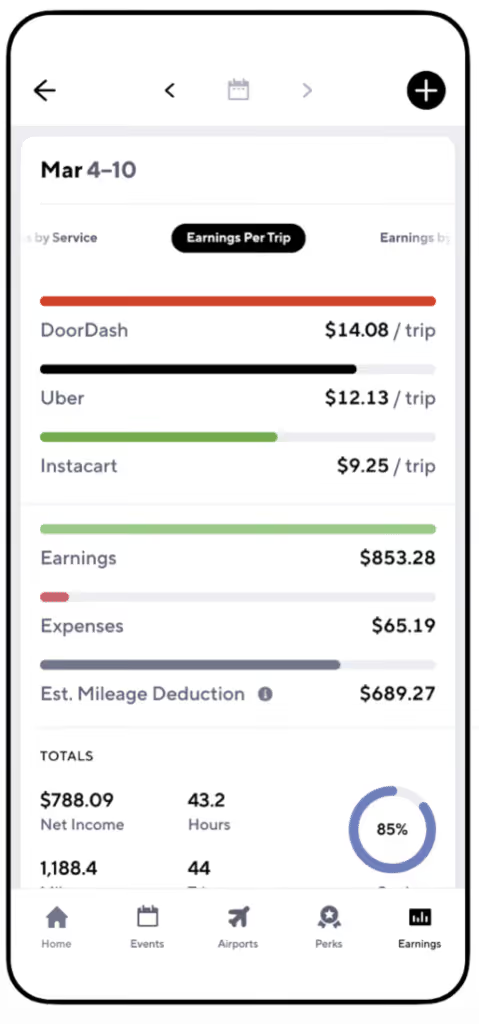
On the Perks tap you’ll get easy access to our informative blog and our awesome YouTube channel, plus deals and special offers just for drivers. Join us on Facebook for camaraderie with your fellow drivers, and participate in gas card giveaways.
Comment below if you have any questions or reports related to the problems apps can bring, and be assured that at Gridwise … we’re always on your side.
Gig platform (Uber Lyft DoorDash Postmates) background checks: Why are they taking so long
Signing up to drive for rideshare or delivery is pretty easy.
You upload your registration, driver’s license, and insurance, and let them run a background check on you. As long as this all goes smoothly, you can get up and running in a few days.
And most of the time it does work like that.
But lately we’ve been hearing reports of drivers getting held up because their background checks are taking F O R E V E R. Worse yet, you might find that your access to the app is either not granted (if you’re new), or suspended (if you’re a current driver), if the background check shows up as “pending.”
It really can make you feel paranoid. Your mind races. What did they find? Do I have a felonious doppelganger out there in the world somewhere? I didn’t do anything wrong, I know it! How does this happen? It’s enough to make you want to scream to the Universe: “What did I do now??”
You have a clean driving record, and as far as you know, you haven’t committed any felonies … so what is the hold up?
In the past, and especially now with that ever-present COVID-19 pandemic, some quirky things have been going on with the background check process. We’ll go through some war stories here, and offer suggestions for getting on top of the situation before it leaves you hanging forever. Here’s what we’ll cover:
- Why background checks get delayed
- What about your legal rights?
- What to do if your background check is past due
We also recorded a YouTube video that discusses these same topics. Check out the video below:
Why background checks get delayed
The dastardly pandemic
Right now, the biggest reason for delayed background checks is … you guessed it, COVID-19. What does that have to do with your driving and court records? Well, in many states and counties, the courts are closed. Yes, even now, almost six months after the pandemic started, that’s the case.
You might wonder why they have to go to a court to get your records; wouldn’t they in a database somewhere?
The answer is yes, in most cases—but not always. Even today, in the midst of the technology age, many courts either have no computer systems, or have systems that are not up to date. Also, the in-person check is considered to be more thorough than the online-only check.
The company performing the background check (usually an outside firm like Checkr) must physically go to the courthouse and have a clerk pull the records. A post on the Checkr website explains how the situation of closed courts is delaying their procedures.
Even if your information is in an electronic file, and an online check is adequate for your company, you could still find yourself in Pending Limbo. If a question comes up about your record, for instance, and it can only be answered by a person who works for the court, this could lead to a delay—possibly a lengthy one.
Software glitches in the app
Although the closures of courts due to COVID is a major reason for delays in background checks, it isn’t the only reason. There have also been reports of glitches on the app; i.e., it says your background check is pending, but it really isn’t. We got a report about a driver who hadn’t gotten Uber Eats pings for about a month, but couldn’t tell why that was happening.
When he examined his account profile for “documents,” it had all the checkmarks in the right boxes—except for one that said there was a “problem.” This driver remembered Uber had done one of those “continuous” background checks on him about a month before. Those involve periodically re-checking drivers to ensure there are no incidents they need to know about.
The driver knew Checkr had cleared him because he had an email that said so. It was the Uber app that had the “problem,” not him. He tried resetting the app, deleting it and re-installing, and cried out for help from other drivers. Some responded to him with similar issues, and the worst thing? None of them were able to work for as long as a month.
With the Greenlight Hubs closed (again, due to COVID), the driver is stuck trying to get help from Uber customer support. He and the other drivers he contacted didn’t get much more than the standard line: “We’re working on it.”
Another driver with a similar issue was able to get help from Uber after contacting them by email. You have to be persistent with Customer Care.
Errors in the background check
No one is perfect, including the folks that perform background checks. This August 2019 article gives an interesting account of dozens of faulty background checks by Checkr. Many of these faulty checks led drivers to either not be approved when they applied, or to lose the place they had previously had on the platform. Many drivers sued Checkr for making mistakes … big ones.
Checkr merely takes an individual driver’s name and Social Security number, and runs checks across various databases. Here are some things that can happen:
- A person with the same name could have a criminal record;
- Charges against a driver could be dropped or expunged, yet still reported;
- They might check and report records that go further back than allowed by state law.
Companies restricting the number of drivers
In some cases, companies might want to keep the number of new drivers down, or eliminate those who aren’t very active on the platform. Make sure you’re being treated fairly here, and if you’re not? Speak up—loud and clear.
What about your legal rights?
The legal climate around background checks is not exactly sunny with a chance of a few clouds. It’s more like a typhoon with driving rain and hail the size of golf balls.
There are a couple things about background checks that make them slippery in terms of legalities. For one, not passing a background check can cause a person to lose his or her livelihood. Many people have sued the rideshare and delivery companies, as well as the background check companies they use because they lost the opportunity to work.
The other side of the story involves customers’ opinions about the thoroughness of background checks on drivers.
Many riders and delivery customers have sued the rideshare and delivery companies because drivers have displayed criminal tendencies that would have been apparent on their criminal record—had it been thoroughly checked.
There are the kinds of checks we already described; namely, checking a person against criminal records by name, SSN, driver’s license number, etc.; and using fingerprints. Obviously, the fingerprint method is more accurate and exhaustive, because if a person has been arrested, the fingerprints will be on file. If the fingerprints of the driver match prints in a criminal file, there won’t be any question about mixed identities.
So … why don’t the companies use fingerprint-based background checks?
Because using fingerprints for background checks is expensive for the companies, and is considered to be inconvenient and intrusive by prospective drivers. This September 2019 article in Vox tells of what happened in 2017 when officials in Austin, Texas wanted to make Uber drivers go through fingerprint-based background checks. Uber threatened to stop operating in the area, and they did just that—until the officials gave up on the idea.
There are a lot of legal issues around background checks, but the fact is, every driver has to get more than one of them. All the companies now check and recheck drivers’ backgrounds on an ongoing basis.
What to do if your background check is past due
Before you do anything, check into the cause of the problem:
- Did you provide all the requested information?
- Is it a problem with the courts?
- Is it a software issue?
- Could it be a case of mistaken identity?
- Do you have a criminal record that extends beyond the state time limit?
If you have any questions about what kinds of things the background check company is looking for, or about the time limits for certain convictions in your state, read this earlier Gridwise post for Uber, and this one for Lyft. This page from Checkr’s site tells you more about how far back in time each state goes when making background checks.
The court problems can’t be helped, at least for now. Unfortunately, you’ll just have to wait.
If you find that there’s a software issue, however, be relentless. Don’t stop contacting Customer Care until you get an answer and/or they fix the problem. If you want to get their attention, post on social media about what you’re experiencing. They’ll catch wind of your discontent, and maybe work a little harder to get things resolved.
In the case of mistaken identity, or the check looking at your record further back than the time limit in your state, do everything you can to stand up for yourself. There are laws in place to protect you, and you might be the one who has to make sure they are properly enforced.
Our best advice is this: If you get into a delayed background check situation with your company, try to work it out with them. If you can’t, and the situation is getting between you and your ability to make a living, consider seeking legal help.
Let’s hope things will get better once COVID-19 is no longer holding everybody back, and that companies, both the gig economy apps and their background checking services, develop a more respectful attitude toward drivers.
And, oh yes, there’s one more thing you can do to protect yourself, especially when it comes to those periodic background checks: Work for multiple platforms. If you have more than one company to work with, you can move over when and if you have problems with a continuous background check. Also, if you’re a newbie, apply to at least two platforms, and see if one gets that background check done faster than the other.
The answer for multiple platform drivers: Gridwise!
When you download Gridwise, you have the ultimate assistant for rideshare and delivery drivers right there in your device. You can track earnings and mileage for all the apps you use, and display useful graphs that inform you about how each is performing in terms of putting money in your pocket.
On our Perks tab, you’ll get cool deals and discounts for drivers, and access to our incredibly insightful blog, developed just for drivers. Get easy access to the Gridwise YouTube Channel, and join us on Facebook for Gridwise Gas Giveaways.
We’ll also tell you what’s going on in town and at the airport, and give you a heads-up on weather that might affect your shift. What would you do without Gridwise? You don’t have to find out … download the app now.
Who are delivery drivers: A demographic breakdown of delivery drivers in the U.S.
What does a delivery driver do?
Delivery drivers are gig workers, meaning independent contractors who decide what job assignments, or “gigs,” they want to take on.
Gig workers choose when they work, which company (or companies) they work for, and how many hours a week they want to spend making deliveries. Groceries, prepared meals, retail purchases, Amazon finds, office supplies, and even alcoholic beverages are among the products these drivers deliver to their customers’ doors.
A number of companies and platforms use delivery drivers, including Amazon Flex, Uber Eats, Postmates, Grubhub, DoorDash, Instacart, Shipt, and others.
The job of delivery driver is performed by a diverse variety of people. Based on information we collected from a recent survey of 750 registered Gridwise drivers, we’ll share with you what we learned about them.
First, we learned that delivery drivers can’t be pigeonholed. They’re male and female, are a wide range of ages and marital statuses, and come from all walks of life. Here’s a rundown of delivery driver demographics.
Most drivers are in the 40+ age group
People often have the impression that delivery drivers are teenagers, but as you can see, most of them are older. In fact, 61% are over age 40. This means they are mature and, most likely financially responsible enough to have money they can spend on products and services they want and/or need.
More men than women deliver, but there’s a good mix
Although the audience is predominantly male, there are enough women to make this a diverse market for products and services that cater to people of both genders.
Most delivery drivers are married
As you can see, 61 percent of delivery drivers are either married or have been married at some point in their lives.
Most delivery drivers are also moms and dads
Many delivery drivers have needs that cater to their parental roles, and also to their kids. This group is family oriented, and often works during hours when they’re not tied down with their kids and their active schedules.
Delivery drivers can, and do, choose their own hours
While many drivers work full time, nearly one-half stick to part-time hours. This might mean that when they’re not out there delivering to customers, they’re working at other jobs.
Delivery drivers are educated
Many delivery drivers are well-educated, and may also be open to opportunities that allow them to expand their knowledge. They’re a great audience for marketing training programs and other sources of learning for expanding career opportunities.
What gig platforms are popular with delivery drivers?
Most drivers work for more than one gig platform and many delivery drivers are also rideshare drivers.
Vehicle ownership dominates over leasing and renting
A large majority of delivery drivers use cars they own for their delivery businesses. This means they’re going to be focused on caring for the vehicle, in terms of maintenance, and to some degree, appearance and cleanliness.
Many delivery drivers have a vehicle specifically for their driving business
Multiple vehicles means a greater need for automotive expenses. This means delivery drivers are prime contacts for services that help them procure, register, insure, and maintain their vehicles.
What car makes are popular with delivery drivers?
Toyota is by far the most popular car make, followed by Honda and Nissan.
Delivery drivers clean their cars often
Keeping a clean vehicle has always been important for drivers, but the COVID-19 pandemic has made cleanliness more crucial than ever. Cleaning up spills, and even eliminating food odors, become issues that must be dealt with, particularly if the vehicle in question is being used for both delivery and rideshare.
Financials
For obvious reasons, earnings are important to delivery drivers. Here are the questions we posed during our survey, and our drivers’ answers, to questions about the ways they motivate themselves and tend to the administrative work of running a business.
Do you set weekly goals?
Do you track your mileage?
Have you purchased rideshare insurance?
Do you use a separate bank account for your gigs?
In many ways, delivery drivers make good business decisions, but not many follow through on insurance and banking requirements for self-employment.
Not sure how you can market to delivery drivers? Let the Gridwise team build a multichannel strategy for you!
Still not 100 percent sure how you should be engaging with delivery drivers?
No problem!
At Gridwise, we have a team of marketers and designers who are experts in engaging and converting rideshare drivers across all channels and we’ll be happy to design a personalized strategy for you!
Simply reach out to sales@gridwise.io and we can set up a strategy session.
From Uber driver to radio entrepreneur: Meet the founder of TNCRadioLive
Tom Kelley is one of those guys who doesn’t just talk about getting things done—he gets things done.
So in early 2019, after being a uber driver for a few months, he had an idea for an app-based radio station just for drivers.
And he decided to make it happen.
Kelley pulled together a team of people on the move: rideshare and delivery drivers, truckers, pilots, and co-pilots, and together they created TNCRadio.Live.
A few weeks ago Kelley sat down with Gridwise and shared some intriguing behind-the-scenes information. In this blog post we’ll tell you his story, reveal more about his entrepreneurial endeavor, TNCRadio.Live, and look at what the future might hold. Here’s what this post covers:
- What is TNCRadio.Live
- Tom Kelley’s story
- Early success
- How to listen and what you’ll hear
- What’s coming next
What is TNCRadio.Live
TNCRadio.Live is an Internet and app-based station that broadcasts directly to rideshare and delivery drivers.
Like Gridwise, TNCRadio offers information about local traffic, road closures, and area events. Kelley told us he believes his new station offers drivers the information “they need to do their jobs.”
After talking with drivers, Kelley noticed they often didn’t have the slightest idea how to get this kind of information.
On top of that, he says, “They don’t know what they don’t know.” This might include how to download tax information or how to contact Uber or Lyft when all the hubs are closed.
Kelley is grateful for Gridwise and all that the app offers drivers. But he recognizes how hard, not to mention unsafe, it can be to use an app when you’re driving down the road at high speed. That’s why listening in can be helpful along with keeping your eye on Gridwise.
TNCRadio.Live broadcasts all day and night, providing the latest news about the driving business, stories covering crucial driver topics, podcasts drivers should know about, and their own interviews with people whose knowledge can help drivers. Much of the programming can be downloaded as podcasts.
To give you a flavor of what listening to TNCRadio.Live is like, here’s a sample of their daily broadcast schedule:

Kelley says the station’s programming is aimed at “anybody who spends their days (or nights) driving the streets of Houston, Texas.”
How it happened: Tom Kelley’s story
Like most of the others involved in TNCRadio.Live, Kelley has a history as a driver.
He got into rideshare in early 2019 when he opted to retire after a long career as an IT executive. He says he wanted to do something “exciting and different,” so he started rideshare driving.
Kelley has driven for both Uber and Lyft, and thoroughly enjoyed it. The flexibility of the hours, the reasonable amount of money he earned, and the satisfaction of knowing that he was doing something valuable, were exactly what he’d been looking for. He even drove for Uber Eats for a while, and found that to be a positive experience as well.
Kelley noticed, while he was out there, that the other drivers waiting for rides at the airport were hungry for information. They’d tap him for what he knew from his Gridwise app and he’d share it with them. But when he suggested they download the Gridwise app, they’d say things like, “Huh? Why do I need that? I already have the Uber app.” Obviously, drivers needed more education. How could he do that, and create a substantive side gig for himself at the same time?
Around this same time, Kelley heard about a guy who was pulling in $80,000 a year playing Led Zeppelin playlists on the Internet. Who wouldn’t want to get in on that kind of gig? Kelley called some friends in the radio business, most of whom were either driving, trucking, or piloting, and they put it all together. That’s when TNCRadio.Live was born.
The initial plan was to launch in late March 2020, but we all know what happened then.
Yes. The pandemic.
Kelley could no longer drive because he had to remain quarantined for the safety of a relative who was living with him. But being the enterprising and quick-thinking person he is, he wouldn’t stay stuck in a rut. He kept going. He threw his heart into developing TNCRadio.
Lockdowns made it impossible for the newly formed group to meet in person. Even though they could do voiceovers and production work while in isolation, live radio needs that up close and personal collaboration if it’s going to sound “real.” The time to launch just wasn’t right, but they knew that when it was time, they’d be primed and ready to go.
By summer, some signs of life were stirring around Houston. Kelley says he noticed a pick-up in traffic and action, and the group had more freedom to gather and collaborate. The moving parts started to fall into place, and the team was ready to go. On July 1, 2020, TNCRadio.Live had its official launch.

Early success
About six weeks after the launch, TNCRadio.Live had about 1,000 regular listeners. From this warm reception, Kelley and the others could see that there’s a strong demand for the kind of information this station and Gridwise send out to drivers.
Despite being off to a great start, the TNCRadio.Live team is learning that the people who need the station the most are the hardest to find. They’re committed to spreading the word, though, and it will be exciting to watch them grow.
More movement, Kelley believes, will start happening as schools open. Not only will commuting families generate traffic, but parents may also be free to go back to work. After all, many jobs can be done from home for only so long. When people do start returning to work, this could be a real boost to rideshare.
While rideshare and delivery drivers are TNCRadio.Live’s main target audience, Kelley is eager to welcome people from other industries, too. He’s hearing from nurses, contractors, truckers, and others who spend a great deal of their working hours driving from one location to the next. They appreciate the information about Houston’s streets and highways, and they also enjoy hearing the banter about sports, the rideshare business, and driver stories.
In fact… if you want to share your story with TNCRadio.Live, all you have to do is get in touch with Kelley through the website. He’s always looking for people with personality to come on the air with him and share their experiences. Although at this point TNCRadio.Live is focused on Houston, Kelley says stories from anyplace else on the planet where people drive will be warmly welcomed. Use this link to get in touch with TNCRadio.Live’s driver story reporter.
How to Listen
Also, whether you live in Houston or some other location, there’s sure to be something you’ll enjoy listening to on this new station created just for drivers. The app is free and you can download it here, although right now it’s Android-only. If you have an iPhone rather than Android, you can listen directly from the website.
Because all the talent on TNCRadio.Live are also drivers, they have their fingers on the pulse of all the goings-on in the driver community. They cover such topics as:
- Smart driving practices
- Driver classification
- Government interference in the gig economy
- Connecting people with government resources
- Driver safety
- Building a better driver community
- Serving the general community
The station offers insightful tips to drivers, and the information it provides can be a big help. For instance, Kelley sees the value in knowing how long it will take to complete a ride. Passengers tend to have more patience about a traffic jam when they’re warned about it ahead of time. Happy passengers often tip, right? And that makes every driver happy.
As an example of how TNCRadio.Live helps people in their community, Kelley shared a heartwarming story about a report of someone stuck in Houston’s oppressive heat without an air conditioner. The station was able to connect the person with the right government agency, and a new air conditioner appeared. As this shows, TNCRadio.Live is not just informative and fun. Kelley and the rest of his team have a sincere intention to build and support the driver population and the surrounding community.
What’s coming next?
When we asked Kelley what his plans are for TNCRadio.Live, he didn’t hesitate. He said they want to get “really, really good at taking care of Houston.” While he believes they have a good thing going already, there’s more that he wants to accomplish so he can take it to the next level.
Once that happens, Kelley and his partners hope to take TNCRadio.Live to more cities. When they do, they’ll be looking for drivers who have radio experience and talent. Stay tuned, and you could become a TNCRadio.Live star.
In the meantime, stick with Gridwise for more great stories about cool drivers like Tom Kelley. Our blog is just a click away, along with discounts for drivers, and links to the Gridwise YouTube channel, all on the Perks tab.
Track your earnings, monitor your mileage, get airport info, event times and places, weather, and more, when you download Gridwise. And, don’t forget to enter to win a gas card in our regular driver contests on our Facebook page.
Last-minute judicial appeal keeps Uber and Lyft rolling in California. Here’s what this means for drivers everywhere.
It came right down to the wire, as Uber and Lyft threatened to suspend operations in California at midnight on August 21.
Hundreds of thousands of drivers would have been out of work. Passengers and delivery customers would’ve had to look elsewhere for a way to get around and have their goods brought to their doors. Chaos would have reined in the state.
If all this had happened, it would’ve been the result of a previous court order for the rideshare and delivery companies to reclassify their independent contractors (aka, drivers) as employees by August 20, 2020. The companies had five days to appeal that ruling, and they made it just in time. A decision in their favor, to hear the appeal on October 13, came down during the afternoon of the August 20 deadline.
Since a decision won’t be reached until at least a few weeks after the hearing, the October 13 date provides the companies with ample time to wait for the outcome of the November 3, 2020 election. That’s when Proposition 22, a ballot measure that could reverse parts of the California law known as AB5, will be up for a vote. (As you undoubtedly recall, AB5 orders companies to reclassify drivers as employees.)
While many are frustrated that the companies have not been forced to comply with California’s AB5, the companies, the remainder of the state’s drivers, and customers breathed a huge sigh of relief.
Although we realize this is a California case, the decisions that are ultimately reached could send San-Andreas-sized tremors across the country, shaking up all the companies and their gig workers in every state. That’s why, in this blog post, we’re going to cover:
- Why companies want drivers to be independent contractors, and not employees
- What AB5 mandates
- What Proposition 22 is, and how drivers might benefit from it … or not
- Other proposals companies have introduced to deal with drivers’ needs
- What could happen if Uber and Lyft are forced to comply with AB5, and what that means for drivers everywhere
- How drivers can protect themselves from losing their gigs
We also did a video discussing this topic on our YouTube channel. Check out the video below.
Why companies want drivers to be independent contractors, and not employees
We’ll start by saying that we know what many drivers want: to be employees rather than contractors. They want to get benefits and protection they would receive from being employed full time.
For the companies that offer app platforms for drivers, however, it’s a whole other angle.
Let’s face it. Uber, Lyft, and other driving gig companies exist for the purpose of making a profit. All of them have struggled to do that—even with the freedom to avoid paying the costs of benefits and taxes for drivers who work as independent contractors.
With the help of some law and economics professors, reporters for the website Splinter found that, even back in 2015, the costs of paying benefits to just one California driver earning about $50,000 per year would be extraordinary. Here’s an estimate of what the companies would have to lay out:
- Federal taxes for unemployment, disability, Social Security, and Medicare: $4,940 per year
- Retirement and health insurance plans (San Francisco Bay Area): $15,483 per year
- Total for one driver for one year: $20,423
Yipes! There’s no exact figure for the number of drivers in California, but we estimate around 260,000. Multiply that by $20,423 (the cost of covering employee expenses) and the companies could be looking at around $5.3 billion each year—in California alone.
Even if we don’t count the drivers who would work under 30 hours per week, and therefore not qualify for full benefits, the bill would still far exceed the $500 million in annual revenue Uber says it would lose if the company ceased operating in the state.
What AB5 mandates
In a previous post, we took you through the details of AB5. So here we’ll simply state that it requires companies to treat those who use their apps as employees. So, companies would have to pay that $20,423 figure per driver, per year.
AB5 went into effect on January 1, 2020, and the companies have not complied with it. They argue that they do not have a relationship with drivers like what is described in the law. After the state sued and the companies appealed, a judge denied the stay on the order and told the companies they’d have to institute an employee-based system by August 20, 2020.
The companies took their appeal to yet another court, and on August 20, a hearing was scheduled for October 13. Along with buying them time to prepare for the possibility of losing on appeal, this date also gets close enough to the November election to allow Proposition 22 to play a prominent role in the eventual outcome.
What Proposition 22 is, and how drivers might benefit from it … or not
On November 3, 2020, California voters will vote on whether they agree with the language in Proposition 22, such as:
- AB5 does not apply to app-based drivers;
- App-based drivers are to be classified as independent contractors;
- App-based drivers are workers who provide delivery services through an application, or use a personal vehicle to provide pre-arranged transportation services through an online-enabled application or platform;
- Other types of workers will still be governed by AB5.
Whether Proposition 22 is beneficial for drivers depends on how you look at it. If you want to be an employee, then this will not help you. If you wish to remain an independent contractor, then this proposition will allow you to do that. Obviously, the companies like it. They’ve put a lot of money behind it, too—about $110 million so far.
It appears that many drivers also support the proposition. According to a survey we recently conducted of more than 750 drivers, 64.8 percent would prefer to remain independent contractors, while only 23.4 percent would rather become employees.
The companies are well aware of driver preferences, and they also understand that some drivers need and want more support from them. In an effort to show their willingness to meet drivers halfway, they’ve taken steps toward making drivers feel more secure as independent contractors.
Other proposals companies have introduced to deal with drivers’ needs
The companies realize they must find ways to treat their drivers better. They have their image to consider. Also, it’s pretty hard to imagine what they’d do if frustrated drivers decided to walk away from the platforms en masse. Here are a few ideas the companies have floated so far, to escape the extreme measures of AB5 and any other legislation like it that could crop up in other states.
A franchise model. If the companies offered drivers the opportunity to operate as franchisees, then Uber, Lyft, and the rest of them would not be in direct control of their independent contractors. This would satisfy one of the main provisions of AB5, which uses evidence of company control to determine whether a worker is an employee.
Benefits Funds. On August 10, 2020, Dara Khosrowshahi wrote an op-ed for the New York Times titled, “I Am the C.E.O. of Uber. Gig Workers Deserve Better.” In the article, Khosrowshahi said he’d be willing to establish “benefits funds" that give workers cash to use “for the benefits they want, like health insurance or paid time off.”
Also in the article, Khosrowshahi expressed his belief that current employment laws are outdated. He doesn’t think workers should have to choose between full-time employment or being fully independent. Rather, he envisions a “third way for gig workers,” with his benefits funds idea one representation of what that might look like.
If Uber and Lyft are forced to comply with AB5, what would it mean for drivers everywhere?
AB5 is a big question mark right now. No one knows what’s going to happen with court decisions, nor does anyone know the fate of Proposition 22. That will be up to the courts, and ultimately California voters.
But we can speculate about what could happen if companies are ultimately forced to comply with the law. Here are a couple of possibilities:
- Drivers as employees may only be able to get benefits if they work 30 hours or more. The companies could limit work time by controlling the number of hours a driver is allowed access to the app. That could mean fewer drivers earning what they did when they could work as many hours as they wanted (within reason).
- Having to pay more than $20,000 per year for each driver-employee could motivate companies to find other ways of getting things done. How? Well, even though we haven’t expected to see an influx of autonomous vehicles anytime soon, we may feel differently if companies are forced to pay drivers far more than they do now. In other words, that robocar we’ve all been dreading might just roll out way ahead of schedule.
Once again, we want to stress that no matter how this situation turns out, it will have global repercussions. That’s why it’s so important to be aware of it, no matter where you live. In fact, it’s not out of the question that this and/or other state legislation pressuring companies to classify drivers as employees will be evaluated on the federal level. If you wonder how that might turn out, well ...
Decisions issued in 2019 by the US Department of Labor reflected the view that drivers are independent contractors. The author of one opinion, National Labor Relations Board associate general counsel Jayme Sophir, states:
“Drivers have virtually complete control of their cars, work schedules, and log-in locations, together with their freedom to work for competitors of Uber, provided them with significant entrepreneurial opportunity. On any given day, at any free moment, UberX drivers could decide how best to serve their economic objectives: by fulfilling ride requests through the App, working for a competing rideshare service, or pursuing a different venture altogether.”
Knowing the federal perspective, it’s hard to see how the companies wouldn’t win if they challenge state laws on the federal level. This makes it clear that the federal government’s position aligns with the companies: that drivers are independent contractors.
The Department of Labor’s opinion was issued to help settle arbitration between Uber and about 60,000 drivers, who filed arbitration demands over their employment status. Nonetheless, it will almost certainly be cited by any attorney who takes a future case like this to the federal level.
If you’re one of the drivers who would prefer to be an employee, the battle isn’t over yet in California, and may not even come close to influencing policy in other parts of the country. We’ll keep our ear to the ground for any new rumblings from the Golden State. In the meantime, here’s what you can do.
How drivers can guard against losing their gigs
We know. It seems like we’re telling you this more and more, for a variety of reasons. Sit in a comfortable position, close your eyes, take a deep breath, and chant the driver mantra:
Work. For. Multiple. Platforms.
When you’re positioned to pivot from one company to the next, you can make sure you keep working, no matter how the legal climate might change. This is always a great idea—but when there’s a possibility that a company can bail on operating in your area, you’ll need backup.
As we saw in the case of California, Uber and Lyft threatening to leave the state caused some huge ripples in the media. It was hard to watch any business news without hearing all about it. And in California, we imagine the news reports were even more numerous.
As you know, when you work for multiple platforms, Gridwise is more essential than ever. Use our amazing new features to track your earnings on all the apps you work with, and let us track your mileage for tax deduction purposes, too.
And … you get info on events, airport traffic, and lots of perks, such as easy access to our blog and the Gridwise YouTube channel, as well as driver discounts and special offers. Why would you ever drive without the ultimate rideshare and delivery assistant? Download Gridwise now.
So, what’s your preference: employee or contractor? Make a comment below, or find us on Facebook to share your thoughts with the Gridwise community.
Work smarter. Earn more.
Whether you drive, deliver, or pick up shifts — Gridwise helps you track earnings, mileage, and performance so you stay in control of your work. Download the app and take charge today.
