Gridwise blog
Tips, insights, and advice to help you earn more and work smarter, whether you do gig work, hourly, or shift work.
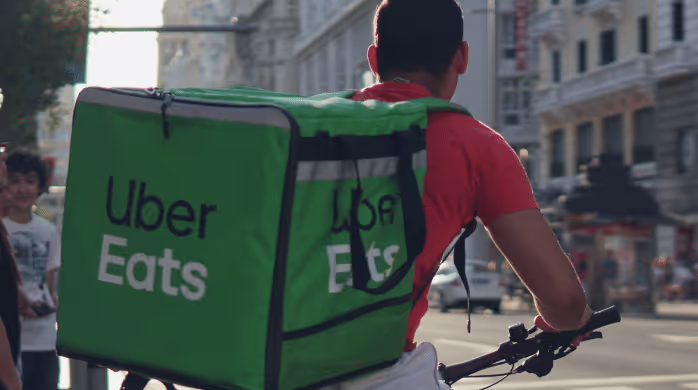
How to Make $1,000 a Week With Uber Eats in 2026 (Tips + Hourly Data)
In this blog, we'll explore the strategies and techniques that can show you how to earn $1000 per week as an Uber Eats delivery driver. We'll cover everything from optimizing your delivery zones and schedules to maximizing your tips and customer satisfaction. Whether you're a seasoned Uber Eats driver or just starting out, this guide will provide you with the insights and actionable steps to take your Uber Eats driver earnings to the next level.
Becoming an Uber Eats delivery partner can be a lucrative opportunity, especially if you're able to consistently earn $1000 a week. By understanding the platform, optimizing your delivery strategies, and focusing on customer satisfaction, you can maximize your earnings and turn Uber Eats into a reliable source of income.
We’ll cover the following topics to provide coaching and ideas to help you push your earnings up to that $1000 per week level:
What do Uber Eats drivers do?
Uber Eats drivers deliver prepared food most of the time, but they also might shop for and deliver goods from convenience outlets and grocery stores. The job is pretty simple. You get a request for an order, you drive to the restaurant or store to pick it up, and then you deliver it to the customer. If you already drive for Uber, you can choose to take orders for Uber Eats delivery any time.
If you’re not an Uber Eats driver yet, it’s pretty easy to become one. This Gridwise post tells you what you need to do if you want to sign up and start making money Uber Eats style. Many rideshare drivers welcome the chance to deliver food rather than people. This article from Nerdwallet covers the Uber Eats gig from that angle.
There are some sweet advantages to working with Uber Eats. In lots of cities you don’t even need to have a car. You can use a bike or a scooter, or even walk, to make your rounds. If you do use a car, Uber Eats’ requirements are a lot easier to meet than they are for Uber rideshare driving.
You also have a lot of flexibility. You can shop and deliver convenience items and groceries, but you don’t have to. And, like most driving gigs, you can choose your own hours, and map out the locations where you want to work.
Use Gridwise features When to Drive and Where to Drive to help you figure out what work hours and which specific areas will be the most profitable for you. Real data from real delivery people will show you earning patterns for drivers in your town.
How much can you earn doing Uber Eats?
The honest answer to this question is: basically, as much as you want! It all depends on how many hours you put in and how strategic you are about your gig. Earnings vary from one area to another, as this article from Entrepreneur points out. To give you a baseline, let’s look at the earnings of Uber Eats drivers who tracked their earnings with Gridwise.
Remember that these numbers show us only average earnings. To make $1,000 a week with Uber Eats, you’re going to have to be better than average, and we’ll show you how. For now, though, it’s good to have these figures so you get a ballpark number of where to start.
How much do Uber Eats drivers make?
Gridwise data tell us the following:
- Monthly earnings average around $444.00 per month.
- Gross earnings per trip are between $9.00 and $10.00.
- Tips make up about 50% of most Uber Eats drivers’ income, which amounts to about $225.00 per month.
Is Uber Eats good money? It can be. While there are other gigs that pay more per trip, if you drive for Uber Eats, you’ll always be pretty busy.
https://datawrapper.dwcdn.net/HPAz8/3
You can also see that, unlike many other gigs, tips play a huge role in Uber Eats earnings.

With these numbers as a baseline, what can we say about how to earn $1,000 a week with Uber Eats? As we said in the introduction, it’s going to be a hustle, but it’s really possible. To figure out how to make the most money with Uber Eats, let’s start by looking at how many trips these “average” drivers made each month.
We know that average gross earnings were $444.00 per month, and drivers got around $10.00 per trip. That means they took 44 or 45 trips per month, which breaks down to 11 trips per week. That’s not a lot of Uber Eats delivery, is it?
The fact that Uber Eats drivers averaged so few trips shows us that many drivers use more than one app at the same time. This is called multi-apping, and you can learn more about it in this Gridwise post. If you want to answer the question of how much you can make with Uber Eats, then you need to stick with the app and keep plugging away at those orders. You also need solid strategies, as well as some inside tips and tricks.
How to make the most money on Uber Eats: Delivery driving tactics
Getting to that $1,000 a week with Uber Eats isn’t so hard when you remember that the drivers we saw making about $111 a week were only taking around 11 trips in the same time period. That’s not much at all! If you work the Uber Eats app like a boss, you’ll soon have many more trips than that, easily reaching the number needed to get you to $1,000 a week. Now, let’s get to some tactics you’ll need to make that kind of bank.
- Stay with the Uber Eats app, and track your earnings. Gridwise can easily do that for you. Simply sync your Uber Eats app with Gridwise, and you’ll be able to see how much you’ve earned with Uber Eats, what times were most profitable, and your average hourly pay. Racking up trips with Uber Eats has other benefits, including perks and bonuses that are awarded to top drivers.
- Leverage surge pricing and promotions. Surge pricing is applied when there is a lot of demand. When surge pricing is in effect, many of the trips you make will pay more than usual. Promotions are offered to drivers who complete a given number of trips in a certain time period. High traffic volume days, nights, and times give you these chances to get extra earnings. Challenging yourself to complete the right number of trips for promotions will add to the number of trips you can count on for big bucks, too. Learn more about Uber Eats surge pay, boosts, and promotions in this Gridwise blog post.
- Say yes to doubling up on orders. With Uber Eats, you can get back-to-back orders or receive batched orders. Back-to-back orders happen when you receive a new request while you’re on the way to deliver an original order. The Uber Eats app routes these trips automatically, so you won’t be sent out of your way.
Batched orders are Uber Eats’ way of bundling together orders from either the same restaurant, or two nearby eating establishments. You get money, and trip count credit, for all the orders you complete, plus customer tips, without having to make a bunch of separate trips.
- Turn on the charm and get bigger tips. Being nice really is part of the Uber Eats driver’s job, and getting tips is one way people who drive for Uber Eats make money beyond their basic pay.. Bring along those extra napkins and condiments, use equipment that keeps food and drinks at the right temperatures and prevents spilling, and consider your customers’ needs. If you deliver groceries, be extra careful with delicate items such as bread and eggs.
And, most important, follow your customers’ directions, and stay in communication with them if you are going to be delayed, or if you have questions about their order. This Gridwise post will tell how to get bigger tips as a delivery driver.
- Use even more charm to keep your ratings high. As an Uber Eats driver, you will be rated by the restaurant or store where you pick up the orders as well as the customers who are waiting for the deliveries. This two-way rating system is designed to keep you on your toes, so Uber can keep people satisfied with your service. Don’t worry, you get to rate them, too.
There’s another reason why your rating as a driver is important. It not only keeps you in good standing with Uber; it helps you to qualify for the Uber Eats Pro incentive program. To learn more about Uber Eats Pro, and what it takes to earn perks such as preferred services, discounts, and deals, check out this Gridwise blog post.
Smart business moves that seal the deal
Now that you know how to gobble up the deliveries you need to make $1,000 a week with Uber Eats, it’s going to be a breeze to get there. Let’s make it even easier, with business moves that boost your earnings and shrink your expenses. If you use these, it will also be easy to say yes when people ask, “Can you make good money with Uber Eats?”
Minimize expenses. Avoid racking up big fast-food bills by bringing your own food and beverages. You might not think you’re hungry when you first start your Uber Eats run, but once the aroma of pepperoni pizza, premium cheeseburgers, and piping hot fries start wafting through your car, that might change. Bring a sandwich or other healthy food from home, and buy bottled water in bulk to save tons of cash compared to what it costs to buy single servings.
Maximize tax deductions. Another way to minimize your expenses is to maximize your tax deductions. Start by tracking mileage with Gridwise.
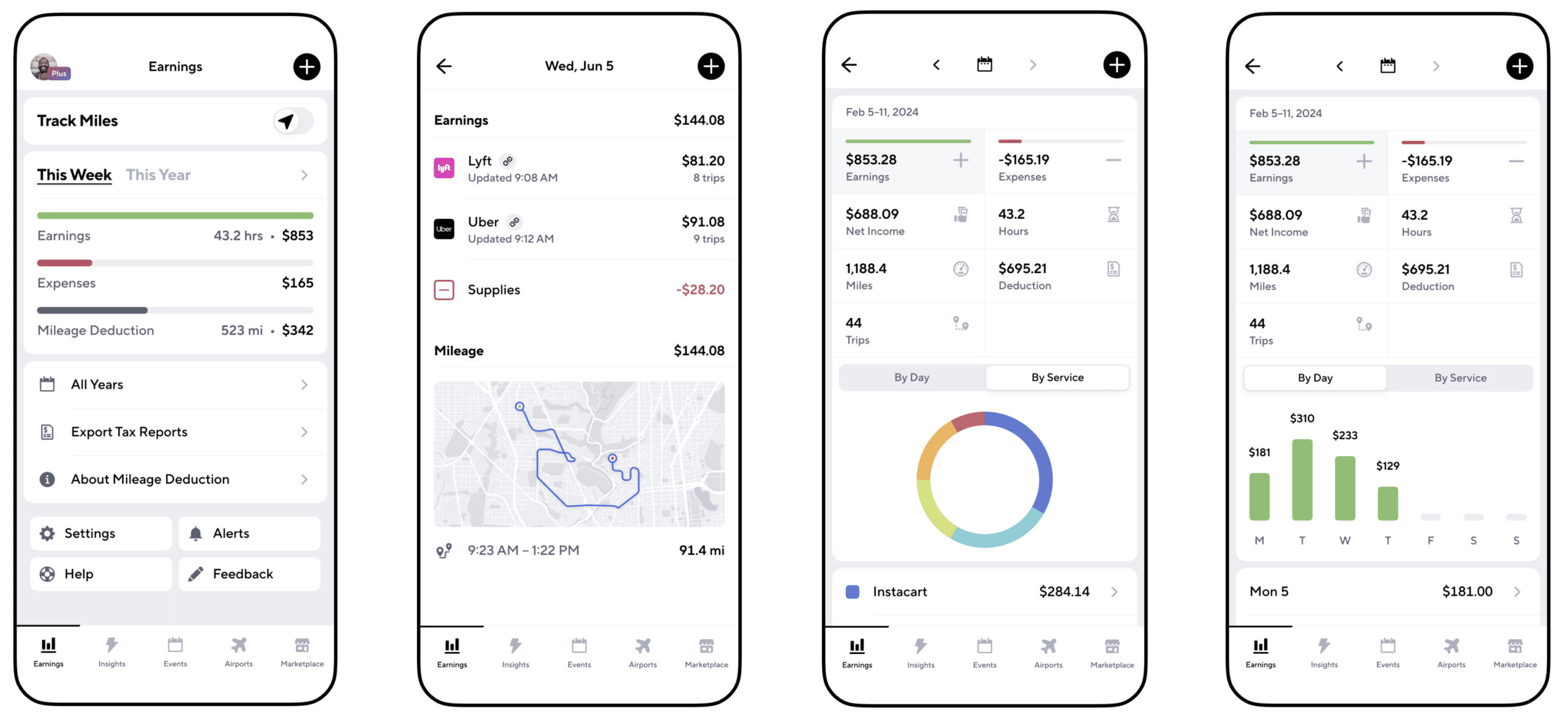
Gridwise App
Gridwise captures every deductible mile you drive, including the distance you cover between the trips your driving app records. Know what expenses you can deduct, and put them to work for you when tax time comes. Learn more about tax deduction strategies in the Gridwise Tax Guide for drivers.
Boost earnings with referrals
As an independent contractor, you’re probably looking for ways to make even more money than you can with Uber Eats. And most gig workers like you enjoy getting passive income. With Uber Eats, there’s a really easy way to do that, referrals!
All you need to do is find friends and encourage them to deliver for Uber Eats. If they make a certain number of deliveries within a specified time, you will get paid for doing nothing more than having them sign up under your referral code! Rates of pay vary by city, so check your Uber Eats app to find out what the current deal might be, and learn more about the referral program on the Uber Eats website.
Also remember: “friends” don’t have to be your best buds. Many delivery people carry cards with a QR code linking to their referral information, so just about anyone you encounter can join Uber Eats and boost your earnings. You could meet a source of passive income at the gas station, on social media, or at your high school reunion. The more you hustle, the more there is to gain, right?
Master the art of self-employment
As an Uber Eats driver, you’re an independent contractor. That means the company isn’t going to withhold your taxes, provide insurance, keep track of your earnings, or tell you about tax deductions. You’ll have to do all these things for yourself.
If you want to maximize your tax advantages, open an official business entity. You can incorporate (create a corporation) or you can work as a limited liability corporation (LLC). You can also work with a DBA (Doing Business As) arrangement, but the corporation or LLC will do a better job of protecting you from liability.
Establishing a corporation or LLC offers better tax advantages than being a sole proprietor. For instance, if you simply collect your earnings into your private account, you’ll be charged self-employment taxes in most states. And paying extra taxes is something we all want to avoid, within legal limits, as much as possible.
Every Uber Eats driver needs to learn about self-employment, and there are some great resources you can review. Check out the CareerOneStop website about self employment which will help explain the basics. You can also check with a professional tax accountant, or look other websites to learn more about actually creating a business.
Scope out your market
Look at the area around you to see where you’re likely to get the most deliveries. Where are all the restaurants? Where might people be more inclined to order deliveries? What hours do you want to drive? What activities might be going on around those times? Think about late-night and after-school times as well as breakfast, lunch, and dinner times.
Be realistic about the potential for your area and aware of new services opening up. For example, in New York, there is already a tab on the Uber Eats app that allows customers to order groceries. In our article about the best food delivery service to work for you’ll see that Uber Eats stacks up well against other delivery companies, mainly because of its potential for expanded opportunities for drivers to earn.
So, is Uber Eats good money? As we said, it isn’t an automatic guarantee that everyone will make $1,000 a week with Uber Eats. Trying out the suggestions we give you here, though, should put you on the right track! Go out there and start stacking up those orders and raking in some impressive earnings!
Get more inside information on Uber Eats in these posts from the Gridwise blog:
- The delivery driver guide: Using the Uber Eats app
- Everything you need to know about driving for Uber Eats
- Uber Eats Pro: What drivers need to know
- Looking for a different gig, part-time or full time job? Check out the Gridwise Job board.
Uber Eats FAQ
How does the Uber Eats platform work for drivers?
Uber Eats is a food delivery service that connects customers with local restaurants and independent delivery partners. As an Uber Eats driver, you'll receive notifications of nearby delivery requests, which you can accept and complete. The platform provides flexibility, allowing you to work on your own schedule and earn money based on the number of deliveries you complete.
What are the requirements to become an Uber Eats delivery partner?
To become an Uber Eats delivery partner, you'll need to meet certain requirements, such as having a valid driver's license, a registered vehicle, and passing a background check.
How can I choose the right delivery zone to maximize my earnings?
Selecting the right delivery zone can significantly impact your earnings, as some areas may have higher demand and better-paying orders. It's important to research and identify the zones in your area that tend to have the most consistent and lucrative delivery opportunities.
How can I take advantage of peak delivery hours and surge pricing?
Understanding peak delivery hours, such as mealtimes and weekends, and taking advantage of surge pricing can boost your earnings. Be aware of when demand is highest in your area and adjust your schedule accordingly to capitalize on these peak periods.
What are some tips for maximizing tips and customer satisfaction?
Providing excellent customer service and going the extra mile to ensure a positive experience can lead to more tips and repeat business. Prioritize communication, timeliness, and attention to detail to keep your customers happy and satisfied.
How can I set realistic weekly goals to reach my $1000 target?
To make $1000 a week with Uber Eats, it's essential to set realistic weekly goals and track your earnings and expenses. Start by determining your target earnings and breaking it down into achievable daily or weekly goals. This will help you stay on track and make adjustments as needed.
What are some strategies for efficient route planning and navigation?
Effective route planning and navigation can save you time and fuel, allowing you to complete more deliveries. Utilize mapping apps and take advantage of features like real-time traffic updates and turn-by-turn directions to find the quickest routes.
How can I balance my Uber Eats deliveries with other commitments?
Develop a schedule that allows you to capitalize on peak delivery hours while still maintaining a healthy work-life balance. Consider using tools like calendar apps to plan your availability and track your hours to ensure you're maximizing your earning potential without sacrificing your personal life.
What are the key considerations for maintaining my vehicle as an Uber Eats driver?
Keeping your car clean and well-maintained is crucial for maximizing your Uber Eats earnings. Regularly scheduled oil changes, tire rotations, and other preventive maintenance can help extend the life of your vehicle and minimize downtime. Additionally, budgeting for vehicle-related expenses, such as fuel, insurance, and repairs, will ensure you're accounting for these costs and maximizing your net earnings.
What are the tax obligations and legal considerations for Uber Eats drivers?
As an Uber Eats delivery driver, it's essential to understand the tax obligations and legal considerations that come with being an independent contractor. This includes properly reporting your earnings, deducting eligible business expenses, and making quarterly estimated tax payments. Additionally, you'll need to ensure you have the appropriate insurance coverage, such as personal auto insurance and possibly commercial auto insurance, to protect yourself and your vehicle while on the road making deliveries.

The Gridwise Job Board: Find Your Ideal Job or Gig Work
Gridwise is an essential assistant app created by gig workers for gig workers. Our mission is to support those engaged in gig work in every way possible. We understand how challenging it can be to deal with income instability, a lack of benefits, and job insecurity that often comes with gig work. The Gridwise app tracks and organizes earnings and expenses, and offers a wide array of discounts, deals, and services that make the lives of independent contractors easier and more rewarding.
We firmly believe it’s possible to make a viable living and create a gig experience that offers flexible hours, variety, and excitement. With issues such as consistent earnings and job security in mind, Gridwise is proud to offer a centralized platform that shows you how to find gig work and secure reliable opportunities. We’re proud to introduce the Gridwise Job Board.
The Gridwise Job Board: Key features
Because Gridwise is dedicated to serving the gig worker community, we’ve filled the Gridwise Job Board with useful features that won’t waste your precious time.
- Comprehensive listings. Find part-time, full-time, temporary, and per-task work. Drive or deliver with your vehicle, utilize an employer’s vehicle, or even find non-driving gig work.
- User-friendly interface. Find the jobs that are right for you with a tap of your screen.
- Verified opportunities. We vet the jobs before they are listed to ensure you’re getting high-quality job postings.
How to get more gig work, seasonal, part-time or full-time jobs with the Gridwise Job Board
Looking specifically for “gig work apps” or “gig jobs near me?” You’re in luck. Our filters and search functions send you directly to the listings you seek.
Here’s how it works.
- Access the Job Board via the Gridwise website.
- Search for jobs by type, location, and more.
- Select the job that interests you, and read all about it.
- Scroll through the description, and if it appeals to you, click “Apply for job.”
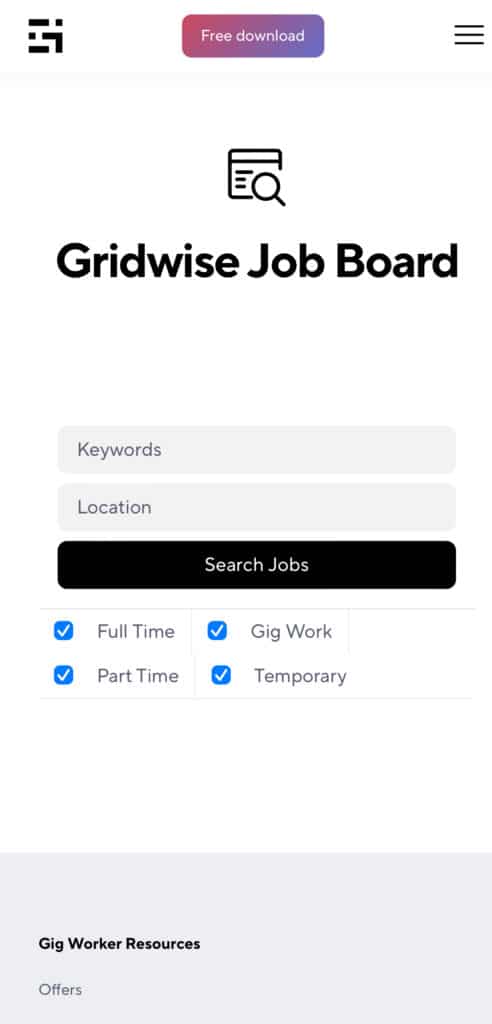
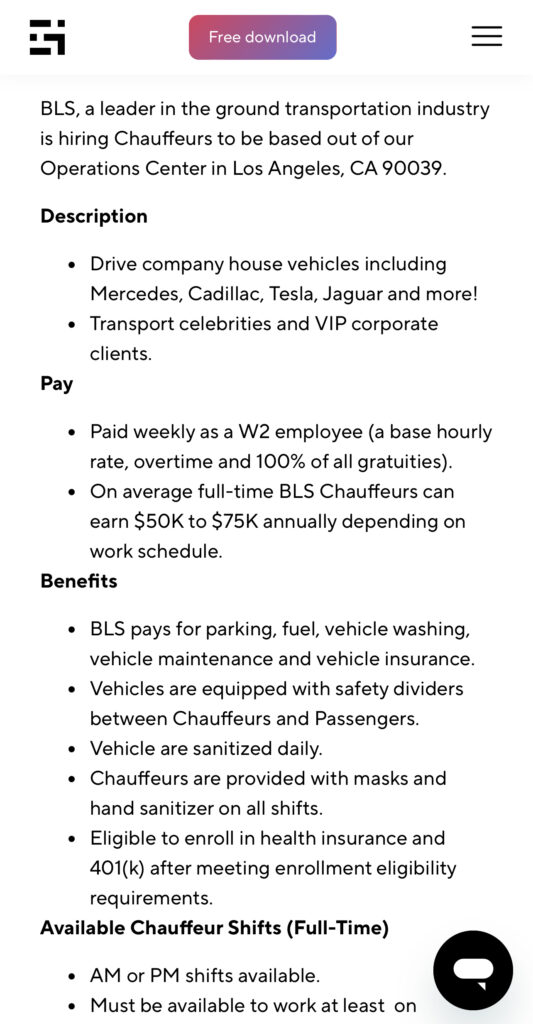
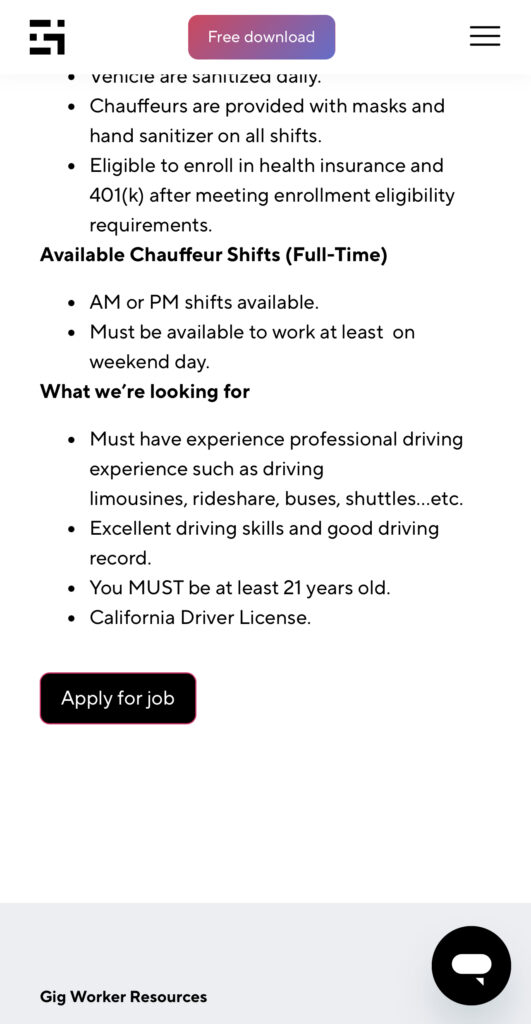
Many types of jobs are available. Adjust the search filter to see the full variety of opportunities that will let you cash in. Deliver food, set up catering, do rideshare driving, get paid for doing package delivery, and much more. You’ll find short-term gigs, long-term contracts, and part-time positions.
Perks of the Gridwise Job Board for gig workers
Gig workers who know how to make extra money will appreciate how the Gridwise Job Board lets you multiply your chances of bringing in big earnings. Here’s how:
- Increased stability. Use the Gridwise Job Board to find part-time or permanent jobs in addition to the part-time gigs you already have. Always keep a steady stream of earning opportunities flowing toward you.
- Flexibility and autonomy. Choose jobs that fit your schedule, work around other jobs and family duties, and still leave room for some fun in your life. Discover side hustles to supplement your full-time job, permanently or just for the season.
- Skill development. Find part-time work that lets you use a skill you already have, or try your hand at something new. It’s a smart way to develop a portfolio to showcase what you can do, or even to find permanent employment.
Get Gridwise and stay up to date on the Gridwise Job Board
Gig workers need plenty of information and assistance, and Gridwise is here to give it to you. Download the app and get essential features such as
- seamless earnings tracking
- mileage tracking
- expense recording, including notes
- low-cost and no-cost insurance benefits
- access to affordable medical, dental, vision, mental health, and alternative care
- professional services including legal and financial help
- deals and discounts
- weather, events, and traffic reports
- inside information on where and when to drive
More to know about gig work:

5 Best Mileage Trackers For Gig Drivers
Many drivers ask, “Do I really need a mileage tracking app?” The answer is simple: only if you want to have an accurate count of all the miles you can legally deduct from your taxable income! You might think your rideshare or delivery driving app has got you covered. After all, they do quite a good job of logging the miles you drive while you’re on a trip or delivery. But, if you want to have the best app to track mileage for Uber, Lyft, Doordash, Instacart, or the other apps you may use, you need more. Why is that?
Without a separate tracker, you’re missing the miles you drive in between pings. Did you realize that all the miles you drive, from the moment you begin your shift until it’s over (as long as you don’t drive several miles on a break to hang with your friends), are tax deductible! That means you need something besides your driving app to keep an accurate count of your travels. Read this Gridwise post to see how important it is to keep track of every deductible mile.
You won’t be surprised to hear that there’s an app for tracking miles. In fact, there are several of them. Here, we’re going to tell you about five top mileage tracking apps, and help you figure out which one is best for you.
Before we get to the list and identify the best mileage tracker app, let’s clarify what exactly a mileage tracking app is. According to G2.com’s technology glossary, mileage tracking is done for the purpose of keeping a log of mileage that is either reimbursable or tax deductible.
And yes, of course you can track your miles simply by taking readings on your odometer. But are you really prepared to account for how many miles you drove for personal reasons and subtract them from the total to get your business mileage? Even if you can remember all that and do the arithmetic, if you want an accurate reading of the miles you drive for business, and can therefore deduct, a mileage tracking app will save you a lot of trouble and prevent you from making costly errors.
Plus, as a gig driver, you have specific needs when it comes to a mileage tracker. Ideally, you’d be able to handle mileage tracking and several other functions all in one app. It can be maddening enough to deal with driving apps, particularly if you’re an avid multi-apper. You would want your mileage tracker app to help you keep account of other aspects of your business, including income, expenses, and inside information about the art of gig driving.
Not all mileage apps are equal, to be sure! Let’s look at five of the best apps to track mileage and figure out which is the best app to track mileage with Uber and Lyft, or what mileage tracker app is best for DoorDash.
1. Zoho Expense
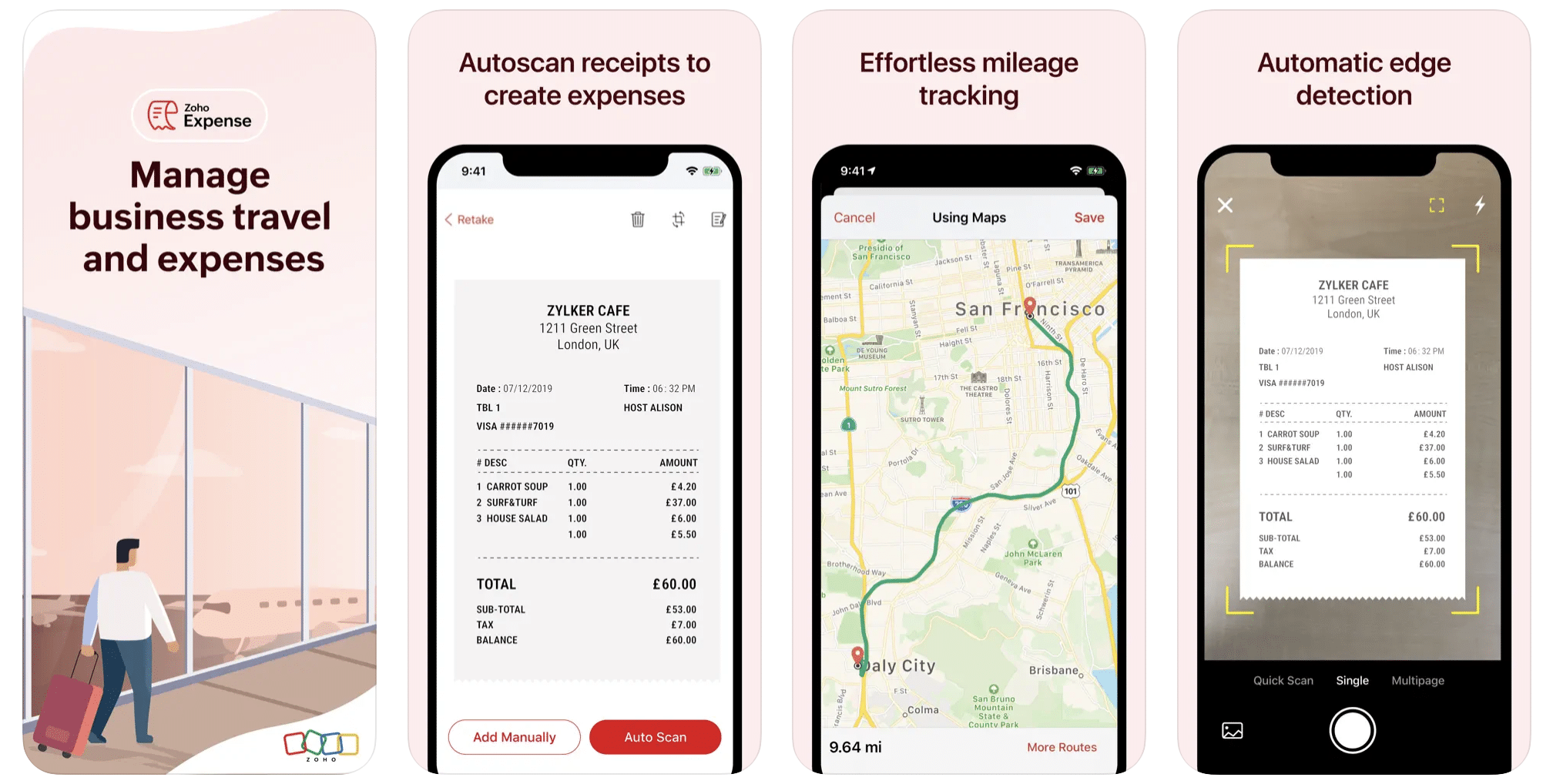
First up is Zoho Expense, which does exactly what its name says. This app is designed to allow companies to give employees a uniform way to create and submit expense reports. It can be used by individuals, including gig drivers, as well.
It includes a mileage tracker, as well as features that let you track other deductible expenses, including the ability to scan and record receipts.
Available on Android and Apple: Yes
Ratings: 4.8 stars on App Store, 4.7 stars on Google Play
Free Version: Yes
Subscription price: $3 per month, billed annually
Created specifically for gig drivers: No
2. Quickbooks Online
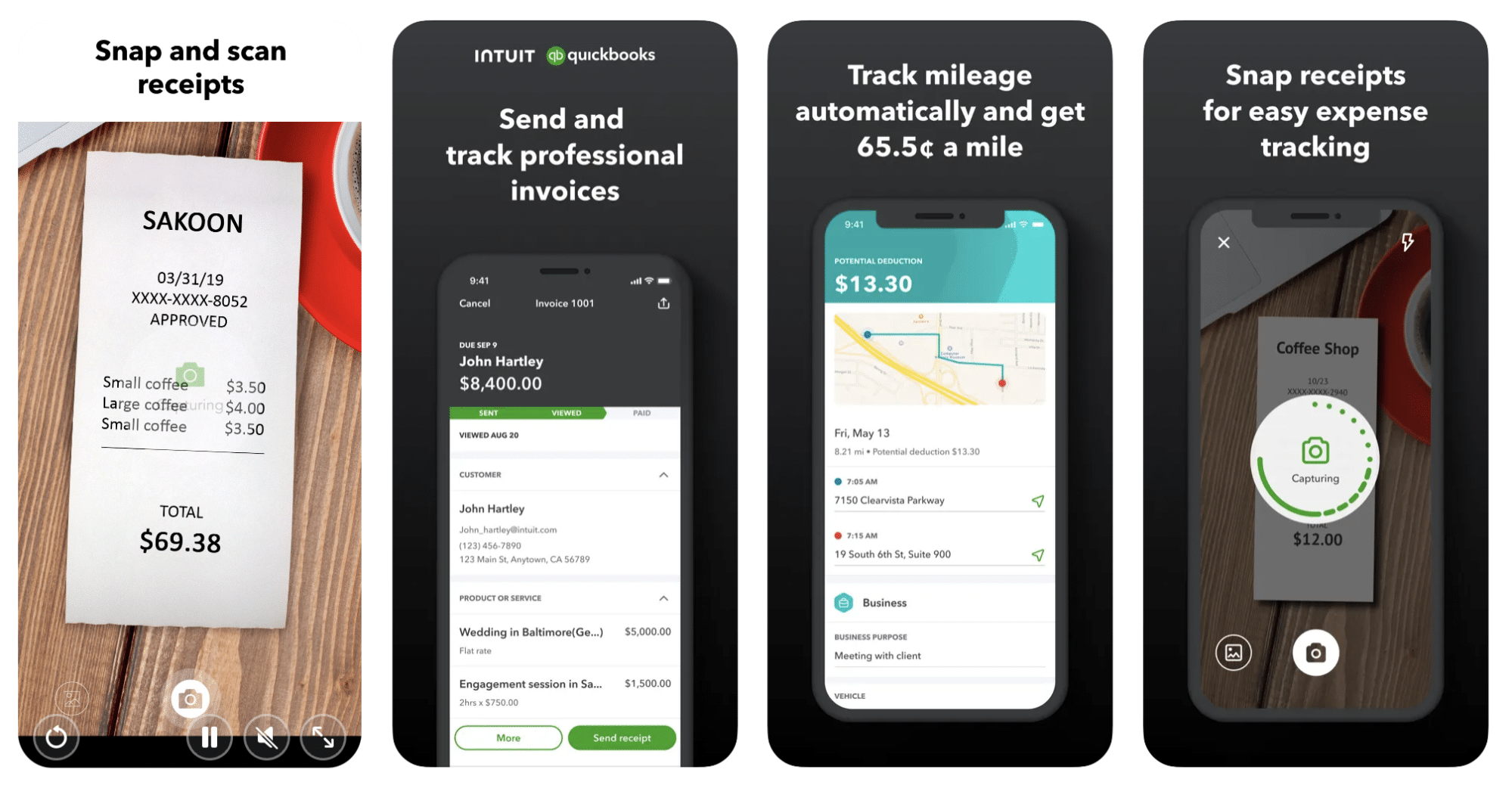
Quickbooks Online is a cloud-based app that allows you to track your mileage, earnings, and expenses. The information you enter can then be used to generate various reports that prepare you for tax time. It also allows you to create graphs that illustrate your cash flow, and includes a receipt scanner so you can instantly record deductible expenses. Quickbooks is popular, highly reliable, and designed mainly to help people keep track of their small businesses.
Available on Android and Apple: Yes
Ratings: 4.7 stars on App Store, 4.4 stars on Google Play
Free version: 30-day free trial
Subscription price: $15 per month for basic version if purchased for 3 months or more
Created specifically for gig drivers: No
Source: quickbooks.intuit.com
3. Shoeboxed
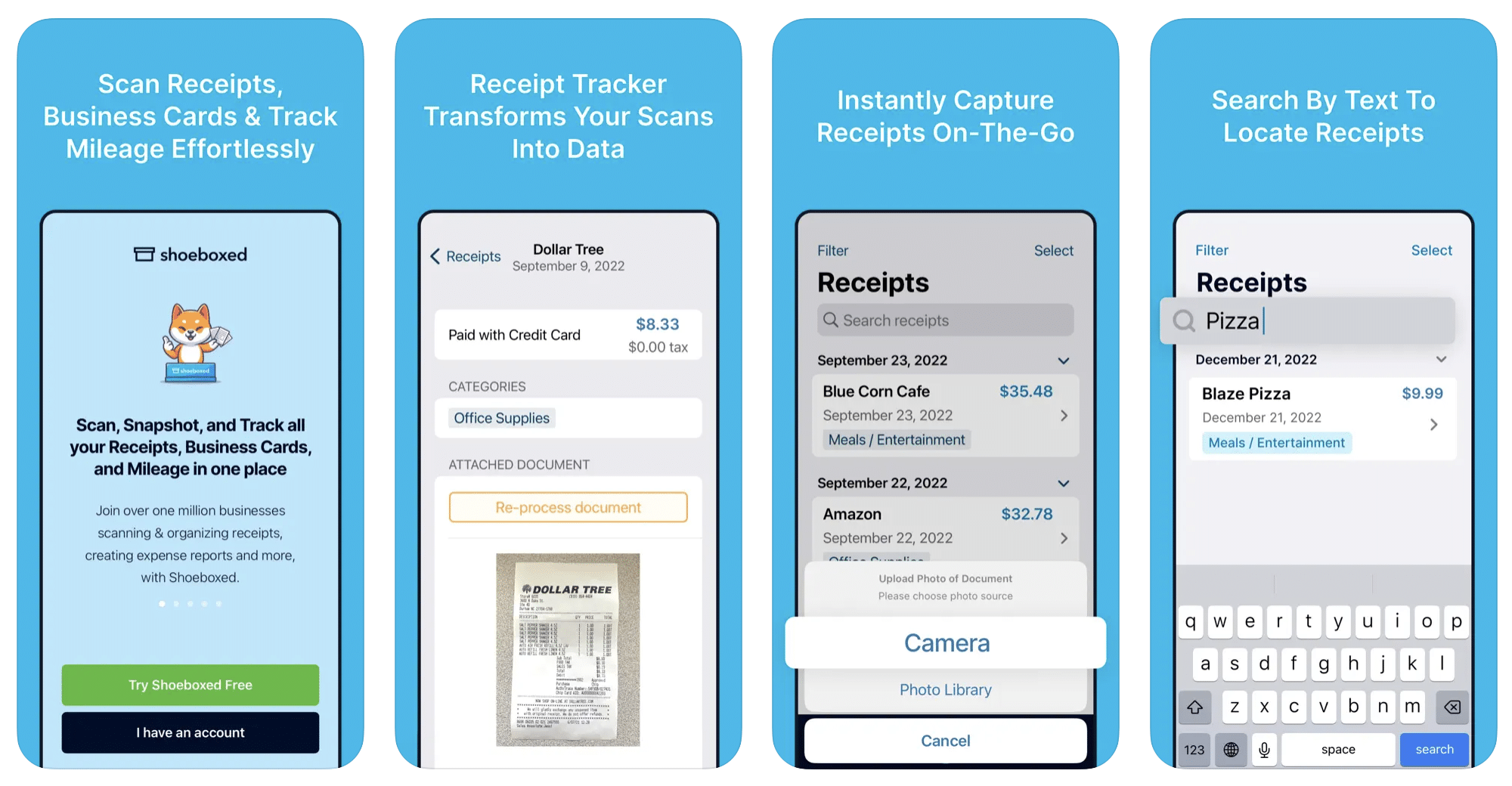
Shoeboxed started in 2007 as a service for scanning paper receipts into digital form. Now the app offers a free mileage tracker and has enabled users to scan receipts directly. It touts itself as the best mileage tracking app for DoorDash, but there are some elements missing that Dashers might like to have. While it provides features that record your expenses and prepare you for tax season, it doesn’t automatically track your earnings. The mileage tracker has a system where you can drop pins along your routes to make the tracking more precise, identifying those legs of a trip that you make for business purposes. The mileage tracker is “free” once you sign up for the basic version.
Available on Android and Apple: Yes
Ratings: 4.5 stars on App Store, 2.3 stars on Google Play
Free version: No
Subscription price: $18 per month for basic version
Created specifically for gig drivers: No
Source: blog.shoeboxed.com
4. Stride
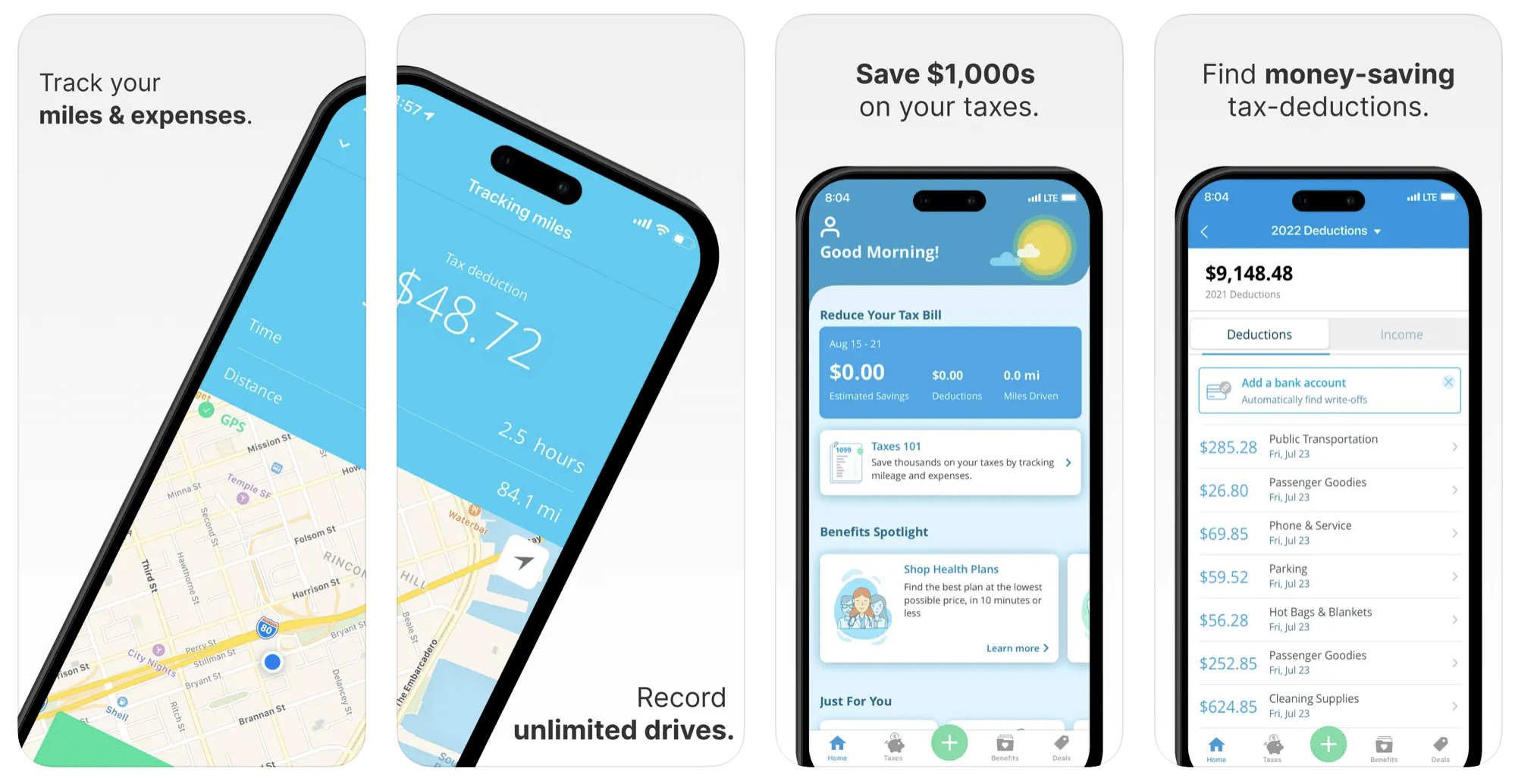
This free mileage tracker does a fair job of keeping track of the distances you rack up while gig driving, but it doesn’t automatically track earnings. It can be a big help, though, in tracking your expenses. You can link Stride to your bank account, and it will automatically scan your expenses to identify items you can potentially deduct. The app is totally free. This could make it the best free mileage tracker app, but there is a small price to pay. The app will persistently push you to consider various insurance plans that they are affiliated with. If you don’t mind that, this is a solid mileage tracker, even if it doesn’t track your earnings.
Available on Android and Apple: Yes
Ratings: 4.8 stars on App Store, 4.6 stars on Google Play
Free version: Yes
Subscription price: None. The app is free.
Created specifically for gig drivers: No
5. Gridwise
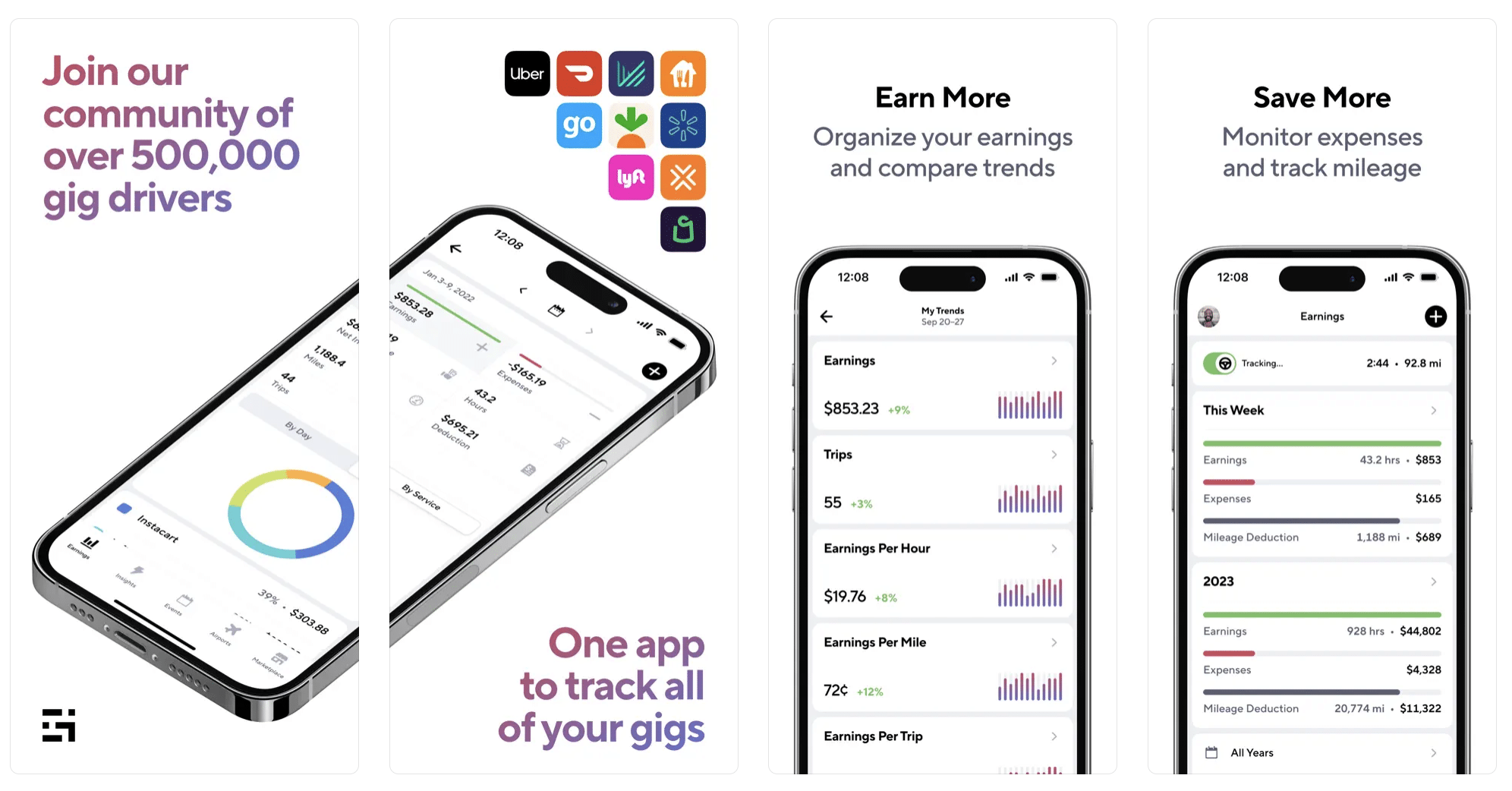
Gridwise has a free mileage tracker and free features that record your income and expenses. It gives you access to insurance and benefits, as well as insights about the best times and places to make the most money while gig driving. The Gridwise mileage tracker captures all the miles you drive while you’re on your driving shift, and it can be used if you have other trips you need to make which qualify as business travel.
Drivers love it because it is geared toward the needs of rideshare and delivery workers, providing free information about airport departures and arrivals, event start and let out times, weather, traffic, and more. The Gridwise Plus subscription adds value by providing additional insights and reports, discounts on benefits, the ability to export data in .csv format,, and more.
Available on Android and Apple: Yes
Ratings: 4.9 stars on App Store, 4.6 stars on Google Play
Free version: Yes
Subscription price: $9.95 per month for Gridwise Plus, or $95.99 per year (a $23.41 savings)
Created specifically for gig drivers: Yes!
What is the best mileage tracking app?
Now that we’ve checked them all out, we’re positive about the answer to that. Hands down, it’s Gridwise. Are we biased? You bet we are! But drivers love it too. Gridwise is the best mileage tracker app, and so much more. So many of the features are free, and the subscription to Gridwise Plus will pay for itself with additional insights to boost your earnings and deeper discounts on products and services.
Most important, Gridwise is designed specifically for gig drivers by experts who were once gig drivers themselves! Knowing what gig drivers need is a crucial step in creating an app that rideshare and delivery drivers can really use! Here are a few of the features, besides mileage tracking:
- seamless earnings tracking
- automatic, on/off toggle and manual mileage tracking
- mileage categorization
- airport, traffic, weather, and events information
- insights into where to drive and when to drive
- reports showing earnings across the platforms you use
- discounts on countless products and services for drivers
- additional resources for finding side gigs
- an informative and comprehensive blog
- affordable benefits, including insurance, medical, dental, and alternative practitioner discounts
- a community of drivers just like you
Don’t settle for just any app. Get the best mileage tracker, and so much more, from Gridwise!

Who are rideshare drivers: A demographic breakdown of rideshare drivers in the U.S.
The people who drive vehicles for Uber, Lyft, and other transportation network companies (TNCs) are a fascinating cross section of the general population.
Their job is straightforward: to prepare their cars for riders, wait to hear from riders who call them through an app, pick up riders, and drop riders at their destinations.
Because of the nature of their jobs, rideshare drivers need many of the same products and services that make driving their cars easier.
Some essentials include accessories; equipment, such as dash cams, and safety and cleaning supplies; fuel; car maintenance; and car repairs. Drivers also need services and tools to make running their business easier. Other must-haves include help with tracking their mileage and other tax deductions, assistance with legal issues and accounting, and options for insurance.
The fascinating thing about the rideshare driver population is, while they have all these common needs, they’re incredibly diverse in terms of age, education, family life, and social status. Because of this, there are all kinds of products and services that can grab their attention—and if you know how and when to appeal to them, you can hit a very responsive target audience.
To help you envision what the rideshare population is like, let’s look at a few pertinent facts. Data from our July 2020 demographic survey of more than 750 rideshare drivers present a picture of the breadth and depth of the rideshare driver population, and this provides ideas for how you can benefit from marketing to them.
Who are rideshare drivers?
The detailed breakdown of the many characteristics of rideshare drivers is rather surprising.
Take a look at the age, gender, marital status, and other demographic data to imagine how you can leverage this driver group to market your services and wares.
Rideshare drivers are generally 30 years or older
Our survey shows that the vast majority of drivers are actually over 30 years with the highest density of users being in the 50-59 year old range.
More men than women drive, but there’s still a healthy mix
Rideshare drivers are predominantly male, but women are certainly represented.
Many are married
Rideshare drivers are split down the middle when it comes to being part of a couple or staying single.
Even more have children
Many rideshare drivers relish the flexibility of their jobs so they can work around the kids’ crazy schedules.
The majority of rideshare drivers consider themselves full-time drivers
Many gig workers consider themselves full-time workers and put in 35+ hour weeks behind the wheel regularly.
Rideshare drivers are well-educated
Rideshare drivers are a educated bunch with a many having advanced degrees. At the same time, a number of drivers would be open to learning more about trades and skills that allow them to work in jobs other than rideshare driving.
Most rideshare drivers are on multiple platforms
Drivers have options when deciding where to focus their efforts. As they adapt to new economic conditions, we see them increasingly using more than one app to find riders. Many are crossing over to mix delivery driving in with rideshare.
Most rideshare drivers work for both Uber and Lyft, but there are still sections that choose to work with only Uber or only Lyft.
Uber attracts the most drivers, to be sure, but Lyft also has a great deal of appeal. "Other" consists of apps like Juno, Roadie and Via.
Most rideshare drivers also do delivery work
Most drivers are also working for grocery and food delivery on apps like Postmates, Instacart, Grubhub, Shipt and Doordash in addition to rideshare driving.
More drivers own their cars than lease them
Most drivers do own their vehicles instead of leasing or renting from places like Hertz or HyreCar.
Many drivers have a vehicle specifically for rideshare
Surprisingly, more than half of all drivers purchased their vehicles specifically for rideshare driving. This means they likely have more than one vehicle, and could benefit from more than the average share of vehicle maintenance and care products.
Cleaning is crucial for rideshare drivers
Drivers are constantly being rated by their customers, and cleanliness is a crowd-pleaser. Here you can see that drivers clean their cars a lot, so products and services that make this easier for them will be in demand. This chart shows how frequently drivers clean their cars.
Rideshare drivers generally prefer to be independent contractors
Rideshare drivers keep close track of their earnings and goals
Drivers also keep a close eye on their rideshare miles for tax purposes
Many drivers have you purchased rideshare insurance
Most rideshare drivers do not have a separate business bank account
Drivers are conscientious about tracking information related to calculating their net income, but many would benefit from knowing more about rideshare insurance and banking. Those who market products in such areas will definitely find, in rideshare drivers, a population in need of their services.
And, as the next chart shows, the rideshare driver population has a healthy income level. This means they can afford products and services that will allow them to increase their profits and improve their lives—and even have a little fun.
Not sure how you can market to rideshare drivers? Let the Gridwise team build a multichannel strategy for you!
Still not 100 percent sure how you should be engaging with rideshare drivers?
No problem!
At Gridwise, we have a team of marketers and designers who are experts in engaging and converting rideshare drivers across all channels and we’ll be happy to design a personalized strategy for you!
Simply reach out to sales@gridwise.io and we can set up a strategy session.
Will Uber and Lyft leave California
Both Uber and Lyft are threatening to leave California as a result of the latest developments in the fight over the employment status of rideshare drivers.
This is important for rideshare drivers everywhere, not just in California.
That’s because California is often a test bed for policy on the state level, and many other states are in the process of examining the relationship between rideshare and delivery companies and their drivers. What happens in California now will tell us a lot about the future of rideshare and delivery companies and how they classify drivers all across the country, and the globe.
In a previous post, we outlined the main differences between being an independent contractor and being an employee.
In this blog post, we’ll give you an update of what’s happening in California, and discuss whether Uber and Lyft could really leave California
Here’s what we’ll cover:
- What exactly AB5 is
- What Uber and Lyft have done to fight back against AB5
- What the companies might do if they lose the fight over driver employment status
- What’s best for drivers?
- How drivers can best protect themselves
Oh, and you can also check out our YouTube video on the AB5 situation in California below.
Now let’s dig in!
What exactly is AB5
AB5 went into effect in January 2020. It decreed that Uber and Lyft, as well as all companies that hire drivers and other gig workers (independent contractors), must now treat these workers as employees. This happened, de facto, because under the terms of the legislation a worker is an employee of a company unless:
- The worker is free to perform services without the control or direction of the company;
- The worker is performing work tasks that are outside the usual course of the company’s business activities;
- The worker is customarily engaged in an independently established trade, occupation, or business of the same nature as that involved in the work performed.
Let’s look at how these three conditions of AB5 compare with the relationship of a driver to a company.
As a driver, are you free to perform services without the control or direction of the company? What would you say to this? On the one hand, you do have control over the hours you work. But on the other… there are many terms you must abide by if you want to maintain your status as a driver in good standing. What happens when you are rude to a customer, refuse a ride, or otherwise operate outside of the company’s rules and standards? Most of us would say we aren’t completely “free,” given the nature of the job.
Is your driving outside the usual course of the company’s business activities? That depends on how you look at it. Uber and Lyft are rideshare companies—right? And Postmates, DoorDash, and Grubhub are delivery services? So would you be driving for any of these companies if you didn’t help them accomplish their business? So as a driver, it’s hard to see how rideshare or delivery work is outside the usual course of business.
Uber and Lyft, however, don’t see things that way. They claim to be platforms, or entities that merely connect drivers with riders, and deliveries with customers and their favorite eateries.
This is the biggest point of contention between the rideshare and delivery companies and state lawmakers.
Are drivers “customarily” engaged in an independently established trade, occupation or business of the same nature? Uber, Lyft, and others have a good argument here as many drivers drive for multiple platforms. Some even drive taxis, limousines, or buses along with being rideshare and delivery drivers.
What Uber and Lyft have done to fight back
While they technically are competitors, Uber and Lyft didn’t hesitate to join forces in fighting back against AB5.
At first, they did very little. They simply continued to operate as they always did, treating drivers as independent contractors. Then, they got their legal teams together to get proposed legislation on the ballot for November 3, 2020. Known as Proposition 22, this measure would reverse the provisions of AB5, allowing companies such as Uber, Lyft, DoorDash, Postmates, and the rest to continue to classify their drivers as independent contractors.
The companies have poured a lot of money into a campaign to persuade voters to vote “yes” on Proposition 22.
So far, according to this August 11 Slate article, the campaign known as Yes on 22 has about $110 million in funding, with $90 million coming from Uber, Lyft, and DoorDash, and $20 million from Postmates and Instacart. That’s definitely a substantial chunk of change—but it’s not nearly as much as the companies stand to lose if the measure doesn’t pass and they have to comply with AB5.
Proposition 22 would create a new definition called “app-based drivers.” Under that definition, drivers would be categorized as workers who provide on-demand services for delivery or transportation companies through an online-based app or platform. This would enable the companies to continue to classify their drivers as independent contractors.
Rather than waiting to see how Proposition 22 fared on the November 2020 ballot, the State of California sued Uber and Lyft in early 2020—and recently won.
The injunction in their favor found the companies to be in violation of the law, and forced them to comply with it. Uber and Lyft appealed the ruling, and just a few days ago, on August 13, were struck down again. Now they must comply with AB5 by August 20.
It would be fair to say the companies should have obeyed the law from the beginning. Yet the reality is, in order to make drivers employees, there would have to be a lot of scrambling to radically change their modes of operation. The fleet of drivers would have many adjustments to make, too. Since the companies are forced into a corner now, no one should be too surprised that they’re playing hardball.
And maybe the companies (and drivers) should have been prepared for the possibility of losing the lawsuit that was filed, and in the meantime, put together a system for making drivers employees.
They didn’t, though.
From their standpoint, if they had made these provisions, it would have been easier for them to give up… and in the process, set a precedent that could literally destroy the rideshare and delivery business’s potential to make a profit.
What the companies might do if they lose it all
In this game of chicken between the State of California and the TNCs, the next step for the companies looks pretty drastic. Uber and Lyft have stated they will be forced into suspending operations in California if they have to comply by August 20.
Gulp. That’s a big step—one that could be devastating to drivers. It also won’t be convenient for riders, or for transportation and delivery systems throughout California in general. People have come to depend on these services, more than ever in this tumultuous year. What will happen if these companies simply pull out of California?
Although that seems like an unlikely outcome, it isn’t impossible. Uber and Lyft claim that, while California represents a large amount of their business, it doesn’t return much of a profit. So if the companies DO leave, it might hurt California a lot more than it would hurt Uber, Lyft, and the other companies.
Moreover, this isn’t the first time Uber and Lyft have threatened to stop operating in a state or city—and when they tried it in the past, it worked.
Uber fought against Chicago, Houston, Austin, and San Antonio over stricter background checks. Uber and Lyft both left Austin on a temporary basis, and Uber left San Antonio. The government jurisdictions revised their regulations or overturned them through legislation, which like Proposition 22, was supported by the companies.
What’s best for drivers?
At Gridwise, our chief concern is that drivers are treated fairly, and have opportunities to make as much money as possible. Because of that, we’re very concerned about what really is best for drivers, not only in the case of California, but everywhere drivers work to get people and things they need to all the right places.
We have found that while many drivers would like to be employees of the rideshare and delivery companies, many others would not. As employees, drivers would receive benefits and stability, but they’d lose the freedom and flexibility of being independent contractors.
California’s approach, making drivers employees rather than independent contractors, is one way of giving drivers a more stable work situation. In Seattle, as this Gridwise article explains, city officials intend to establish a minimum hourly wage for drivers, and make the companies pay that to them.
Earlier this week, Uber CEO Dara Khosrowshahi suggested another possibility for classifying drivers. He opined that companies who use gig workers should be required by law to create benefits funds to cover the things they want and need. This might include anything from health benefits to paid time off.
The difficulty of getting benefits and other employee entitlements is real—but so is the possibility of bankrupting the companies in the process.
What do you think is the best way to get benefits for drivers, while keeping the companies in business? Do you want to be an employee, or a contractor? Would it be enough if companies established benefits funds, like Uber’s CEO suggested?
Leave us your comments below. We want to know what you think.
And… what can you do if they do stop operating in California, or in your state?
How drivers can best protect themselves
If you’re driving for just one platform right now, you could be making a big mistake.
It would be wise to sign up with at least two different companies, and probably more. Why? Because even if you don’t drive for them all on a regular basis, you’ll be covered in case you need to shift over in a pinch.
Companies can go out of business, or like Uber and Lyft in the case of California, they could stop doing business altogether.
You’ve probably seen the “Sign up with all the apps” driver mantra on your favorite Reddit thread or Facebook group, and we’re repeating it here. Different companies will have different reactions to situations like the one in California, or wherever you are.
In the event you can no longer drive for your regular company, have a backup plan in place. Don’t let changes in the political landscape disrupt your driving, and earning, rhythm. It can take a week or more to get a background check, and in many cases the companies will wait-list you before it’s even possible to apply.
How do you track your earnings on all those different apps? Download Gridwise, if you haven’t already. On top of being able to see your stats and record your important tax deductions, you’ll get easy access to our blog and the Gridwise YouTube channel. Plus, there are driver discounts and offers, all on the Perks tab.
Don’t forget, also, to sign up for our gas card giveaways, through the app and on our Facebook page. We like you, so we’re hoping you’ll head over there and like us too. If you do … there could be real gas card-type gold in your future.
Executive order creates a $400 unemployment subsidy—but is it enough for drivers
For the last few weeks, we’ve been watching and hoping that the federal government would find a way to extend the $600 Pandemic Unemployment Assistance (PUA) subsidy that expired July 31, 2020.
But, sadly, a week after the expiration date it became apparent that White House representatives and congressional representatives from both parties couldn’t come to an agreement about extending it.
Both sides were resolute in holding their ground on many of the points in their respective versions of proposed legislation to cover pandemic relief. The Democrats, who introduced their legislation in May 2020, held fast to the $600 weekly unemployment subsidy. Republicans, who didn’t introduce their bill until July 2020, proposed reducing the subsidy to $200 per week.
Neither side would budge, and as of Friday afternoon, August 7, negotiations had stalled. President Trump responded to this impasse by signing four executive orders, one of which authorized the continuation of PUA supplemental payments at a reduced amount.
In this post, we’ll take a look at what’s been done to break the logjam created by stalled negotiations among the usual political players, and what drivers can expect, including:
- The executive order and what it offers
- What we didn’t get… yet
- When we can expect money to begin flowing again
- What might happen if Congress (or someone else) objects to these orders
- How drivers can do their part
The executive order and what it offers
The executive order, says the American Bar Association, is “a signed, written, and published directive from the President of the United States that manages operations of the federal government.” Ideally, decisions about spending for programs like the PUA are made by Congress, which is the only branch authorized to create laws.
This was a unique situation, however. Since Congress and the White House were unable to agree on what to do about extending certain provisions in the CARES Act, which addressed acute problems arising from the COVID-19 pandemic, the executive order came into play. President Trump signed four executive orders related to extending provisions in the CARES Act on Saturday afternoon, August 8, 2020.
Now, the federal government is under order by the president to execute the provisions set out in the executive orders, as of the time they were signed. The order pertaining to the extended unemployment subsidy is officially titled the “Memorandum on Authorizing the Other Needs Assistance Program for Major Disaster Declarations Related to Coronavirus Disease 2019.”
When the $600 unemployment subsidy expired on July 31, we all wondered what would happen next, and now we know. Per the executive order, the supplement will continue through December 27, 2020, but it will be $400 per week rather than $600.
The president and a number of Republican legislators are convinced that an extra $600 per week is too much. They’ve often said publicly that it was more than many people earned while working—and by earning more money for staying home, they had little incentive to return to work.
Those of us who need that money, and still find it hard or impossible to go out and drive and deliver, see things quite differently. But even though the $400 is less than we had before, it’s still $200 more per week than the Republican legislators wanted us to have.
The other provision in the order is that the federal government will only pay 75 percent of the $400. The rest, the president says, will be covered by “unspent” money that was already allocated to the states through previous legislation.
With a reduced rate and questions about whether states are going to be content (or financially able) to pay 25 percent of the supplemental pay for their unemployed workers, there could be controversy, maybe even lawsuits, that ultimately alter the effects of this executive order. For now, though, it’s what we have.
The president signed three other orders on the same day, which covered:
- A deferral on payroll taxes
- A moratorium on evictions
- Student loan payment deferments and interest rate change to 0 percent through December 2020
What we didn’t get... yet
Those of us who still haven’t been able to return to driving, as well as those who have, might be wondering… did the President also authorize a second round of those nice, useful stimulus checks? The answer is no. There was no mention of the stimulus check outside of the political discussion that preceded the signing.
From what he has said, it seems like the president would support a second round of stimulus checks, but there was no executive order issued. “Why?” you might ask.
Because executive orders, despite their reputation for being powerful and broad in scope, do have limits. Congress, in particular the House of Representatives, holds the “power of the purse,” meaning that only Congress has the ability to tax and spend public money on behalf of the federal government.
Stimulus checks, therefore, must be authorized by Congress. So… in regard to the stimulus issue, it’s back to the drawing board with the stormy negotiations.
When will money begin flowing again?
When President Trump was asked this question in an interview, his only answer was that he wants the money “to get there quickly and in a non complicated fashion.”
As vague as that answer may sound, no one, even the president, can say for sure how long it’s going to take for money to begin flowing again. It’s reasonable to expect some delays, which will probably vary from state to state. The fact that the PUA subsidy was allowed to expire before the executive order was signed will likely cause a delay in processing the extra unemployment payments.
Now that states will have to pay $100 of the $400 weekly supplement, some accounting and adjustments to computer systems will invariably be necessary. Millions of drivers who had to wait for states to get up to speed with the PUA, and to set up systems to process payments, are painfully familiar with this particular drill.
Hopefully, we’ll find out soon when money will be available. And when we at Gridwise hear the latest news, we’ll pass it along to you without delay.
What could happen if Congress (or someone else) objects to these orders?
The political climate around executive orders is rarely cool and breezy. But during an election year, and in an era when politicians are worlds apart on so many levels, the sky will be on fire. No one can say whether Congress will go along with the principle of the unemployment subsidy executive order, and work out some compromise on other elements of COVID-19 pandemic aid.
Those who remain opposed to the executive orders could take their objections to court or pass legislation that strikes them down. We can speculate about that, but it would be useless. It’s impossible to know what could happen in the current political environment.
If a lawsuit is filed, a judge could put a stay on the order, making it impossible for the money to be sent through until the case was decided. If a law is passed to knock down the order, it would be wise for the authors of such legislation to have even more money allocated for enhanced unemployment payments. People are not going to be happy if the supplemental payments are offered… and then rescinded, over political infighting.
How drivers can do their part
It’s hard to avoid becoming frustrated over this situation. While it’s good that drivers who need the money will get some payment, knowing that it’s still not a sure thing is unsettling. Also, the reduction from $600 to $400 stings.
As good citizens, we all know we’re supposed to do our part to ensure that our government puts us first when it comes to why, when, and how they enact the laws we must live by.
If you want to do your part, the best thing you can do is participate in the process of government. That means attending local meetings when an issue that affects you is being discussed, voting (of course), and letting your representatives in Congress and the Executive Branch know what you think, and what you want them to do.
Here is where you can find contact information for your congressional representatives (House and Senate).
Here is how you can contact the President and White House staff members.
You might be surprised to find that, especially in an election year, hearing loud (yet courteous) voices has a way of getting politicians to move in the desired direction.
Remember to check in with Gridwise
We’re on top of all the news that affects rideshare and delivery drivers, so visit our blog often, and tune into the Gridwise YouTube channel for the latest. And, if you’re already back out there working at your driving and delivery gig, you know how crucial Gridwise’s powerful features are when you want to maximize your income.
Track mileage, calculate earnings, use multiple apps, get airport event info, and simplify your driving life. Say what? You don’t have the Gridwise app?? Well, download it now!

Pandemic Unemployment Assistance update: Will Congress extend $600/wk payments
We knew this was going to happen.
When the CARES Act passed Congress in late March, drivers and other independent contractors were given the ability to collect Pandemic Unemployment Assistance (PUA) from their individual states.
On top of that, the federal government added an extra $600 per week to the compensation. This was a huge relief for many drivers.
At that time, it seemed like having the extra $600 per week through July 31 would be long enough to see us through. A look at the situation now tells us that this benefit has run out before we stopped needing it.
So what will our government do?
As of August 5th, 2020, there are high-level discussions among White House representatives, the Speaker of the House, and the Senate Majority Leader. It would be great if we could report that a deal has been struck, and it calls for an extension of PUA provisions and the federal subsidy. However, as of this writing, the negotiations are at an impasse.
The one thing all major players agree on is the need for another round of stimulus checks. The amount should be around $1,200, but like all topics related to coronavirus relief, the final number is still under negotiation... a very long, complicated, and contentious negotiation.
In this blog post, we’ll examine what drivers need, what’s happening in the negotiations, and what options remain if an agreement doesn’t get reached soon. We’ll include:
- What drivers need
- What the White House wants
- What the Democrat legislators want
- What the Republican legislators want
- What’s likely to happen
- Options if no agreement is reached
What drivers need
Many drivers have been able to go back to work, but others still need support from the PUA program and the federal subsidy. Those of us who were rescued by this safety net are very aware of how necessary this income was, and in some cases still is.
Quite a few politicians make the point that the $600 per week subsidy is often more than workers, including drivers, earn when they’re on the job. Their concern is that the extra money provides an incentive for people to stay home, rather than returning to work. Although this might be the case for some drivers, for others it certainly isn’t because they are unable to return to work.
Those who have been infected with COVID-19, are in quarantine, are part of a high risk group, or live with someone who is at elevated risk, absolutely cannot expose themselves to people who may be carrying the virus—which they certainly are while in the close quarters of their vehicles.
Delivery drivers are also exposed to risk, since they come into contact with restaurant workers and other individuals they encounter when doing pickups and deliveries.
Another consideration is the economies that are still shut down in many localities. While some states and cities are trying to open up and resume an economic rhythm that’s as close to normal as possible, most have not been able to do that.
It can be very difficult for rideshare and delivery drivers to earn money at the same levels they did before the pandemic began. It can also be challenging to come close enough to those levels to make ends meet.
So, even though fewer drivers may need unemployment compensation, the fact is that many still do. Therefore, drivers and all people who find themselves out of a job or unable to earn at acceptable levels need the executive and legislative branches to come up with a solution that will provide continued relief… soon.
What the White House wants
The White House originally proposed that PUA and federal subsidies be continued through September 30, 2020, but that the weekly supplement be reduced to $200. After September 30, the amount of PUA would drop to 70% of an individual worker’s employment income.
When negotiations actually began, the White House proposed a one-week extension of the $600 subsidy, and the Democrats (Speaker Nancy Pelosi and Senate Minority Leader Chuck Schumer) soundly rejected it.
After that, White House Chief of Staff Mark Meadows put what he called a “skinny proposal” on the table. This would have included four months of federal subsidies at $400 per week, plus $105 billion for schools, liability protections, and some amount (not specified) for the Paycheck Protection Program.
We don’t know what the final numbers will be, but we do have some idea of what the White House wants:
- Continuation of PUA with limits on the weekly subsidy and duration of payments
- Money that’s earmarked for helping schools open safely
- Provisions to utilize previously allocated funds and/or additional funds for the Paycheck Protection Program
- Extension of the eviction suspension provisions
- Funds for additional costs incurred by the US Postal Service
- Liability protection for businesses,hospitals, and other institutions, to protect them from lawsuits by workers and consumers (the White House has indicated a willingness to strike a deal without this)
What the Democrat legislators want
Speaker Pelosi and Minority Leader Schumer have articulated a broader plan for virus relief. The House of Representatives passed the Health and Economic Recovery Omnibus Emergency Solutions Act in May 2020.
Known as the HEROES Act, it would allocate some $3 trillion to the cause of supporting continued unemployment benefits, hazard pay for essential workers, suspension of student loan payments, and aid to states that face fiscal problems due to the impact of COVID-19.
Some more specific elements of the HEROES Act include:
- Continuation of PUA with the $600 weekly subsidy through January 2021
- Suspension of student loan payments, plus the excusal of up to $10,000 in student and private loans
- Rental assistance
- A ban on evictions
- Mortgage assistance
- $900 billion+ in direct aid to states and municipalities, to be allocated as needed
- Healthcare-related spending
- Small business assistance
- Reduction of tax deduction caps for individuals
- Money for the US Postal Service
- Agriculture aid
- Limits reimposed on business loss deductibility
This legislation was passed by the House of Representatives on May 15, 2020, but it is not likely to make it through the Senate without major modifications. In fact, the Republican-majority Senate found so much wrong with the HEROES Act that they introduced a plan of their own.
What the Republican legislators want
Republican legislators maintain that the HEROES Act is excessive, and that many of the allocations it includes have little or nothing to do with COVID-19 relief. In response to the House bill, the Senate passed the Health Care Economic Assistance Liability Protection and Schools, or HEALS Act.
Like all the proposals, the HEALS Act provides for a second round of stimulus checks. There’s also money for the PPP program, and a change in unemployment benefits. It is the same as the original Republican proposal: $200 per week through September 30, and then 70% of the worker’s income after that, up to the individual state cap. Here are some more specific details:
- Additional PPP loans to businesses that are still making 50% or less of previous income
- Continuation of PUA but at $200 per week, and only through September 30, then to 70% of income
- Liability protection for businesses, hospitals, and other institutions to protect them from lawsuits filed by workers and/or consumers
- Healthcare aid aimed at COVID-19 testing, treatments, and vaccines
- Protection from premium spikes for Medicare recipients
- Incentives to manufacture PPE made in the United States
- Tax breaks, including 100% deduction for meals and entertainment
- Money to help schools open safely
What’s likely to happen
At this writing, the negotiations are moving along so slowly they appear to be at a standstill—but they are moving. White House representatives went to the Republican Senate leaders to complain that they cannot get the Democrats to move. The Democrats remind Republicans that their proposed HEROES Act was available for review in mid-May and was basically ignored. So here we are.
Of course, Democrats and Republicans always see things differently, but why is this particular negotiation so difficult?
For one thing, the two parties are pretty much divided as decisively as the Hatfields and the McCoys. There isn’t much reaching across the aisle these days. The more pressing reason for the stubborn contention, though, most likely stems from the fact that this is an election year.
Each side is always jockeying for position, but now they’re pressing harder than usual to make the other side seem uncooperative, unreasonable, and of course, not worth voting for in November.
All this is getting a bit unsettling, as Congress is scheduled for its yearly August recess. But according to an August 3 CBS News report, House Majority Leader Steny Hoyer said the recess will not happen “until such time as we adopt COVID-9 legislation.”
Certainly the idea of missing August recess might motivate most of Congress… but if that doesn’t, the White House just added new incentive at the August 5 Presidential press briefing.
President Trump hinted that, if no agreement is reached, he could use executive orders to extend PUA and eviction suspension, as well as other provisions designed to help individuals who continue to be directly impacted by COVID-19.
It’s our guess that (at the eleventh hour) there will be an agreement, an unimaginable amount of tax dollars will be spent, and there will be some form of PUA for drivers in need that should extend into the foreseeable future.
The details are yet to be divulged, but as soon as they are, we’ll get them to you—just keep watching for our next post.
Keep current with Gridwise!
Not only do you get easy access to our blog and the Gridwise YouTube channel when you download Gridwise, you get the ultimate assistant for rideshare and delivery drivers at your fingertips.
Track your mileage and earnings for all the apps you work with, and get updates on airport traffic and events in your town. We’re rolling out some features that will make Gridwise even better, so if you want to get the latest updates, be sure to download Gridwise now.
Sweet Side Hustles: Companies That “Ad” Value to Your Ride
Want to Make More Money?
Who doesn’t, right? Well as a rideshare driver, you have more opportunities than you might realize to generate income just by driving your vehicle around … because your vehicle is valuable to advertisers.
There are several reasons why advertisers covet your vehicle, and the fact that everybody sees it tops the list. You drive through busy city streets, across bridges and through tunnels, past big events, schools, and hospitals. Plus, you take people with you, or you deliver food and other items to their doors.
Companies would love to have the chance to get their logos, graphics, and taglines in the public eye for even half the time your ride is visible on any given day. So, these companies have come up with what they view as a win-win situation. They get exposure by using your vehicle to carry their ads, and you get a sweet deal because they’ll pay you for the privilege.
In this article, we've rounded up the best ad-carrying options out there for drivers. Check them out and see just how much money you can make with little effort on your part.
Inside the Car
Play Octopus
Very few things catch the eyes of riders faster than video games, except maybe the chance to win cash prizes—and Play Octopus has both. You apply to get a free tablet, your customers get their games on, and you can earn up to $100 per month.
Play Octopus pays you to make their games (and the occasional ads appearing on the tablet screen) available to your passengers. The more you encourage your pax to play, the more Play Octopus pays you. There’s also a referral program that allows you to earn bonus cash by referring other drivers.
On the Outside and On Top
Mobilads
Mobilads calls itself “America's leading rideshare car-wrap advertiser,” and they pay generously. You can get up to $500 per month for carrying their creative cargo with a full wrap on your car, and $250 for letting them cover your doors.
The company’s clients are some of the gigantic advertisers, so there are plenty of dollars coming their way. There’s one condition for drivers, though: You must be on the road for at least 40 hours per week, so you'll need to be a pretty big deal driver.
Wrapify
Sounds like ads that get wrapped around your vehicle! Wait—these are ads that get wrapped around your vehicle. Don’t worry, though, Wrapify, Inc. has figured out ways to protect the paint.
You don’t have to be a rideshare driver to sport their wraparound ads on your vehicle, but if you are, you’ll do very well. Wrapify pays by the miles you log in your car. It also monitors your location to gauge local foot traffic, adjusting payment according to how many people are likely to lay eyes on your vehicle.
You can earn up to $300 a month with Wrapify. You download the app, the company comes and puts the wrap on your car, and you’re in business. Just don’t drive it into an Uber or Lyft hub while it’s wrapped, since it could violate their policies.
Nickelytics
This ad-wrap company offers you options that allow you to limit how much of your car you’ll devote to ad space. Your choices include covering just the back windshield, partial wrap, or full wrap. Hey, just like tattoos! The company claims to have cleared its wraps with both Uber and Lyft for compliance.
As long as your vehicle is a 2010 model or newer, and you drive 30 or more miles a day, you can benefit from Nickelytics. They’re in eight markets now, and are expanding in 2020. If you’re up for that full wrap option, you can rake in up to $300 per month.
Wrapping It Up and Topping It Off
We said at the beginning of this article that you have more opportunities to make money than you might realize—and now you do realize
We also want you to remember there’s another tool that can help you make more money, and drive to where the biggest crowds will see your flashy ads and play with your video games and rock out to your music players. And that tool is ...
Gridwise!
Our app keeps you on top of local events and weather, and also tracks your mileage, so you’ll always know if you’re cutting it with your mileage quota. What’s that? You don’t have Gridwise yet? Well you can remedy that right now by downloading the Gridwise app.
Uber is using drivers’ wages to pay airport fines… without telling drivers
You read that right.
If an airport official cites an Uber driver for a traffic infraction, Uber pays the fine and then deducts the fine from the driver’s pay.
Most drivers don’t have a chance to defend themselves, and some have no recollection of the incidents in question. In many cases, the incidents may never have happened at all.
We certainly don’t think that’s right, and we’re pretty sure you won’t either. In this post, we’ll explain what we know about this puzzling situation by covering the issues it raises.
- The perils of airport pickups and drops
- How Uber’s deals with airports skip over due process
- Who profits? Who pays?
- What can drivers do to stop this?
The downside of airport pickups and drops
Back before COVID consumed us (when things were normal), the average driver would say that airport runs constituted a large part of their revenues. Yet long, lucrative rides to and from the terminals don’t come without risks.
There aren’t many drivers around who don’t have a story about getting cited, scolded, and/or yelled at by surly airport cops and dispatchers.
With no-go zones, commercial curbs, no parking areas, pedestrian-only sections, Uber decals that come unstuck, and speed limits that can be exceeded even while you ride your brakes, it is hard NOT to break some kind of rule at most airports.
So what happens when you get on the wrong side of airport protocol? In most cases, you receive a citation. If you decide to admit to the infraction, you’ll pay a fine and be done with it. If you’re absolutely sure you didn’t do anything wrong, then you go to court, tell your side of the story, and hope to get the case dismissed and the fine refunded.
At least, that's what you’d think. But for drivers working at several airports, something different is going on… something that’s not quite on the up and up.
How Uber’s agreements with airports skip over due process
Specifically, this has happened to drivers working at LAX, San Francisco, and San Diego airports. Here’s the scenario …
Drivers mysteriously received notifications from Uber informing them that they had committed an infraction at the airport. The notification made it clear that there was no need for the driver to do anything, including mount a defense. Uber was simply letting the driver know that the citation was taken care of… and the amount of the fine would be taken from their wages.
How would you react if you got that message from Uber? At first you might think, “Oh good, Uber’s paying my fine for me.” But when you got to the part about money being taken from your pay? Your reaction would likely be anything but positive.
Even worse, suppose you were never told about the alleged infraction in the first place? Maybe the ticket-writing official said you did something wrong, but you’re absolutely positive you didn’t… and now, the $100 you were counting on for gas money was used to pay a bogus citation.
This happened to a driver named Tedros—not just once, but multiple times. According to a July 22, 2020 article on the website VICE, he got in touch with Uber to ask why it happened. He received a response saying that per his agreement with Uber, he was responsible for all traffic citations. Since the airport sent the citation to Uber with his license number attached to it, the cost of the fine was coming out of his wages. “There was no way for me to contest the citation,” says Tedros.
After you’re done getting fired up about that, you might start to wonder what right an airport official has to issue a citation without talking to the driver, stating what the infraction was, and giving the driver a chance to appear before an impartial party in order to dispute the charge. Yeah. We wonder that too.
Who profits, who pays?
This all comes down to contractual agreements that Uber makes with airports. Airport officials are allowed to cite drivers and then send Uber the bills—and according to the VICE article, the fees collected are quite substantial. The article cites data collected by the Mobile Workers Alliance, a SoCal advocacy group that represents gig workers. The data show that at LAX alone, the Los Angeles World Airports Authority issued 11,117 citations to drivers, and collected $3.8 million dollars from drivers between 2016 and 2018. Uber, complying with their agreement with the authority, deducted the fees from drivers’ payments.
This isn’t the only way airport authorities siphon money from the rideshare business. In Los Angeles, the airport authority charges Uber drivers $4 per ride, whether the ride is a pickup or drop-off. These fees are normally paid by the passengers.
In 2018 alone, there were 8.9 million rideshare trips involving LA airports, resulting in almost $36,000,000 in fees landing back in the authority’s coffers. San Francisco charges $5 per ride, and had more than 10 million rideshare trips involving their airport facility in 2018, making their take around $50 million.
That’s a lot of dough.
Uber also profits from the airport rides. The longer distance and extended time these airport trips normally involve add up, and so do the company’s profits. And yes, drivers benefit from the airport rides they provide. However, when they receive citations, we don’t think they should be presumed guilty and have their pay docked for the fines.
To be fair, Uber and other rideshare companies pay airport authorities for the privilege of doing business. But we can easily make the case that these costs are, at least partially, passed on.
When we examine the airport ride (and citation) dynamic closely, and answer the question we posed at the start of this section, here’s what we find:
- The airports profit
- Uber profits
- Drivers profit—and drivers pay
- Passengers pay
Where, in this dynamic, do Uber and the airports pay? We can’t seem to figure out under what circumstances that might occur.
Please understand, we’re not saying that drivers shouldn’t have to pay fines when they commit infractions. We are saying that drivers deserve the chance to defend themselves if and when they do get cited and fined. In the case of these “phantom citations,” where drivers are totally unaware of the situation, it’s even more important that they at least hear what they supposedly did wrong.
By Uber striking this deal with airports, whereby they can just admit to an infraction on a driver’s behalf and then dock the driver’s pay for the fine, they’re doing more than just being unfair. They’re actually trampling on the drivers’ rights to due process under the Fifth Amendment of the Constitution. “I think it’s a due process issue; the government is taking away their money without them understanding why,” says Veena Dubal, a law professor at UC Hastings and gig economy expert.
Fortunately, this isn’t happening everywhere. VICE reporters spoke with drivers in New York City, Chicago, Atlanta, and Sacramento, who said they are able to seek legal recourse, and that Uber doesn’t automatically deduct the fine from their wages.
What’s the situation in your city? Comment below and tell us what you know.
Can drivers stop this?
Unfortunately, there isn’t much individual drivers can do to stop Uber from taking money from your pay for fines, even if you were never informed you committed an infraction.
When you sign up to be a driver with Uber, you agree to the company’s Terms and Conditions. Yes, there is a ton of verbiage in that agreement, and we all skipped over at least some part of it. But now, read this tiny section closely. It tells you what Uber’s “rights” are with regard to tickets, citations, and other such unpleasantries. It doesn’t say much about your rights.
Deductions; Set-off. You also agree that Fares, incentives, and any gratuities may be used to satisfy a court order of garnishment against you; to reimburse us for citations, tickets, or other administrative penalties or fines assessed by governmental entities arising from your conduct; or to reimburse us for any erroneous overpayment to you.
Yet the situation isn’t completely hopeless. There are steps drivers can take to circumvent the maddening process of Uber taking your money without your consent.
- Know the ropes. Each airport has certain rules that all drivers must follow. Don’t know yours? You’re in luck, because Gridwise has them for every major US city. Visit the Gridwise blog’s airport section for current information about the rules, boundaries and obligations that apply in your town. When you know the rules, you’re far less likely to unknowingly break them.
- Petition Uber. You can always contact Uber Support. Placing a phone call will normally initiate a written exchange that you can use as documentation. There’s a chance that they’ll listen to your side of the story, and maybe even put the money back into your account. Who knows, if enough drivers do this, maybe it will motivate Uber to change their agreements with airports.
- Get a dashcam. No matter what you say was the case at the time of an alleged infraction, it’s still a “He said, she said” situation—and without proof, it can be impossible to prove your case. Having video and audio of the exchange between you and the officer involved will add weight to your argument, and possibly settle the dispute, if you get the opportunity to contest the ticket.
- Consider legal action. While it’s probably going to cost more to secure a lawyer than it will to simply pay the fine, there are principles here worth fighting for. If you can get several drivers to create a class action, you might have some success. You may not be able to reverse fines or erase infractions, but you might get Uber to change its policy about taking money directly out of driver accounts.
- Get active with drivers’ rights groups. As situations like this arise, as well as the contractor vs. employee controversy and COVID-19 safety issues, it’s more important than ever for drivers to work together. Groups all over the world are dedicated to getting fair treatment for drivers. Join one near you, and ask what you can do, together, to stop the unfair airport fine practice.
Of all these actions, “know the ropes” is probably most important.
Remember to consult the airport section of the Gridwise blog to discover what you need to know about driving at your airport. Also, the Uber app has information about your airport rules and regulations. You probably had to sign off on those at some point, but if you didn’t scrutinize them then, do it now.Information for rideshare and delivery drivers is what Gridwise is all about. Make sure you download the app to track your earnings, get airport arrival and departure information, weather conditions, events, and links to driver discounts and special offers. Also, make sure you catch the rest of the articles on the Gridwise blog, and super-informative videos on our YouTube channel!

$600/wk unemployment subsidy ends July 31st: What drivers need to know
COVID-19 is still here … so why is unemployment for gig workers going away?
A cursory look around your town will tell you how little things have changed since the end of March, when the COVID-19 world got geared up for its first round.
The legislation passed at that point, the CARES Act, awarded unemployment compensation to independent contractors. The base amount was supplied by states, and supplemented by an extra payment of $600 per week from the feds.
That safety net felt rather secure for many of us … but now that July is ending in just a few days, and the supplemental payment is scheduled to end with it, what’s going to happen? We don’t know what’s in the final version of the plan, but we do know there will be changes in the unemployment picture for most drivers.
On Monday July 27 the Republicans released their ideas, and now the “sausage making” will begin. In this post we’ll tell you what we know and what we don’t know. You can rest assured that as news develops, we’ll keep you up to date on what’s going on.
Let’s look at …
- 3 things we know
#1 It will be a battle
#2 There will be pressure to cut unemployment compensation
#3 There will almost certainly be another stimulus check
- 3 things we don’t know
#1 Whether the final legislation will include federal supplements to state unemployment
#2 If drivers and other independent contractors will still be able to receive unemployment compensation
#3 Whether the two sides will come to terms in time for unemployment compensation to keep flowing
3 Things We Know
#1: It will be a battle
Before it even begins, the legislative battle looks something like a prize fight, with a contingent from each of the two major political parties in each corner. The bell indicating the start of the first round rang on July 27, when the Republican side brought out their vision of the potential legislation, The first punch, thrown by the Democrats, was a left hook to the ribs, accusing the Repubs of being manipulative by holding out for so long before releasing their ideas to the public.
It does seem odd that they waited so long, since the provisions in the CARES Act are due to expire so soon. The Democrats have plenty of ideas about how they want the money to be spent, and they’re eager to begin the discussions.
The Republicans, because this is a Senate bill and they hold the majority, put the package together. This time it’s not totally focused on unemployment compensation or business success. To give you an idea of where they’re going, it’s called the Health, Economic Assistance, Liability Protection, and Schools (HEALS) Act.
That title, and certainly the acronym, has a positive ring to it. It sounds like it will focus on money for the healthcare sector (testing and tracing), liability limitations that make it easier to do business (less risk of “that ride with your driver gave me COVID!” lawsuits), money for schools, and yes, some money for those of us who find cash hard to come by during this pandemic.
To be fair to Senate Republicans, there were probably other reasons for their delay aside from trying to secure a position of advantage. There were battles raging behind the scenes, and those were pretty rough. For instance, not everybody on that side of the aisle is happy about spending another trillion dollars on anything.
#2 There will be calls for less unemployment compensation
One of the most heated points of dispute was the extra $600 in unemployment benefits; specifically, that it served as a disincentive for people to go back to work. Although one could easily get defensive over such a remark, if we drivers are being honest, it would be hard to say that the benefits we collected were not more than we expected.
Under ordinary conditions, when a person is an actual employee, only a certain percentage of the working salary is awarded in the weekly unemployment check. It was a gift for independent contractors to get unemployment benefits at all, and the $600 extra every week was really sweet.
In fact, with that additional $600 per week supplement, many of us were making more than we would have earned while working. Sure, much of what we got from those payments will probably go back to the government as taxes, but that’s another topic.
What’s important to know is this: Since the Republicans noticed that amply subsidized workers don’t get overly excited about getting back to work, they will not be including the $600 subsidy as part of the new package.
That doesn’t mean there won’t be any supplemental payment, but it will likely be substantially less. The current Republican proposal is a $200 subsidy per week through September 30.
#3 There will probably be another stimulus check
The Republicans came out of the gate with an offer for another $1,200 stimulus check. It wound up being this amount because senators viewed it (believe it or not) as a way of keeping costs down. The President was pushing hard for a payroll tax cut and a stimulus check. The less freewheeling among the group probably figured the stimulus check would be enough for now, and easier to pass through both houses of Congress.
Remember, House Democrats passed their own bill earlier this summer, with a price tag of $3 trillion, but it was DOA in the Senate. Still, there’s a wish list left over from that bill, and the Dems will fight for it and probably win some of what they want. But not before the Battle Royale over the ultimate contents of the HEALS Act is done raging.
Get an ample supply of popcorn, and hope they decide to “stimulate” us more … but do rest assured there will likely be a check in the picture.
3 Things We Don’t Know
There are good reasons why the process of creating legislation is likened to the art of sausage making. We probably don’t want to know everything that’s in it, and there’s a lot of “filler” that isn’t really necessary.
It’s not our place to get into political debates about government spending, but we do want to make the point that this is a messy process. With that in mind, don’t expect the final bill to look exactly like the Republican or Democrat proposals. Rather, it will be a hybrid with components of both.
Here are a few unknown factors that have yet to be hammered out.
#1 Will the final legislation include federal supplements to state unemployment?
The House Democrats’ Health and Economic Recovery Omnibus Emergency Solutions (HEROES) Act, which was the $3 trillion bill mentioned earlier, called for aid to state and local governments. It’s true that many of these governmental jurisdictions are in fiscal troubles too deep to fathom—but there will be a big fight (“debate” is too mild for the current political climate) over whether they should be bailed out with federal taxpayer dollars.
This could play into how much money is available for unemployment compensation, especially for independent contractors. Remember that our companies, Uber, Lyft, Postmates, DoorDash, Grubhub, Instacart, and the rest are not paying into the state tax coffers—which means the states are fully subsidizing the cost of their portion of gig workers’ unemployment compensation.
If the states don’t receive additional subsidies to cover this and other costs, will they be able to keep paying us unemployment benefits? Then … if they can’t pay those bills, will the feds have to pitch in to make sure the money keeps flowing to drivers and other independent contractors, potentially with that supplemental payment? We don’t know the answer, but it’s a question we certainly have a big interest in.
#2 Will drivers and other independent contractors still be able to receive any unemployment compensation?
This takes question #1 a bit further, considering whether states will be willing to continue compensating unemployed gig workers at all. Remember, because of COVID-19, states temporarily extended unemployment benefits to independent contractors. If they don’t get any aid from the feds, and Congress doesn’t include a supplemental payment in the HEALS Act, it will be up to the states to pay gig workers.
Right now, what’s being proposed by Republicans is that all recipients of unemployment be paid no more than 75% of their regular earnings. Will the states be able to manage that without federal assistance?
It’s totally possible that the states will turn to our companies, pockets turned inside-out and empty, telling them they’re no longer able to foot the bill for their contractors’ lost wages. This could expedite the process of the companies considering drivers as employees, or … it could leave drivers without a source of income unless they’re willing to go back to work and risk getting COVID while earning far less money than they used to make.
#3 Will the two sides come to terms in time to keep unemployment compensation flowing?
No one can be certain about the answer to this one, but our guess is “probably.” Despite the mud-slinging and name-calling that stands in for civil discourse these days, there will most likely be some solution.
As we mentioned, the Republicans want to extend the extra unemployment payment through September 30th, but reduce it to $200 per week. After that, there would be a payment of up to $500 that, when added to the state unemployment benefit, would be limited to 70% of lost wages. In the Democrats’ CARES bill, the amount would have stayed at $600 per week, and most likely would have continued quite a while past September 30th.
There are other items the two sides must compromise on, including whether states, hard pressed by COVID-19 expenses and a lack of tax revenue, will get direct aid. There’s also a proposal to grant student loan relief, plus how much will be allocated for additional health care and education costs.
Despite all the differences, both sides are motivated to do something to keep their constituents afloat despite the continued decimation of the economy and the looming uncertainty of the future. And, as it’s an election year, we can realistically look forward to a solution, signed and delivered by the time Congress disbands for (yet another!) vacation on August 4.
If they don’t, we’ll need to come up with a Plan B.
What can drivers do if unemployment compensation dries up?
Truth is, unemployment has already been drying up in certain places over the last few months. In Pennsylvania, for example, a message popped up on the weekly claim screen. It said the regulations had changed, and independent contractors would no longer be eligible for the CARES Act compensation unless they met certain conditions.
The new requirements included: having the coronavirus, living with someone who has the virus, being in quarantine because of the virus, or having health conditions that create a high risk of catching the virus. Doctor-signed verification was necessary. This knocked many drivers back out into the streets, or wherever else they could make some money. There’s a possibility that new regulations along these lines might be more strictly enforced after the new legislation passes.
What, then, can a driver do?
Unless you’re truly at risk for getting COVID-19, you’ll have to find ways to work. If you stick with driving, and you don’t want to do rideshare, you might want to go to a pure delivery model. That would restrict the number of people with whom you’d need to interact.
If you haven’t been out to drive rideshare since March, rest assured there are protective measures in place to help drivers be somewhat safer. Drivers and passengers must wear masks; drivers have to sanitize their cars daily; and before they can even get the app to open for rides, they must verify they aren’t carrying or suffering symptoms of COVID-19.
In a recent Gridwise article, we discussed how companies are making PPE available to their drivers. They are also making some effort to ease the burden of enforcing rules on passengers. Uber recently sent this card for drivers to hang on their seats to display to their passengers.
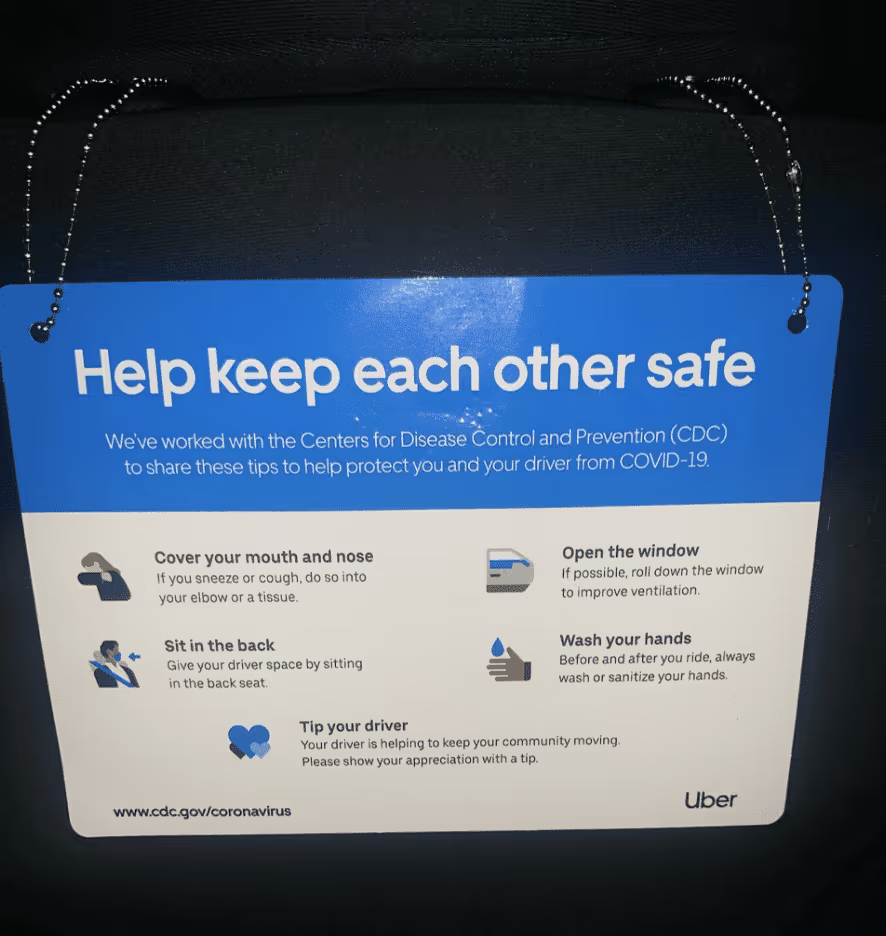
This notice reminds riders of their responsibilities, and helps drivers who struggle to enforce these common sense practices with their passengers. Now, there’s no doubt about what the “rules” are. And we LOVE the part that says “Tip your driver”!
Following safety measures, and possibly either switching to delivery or making yours a hybrid gig, will go a long way toward getting you back in action and restoring your income.
At Gridwise, we want you to stay safe. Do what is healthiest and best for you, but we hope you’ll accept the reality that unemployment compensation isn’t going to last forever.
When you do get back into action, remember that if you download the Gridwise app, you’ll have the ultimate assistant for rideshare and delivery drivers right there with you. Get airport and event information, track your earnings and mileage, and take advantage of great perks for drivers. Also, you can click right into our amazing blog articles, and find the fast track to the always informative and entertaining Gridwise YouTube channel!
What do you plan to do if unemployment compensation can’t cut it for you anymore? Leave us your comments and pass your great ideas on to the rest of us in the Gridwise community.

Case Study: Leveraging industry experts to generate leads in the hyper-competitive financial services industry
“The human element was key to us. We’re not experts when it comes to advertising to gig-drivers, but Clay and the Gridwise team were!” - Gridwise Client, stealth startup
Overview
Launching a new product in the hyper-competitive insurance industry can be a daunting task, especially when your target audience is a highly specialized demographic like rideshare drivers. That’s why this insurance startup decided to work with the Gridwise team. Not only were they able to engage our network of 100k rideshare drivers, but they also benefited from our expertise to build a multi-channel campaign designed to drive long-term, bottom of the funnel success. Not just clicks.
Problem
This client had enjoyed some success working with Google and Facebook ads, but as time went on, it became harder to reach their target demographic of rideshare drivers. More and more of their ads on these networks were falling on deaf ears.
Being a startup, it was essential to maximize every advertising dollar in the targeted effort to reach rideshare drivers.
The clients were looking for solutions that would allow them to work directly with rideshare drivers, and through a Techstars listing, they learned about Gridwise. Knowing they could call and get answers to their many questions was a load off their minds.
“It was difficult for us to understand all the advertising terms we came across, so we spent about two weeks trying, on our own, to decipher what was being offered. Once we talked to the Gridwise team, the whole process got way easier than dealing with Google or Facebook.” - Gridwise Client
Strategy
It’s great that Gridwise put this client in direct contact with our targeted audience, but what’s even better is how we did it. We shared our expertise as digital marketers to help the client engage rideshare drivers and create a successful campaign. Our work together is ongoing, but even in the early stages, the results are positive.
“We noticed a huge wave of traffic coming through Gridwise after the email was sent out.” - Gridwise Client
A multi-channel advertising campaign worked well for this startup, and the custom-written email was particularly effective. The startup didn’t have the in-house resources to produce the kind of creative content that grabs eyeballs and gets to hearts and minds.
Gridwise stepped up and put together the valuable creative needed to get the clients the attention they were looking for. Right away, the conversion rate surpassed what they were getting through Google, and broke even with their results from Facebook.
The clients are looking at a blog post as one of their next steps. This would, naturally, be a potent way to get even more exposure. Using the right words in a blog post boosts SEO, giving any company a greater chance of expanding its audience at almost no cost.
“We are able to crush it from SEO through blog posts. Using these as part of your multichannel approach is going to pump up your chances for success.” - Clay Moore, Growth Lead, Gridwise
It’s this kind of advice, from a real human expert, that makes the experience of working with Gridwise superior to dealing with Google, Facebook, and other large companies that don’t give clients direct answers to their questions.
Clay has spent a great deal of time speaking with the clients regarding overall marketing strategy, often using Gridwise and its efforts to expand as an example. He shared many of the insights he had gained from his digital marketing experience.
Chief among these is to put a bigger emphasis on the creative. Gridwise helped the client to design ads and come up with taglines, crafting a more out-of-the-box approach, but there’s so much more that can be done.
When the client noticed that response to ads was gradually dwindling over days and weeks, Clay expressed the need to switch up the creative from time to time. There’s a lot of “ad fatigue” that happens with rideshare drivers, as with all audiences. It’s important to keep sending messages that look and sound fresh and on-point.
This company would also benefit from using Gridwise app ads. The Gridwise app caters to rideshare drivers, and the client could be assured their ads would be seen by people in their target audience.
Results
“Clay and the team were able to help us with CPC, which is great.” - Gridwise Client
While this company is still in the early stages of working with Gridwise, the results are already apparent—and impressive. Conversion rates from the email Gridwise created for the client competed with Facebook and surpassed the Google ads they had placed in the past. In addition, the CPC came down to reasonable levels as a result of the work of Clay and his team.
By continuing to work directly with the experts at Gridwise, the startup will likely continue to see its numbers grow and its influence expand. The experience of working with experts who actually responded to calls for help was a new and very soothing experience for this client.
“The Gridwise Team was amazingly responsive to our questions.” - Gridwise Client
The world of online marketing can be complex, unwieldy, and expensive. A startup like this one has to impress investors with its ability to be effective and economical. Gridwise can definitely assist in meeting these goals.
Investors also like to see numbers—good ones. Gridwise is able to assist this client and all others in tabulating results from ads through the Gridwise Dashboard.
“The Dashboard was very straightforward. We learned more and more about it as we worked with it, too.” - Gridwise Client
Ease of use and the ability to get questions answered by a real human expert who will sit down long enough to understand your business makes working with Gridwise as easy as it is beneficial. Gridwise marketing experts know their business, and can help you drive yours.
The real power of carrying the message doesn’t always rest with the biggest brand. It can be easier and more fruitful to work with a specialized, market-specific team whose hands-on experts can help guide a company through a successful and lucrative ad campaign.
Are you ready to boost your results and get a grip on a solid population of rideshare drivers? Contact Gridwise. We’re here to help you.
Work smarter. Earn more.
Whether you drive, deliver, or pick up shifts — Gridwise helps you track earnings, mileage, and performance so you stay in control of your work. Download the app and take charge today.
