Gridwise blog
Tips, insights, and advice to help you earn more and work smarter, whether you do gig work, hourly, or shift work.
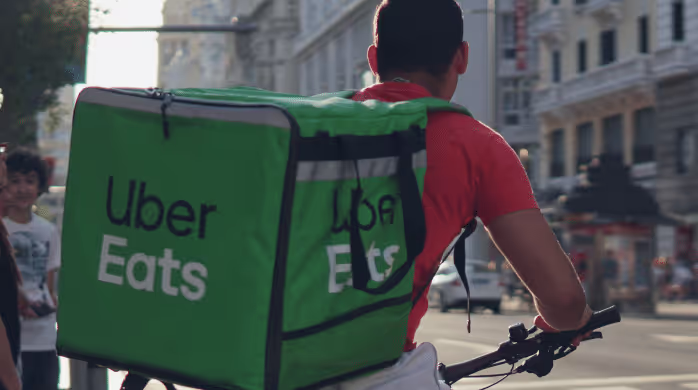
How to Make $1,000 a Week With Uber Eats in 2026 (Tips + Hourly Data)
In this blog, we'll explore the strategies and techniques that can show you how to earn $1000 per week as an Uber Eats delivery driver. We'll cover everything from optimizing your delivery zones and schedules to maximizing your tips and customer satisfaction. Whether you're a seasoned Uber Eats driver or just starting out, this guide will provide you with the insights and actionable steps to take your Uber Eats driver earnings to the next level.
Becoming an Uber Eats delivery partner can be a lucrative opportunity, especially if you're able to consistently earn $1000 a week. By understanding the platform, optimizing your delivery strategies, and focusing on customer satisfaction, you can maximize your earnings and turn Uber Eats into a reliable source of income.
We’ll cover the following topics to provide coaching and ideas to help you push your earnings up to that $1000 per week level:
What do Uber Eats drivers do?
Uber Eats drivers deliver prepared food most of the time, but they also might shop for and deliver goods from convenience outlets and grocery stores. The job is pretty simple. You get a request for an order, you drive to the restaurant or store to pick it up, and then you deliver it to the customer. If you already drive for Uber, you can choose to take orders for Uber Eats delivery any time.
If you’re not an Uber Eats driver yet, it’s pretty easy to become one. This Gridwise post tells you what you need to do if you want to sign up and start making money Uber Eats style. Many rideshare drivers welcome the chance to deliver food rather than people. This article from Nerdwallet covers the Uber Eats gig from that angle.
There are some sweet advantages to working with Uber Eats. In lots of cities you don’t even need to have a car. You can use a bike or a scooter, or even walk, to make your rounds. If you do use a car, Uber Eats’ requirements are a lot easier to meet than they are for Uber rideshare driving.
You also have a lot of flexibility. You can shop and deliver convenience items and groceries, but you don’t have to. And, like most driving gigs, you can choose your own hours, and map out the locations where you want to work.
Use Gridwise features When to Drive and Where to Drive to help you figure out what work hours and which specific areas will be the most profitable for you. Real data from real delivery people will show you earning patterns for drivers in your town.
How much can you earn doing Uber Eats?
The honest answer to this question is: basically, as much as you want! It all depends on how many hours you put in and how strategic you are about your gig. Earnings vary from one area to another, as this article from Entrepreneur points out. To give you a baseline, let’s look at the earnings of Uber Eats drivers who tracked their earnings with Gridwise.
Remember that these numbers show us only average earnings. To make $1,000 a week with Uber Eats, you’re going to have to be better than average, and we’ll show you how. For now, though, it’s good to have these figures so you get a ballpark number of where to start.
How much do Uber Eats drivers make?
Gridwise data tell us the following:
- Monthly earnings average around $444.00 per month.
- Gross earnings per trip are between $9.00 and $10.00.
- Tips make up about 50% of most Uber Eats drivers’ income, which amounts to about $225.00 per month.
Is Uber Eats good money? It can be. While there are other gigs that pay more per trip, if you drive for Uber Eats, you’ll always be pretty busy.
https://datawrapper.dwcdn.net/HPAz8/3
You can also see that, unlike many other gigs, tips play a huge role in Uber Eats earnings.

With these numbers as a baseline, what can we say about how to earn $1,000 a week with Uber Eats? As we said in the introduction, it’s going to be a hustle, but it’s really possible. To figure out how to make the most money with Uber Eats, let’s start by looking at how many trips these “average” drivers made each month.
We know that average gross earnings were $444.00 per month, and drivers got around $10.00 per trip. That means they took 44 or 45 trips per month, which breaks down to 11 trips per week. That’s not a lot of Uber Eats delivery, is it?
The fact that Uber Eats drivers averaged so few trips shows us that many drivers use more than one app at the same time. This is called multi-apping, and you can learn more about it in this Gridwise post. If you want to answer the question of how much you can make with Uber Eats, then you need to stick with the app and keep plugging away at those orders. You also need solid strategies, as well as some inside tips and tricks.
How to make the most money on Uber Eats: Delivery driving tactics
Getting to that $1,000 a week with Uber Eats isn’t so hard when you remember that the drivers we saw making about $111 a week were only taking around 11 trips in the same time period. That’s not much at all! If you work the Uber Eats app like a boss, you’ll soon have many more trips than that, easily reaching the number needed to get you to $1,000 a week. Now, let’s get to some tactics you’ll need to make that kind of bank.
- Stay with the Uber Eats app, and track your earnings. Gridwise can easily do that for you. Simply sync your Uber Eats app with Gridwise, and you’ll be able to see how much you’ve earned with Uber Eats, what times were most profitable, and your average hourly pay. Racking up trips with Uber Eats has other benefits, including perks and bonuses that are awarded to top drivers.
- Leverage surge pricing and promotions. Surge pricing is applied when there is a lot of demand. When surge pricing is in effect, many of the trips you make will pay more than usual. Promotions are offered to drivers who complete a given number of trips in a certain time period. High traffic volume days, nights, and times give you these chances to get extra earnings. Challenging yourself to complete the right number of trips for promotions will add to the number of trips you can count on for big bucks, too. Learn more about Uber Eats surge pay, boosts, and promotions in this Gridwise blog post.
- Say yes to doubling up on orders. With Uber Eats, you can get back-to-back orders or receive batched orders. Back-to-back orders happen when you receive a new request while you’re on the way to deliver an original order. The Uber Eats app routes these trips automatically, so you won’t be sent out of your way.
Batched orders are Uber Eats’ way of bundling together orders from either the same restaurant, or two nearby eating establishments. You get money, and trip count credit, for all the orders you complete, plus customer tips, without having to make a bunch of separate trips.
- Turn on the charm and get bigger tips. Being nice really is part of the Uber Eats driver’s job, and getting tips is one way people who drive for Uber Eats make money beyond their basic pay.. Bring along those extra napkins and condiments, use equipment that keeps food and drinks at the right temperatures and prevents spilling, and consider your customers’ needs. If you deliver groceries, be extra careful with delicate items such as bread and eggs.
And, most important, follow your customers’ directions, and stay in communication with them if you are going to be delayed, or if you have questions about their order. This Gridwise post will tell how to get bigger tips as a delivery driver.
- Use even more charm to keep your ratings high. As an Uber Eats driver, you will be rated by the restaurant or store where you pick up the orders as well as the customers who are waiting for the deliveries. This two-way rating system is designed to keep you on your toes, so Uber can keep people satisfied with your service. Don’t worry, you get to rate them, too.
There’s another reason why your rating as a driver is important. It not only keeps you in good standing with Uber; it helps you to qualify for the Uber Eats Pro incentive program. To learn more about Uber Eats Pro, and what it takes to earn perks such as preferred services, discounts, and deals, check out this Gridwise blog post.
Smart business moves that seal the deal
Now that you know how to gobble up the deliveries you need to make $1,000 a week with Uber Eats, it’s going to be a breeze to get there. Let’s make it even easier, with business moves that boost your earnings and shrink your expenses. If you use these, it will also be easy to say yes when people ask, “Can you make good money with Uber Eats?”
Minimize expenses. Avoid racking up big fast-food bills by bringing your own food and beverages. You might not think you’re hungry when you first start your Uber Eats run, but once the aroma of pepperoni pizza, premium cheeseburgers, and piping hot fries start wafting through your car, that might change. Bring a sandwich or other healthy food from home, and buy bottled water in bulk to save tons of cash compared to what it costs to buy single servings.
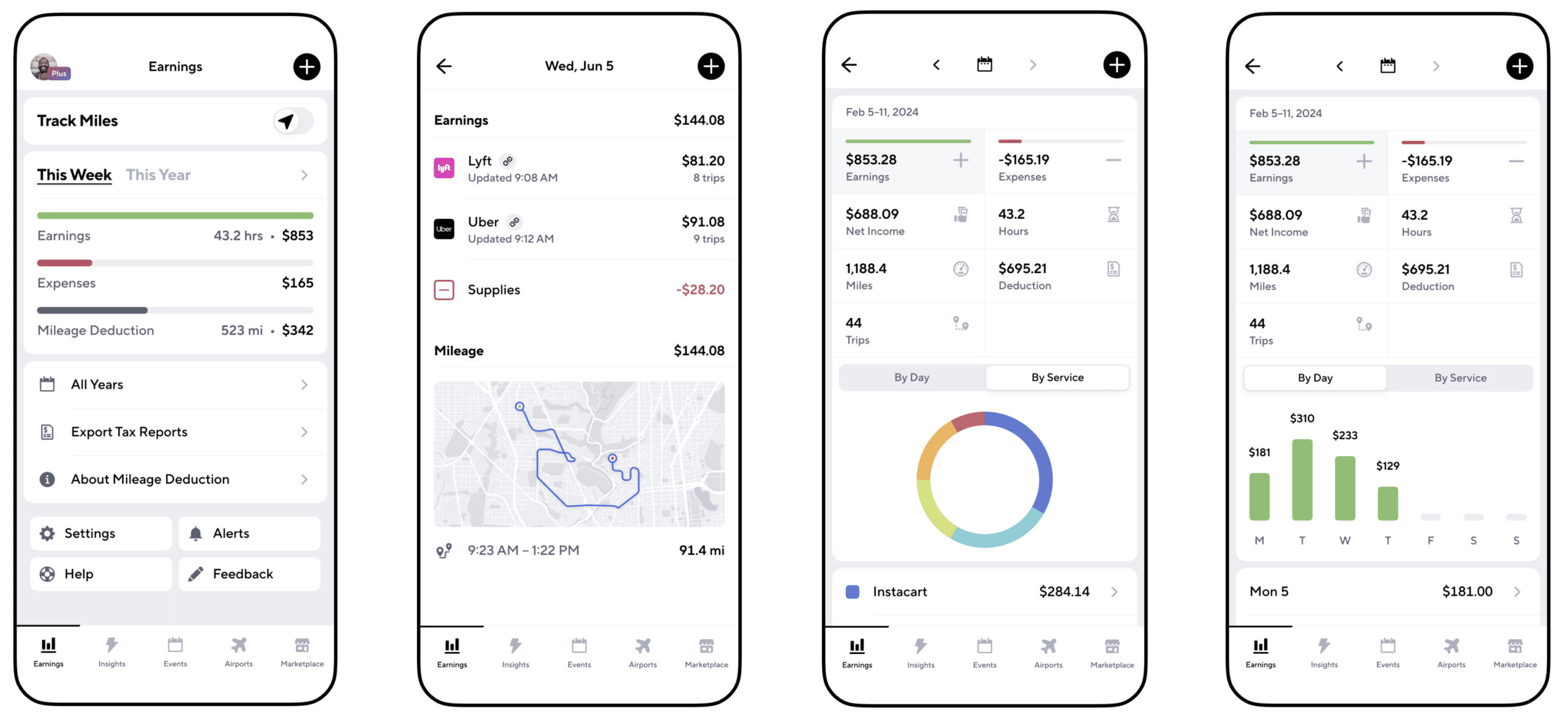
Maximize tax deductions. Another way to minimize your expenses is to maximize your tax deductions. Start by tracking mileage with Gridwise.
Gridwise App
Gridwise captures every deductible mile you drive, including the distance you cover between the trips your driving app records. Know what expenses you can deduct, and put them to work for you when tax time comes. Learn more about tax deduction strategies in the Gridwise Tax Guide for drivers.
Boost earnings with referrals
As an independent contractor, you’re probably looking for ways to make even more money than you can with Uber Eats. And most gig workers like you enjoy getting passive income. With Uber Eats, there’s a really easy way to do that, referrals!
All you need to do is find friends and encourage them to deliver for Uber Eats. If they make a certain number of deliveries within a specified time, you will get paid for doing nothing more than having them sign up under your referral code! Rates of pay vary by city, so check your Uber Eats app to find out what the current deal might be, and learn more about the referral program on the Uber Eats website.
Also remember: “friends” don’t have to be your best buds. Many delivery people carry cards with a QR code linking to their referral information, so just about anyone you encounter can join Uber Eats and boost your earnings. You could meet a source of passive income at the gas station, on social media, or at your high school reunion. The more you hustle, the more there is to gain, right?
Master the art of self-employment
As an Uber Eats driver, you’re an independent contractor. That means the company isn’t going to withhold your taxes, provide insurance, keep track of your earnings, or tell you about tax deductions. You’ll have to do all these things for yourself.
If you want to maximize your tax advantages, open an official business entity. You can incorporate (create a corporation) or you can work as a limited liability corporation (LLC). You can also work with a DBA (Doing Business As) arrangement, but the corporation or LLC will do a better job of protecting you from liability.
Establishing a corporation or LLC offers better tax advantages than being a sole proprietor. For instance, if you simply collect your earnings into your private account, you’ll be charged self-employment taxes in most states. And paying extra taxes is something we all want to avoid, within legal limits, as much as possible.
Every Uber Eats driver needs to learn about self-employment, and there are some great resources you can review. Check out the CareerOneStop website about self employment which will help explain the basics. You can also check with a professional tax accountant, or look other websites to learn more about actually creating a business.
Scope out your market
Look at the area around you to see where you’re likely to get the most deliveries. Where are all the restaurants? Where might people be more inclined to order deliveries? What hours do you want to drive? What activities might be going on around those times? Think about late-night and after-school times as well as breakfast, lunch, and dinner times.
Be realistic about the potential for your area and aware of new services opening up. For example, in New York, there is already a tab on the Uber Eats app that allows customers to order groceries. In our article about the best food delivery service to work for you’ll see that Uber Eats stacks up well against other delivery companies, mainly because of its potential for expanded opportunities for drivers to earn.
So, is Uber Eats good money? As we said, it isn’t an automatic guarantee that everyone will make $1,000 a week with Uber Eats. Trying out the suggestions we give you here, though, should put you on the right track! Go out there and start stacking up those orders and raking in some impressive earnings!
Get more inside information on Uber Eats in these posts from the Gridwise blog:
- The delivery driver guide: Using the Uber Eats app
- Everything you need to know about driving for Uber Eats
- Uber Eats Pro: What drivers need to know
- Looking for a different gig, part-time or full time job? Check out the Gridwise Job board.
Uber Eats FAQ
How does the Uber Eats platform work for drivers?
Uber Eats is a food delivery service that connects customers with local restaurants and independent delivery partners. As an Uber Eats driver, you'll receive notifications of nearby delivery requests, which you can accept and complete. The platform provides flexibility, allowing you to work on your own schedule and earn money based on the number of deliveries you complete.
What are the requirements to become an Uber Eats delivery partner?
To become an Uber Eats delivery partner, you'll need to meet certain requirements, such as having a valid driver's license, a registered vehicle, and passing a background check.
How can I choose the right delivery zone to maximize my earnings?
Selecting the right delivery zone can significantly impact your earnings, as some areas may have higher demand and better-paying orders. It's important to research and identify the zones in your area that tend to have the most consistent and lucrative delivery opportunities.
How can I take advantage of peak delivery hours and surge pricing?
Understanding peak delivery hours, such as mealtimes and weekends, and taking advantage of surge pricing can boost your earnings. Be aware of when demand is highest in your area and adjust your schedule accordingly to capitalize on these peak periods.
What are some tips for maximizing tips and customer satisfaction?
Providing excellent customer service and going the extra mile to ensure a positive experience can lead to more tips and repeat business. Prioritize communication, timeliness, and attention to detail to keep your customers happy and satisfied.
How can I set realistic weekly goals to reach my $1000 target?
To make $1000 a week with Uber Eats, it's essential to set realistic weekly goals and track your earnings and expenses. Start by determining your target earnings and breaking it down into achievable daily or weekly goals. This will help you stay on track and make adjustments as needed.
What are some strategies for efficient route planning and navigation?
Effective route planning and navigation can save you time and fuel, allowing you to complete more deliveries. Utilize mapping apps and take advantage of features like real-time traffic updates and turn-by-turn directions to find the quickest routes.
How can I balance my Uber Eats deliveries with other commitments?
Develop a schedule that allows you to capitalize on peak delivery hours while still maintaining a healthy work-life balance. Consider using tools like calendar apps to plan your availability and track your hours to ensure you're maximizing your earning potential without sacrificing your personal life.
What are the key considerations for maintaining my vehicle as an Uber Eats driver?
Keeping your car clean and well-maintained is crucial for maximizing your Uber Eats earnings. Regularly scheduled oil changes, tire rotations, and other preventive maintenance can help extend the life of your vehicle and minimize downtime. Additionally, budgeting for vehicle-related expenses, such as fuel, insurance, and repairs, will ensure you're accounting for these costs and maximizing your net earnings.
What are the tax obligations and legal considerations for Uber Eats drivers?
As an Uber Eats delivery driver, it's essential to understand the tax obligations and legal considerations that come with being an independent contractor. This includes properly reporting your earnings, deducting eligible business expenses, and making quarterly estimated tax payments. Additionally, you'll need to ensure you have the appropriate insurance coverage, such as personal auto insurance and possibly commercial auto insurance, to protect yourself and your vehicle while on the road making deliveries.

The Gridwise Job Board: Find Your Ideal Job or Gig Work
Gridwise is an essential assistant app created by gig workers for gig workers. Our mission is to support those engaged in gig work in every way possible. We understand how challenging it can be to deal with income instability, a lack of benefits, and job insecurity that often comes with gig work. The Gridwise app tracks and organizes earnings and expenses, and offers a wide array of discounts, deals, and services that make the lives of independent contractors easier and more rewarding.
We firmly believe it’s possible to make a viable living and create a gig experience that offers flexible hours, variety, and excitement. With issues such as consistent earnings and job security in mind, Gridwise is proud to offer a centralized platform that shows you how to find gig work and secure reliable opportunities. We’re proud to introduce the Gridwise Job Board.
The Gridwise Job Board: Key features
Because Gridwise is dedicated to serving the gig worker community, we’ve filled the Gridwise Job Board with useful features that won’t waste your precious time.
- Comprehensive listings. Find part-time, full-time, temporary, and per-task work. Drive or deliver with your vehicle, utilize an employer’s vehicle, or even find non-driving gig work.
- User-friendly interface. Find the jobs that are right for you with a tap of your screen.
- Verified opportunities. We vet the jobs before they are listed to ensure you’re getting high-quality job postings.
How to get more gig work, seasonal, part-time or full-time jobs with the Gridwise Job Board
Looking specifically for “gig work apps” or “gig jobs near me?” You’re in luck. Our filters and search functions send you directly to the listings you seek.
Here’s how it works.
- Access the Job Board via the Gridwise website.
- Search for jobs by type, location, and more.
- Select the job that interests you, and read all about it.
- Scroll through the description, and if it appeals to you, click “Apply for job.”
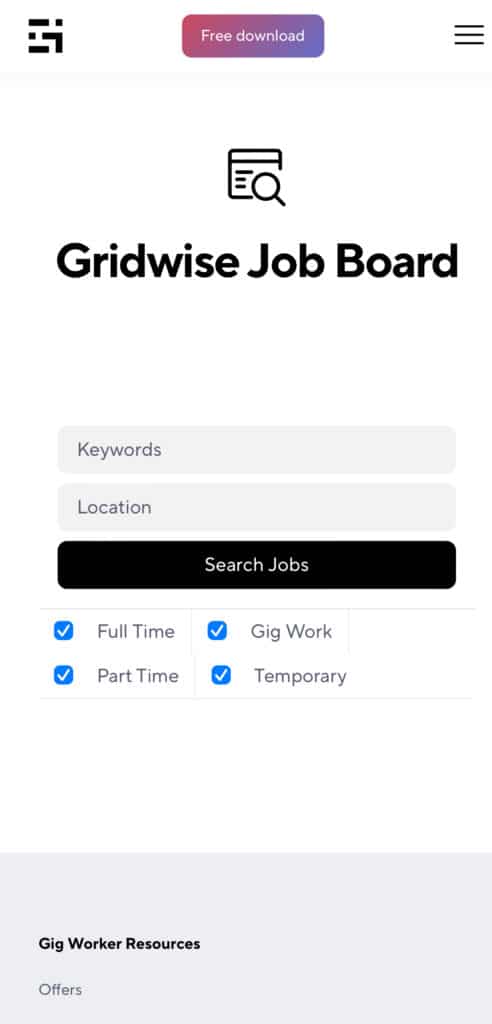
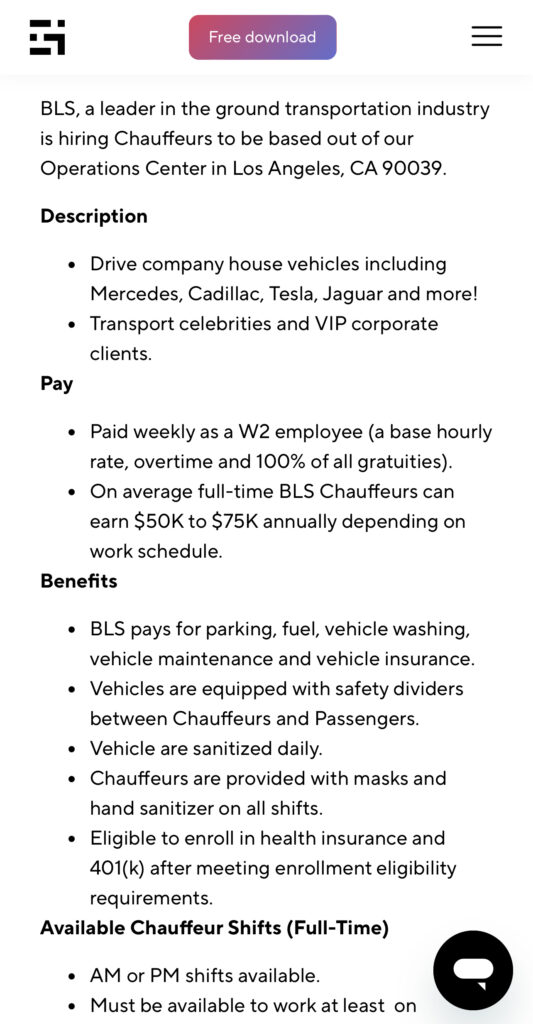
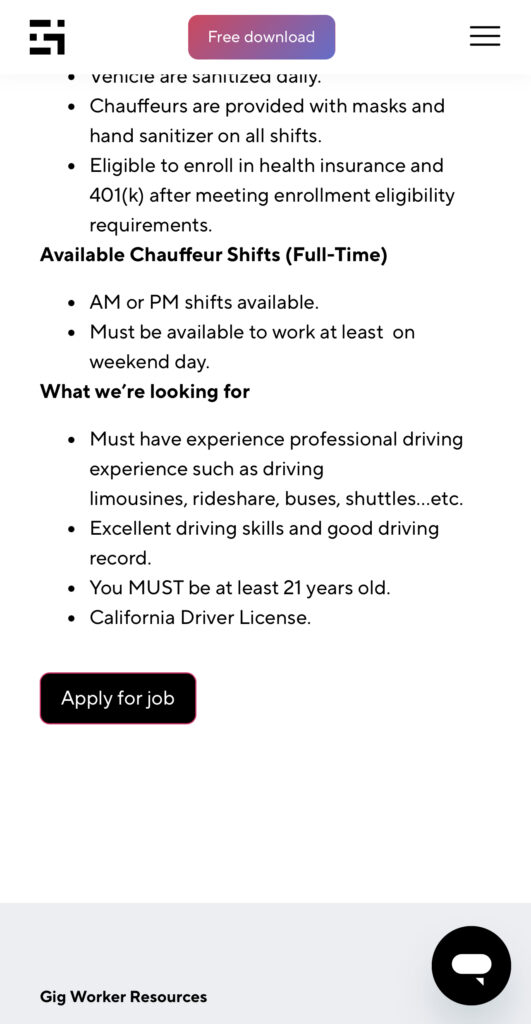
Many types of jobs are available. Adjust the search filter to see the full variety of opportunities that will let you cash in. Deliver food, set up catering, do rideshare driving, get paid for doing package delivery, and much more. You’ll find short-term gigs, long-term contracts, and part-time positions.
Perks of the Gridwise Job Board for gig workers
Gig workers who know how to make extra money will appreciate how the Gridwise Job Board lets you multiply your chances of bringing in big earnings. Here’s how:
- Increased stability. Use the Gridwise Job Board to find part-time or permanent jobs in addition to the part-time gigs you already have. Always keep a steady stream of earning opportunities flowing toward you.
- Flexibility and autonomy. Choose jobs that fit your schedule, work around other jobs and family duties, and still leave room for some fun in your life. Discover side hustles to supplement your full-time job, permanently or just for the season.
- Skill development. Find part-time work that lets you use a skill you already have, or try your hand at something new. It’s a smart way to develop a portfolio to showcase what you can do, or even to find permanent employment.
Get Gridwise and stay up to date on the Gridwise Job Board
Gig workers need plenty of information and assistance, and Gridwise is here to give it to you. Download the app and get essential features such as
- seamless earnings tracking
- mileage tracking
- expense recording, including notes
- low-cost and no-cost insurance benefits
- access to affordable medical, dental, vision, mental health, and alternative care
- professional services including legal and financial help
- deals and discounts
- weather, events, and traffic reports
- inside information on where and when to drive
More to know about gig work:

5 Best Mileage Trackers For Gig Drivers
Many drivers ask, “Do I really need a mileage tracking app?” The answer is simple: only if you want to have an accurate count of all the miles you can legally deduct from your taxable income! You might think your rideshare or delivery driving app has got you covered. After all, they do quite a good job of logging the miles you drive while you’re on a trip or delivery. But, if you want to have the best app to track mileage for Uber, Lyft, Doordash, Instacart, or the other apps you may use, you need more. Why is that?
Without a separate tracker, you’re missing the miles you drive in between pings. Did you realize that all the miles you drive, from the moment you begin your shift until it’s over (as long as you don’t drive several miles on a break to hang with your friends), are tax deductible! That means you need something besides your driving app to keep an accurate count of your travels. Read this Gridwise post to see how important it is to keep track of every deductible mile.
You won’t be surprised to hear that there’s an app for tracking miles. In fact, there are several of them. Here, we’re going to tell you about five top mileage tracking apps, and help you figure out which one is best for you.
Before we get to the list and identify the best mileage tracker app, let’s clarify what exactly a mileage tracking app is. According to G2.com’s technology glossary, mileage tracking is done for the purpose of keeping a log of mileage that is either reimbursable or tax deductible.
And yes, of course you can track your miles simply by taking readings on your odometer. But are you really prepared to account for how many miles you drove for personal reasons and subtract them from the total to get your business mileage? Even if you can remember all that and do the arithmetic, if you want an accurate reading of the miles you drive for business, and can therefore deduct, a mileage tracking app will save you a lot of trouble and prevent you from making costly errors.
Plus, as a gig driver, you have specific needs when it comes to a mileage tracker. Ideally, you’d be able to handle mileage tracking and several other functions all in one app. It can be maddening enough to deal with driving apps, particularly if you’re an avid multi-apper. You would want your mileage tracker app to help you keep account of other aspects of your business, including income, expenses, and inside information about the art of gig driving.
Not all mileage apps are equal, to be sure! Let’s look at five of the best apps to track mileage and figure out which is the best app to track mileage with Uber and Lyft, or what mileage tracker app is best for DoorDash.
1. Zoho Expense
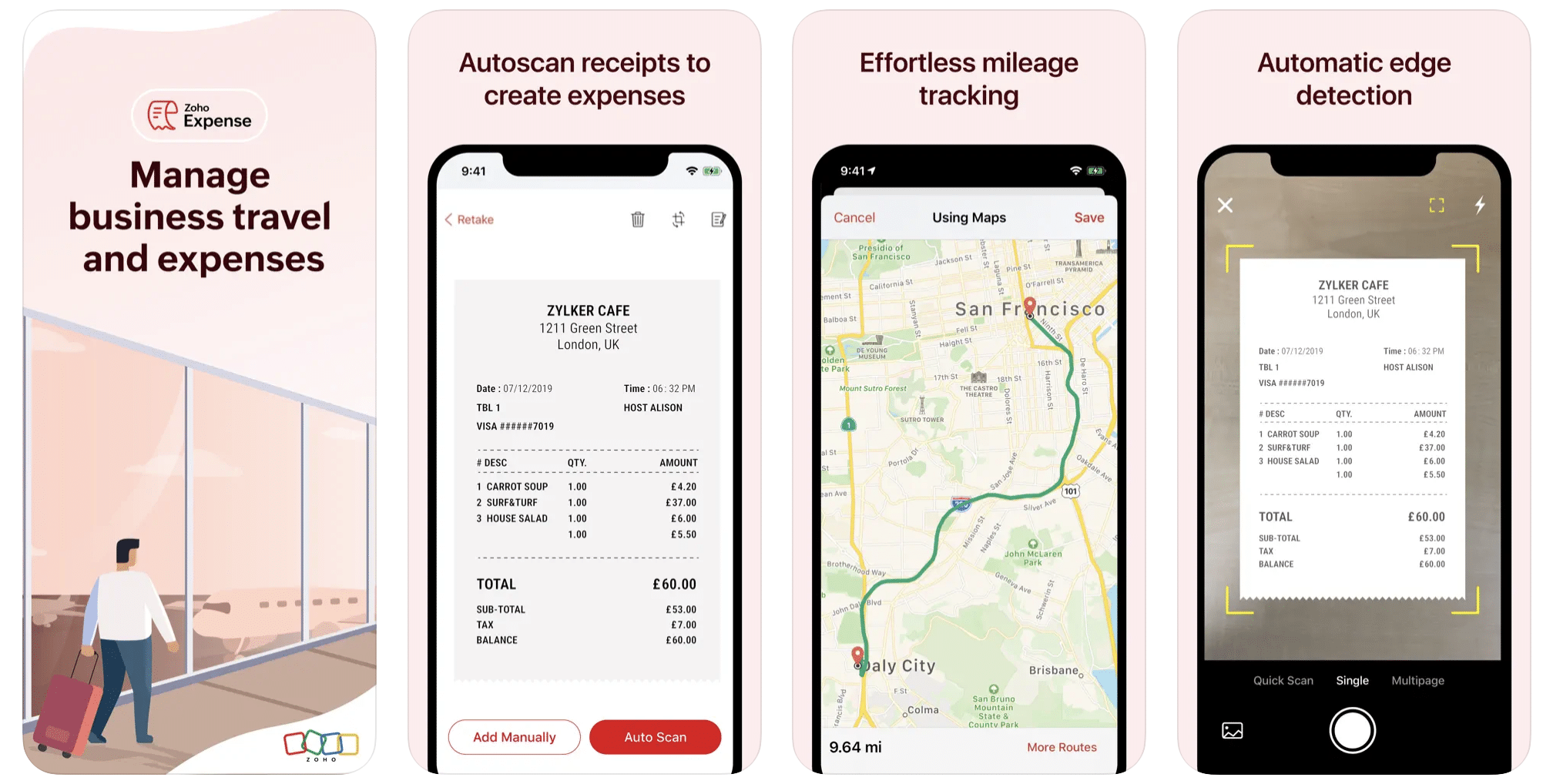
First up is Zoho Expense, which does exactly what its name says. This app is designed to allow companies to give employees a uniform way to create and submit expense reports. It can be used by individuals, including gig drivers, as well.
It includes a mileage tracker, as well as features that let you track other deductible expenses, including the ability to scan and record receipts.
Available on Android and Apple: Yes
Ratings: 4.8 stars on App Store, 4.7 stars on Google Play
Free Version: Yes
Subscription price: $3 per month, billed annually
Created specifically for gig drivers: No
2. Quickbooks Online
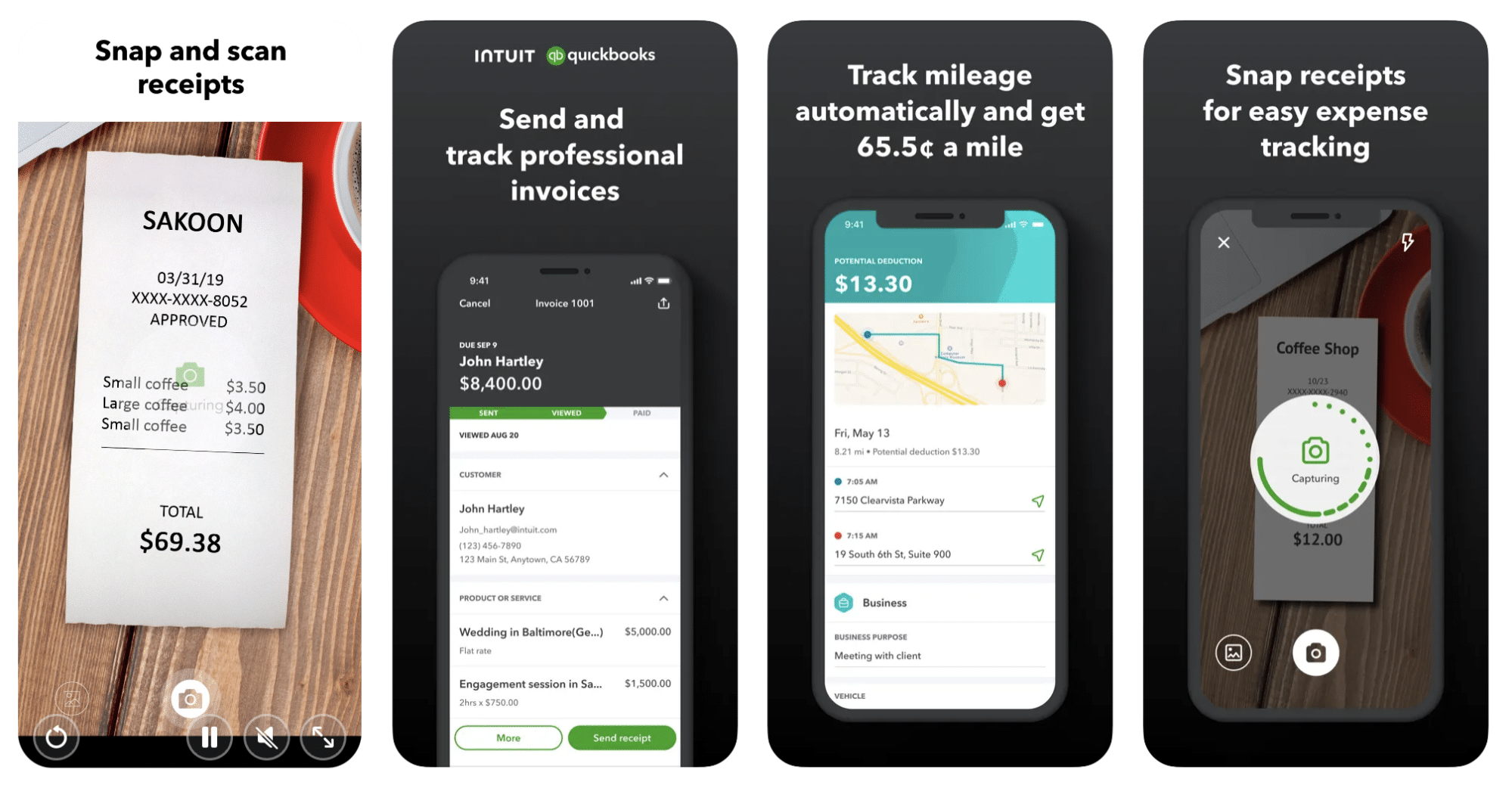
Quickbooks Online is a cloud-based app that allows you to track your mileage, earnings, and expenses. The information you enter can then be used to generate various reports that prepare you for tax time. It also allows you to create graphs that illustrate your cash flow, and includes a receipt scanner so you can instantly record deductible expenses. Quickbooks is popular, highly reliable, and designed mainly to help people keep track of their small businesses.
Available on Android and Apple: Yes
Ratings: 4.7 stars on App Store, 4.4 stars on Google Play
Free version: 30-day free trial
Subscription price: $15 per month for basic version if purchased for 3 months or more
Created specifically for gig drivers: No
Source: quickbooks.intuit.com
3. Shoeboxed
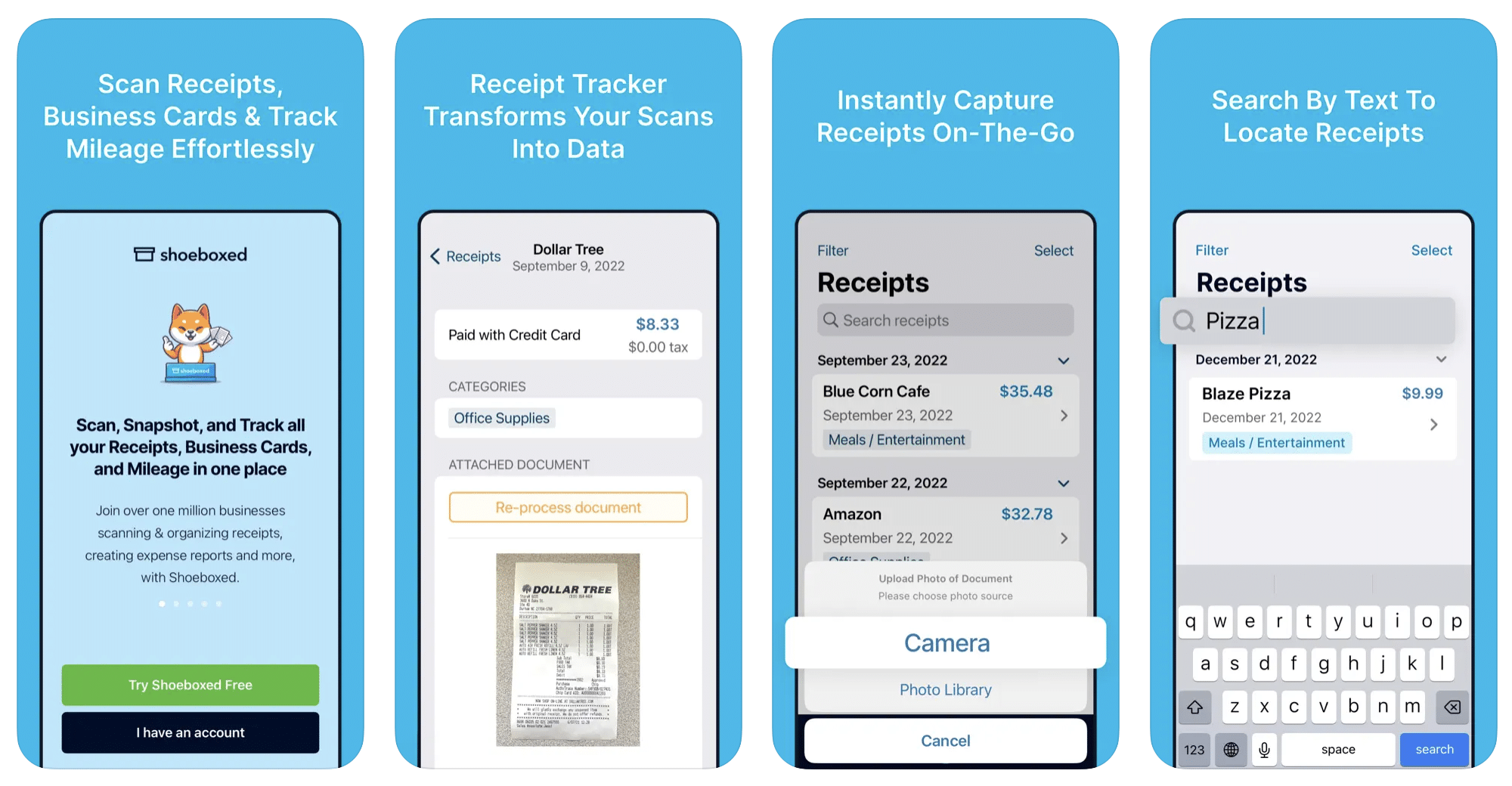
Shoeboxed started in 2007 as a service for scanning paper receipts into digital form. Now the app offers a free mileage tracker and has enabled users to scan receipts directly. It touts itself as the best mileage tracking app for DoorDash, but there are some elements missing that Dashers might like to have. While it provides features that record your expenses and prepare you for tax season, it doesn’t automatically track your earnings. The mileage tracker has a system where you can drop pins along your routes to make the tracking more precise, identifying those legs of a trip that you make for business purposes. The mileage tracker is “free” once you sign up for the basic version.
Available on Android and Apple: Yes
Ratings: 4.5 stars on App Store, 2.3 stars on Google Play
Free version: No
Subscription price: $18 per month for basic version
Created specifically for gig drivers: No
Source: blog.shoeboxed.com
4. Stride
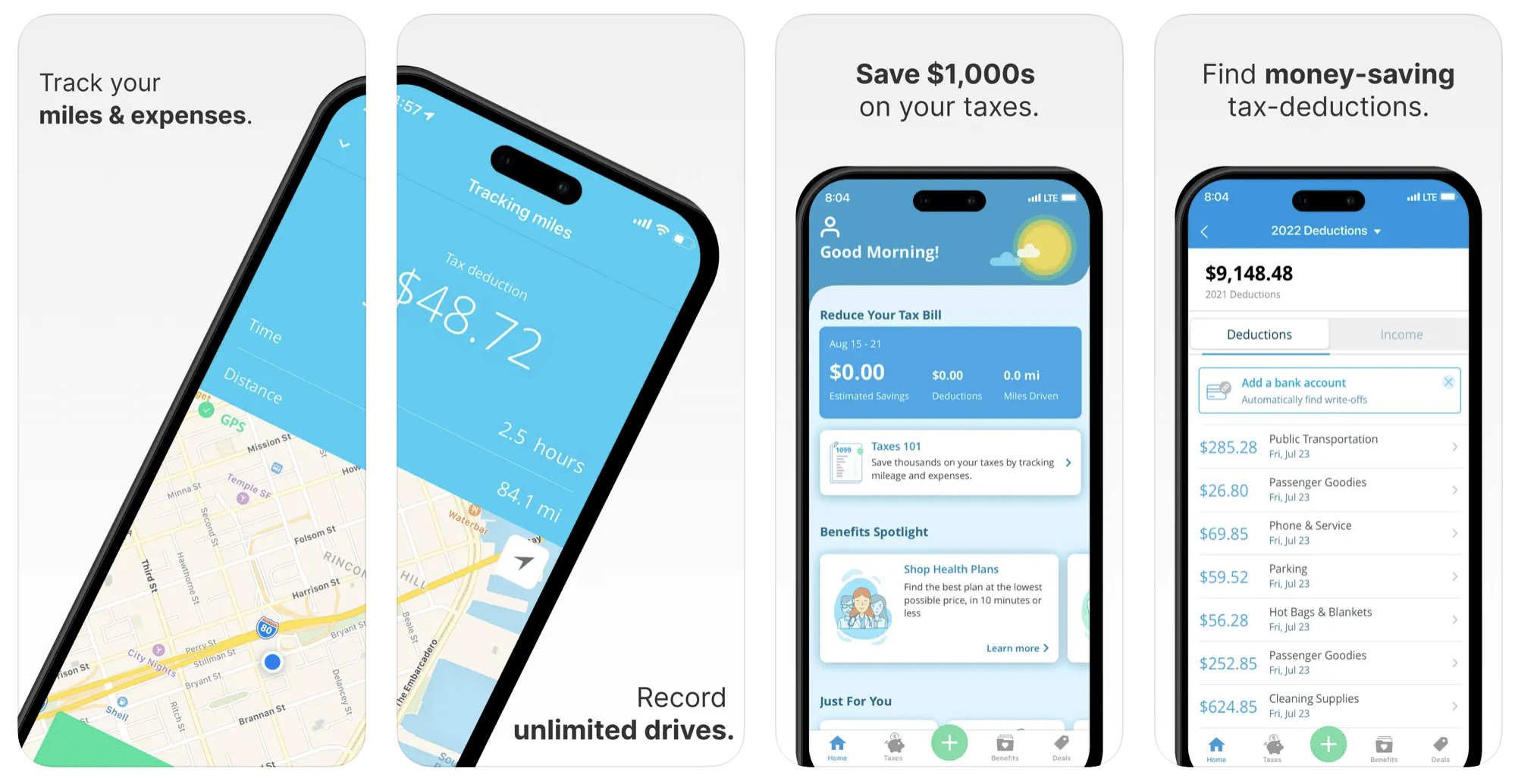
This free mileage tracker does a fair job of keeping track of the distances you rack up while gig driving, but it doesn’t automatically track earnings. It can be a big help, though, in tracking your expenses. You can link Stride to your bank account, and it will automatically scan your expenses to identify items you can potentially deduct. The app is totally free. This could make it the best free mileage tracker app, but there is a small price to pay. The app will persistently push you to consider various insurance plans that they are affiliated with. If you don’t mind that, this is a solid mileage tracker, even if it doesn’t track your earnings.
Available on Android and Apple: Yes
Ratings: 4.8 stars on App Store, 4.6 stars on Google Play
Free version: Yes
Subscription price: None. The app is free.
Created specifically for gig drivers: No
5. Gridwise
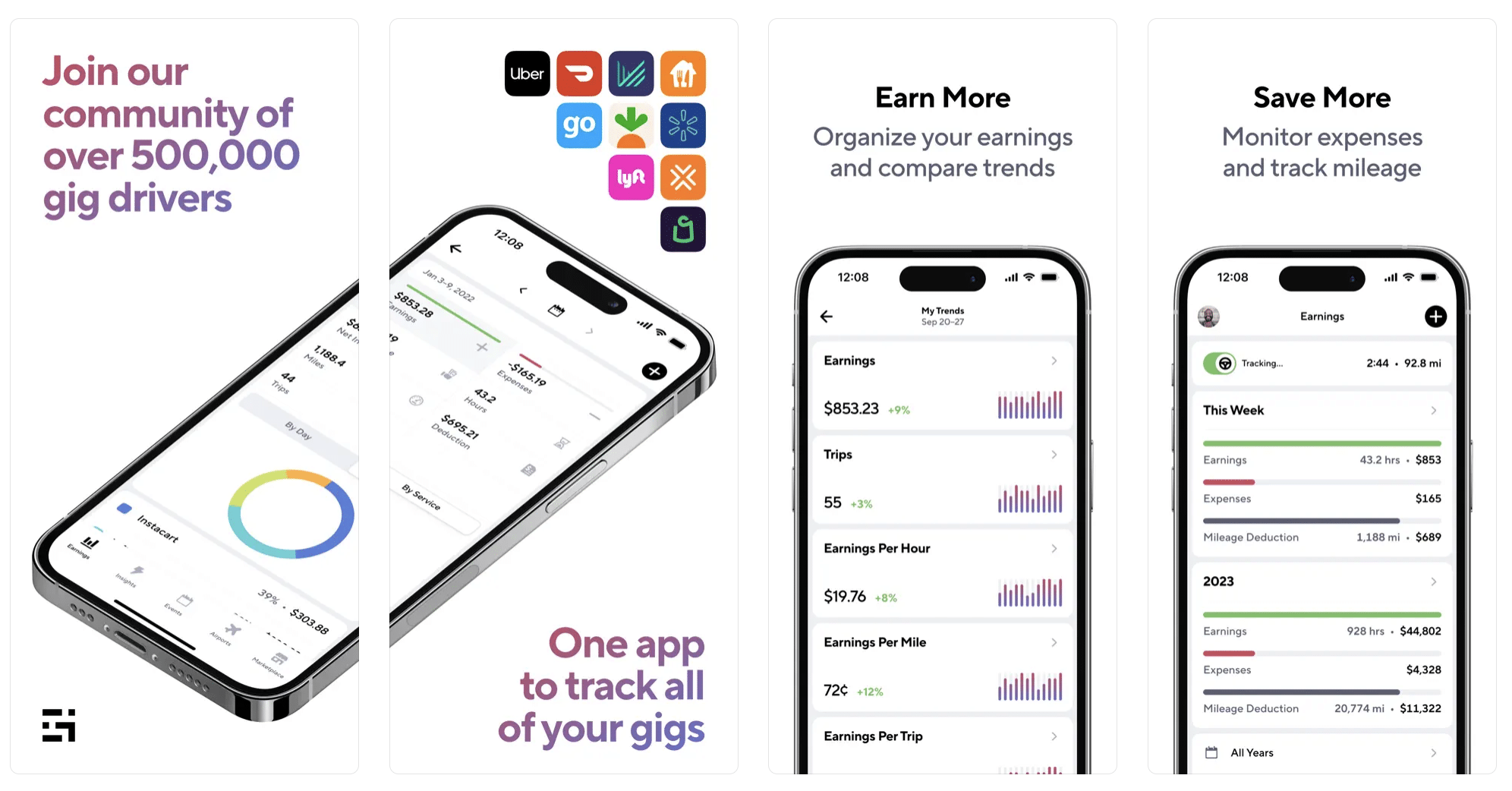
Gridwise has a free mileage tracker and free features that record your income and expenses. It gives you access to insurance and benefits, as well as insights about the best times and places to make the most money while gig driving. The Gridwise mileage tracker captures all the miles you drive while you’re on your driving shift, and it can be used if you have other trips you need to make which qualify as business travel.
Drivers love it because it is geared toward the needs of rideshare and delivery workers, providing free information about airport departures and arrivals, event start and let out times, weather, traffic, and more. The Gridwise Plus subscription adds value by providing additional insights and reports, discounts on benefits, the ability to export data in .csv format,, and more.
Available on Android and Apple: Yes
Ratings: 4.9 stars on App Store, 4.6 stars on Google Play
Free version: Yes
Subscription price: $9.95 per month for Gridwise Plus, or $95.99 per year (a $23.41 savings)
Created specifically for gig drivers: Yes!
What is the best mileage tracking app?
Now that we’ve checked them all out, we’re positive about the answer to that. Hands down, it’s Gridwise. Are we biased? You bet we are! But drivers love it too. Gridwise is the best mileage tracker app, and so much more. So many of the features are free, and the subscription to Gridwise Plus will pay for itself with additional insights to boost your earnings and deeper discounts on products and services.
Most important, Gridwise is designed specifically for gig drivers by experts who were once gig drivers themselves! Knowing what gig drivers need is a crucial step in creating an app that rideshare and delivery drivers can really use! Here are a few of the features, besides mileage tracking:
- seamless earnings tracking
- automatic, on/off toggle and manual mileage tracking
- mileage categorization
- airport, traffic, weather, and events information
- insights into where to drive and when to drive
- reports showing earnings across the platforms you use
- discounts on countless products and services for drivers
- additional resources for finding side gigs
- an informative and comprehensive blog
- affordable benefits, including insurance, medical, dental, and alternative practitioner discounts
- a community of drivers just like you
Don’t settle for just any app. Get the best mileage tracker, and so much more, from Gridwise!
How Rideshare Drivers are Maximizing Their Earnings Using Destination Filters
Possibly the most underutilized tool at a rideshare drivers disposal is the destination filter.
This isn't to say that drivers aren't using the feature at all, many just aren't taking full advantage of all of that a destination filter can help you with.
The Gridwise team has been hanging out at airports in Chicago, Pittsburgh, and D.C. over the last few weeks, so drivers have been schooling me on how they are using destination filters to maximize their earnings.
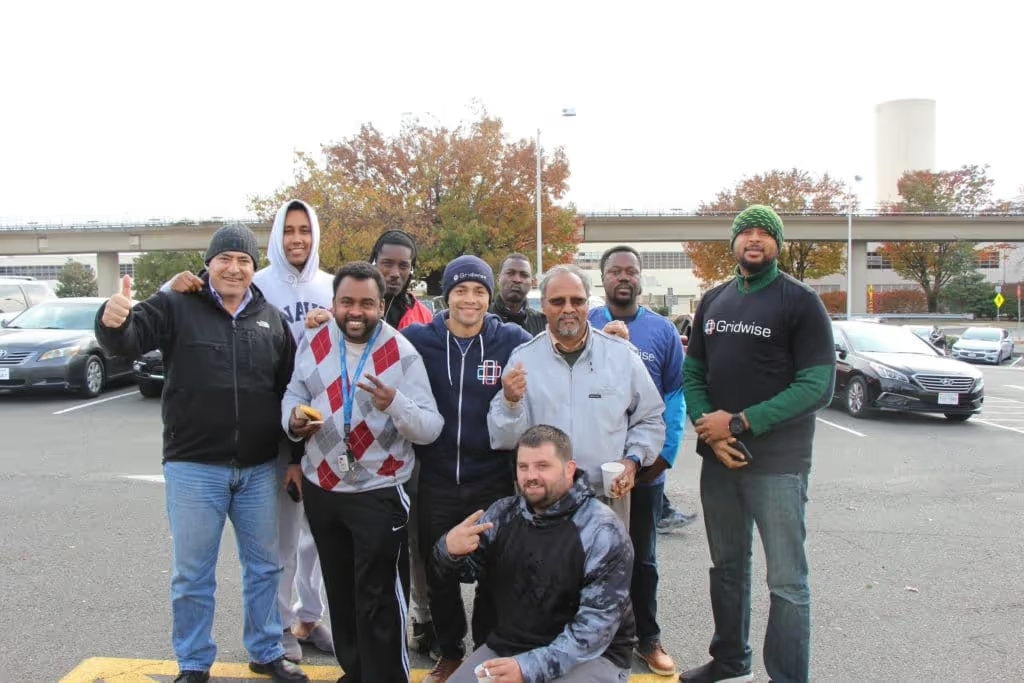
These D.C. drivers taught me a few things last fall
They gave me the OK to spill the beans on their secrets to success, but let's first dive into what exactly destination filters are and how they work.
How the Destination Filter Works
Destination filters are easy to understand. You simply set a desired location, and Uber or Lyft will do their best to give you a ride headed in that general direction. It doesn't take you exactly where you want to go, but it SHOULD give you a ride headed in that general direction.
There are a few slight differences between Uber and Lyft's offerings.
How Lyft's Destination Mode Works
Lyft calls their destination feature "Destination mode" and according to Lyft, when Destination Mode is activated, you'll only receive requests from passengers that get you closer to your destination. You may not always be closer in terms of miles, but you will be closer to your destination in terms of travel time to your destination.
What Lyft appears to do is map what route you would be using to go to your destination, and gives you rides that take you along that route. This means that sometimes you could get a passenger that moves you slightly away from your destination IF the route that you would otherwise take to that destination calls for that.
This is an important distinction to keep in mind.
Lyft also allows you to use destination filters six times per day.
How Uber's Destination Filters Work
Uber's destination filter feature works similarly to Lyft, except it is less tied to the route that you would take to get to that destination. Meaning, Uber tries its best to get you to that area, unlike Lyft which tries its best to get you on your route. I suspect this is because Uber tends to have more volume and you're more likely to find a rider headed toward your location.
Uber gives you two destination filters per day.
When to use Destination Filters
The original thought behind Uber creating these destination filters seems to be for drivers that are headed home and want to get that last ride. That's an obvious and extremely useful use case, but savvy drivers have found more and more interesting and profitable times to use destination filters.
When Driving Back to Civilization
If you're usually a city driver, I'm sure there have been times when you have been taken out into the suburbs and have gotten the feeling you're in the middle of nowhere. Well, usually you have two options in this situation. You can head back to a more populated area, or hangout in the suburbs driving around to see if you can grab a few rides.
A few drivers we spoke with during our Chicago trip earlier this year had different ideas, however.

Coffe and donuts with Chicago drivers... it's a bit cold
Instead of just heading directly back to the city, they checked Gridwise to see if there were any events going on in the suburbs, and then checked to see what the airport queue was.
If the airport was about to peak for departures, they would set a destination filter to head to the airport.
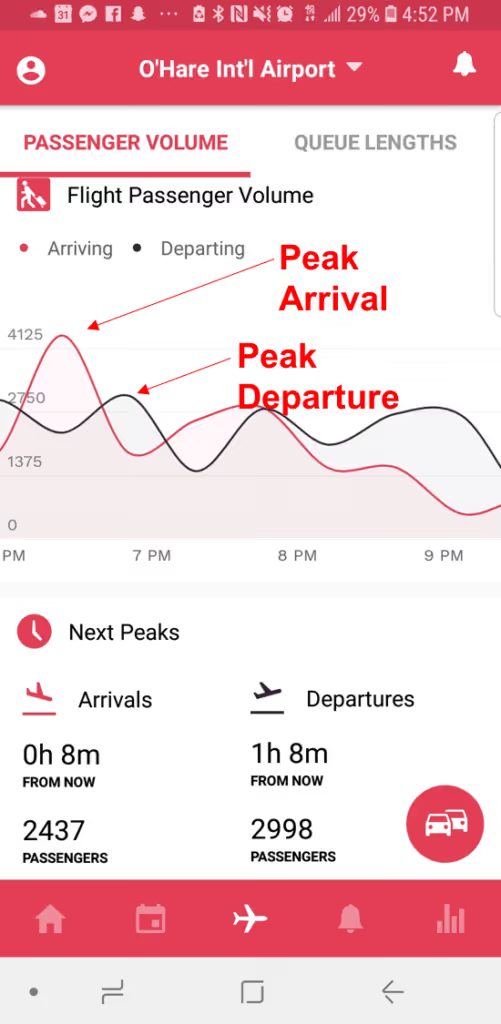
Being out in the suburbs a few hours before a departure peak means that passengers are likely to be headed toward the airport which means a nice long airport trip. What's even better is when there is also an arrival peak, meaning many passengers are coming into the airport.
There isn't always an airport peak, however, which is why drivers also check to see if any big events are going on in the suburbs.
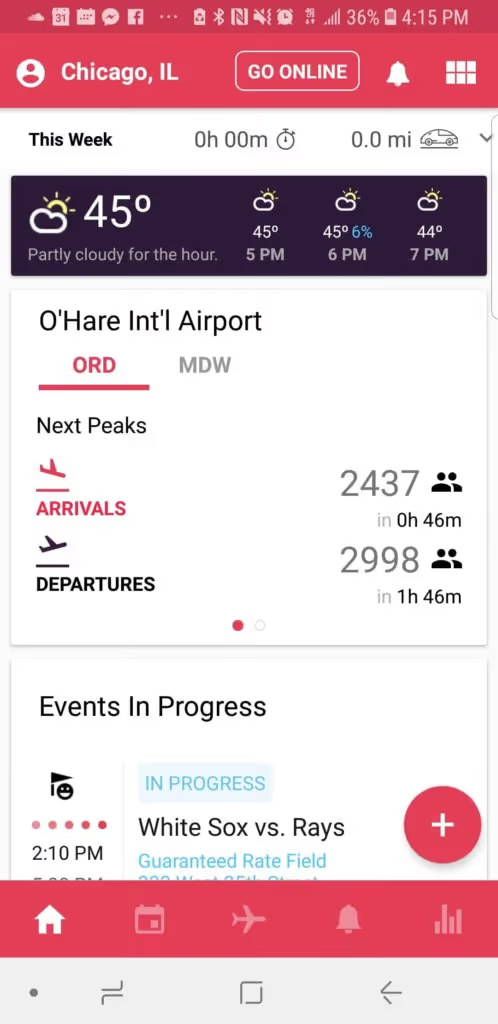
If nothing is going on in the suburbs, drivers will simply check and see what events are going on in the city and set their destination there.
"One of my favorite moves is to set my destination to the CIBC theatre when I'm out in the suburbs in the evenings because a ton of people are headed to see Hamilton." said Reggie, a Chicago rideshare driver "I get into the city with a passenger easily."
Head Toward Hotels Before Peak
I love this move.
You all know that you can check Gridwise and understand when passengers are arriving at the airport and when they should be departing, which means we can understand when people at hotels are most likely leaving to head to the airport.
What some drivers are doing is setting their destination to busy hotel areas about 2.5 hours before a departure peak which is when passengers are most likely headed to the airport. From there, they're reporting getting rides to the airport when they hangout here the majority of the time.
This is a great way to ensure a long trip to an airport.
This can also be expanded on if there is an arrival peak around the departure peak. That way you can get a long ride to the airport, and back.
Head Toward the Airport Before an Arrival Peak
Speaking of being at the airport for an arrival peak, you can always set your destination for the airport where ever you are if you see an arrival peak that you want to take advantage of.
Moving Away From Traffic
Traffic sucks.
Not only is it boring, but it makes you less profitable as a driver because speed is a major factor in your overall profitability. You see, drivers get paid more by the mile than the minute, so the faster you can pick up rides, drop them off, and get to the next one, the more money you make.
That's why trips per hour is such an important stat for rideshare drivers.
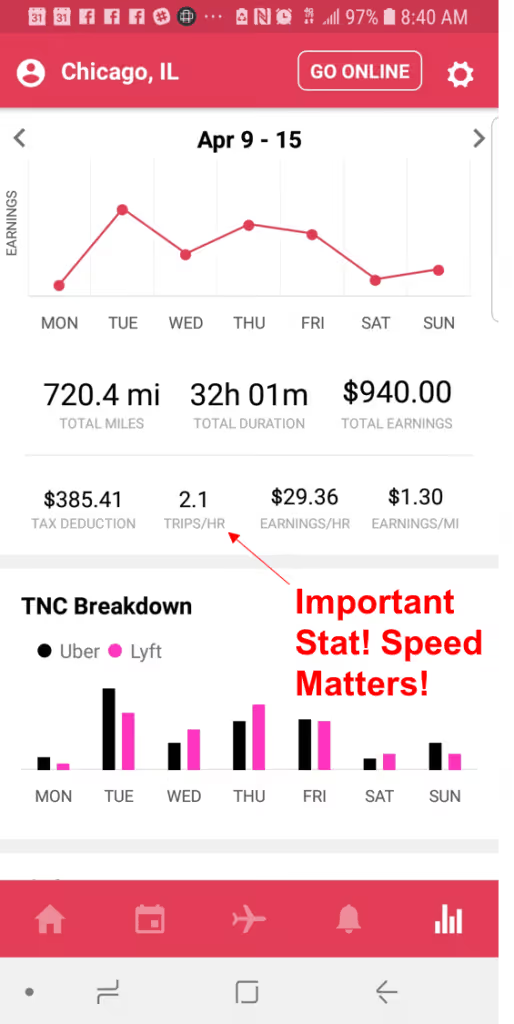
Drivers are using destination filters to make sure they don't get stuck in traffic by setting their destination away from known heavy traffic areas, or areas they get traffic alerts from Gridwise about.
Getting Back Downtown During Rush Hour
Some cities like Chicago, D.C., and Pittsburgh have VERY profitable rush hours for rideshare drivers. Between 4:00 pm and 6:00 pm business districts are hotbeds for rides and surges, however, you have to make sure that you are able to stay around the business district in order to reap the benefits.
So many rideshare drivers are heading to these business districts, getting rides away from them, and then using destination filters to get back to these business districts. They are using Lyft's filters as there are significantly more of them to do this.
This is a great tactic that can keep a driver busy for an afternoon while using 3 or 4 destination filters.
How Are You Using Filters?
These are just a few interesting ways we've seen drivers use destination filters, but now I want to hear from you. How are you using destination filters? Let us know in the comments below? Your fellow drivers thank you!
How This Full-Time Student and Soon to be Dad Became a Highly Profitable Rideshare Driver in Days. Not Months.
Everyone starts driving for their own unique reasons.
Some people want to escape their mundane corporate jobs and try something new for awhile. Many people are starting their own businesses or following their passion and need extra side income. Some even just want an opportunity to talk to and meet new people.
Everyone has their own "why", and for Sean, a rideshare driver out of Northern Virginia, his "why" was the little one that he has on the way.
You see, Sean is a full-time student, with a part-time job and a baby on the way. Oh, and he occasionally makes the trek down to Virginia Beach to do odd jobs around the house for his elderly parents.
So not only is Sean a busy guy, but he's also a guy that could use some extra cash. Therein lies Sean's "why", his reason for becoming a driver and using his spare time to earn instead of relaxing. However, being a rideshare driver wasn't the first thing that came to mind when he decided to find a way to make some extra cash.
"I told my wife that I really wanted to make some extra cash that we can use for the baby, but I needed something extremely flexible. That's when she brought up Uber, I didn't exactly jump at the idea initially" says Sean. "But when I started to dig in and do some research, that's when I realized how great this could be for us."
That initial research that Sean did which helped convince him that he should be a rideshare driver, also helped him become a highly profitable rideshare driver almost immediately. That's because we know how easy it is to become a rideshare driver, it only takes a car, a clean background and a bit of will power. However, becoming a highly profitable rideshare driver isn't easy, and tends to take a lot of time.
According to a Stanford study from earlier this year, it takes approximately 1500 trips to become a "good" rideshare driver.
Well, Sean didn't have that type of time, so he took matters into his own hands and built a strategy that nearly eliminated his ramp up time and helped him make a great hourly wage after being a driver for just a few days. In this blog post, we're going to look at what Sean did before he became a driver and in his first few days and weeks as a driver that helped him ramp up so quickly.
Have a Strategy From Day 1
One of the biggest and most common mistakes that new rideshare drivers make is starting to drive without a strategy. Too many new drivers expect to be able to turn on their app and get tons of pings wherever they are. Nope. It's not 2012 anymore.
Passenger demand is out there, but it's not just waiting for you, you have to go get it.
Sean did hours of research before he even signed up to become a rideshare driver, so he already knew that he couldn't just drive anywhere. He had to be strategic.
That's why he built a strategy that consists of the following:
- Driving late nights AWAY from bars
- Using destination filters to get back to popular areas
- Driving past airports at peak hours
"I knew that I could drive the bar scene in D.C. and Northern Virginia, but that would mean drunk people and traffic. Two things I want to avoid," said Sean. "That's why I focus on more suburban areas, and a few other hot spots not downtown."
Instead of relying on the bar scene, Sean focuses on areas like the MGM casino in D.C. and the National Harbor which is a restaurant district close to D.C. By understanding where those areas were before he started driving, Sean was able to use these hotspots as starting points and points that he could always gravitate back towards if he needs to find a passenger.
Sean also quickly realized that just because he started in a certain area, that doesn't mean he's going to stay there.
"I would frequently start near National Harbor but could be brought all the way out to a suburb pretty easily," said Sean.
This can make for a tough decision for many drivers. Do you stay in the suburbs and hope for a ride, or do you head back to a downtown area? Well, instead of having to make a blind choice, Sean uses Gridwise to help him understand what events are going on immediately around him or in his surrounding areas so he knows if there will be demand around him soon.
If there is demand coming, he can afford to wait a few minutes for a ping, if it looks like there will be greater demand downtown or even at an airport, he can place a destination filter toward that area and start making his way there.
Sean can also use Gridwise to understand when there will be a peak in airport passengers, so a little trick he learned was to always strategically drive past the airport during a peak time.
"It isn't supposed to work this way, but sometimes if I'm just driving near an airport I'll get a ping from the airport. It's always a lucrative ride, so I try and get lucky every once and awhile."
Track Miles and Performance
Mileage deductions are crucial for rideshare drivers, and if you're just using what Uber and Lyft are giving you, then you're likely missing out on a ton of miles that you should be tracking, as these TNC's don't report on miles that you are driving to get to your main driving area and miles that you are driving from when you start, to when you go home.
Sean understood this, which is why he tracked his mileage from day one. So when tax season comes, he will feel confident that he has maximized his tax deduction.
With Gridwise, drivers can automatically track their mileage and time driven, along with other stats like earnings, and number of trips.
Maximize Your Bonus Opportunities
One of the most important things that every driver needs to do when they start driving is maximize your initial bonus. Every TNC will have a lucrative bonus opportunity that they are advertising for your specific area. Before you enter just any bonus code into your sign up form, check to make sure you're getting the largest bonus possible as they can change monthly.
Also, don't take on too many bonuses at once, especially if they are timed. If you only have one month to do 1,000 rides on Uber for a $1,000 bonus and one month to do 1,000 rides on Via for a $1,000 bonus, it might be difficult for you to hit both of those goals. So stagger when you start up on a TNC to be sure you have time for all of your bonuses.
Remember your Why
Driving rideshare is a customer facing job, which means it isn't always going to be easy. However, if you're smart and stay focused on your why, whether it be a kid on the way, a business you're trying to start, or just a desire to meet new people, you can have a great time being a profitable driver in no time.
The State of Rideshare in 2018: Are Autonomous Cars Taking Over
The last 18 months have not gone well for Uber, and early in March things took another tumultuous turn when one of their self-driving vehicles struck and killed a woman in Tempe, Arizona. The incident rocked the company and has resulted in Uber halting all of their self-driving cars across all cities including San Francisco, Pittsburgh, Phoenix, Tempe, and Toronto.
This unfortunate event leads us to ask the questions: What is the state of self-driving cars? Are they coming soon? Are they safe? And, how will they affect Rideshare drivers and Taxi drivers?
We took a look at the autonomous car landscape to see if we can answer some of the most pressing questions on the minds of rideshare drivers and passengers including:
- Who is making self-driving cars?
- How far are we away from self-driving cars?
- What states allow self-driving cars?
- How safe are self-driving cars?
- How will self-driving effect rideshare drivers?
Let's dive in.
What are autonomous cars?
Easy question to answer right?
Not so much. You see, there are various levels of "autonomous cars" and companies are developing technology to tackle each one of them.
Brian Solis, a principal analyst of Altimeter, has defined autonomous cars as follows:

Picture Via: The Race to 2021: The State of Autonomous Vehicles and a "Who's Who" of Industry Drivers
Most cars are still at Level 2, where drivers are still in full control of the car, have their hands on the wheel and eyes on the road, however, have some sort of cruise control functionality enabled. Many automakers are promising to move from Level 2 all the way to Level 5 by the end of 2021.
In fact, you can see a list of automakers that have made significant progress toward a fully autonomous car and are said to be on pace to reach their goals by 2021 below:
- Uber (in partnership with Volvo)
- Lyft (in partnership with General Motors and Ford)
- Google's Waymo
- Toyota
- BMW
- Nissan
- Ford
- Daimler
- Tesla
- Baidu
- Bosch
How will autonomous cars be used?
To a rideshare driver and the public, one of the most lucrative markets for an autonomous car would seem to be taxi services, however, there are many use cases for these vehicles.
According to Brian Solis, there are 5 main categories for autonomous cars with multiple use cases within each category
Industrial
- Warehouse
- Farming
- Construction
- Military
Purpose/Specialized
- Tourism/Travel
- Care/Medical
- Racing
Transportation
- Mass Transit
- Shuttle
- Ride/Hail
Consumer
- Owned
- Shared
- Task driven
- Retail delivery
Logistics
- Cargo/Freight
- Delivery
- Parcel
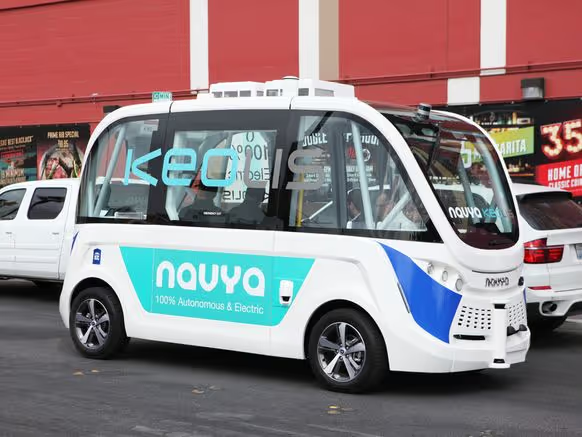
While the use cases for a taxi like service is more visible, use cases such as trucking, parcel delivery, and shuttles have seen more traction. For instance, in Europe and Asia, there are many hospitals, airports, and university campuses that use a service called Navya instead of standard shuttle buses.
What Legal Hurdles Stand in The Way?
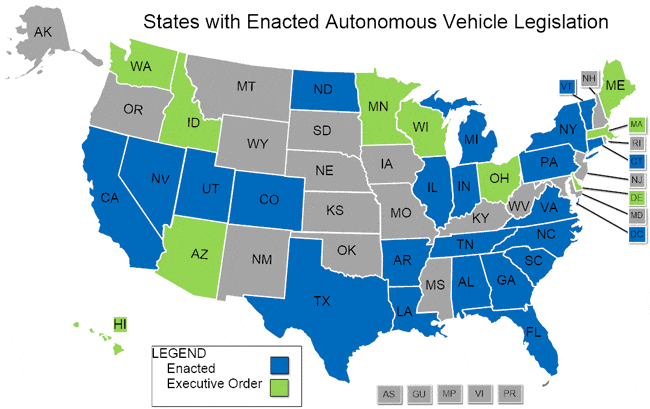
As of today, there are 21 states that have passed some sort of legislation allowing autonomous cars in some form or fashion.
See a map below from the National Conference of State Legislators:
Last September Congress also passed the SELF DRIVE Act, which lays out a basic federal framework for autonomous vehicle regulation, signaling that federal lawmakers are finally ready to think seriously about self-driving cars and what they mean for the future of the country.
Now I know what you're thinking, disruptive technology companies have famously done a lousy job working with regulators across the globe. Uber, Lyft, Airbnb, and other tech giants have had their fair share of public court cases, however, automobile manufacturers, more than anyone else, have a reputation for working closely with the government to understand (and potentially shape) regulations and compliance.
Given automobile makers willingness to work with legislators along with Congress's new found interest in the self-driving car industry, it appears that regulation for these vehicles will be worked out.
How safe are autonomous cars?
One of the largest hurdles that any company will need to jump over will be ensuring autonomous cars are safe, which is why Uber's incident in Arizona was such a big deal.
Since then, Arizona has suspended Uber's autonomous car program for the time being, even after Uber had voluntarily pulled its autonomous cars from the road and every autonomous car maker is having to answer questions about safety in their cars.
Lyft's cofounder and CEO John Zimmer was quoted as saying “I don’t know all the specifics. I did see the video. It did look like both the tech and the driver could have or should have prevented that. But I don’t know all the details,” while also stating that “We need to make sure that all players are acting responsibly because, again, the goal is to actually make it a safer opportunity for people.”
What's important to note in this statement is that the goal of autonomous cars is to make driving significantly safer for pedestrians and drivers alike.
While the accident in Arizona was tragic and a catastrophic blow for Uber's self driving initiatives, it is worth noting that this was just the first instance of fully autonomous car resulting in a pedestrian fatality while more than 6,000 pedestrians were killed in accidents involving human drivers in just 2016. So while the self driving car industry is appropriately being scrutinized for it's failure, these cars so far are significantly safer than human driven cars in many circumstances.
What does all this mean for rideshare drivers?
For rideshare drivers, the most important thing to understand is that the world isn't just going to flip a switch and be completely autonomous. We are still 4-5 years away from autonomous cars being available to consumers, and even then, we could be 20+ years away from autonomous cars being the standard.
Just last year, Lyft's Vice President of Engineering Luc Vincent stated that the company would "always operate a hybrid network, with rides from both human-driven and self-driving cars.” He added that “When a passenger requests a ride that a self-driving car can complete, we may send one to complete the trip,” he also stated that “If that person needs to go somewhere self-driving cars are unable to navigate, or their needs call for a different level of service, they will have a driver. But in either event, we’ll make sure everyone can get where they need to go.”
Here, Vincent is talking about cases where human interaction is still vital. Philipp Kampshoff of the consulting firm McKinsey & Co noted a prime example of a use case that is extremely difficult to automate. "Another example is a construction site where you have a red traffic light, and the autonomous vehicle is approaching the red traffic light, but there is a construction worker who waves the people and cars through. How does the autonomous vehicle know that it can ignore the red traffic light? So these are the kinds of edge cases that have to be overcome for autonomous vehicles to really be out there in mass adoption."
Because of these fringe cases, we believe that there will always be a place for a driver behind the wheel, however, autonomous cars may make for additional opportunities for rideshare drivers as Lyft's Director of Product Taggart Matthiesen alluded to in a conversation with Recode from last August.
"As far as I’m concerned, they will (human drivers) continue to be that. Over time, technology will give us the opportunity to provide additional services on our platform, whether that is a concierge service, whether that is an in-vehicle experience ... these are all things that we will slowly evolve and work with our drivers on."
Here, Taggart is referring to the ability for drivers in vehicles to act as operators or even a concierge service for the cars instead of drivers. This is similar to how the trucking industry views the role of drivers.
Taggert later added “If I need to go to the doctor’s office and my leg is in a cast and I can’t drive, we have a service for that,” he said. “If you get into the world of autonomous, we may need someone in that vehicle to help that person. There are things we’re doing beyond getting a passenger from point A to point B, additional services that we as a company can look at.”
There may be even more opportunity for rideshare drivers to become operators of their own fleet of autonomous cars. This would be similar to Turo's model where drivers simply rent out their autonomous cars to the Uber's and Lyft's of the world and take home some fee as they sit at home. Drivers would just need to keep the vehicles well maintained.
Don't Worry, But Stay Vigilant
We are far from a seeing the current rideshare model make any significant amount of changes, so you don't need to worry about a robot car overtaking you as a rideshare driver any time soon. However, drivers do need to stay Vigilant about emerging trends and technologies so you can see what's coming and *take advantage of opportunities*.
The State of Rideshare in 2018: How Much are Drivers Really Making
The rideshare industry has come a long way since 2009 when Uber was first launched.
Dozen's of additional transportation companies have been launched including driver favorites like Via and Juno. New services like Uber Pool and Lyft Line have been championed, and unfortunately, driver fares for the most part, have gone down while the supply of drivers has skyrocketed.
These fluctuating rates and a rapidly changing industry have begged the question: How much are rideshare drivers really making? Well, over the past few months and years we've received a number of answers from various scientific studies and surveys that have come up with different answers to that question along with different reasoning.
We want to better understand what the economic landscape for rideshare drivers is, so we took a deep dive into the various studies of the rideshare industry to try to gain a complete understanding of how much rideshare drivers are making and WHY rideshare drivers make what they make.
The Studies
The Gig economy is one of the most heavily researched industries in the world today because of how little we currently know about it.
Questions like, what would happen if Uber dissolved, how does discrimination affect the gig economy, and what is the tax impact of the gig economy have economist rushing to understand who is involved and how it affects the macro and micro-economic landscapes. As a result, we can see public studies like these.
- The Gender Earnings Gap in the Gig Economy: Evidence from over a Million Rideshare Drivers
- 2018 Uber and Lyft Driver Survey Results – The Rideshare Guy
- 2018 MIT Uber earnings study
- Revised 2018 MIT Uber earnings study
- The Ridesharing Revolution: Economic Survey and Synthesis
- Labor Market Equilibration: Evidence from Uber
Each of these studies helps us piece together the past and present of the rideshare industry and gives us clues into the future of the rideshare industry.
Let's start our analysis of these reports by seeing how these reports answer everyone's most burning question.
How much do drivers make?
Over the past few weeks, Uber has found itself in a PR nightmare caused by MIT's initial study that claimed rideshare drivers made a mere $3.37 per hour after expenses with a whopping 74% of drivers making less than minimum wage.
In response, Dana Khosrowshahi, Uber's new CEO following the departure of Travis Kalanick, criticized MIT by calling it the University of "Mathematically Incompetent Theories" while noting that various other studies have significantly different findings.
MIT = Mathematically Incompetent Theories (at least as it pertains to ride-sharing). @techreview report differs markedly from other academic studies and @TheRideshareGuy recent survey. Our analysis: https://t.co/S2aAqCuDR0
— dara khosrowshahi (@dkhos) March 3, 2018
So who's correct here? Let's look at the data.
Driver Earnings Data
Various studies, reports, and surveys have found the following results:
- Rideshare guy 2018: $16.93
- Rideshare guy 2017: $15.68
- Stanford Pay Gap Study 2017: $21.07
- Princeton Labor Market Analysis 2015: $19.04
- MIT Study #1 2018: $3.37
- Revised MIT Study 2018: $8.55 - $10.00 (profit after expenses)
The differences in each one of these reports or studies can stem from a number of different factors including most notably when it was taken, who was in the sample, and survey method.
The clear outlier here is MIT's initial study that revealed that drivers were making on average $3.37 after taxes and was publically scrutinized by Uber's Chief Economist, Jonathan Hall in a medium post.
The issue that Hall pointed out in MIT's study was an unclear question which he claimed caused a $6 difference in total profit per hour.
See a deeper explanation of the claimed question error below:
The Rideshare Guy survey asks a number of questions about how much drivers earn and how many hours they work per week. The most important are questions 11, 14, and 15.
Q11: “How many hours per week do you work on average? Combine all of the on-demand services that you work for.”
Q14: “How much money do you make in the average month? Combine the income from all your on-demand activities.”
Q15: “How much of your total monthly income comes from driving?”
The problem, in this case, is inconsistent logic on the part of the paper’s authors. Consider this: for question 14, the authors assume respondents are reporting income from *all* sources, not just on-demand work. As a result of this assumption, the authors discount the earnings from Q14 by the answer to Q15, “How much of your total monthly income comes from driving?”
For example: if a driver answered $1,000 to $2,000 to Q14, the authors would interpret that as $1,420.63² according to their methodology. If the respondent then answered “Around half” to Q15, the authors conclude this driver made $710.32 driving — half what they actually earned from driving with ridesharing platforms.***
Stephen Zoepf, co-author of MIT's study, recognized that the criticism from the rideshare industry was, in fact, valid and made changes to his methodology. In his second attempt at analyzing these figures, MIT found that median after expense profit rose to $8.55 an hour.
Here is my statement regarding the recent CEEPR working paper "The Economics of Ride Hailing." pic.twitter.com/lHJkaB0frX
— Stephen Zoepf (@StephenZoepf) March 5, 2018
These figures are more in line with what previous studies have found such as those from the Rideshare Guy.
Given this data, we can see that earnings before expenses for rideshare drivers can range from around $15 per hour to $21.09 per hour according to these reports. This is an incredibly wide range, so what factors most commonly effect driver earnings?
Well, location is one of the largest factors in how much you make before and after expenses. A driver in New York has traditionally made as much as 2x more than what a driver in any other city has made. Hard city by city data has been difficult to obtain, however, we do have a 2015 survey from Sherpashare that found the following:
Aside from location, we can look to Stanford's gender pay gap study to help explain why some drivers make more than others.
Driving experience means everything
In my opinion, the most important graph for every rideshare driver to understand comes from Stanford's gender pay gap study. The graph plots total earnings against the number of trips a driver has given.
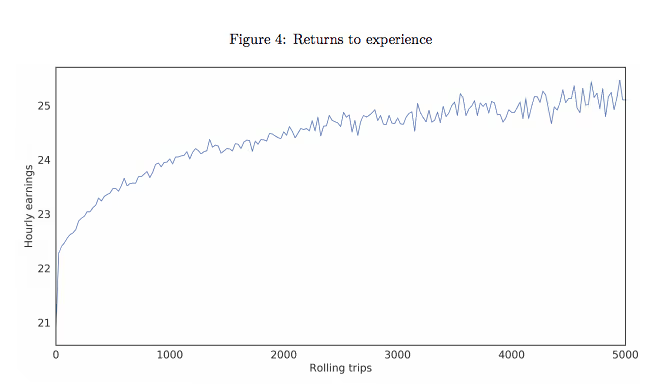
Stanford's study attempted to find out if there was a gender pay gap in the rideshare industry, and if so why? Well, the report found that there was a 7% difference in pay between men and women, however, this wasn't discriminatory in nature, it was based on experience and driving speed.
The study found that women are less likely to stick with Uber or Lyft for a long period of time. In fact, the 6-month attrition rate for women was 76.5% while the 6-month attrition for men was just 65.0%.
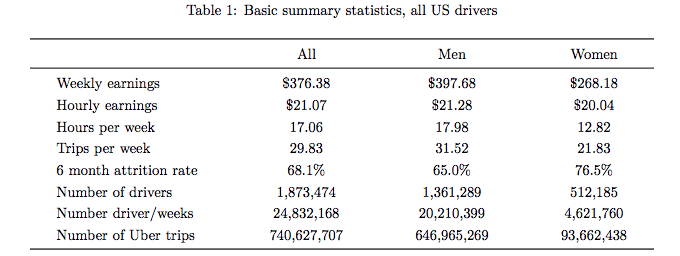
This means that women are less likely to obtain the amount of experience that a driver needs to be able to understand their city, find the best driving routes, times, and locations.
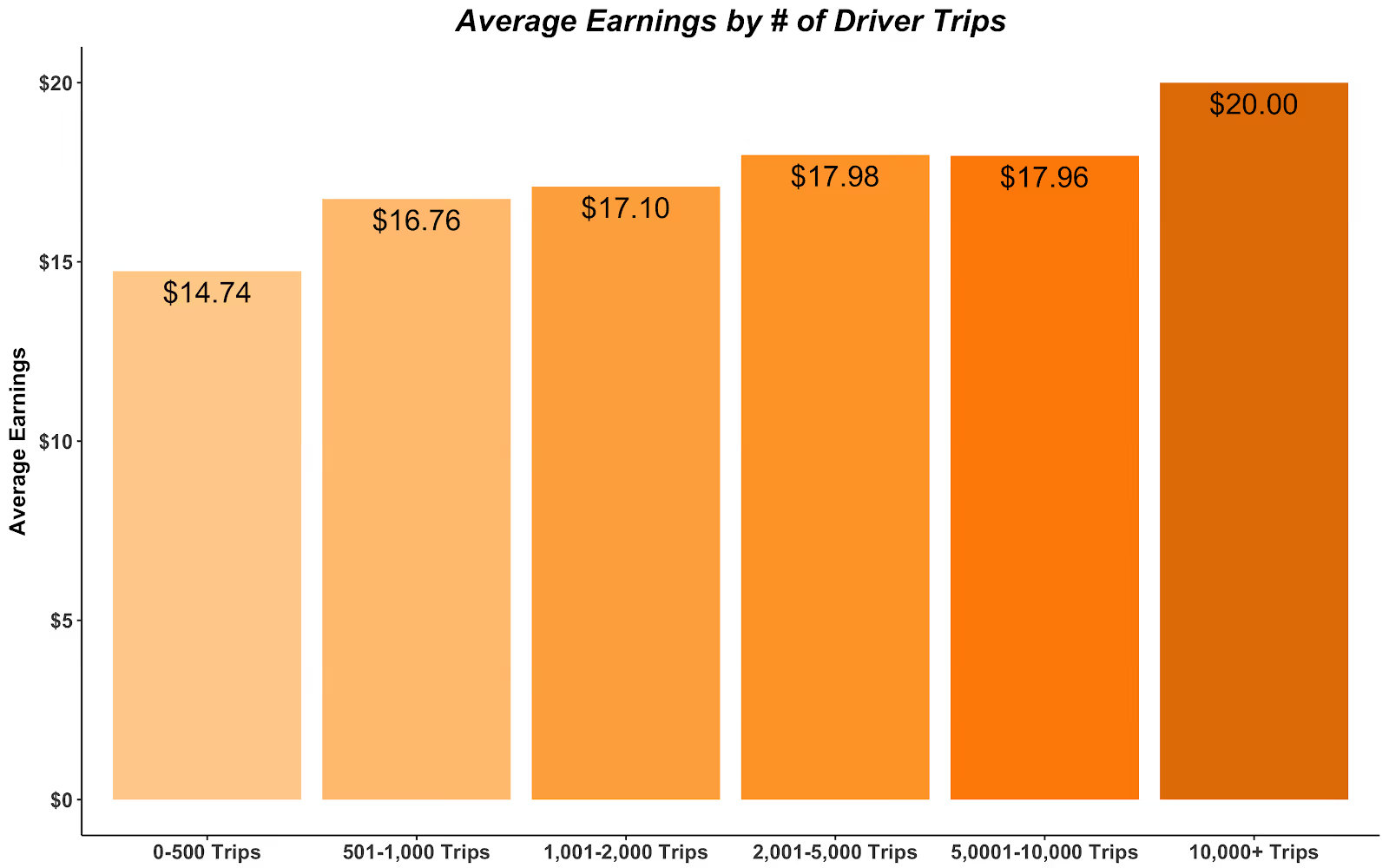
We can also see that in the Rideshare Guy's 2018 survey which finds that experience is a heavy factor in driver earnings.
With a lack of experience comes significantly more downtime as a driver, which a study completed by NYU's John Horton with help from Uber's Jonathan Hall and Daniel Knoepfle, called “Labor Market Equilibration: Evidence from Uber" shows is extremely important.
Let me explain
Transportation companies have consistently and publicly reduced fares multiple times over the last few years. See a graphical representation of the fare reductions below.
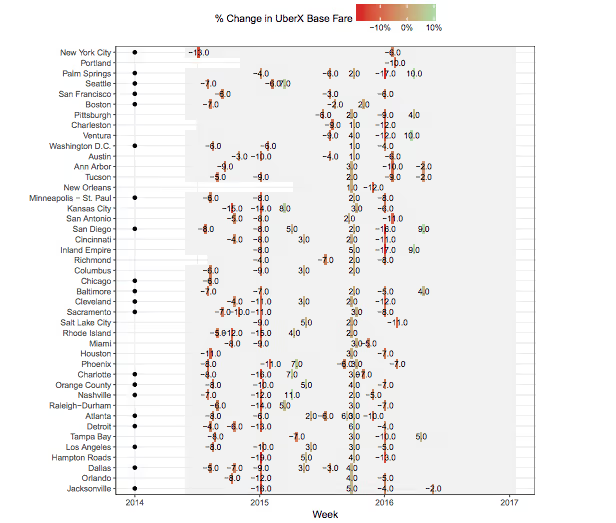
However, despite these fare decreases the Rideshare Guy's 2017 and 2018 surveys find that drivers are making slightly more. If we look at the two academic studies done by Stanford and Princeton, we again see that drivers are supposedly making more per hour despite fare decreases.
Why?
The study completed by NYU's John Horton with help from Uber's Jonathan Hall and Daniel Knoepfle, found that a change in the base fares had little to no effect on how much a driver gets paid.
This because of Supply and demand.
When fares decrease, drivers may be paid less, but there is also a flood of riders on the system which results in more available rides for drivers. If fares increase, drivers get paid more, but passengers are scared off and will find other ways to travel.
The bottom line is that when transportation companies decrease fares, driver earnings ARE NOT likely to change because drivers spend significantly less time idle than they otherwise would.
This shows that preventing idle time by understanding where you are driving will do more to increase your earnings per hour than almost anything else.
Stanford's gender pay gap study takes this even further by noting that how fast drivers travel during trips can significantly effect earnings.
Men on average drove faster than women, which means they were able to drive more miles with passengers. This resulted in men having more trips per hour and making more per hour. This is likely again due to men on average having more experience behind the wheel.
What can drivers do to stay ahead?
Now that we know how much the average driver is making and why, we can look at how drivers can stay ahead of the curve.
1. Don't sweat price hikes and increases
As we saw in a labor study report conducted in part by Uber's own Chief Economist, rate hikes, and decreases do little to effect a drivers earnings. Uber and other ride-sharing services understand that they must rely heavily on incentive payment programs like "quests" to increase driver earnings.
2. Do take advantage of bonuses
Just as the rideshare companies understand that incentive programs are the biggest factor in increasing driver income, so should you. When you have a bonus or quest opportunity that does not interfere with you making your normal amount, take it.
3. Focus on open roads
It can be tempting to always drive in downtown areas, however, if traffic is bad that may not be the best option. If the amount of traffic is slowing you down and decreasing your trips per hour, you're likely to find more success driving in another area even if that means driving Pool/Line or accepting shorter rides.
4. Track every last mile
What has often been missed in MIT's study is their reporting that up to 74% of a drivers income can go untaxed.
From the study:
On a monthly basis, mean profit is $661/month (median $310). Drivers are eligible to use a Standard Mileage Deduction for tax purposes ($0.54/mile in 2016) which far exceeds median costs per mile of $0.30/mile. Because of this deduction, most ridehailing drivers are able to declare profits that are substantially lower. Mean drivers who use a Standard Mileage Deduction would declare taxable profit of $175 rather than the $661 earned. These numbers suggest that approximately 74% of driver profit is untaxed.
This goes to show the extreme importance of tracking every last mile. Not just what Uber or Lyft sends you, not what you estimate, but every last mile that you are driving for a transportation company.
5. Drive smarter faster
As we saw time and time again when reviewing these various reports, driving experience is paramount. It is very difficult to be a profitable driver if you don't have a keen understanding of where to drive in your city and when to drive in your city. New drivers can use Gridwise to help them immediately understand their city while also taking cues from blogs like this one, Ridster and The Rideshare Guy, along with city-specific Facebook groups and forums like UberForum.
Now we're curious, are you seeing earnings in line with these various reports? What do you think is the biggest factor in your earnings success? Let us know in the comments below!
Is Traveling to a Larger City to Drive for Uber Worth it
Every now and then we come across a rideshare driver with a unique strategy that works well for them and their specific situation.
One of the most unique strategies that we have come across is used by a Gridwiser named Vegas.
Vegas is a D.C. area driver who drives the normal routes in the DMV. He frequents Dulles and Ronald Reagan airports, stays downtown for the rush hour, and sticks to the bars during late nights.
So what's unique about Vegas' strategy?
Well, Vegas lives in Newport News Virginia which is about 170 miles away from the District of Columbia. He, along with a team of 2 other drivers head to the D.C. area every week to drive.
"We pack up Thursday morning very early, around 3:00 am so that we get to near D.C. around 6:00 am." Says Vegas. "From there, we decide what airport we want to go to and just flow from there."
Why would you drive so far?!?!
Our first question, and I'm sure your first question when reading this article is why would you drive so far just to drive Uber? Well, to answer that question you have to know a bit about Vegas and why he drives.
Vegas, is a man that cares about his family who reside in Newport beach, so he likes to stay close. However, he also craves the freedom and flexibility that being a full-time rideshare driver provides.
And he's not afraid to put in some long hours to keep that freedom.
Newport News isn't a large city by any means so there just isn't enough demand to make sure that Vegas makes what he needs to on a weekly basis. So Vegas decided to take manners into his own hands.
"Instead of just waiting around for a ride in Newport News, we spend 2 or 3 days at a time to travel to D.C., drive hard, hit our numbers, and head home." Says Vegas.
As you would expect that leads to some long hours and a night or two sleeping in your car, but also a few really fun nights with his fellow drivers.
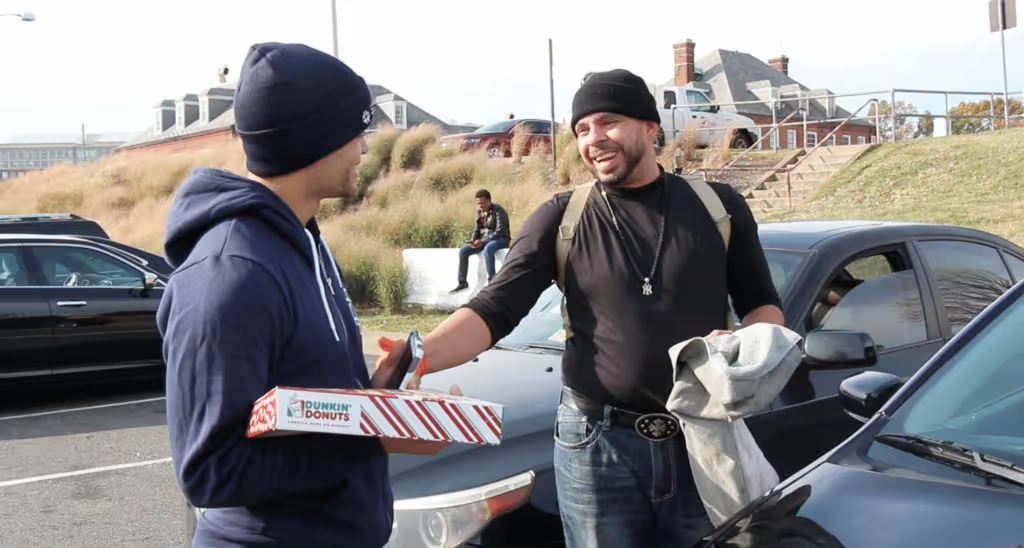
Vegas and his crew work hard, but they have a great time together
Do rideshare companies allow drivers to drive in other cities or states?
Another question we had when we first talked to Vegas was how exactly he managed to drive in multiple states with Uber and Lyft.
We knew that once a driver signs up to drive in city that he or she can drive in any city in their home state, but how do you cross state lines and drive?
Well, it turns out that Uber doesn't usually allow this. However, in certain areas where there is a lot of cross traffic like D.C., they will allow you to cross state lines for both drop-offs and pickups. Other transportation companies like Lyft will allow drivers to pick up and drop off passengers without incident across state lines.
Because Vegas and his team are Virginia drivers, they can travel all the way up to D.C. and Maryland and successfully pick up passengers.
What about insurance?
Here is where things get a bit tricky. Most insurance companies work on a state by state basis, so if you decide to drive in another state and Uber or Lyft allow you to drive in another state, that doesn't mean that your insurance company will cover you.
Many areas with a significant amount of cross traffic like the D.C./Maryland/Virginia area will build in cross state coverage, however, this is something that you would want to individually double check.
The Rideshare guy has a great list of insurance agents that specialize in Rideshare Insurance here.
How does they do it?
If you're going to drive 170 miles just to start working, you better come with a strategy, and Vegas and his team have built one that relies heavily on airports.
When Vegas starts to get close to D.C. at about 6:00am, he turns on Gridwise and figures out what airports have the most passengers coming in and the smallest queue, and that's where they head first. From there, he will focus on the morning rush hour downtown, and then meet with his team for a break at lunch before the afternoon rush hour.
If there is ever a lull in demand Vegas will look to Gridwise's airport demand feature to see what airports are peaking so he can head in that direction.
What's great about working with another driver is that you have each others back. That means that if one driver isn't getting any pings and another driver is in the middle of a surge, he can let that driver know that there is a real surge going on and that he or she should head in that direction. Working with another driver also means that if something happens like a flat tire or a dead battery, you have someone to call to give you a hand.
Is it worth it? Who should be using this strategy?
Even if you can drive across state lines, or to more populated cities in your state, that doesn't mean it will be the best strategy for you.
Vegas is in a unique position where he is able and willing to make the trek up to a larger city while also really needing to in order to meet his weekly quota. However, if you were driving in a city like Ft. Lauderdale or Tampa and considering a drive to Orlando or Miami, that may not always be worth it, unless there is a special event that you want to drive.
For instance, drivers in Atlanta frequently make the trip to Athens to be around for Georgia football games on Saturdays in the fall. This is worthwhile because Georgia football games aren't just a single event. They are an all-day marathon of tailgates, parties, and then the game.
If you're in a city that has a good amount of demand, it's probably not going to be worth your while to chase demand to other major cities. However, if you want to be in town for a certain event. That can certainly be an attractive option.
What's your strategy?
We love a unique driving strategy and the hustle that it takes to head all the way up to D.C. from Newport News is commendable. But now we want to hear from you guys, do you have a unique driving strategy? Let us know in the comments below!
We're giving away $100 to one rideshare driver every week
Gas prices are always on the rise.
And transportation companies aren't exactly reimbursing rideshare drivers or increasing pay when filling up your gas tank costs $55 per tank rather than $45.
We want to help put money back in rideshare drivers pockets, so we're giving away a gas card every week to one rideshare driver in Gridwise's Gas Card Giveaway!

Wait... But what's the catch you ask?
All you need to do is sign up to receive a FREE Gridwise car sticker, place it in your car, and then take a picture with it and send it to us.
Check out the pictures of our winners in February:

All you need to do is fill out this form [contest ended] and we'll mail you a car sticker 100% free. It looks a bit like this:
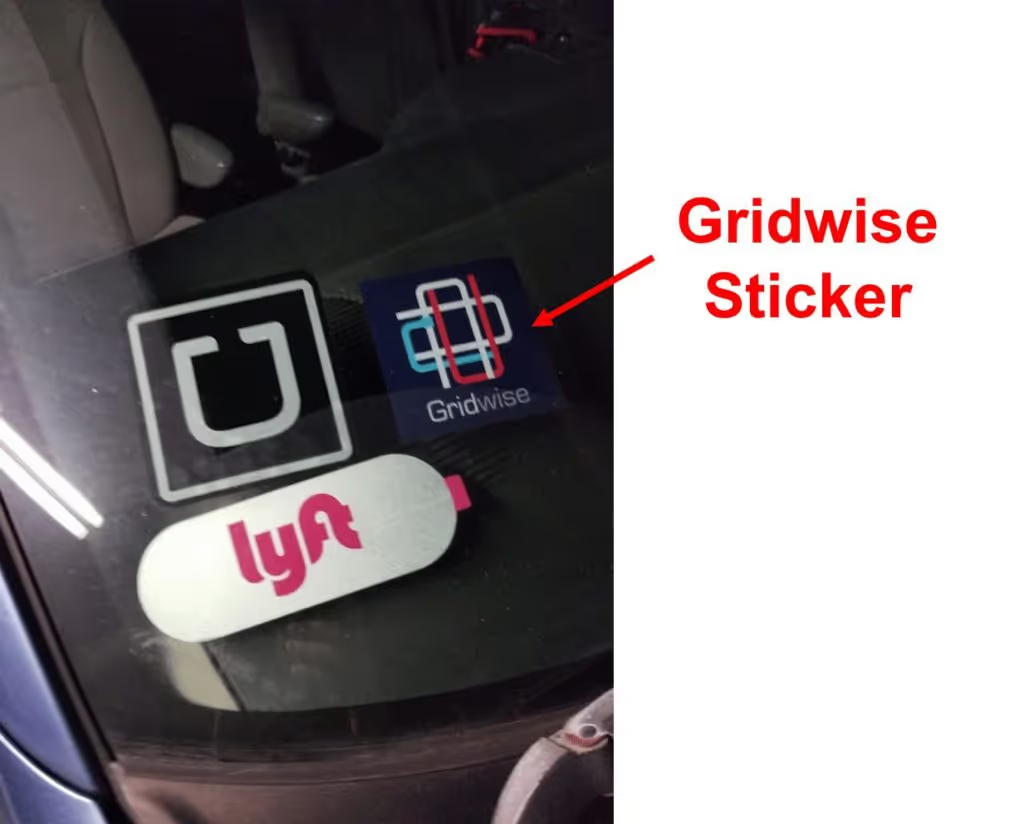
You can also see the sticker in our winner's pictures above.
We'll have one winner per week, so hurry and enter while your odds are still HIGH! Sign up using the link below! [Contest has ended]
[Update 2018!] Rider Interaction Strategies for When You're Stuck in Traffic
For many drivers, the absolute best part of the job is interacting with passengers.
Yes, we are in this to get paid. No, there is absolutely zero chance we would be doing this if we didn't see the direct deposit hitting our bank accounts. However, on a day to day basis, getting to know new people can be the most rewarding part of the job.
I recently got a chance to sit down and talk to a Philadelphia area driver named Valery who had just been driving for about two months but was already full of stories.
Valery drives on the south side of Philly and often finds herself with college-age passengers that are more than willing to open up, especially on a longer ride. One rider, in particular, was having a stressful day and Valery lent him her ear.
"We're kind of like bartenders." says Valery, "He was stressed about balancing classes and working and I just provided an ear."
After cathartic ride where Valery just listened and provided a few words of wisdom, she received her biggest tip to date, $20, and a hug. Valery says the tip was great, but the hug was what made her day. "I'm sure I'll get lots of tips, but it's not every day you can make a real impact on peoples lives."
Now, most drivers aren't measuring success by the number of hugs they give throughout the day, but we do appreciate meaningful interactions like these.
So in today's blog post, we're going to look at a few ways that drivers can have meaningful interactions with their customers that can lead to hugs, and maybe even a few tips!
Check their body language
Right after you confirm the identity of your passenger, take a few seconds to read their body language.
Is your passenger on their phone? Do they have headphones in? Do they look frantic? Try your best to understand the state of the passenger so you know how to move the conversation forward.
If the passenger looks a bit frantic like they may be in a rush, go ahead and ask them if they are in a hurry and assure them that you'll do your best to safely get them to their destination as quickly as possible.
Gauge their willingness to chat with small talk
Regardless of the passenger's body language, everyone isn't up for a conversation and you don't need to try and force one.
We’ve all been in the situation where we’re forced into a conversation we do not want to have. Think about the last party you went to that had people you don’t know. Even if you were invited by your friends, there was a chance that you’d end up stuck in a conversation that you didn’t want to have. It sucked, didn’t it?
Now, imagine that you’re stuck in a mid-sized sedan with a well-intentioned stranger who is trying a little too hard to force chit-chat. On top of that, you’re stuck in this car for longer than you expected because of traffic.
Don’t put anyone in that situation who doesn’t want to be in that situation. You should never feel like you absolutely need to break the ice.
Along the same lines, be ready with basic small talk responses if the customer reacts positively to your comments. Knowing how to really engage in small talk is paramount if you’re pushing for that extra tip, but can also help to increase your positive reviews.
Here are a few topics that are always great:
- Talking about the weather is always a great way to break the ice
- What's going on with the local sports team? If your passenger looks like they are into sports (Have a sports shirt, jersey, or hat) then talking sports is a great way to connect
- Does your passenger look like a tourist? Give them some information about the city. Let them know of great places to eat, drink, or have a good time
- Speaking of places to have a good time, if you're a Gridwise user you can let your passengers know of any events that you think are cool around the city by checking the event feed
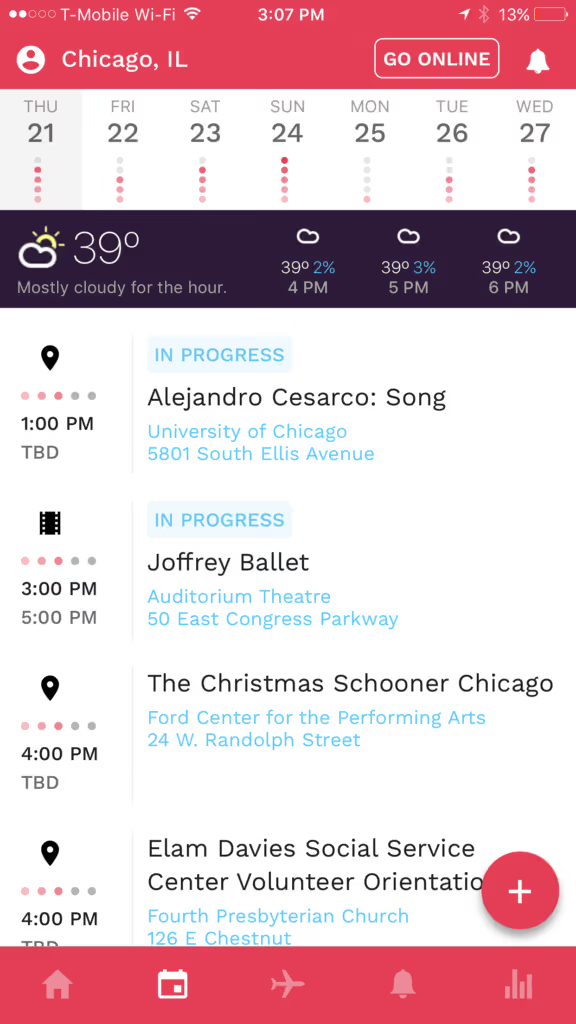
Is your passenger looking for fun? Use Gridwise to let them know what's going on around town!
Don’t be afraid to sit in silence
Silence is golden, or so they say. It may seem like a simple concept, but it can be stressful! Sitting in traffic with only horns and engines sounding in the background can be unnerving for sure. Don’t sweat it too much, though! Remember: they requested an Uber to get from point A to point B.
Tell us more about the rider interaction strategies you take when talking to customers in the comments section below!
The Rideshare Drivers Guide to Express Pool
During a recent trip to Chicago, I had the opportunity to chat with a few drivers about their experiences with Uber Pool, and they were interesting, to say the least.
You see, when Uber Pool and Lyft Line were first made available, many passengers choose to use these services without fully understanding exactly what they were.
So when they found out that they were not headed to their destination, but were actually going to pick up another passenger, riders reacted a bit like this:

One driver, we spoke with told a tale of a passenger that furiously yelled at the driver when they found out they were not getting dropped off first, and just became more infuriated with this driver after he explained that this was an Uber Pool ride and the order of dropoffs was out of his control.
After finally dropping this passenger off, the driver was notified of not just a 1-star rating, but the passenger reported them for being unprofessional!
If you're a driver then you know this was a common occurrence when Uber Pool was first released. So many drivers are a bit apprehensive about Pool Express, how it will be received by passengers, and how it will affect their pay.
We took a deep dive into Uber Pool Express and in this blog post, we're going to take a look at what Pool Express is, who can use it, and how it's resonating with riders and drivers alike.
How does Pool Express Work?
Uber Pool Express works very much like Uber Pool. Instead of driving one party, you will be matched with multiple parties that are headed more or less toward the same area.
Uber's app will automatically match you with parties and decides who will be dropped off first, second, etc.
The difference between Pool and Express Pool is that Express isn't a door to door service. There is a set location that is likely a few blocks away from your passenger's original location. This means they will need to do a bit of walking to come to you, and you will just be dropping them off at a designated location.
Uber claims that "With Express POOL, you'll earn the new flat fare for every added pickup stop, in addition to your usual POOL rates."
Uber Pool isn't available everywhere yet. The service has been available in San Francisco and Boston since last year and has just been released to Washington, D.C., Los Angeles, Miami, Philadelphia, San Diego, and Denver, with many more cities on the way.
So if you're in a large city, you should plan on needing to deal with Pool Express eventually. Though, you can, of course, opt out of Pool Express.
What do Passengers and Drivers think about Pool Express?
For rideshare drivers, it's important to stay on top of consumer sentiment for the services we provide. When someone is getting in your car, you want to know what their likely attitude is going to be.
For Pool Express, that sentiment has been mixed with the majority of people asking, is this just a bus service?
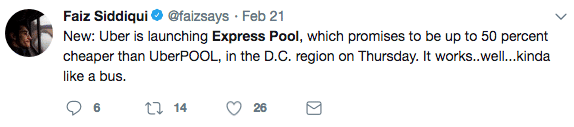

Many wondered whether it made sense to take the time to walk to the stop:
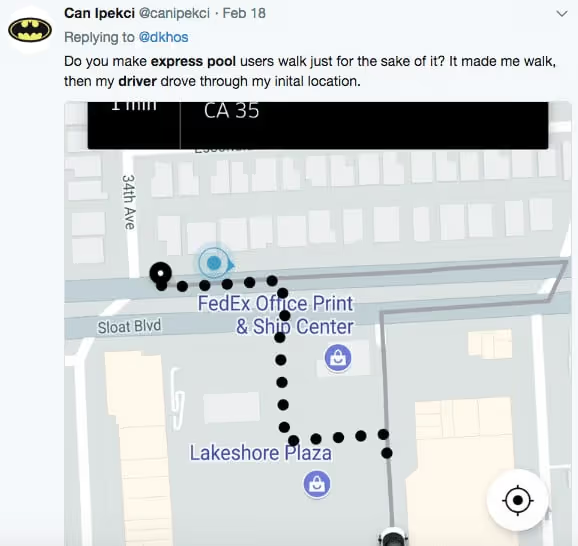

While some were optimistic for the future:


Drivers, on the other hand, are more concerned:

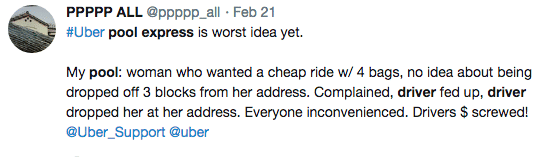
Many drivers just want Uber to ensure passengers know what they're are getting into:
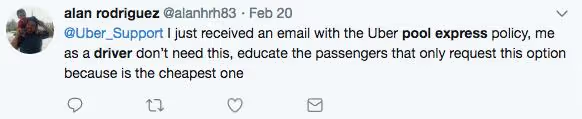
What are the pros and cons for drivers?
While the sentiment is mixed, there are a few clear pros and cons for drivers.
Pros:
More trips: Yes, Pool Express would offer shorter rides that would not pay as much as a normal UberX but drivers will almost certainly get more overall pings
Easier to hit incentives: If you're going for a bonus, hitting your ride quota will be easier if you are getting more pings with Pool Express
More overall demand: Many have speculated that Uber's entire Pool service is intended to attract passengers that would otherwise not use Uber at all and stick to other Transportation Network Company's (TNCs). If this is true, that means more overall demand for drivers. Learn about what top rideshare services drivers are using.
No door to door: It can be a pain to search for passengers and find their exact drop off location, so not having to do that will certainly save drivers time
Cons:
The cons around Pool Express revolve around a number of uncertainties and issues that drivers will likely face at one point or another.
Will passengers know what they are getting into?: The big problem with Uber Pool, in the beginning, was that passengers didn't know what they were getting into. Many drivers ended up with angry passengers that were in a hurry. Uber must properly educate passengers.
Will passengers be on time?: If Express Pool is intended to save drivers time, then passengers must be on time. Will, passengers, end up making drivers wait even longer because they need to walk to their destination?
How will this affect overall pay?: Pay is a huge uncertainty right now and Uber has given little guidance about how Express Pool's pay will actually be structured.
What does this mean for UberX or UberBlack even?: Does this mean drivers will see even fewer UberX rides? Will this mean UberBlack will almost completely be eliminated?
How should drivers approach pool?
There are quite a few uncertainties around Express Pool for drivers right now, so the best thing to do is to test the service for yourself and monitor your metrics carefully.
I would suggest taking a few days where you focus completely on Pool. Track your mileage, trips per hour, and overall profitability and compare it to when you are not driving pool.
Track your metrics with Gridwise!!!
After a few days, you'll be able to see exactly how profitable the new service can be for you.
Talk to passengers
When you get a Pool Express ride, make sure that your passenger knows that they are in a Pool Express and knows what it entails before you set off.
That means confirm their name as usual, ask them if they know if they are taking a Pool Express, and let them know that you'll be picking up other passengers and dropping them off a few blocks from their location.
Don't be swayed to go door-to-door
Inevitably you'll have passengers that call you and ask you to pick them up at a different location. Don't do it, stay stern and disciplined.
This goes for drop-offs as well. As long as the dropoff location is safe, ONLY drop passengers off at the drop-off point. If they complain, make sure they know that you are not allowed to drop Pool Express passengers off anywhere but at that exact location.
Use it to hit your weekly incentive
The very best use case for drivers with Pool and Pool Express will likely be for hitting your incentives. With more passengers using Pool, a smaller pool of drivers doing Pool Express, and shorter trips, you'll receive more pings more often which will help you hit your bonus.
Only Time Will Tell
Right now, Pool Express is an uncertainty for drivers. We'll be talking to drivers and analyzing how Pool Express is affecting demand over the coming months and will be reporting best practices back to you.
In the meantime, test the service and let us know your thoughts in the comments below!
Work smarter. Earn more.
Whether you drive, deliver, or pick up shifts — Gridwise helps you track earnings, mileage, and performance so you stay in control of your work. Download the app and take charge today.
