Gridwise blog
Tips, insights, and advice to help you earn more and work smarter, whether you do gig work, hourly, or shift work.
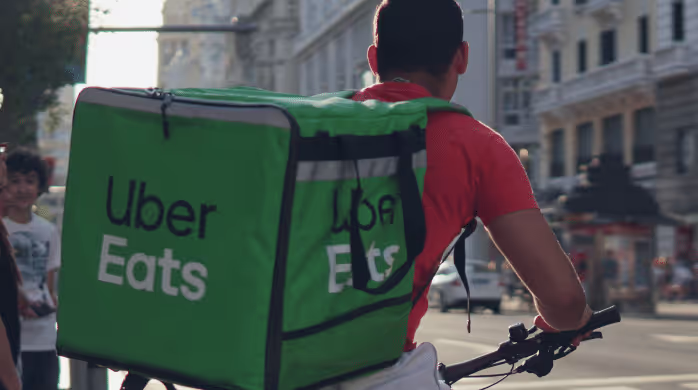
How to Make $1,000 a Week With Uber Eats in 2026 (Tips + Hourly Data)
In this blog, we'll explore the strategies and techniques that can show you how to earn $1000 per week as an Uber Eats delivery driver. We'll cover everything from optimizing your delivery zones and schedules to maximizing your tips and customer satisfaction. Whether you're a seasoned Uber Eats driver or just starting out, this guide will provide you with the insights and actionable steps to take your Uber Eats driver earnings to the next level.
Becoming an Uber Eats delivery partner can be a lucrative opportunity, especially if you're able to consistently earn $1000 a week. By understanding the platform, optimizing your delivery strategies, and focusing on customer satisfaction, you can maximize your earnings and turn Uber Eats into a reliable source of income.
We’ll cover the following topics to provide coaching and ideas to help you push your earnings up to that $1000 per week level:
What do Uber Eats drivers do?
Uber Eats drivers deliver prepared food most of the time, but they also might shop for and deliver goods from convenience outlets and grocery stores. The job is pretty simple. You get a request for an order, you drive to the restaurant or store to pick it up, and then you deliver it to the customer. If you already drive for Uber, you can choose to take orders for Uber Eats delivery any time.
If you’re not an Uber Eats driver yet, it’s pretty easy to become one. This Gridwise post tells you what you need to do if you want to sign up and start making money Uber Eats style. Many rideshare drivers welcome the chance to deliver food rather than people. This article from Nerdwallet covers the Uber Eats gig from that angle.
There are some sweet advantages to working with Uber Eats. In lots of cities you don’t even need to have a car. You can use a bike or a scooter, or even walk, to make your rounds. If you do use a car, Uber Eats’ requirements are a lot easier to meet than they are for Uber rideshare driving.
You also have a lot of flexibility. You can shop and deliver convenience items and groceries, but you don’t have to. And, like most driving gigs, you can choose your own hours, and map out the locations where you want to work.
Use Gridwise features When to Drive and Where to Drive to help you figure out what work hours and which specific areas will be the most profitable for you. Real data from real delivery people will show you earning patterns for drivers in your town.
How much can you earn doing Uber Eats?
The honest answer to this question is: basically, as much as you want! It all depends on how many hours you put in and how strategic you are about your gig. Earnings vary from one area to another, as this article from Entrepreneur points out. To give you a baseline, let’s look at the earnings of Uber Eats drivers who tracked their earnings with Gridwise.
Remember that these numbers show us only average earnings. To make $1,000 a week with Uber Eats, you’re going to have to be better than average, and we’ll show you how. For now, though, it’s good to have these figures so you get a ballpark number of where to start.
How much do Uber Eats drivers make?
Gridwise data tell us the following:
- Monthly earnings average around $444.00 per month.
- Gross earnings per trip are between $9.00 and $10.00.
- Tips make up about 50% of most Uber Eats drivers’ income, which amounts to about $225.00 per month.
Is Uber Eats good money? It can be. While there are other gigs that pay more per trip, if you drive for Uber Eats, you’ll always be pretty busy.
https://datawrapper.dwcdn.net/HPAz8/3
You can also see that, unlike many other gigs, tips play a huge role in Uber Eats earnings.

With these numbers as a baseline, what can we say about how to earn $1,000 a week with Uber Eats? As we said in the introduction, it’s going to be a hustle, but it’s really possible. To figure out how to make the most money with Uber Eats, let’s start by looking at how many trips these “average” drivers made each month.
We know that average gross earnings were $444.00 per month, and drivers got around $10.00 per trip. That means they took 44 or 45 trips per month, which breaks down to 11 trips per week. That’s not a lot of Uber Eats delivery, is it?
The fact that Uber Eats drivers averaged so few trips shows us that many drivers use more than one app at the same time. This is called multi-apping, and you can learn more about it in this Gridwise post. If you want to answer the question of how much you can make with Uber Eats, then you need to stick with the app and keep plugging away at those orders. You also need solid strategies, as well as some inside tips and tricks.
How to make the most money on Uber Eats: Delivery driving tactics
Getting to that $1,000 a week with Uber Eats isn’t so hard when you remember that the drivers we saw making about $111 a week were only taking around 11 trips in the same time period. That’s not much at all! If you work the Uber Eats app like a boss, you’ll soon have many more trips than that, easily reaching the number needed to get you to $1,000 a week. Now, let’s get to some tactics you’ll need to make that kind of bank.
- Stay with the Uber Eats app, and track your earnings. Gridwise can easily do that for you. Simply sync your Uber Eats app with Gridwise, and you’ll be able to see how much you’ve earned with Uber Eats, what times were most profitable, and your average hourly pay. Racking up trips with Uber Eats has other benefits, including perks and bonuses that are awarded to top drivers.
- Leverage surge pricing and promotions. Surge pricing is applied when there is a lot of demand. When surge pricing is in effect, many of the trips you make will pay more than usual. Promotions are offered to drivers who complete a given number of trips in a certain time period. High traffic volume days, nights, and times give you these chances to get extra earnings. Challenging yourself to complete the right number of trips for promotions will add to the number of trips you can count on for big bucks, too. Learn more about Uber Eats surge pay, boosts, and promotions in this Gridwise blog post.
- Say yes to doubling up on orders. With Uber Eats, you can get back-to-back orders or receive batched orders. Back-to-back orders happen when you receive a new request while you’re on the way to deliver an original order. The Uber Eats app routes these trips automatically, so you won’t be sent out of your way.
Batched orders are Uber Eats’ way of bundling together orders from either the same restaurant, or two nearby eating establishments. You get money, and trip count credit, for all the orders you complete, plus customer tips, without having to make a bunch of separate trips.
- Turn on the charm and get bigger tips. Being nice really is part of the Uber Eats driver’s job, and getting tips is one way people who drive for Uber Eats make money beyond their basic pay.. Bring along those extra napkins and condiments, use equipment that keeps food and drinks at the right temperatures and prevents spilling, and consider your customers’ needs. If you deliver groceries, be extra careful with delicate items such as bread and eggs.
And, most important, follow your customers’ directions, and stay in communication with them if you are going to be delayed, or if you have questions about their order. This Gridwise post will tell how to get bigger tips as a delivery driver.
- Use even more charm to keep your ratings high. As an Uber Eats driver, you will be rated by the restaurant or store where you pick up the orders as well as the customers who are waiting for the deliveries. This two-way rating system is designed to keep you on your toes, so Uber can keep people satisfied with your service. Don’t worry, you get to rate them, too.
There’s another reason why your rating as a driver is important. It not only keeps you in good standing with Uber; it helps you to qualify for the Uber Eats Pro incentive program. To learn more about Uber Eats Pro, and what it takes to earn perks such as preferred services, discounts, and deals, check out this Gridwise blog post.
Smart business moves that seal the deal
Now that you know how to gobble up the deliveries you need to make $1,000 a week with Uber Eats, it’s going to be a breeze to get there. Let’s make it even easier, with business moves that boost your earnings and shrink your expenses. If you use these, it will also be easy to say yes when people ask, “Can you make good money with Uber Eats?”
Minimize expenses. Avoid racking up big fast-food bills by bringing your own food and beverages. You might not think you’re hungry when you first start your Uber Eats run, but once the aroma of pepperoni pizza, premium cheeseburgers, and piping hot fries start wafting through your car, that might change. Bring a sandwich or other healthy food from home, and buy bottled water in bulk to save tons of cash compared to what it costs to buy single servings.
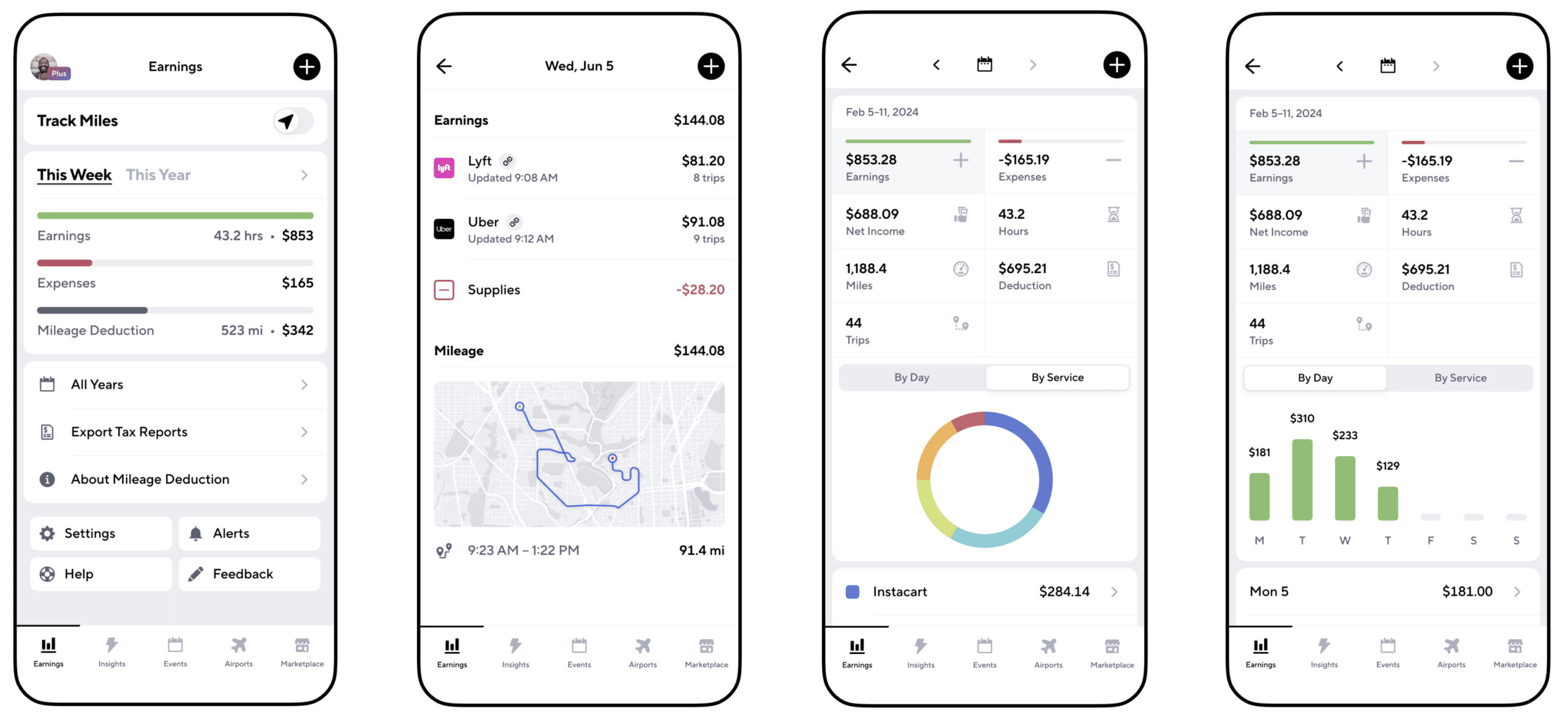
Maximize tax deductions. Another way to minimize your expenses is to maximize your tax deductions. Start by tracking mileage with Gridwise.
Gridwise App
Gridwise captures every deductible mile you drive, including the distance you cover between the trips your driving app records. Know what expenses you can deduct, and put them to work for you when tax time comes. Learn more about tax deduction strategies in the Gridwise Tax Guide for drivers.
Boost earnings with referrals
As an independent contractor, you’re probably looking for ways to make even more money than you can with Uber Eats. And most gig workers like you enjoy getting passive income. With Uber Eats, there’s a really easy way to do that, referrals!
All you need to do is find friends and encourage them to deliver for Uber Eats. If they make a certain number of deliveries within a specified time, you will get paid for doing nothing more than having them sign up under your referral code! Rates of pay vary by city, so check your Uber Eats app to find out what the current deal might be, and learn more about the referral program on the Uber Eats website.
Also remember: “friends” don’t have to be your best buds. Many delivery people carry cards with a QR code linking to their referral information, so just about anyone you encounter can join Uber Eats and boost your earnings. You could meet a source of passive income at the gas station, on social media, or at your high school reunion. The more you hustle, the more there is to gain, right?
Master the art of self-employment
As an Uber Eats driver, you’re an independent contractor. That means the company isn’t going to withhold your taxes, provide insurance, keep track of your earnings, or tell you about tax deductions. You’ll have to do all these things for yourself.
If you want to maximize your tax advantages, open an official business entity. You can incorporate (create a corporation) or you can work as a limited liability corporation (LLC). You can also work with a DBA (Doing Business As) arrangement, but the corporation or LLC will do a better job of protecting you from liability.
Establishing a corporation or LLC offers better tax advantages than being a sole proprietor. For instance, if you simply collect your earnings into your private account, you’ll be charged self-employment taxes in most states. And paying extra taxes is something we all want to avoid, within legal limits, as much as possible.
Every Uber Eats driver needs to learn about self-employment, and there are some great resources you can review. Check out the CareerOneStop website about self employment which will help explain the basics. You can also check with a professional tax accountant, or look other websites to learn more about actually creating a business.
Scope out your market
Look at the area around you to see where you’re likely to get the most deliveries. Where are all the restaurants? Where might people be more inclined to order deliveries? What hours do you want to drive? What activities might be going on around those times? Think about late-night and after-school times as well as breakfast, lunch, and dinner times.
Be realistic about the potential for your area and aware of new services opening up. For example, in New York, there is already a tab on the Uber Eats app that allows customers to order groceries. In our article about the best food delivery service to work for you’ll see that Uber Eats stacks up well against other delivery companies, mainly because of its potential for expanded opportunities for drivers to earn.
So, is Uber Eats good money? As we said, it isn’t an automatic guarantee that everyone will make $1,000 a week with Uber Eats. Trying out the suggestions we give you here, though, should put you on the right track! Go out there and start stacking up those orders and raking in some impressive earnings!
Get more inside information on Uber Eats in these posts from the Gridwise blog:
- The delivery driver guide: Using the Uber Eats app
- Everything you need to know about driving for Uber Eats
- Uber Eats Pro: What drivers need to know
- Looking for a different gig, part-time or full time job? Check out the Gridwise Job board.
Uber Eats FAQ
How does the Uber Eats platform work for drivers?
Uber Eats is a food delivery service that connects customers with local restaurants and independent delivery partners. As an Uber Eats driver, you'll receive notifications of nearby delivery requests, which you can accept and complete. The platform provides flexibility, allowing you to work on your own schedule and earn money based on the number of deliveries you complete.
What are the requirements to become an Uber Eats delivery partner?
To become an Uber Eats delivery partner, you'll need to meet certain requirements, such as having a valid driver's license, a registered vehicle, and passing a background check.
How can I choose the right delivery zone to maximize my earnings?
Selecting the right delivery zone can significantly impact your earnings, as some areas may have higher demand and better-paying orders. It's important to research and identify the zones in your area that tend to have the most consistent and lucrative delivery opportunities.
How can I take advantage of peak delivery hours and surge pricing?
Understanding peak delivery hours, such as mealtimes and weekends, and taking advantage of surge pricing can boost your earnings. Be aware of when demand is highest in your area and adjust your schedule accordingly to capitalize on these peak periods.
What are some tips for maximizing tips and customer satisfaction?
Providing excellent customer service and going the extra mile to ensure a positive experience can lead to more tips and repeat business. Prioritize communication, timeliness, and attention to detail to keep your customers happy and satisfied.
How can I set realistic weekly goals to reach my $1000 target?
To make $1000 a week with Uber Eats, it's essential to set realistic weekly goals and track your earnings and expenses. Start by determining your target earnings and breaking it down into achievable daily or weekly goals. This will help you stay on track and make adjustments as needed.
What are some strategies for efficient route planning and navigation?
Effective route planning and navigation can save you time and fuel, allowing you to complete more deliveries. Utilize mapping apps and take advantage of features like real-time traffic updates and turn-by-turn directions to find the quickest routes.
How can I balance my Uber Eats deliveries with other commitments?
Develop a schedule that allows you to capitalize on peak delivery hours while still maintaining a healthy work-life balance. Consider using tools like calendar apps to plan your availability and track your hours to ensure you're maximizing your earning potential without sacrificing your personal life.
What are the key considerations for maintaining my vehicle as an Uber Eats driver?
Keeping your car clean and well-maintained is crucial for maximizing your Uber Eats earnings. Regularly scheduled oil changes, tire rotations, and other preventive maintenance can help extend the life of your vehicle and minimize downtime. Additionally, budgeting for vehicle-related expenses, such as fuel, insurance, and repairs, will ensure you're accounting for these costs and maximizing your net earnings.
What are the tax obligations and legal considerations for Uber Eats drivers?
As an Uber Eats delivery driver, it's essential to understand the tax obligations and legal considerations that come with being an independent contractor. This includes properly reporting your earnings, deducting eligible business expenses, and making quarterly estimated tax payments. Additionally, you'll need to ensure you have the appropriate insurance coverage, such as personal auto insurance and possibly commercial auto insurance, to protect yourself and your vehicle while on the road making deliveries.

The Gridwise Job Board: Find Your Ideal Job or Gig Work
Gridwise is an essential assistant app created by gig workers for gig workers. Our mission is to support those engaged in gig work in every way possible. We understand how challenging it can be to deal with income instability, a lack of benefits, and job insecurity that often comes with gig work. The Gridwise app tracks and organizes earnings and expenses, and offers a wide array of discounts, deals, and services that make the lives of independent contractors easier and more rewarding.
We firmly believe it’s possible to make a viable living and create a gig experience that offers flexible hours, variety, and excitement. With issues such as consistent earnings and job security in mind, Gridwise is proud to offer a centralized platform that shows you how to find gig work and secure reliable opportunities. We’re proud to introduce the Gridwise Job Board.
The Gridwise Job Board: Key features
Because Gridwise is dedicated to serving the gig worker community, we’ve filled the Gridwise Job Board with useful features that won’t waste your precious time.
- Comprehensive listings. Find part-time, full-time, temporary, and per-task work. Drive or deliver with your vehicle, utilize an employer’s vehicle, or even find non-driving gig work.
- User-friendly interface. Find the jobs that are right for you with a tap of your screen.
- Verified opportunities. We vet the jobs before they are listed to ensure you’re getting high-quality job postings.
How to get more gig work, seasonal, part-time or full-time jobs with the Gridwise Job Board
Looking specifically for “gig work apps” or “gig jobs near me?” You’re in luck. Our filters and search functions send you directly to the listings you seek.
Here’s how it works.
- Access the Job Board via the Gridwise website.
- Search for jobs by type, location, and more.
- Select the job that interests you, and read all about it.
- Scroll through the description, and if it appeals to you, click “Apply for job.”
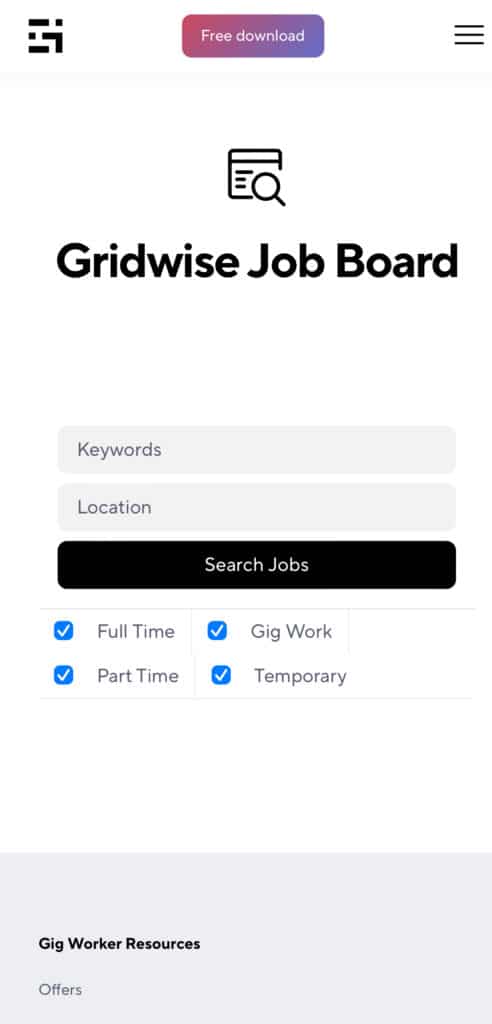
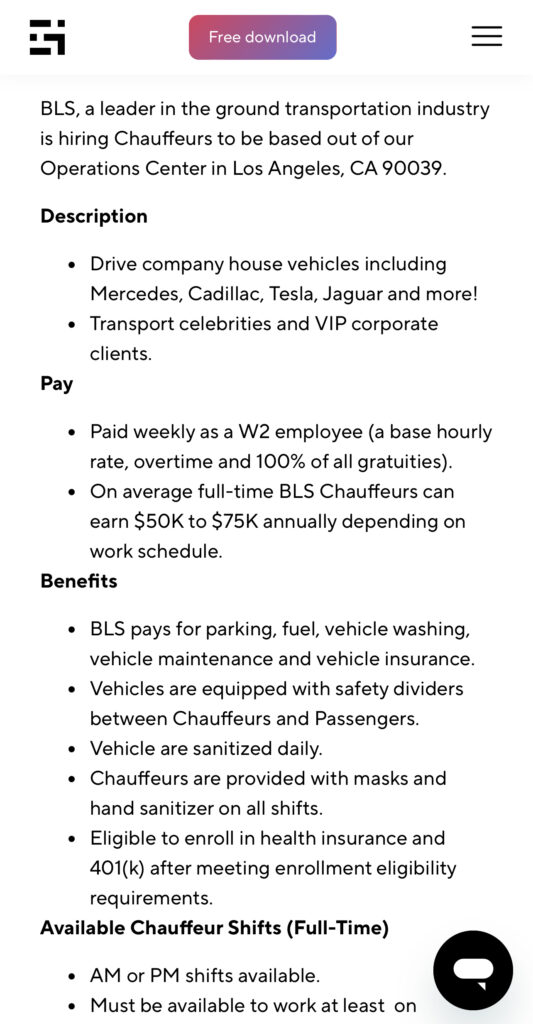
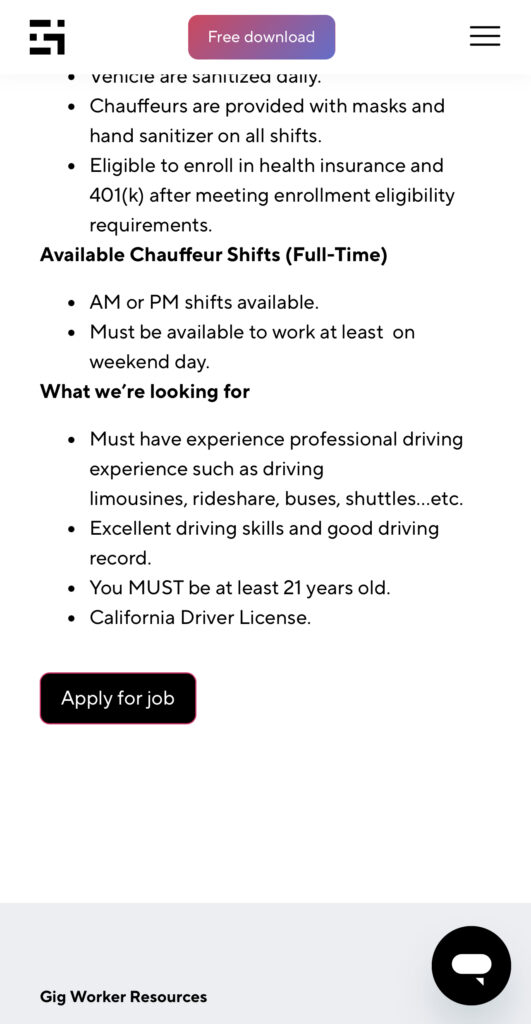
Many types of jobs are available. Adjust the search filter to see the full variety of opportunities that will let you cash in. Deliver food, set up catering, do rideshare driving, get paid for doing package delivery, and much more. You’ll find short-term gigs, long-term contracts, and part-time positions.
Perks of the Gridwise Job Board for gig workers
Gig workers who know how to make extra money will appreciate how the Gridwise Job Board lets you multiply your chances of bringing in big earnings. Here’s how:
- Increased stability. Use the Gridwise Job Board to find part-time or permanent jobs in addition to the part-time gigs you already have. Always keep a steady stream of earning opportunities flowing toward you.
- Flexibility and autonomy. Choose jobs that fit your schedule, work around other jobs and family duties, and still leave room for some fun in your life. Discover side hustles to supplement your full-time job, permanently or just for the season.
- Skill development. Find part-time work that lets you use a skill you already have, or try your hand at something new. It’s a smart way to develop a portfolio to showcase what you can do, or even to find permanent employment.
Get Gridwise and stay up to date on the Gridwise Job Board
Gig workers need plenty of information and assistance, and Gridwise is here to give it to you. Download the app and get essential features such as
- seamless earnings tracking
- mileage tracking
- expense recording, including notes
- low-cost and no-cost insurance benefits
- access to affordable medical, dental, vision, mental health, and alternative care
- professional services including legal and financial help
- deals and discounts
- weather, events, and traffic reports
- inside information on where and when to drive
More to know about gig work:

5 Best Mileage Trackers For Gig Drivers
Many drivers ask, “Do I really need a mileage tracking app?” The answer is simple: only if you want to have an accurate count of all the miles you can legally deduct from your taxable income! You might think your rideshare or delivery driving app has got you covered. After all, they do quite a good job of logging the miles you drive while you’re on a trip or delivery. But, if you want to have the best app to track mileage for Uber, Lyft, Doordash, Instacart, or the other apps you may use, you need more. Why is that?
Without a separate tracker, you’re missing the miles you drive in between pings. Did you realize that all the miles you drive, from the moment you begin your shift until it’s over (as long as you don’t drive several miles on a break to hang with your friends), are tax deductible! That means you need something besides your driving app to keep an accurate count of your travels. Read this Gridwise post to see how important it is to keep track of every deductible mile.
You won’t be surprised to hear that there’s an app for tracking miles. In fact, there are several of them. Here, we’re going to tell you about five top mileage tracking apps, and help you figure out which one is best for you.
Before we get to the list and identify the best mileage tracker app, let’s clarify what exactly a mileage tracking app is. According to G2.com’s technology glossary, mileage tracking is done for the purpose of keeping a log of mileage that is either reimbursable or tax deductible.
And yes, of course you can track your miles simply by taking readings on your odometer. But are you really prepared to account for how many miles you drove for personal reasons and subtract them from the total to get your business mileage? Even if you can remember all that and do the arithmetic, if you want an accurate reading of the miles you drive for business, and can therefore deduct, a mileage tracking app will save you a lot of trouble and prevent you from making costly errors.
Plus, as a gig driver, you have specific needs when it comes to a mileage tracker. Ideally, you’d be able to handle mileage tracking and several other functions all in one app. It can be maddening enough to deal with driving apps, particularly if you’re an avid multi-apper. You would want your mileage tracker app to help you keep account of other aspects of your business, including income, expenses, and inside information about the art of gig driving.
Not all mileage apps are equal, to be sure! Let’s look at five of the best apps to track mileage and figure out which is the best app to track mileage with Uber and Lyft, or what mileage tracker app is best for DoorDash.
1. Zoho Expense
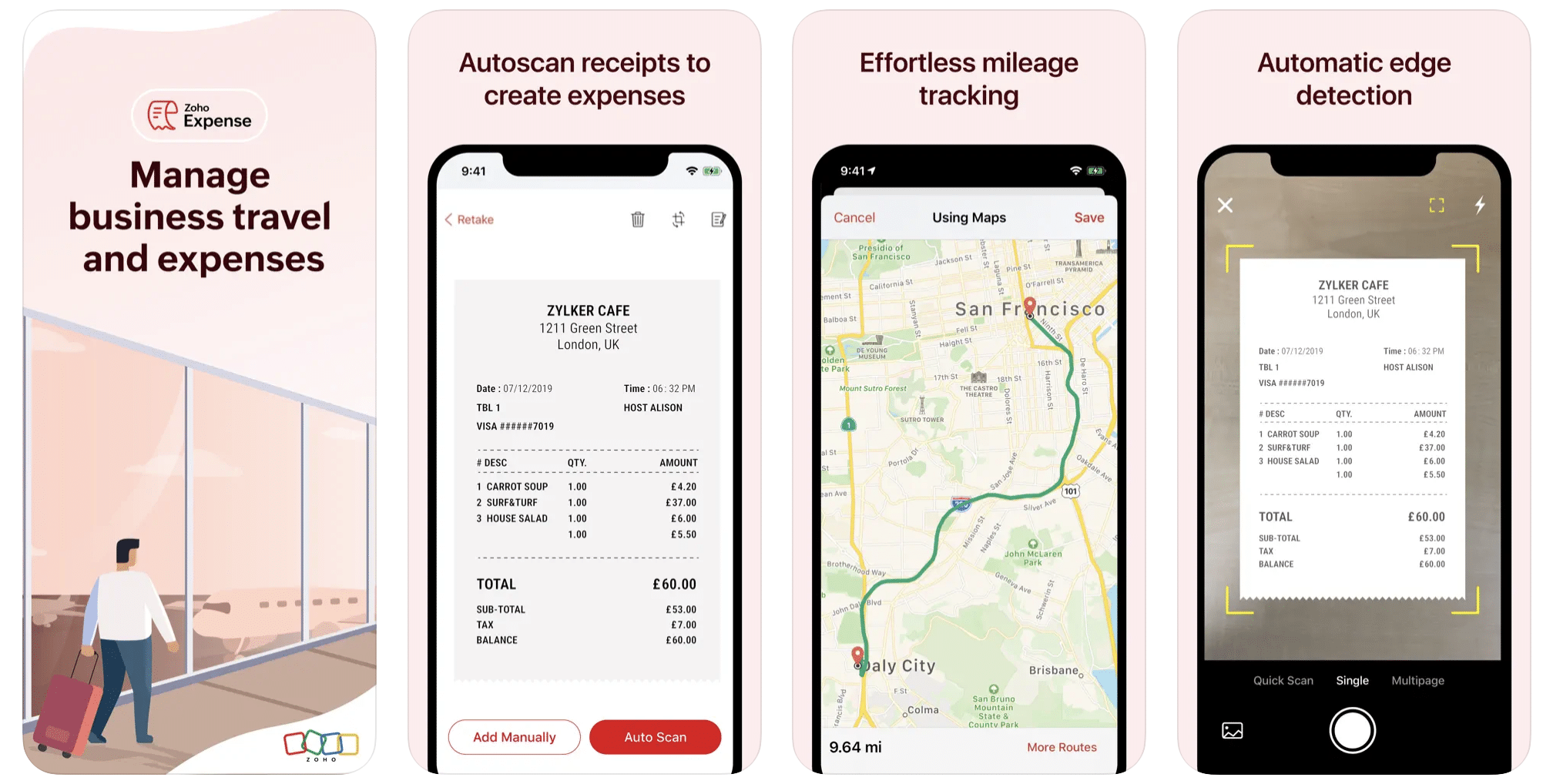
First up is Zoho Expense, which does exactly what its name says. This app is designed to allow companies to give employees a uniform way to create and submit expense reports. It can be used by individuals, including gig drivers, as well.
It includes a mileage tracker, as well as features that let you track other deductible expenses, including the ability to scan and record receipts.
Available on Android and Apple: Yes
Ratings: 4.8 stars on App Store, 4.7 stars on Google Play
Free Version: Yes
Subscription price: $3 per month, billed annually
Created specifically for gig drivers: No
2. Quickbooks Online
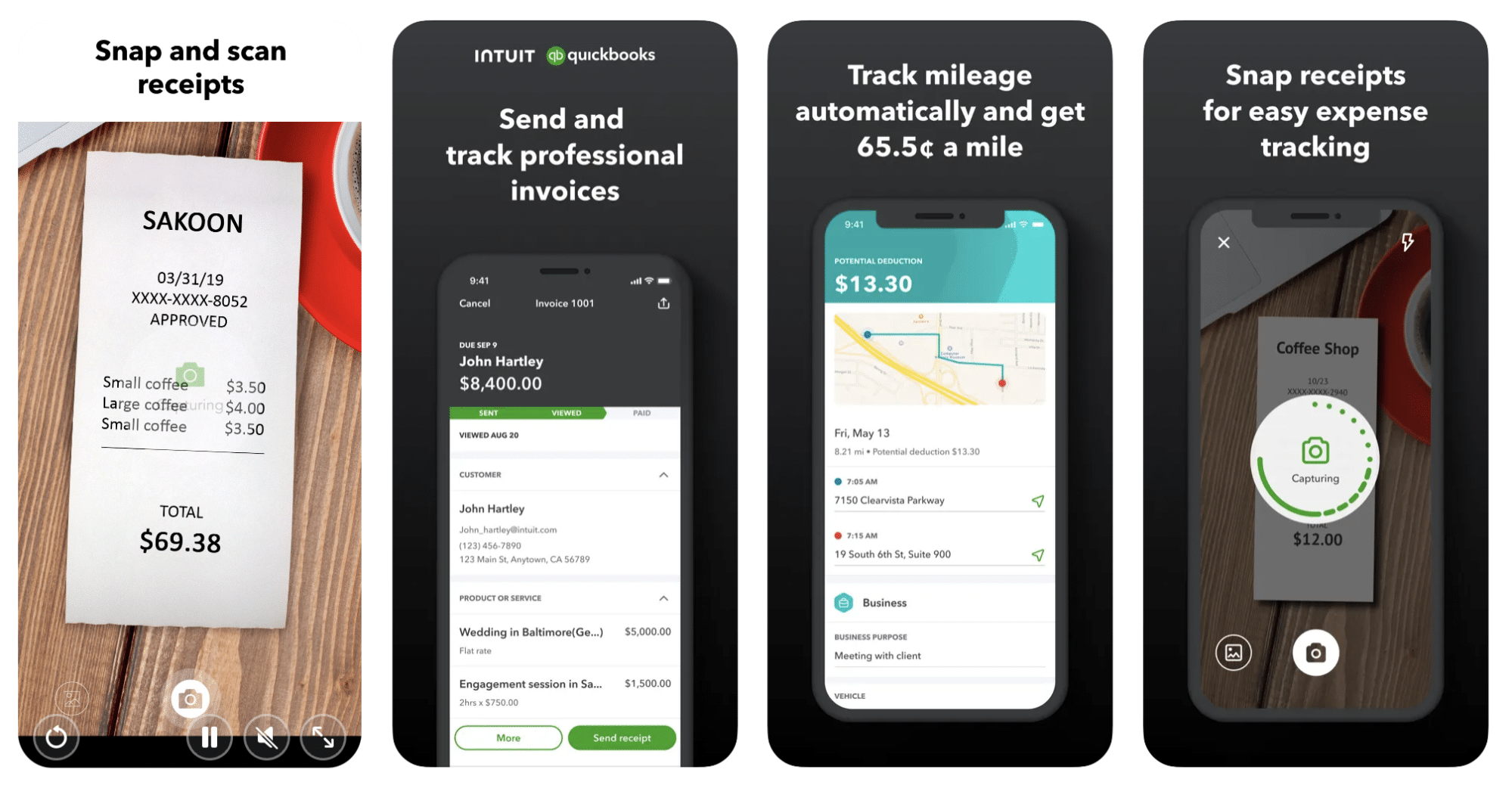
Quickbooks Online is a cloud-based app that allows you to track your mileage, earnings, and expenses. The information you enter can then be used to generate various reports that prepare you for tax time. It also allows you to create graphs that illustrate your cash flow, and includes a receipt scanner so you can instantly record deductible expenses. Quickbooks is popular, highly reliable, and designed mainly to help people keep track of their small businesses.
Available on Android and Apple: Yes
Ratings: 4.7 stars on App Store, 4.4 stars on Google Play
Free version: 30-day free trial
Subscription price: $15 per month for basic version if purchased for 3 months or more
Created specifically for gig drivers: No
Source: quickbooks.intuit.com
3. Shoeboxed
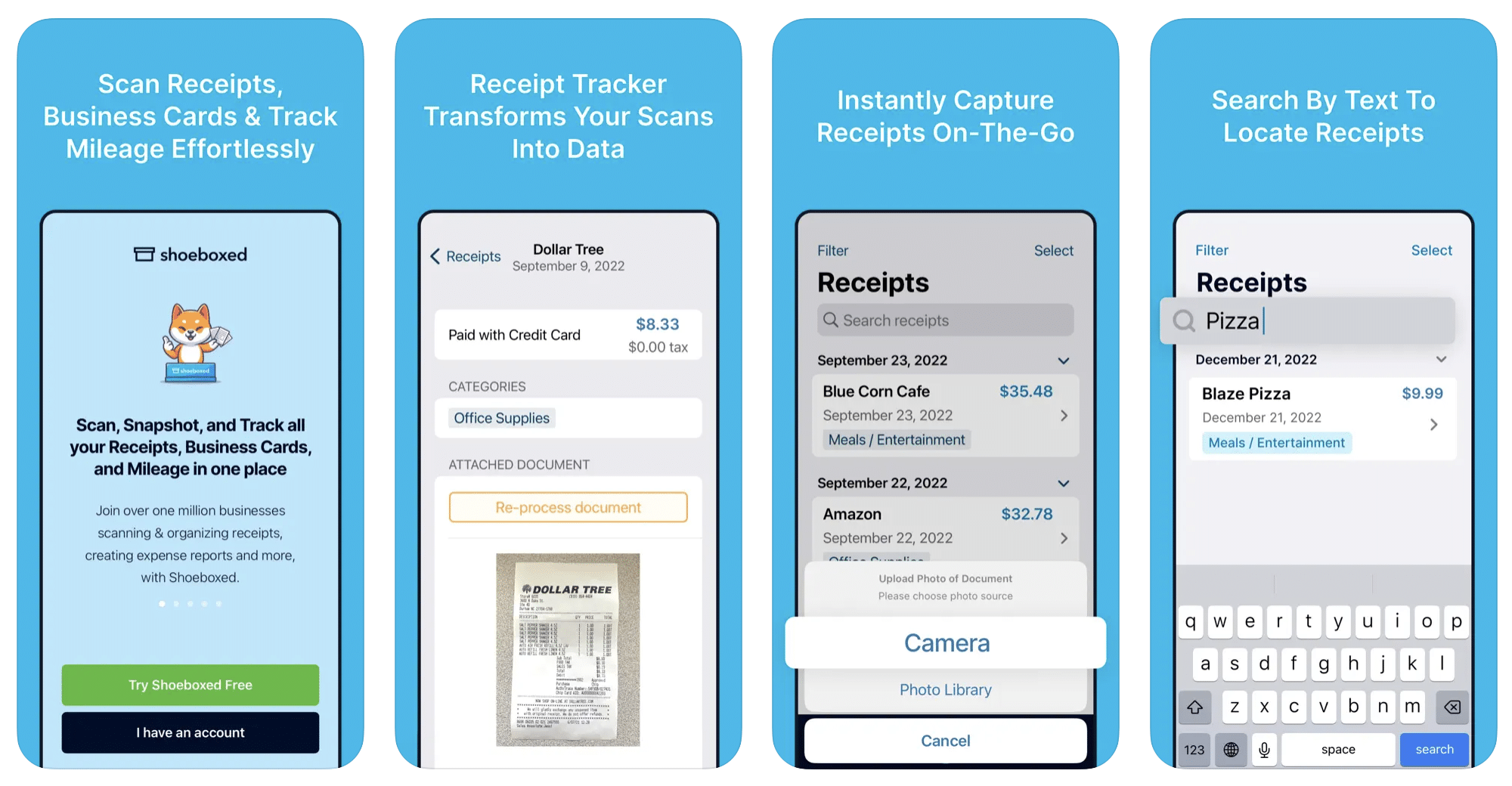
Shoeboxed started in 2007 as a service for scanning paper receipts into digital form. Now the app offers a free mileage tracker and has enabled users to scan receipts directly. It touts itself as the best mileage tracking app for DoorDash, but there are some elements missing that Dashers might like to have. While it provides features that record your expenses and prepare you for tax season, it doesn’t automatically track your earnings. The mileage tracker has a system where you can drop pins along your routes to make the tracking more precise, identifying those legs of a trip that you make for business purposes. The mileage tracker is “free” once you sign up for the basic version.
Available on Android and Apple: Yes
Ratings: 4.5 stars on App Store, 2.3 stars on Google Play
Free version: No
Subscription price: $18 per month for basic version
Created specifically for gig drivers: No
Source: blog.shoeboxed.com
4. Stride
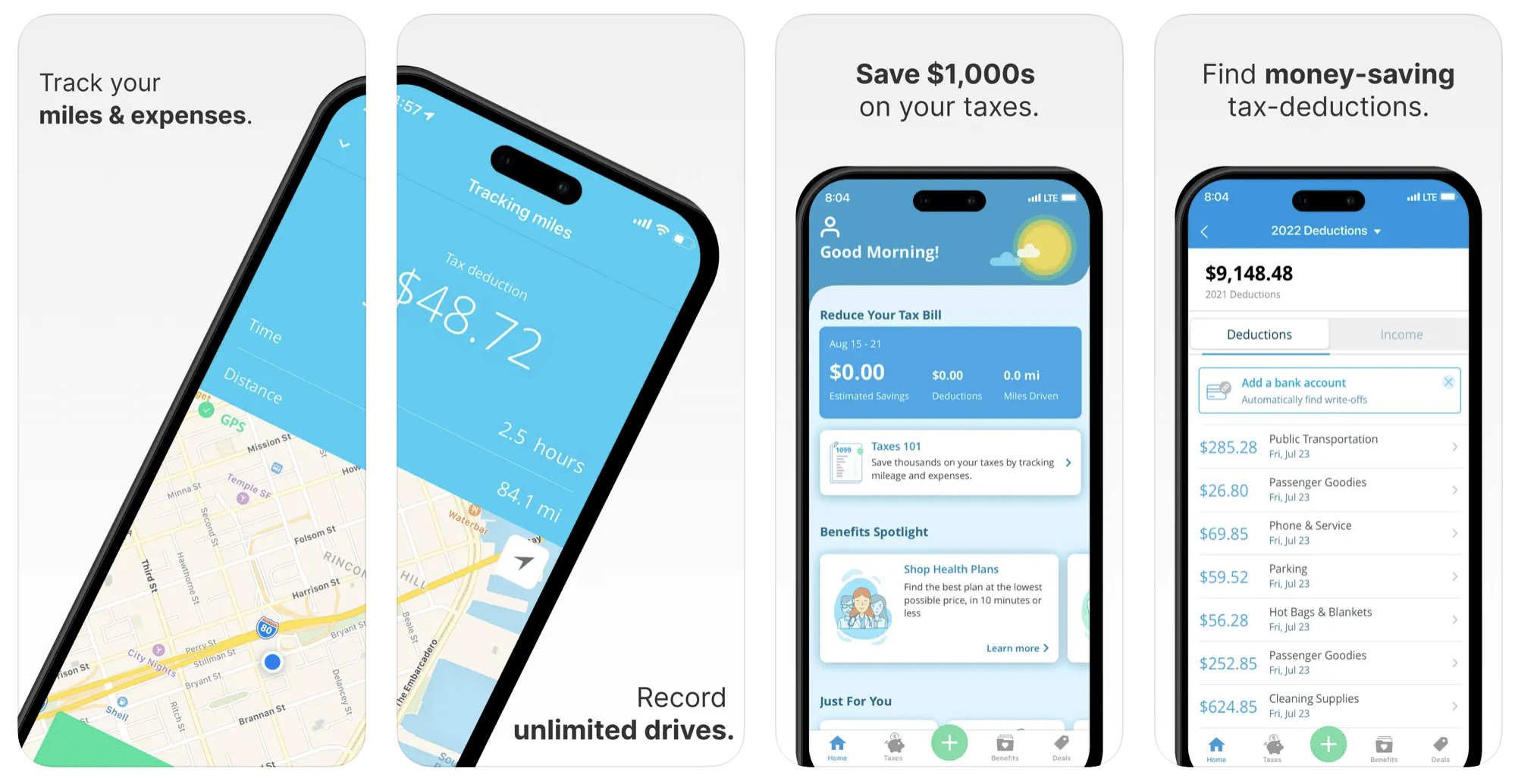
This free mileage tracker does a fair job of keeping track of the distances you rack up while gig driving, but it doesn’t automatically track earnings. It can be a big help, though, in tracking your expenses. You can link Stride to your bank account, and it will automatically scan your expenses to identify items you can potentially deduct. The app is totally free. This could make it the best free mileage tracker app, but there is a small price to pay. The app will persistently push you to consider various insurance plans that they are affiliated with. If you don’t mind that, this is a solid mileage tracker, even if it doesn’t track your earnings.
Available on Android and Apple: Yes
Ratings: 4.8 stars on App Store, 4.6 stars on Google Play
Free version: Yes
Subscription price: None. The app is free.
Created specifically for gig drivers: No
5. Gridwise
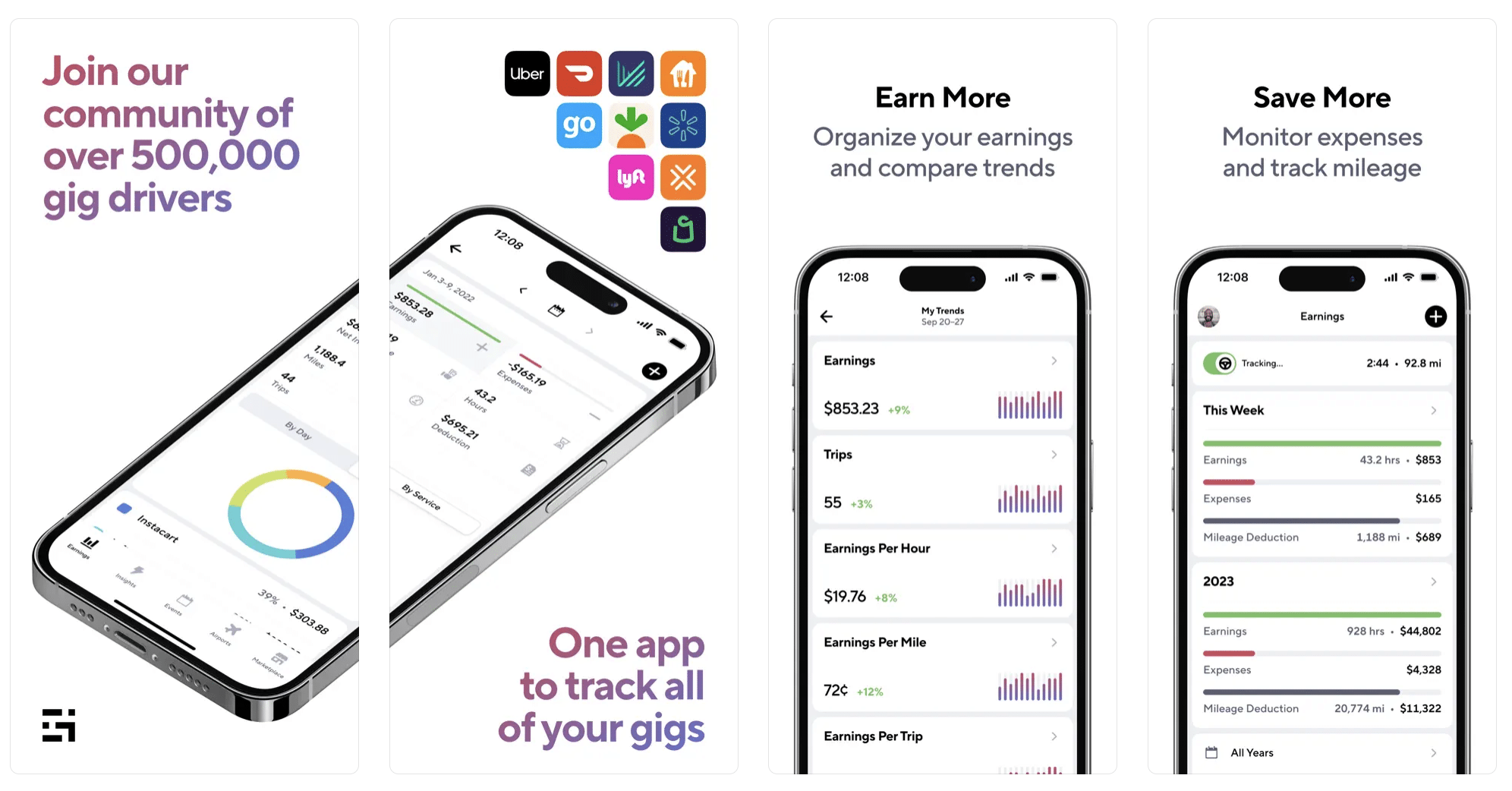
Gridwise has a free mileage tracker and free features that record your income and expenses. It gives you access to insurance and benefits, as well as insights about the best times and places to make the most money while gig driving. The Gridwise mileage tracker captures all the miles you drive while you’re on your driving shift, and it can be used if you have other trips you need to make which qualify as business travel.
Drivers love it because it is geared toward the needs of rideshare and delivery workers, providing free information about airport departures and arrivals, event start and let out times, weather, traffic, and more. The Gridwise Plus subscription adds value by providing additional insights and reports, discounts on benefits, the ability to export data in .csv format,, and more.
Available on Android and Apple: Yes
Ratings: 4.9 stars on App Store, 4.6 stars on Google Play
Free version: Yes
Subscription price: $9.95 per month for Gridwise Plus, or $95.99 per year (a $23.41 savings)
Created specifically for gig drivers: Yes!
What is the best mileage tracking app?
Now that we’ve checked them all out, we’re positive about the answer to that. Hands down, it’s Gridwise. Are we biased? You bet we are! But drivers love it too. Gridwise is the best mileage tracker app, and so much more. So many of the features are free, and the subscription to Gridwise Plus will pay for itself with additional insights to boost your earnings and deeper discounts on products and services.
Most important, Gridwise is designed specifically for gig drivers by experts who were once gig drivers themselves! Knowing what gig drivers need is a crucial step in creating an app that rideshare and delivery drivers can really use! Here are a few of the features, besides mileage tracking:
- seamless earnings tracking
- automatic, on/off toggle and manual mileage tracking
- mileage categorization
- airport, traffic, weather, and events information
- insights into where to drive and when to drive
- reports showing earnings across the platforms you use
- discounts on countless products and services for drivers
- additional resources for finding side gigs
- an informative and comprehensive blog
- affordable benefits, including insurance, medical, dental, and alternative practitioner discounts
- a community of drivers just like you
Don’t settle for just any app. Get the best mileage tracker, and so much more, from Gridwise!
5 Things to Consider Before Becoming a Full-Time Rideshare Driver
If the thought of becoming your own boss, setting your own schedule and getting out of that office has led you to consider becoming a full-time rideshare driver, you’re not alone. Thousands of people across the world have dropped the 9-to-5 in favor of driving, but, of course, it’s not always as easy as it sounds.
Here are five important things to consider before taking the leap.
Am I ready to drive 12 hours a day?
Sure, it’s nice to dream about driving just a few hours here and there whenever you want, but that won’t really work. To make a living as a rideshare driver, you may have to work overtime. In other words, being a full-time driver is really full-time. So the first thing you need to ask yourself is, am I ready to drive 12 hours a day (at least sometimes)?
Here are some things to consider:
- Back pain: 12 hours is a long time to sit. And this extended time in one position can really hurt your back, or exacerbate already-existing back and body issues. Is this something you can deal with?
- Lack of exercise: Being in the car that long also means you’re not exercising. Sure, that 9-to-5 office job meant little exercise too, but at least you got up and walked to the copier, or did a few blocks on foot to grab lunch, or stood on the train during your commute. With rideshare driving, it’s hard to avoid sitting the whole time.
- Boredom: Think back to that really long road trip you took. Remember how boring those hours of driving were? Really consider if you could do that five days a week.
- Overall long hours: There are a million other reasons why the long hours might get to you. Do you have side projects you still want to work on? A family at home that you want to spend time with? A dog that needs walking? Think of all your other obligations and aspirations and be honest about how much time you can take away from them.
Of course, there are ways to drive full-time and not totally sacrifice your well being. You just have to commit to remaining healthy while driving. Here’s how you can do it.
- Set aside time for exercise. Either before, during or after your shift, try to fit in at least 15 minutes of strenuous exercise a day. Even if you can’t hit the gym, take a break and stretch, do some jumping jacks or take a walk.
- Make it fun. You’re going to have to entertain yourself for long hours, so make sure you’ve got some stuff to occupy your mind while you drive. Load your phone up with good music, download some interesting podcasts for between rides, and brush up those conversation skills.
When do I want to have flexibility?
Like any full-time job, it’s good to have a set schedule that you stick to at least most of the time. And when you’re your own boss, you can build your schedule in whatever way makes sense to you. But there are some caveats when it comes to rideshare driving.
For one, you will want to maximize your earnings by working during peak hours. That means doing the morning commute, evening commute, nights and/or weekends. And because that means you’ll be working when most people aren’t (and for long hours on top of that) you have some FOMO. Here’s what you can do about that.
- Plan to be around when your friends and family are. If you need to help get your kids off to school, plan on skipping the morning commute. If you and your family like to go out on the weekends, drive during the weekdays. If you like to go out at night with your friends, drive during the day. In other words, identify the times that are important to you, and try to maximize the hours you work around that.
- Use your off-time well. If you drive late, it may be tempting to sleep in until your next shift, but try to be disciplined about maximizing your off-time as much as you do your working hours. If you’re enjoying your remaining time, the 12-hour shifts won’t feel so bad.
Am I a people person?
At its core, rideshare driving is a service job. And like all service jobs, you have to be good with people to enjoy it and do it well. If you’re considering jumping into the game full-time, make sure you ask yourself if you’re ready for what that means.
- You will be meeting and talking to a lot of people. If you don’t find people’s stories interesting or find yourself exhausted by the thought of talking to so many people every day, you may not be cut out for full-time driving. On the flip side, if this idea excites you, you’re in the right business.
- Ratings and tips depend on likeability. Whether you consider yourself a people person or not, your ratings and tips will be determined by how people perceive you. So if you want to get that extra boost in cash – and keep your job – you’re going to have to be likeable.
That said, you can still do this job even if you’re not an extrovert. Here are some tips to be more outgoing, and maybe even become more of a people person:
- Open up. The first step is just plain talking. Always greet your rider, ask them how they’re doing, and learn some good conversation starters. Ask questions, talk about the weather, or ask them where they’re headed.
- Read people. Knowing when to talk is just as important as knowing when to stop talking. Learn to read your passengers for cues of conversation willingness. Are they looking at their phone? Have their head tilted back and eyes closed? That’s a good time to turn on some music and let them be.
- Have a good time and don’t be too serious. People always like a happy person, so don’t be too serious. Even if you’re not talking, a rider can pick up on your mood, so if you’re enjoying yourself, you’re more likely to get better ratings and tips, and have better conversations.
Do I have the right equipment?
Rideshare driving isn’t just about having a clean car and knowing how to drive. Any pro driver will tell you that you shouldn’t go full-time until you’re stocked with the right equipment, from car to GPS.
So before getting started, make sure you have:
- A newish, reliable, low-mileage, efficient car. Don’t skimp, but don’t go overboard, either. Lease payments can be pricey, but so can repairs. Do your research and find the right car for you.
- The right tech. Get a smartphone mount for hands-off, easy driving; a dashcam in case something happens; a mileage log; an illuminated Uber/Lyft sign for night driving; plenty of phone chargers for you and your passengers; and a good GPS system.
- Emergency equipment. Make sure you’re prepared for emergencies with a first aid kit, seat belt cutters and a roadside tool kit.
Am I ready to treat this like a business?
The last question you need to ask yourself is if you’re ready to be a small business owner. That may sound a little overly ambitious, but the truth is, if you’re your own boss, you are a business owner. And that means there’s some extra things to consider.
Here are the main things you need to think about – and be on top of – as a full-time rideshare driver:
- Car maintenance. Driving full-time is going to put some wear and tear on your car. And that means you’re going to have to get it maintenanced more often than you’re used to. That means you need to not only be on top of getting new tires, oil changes, and tune ups on the regular, you also need to set aside money in order to do so.
- Healthcare. Now that’s you’re not employed by a company, you’re going to be paying your own healthcare costs. Depending on where you are and what your general health is, they may or may not be a big deal. Before going full-time, really think about what you can and can’t afford to live without.
- Taxes. Taxes are way more complicated when all your paychecks aren’t automatically deducting taxes and you don’t get a single W2. Consider how organized you are before doing this full-time. Can you keep track of expenses? Do you know the rules of filing as a freelancer? Make sure you know what you’re getting into so it won’t come back to bite you.
So... what else are we missing from this list? Full-time drivers, what else should part-time drivers consider before taking the full-time plunge? Which apps are your favorite for rideshare and delivery?
Let us know in the comments below!
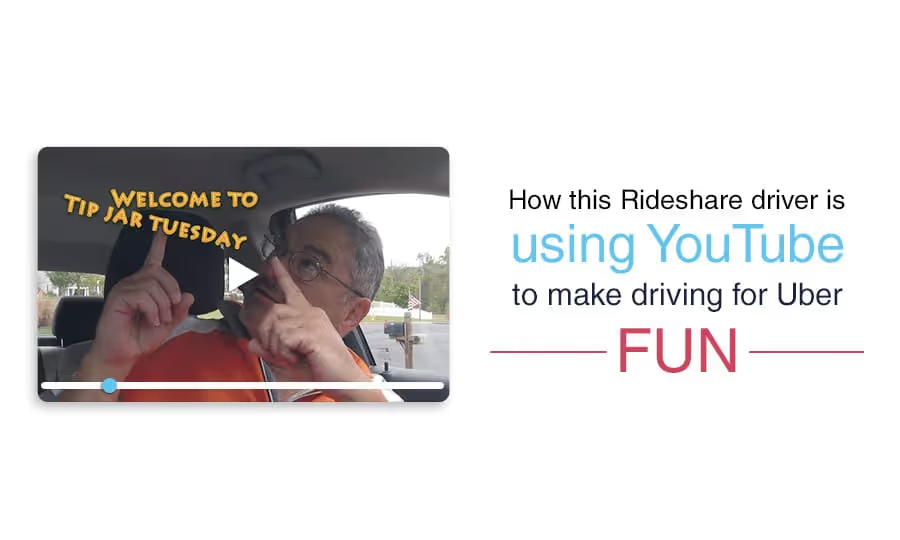
How this Rideshare driver is using YouTube to make driving for Uber Fun
We get it. Driving can be a grind, and it’s not always going to be a good time. Sometimes you’ll get a grouchy passenger, or a nightmare pool, or a bad review. And while these days are always going to happen, there are some things you can do to make driving more enjoyable, despite the odds.
Just ask Paul.
Paul moonlights as a driver in the D.C. and Northern Virginia area in the evenings and on the weekends. He has a full-time job doing something that he loves, but decided to give rideshare driving a go after a friend suggested he make a little extra money on all the driving around he was already doing. And he thought, why not?
The prospect of a little extra vacation money was tempting, but really, Paul’s in it for the fun. That’s right – for fun.
“Uber’s marketing makes it sound like you can make a ton of money, but you aren’t exactly going to get rich here,” Paul says. “But overall, as long as I’m in the black, I’m a happy camper. Even if it’s only 10 bucks this week, 100 bucks next week, and it’s still fun, that’s all I care about.”
Sure, not everyone has the luxury of driving part-time for fun and a little extra cash. But there’s still something to be learned from Paul’s attitude. So why does he love driving so much?
“The people, hands down,” he says. “I love meeting all different kinds of people.”
If you get in Paul's car, you can't help but notice.
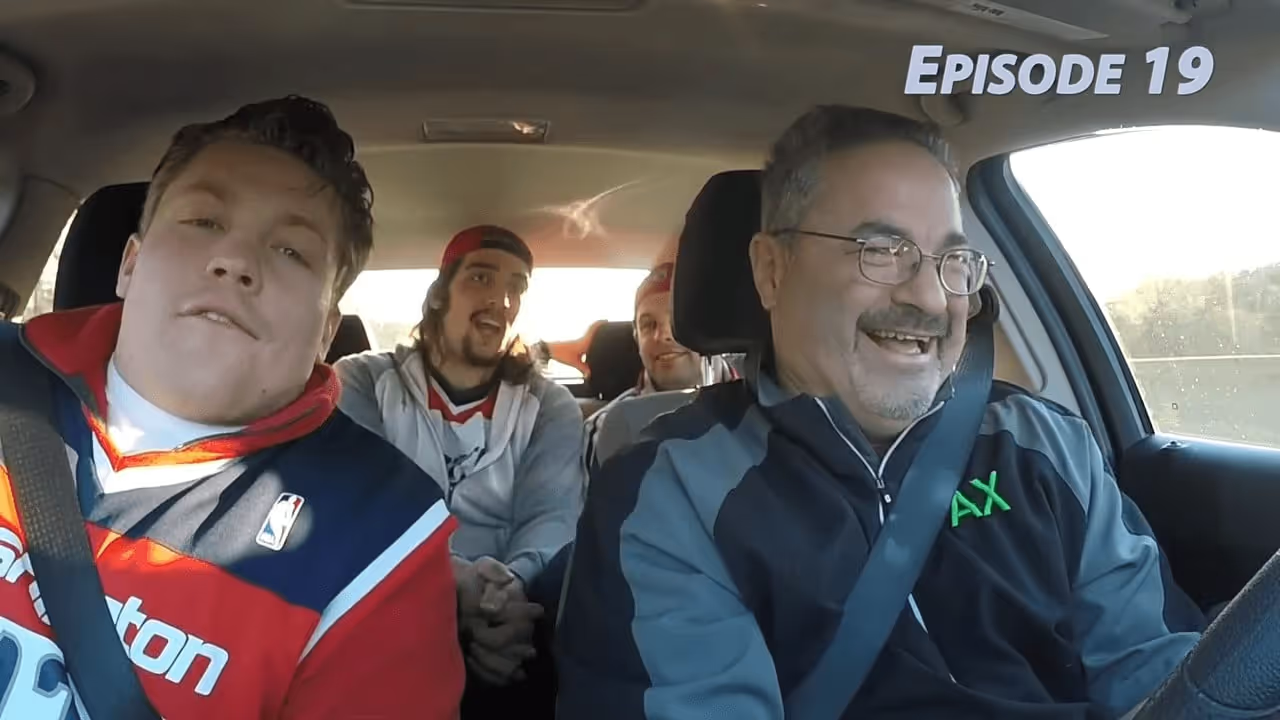
Paul is a self-described people-person and has got “the gift of gab,” so for him, the best part of the job is chatting with his passengers, and getting them to open up.
Of course, he recognizes that sometimes people don’t want to talk, or they’re in a bad mood. When he comes across that, he decides to try to make them feel better non-verbally.
“I turn the music down a little bit, change it to jazz, get them to relax without saying anything,” he says. “I try to get some positive vibes into that person.”
Because he likes talking to new people so much, that is what keeps him going, and makes what could be a long shift in the car fly by.
“You know how runners get a ‘runner’s high?’ Sometimes I’ll get a driver’s high,” he says. “Just, ‘What a great day to be driving!’ People are climbing in the car, I’m making money. And I’m just like, ‘This is great.’ And next thing I know it’s eight hours later. It feels good and you don’t want it to stop. And it’s not even based on the money. It’s just a feeling.”
Building a Youtube Channel
Paul also decided to make driving fun for himself by setting up a YouTube channel for drivers, Uber DC, which is full of tips, stories and even a game show.
The impulse to start filming came right when he started driving. As a golfer, Paul had gotten into GoPro cameras and filmed some of his rounds. He had a YouTube account but hadn’t done much with it. Then when he decided to start driving, he got a “wild hair” to film his first day.
The six-minute video chronicling his first fares is by far his most popular one with over 550,000 views. But in the two years since, he’s made countless others, and has even created regular segments: “Tip Jar Tuesday,” in which he counts his tips for the week and gives advice to other drivers for how to get more, and “PAX - A Rideshare Game Show.”
PAX is where Paul gets truly unique – and has the most fun. If he has a long drive with a passenger ahead – and the passenger is willing – he’ll play a live trivia game with them, MCed and filmed by him.
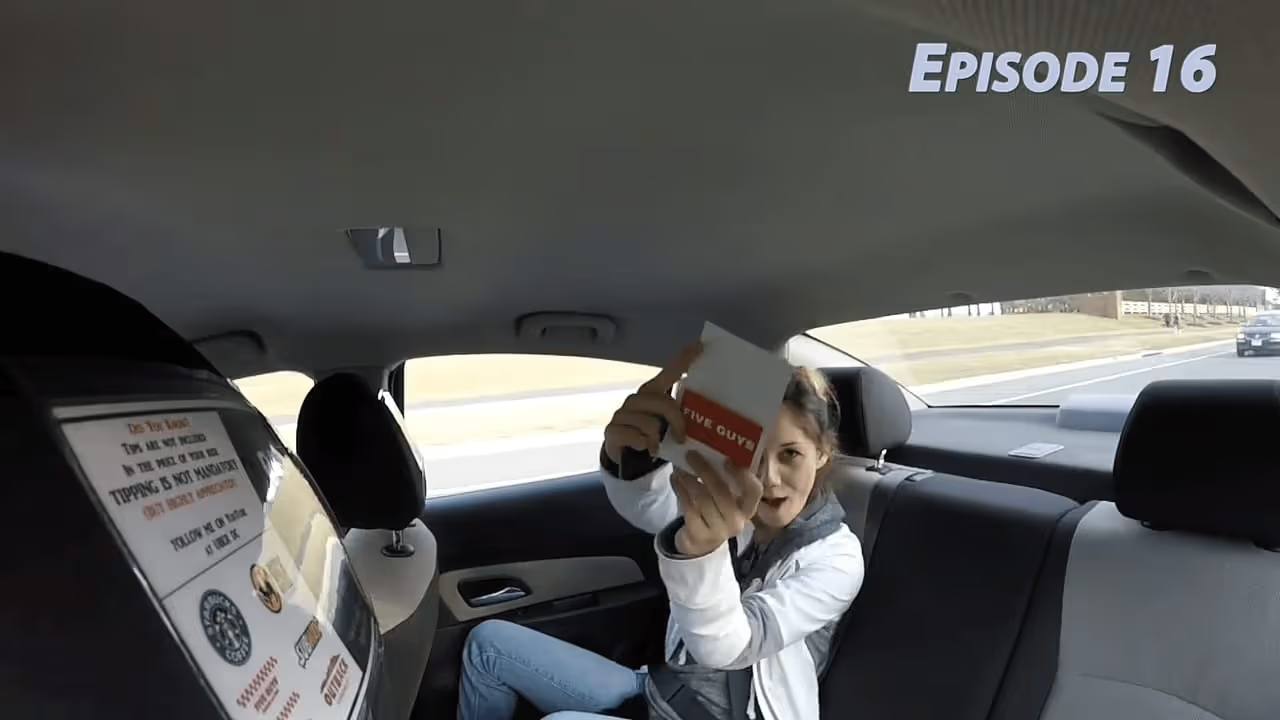
Paul gets the questions online and prints and laminates the cards himself. Then he puts them in a little black bag, which passengers can select from.
Paul also keeps a sign on the dashboard that says “Ask Me About PAX” – a natural conversation-starter even if the passenger doesn’t want to play.
Challenges
Of course, it hasn’t all been easy. When he first started, the biggest issue was learning the app.
“First of all, you want to make sure you’re hitting all the buttons right,” he laughs. “A couple times I forgot to start the trip. So, in the beginning, I took long breaks between the rides to reevaluate what I did and make sure I did it right.”
Next came the unfamiliar territories.
“It took a while to comfortable knowing the neighborhoods I was driving in.”
Even as a pro driver now, he has hit some obstacles. Recently, when trying to meet a Quest, he decided to take a pool ride. After waiting past the allocated two minutes for his passenger to arrive, the rider came out and said it would be another minute. Paul then started the trip, waited two more minutes, and then canceled the ride when the passenger didn’t reappear.
In the end, what should have been $4 for his wasted time ended being $0, and his complaint to Uber didn’t get him his money. But that doesn’t get him too down.
“It happens,” he says. “I just keep driving.”
Strategy
This “just-keep-driving” attitude is also at the center of his driving strategy.
“I just go from point to A to point B,” he says, admitting that he doesn’t have much of a master plan when he gets in his car beyond getting pings. “It blows me away that people turn down rides.... The whole idea is to make money, and the way to make money is to have a body in your car.”
Granted, that might not work for everyone. But for Paul’s goal of having fun – and maybe playing some trivia – he doesn’t care where he’s going as long as he’s going.
Paul’s driving tips:
- Know your market.
GPS is helpful, but Paul says it’s important to know where you’re going, have a plan and work it. - Be people-friendly.
If you’ve taken anything from Paul’s story, it should be this.“You’ve got to put that smile on and be people friendly,” he says. “Treat people the way you’d want to be treated.”While this means chatting with people and maybe playing a game or two, it also means going out of your way to be helpful. This means opening doors, helping with luggage and groceries, and waiting for passengers to get inside the house before driving off. - Don’t take it personally.
When you run into that inevitable unhappy passenger, don’t let it ruin it your day.“People have bad days, but it’s only one ride,” he says. “You’ve got to have thick skin. If you’re a real sensitive person, this isn’t the job for you.”
Check out Paul's PAX Game Show Season 3 Episode #26 below:
[embed]https://www.youtube.com/watch?v=pPJGRMWBP2o[/embed]
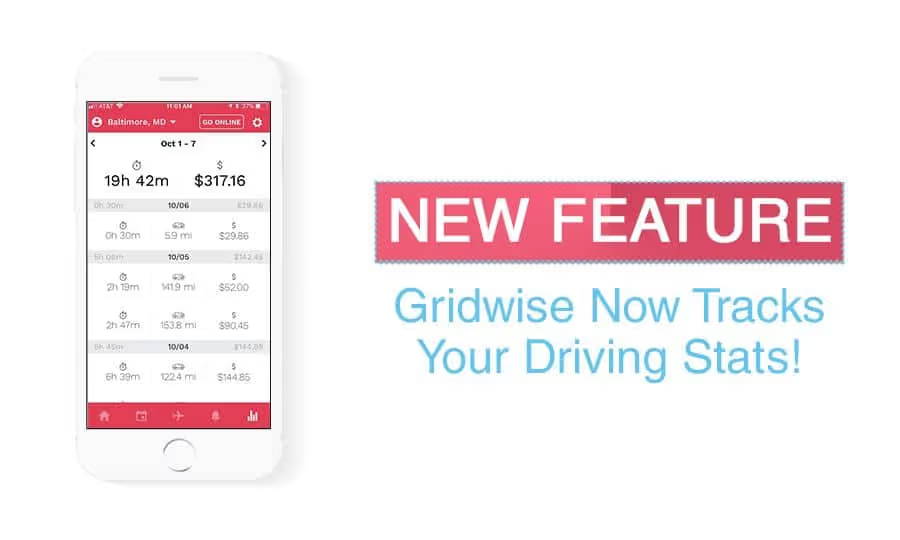
New Feature - Gridwise tracks your driving analytics!
Introducing: Shift Tracking
This week we’re releasing the ability to track your performance metrics across ALL your rideshare services.
So what does this mean?
Drivers will have the ability to track and analyze the following metrics:
- Total Miles Driven
- Total Earnings
- $/hour
- $/mile
- trips/hour
- $/shift
- $ to miles profit
- Tax savings
All in the Gridwise App.

Gridwise has been doing a great job helping drivers understand where and when they should drive, but one thing that always comes up when we talk to drivers is performance metrics.
Rideshare drivers told us that you want to know how much you’ve been driving and how well you’ve been driving.
Now you can track this.
Here’s how it works.
As a driver you now has a button that says “Go Online” at the very top of your screen in the Gridwise app. You can press that button and you’ll start a driving session.
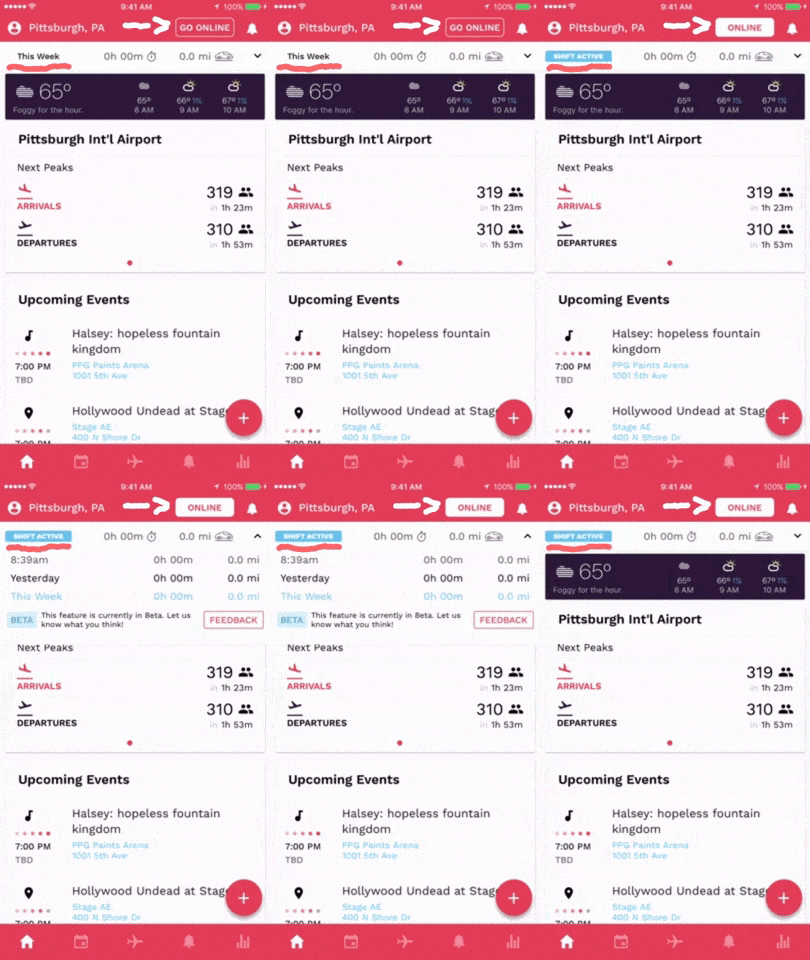
Now, you’ll see a “Shift Active” bar.
Here you’ll get a real-time look into how far you’ve driven and how long you’ve driven for the day, the day before, and the entire week.
Turn your shift status to on every time you start driving so that your miles and time are automatically tracked.
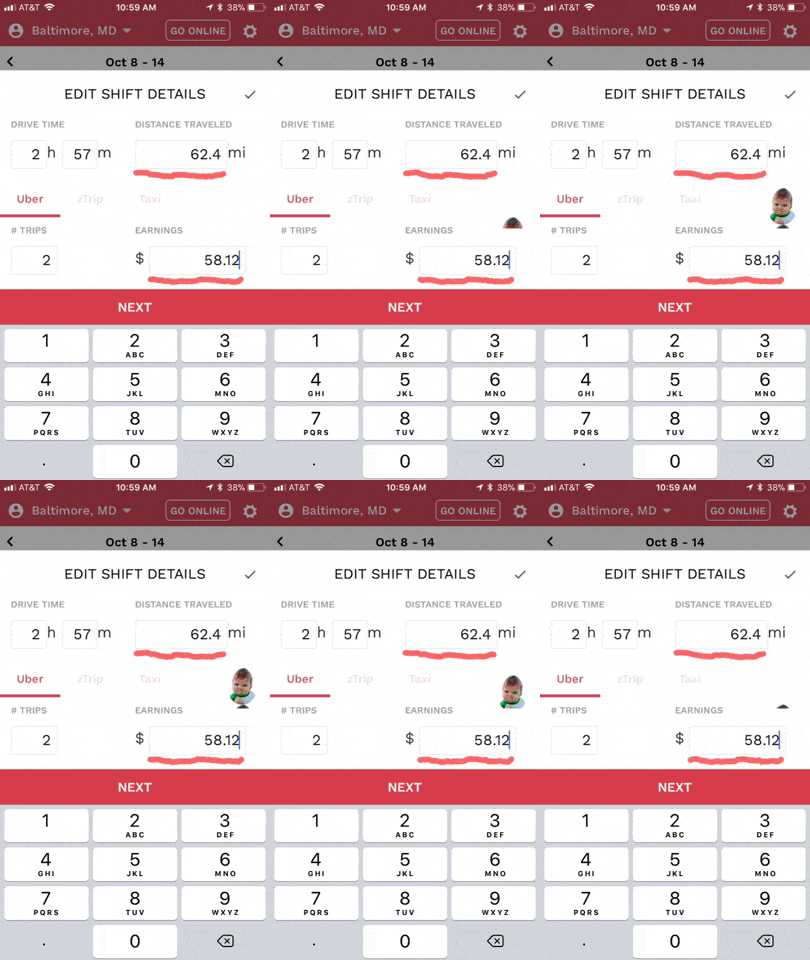
After you’ve finished a shift, you’ll be prompted to input your driving statistics for your session.
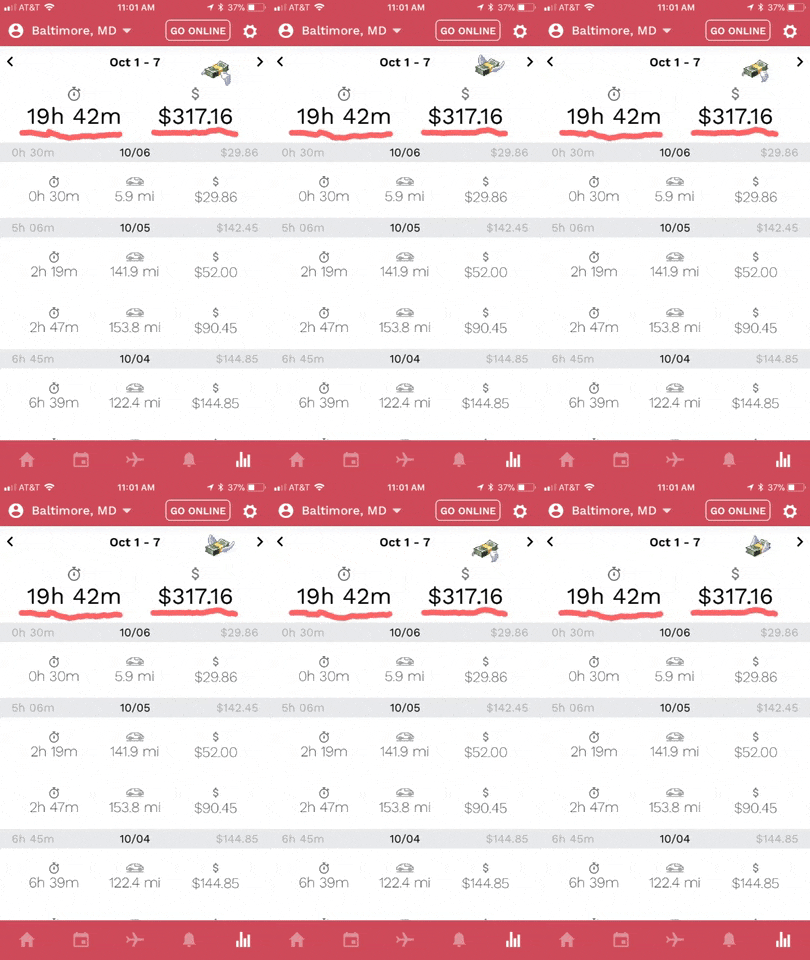
And you’ll be able view your weekly and daily results in the analytics tab. This will include your total earnings, total number of rides given
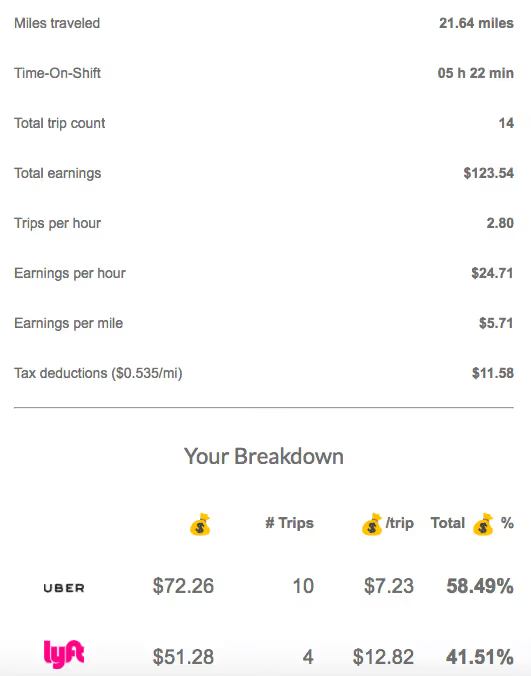
You'll then receive a shift summary email with more detailed stats.
This feature is now live for ALL Gridwise users, so log in and start tracking your performance!
This is how to maximize your earnings from boost & quest bonus incentives
If you’ve been driving for rideshare services for a while, you probably know that Uber and Lyft are trying to incentivize you at every turn. Sign up bonuses, Quests, Boosts, Surges – these can be beneficial, or just plain distracting.
The trick is to know exactly how to use the promotions on all these apps to your advantage, and to weave them into the strategies you’ve already cultivated. And as you know, we've combined multiple studies and reviews to find out exactly which are the top promotions and top rideshare driving services.
So, if you don’t already know, here’s a quick intro to Uber’s Boost and Quest promotions.
How Boost works
The idea behind Boost is to guarantee drivers higher fares in certain locations at certain times. Essentially, it’s a way for Uber to get drivers where they’re most needed, and to “boost” your fare to make it worth it.
Unlike Surge, Boost isn’t dependent on an unexpected increase in rider demand. Instead, it’s a more predictable uptick, which means you can factor Boosts into your day in advance if you look in the promotions tab of your Uber app.
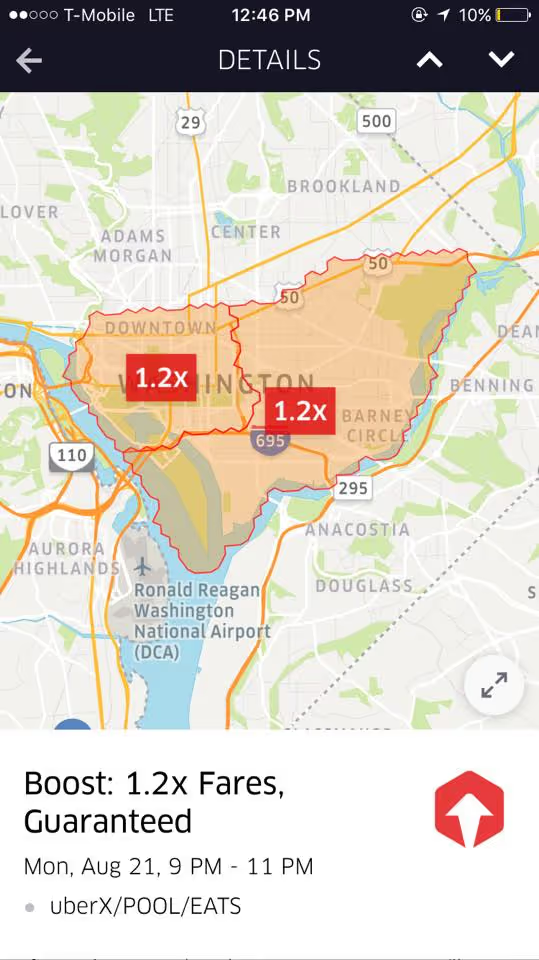
The app will tell you exactly when and where the Boost is going to happen, and exactly how much of increase you’ll see in fare price. But generally, the Boosts happen in expected areas and windows of time: Commuter hours in your city’s downtown district, for instance.
These higher fares increase in multiples, so 2x, 1.3x, etc. That means if you’d normally make $10 for a trip, and your Boost is 2x, you’d make $20. At 1.3x, you’d get $13.
The Boost applies to your fares as long as the rider requests within the Boost zone, and it applies to UberX and UberPOOL rides.
Also, Boost doesn’t cancel out Surge fares – if Surge pricing is ever higher than the Boost multiple, you’ll make the Surge amount.
How Quest works
Quest’s are Uber’s goal-setting promotions, which incentivize you to take a certain number of trips in a certain time period by dangling a bonus at the end of the stick.
An example might be, take 10 trips between 9pm and midnight on Friday and get an extra $20. Some are bigger, some are smaller. It all depends on the demand in your city, and likely your previous behaviors in the app – how many trips you’ve completed, when you’ve completed them, etc.
Unlike Boost, getting these bonuses is completely dependent upon completing the required number of trips within the designated time period. But there are some other requirements to factor in, too. The Rideshare Guy lists the following requirements:
- Completion rates: To get your bonus, you have to complete 25 percent of your accepted rides. This should be an easy one for a regular driver.
- Acceptance rates: You also have to accept at least 80 percent of the rides offered to you. This is where it can get tricky. If it’s busy and you’re getting pings from distant locations that you don’t want to accept, you could lose your Quest by denying them. On the other hand, you could up your driving time and cut down the total number of rides, jeopardizing the Quest from the other side.
- Types of trips: Quest generally applies to most types of trips, including UberX, UberPOOL, UberEATS and other location-specific trips.
- Excluded trips: Quest doesn’t apply to destination trips, rider cancellations or driver cancellations. So you can’t accept a trip then cancel it just to meet your quest.
Keep in mind that Quests are mostly offered in larger Uber markets, where the demand for rides is strong and rideshare companies are constantly competing for drivers’ services. If you’re in a smaller city, you might not get these offers.
Building your Quest strategy
When building your strategy, the first thing you want to ask yourself is, “Is this worth it?”
If you’re being offered $20 for 20 rides, is that amount of money really worth the extra effort? If it’s not, it never hurts to accept the quest anyway, but don’t overextend yourself or throw away your strategy to try and beat a quest.
If it is worth it, there are some tactics you can use to make sure you reach that goal.
- Know where and when to drive.
The key to unlocking those bonuses is knowing where and when to find shorter rides and frequent requests. Depending on the city, this is most likely in the downtown area, near universities, and near the bar and restaurant hotspots. Here are a few handy guides to the best places to drive in D.C. and Pittsburgh: - It goes without saying, too, that you have to hit these spots at the right time. If you’re going downtown, do it during commuter or lunch hours. Go to the university later at night and on the weekends when the students are going out to drink.Late night is always good if you’re in the right spot. If you’re looking for something other than the usual bar scene, check your Gridwise app to see where some events might be letting out soon.
- Consider airport rides with caution.
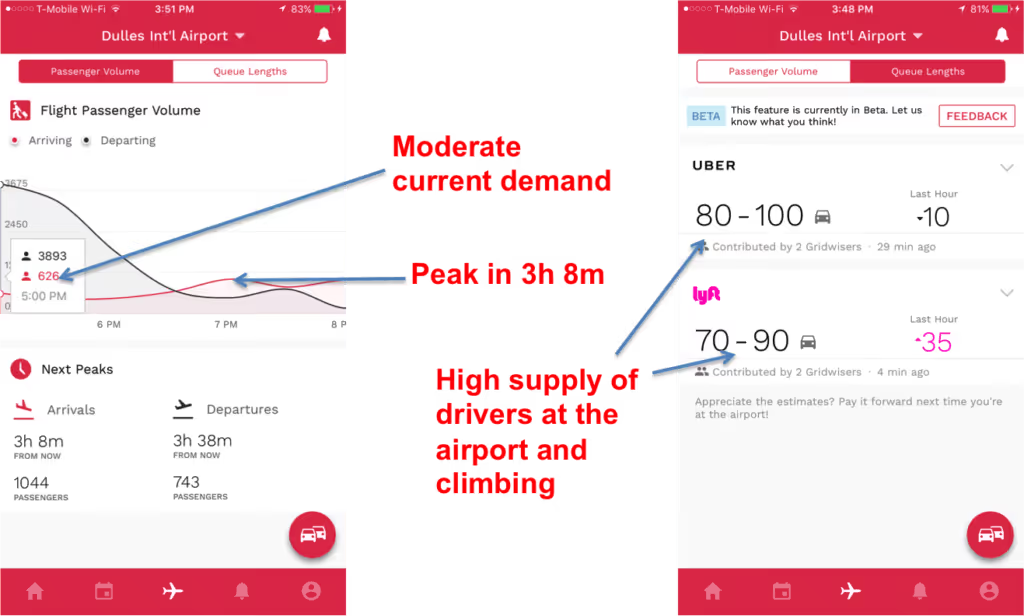
To reach a Quest goal, you probably want to avoid the airport. While those can be meaty fares, you don’t have that kind of time when you’re pushing up against a quest deadline.However, some cities – like D.C. – have centrally located airports (DCA). If you can do airport rides without losing out on the distance, it’s always a safe bet. Just remember to check the airport queue with Gridwise to maximize your time.
- Don’t forget about UberPOOL and UberEATS.
Using UberPOOL and EATS is a great way to up your ride count. You know as well as we do that POOL can be a headache, but because you can get up to three rides in as little as 10 minutes, it can really help nudge you towards a Quest goal.UberEATS can factor into your strategy, too. For one, EATS rides are generally pretty short, so when you accept one, you can be pretty sure you’re not getting way off track. Also, you can easily sandwich EATS between your commuter and late-night hours, so you minimize your downtime.
Building your Boost strategy
Taking advantage of Boost seems pretty straightforward. You see the zone with the highest fare increase, go to it, and wait for the requests to pour in.
Of course, it’s not so simple. As you know, there’s going to be more competition in a Boost zone, and that means all the rides could be snapped up before any of them reach you. So here’s how you can try to get around that.
- Get a head start.
Uber will alert you ahead of time to let you know the Boost zones and times for the entire week and weekend. Typically you’ll get an email Sunday night letting you know the Boosts for Monday through Thursday, and another email on Thursday detailing the Friday through Sunday Boosts.Also, they are typically pretty predictable: The boosts will be where the most people are going.So get there early. If you’re going for a morning rush hour Boost that starts at 7am, get there a few minute early to catch the first rides. - Check your positioning.
You’ve probably had it happen before where you’re sitting in a Boost or Surge zone and you’re not getting any rides. What’s the deal?Turn on your rider app and check out the activity around you. On the map, you can see if you’re in a swarm of drivers. If there are more than two other cars around you, it’s going to take longer to get a ride.Even worse, if you’re in the middle of the swarm, the cars on the edges will get the requests first because they will likely be closer to the passenger. So remember to check your position and repark to optimize your location. - Know when it isn’t worth it.
Permanent Boost zones can be more of a headache than a help sometimes. If you’re not having luck getting frequent rides in the zone, it can be best to go outside the limits and focus on ride quantity instead of fare – especially if you’re trying to complete a quest.
Use Boost and Quest together
Of course, the best way to optimize any promotion is to combine it with another. While Quest is a good way to consistently get bonuses, and Boost is harder to predict, pursuing both simultaneously can really help you pull in extra cash for doing the same amount of work.
However, there are risks with this method. Because Boost zones are so competitive and it’s harder to predict the distance you’re going to travel, you can lose out on the frequency required to get a Quest goal.
Additionally, if you are chasing a Quest and a Boost ride comes in that you don’t want to take because of the distance (i.e. to the airport), not accepting the ride can hurt your chances of getting your Quest bonus.
Clearly, it’s all a delicate balance. The key, then, is to stick to your strategy. If you’re going to go for a few Boost rides, make up that potential time lost by running a few UberEATS rides, or going for a POOL.
No matter your action plan, stick to what works for you, weave in the promotions and don’t be wooed by incentives that don’t fit your style.
Spend Less Time Waiting in Airport Queues - Gridwise Now Provides Airport Queue Lengths
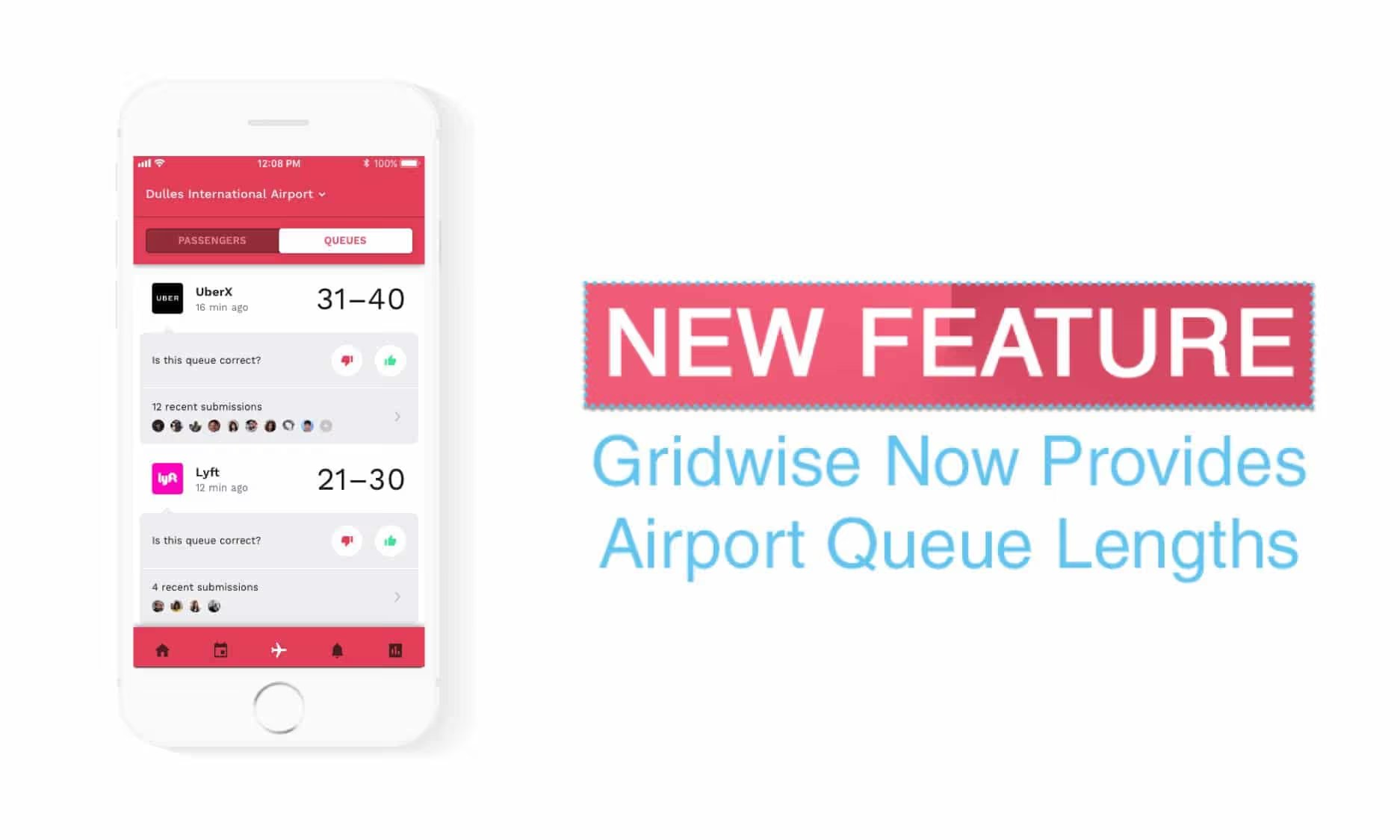
Drivers in all markets can now see how many other rideshare drivers are in the airport queue for each sub-service.
Yep.
This means that before you decide to head to the airport you can check Gridwise and see if there are more than enough drivers at the airport to meet demand.

When we talk to drivers, we hear that airport passengers can be very profitable because rides are longer, which can increase the amount rideshare drivers make. But sometimes it’s just not worth it to wait at the airport for 90+ minutes for a ride.
Well, we decided to do something about it.
So now drivers can compare the number of drivers at the airport and decide if it’s a good time to be there.
For example:
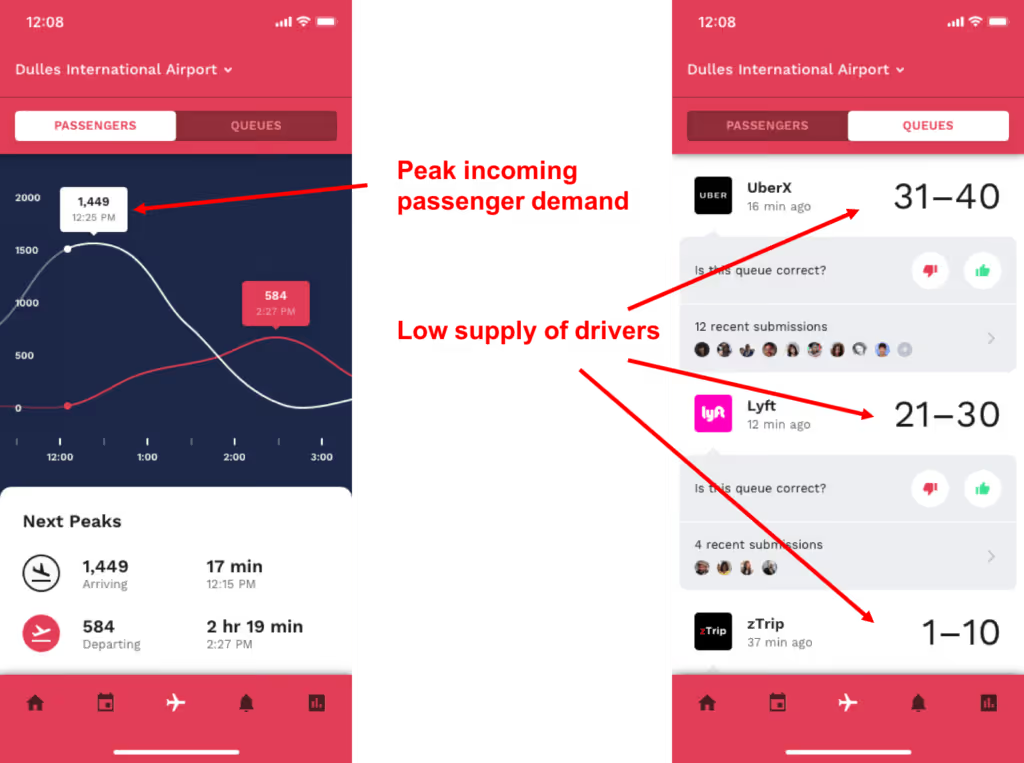
We can see that there are anywhere from 31 – 40 Uber drivers and 21 – 30 Lyft drivers in the queue and the airport is currently peaking with 1,449 passengers arriving in the next 30 minutes.
There are not many drivers at the airport and plenty of passengers arriving, so I would jump in the short queue if I was nearby.
Sooo... how does Gridwise know the airport queue lengths?
Simply put… drivers tell us.
Drivers have the ability to enter their position in the queue using the “Queue Lengths” tab in the airport section of your Gridwise app. Drivers can enter their position in the queue even if they are not in the airport lot, and for any individual sub-services such as UberX and UberXL.
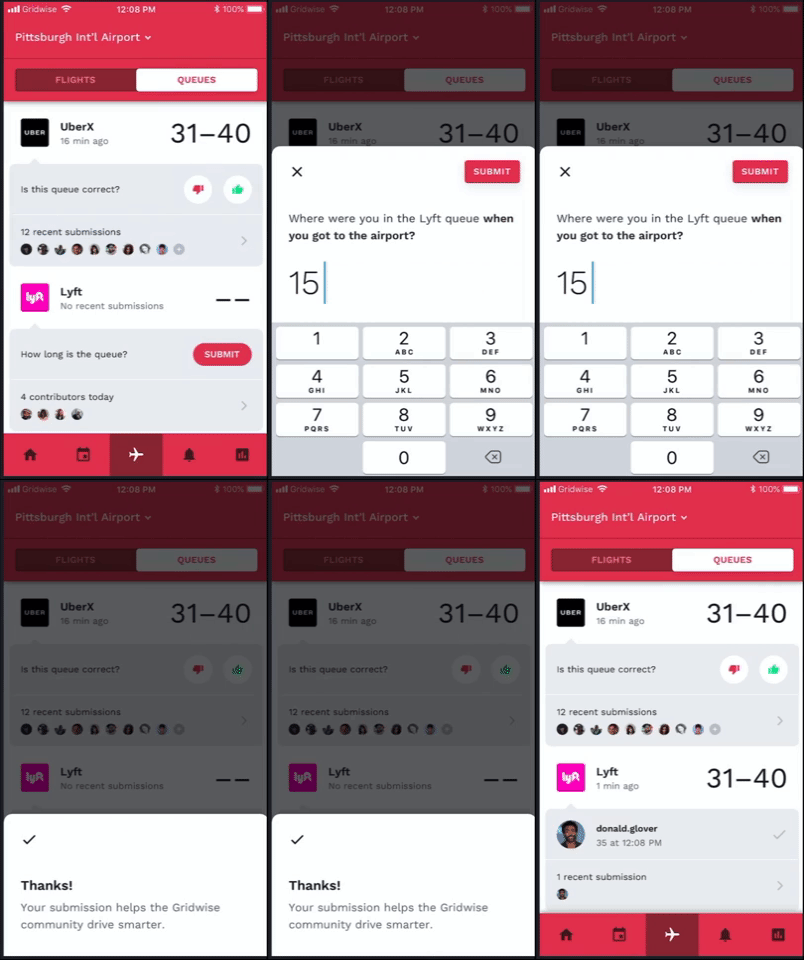
This lets your fellow drivers know how busy, or empty, the airport queue is.
It will always be our mission to improve the lives and rideshare experience for all Gridwisers and help every driver work better together. That’s why we’ve also given drivers the ability to see a list of every driver that has submitted a queue for the day.
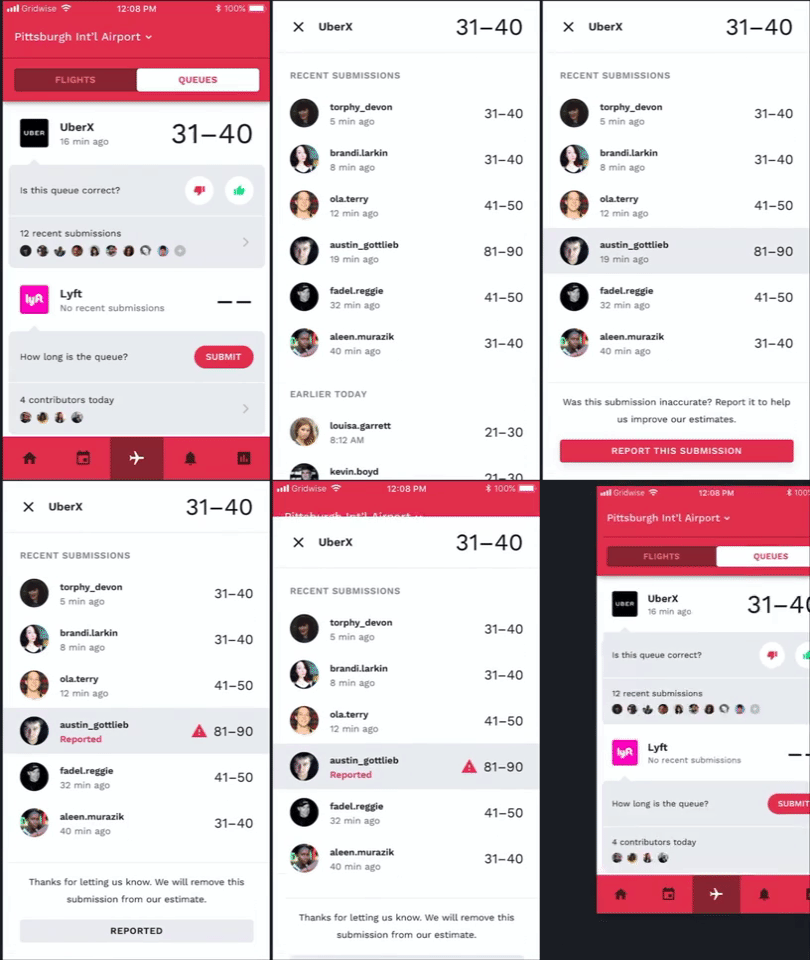
This ensures that drivers know who is providing information, and allows a mechanism to report someone that is submitting false or misleading reports.
More than ever before, Gridwise helps drivers work better together. So download the Gridwise mobile app and start using the new Airport Queue Lengths feature today!
How rideshare drivers can start conversations that lead to tips and 5-star ratings
Let’s not fool ourselves here… As a rideshare driver, you’re not expecting to make much money from tips.
Sure, tips are a perk that pads your wallet (and maybe your ego), but they’re not a guarantee. But still – wouldn’t it be nice to get more of them?
The trick to more tips – and more 5-Star ratings – is to give your riders a reason to like you. And that has nothing to do with the water and candy you stock your car with, and everything to do with good old-fashioned conversation.
“People don’t want to give out five stars by default,” said Mike, a driver in Baltimore and D.C. that pulls in over $1000 per week. “I think that they’re looking for a memorable experience. That means, ‘This uber driver was different than my prior experiences.’ And how you set yourself apart from that can be a lot of different things, but everyone likes to talk.”
Sure, not every rider is going to be your next best friend, and not every rider is going to want to chat, but making a connection is an important part of the job. So whether you’re a pro talker or still getting comfortable with it, here are some tips to help you up your conversation game – and your take-home.
Make a Great First Impressions
It helps to read your passenger right when they get in the car. Is their heart racing? Did they give just a quick hello? They might be in a hurry. And even though the car ride lasts as long as it lasts with or without conversation, passengers that are running late usually prefer to concentrate on the ride and skip the small talk.
If it seems like they might be open to conversation, first impressions are still important. Analyze their clothes. Are they wearing a sports team shirt? Strike up a conversation about the game last night.
Are they dressed as a comic book character? Chances are they’re at a Comic-Con conference, and there’s got to be something interesting there to talk about.
If they’re wearing a suit and it’s 5pm, you can assume they’re just getting off of work. This can open up a few avenues of conversation: a simple “Heading home?” or, “So you made it through Monday,” or, “Any weekend plans?”
You can also see if they’re carrying a camera or looking attentively out the window. These could be signs that they’re a tourist. Ask them what they’re doing in town, if they’re enjoying the city, or even give some impromptu tour guiding. They may be in need of a good restaurant recommendation, or might enjoy knowing the history of the neighborhood they’re staying in.
Breaking the Ice
If first impressions aren’t giving much away, it’s time to pull out the tried-and-true icebreakers – but try to shake them up a little bit.
Everyone’s first instinct is to talk about the weather, and that’s not a bad thing. But rather than the usual, “Wow, how about this weather?” try to think of funny or unusual lines to make it more interesting.
Something as simple as “What are you going to do to enjoy this beautiful weather?” or “What’s your favorite way to escape the cold?” can immediately take a conversation away from the weather and into plans, interests and hobbies – the things that actually get a conversation going.
Another easy icebreaker is to talk about ridesharing itself. It’s something you both obviously have in common, and you can even sneak some work tips out of the conversation.
For instance, ask your passenger about their best, worst or most memorable rideshare experience. When they launch into a story about the guy that blasted country music, or the car that smelled like hot dogs, take note.
Another safe conversation bet is to steer the conversation back to the passenger. People like to talk about themselves, and the usual “What do you do?” “Where are you from” and “How long have you lived here?” can get people talking.
If your passenger lives in the area, it can also be informative for you. Maybe they’re craft beer buffs, or just heard of a great new restaurant opening. These are things you can use in your personal life, or that you can pass on to other passengers to up those stars and tips.
Remember though: the dinner party rule applies in the car, too. Don’t bring up religion or politics, unless you have positive confirmation that the conversation will go smoothly.
Sometimes, STOP Talking
Knowing when keep quiet is just as important as knowing when to engage. Conversations are important, but only when the passenger is in the mood. Otherwise, you run the risk of doing the opposite of what you intended – your rider might give you a bad rating because of how much you talked.
Luckily, there are some simple ways to read whether someone is open to engaging or not: If they get in the car and keep their eyes on their phone, chances are they want to keep doing that.
If they put their phone away but lean their head back against the headrest, take it as a sign that they want to be left alone – especially if they close their eyes.
If none of these signs are there but your attempts at small talk are falling flat, take it as your cue to turn on a little music and give your rider their space.
However, there are still things you can do to be a standout driver and get those ratings high. Offer them a charging cord for their phone. Ask if the temperature in the car is OK. Offer to let them pick the music.
Even if they decline all of the above, you’re bound to stand out as a top-notch driver, and your ratings will show it.
Make the Ask
After all of that positive customer interaction, you still have to make sure that riders know how much you would appreciate tips and a 5-star rating.
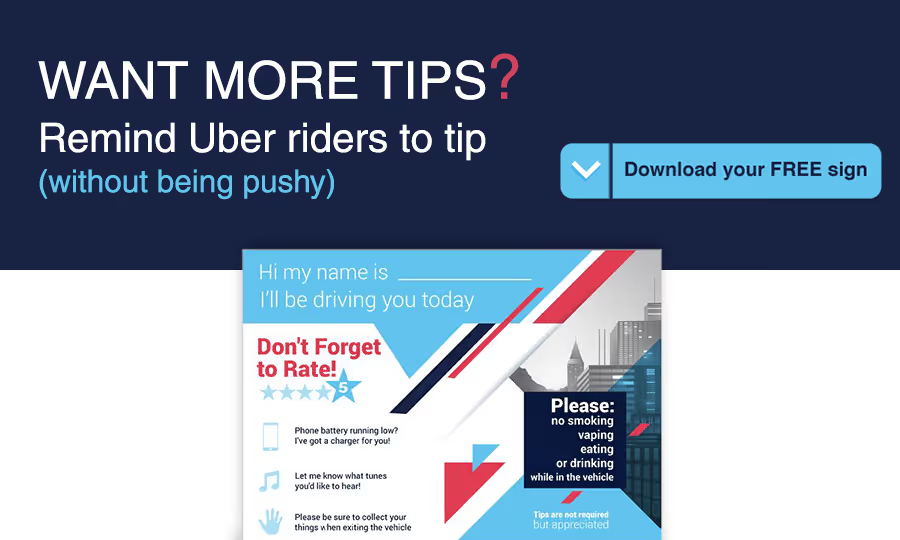
Use a rideshare sign to politely remind passengers that you’d appreciate tips and 5-star ratings without being pushy.
25 Tips for Uber drivers from fellow rideshare drivers
If you’re in the rideshare business, you know it’s a tough game. We have to deal with road conditions, bad passengers, traffic, surges that aren’t really surges, and we even have to deal with the TNC’s themselves.
That’s a lot to master, so we enlisted some help from our favorite rideshare groups around the internet to help out our fellow drivers. Below are words of wisdom from 25 rideshare drivers around the country. See the comments section for additional tips!
Shout out to the following Rideshare Facebook communities for their input.
Pittsburgh Uber Driver Lounge
DC Uber Drivers - Uber/Lyft DC
UBER DRIVERS
Uber and Lyft Drivers - DC, MD and VA
We've blurred the names of contributors to protect their privacy, however if you see a tip that you contributed, give us a shout out and let us know which tip you contributed so we can send you a $10 Gas Card!
Let's dive in!
1. Never forget the Golden Rule: Don’t Chase the Surge



2. If you want tips, sell your personality

3. But know who you should be talking to..

4. And who just wants to get somewhere really fast.

5. Be prepared for the worst if you’re a late night driver

6. Even out your mood because there will be ups and there will be downs

7. Don’t drive yourself crazy by checking your earnings too much

8. Definitely Keep a dashcam in tow


A dashcam helped save this driver from a ticket
[embed]https://youtu.be/EkJUo5DZfxo[/embed]
9. Keep your car looking spiffy



10. If you’re driving full-time, split up your hours
11. Set goals and stick to them...


12. But once you’re hitting your goals, push yourself to do more.
13. Don’t mess around with your auto insurance.


14. And don’t drive around aimlessly looking for pings. You'll just waste gas..
15. Instead, be prepared and know where to drive.
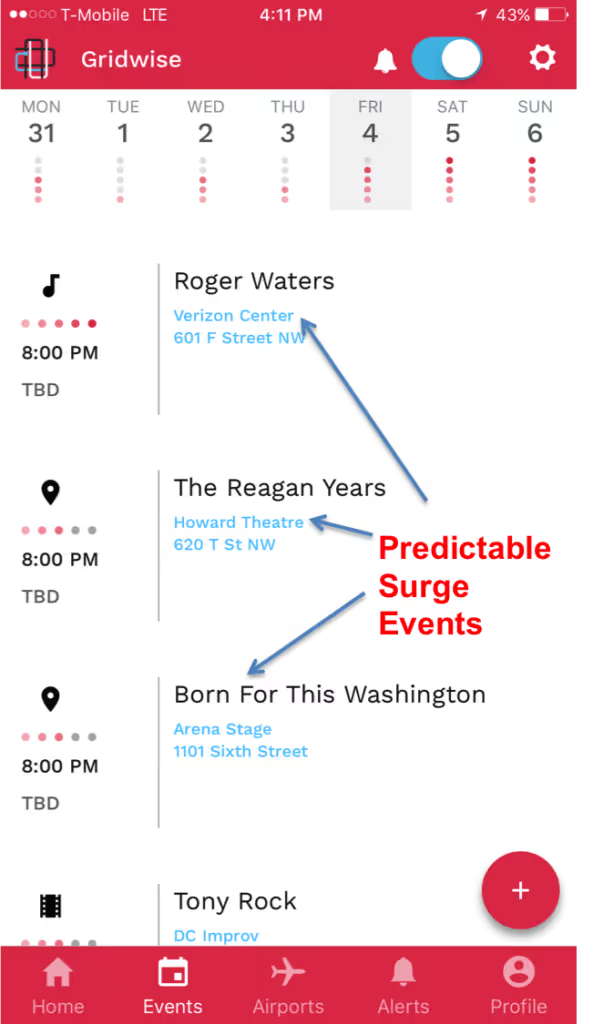
[su_note note_color="#fefedf"]Free Bonus: Always know what events are going on in your city using theFREE Gridwise app.[/su_note]
16. And invest in a EZ-Pass or commuter plan for the tolls..

17. Keep a positive attitude...




18. Find a way to connect with your passengers..

19. Hang out with the right crowd.
20. Tickets ain’t cheap... So know the rules and follow the rules!

21. Choose your music wisely

22. And remember It’s not all about the money

23. Because sometimes you just gotta go with the flow

24. Cherry pick passengers at your own risk

25. And above all else:
Bonus: This guy said it all:
If you could tell a new rideshare driver one tip, what would it be? Let us know in the comments below!
The Ultimate Airport Guide: Pittsburgh
I have the same conversation with rideshare drivers waiting at Pittsburgh International all the time.
Driver: “Man there are no pings coming in AT ALL… It’s going to take more than an hour to get a ride”
Me: “How many passengers are coming in?”
Driver: “I’m not sure but it’s 7:00 so there should be some planes coming in”
Me: “Ok, did you check the queue length before you drove up here”
Driver: “No… I was just hoping it is low”
Now, these drivers aren’t really wrong. Sometimes waiting at Pittsburgh International is just a waste of time, unless you just like hanging out at airport parking lots (we hear you can run over to the Sunco for a bathroom break).
If you have a strategy however, you can make a lot of money driving airports with rideshare services.
You Need an Airport Strategy
Yes, it can be frustrating to sit in the TNC lot surrounded by other drivers doing the exact same thing. But creating an airport strategy gives you an advantage they don't have.
The first step is thinking ahead. You need to understand how the airport works, how to navigate it correctly, and probably most importantly, when to arrive. I’m going to cover all those topics in more detail, but there’s something else you might not have thought of.
If you’re going to be driving to Pittsburgh International anyway, why not try to pick up someone headed that way? Hang around downtown hotels a few hours before peak hours and you might luck out and find passengers who need a ride to Pittsburgh International. If you want to really increase your chances of getting a ride to the airport then set your desired destination to airport. Nothing’s better than making money on your way to make even more.
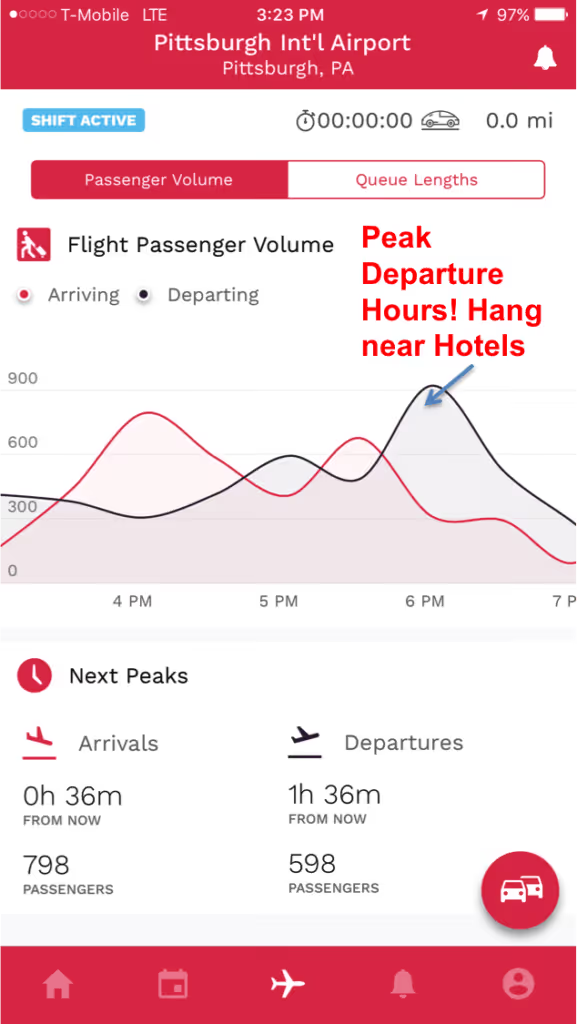
You also need to decide in advance how long you are willing to wait - and what time it currently is. It’s not too bad to wait an extra 30 minutes if more flights are landing soon but you don’t want to realize you’ve wasted hours because there aren’t any more flights coming in until morning!
Having a solid airport strategy is the key to making money at PIT, so let’s learn more about how things work there.
How PIT Works
Uber, Lyft, and other TNC’s specially designate airports with a geofence that tightly defines the airport area. As a driver, if you have an app on in those areas, you’ll be placed in a queue that acts as a virtual driver line, kind of like traditional taxi lines.
As you wait in the queue, you’ll cycle through the line (sometimes quickly but it can be painfully slow, I know) and finally be pinged by a rider.
PIT has a designated pickup area (more on that below) which is the only place TNC drivers are allowed to wait. You’ll also want to always clearly display your TNC’s sign in your passenger window.
How to Navigate Pittsburgh International Airport
Some people don't like going to PIT because it can be a little tricky to navigate. Pittsburgh International, like most airports, has a ton of rules and regulations.
Where to Wait
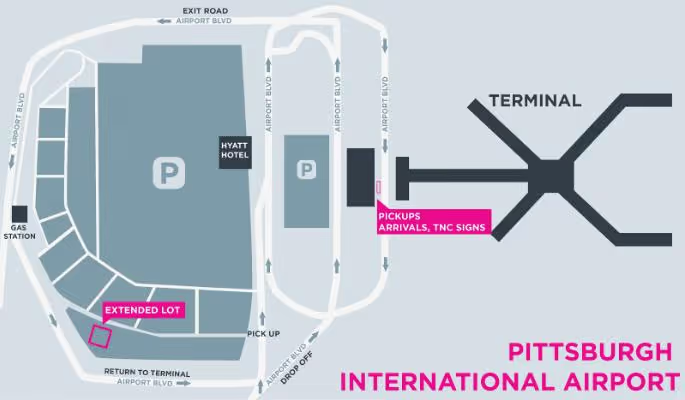
PIT has pretty strict regulations for TNC drivers. We are all required to wait in the TNC lot located in extended parking. To get there, take a left turn off the Return to Terminal Roadway (behind the Sunoco) down to the sloped area.
Some people like to push the limits a bit, but to avoid getting booted from the queue it’s best to stay put here.
I know, you might be tempted to snag a prime spot in the cell lot if you see it. But if you do, you won't actually be in the queue. You could find yourself waiting and waiting and waiting with nothing ever happening. So stick to the cell lot and save yourself some time - and some gas.
Where to Pick Up
PIT has a designated pick up zone for TNC drivers. Once you've been pinged, you’ll need to go to the landside terminal and use the commercial curb. It’s easy to find. Follow the yellow sign that says “Deliveries, Rental Car Return” and then “Commercial Curb Arrivals”.
Your passengers should be waiting outside Baggage Claim Door #4. Make sure to pull up to the furthest space available. And remember that you can’t pick up from the Public Curb.
When to Go to the Airport
The biggest problem TNC drivers seem to have is understanding when to go the airport. You show up too early and you’re waiting for hours. You show up too late and you’ve missed all the fares - and the surge fees.
Finding the right time to go to the airport isn’t as tricky as you might think.
There are patterns in flight traffic that are easily identifiable, if you know what you’re looking for. You’ll usually see an influx of business passengers on Monday and Tuesday mornings, flying in for meetings or work trips. Those same passengers leave on Thursday afternoons or Friday mornings.
Maybe driving is a second job for you and you aren’t available during those times. That’s ok, there are other tricks for you too!
Travel picks up around holidays, sports games, and other big events like:
- Christmas and Thanksgiving
- Spring Break
- Memorial Day, Labor Day, and 4th of July
- Steelers or Penguins games
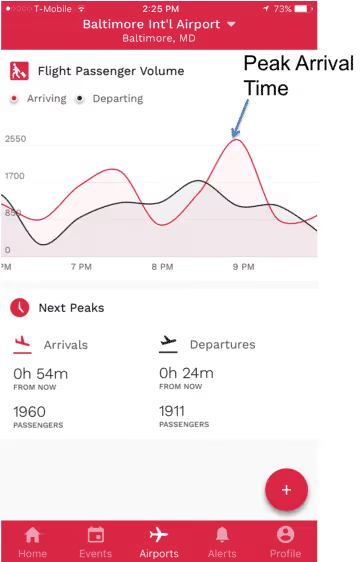
Plan to spend some time near the airport around these events to make the most of the additional passengers. You can use the free Gridwise App to help you know when the flights are coming in. Arriving to the cell lot around 10-15 minutes before the peak is the perfect way to snag a great spot in the queue and hopefully get pinged by a passenger needing a long ride.
Can't Miss Tips
If you’ve been paying for parking at PIT, STOP!
There’s no need to pay or to leave and circle the airport every hour. Simply sign the lot ticket and tell the attendant at the lot exit that you’re a TNC driver and they’ll waive the fee. You may need to show proof, but usually having your company’s placard displayed is enough.
Consider driving for more than one TNC
The queues can get long, especially during peak hours. Driving for more than one TNC is a good way to open yourself up to more requests. While you might be 33rd in line at Uber, you could be 15th with Lyft.
Do not cancel on a passenger after you’ve accepted a fare
If you do, you will be bumped to the bottom of the queue and your wait starts all over again. The good news is that if it’s a short ride, some companies let you jump back in line after you’ve dropped that passenger off.
Always be prepared
You never know when law enforcement will show up, so always keep your driver’s license, insurance card, and registration handy. And don’t forget to have your placard displayed.
Now you should be ready to make that drive to PIT and actually earn money instead of snacking on candy from Sunoco. I’m not the only one who does that, right?
Work smarter. Earn more.
Whether you drive, deliver, or pick up shifts — Gridwise helps you track earnings, mileage, and performance so you stay in control of your work. Download the app and take charge today.
