Gridwise blog
Tips, insights, and advice to help you earn more and work smarter, whether you do gig work, hourly, or shift work.
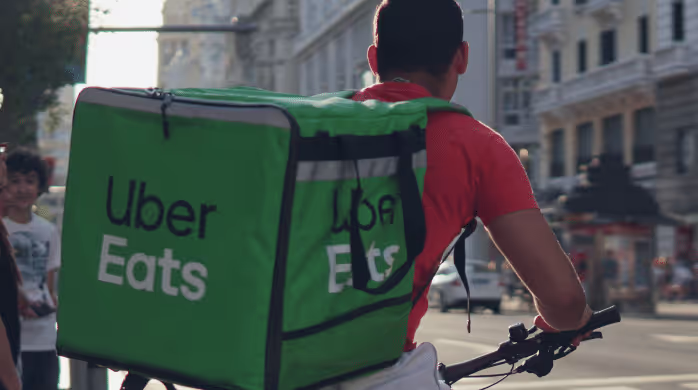
How to Make $1,000 a Week With Uber Eats in 2026 (Tips + Hourly Data)
In this blog, we'll explore the strategies and techniques that can show you how to earn $1000 per week as an Uber Eats delivery driver. We'll cover everything from optimizing your delivery zones and schedules to maximizing your tips and customer satisfaction. Whether you're a seasoned Uber Eats driver or just starting out, this guide will provide you with the insights and actionable steps to take your Uber Eats driver earnings to the next level.
Becoming an Uber Eats delivery partner can be a lucrative opportunity, especially if you're able to consistently earn $1000 a week. By understanding the platform, optimizing your delivery strategies, and focusing on customer satisfaction, you can maximize your earnings and turn Uber Eats into a reliable source of income.
We’ll cover the following topics to provide coaching and ideas to help you push your earnings up to that $1000 per week level:
What do Uber Eats drivers do?
Uber Eats drivers deliver prepared food most of the time, but they also might shop for and deliver goods from convenience outlets and grocery stores. The job is pretty simple. You get a request for an order, you drive to the restaurant or store to pick it up, and then you deliver it to the customer. If you already drive for Uber, you can choose to take orders for Uber Eats delivery any time.
If you’re not an Uber Eats driver yet, it’s pretty easy to become one. This Gridwise post tells you what you need to do if you want to sign up and start making money Uber Eats style. Many rideshare drivers welcome the chance to deliver food rather than people. This article from Nerdwallet covers the Uber Eats gig from that angle.
There are some sweet advantages to working with Uber Eats. In lots of cities you don’t even need to have a car. You can use a bike or a scooter, or even walk, to make your rounds. If you do use a car, Uber Eats’ requirements are a lot easier to meet than they are for Uber rideshare driving.
You also have a lot of flexibility. You can shop and deliver convenience items and groceries, but you don’t have to. And, like most driving gigs, you can choose your own hours, and map out the locations where you want to work.
Use Gridwise features When to Drive and Where to Drive to help you figure out what work hours and which specific areas will be the most profitable for you. Real data from real delivery people will show you earning patterns for drivers in your town.
How much can you earn doing Uber Eats?
The honest answer to this question is: basically, as much as you want! It all depends on how many hours you put in and how strategic you are about your gig. Earnings vary from one area to another, as this article from Entrepreneur points out. To give you a baseline, let’s look at the earnings of Uber Eats drivers who tracked their earnings with Gridwise.
Remember that these numbers show us only average earnings. To make $1,000 a week with Uber Eats, you’re going to have to be better than average, and we’ll show you how. For now, though, it’s good to have these figures so you get a ballpark number of where to start.
How much do Uber Eats drivers make?
Gridwise data tell us the following:
- Monthly earnings average around $444.00 per month.
- Gross earnings per trip are between $9.00 and $10.00.
- Tips make up about 50% of most Uber Eats drivers’ income, which amounts to about $225.00 per month.
Is Uber Eats good money? It can be. While there are other gigs that pay more per trip, if you drive for Uber Eats, you’ll always be pretty busy.
https://datawrapper.dwcdn.net/HPAz8/3
You can also see that, unlike many other gigs, tips play a huge role in Uber Eats earnings.

With these numbers as a baseline, what can we say about how to earn $1,000 a week with Uber Eats? As we said in the introduction, it’s going to be a hustle, but it’s really possible. To figure out how to make the most money with Uber Eats, let’s start by looking at how many trips these “average” drivers made each month.
We know that average gross earnings were $444.00 per month, and drivers got around $10.00 per trip. That means they took 44 or 45 trips per month, which breaks down to 11 trips per week. That’s not a lot of Uber Eats delivery, is it?
The fact that Uber Eats drivers averaged so few trips shows us that many drivers use more than one app at the same time. This is called multi-apping, and you can learn more about it in this Gridwise post. If you want to answer the question of how much you can make with Uber Eats, then you need to stick with the app and keep plugging away at those orders. You also need solid strategies, as well as some inside tips and tricks.
How to make the most money on Uber Eats: Delivery driving tactics
Getting to that $1,000 a week with Uber Eats isn’t so hard when you remember that the drivers we saw making about $111 a week were only taking around 11 trips in the same time period. That’s not much at all! If you work the Uber Eats app like a boss, you’ll soon have many more trips than that, easily reaching the number needed to get you to $1,000 a week. Now, let’s get to some tactics you’ll need to make that kind of bank.
- Stay with the Uber Eats app, and track your earnings. Gridwise can easily do that for you. Simply sync your Uber Eats app with Gridwise, and you’ll be able to see how much you’ve earned with Uber Eats, what times were most profitable, and your average hourly pay. Racking up trips with Uber Eats has other benefits, including perks and bonuses that are awarded to top drivers.
- Leverage surge pricing and promotions. Surge pricing is applied when there is a lot of demand. When surge pricing is in effect, many of the trips you make will pay more than usual. Promotions are offered to drivers who complete a given number of trips in a certain time period. High traffic volume days, nights, and times give you these chances to get extra earnings. Challenging yourself to complete the right number of trips for promotions will add to the number of trips you can count on for big bucks, too. Learn more about Uber Eats surge pay, boosts, and promotions in this Gridwise blog post.
- Say yes to doubling up on orders. With Uber Eats, you can get back-to-back orders or receive batched orders. Back-to-back orders happen when you receive a new request while you’re on the way to deliver an original order. The Uber Eats app routes these trips automatically, so you won’t be sent out of your way.
Batched orders are Uber Eats’ way of bundling together orders from either the same restaurant, or two nearby eating establishments. You get money, and trip count credit, for all the orders you complete, plus customer tips, without having to make a bunch of separate trips.
- Turn on the charm and get bigger tips. Being nice really is part of the Uber Eats driver’s job, and getting tips is one way people who drive for Uber Eats make money beyond their basic pay.. Bring along those extra napkins and condiments, use equipment that keeps food and drinks at the right temperatures and prevents spilling, and consider your customers’ needs. If you deliver groceries, be extra careful with delicate items such as bread and eggs.
And, most important, follow your customers’ directions, and stay in communication with them if you are going to be delayed, or if you have questions about their order. This Gridwise post will tell how to get bigger tips as a delivery driver.
- Use even more charm to keep your ratings high. As an Uber Eats driver, you will be rated by the restaurant or store where you pick up the orders as well as the customers who are waiting for the deliveries. This two-way rating system is designed to keep you on your toes, so Uber can keep people satisfied with your service. Don’t worry, you get to rate them, too.
There’s another reason why your rating as a driver is important. It not only keeps you in good standing with Uber; it helps you to qualify for the Uber Eats Pro incentive program. To learn more about Uber Eats Pro, and what it takes to earn perks such as preferred services, discounts, and deals, check out this Gridwise blog post.
Smart business moves that seal the deal
Now that you know how to gobble up the deliveries you need to make $1,000 a week with Uber Eats, it’s going to be a breeze to get there. Let’s make it even easier, with business moves that boost your earnings and shrink your expenses. If you use these, it will also be easy to say yes when people ask, “Can you make good money with Uber Eats?”
Minimize expenses. Avoid racking up big fast-food bills by bringing your own food and beverages. You might not think you’re hungry when you first start your Uber Eats run, but once the aroma of pepperoni pizza, premium cheeseburgers, and piping hot fries start wafting through your car, that might change. Bring a sandwich or other healthy food from home, and buy bottled water in bulk to save tons of cash compared to what it costs to buy single servings.
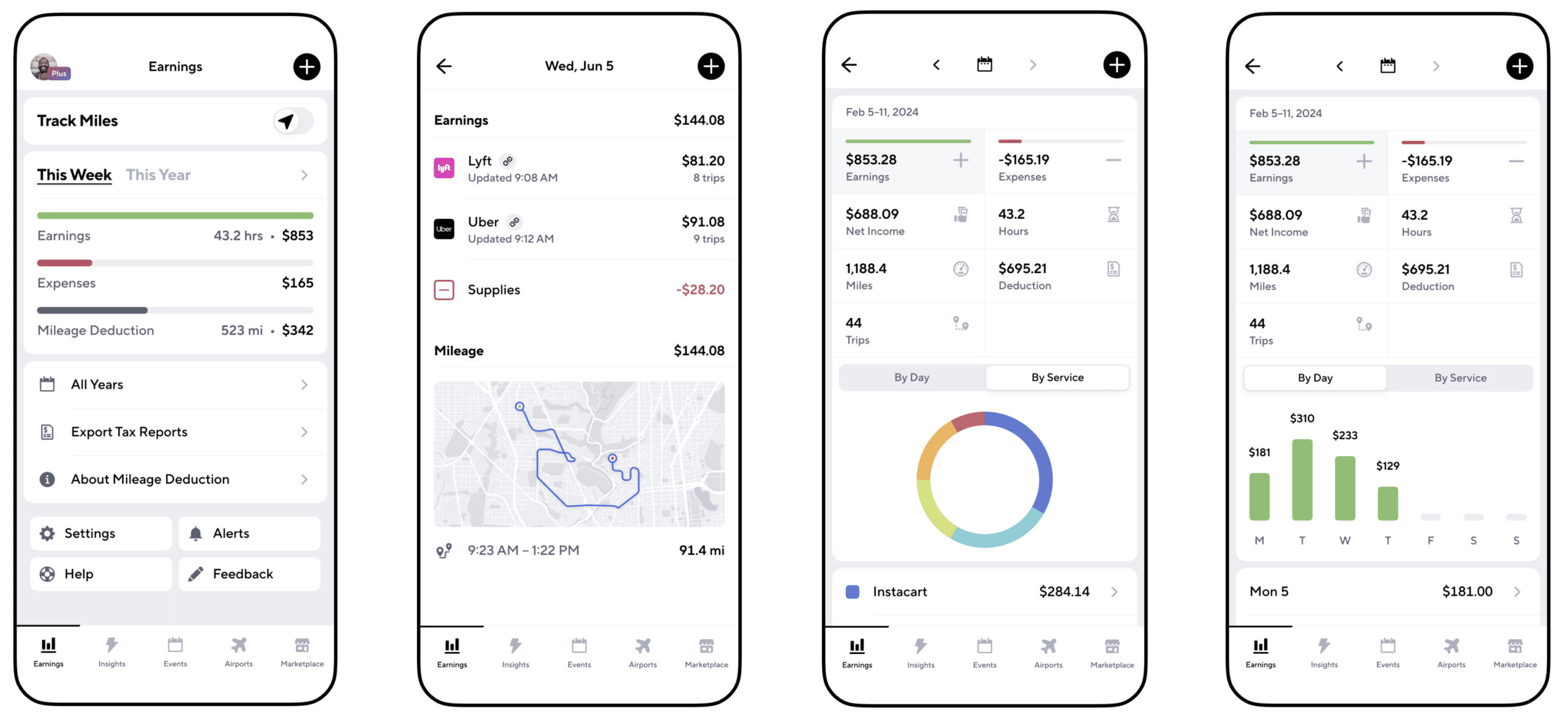
Maximize tax deductions. Another way to minimize your expenses is to maximize your tax deductions. Start by tracking mileage with Gridwise.
Gridwise App
Gridwise captures every deductible mile you drive, including the distance you cover between the trips your driving app records. Know what expenses you can deduct, and put them to work for you when tax time comes. Learn more about tax deduction strategies in the Gridwise Tax Guide for drivers.
Boost earnings with referrals
As an independent contractor, you’re probably looking for ways to make even more money than you can with Uber Eats. And most gig workers like you enjoy getting passive income. With Uber Eats, there’s a really easy way to do that, referrals!
All you need to do is find friends and encourage them to deliver for Uber Eats. If they make a certain number of deliveries within a specified time, you will get paid for doing nothing more than having them sign up under your referral code! Rates of pay vary by city, so check your Uber Eats app to find out what the current deal might be, and learn more about the referral program on the Uber Eats website.
Also remember: “friends” don’t have to be your best buds. Many delivery people carry cards with a QR code linking to their referral information, so just about anyone you encounter can join Uber Eats and boost your earnings. You could meet a source of passive income at the gas station, on social media, or at your high school reunion. The more you hustle, the more there is to gain, right?
Master the art of self-employment
As an Uber Eats driver, you’re an independent contractor. That means the company isn’t going to withhold your taxes, provide insurance, keep track of your earnings, or tell you about tax deductions. You’ll have to do all these things for yourself.
If you want to maximize your tax advantages, open an official business entity. You can incorporate (create a corporation) or you can work as a limited liability corporation (LLC). You can also work with a DBA (Doing Business As) arrangement, but the corporation or LLC will do a better job of protecting you from liability.
Establishing a corporation or LLC offers better tax advantages than being a sole proprietor. For instance, if you simply collect your earnings into your private account, you’ll be charged self-employment taxes in most states. And paying extra taxes is something we all want to avoid, within legal limits, as much as possible.
Every Uber Eats driver needs to learn about self-employment, and there are some great resources you can review. Check out the CareerOneStop website about self employment which will help explain the basics. You can also check with a professional tax accountant, or look other websites to learn more about actually creating a business.
Scope out your market
Look at the area around you to see where you’re likely to get the most deliveries. Where are all the restaurants? Where might people be more inclined to order deliveries? What hours do you want to drive? What activities might be going on around those times? Think about late-night and after-school times as well as breakfast, lunch, and dinner times.
Be realistic about the potential for your area and aware of new services opening up. For example, in New York, there is already a tab on the Uber Eats app that allows customers to order groceries. In our article about the best food delivery service to work for you’ll see that Uber Eats stacks up well against other delivery companies, mainly because of its potential for expanded opportunities for drivers to earn.
So, is Uber Eats good money? As we said, it isn’t an automatic guarantee that everyone will make $1,000 a week with Uber Eats. Trying out the suggestions we give you here, though, should put you on the right track! Go out there and start stacking up those orders and raking in some impressive earnings!
Get more inside information on Uber Eats in these posts from the Gridwise blog:
- The delivery driver guide: Using the Uber Eats app
- Everything you need to know about driving for Uber Eats
- Uber Eats Pro: What drivers need to know
- Looking for a different gig, part-time or full time job? Check out the Gridwise Job board.
Uber Eats FAQ
How does the Uber Eats platform work for drivers?
Uber Eats is a food delivery service that connects customers with local restaurants and independent delivery partners. As an Uber Eats driver, you'll receive notifications of nearby delivery requests, which you can accept and complete. The platform provides flexibility, allowing you to work on your own schedule and earn money based on the number of deliveries you complete.
What are the requirements to become an Uber Eats delivery partner?
To become an Uber Eats delivery partner, you'll need to meet certain requirements, such as having a valid driver's license, a registered vehicle, and passing a background check.
How can I choose the right delivery zone to maximize my earnings?
Selecting the right delivery zone can significantly impact your earnings, as some areas may have higher demand and better-paying orders. It's important to research and identify the zones in your area that tend to have the most consistent and lucrative delivery opportunities.
How can I take advantage of peak delivery hours and surge pricing?
Understanding peak delivery hours, such as mealtimes and weekends, and taking advantage of surge pricing can boost your earnings. Be aware of when demand is highest in your area and adjust your schedule accordingly to capitalize on these peak periods.
What are some tips for maximizing tips and customer satisfaction?
Providing excellent customer service and going the extra mile to ensure a positive experience can lead to more tips and repeat business. Prioritize communication, timeliness, and attention to detail to keep your customers happy and satisfied.
How can I set realistic weekly goals to reach my $1000 target?
To make $1000 a week with Uber Eats, it's essential to set realistic weekly goals and track your earnings and expenses. Start by determining your target earnings and breaking it down into achievable daily or weekly goals. This will help you stay on track and make adjustments as needed.
What are some strategies for efficient route planning and navigation?
Effective route planning and navigation can save you time and fuel, allowing you to complete more deliveries. Utilize mapping apps and take advantage of features like real-time traffic updates and turn-by-turn directions to find the quickest routes.
How can I balance my Uber Eats deliveries with other commitments?
Develop a schedule that allows you to capitalize on peak delivery hours while still maintaining a healthy work-life balance. Consider using tools like calendar apps to plan your availability and track your hours to ensure you're maximizing your earning potential without sacrificing your personal life.
What are the key considerations for maintaining my vehicle as an Uber Eats driver?
Keeping your car clean and well-maintained is crucial for maximizing your Uber Eats earnings. Regularly scheduled oil changes, tire rotations, and other preventive maintenance can help extend the life of your vehicle and minimize downtime. Additionally, budgeting for vehicle-related expenses, such as fuel, insurance, and repairs, will ensure you're accounting for these costs and maximizing your net earnings.
What are the tax obligations and legal considerations for Uber Eats drivers?
As an Uber Eats delivery driver, it's essential to understand the tax obligations and legal considerations that come with being an independent contractor. This includes properly reporting your earnings, deducting eligible business expenses, and making quarterly estimated tax payments. Additionally, you'll need to ensure you have the appropriate insurance coverage, such as personal auto insurance and possibly commercial auto insurance, to protect yourself and your vehicle while on the road making deliveries.

The Gridwise Job Board: Find Your Ideal Job or Gig Work
Gridwise is an essential assistant app created by gig workers for gig workers. Our mission is to support those engaged in gig work in every way possible. We understand how challenging it can be to deal with income instability, a lack of benefits, and job insecurity that often comes with gig work. The Gridwise app tracks and organizes earnings and expenses, and offers a wide array of discounts, deals, and services that make the lives of independent contractors easier and more rewarding.
We firmly believe it’s possible to make a viable living and create a gig experience that offers flexible hours, variety, and excitement. With issues such as consistent earnings and job security in mind, Gridwise is proud to offer a centralized platform that shows you how to find gig work and secure reliable opportunities. We’re proud to introduce the Gridwise Job Board.
The Gridwise Job Board: Key features
Because Gridwise is dedicated to serving the gig worker community, we’ve filled the Gridwise Job Board with useful features that won’t waste your precious time.
- Comprehensive listings. Find part-time, full-time, temporary, and per-task work. Drive or deliver with your vehicle, utilize an employer’s vehicle, or even find non-driving gig work.
- User-friendly interface. Find the jobs that are right for you with a tap of your screen.
- Verified opportunities. We vet the jobs before they are listed to ensure you’re getting high-quality job postings.
How to get more gig work, seasonal, part-time or full-time jobs with the Gridwise Job Board
Looking specifically for “gig work apps” or “gig jobs near me?” You’re in luck. Our filters and search functions send you directly to the listings you seek.
Here’s how it works.
- Access the Job Board via the Gridwise website.
- Search for jobs by type, location, and more.
- Select the job that interests you, and read all about it.
- Scroll through the description, and if it appeals to you, click “Apply for job.”
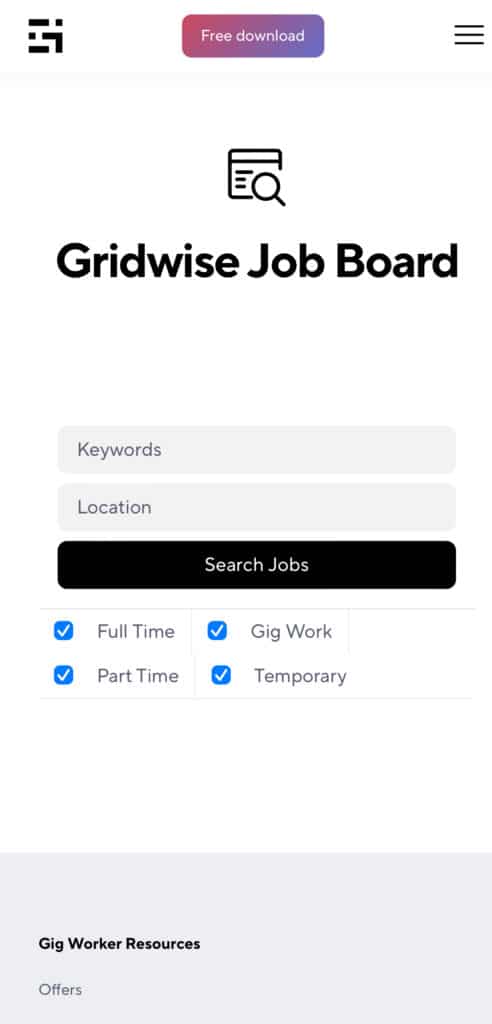
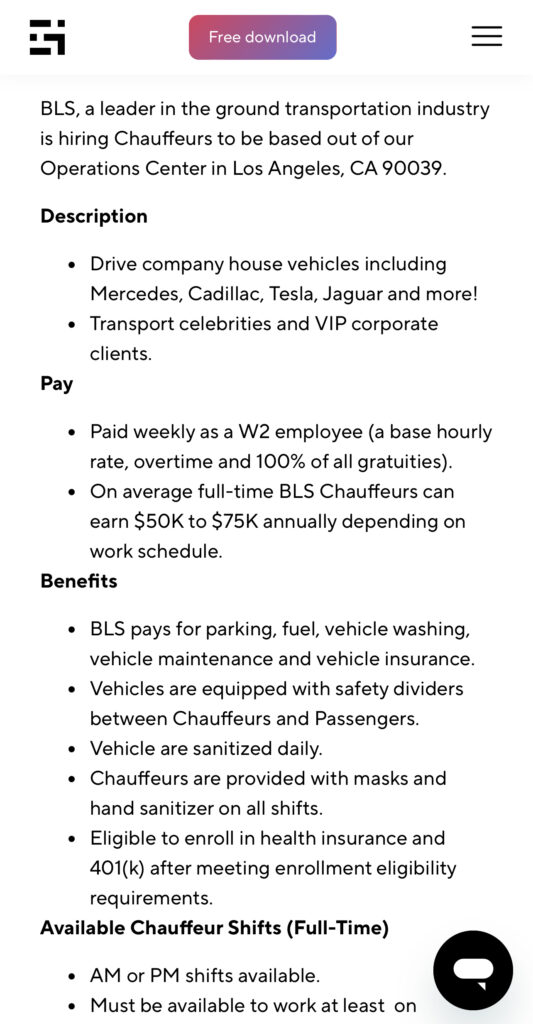
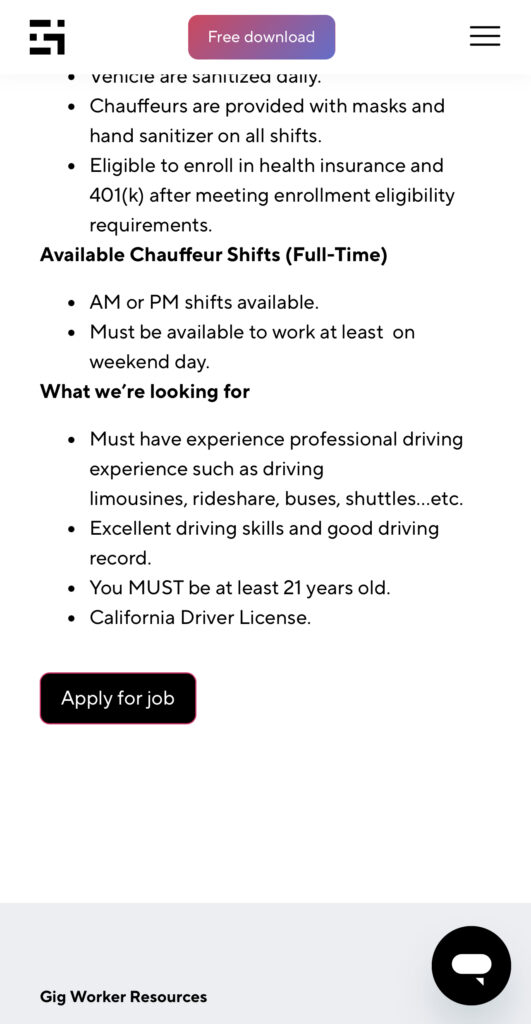
Many types of jobs are available. Adjust the search filter to see the full variety of opportunities that will let you cash in. Deliver food, set up catering, do rideshare driving, get paid for doing package delivery, and much more. You’ll find short-term gigs, long-term contracts, and part-time positions.
Perks of the Gridwise Job Board for gig workers
Gig workers who know how to make extra money will appreciate how the Gridwise Job Board lets you multiply your chances of bringing in big earnings. Here’s how:
- Increased stability. Use the Gridwise Job Board to find part-time or permanent jobs in addition to the part-time gigs you already have. Always keep a steady stream of earning opportunities flowing toward you.
- Flexibility and autonomy. Choose jobs that fit your schedule, work around other jobs and family duties, and still leave room for some fun in your life. Discover side hustles to supplement your full-time job, permanently or just for the season.
- Skill development. Find part-time work that lets you use a skill you already have, or try your hand at something new. It’s a smart way to develop a portfolio to showcase what you can do, or even to find permanent employment.
Get Gridwise and stay up to date on the Gridwise Job Board
Gig workers need plenty of information and assistance, and Gridwise is here to give it to you. Download the app and get essential features such as
- seamless earnings tracking
- mileage tracking
- expense recording, including notes
- low-cost and no-cost insurance benefits
- access to affordable medical, dental, vision, mental health, and alternative care
- professional services including legal and financial help
- deals and discounts
- weather, events, and traffic reports
- inside information on where and when to drive
More to know about gig work:

5 Best Mileage Trackers For Gig Drivers
Many drivers ask, “Do I really need a mileage tracking app?” The answer is simple: only if you want to have an accurate count of all the miles you can legally deduct from your taxable income! You might think your rideshare or delivery driving app has got you covered. After all, they do quite a good job of logging the miles you drive while you’re on a trip or delivery. But, if you want to have the best app to track mileage for Uber, Lyft, Doordash, Instacart, or the other apps you may use, you need more. Why is that?
Without a separate tracker, you’re missing the miles you drive in between pings. Did you realize that all the miles you drive, from the moment you begin your shift until it’s over (as long as you don’t drive several miles on a break to hang with your friends), are tax deductible! That means you need something besides your driving app to keep an accurate count of your travels. Read this Gridwise post to see how important it is to keep track of every deductible mile.
You won’t be surprised to hear that there’s an app for tracking miles. In fact, there are several of them. Here, we’re going to tell you about five top mileage tracking apps, and help you figure out which one is best for you.
Before we get to the list and identify the best mileage tracker app, let’s clarify what exactly a mileage tracking app is. According to G2.com’s technology glossary, mileage tracking is done for the purpose of keeping a log of mileage that is either reimbursable or tax deductible.
And yes, of course you can track your miles simply by taking readings on your odometer. But are you really prepared to account for how many miles you drove for personal reasons and subtract them from the total to get your business mileage? Even if you can remember all that and do the arithmetic, if you want an accurate reading of the miles you drive for business, and can therefore deduct, a mileage tracking app will save you a lot of trouble and prevent you from making costly errors.
Plus, as a gig driver, you have specific needs when it comes to a mileage tracker. Ideally, you’d be able to handle mileage tracking and several other functions all in one app. It can be maddening enough to deal with driving apps, particularly if you’re an avid multi-apper. You would want your mileage tracker app to help you keep account of other aspects of your business, including income, expenses, and inside information about the art of gig driving.
Not all mileage apps are equal, to be sure! Let’s look at five of the best apps to track mileage and figure out which is the best app to track mileage with Uber and Lyft, or what mileage tracker app is best for DoorDash.
1. Zoho Expense
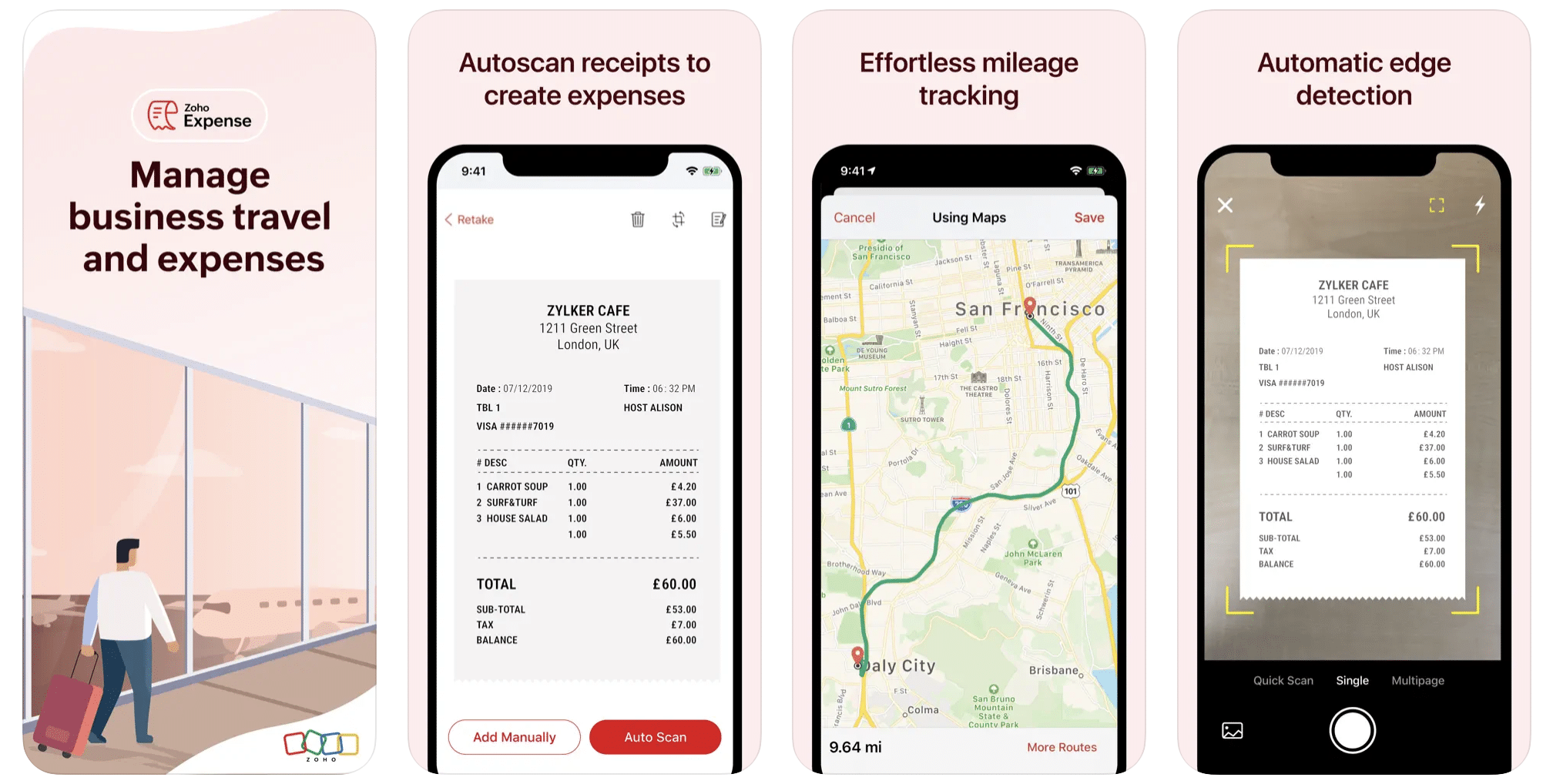
First up is Zoho Expense, which does exactly what its name says. This app is designed to allow companies to give employees a uniform way to create and submit expense reports. It can be used by individuals, including gig drivers, as well.
It includes a mileage tracker, as well as features that let you track other deductible expenses, including the ability to scan and record receipts.
Available on Android and Apple: Yes
Ratings: 4.8 stars on App Store, 4.7 stars on Google Play
Free Version: Yes
Subscription price: $3 per month, billed annually
Created specifically for gig drivers: No
2. Quickbooks Online
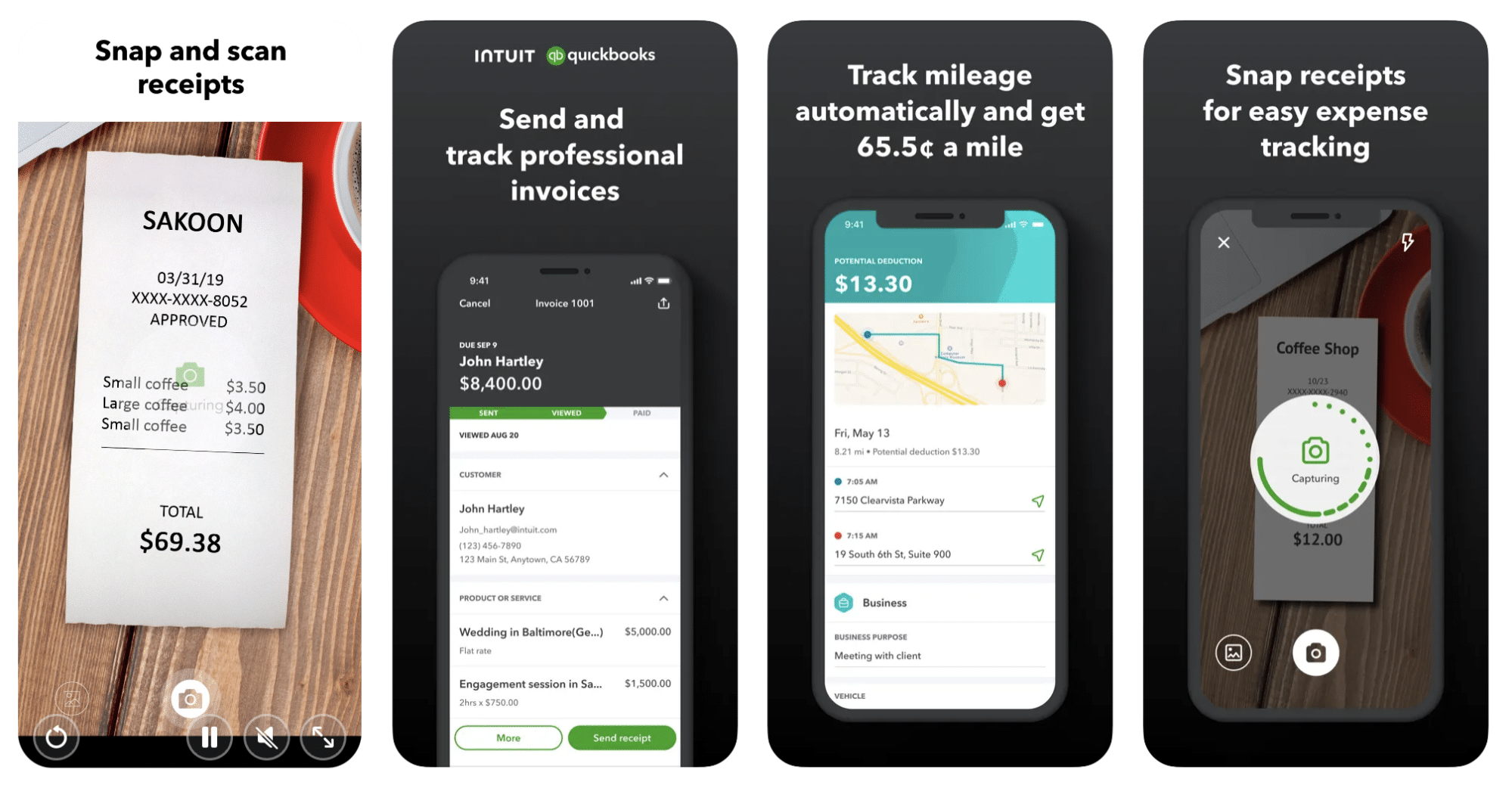
Quickbooks Online is a cloud-based app that allows you to track your mileage, earnings, and expenses. The information you enter can then be used to generate various reports that prepare you for tax time. It also allows you to create graphs that illustrate your cash flow, and includes a receipt scanner so you can instantly record deductible expenses. Quickbooks is popular, highly reliable, and designed mainly to help people keep track of their small businesses.
Available on Android and Apple: Yes
Ratings: 4.7 stars on App Store, 4.4 stars on Google Play
Free version: 30-day free trial
Subscription price: $15 per month for basic version if purchased for 3 months or more
Created specifically for gig drivers: No
Source: quickbooks.intuit.com
3. Shoeboxed
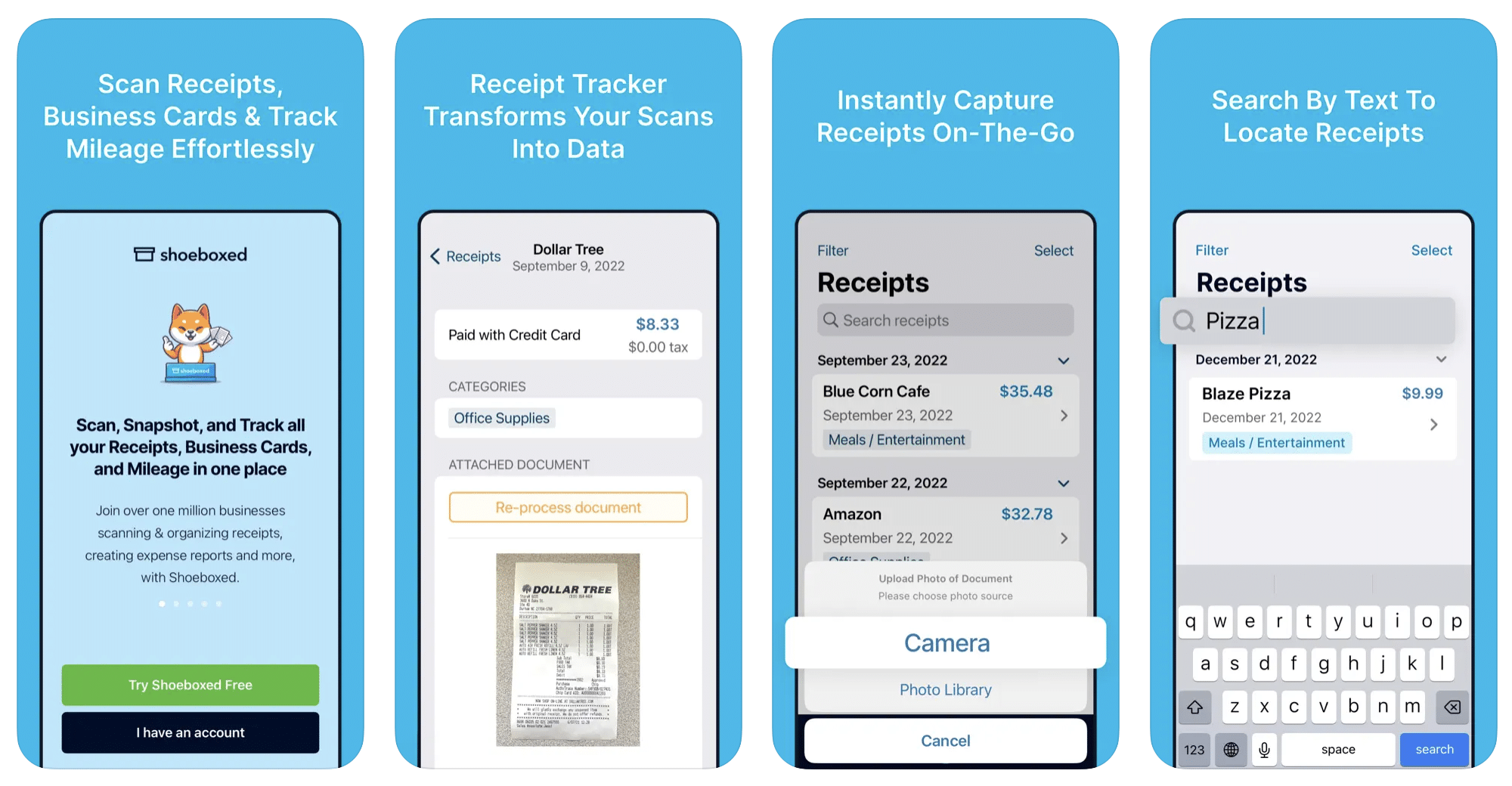
Shoeboxed started in 2007 as a service for scanning paper receipts into digital form. Now the app offers a free mileage tracker and has enabled users to scan receipts directly. It touts itself as the best mileage tracking app for DoorDash, but there are some elements missing that Dashers might like to have. While it provides features that record your expenses and prepare you for tax season, it doesn’t automatically track your earnings. The mileage tracker has a system where you can drop pins along your routes to make the tracking more precise, identifying those legs of a trip that you make for business purposes. The mileage tracker is “free” once you sign up for the basic version.
Available on Android and Apple: Yes
Ratings: 4.5 stars on App Store, 2.3 stars on Google Play
Free version: No
Subscription price: $18 per month for basic version
Created specifically for gig drivers: No
Source: blog.shoeboxed.com
4. Stride
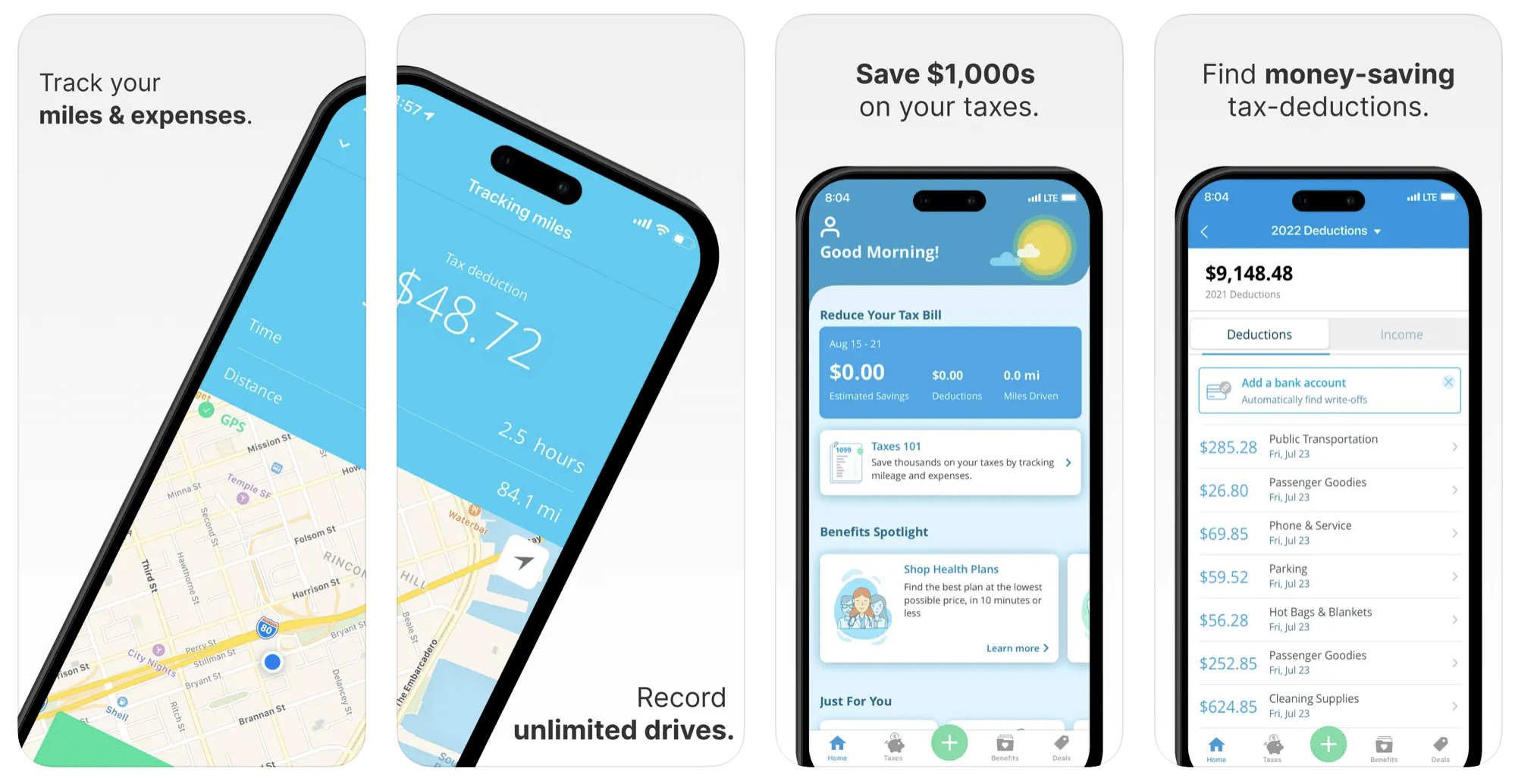
This free mileage tracker does a fair job of keeping track of the distances you rack up while gig driving, but it doesn’t automatically track earnings. It can be a big help, though, in tracking your expenses. You can link Stride to your bank account, and it will automatically scan your expenses to identify items you can potentially deduct. The app is totally free. This could make it the best free mileage tracker app, but there is a small price to pay. The app will persistently push you to consider various insurance plans that they are affiliated with. If you don’t mind that, this is a solid mileage tracker, even if it doesn’t track your earnings.
Available on Android and Apple: Yes
Ratings: 4.8 stars on App Store, 4.6 stars on Google Play
Free version: Yes
Subscription price: None. The app is free.
Created specifically for gig drivers: No
5. Gridwise
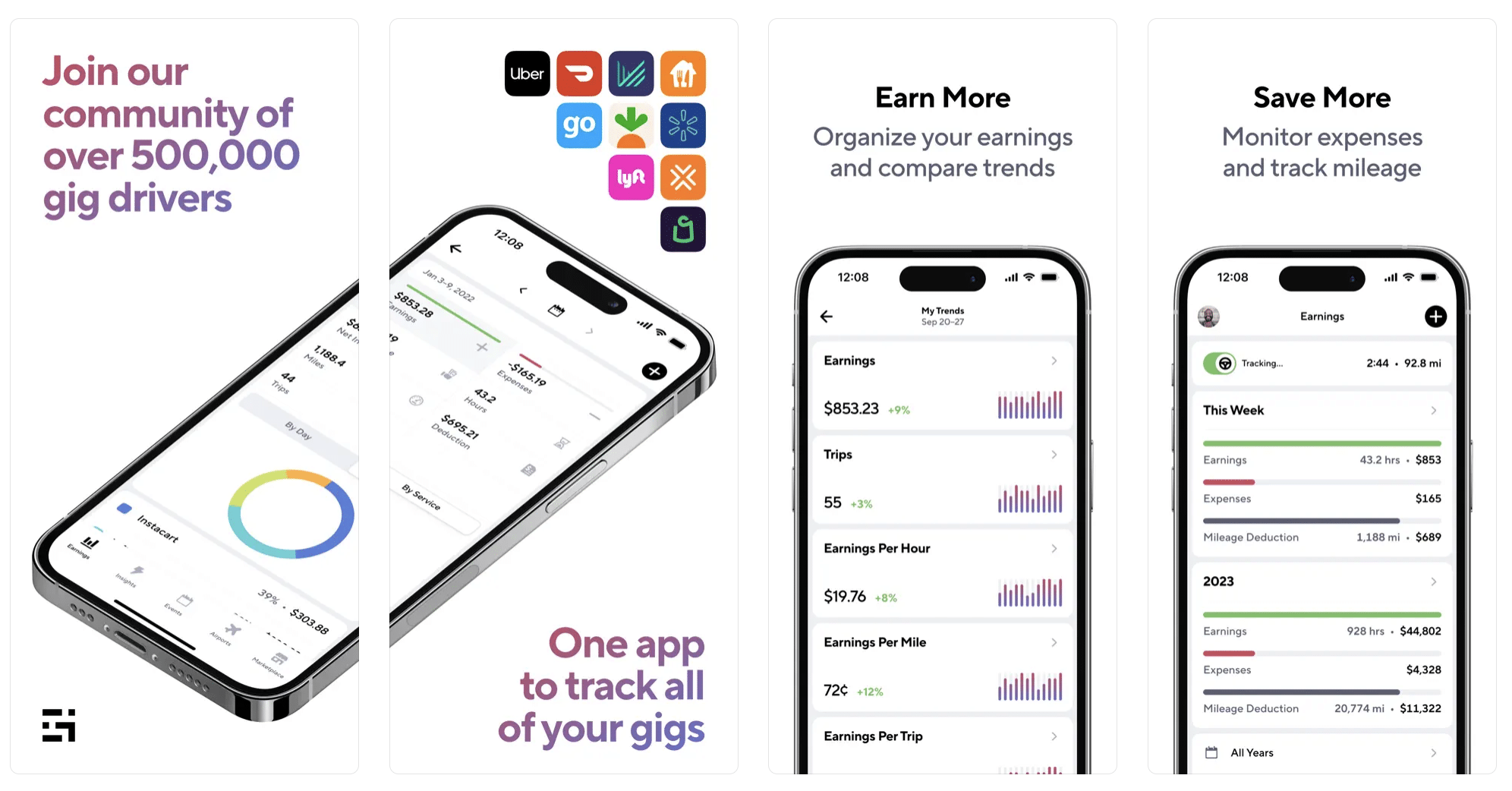
Gridwise has a free mileage tracker and free features that record your income and expenses. It gives you access to insurance and benefits, as well as insights about the best times and places to make the most money while gig driving. The Gridwise mileage tracker captures all the miles you drive while you’re on your driving shift, and it can be used if you have other trips you need to make which qualify as business travel.
Drivers love it because it is geared toward the needs of rideshare and delivery workers, providing free information about airport departures and arrivals, event start and let out times, weather, traffic, and more. The Gridwise Plus subscription adds value by providing additional insights and reports, discounts on benefits, the ability to export data in .csv format,, and more.
Available on Android and Apple: Yes
Ratings: 4.9 stars on App Store, 4.6 stars on Google Play
Free version: Yes
Subscription price: $9.95 per month for Gridwise Plus, or $95.99 per year (a $23.41 savings)
Created specifically for gig drivers: Yes!
What is the best mileage tracking app?
Now that we’ve checked them all out, we’re positive about the answer to that. Hands down, it’s Gridwise. Are we biased? You bet we are! But drivers love it too. Gridwise is the best mileage tracker app, and so much more. So many of the features are free, and the subscription to Gridwise Plus will pay for itself with additional insights to boost your earnings and deeper discounts on products and services.
Most important, Gridwise is designed specifically for gig drivers by experts who were once gig drivers themselves! Knowing what gig drivers need is a crucial step in creating an app that rideshare and delivery drivers can really use! Here are a few of the features, besides mileage tracking:
- seamless earnings tracking
- automatic, on/off toggle and manual mileage tracking
- mileage categorization
- airport, traffic, weather, and events information
- insights into where to drive and when to drive
- reports showing earnings across the platforms you use
- discounts on countless products and services for drivers
- additional resources for finding side gigs
- an informative and comprehensive blog
- affordable benefits, including insurance, medical, dental, and alternative practitioner discounts
- a community of drivers just like you
Don’t settle for just any app. Get the best mileage tracker, and so much more, from Gridwise!

What’s the Best Mileage Tracking App for Gig Workers?
As a gig worker, you’re constantly navigating challenges: keeping track of endless miles, managing expenses, and figuring out which platform will make your next shift worth your time. It can feel overwhelming, like you’re working harder but not seeing the payoff. Imagine instead having everything in one place: every mile logged automatically, your expenses neatly organized, and personalized insights showing you where and when to drive for maximum earnings. That’s the dream, right? With Gridwise, it’s not just a dream, it’s your new realityGridwise is more than just the best mileage tracking app for delivery drivers, it’s your ultimate sidekick for maximizing earnings, saving on taxes, and working smarter across multiple platforms. Let’s dive into what makes Gridwise the go-to tool for gig workers everywhere.
What Gig Workers Need in a Mileage Tracker
Mileage tracking isn’t just about logging miles, it’s about unlocking your full earning potential. Here’s what gig workers need in a business mileage tracking app, and how Gridwise checks every box:
1. Accurate and Automatic Mileage Tracking
Gig drivers juggle countless tasks during a shift. Manually logging miles can be tedious and prone to errors. Relying solely on gig apps for your mileage can leave you shortchanged on deductible miles.
- What You Need: A tracker that logs every eligible mile automatically from the moment you leave your driveway until you return.
- How Gridwise Helps: Gridwise uses advanced GPS tracking to record every mile you drive, not just the ones gig apps count. It’s the best mileage tracking app for DoorDash, Uber, Grubhub, and beyond, ensuring you don’t miss a single deductible mile.
2. Simplified Tax Preparation
Every mile you drive for gig work in 2024 is worth 67 cents in tax deductions. With detailed, IRS-compliant records, you can avoid leaving money on the table or struggling during tax season.
- What You Need: A reliable way to document miles and expenses, ready for tax time or even an audit.
- How Gridwise Helps: Gridwise creates comprehensive logs for your business mileage so you can confidently claim deductions. No more scrambling for receipts or guessing your total miles.
3. Multi-App Compatibility
Most gig workers drive for multiple platforms to maximize earnings. Switching between apps can make tracking miles and earnings messy.
- What You Need: A mileage tracker that integrates seamlessly across all your gig platforms.
- How Gridwise Helps: Gridwise syncs with DoorDash, Uber, Instacart, Lyft, and more, consolidating your earnings and mileage in one dashboard. It’s not just the best mileage tracking app, it’s the smartest.
4. Insights to Boost Earnings
Knowing when and where to drive can make or break your shift. Without data, you’re left guessing where the high-paying jobs will be.
- What You Need: A tool that provides real-time updates and recommendations tailored to your gig work.
- How Gridwise Helps: Gridwise offers insights into peak driving times, high-demand areas, airport activity, and even local events. It’s more than a tracker, it’s your guide to driving smarter.
Why Gridwise Is the Best Mileage Tracking App for Delivery Drivers
Here’s how Gridwise compares to other mileage-tracking apps:
- Mileage tracker: Gridwise, Solo, QuickBooks, Everlance, and Stride all have it
- Expense tracker: Gridwise, Solo, QuickBooks, Everlance, and Stride all have it
- Gig earnings sync: Gridwise and Solo only
- Airport reporting: Gridwise and Solo only
- When and where to drive: Gridwise only
- Weather info: Gridwise only
Gridwise stands out as the best mileage tracking app for DoorDash and other delivery platforms because it’s designed specifically for the gig economy. From tracking to insights, it offers everything you need to drive efficiently and profitably.
How the Gridwise Mileage Tracker Works
Gridwise makes mileage tracking effortless with two flexible options: Automatic Mileage Tracking Plus and manual entry. Additionally, its mileage categorization feature takes organization to the next level, helping you track and optimize every mile for tax deductions and business insights.
1. Automatic Mileage Tracking Plus
Gridwise’s Automatic Mileage Tracking Plus is perfect for gig drivers who want a hands-free solution to ensure every mile is logged accurately.
- Smart Trip Detection: The app starts tracking as soon as you’re on the move and stops when your trip ends. No need to manually start or stop the tracker.
- Cross-Platform Coverage: Whether driving for DoorDash, Uber, Lyft, or any other platform, Gridwise captures all business-related miles, including trips between gigs.
- Always Running in the Background: The feature works seamlessly without disrupting your workflow, ensuring no miles are left untracked.
How to Enable Automatic Mileage Tracking Plus:
- Open the Gridwise app and navigate to Settings.
- Select Mileage Tracking and turn on Automatic Mileage Tracking Plus.
- Grant location permissions to let the app track your drives accurately.
This tool makes Gridwise the best mileage tracking app for DoorDash and other platforms, helping gig drivers save time and maximize deductions.
2. Manual Mileage Entry
Sometimes, a trip isn’t tracked automatically, or you need to log a particular drive. Gridwise’s manual mileage entry ensures no deductible mile is missed.
- Perfect for Custom Trips: Whether it’s driving for a one-off gig, a meeting, or other business-related errands, manual entry has you covered.
- How to Add Mileage Manually:
- Go to the Mileage Log section in the Gridwise app.
- Tap Add Mileage and input the trip’s start and end points.
- Enter the total miles driven and save the entry.
https://vimeo.com/1013582587
This feature ensures complete mileage records, giving you total control over your business mileage.
3. Mileage Categorization for Better Organization
Gridwise doesn’t stop at tracking, it takes organization to the next level with Mileage Categorization. This feature allows gig workers to separate their miles into business and personal categories, making tax filing and performance tracking easier than ever.
- Why Categorization Matters:
- Helps you distinguish between personal and business drives.
- Ensures you claim only deductible miles, keeping your tax records accurate and audit-ready.
- Provides insights into how much of your driving contributes to income.
- How It Works:
- After a trip is logged, either automatically or manually, open the Mileage Log.
- Assign the trip to a category, such as "business," "personal," or a custom label.
- Use the categorized data to generate reports during tax season or analyze your driving patterns.
https://vimeo.com/1010716836
Example Use Case:
If you drive to a busy hotspot between shifts or pick up supplies for your gig work, you can categorize those miles as "business." Personal errands, like grocery runs, can be categorized separately to avoid confusion when filing taxes.
This level of organization makes Gridwise more than just a business mileage tracking app, it’s a comprehensive tool for precisely managing your gig driving activity.
By combining Automatic Mileage Tracking Plus, manual mileage entry, and robust Mileage Categorization, Gridwise ensures you stay organized, maximize deductions, and gain insights into your driving. It’s no wonder gig drivers call it the best mileage tracking app for delivery drivers and beyond.
How Gridwise Supports Your Gig Work Beyond Mileage Tracking
Mileage tracking is just the beginning. Gridwise goes the extra mile to help gig workers manage their business:
- Expense Management: Log gas, maintenance, tolls, and parking costs. Snap photos of receipts and store them within the app for easy tax filing.
- Analytics and Insights: Track your earnings by platform, time, and location to see which gigs are most profitable. Optimize your schedule based on real data.
- Real-Time Alerts: Stay ahead of changing conditions with airport activity updates, weather notifications, and local event alerts.
These features make Gridwise more than the best business mileage tracking app, it’s a full-suite solution for gig workers.
Affordable Options for Every Driver
Gridwise offers flexible pricing to suit your needs:
- Basic, our free version Includes mileage tracking, expense logging, and basic analytics.
- Gridwise Plus: At just $14.99/month or $71.99/year, unlock advanced features like multi-platform analytics, peak time recommendations, and enhanced insights.
Start Driving Smarter Today
Gig work can be unpredictable, but with Gridwise, you’ll always have the tools you need to stay ahead. It’s not just the best mileage tracking app for delivery drivers, it’s the ultimate companion for anyone working in the gig economy.
Join thousands of gig workers who rely on Gridwise to simplify their work and maximize their income. Download Gridwise today and see how it transforms the way you drive, earn, and save.
Read on here about how much these gig workers make
- How Much Do Uber Drivers Make?
- How Much Do Lyft Drivers Make?
- How Much Do DoorDash Drivers Make?
- Everything You Need to Know About Amazon Flex
- Walmart Spark Delivery Driver Pay: How Much Does a Walmart Spark Driver Make?
- How Much Can You Make on Instacart?
- How Much Do Shipt Shoppers Make?
- How Much Do Uber Eats Drivers Make?
12 Ways Rideshare Drivers Can Earn More Tips
If you spend even one shift as a rideshare driver, you discover your income is not limited only to what you earn through giving passengers rides. You make more than the Uber and Lyft driver pay by generating tips.
This past July, an article in USA Today titled Do You Tip Uber and Lyft Drivers? Rideshare Tipping and Compensation Explained recommended that passengers set a tip of $4 to $6 for rideshare.
However, not every passenger that hops in your car will be a generous tipper. So what can you do to increase tips? Take a few minutes and read on as we reveal some conventional–and unconventional–ways to generate more tips and how to make the most money on Uber and Lyft.
Tips come from everyone
Anyone involved in a service industry where gratuities are part of the custom can tell you that good tips come from the least expected sources. This is true with rideshare, too. You may transport an attorney across town or take a flight attendant a few miles to the airport, and you find that only the flight attendant tips. You may drive someone home from what appears to be the most menial job, and they leave you a five-dollar tip. It may not always sense, but this is what happens. The moral: Don’t dismiss any passenger as the source of a tip.
But there is more you can do.
12 ways to increase your rideshare tips
- A clean car goes a long way
According to an article by the U.S. Census Bureau titled America’s Love Affair With (Clean) Cars, “because many see their cars as an extension of their personality, maintaining an image by keeping their cars clean also matters.” Now that more people use rideshare as their main form of transportation, the clean rideshare car becomes an extension of their personality. They’ll tip for it, too.
Many drive-through car washes offer unlimited drive-through washes for a monthly fee, as low as $20. They take five minutes. Use their vacuums to clean the interior. Don’t forget the windows, too.
- Have a dress code for yourself
You don’t have to wear a button-down and tie (although some drivers do), but some drivers have found success in dressing up a little for the job. One driver in Los Angeles wears a bowtie during the cooler months. It is part of his image, and he says he gets comments all the time—and tips, too.
- Collect good tunes
The best Lyft or Uber driver advice for improving tips is to build a good music playlist. Build an extensive music library with Amazon Music, Spotify, and others. Strive for an eclectic collection. Everyone likes Sinatra, even the younger crowd. Throw in Billie Holiday, Tony Bennet and Lady Gaga duets, jazz, classical guitar, doo-wop. Experiment and see which genre of music works.
- Be a good conversationalist, but know when to be quiet
Talk it up with your passengers. Stay away from politics and sex, but most everything else is fair game. It’s always best to listen more than you talk. There is a certain anonymity to being a rideshare driver. People expect they’ll never see you again, so they feel as if they can tell you anything. Occasionally you get a passenger who doesn’t want to talk. Respect their desire for silence.
- Maintain a supply of goodies
We mean gum, breath mints, and water. If airport pickups are part of your passenger base, know that many folks sleep on the plane. They need to freshen up when they get off. No one wants to show up at a meeting with dragon’s breath. A case of water costs less than five dollars. Make sure every cupholder in your car has a bottle, replenishing as needed. You get extra points for toothpicks. The ones individually wrapped in cellophane are perfect.
- Have a stash of power cords for recharging phones
It is amazing that on just a ten-minute ride, you can get a passenger that wants to charge their phone. You can earn a tip if you can accommodate them. Keep three extra power cords in your car: the USB-C, the iPhone lightning charger, and a micro USB. Keep a few extra hidden away, too. These things tend to grow legs and walk. Make sure they are long enough to reach your back seat unless you are fortunate enough to have a USB charging port back there.
- Have three or four cash apps
We mentioned this a few blog posts back. Many car dealerships have agreements with Lyft or Uber to take clients home or drive them to the dealership when they get their car serviced. There are also medical insurance companies and others that contract with rideshare companies for patient transportation. Sometimes the customer wants to tip the rideshare driver but can’t because the ride is not on their app and they don’t have any cash. It is worth downloading a few of the more popular cash apps on your phone, such as PayPal, Cash App, Venmo, and others.
- Use icebreakers in group rides
Have you ever had a Lyft shared ride or an UberX Share, and when the second passenger gets in the car, all conversation screeches to a halt? It’s a psychological thing. Nobody wants to be vulnerable. Well, it’s your car. You run the show. Try playing two truths and a lie. Everyone tells three things about themselves. Two are true, and one is a lie. Everyone else in the car gets to guess which is the lie. It is a lot of fun. One driver reports that the most interesting truth he had in his car was a woman who spoke six languages. Some might work for you. Ironically, people use these group rides to save money but end up tipping you for a great rideshare.
- Watch over unaccompanied women
A rideshare driver with daughters made it a habit of watching unaccompanied women passengers get in the door of their house, but he sensed that some of them were uncomfortable with him watching. That's when he made it a point of telling them, “I am going to watch you get in your front door. I want to make sure you’re safe.” The unexpecting and surprising result is that 75% of them tipped.
- Return lost cell phones
There isn’t a driver around who has not had a passenger leave one in the car. This happens regularly when you work the bar crowd. Take the phone home and put it on your nightstand. They will most likely call it when they wake up in the morning, preferably a little more sober than the night before. One driver reported adding more than $80 in tips to his previous night’s earnings by returning three lost cell phones. The best part? Two people drove to his house to pick theirs up. The third was willing to meet him that night when he went out to rideshare again. If the owner doesn’t tip you, report it to Lyft or Uber. They automatically ding the passenger $15, which gets credited to your account.
- Hand out smiley face stickers
This sounds corny, but it works. Keep a few sheets of smiley face stickers in your glove compartment, center console, or tucked in the sun visor. When a passenger says or does something nice, or if they seem a little down, peel off a sticker and give it to them. Blue collar men in overalls will get out of your car wearing that sticker like a badge of honor, and they’ll tip, too.
- Learn the second language in your market
Master key phrases or become conversational in the second language you’ve always wanted to learn. Many non English speakers are delighted when they find you took the time to learn how to communicate with them. They reward it, too. Check out Babbel, Duolingo, or any other language learning apps. They have short lessons of 10 to 12 minutes. Perfect for between rides.
BONUS: Have a snappy response to “I’ll tip you in the app.”
Every rideshare driver knows that 80% of passengers uttering that phrase will never tip. Imagine if all the passengers who say, “I’ll tip you in the app,” actually do. Prepare a snappy response. One driver on Facebook a few years ago had this standard response: “I appreciate that. I use my tip money to buy medicine for the kids.” Another approach is to say, in a joking way, “Oh, wow, you just jinxed it. Four out of five people, when they say, ‘I’ll tip you in the app,’ never do. It’s common knowledge.” Now you’ve challenged them to tip you. Work on your delivery of this one. You’ll see those tips increase.
Hot driver tip - use Gridwise
Gridwise has many features that help drivers boost their earnings. In addition to having a free Uber and Lyft mileage tracker, Gridwise helps gig driver income with:
- When to Drive and Where to Drive - these features show you profitable neighborhoods and times of day to drive.
- Airport info - use the app to find out when the peak times are for arrivals and departures at the airports in your market.
- Event info - doing rideshare to take people to and from events? Gridwise shows all events in your area and lets you set reminders for when the event is starting and ending.
- Gridwise Gas - Gridwise users save 2¢ per gallon.
Ready to earn more on the road? Use some of these tip boosting recommendations and download Gridwise!
Boost Your Seasonal Delivery Earnings with FedEx and UPS
The holiday season isn’t just a time for giving—it’s also a time for earning, especially for gig workers. As delivery services like FedEx and UPS gear up for the seasonal rush, they offer a prime opportunity to earn more through temporary roles. These positions are perfect for rideshare and delivery drivers seeking to maximize their income during one of the busiest times of the year. Whether you’re looking to add another revenue stream or simply want to capitalize on the high demand, seasonal delivery work offers flexibility, competitive pay, and a chance to finish the year strong.
Why Consider Seasonal Delivery Jobs?
Seasonal delivery jobs with FedEx and UPS stand out for several reasons. During the holiday months, these companies see a surge in package volumes, which means they’re eager to hire. Here's why it’s a great option for gig workers:
- Higher Pay Rates: Seasonal positions often pay above the standard rate for delivery jobs. Drivers and helpers can earn $20 to $25 per hour or more depending on location and experience.
- Job Flexibility: These roles cater to both part-time and full-time workers, allowing you to choose shifts that suit your lifestyle. Whether you’re free in the mornings, evenings, or weekends, there’s likely a shift that fits.
- Simple Requirements: Many roles only ask for a valid driver’s license and the ability to handle physical work. This makes it easy for new workers or those transitioning from other gigs to get started quickly.
- Steady Demand: Unlike rideshare or food delivery jobs that can experience lulls, delivery roles during the holidays are consistent. Companies guarantee shifts, so you’ll always have work.
Added Bonus: These jobs can provide valuable experience in logistics and supply chain management—skills that can open doors for future opportunities.
FedEx vs. UPS: What to Expect
When it comes to seasonal work, FedEx and UPS are the heavyweights. Both companies are reliable and offer great benefits, but they have some differences that might influence your choice.
FedEx
- Roles Available:
- Driver Helper: Assist delivery drivers with package drop-offs.
- Package Handler: Work in the warehouse loading and unloading trucks.
- Seasonal Driver: Deliver packages using FedEx vehicles.
- Pay Rates: Drivers can earn up to $25/hour. Helpers and handlers typically earn around $15-$20/hour.
- Physical Workload: Expect to walk and lift packages throughout your shift, which can be physically demanding.
- Best Fit For: Those who prefer a dynamic workday and are comfortable with a physical role.
UPS
- Roles Available:
- Seasonal Driver: Deliver packages independently.
- Package Handler: Sort packages in the warehouse.
- Driver Helper: Ride along with drivers to assist with deliveries.
- Pay Rates: Similar to FedEx, with bonuses often included for peak times.
- Unique Perks: UPS tends to offer more full-time seasonal roles, which might appeal to those looking for steady hours.
- Best Fit For: Workers who want long-term opportunities or the potential to convert into permanent positions.
Pro Tip: Both companies often reward workers with bonuses for completing the holiday season without absences or missed shifts.
Maximizing Earnings During the Holidays
While seasonal delivery work pays well, there are ways to boost your income even further. Here’s how:
- Choose Peak Shifts: Early mornings, evenings, and weekends are when demand (and pay) is highest.
- Stay Local: Deliver in areas you know well to save time and complete more deliveries per hour. Familiar routes can also reduce stress during busy shifts.
- Track Bonuses: Companies like UPS and FedEx frequently offer surge pay or bonuses for shifts during critical times, such as Christmas Eve. Sign up for alerts to grab these lucrative opportunities.
- Combine Jobs: If you’re already driving for platforms like Uber or DoorDash, consider alternating shifts. Use delivery work to fill gaps when rideshare demand slows.
- Use Efficiency Tools: Apps like Gridwise help you track mileage, optimize routes, and monitor your earnings across all your gigs. This keeps you organized and ensures you’re maximizing your time.
How Gridwise Can Help You Succeed
Seasonal delivery jobs can be fast-paced, and balancing them with other gigs or personal commitments can get tricky. That’s where Gridwise comes in:
- Optimize Your Schedule: Gridwise’s “When to Drive” feature helps you find the most profitable hours for delivery and rideshare work.
- Track Your Earnings: See exactly how much you’re earning from FedEx, UPS, and other platforms. This clarity is essential for identifying your most profitable gigs.
- Mileage Tracking: Seasonal delivery roles require a lot of driving. Gridwise logs your mileage automatically, making tax deductions easy and accurate.
- Expense Management: Beyond mileage, Gridwise lets you track fuel costs, maintenance expenses, and more, giving you a complete picture of your profitability.
Gridwise Plus Bonus: If you want advanced features like weather alerts and real-time market trends, consider upgrading to Gridwise Plus. It’s the ultimate tool for staying ahead of the game.
Gridwise: Your Ultimate Partner for Holiday Success and Year-Round Gig Optimization
The holiday season is a prime opportunity for gig workers to maximize their earnings, and seasonal delivery jobs with FedEx and UPS offer an excellent way to do just that. These positions provide competitive pay, flexible schedules, and steady demand, making them a top choice for gig drivers who want to capitalize on the busiest time of the year. But to truly unlock the full potential of seasonal work, the right tools and resources are essential.
The Gridwise App is the ultimate companion for gig workers. It’s more than just an earnings tracker—it’s a comprehensive tool designed to help you work smarter, not harder. With features like When to Drive, you can pinpoint the most profitable times to be on the road, while earnings tracking helps you keep tabs on income across multiple platforms, including FedEx, UPS, Uber, DoorDash, and more. Gridwise also streamlines expense management with automated mileage tracking, ensuring that you don’t miss out on critical tax deductions.
Additionally, the Gridwise Job Board is a powerful resource for finding new gig opportunities. From seasonal delivery positions to rideshare and food delivery roles, the job board connects you with companies actively hiring in your area. This makes it easy to diversify your income streams and find roles that align with your skills and availability.
By integrating Gridwise into your workflow, you’ll not only optimize your earnings during the holidays but also gain valuable insights to carry into the new year. Whether you’re planning your schedule, tracking your mileage, or searching for your next gig, Gridwise equips you with the tools you need to succeed in the competitive gig economy.
Get ahead this holiday season and beyond—download the Gridwise app and explore the Gridwise Job Board today. Your next big earning opportunity is just a click away!
Already gig driving? Check out these resources:

eHealth: Simplifying Health Insurance for Gig Workers and Drivers
As a gig worker—whether you’re a rideshare driver, delivery pro, or freelancer—health insurance can feel like a puzzle you have to solve alone. Contractors typically don’t receive employer health benefits, leaving you to figure out coverage that fits both your needs and your budget.
That’s where eHealth comes in. With options for individual, family and Medicare health insurance, eHealth makes finding affordable coverage easy. In fact, you could save up to $2,760 a year, with some individual and family plans costing as little as $0 per month for people who qualify for subsidies, based on a 2024 eHealth study.
Here’s how eHealth helps gig workers like you get insured without the headache.
Who is eHealth?
eHealth is a private health insurance marketplace designed to make shopping for health plans fast, secure, and easy. No matter which type of coverage you need, their platform and team of licensed agents guide you every step of the way.
Why Gig Workers Need Health Insurance
Health insurance isn’t just nice to have—it’s essential. From routine check-ups to unexpected emergencies, your coverage should protect your health and finances.
Unfortunately, nearly a quarter of gig workers may be uninsured, exposing them to high out-of-pocket costs.
Here’s why it matters:
- Preventive Care: Long hours on the road or in the field can take a toll. Routine care helps you stay healthy and catch issues early.
- Financial Protection: A single medical emergency can wipe out your earnings. Insurance could shield you from devastating bills.
- Family Coverage: Many gig workers support dependents. Health insurance helps ensure their needs are covered without straining your wallet.
With eHealth, you can find plans that cover benefits like mental health, physical therapy, and family medicine—all tailored to your unique situation.
Why Choose eHealth?
- Affordable Plans: Find plans starting at $0 per month for those who qualify for subsidies. eHealth could help you save up to $2,760 annually, based on a 2024 eHealth study.
- Comprehensive Benefits: Search for plans that include hospital visits, prescriptions, mental health services, and more.
- Customized Options: Filter plans to ensure your preferred doctor and prescriptions are covered.
Simple Enrollment, Zero Hassle
eHealth’s online platform lets you shop, compare, and enroll in plans from the comfort of your phone or computer. No paper. No confusion. Just fast, secure enrollment. This means you can secure coverage before your enrollment period ends without the hassle of traditional applications.
In most states, you’ll need to enroll by the following dates:
- December 15, 2024 for coverage starting January 1, 2025.
- January 15, 2025 for coverage starting February 1, 2025.
You can check your state’s specific deadline here.
Options for Medicare-Eligible Gig Workers
If you are eligible for Medicare, eHealth offers options like Medicare Advantage, Medicare Prescription Drug Plans (PDPs), and Medicare Supplement (Medigap). Their licensed agents will help you sort through the details to find the right fit for you.
Getting covered is easy:
- Visit eHealth’s website to explore plans tailored to your needs.
- Compare options by cost, coverage, and benefits like mental health, prescriptions, or family care.
- Enroll online or call eHealth’s licensed agents at 833-302-1395 TTY 711 for one-on-one guidance.
Ready to secure health insurance that works for your gig lifestyle? Start comparing plans with eHealth today!
Exciting DoorDash Updates for Gig Workers
In the fast-paced world of food delivery, staying ahead of the curve is your ticket to success. Whether you're dashing full-time or part-time, keeping up with the DoorDash updates can shape how you work, earn, and stay safe. DoorDash, a leader in the gig economy, has rolled out a series of game-changing features that could redefine the experience for Dashers everywhere. Let’s break it all down—because these aren’t just updates; they’re opportunities to thrive.
Hourly Pay Option: Stability Meets Flexibility
Imagine knowing exactly how much you’ll earn per hour, regardless of how many deliveries you complete. DoorDash’s new hourly pay option stabilizes select markets, thanks to partnerships with local delivery providers. For these roles, Dashers are employed as W-2 workers, which means you’d receive benefits like health insurance, mileage reimbursement, and guaranteed hourly wages (IBTimes, Business Insider).
- Two Pay Models, One Goal: You can choose between hourly pay (Earn by Time) and per-delivery pay, choose what works best for your lifestyle and goals.
- Tailored Pay Rates: DoorDash ensures fair pay by adjusting hourly rates to reflect local market conditions.

Image credit: Doordash
Why It Matters: We all know gig work can sometimes mean feast or famine. The hourly pay option offers peace of mind during slower hours while keeping the flexibility that makes gig work so appealing. It’s a win-win for Dashers who value consistency.
Safety First: DoorDash Has Your Back
For many Dashers, safety isn’t just important—it’s essential. Whether you’re delivering in a new neighborhood or working late nights, DoorDash’s new safety features aim to provide greater security on the road.
- SafeChat+: Announced in March 2024, SafeChat+ is powered by AI. This feature detects and prevents harassment within the app, creating a safer communication environment between you and customers.
- According to Doordash’s latest help article, your ratings wont be affected.

Gif credit: Doordash
Why It Matters: Safety features like these show DoorDash is listening. As a gig worker, you deserve tools that protect your well-being. When you feel safe, you can focus on delivering great service without added stress.
Boost Your Earnings: Smarter Ways to Make More
We all got into this game to make money, right? DoorDash is making it easier for you to maximize your earnings and rewards. Here’s how:
- Post-Checkout Tipping: Customers can tip you up to 30 days after a delivery. That means your exceptional service could still pay off weeks later if you go above and beyond.
- Dasher Rewards Program: With Silver, Gold, and Platinum tiers, DoorDash rewards Dashers who maintain strong metrics like high acceptance rates. Perks include scheduling priority and exclusive discounts.
- Crimson Program: Need gas perks? DoorDash’s Crimson Program offers cash back on gas and EV charging, putting more money back in your pocket where it belongs.
Why It Matters: These features reward hard work and efficiency, so you can work smarter, not harder. Plus, who doesn’t love extra perks for doing a great job?
Efficiency Boost: Making Grocery Orders Simpler
If grocery deliveries are part of your routine, you’ll appreciate this one. DoorDash’s new grocery list import tool helps customers streamline their orders. While this feature is aimed at customers, Dashers stand to benefit too.
Why It Matters: A smoother grocery ordering process means fewer issues for you during deliveries and potentially higher demand in suburban areas. That’s a win for your schedule and your wallet.
The Big Picture: Why These Updates Are a Game-Changer
DoorDash’s latest features come at a critical time for gig workers. With regulatory changes, growing competition, and shifting worker expectations, the platform is working hard to meet your needs.
- Regulatory Shifts: Worker classification is a hot topic, and updates like the hourly pay option are DoorDash’s way of adapting to the conversation (Library of Congress).
- Driver Retention: With other platforms competing for drivers, these updates help DoorDash stay ahead of the curve and their delivery workers looked after.
- Meeting Worker Expectations: From guaranteed pay to enhanced safety tools, these changes reflect the evolving needs of gig workers.
Why It Matters: DoorDash isn’t just tweaking features—it’s laying the groundwork for a better gig work experience. For you, that means more control, safety, and earning potential.
What You Can Do Today to Maximize Your Success
Don’t just read about these updates—take action! Here’s how to get started:
- Explore the Hourly Pay Option: See if this option is available in your area and test it out during slower periods.
- Use Safety Features: Familiarize yourself with SafeChat+ and encourage customers to turn on their porch lights.
- Boost Your Tips: Follow up with top-notch service and check your post-delivery tips for surprises.
- Climb the Rewards Tiers: Aim for Platinum status in the Dasher Rewards Program to unlock the best perks.
Smart Dashers Use Gridwise to Make Every Update Count
DoorDash’s latest updates are a step forward for gig workers, offering more stability, safety, and opportunities to earn. But to truly maximize these features and your overall gig work strategy, you need the right tools in your corner. That’s where Gridwise comes in.
With Gridwise, you can track your earnings, plan the best times to drive, and gain insights into the busiest delivery hours in your area. Imagine combining DoorDash’s new hourly pay option or tipping updates with Gridwise’s data-driven features to optimize your schedule and earnings. Plus, Gridwise helps you compare performance across multiple gig apps, so you can decide when it’s best to Dash or switch to another platform.
The gig economy is evolving, and you don’t have to navigate it alone. DoorDash is enhancing the way you work, and with Gridwise, you can take your gig career to the next level. Download the Gridwise app today and unlock the full potential of these game-changing updates!

How to Make $1,000 a Week With Lyft in 2026 — Is It Realistic?
With the right strategy, including the information you need to make data-driven decisions, you could learn how to make $1000 a week with Lyft.
Start by using objective information from a source you can depend on. There is no bias behind the numbers you will see here. Gridwise provides actual data from real drivers. Once you know what drivers are earning on average, you can formulate a winning strategy that gets you into the $1000 club in no time.
What are Lyft's average hourly earnings?
They hover around $20, but Lyft average hourly earnings vary widely. Location is the most influential factor when considering how much a driver will make per hour. $20 an hour is low for drivers in large urban centers and high for those living in areas with less steep passenger fares.
What are Lyft's average daily earnings?
2023 saw a dip in daily earnings, according to Gridwise data. This could be due to drivers not working the Lyft gig full-time. Given the average hourly wage of $20, a driver could make way more than $90 a day without a whole lot of extra hustle.
The rise of multi-apping, plus an increase in the number and types of gigs available, could be responsible for the average Lyft driving day becoming shorter and less lucrative.
What are Lyft average weekly earnings
Weak earnings, between $350 and $385, start to make that goal of $1000 a week look almost impossible. The same factors that keep daily earnings down, namely a lack of consistency in driving, are likely to be responsible for the low numbers we see here. Drivers can do better, though, with the right approach.
Lyft average monthly earnings
Monthly figures also seem to be discouraging at first glance. When drivers don’t work more than a few hours a day, it’s easy to see how these monthly earnings numbers that hover between $1,000 and $1,200, equating to $250-$300 a week, come about.
How to make $1000 a week with Lyft - the blue print
Strategy A: work 50 hours a week for Lyft50 hours x $20 per hour = $1,000Strategy B: work 40 hours and add bonuses, incentives, and referrals40 hours x $20 per hour = $800 + $200 in incentives and referralsStrategy C: work 35 hours at peak times and multi-app 25 hours x $20* per hour = $500
10 hours at $25** per hour = $250
Multi-apping in between peak times = $250*based on average hourly earnings **based on using the best times and places to drive
Drive smarter, not harder. Gridwise shows you the best times, places, and platforms to drive. Download for free →
All hourly rates, bonuses, incentives, and referrals shown are based on average numbers; they will vary by location, time of day, and the types of offers available.
Key Strategies to Maximize Earnings as a Lyft Driver
If you’re a Lyft driver looking to increase your income, these strategies can help you make the most out of your driving hours. From focusing on high-demand periods to utilizing bonus incentives, here’s how to boost your earnings efficiently and how to make $1000 a week with Lyft.
1. Drive During Peak Hours
Driving during peak times is one of the simplest ways to increase your fares. Morning, evening, and weekend hours tend to have higher demand, often resulting in surge pricing and more ride requests.
- High-demand times to prioritize: Weekday mornings (7–10 a.m.), weekday evenings (4–7 p.m.), and Friday/Saturday nights are typically the busiest.
- Leverage surge pricing: When demand is high, Lyft implements surge pricing, meaning you’ll earn more per ride. Use this to your advantage by aligning your schedule with these peak hours.
- Tool Tip: Use Gridwise’s “When to Drive” feature to get real-time insights on peak hours in your area, maximizing your time on the road during high-demand periods.
2. Be Selective with Ride Acceptance
Not all rides are equally profitable, so it’s essential to be strategic in which ones you accept. Focus on rides with higher earnings potential based on distance, destination, and tips.
- Accept rides based on potential profitability: Long-distance rides during surge pricing periods can yield higher earnings, while short rides in busy areas might offer good tips per minute.
- Avoid low-demand zones: If you find yourself frequently in areas with low demand or poor tipping history, use Gridwise data to identify these regions and adjust your routes.
- Maximize tips: Accept rides from high-traffic areas where passengers are likely to tip, such as city centers or event venues.
3. Utilize Lyft Bonuses and Incentives
Lyft regularly offers bonuses to drivers, like Ride Streak Bonuses, Power Zones, and seasonal promotions. Taking advantage of these incentives can significantly boost your weekly income.
- Ride Streak Bonuses: Complete a specific number of consecutive rides during designated hours for extra earnings.
- Power Zones: Driving within certain zones can earn you bonus payouts per ride. These are usually in high-demand areas or during specific time frames.
- Track seasonal bonuses: Lyft often rolls out bonus promotions during holidays or major events, so stay updated to plan your schedule around these times.
4. Maximize Airport Runs
Airports are consistently high-demand areas with passengers needing transport to and from flights. Targeting airport rides, especially during peak travel times, can be lucrative.
- Optimize queue time: Lyft has a specific queue system for airport pickups. Make sure to be in the designated waiting area to keep your spot in line.
- Know airport peak times: Use flight schedules to plan around high-volume travel times, like early mornings and late afternoons.
- Avoid dead mileage: If you’re taking someone to the airport, try to time it so you’re positioned for a return pickup, reducing downtime and boosting earnings.
5. Enhance Customer Experience to Increase Tips
Providing a memorable experience can encourage passengers to tip more. From a clean vehicle to a friendly attitude, a small effort here can result in better reviews and higher earnings.
- Offer amenities: Small touches, like a phone charger or bottled water, can make a positive impression on riders and increase your tips.
- Customer-first approach: Gauge whether the passenger wants to chat or enjoy a quiet ride and adapt accordingly.
- Cleanliness is key: Regularly clean your car’s interior and exterior to make riders feel comfortable and safe.
6. Utilize Lyft Eats During Downtime
When passenger demand is low, you can supplement your earnings by delivering food through Lyft Eats. This can keep your income flowing even during quieter hours.
- Fill in the gaps: Use Lyft Eats to make the most of slow hours when there are fewer passenger requests.
- Balance both services: Delivery requests are often more consistent during non-peak hours for rideshare, making it an ideal backup income stream.
7. Track Expenses for Tax Deductions
Keeping track of your expenses and mileage can lead to significant savings during tax season, as you’ll be able to claim deductions that lower your taxable income.
- Mileage tracking: Every mile driven for work can be a deduction, so keep an accurate log. Gridwise can track this for you automatically.
- Save receipts: Expenses like fuel, car maintenance, and supplies for customer service (water bottles, chargers) are deductible.
- Use Gridwise to simplify tracking: Record and categorize your expenses easily, helping you get organized for tax time and maximizing deductions.
Track your progress and sharpen your strategy
Your competitive edge gets stronger when you use Gridwise to get information and analytics that informs you about your Lyft driving activity. Because Gridwise is designed for drivers by drivers, this amazing app gives you features you need to optimize earnings and manage all your gigs.
Use Gridwise to
- track earnings in real time and compare your earnings with other drivers
- find where and when to drive to make the most of your work hours in town, and be aware of airport activity
- record all your expenses and be ready for tax time in a flash
Data-driven decisions + the right tools = $1000 per week with Lyft
By now, you probably don’t doubt your ability to earn $1000 a week with Lyft. Success is assured when you use the power of data-driven decisions that you can take to the bank.
Put Gridwise data to work with these key strategies:
- Discover the real hourly rates for drivers in your area, and see how yours compares.
- Add to your earnings with insight into where and when to drive.
- Cut down on hours and ramp up your payments from tips, incentives, and bonuses.
- Get all the information you need to drive effectively, efficiently, and profitably!
More ways to increase your earnings
Delivery Showdown: Can McDonald’s Recover Amid E. Coli Fallout?
2024 has been an interesting year for McDonald’s, the world’s leading fast-food chain. Despite its global dominance, McDonald’s is navigating a maze of challenges, from declining sales and intensifying competition to external crises that have shaken consumer confidence. For investors, financial analysts, and hedge funds, the fast-food giant’s recent struggles are more than just short-term hiccups; they reflect more profound questions about its ability to adapt to an increasingly competitive and digital-first delivery landscape.
This report takes a closer look at the dynamics shaping McDonald’s performance, from external shocks to strategic initiatives, offering a comprehensive analysis of the company’s position in the evolving fast-food delivery market.
Unpacking the $150 Billion Global Delivery Boom: Opportunities for Investors
Fast-food delivery has undergone a seismic shift, transforming from a niche convenience into a core revenue stream for major players. For McDonald's, delivery now accounts for over 10% of sales in participating locations, with higher average transaction values than in-store purchases. According to Skift Table, the average McDonald's delivery check size is about 50% higher than the in-store check size. This shift reflects a broader trend: consumers prioritize convenience and digital accessibility in their dining choices, making delivery a critical battleground for fast-food giants.
It's It's All Goods Inc notes that 78% of consumers value convenience more now than before the pandemic, and the food delivery market is now worth more than $150 billion globally. This underscores the importance of digital ordering and delivery services for fast-food chains like McDonald's to remain competitive in the current market.
McDonald's Delivery Dilemma: Lessons in Crisis and Resilience
Declining Same-Store Sales
McDonald's same-store sales in 2024 paint a challenging picture. According to the CNBC, Global same-store sales declined by 1.5% in Q3, more than double Wall Street's expected drop of 0.6%. In the U.S., growth was a meager 0.3%, falling short of the 0.5% forecast. These figures could likely reflect weakening consumer demand for McDonald's offerings, and are raising concerns about its ability to sustain market share amid mounting competition.
The Role of Ecoli outbreak
In October 2024, a public health crisis rattled McDonald's when the Centers for Disease Control and Prevention (CDC) linked an E. coli outbreak to its locations. The fallout was immediate and severe, with foot traffic plummeting by 10% within three days. By the end of the month, 75 cases were reported, including one reported fatality.
The impact on delivery orders for McDonald’s may have been even greater. From the week of October 14 to the week of October 21, McDonald's experienced a sharp 13.6% drop in weekly delivery orders, McDonald’s experienced a sharp 13.6% drop in delivery orders. Competitors like Taco Bell (+5.3%) and Chick-fil-A (+4.7%) saw gains.
This incident highlighted the vulnerability of fast-food chains to food safety issues and the critical importance of robust crisis management strategies. While the impact of the health crisis may be short lived, it does underscore a broader issue of declining delivery sales for McDonald’s throughout all of 2024.
McDonald’s has struggled to keep consistent delivery volumes into Q4. Whether they show signs of recovery at the end of Q4 remains to be seen.
Other Factors Influencing McDonald’s Delivery Performance
1. Macroeconomic Challenges
Inflationary pressures and reduced discretionary spending have pushed consumers toward value-driven options. While McDonald’s value meals offer some relief, its profit margins seem to remain under strain, particularly in the competitive delivery segment according to Gridwise Analytics delivery analysis.
2. Shifting Consumer Behavior
The rise of deal-seeking behavior—where consumers actively compare options across platforms and restaurants to find the best value—has intensified the challenge of retaining loyal customers. In 2024, price sensitivity among consumers has grown due to inflation and economic pressures, prompting many to opt for competitors offering more attractive pricing or incentives.
McDonald’s has struggled to counter this trend effectively, mainly as rivals like Chick-fil-A, Taco Bell, and Burger King focus on delivering both value and convenience. The frequent switching of customers to competitors erodes McDonald’s delivery demand, underscoring the importance of implementing competitive pricing strategies and enhancing customer loyalty initiatives.
3. Intensifying Competition among QSRs
The competitive fast-food landscape in 2024 is fiercer than ever. Rivals such as Chick-fil-A and Taco Bell have aggressively expanded their delivery operations, leveraging operational efficiencies, superior customer service, and strategic promotions to attract new and existing customers. According to delivery data, these brands have maintained strong delivery performance and successfully captured a market share during McDonald’s periods of crisis.
Though less aggressive in its promotional strategies, Burger King has shown steady growth by focusing on incremental improvements in delivery services and maintaining a consistent value proposition. Popeyes has also made gains in the delivery space, benefiting from its strong brand equity and targeted marketing campaigns.
In this crowded market, McDonald’s faces a dual challenge: It must recover from recent setbacks and innovate to differentiate itself from competitors that have capitalized on operational excellence and customer-centric strategies.
Crisis to Opportunity: Strategic Takeaways from McDonald’s Delivery for Investors
McDonald’s 2024 performance underscores several key takeaways for investors. Leveraging data and insights, particularly from platforms like Gridwise Analytics, can provide a sharper lens into these challenges and opportunities:
- Delivery as a Growth Driver:
While delivery is a vital revenue stream, its success is consistent execution. Gridwise Analytics offers granular delivery performance data that can help investors track trends in consumer behavior, order frequency, and delivery efficiency. Investors can better evaluate McDonald’s ability to stabilize and grow its delivery channel by identifying patterns. - Operational Vulnerabilities:
External crises like the E. coli outbreak reveal gaps in operational resilience. Gridwise Analytics enables detailed analysis of market dynamics during such disruptions through its first-party gig mobility data. For example, tracking shifts in driver availability, delivery delays, and customer retention metrics could highlight areas where McDonald’s needs to strengthen its operations. - Competitive Pressures:
McDonald’s must counter competitors like Chick-fil-A, Taco Bell, and Burger King, which excel in delivery efficiency and customer loyalty. Gridwise Analytics’ benchmarking tools provide insights into competitor delivery volumes, consumer satisfaction scores, and market share trends, empowering investors to gauge McDonald’s standing against industry leaders. - Strategic Decision-Making:
Leveraging data-driven insights from Gridwise Analytics, investors can assess the impact of McDonald’s investments in technology, menu innovation, and delivery expansion. Metrics such as driver retention, geographic delivery growth, and order batching efficiency can offer a clearer picture of McDonald’s ROI on its strategic initiatives.
Leveraging Gridwise Analytics for Strategic Insights in Retail Delivery Performance
By utilizing Gridwise Analytics’ unparalleled access to comprehensive gig mobility data, investors can unlock critical insights into the delivery operations of major quick-service restaurants (QSRs) such as McDonald’s, Chick-fil-A, Taco Bell, and Burger King. The platform provides granular metrics such as delivery trip volumes, driver retention rates, geographic delivery growth, and customer behavior trends—offering a complete picture of QSR delivery performance and market dynamics.
1. Seize Market Opportunities with Consumer-Driven Insights
Gridwise Analytics equips investors with data on emerging consumer preferences, competitive positioning, and evolving delivery trends. By tracking shifts in customer behavior—such as increased demand for convenience or loyalty to brands offering superior service—investors can identify opportunities for QSRs to capture market share and stay ahead in a fast-paced delivery economy.
2. Strengthen Operational Performance to Overcome Vulnerabilities
Data on driver availability, delivery delays, and order batching efficiency allows investors to pinpoint weaknesses in QSR delivery networks. For instance, disruptions like ingredient shortages or rising operational costs can reveal vulnerabilities. Insights into how QSRs like Chick-fil-A maintain resilience during such challenges provide a roadmap for overcoming obstacles.
3. Identify Growth Potential in High-Impact Areas
Gridwise Analytics’ detailed metrics on market share and delivery efficiency enable investors to evaluate growth opportunities across the QSR sector. Identifying high-demand locations, improving delivery logistics, or deploying innovative solutions like AI-driven order management helps chains like Taco Bell and Burger King expand their operations and boost ROI.
4. Outpace Your Competitors with Targeted Benchmarking
Through Gridwise’s comparative analysis tools, investors can assess QSR delivery performance relative to competitors. For example, benchmarking Taco Bell’s promotional strategies against McDonald’s or analyzing Chick-fil-A’s customer retention rates reveals actionable insights to refine strategies and strengthen market positioning.
5. Turn Data into Winning Strategic Moves
With access to data from 400+ million trips and $4 billion in gig earnings tracked, Gridwise Analytics empowers investors to transform insights into actionable strategies. Evaluating the financial impact of delivery innovations or projecting returns on operational upgrades helps QSRs deliver measurable growth, efficiency, and profitability.
By leveraging Gridwise Analytics, investors gain a strategic advantage in understanding delivery performance across the QSR sector, ensuring that their investment decisions are backed by data-driven insights and market expertise.

Thanksgiving 2024: Craft a Personalized Strategy for Maximum Earnings
Thanksgiving week can be both a challenge and a significant opportunity for gig drivers. While earnings often fluctuate, a well-thought-out strategy can help you stay on top. In this guide, we’ll help you craft a personalized plan based on data trends and proven strategies to maximize earnings. And, of course, Gridwise will be your essential tool for success. Let's dive in and make your Thanksgiving week as profitable as possible.
Why Thanksgiving Week is Different
Thanksgiving creates unique demand and earning patterns you won’t see any other time of the year. To give you a sense of what to expect, here’s a look at last year’s earnings across several platforms during Thanksgiving week:
- DoorDash drivers saw earnings drop to $208.82, the lowest for the season.
- Uber pay dropped from $506.48 to $450.22.
- Lyft earnings also decreased from $331.98 to $300.06.
However, the bounce-back the following week was impressive:
- Uber’s earnings jumped by nearly 20% to $539.65.
- DoorDash rose to $227.51, marking its highest in the observed period.
- Lyft earnings also increased to $317.16, up 5.7%.
This pattern—an initial dip followed by a strong recovery—is a powerful reminder that smart drivers can still make Thanksgiving week profitable with the right strategies.
Contextualizing the Fluctuations
It’s helpful to understand the reasons behind the Thanksgiving dip and subsequent rebound:
- Reduced Demand During Thanksgiving: Many people travel to be with family, potentially reducing the need for local rideshare and food delivery. Additionally, with more people cooking at home, food delivery orders may decrease during the holiday.
- Limited Business Operations: Some businesses close or reduce hours, which also limits opportunities for gig workers to provide services.
Following the holiday, the quick recovery can be explained by:
- Surge in Shopping: Black Friday and Cyber Monday spur shopping, which means increased demand for deliveries.
- Return Travel: As people return from holiday trips, rideshare demand tends to rise.
- Back to Routine: With the holiday behind them, more people resume their normal routines, often leading to an uptick in food delivery orders.
Understanding these trends can help you anticipate when and where demand will likely shift, allowing you to adjust your driving strategy accordingly.
Recognizing Local Variations and Individual Factors
It’s important to remember that your Thanksgiving driving experience will be influenced by several personal and regional factors:
- Location: Urban, suburban, and rural areas can have very different demand curves.
- Events: Local events, parades, or games can boost demand.
- Weather: Inclement weather may impact demand and safety.
- Platform Preferences: Popular platforms vary by region, so demand may differ.
- Personal Availability: Your earnings depend on when you’re available to drive.
- Competition: Higher driver saturation may affect competition.
Each of these factors can impact your strategy, so let’s look at how you can tailor your plan accordingly.
Platform-Specific Resilience
While rideshare platforms like Uber and Lyft saw earnings drop during Thanksgiving week, some platforms proved more resilient:
- Instacart: Instacart earnings held steady, even increasing slightly to $202.17 from $190.92, as people turned to grocery delivery ahead of Thanksgiving gatherings.
- Food Delivery Platforms: While Uber Eats and Grubhub saw dips, the decline was less severe compared to rideshare. This trend suggests that while rideshare demand might slow, food delivery can remain relatively steady during the holiday.
Knowing which platforms perform better during Thanksgiving week can help you make more informed choices about where to focus your efforts.
Building Your Thanksgiving Driving Strategy
1. Evaluate Platform Trends
Different platforms show varying patterns during Thanksgiving, so knowing where to focus is essential:
- Instacart remained steady, even seeing slight increases in earnings.
- Food delivery services like DoorDash and Uber Eats tended to be more stable compared to rideshare platforms like Uber and Lyft.
Gridwise Tip: Use the Earnings Tracker to compare past performance on different platforms during holiday periods and see which ones yielded the best returns for you.
2. Identify High-Demand Times and Places
While demand may dip, specific times and locations can still be very profitable. Here are some opportunities:
- Pre-Thanksgiving Airport Runs: Airports see a major spike on the Tuesday and Wednesday before Thanksgiving as people travel.
- Thanksgiving Day Deliveries: Many people order last-minute groceries or takeout, creating a potential spike for delivery drivers.
- Black Friday Demand: The day after Thanksgiving can bring strong demand for rides as shoppers hit stores early and frequently.
Gridwise Tip: Use When to Drive to pinpoint the busiest times in your area, and the Airport Demand Tracker to target profitable airport runs around peak travel hours.
3. Plan for Post-Thanksgiving Earnings Boost
While Thanksgiving week may require adaptability, the following week often sees a noticeable uptick in earnings as routines resume.
- Travelers return, normal work schedules kick back in, and demand for both rideshare and delivery services increases.
Gridwise Tip: Take advantage of the Event Tracking feature to keep up with local events that might drive post-holiday demand.
4. Adapt Your Strategy for Local Market Needs
National trends are helpful, but your local market is unique. By understanding these patterns, you can better capitalize on Thanksgiving’s ups and downs.
- Urban drivers might see high demand for short rides in the city, while suburban drivers might find more airport or long-distance opportunities.
- College towns could see quiet periods as students leave, but a busy return period when they’re back.
Gridwise Tip: Check Gridwise’s local area data to get a better understanding of what to expect based on past years in your specific location.
5. Find Your Balance: Earnings vs. Personal Time
Maximizing earnings is important, but it’s also crucial to weigh your time and well-being.
- Think about whether working on Thanksgiving Day fits into your family and holiday plans.
- Consider condensing your driving hours into high-demand windows to optimize earnings while maintaining time for yourself.
Gridwise Tip: Set personal income goals with the Earnings Tracker and monitor your progress to make sure you’re hitting your targets while also enjoying the holiday season.
Boost Your Earnings with Gridwise
Gridwise is your go-to partner for a profitable Thanksgiving-driving strategy. Here’s how to make the most of Gridwise’s tools:
- Earnings Tracker: See trends in your past holiday earnings to pinpoint peak opportunities.
- When to Drive: Access real-time insights on the best times to drive in your area, maximizing efficiency.
- Airport Demand Tracker: Use updated flight data to time airport trips and benefit from holiday travel surges.
- Event Tracking: Stay aware of local events that could lead to increased demand.
- Expense Tracker: Track your costs to keep expenses low and net earnings high.
Wrapping Up: Maximize Thanksgiving Opportunities with Smart Planning
Thanksgiving week may have its challenges, but with a clear strategy, it can still be a very profitable time for gig drivers. Using tools like Gridwise allows you to adapt to changing demand, recognize trends, and ultimately get the most out of every shift. Remember to stay flexible—real-time data and your insights will help you adjust as the week progresses.
This Thanksgiving, use Gridwise to navigate the holiday demand shifts with confidence and make this season a rewarding one for you and your goals.
Happy driving, and here’s to a profitable Thanksgiving week!
Work smarter. Earn more.
Whether you drive, deliver, or pick up shifts — Gridwise helps you track earnings, mileage, and performance so you stay in control of your work. Download the app and take charge today.
