Gridwise blog
Tips, insights, and advice to help you earn more and work smarter, whether you do gig work, hourly, or shift work.
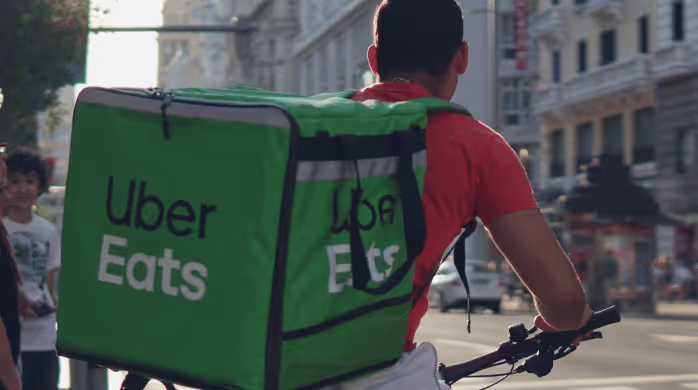
How to Make $1,000 a Week With Uber Eats in 2026 (Tips + Hourly Data)
In this blog, we'll explore the strategies and techniques that can show you how to earn $1000 per week as an Uber Eats delivery driver. We'll cover everything from optimizing your delivery zones and schedules to maximizing your tips and customer satisfaction. Whether you're a seasoned Uber Eats driver or just starting out, this guide will provide you with the insights and actionable steps to take your Uber Eats driver earnings to the next level.
Becoming an Uber Eats delivery partner can be a lucrative opportunity, especially if you're able to consistently earn $1000 a week. By understanding the platform, optimizing your delivery strategies, and focusing on customer satisfaction, you can maximize your earnings and turn Uber Eats into a reliable source of income.
We’ll cover the following topics to provide coaching and ideas to help you push your earnings up to that $1000 per week level:
What do Uber Eats drivers do?
Uber Eats drivers deliver prepared food most of the time, but they also might shop for and deliver goods from convenience outlets and grocery stores. The job is pretty simple. You get a request for an order, you drive to the restaurant or store to pick it up, and then you deliver it to the customer. If you already drive for Uber, you can choose to take orders for Uber Eats delivery any time.
If you’re not an Uber Eats driver yet, it’s pretty easy to become one. This Gridwise post tells you what you need to do if you want to sign up and start making money Uber Eats style. Many rideshare drivers welcome the chance to deliver food rather than people. This article from Nerdwallet covers the Uber Eats gig from that angle.
There are some sweet advantages to working with Uber Eats. In lots of cities you don’t even need to have a car. You can use a bike or a scooter, or even walk, to make your rounds. If you do use a car, Uber Eats’ requirements are a lot easier to meet than they are for Uber rideshare driving.
You also have a lot of flexibility. You can shop and deliver convenience items and groceries, but you don’t have to. And, like most driving gigs, you can choose your own hours, and map out the locations where you want to work.
Use Gridwise features When to Drive and Where to Drive to help you figure out what work hours and which specific areas will be the most profitable for you. Real data from real delivery people will show you earning patterns for drivers in your town.
How much can you earn doing Uber Eats?
The honest answer to this question is: basically, as much as you want! It all depends on how many hours you put in and how strategic you are about your gig. Earnings vary from one area to another, as this article from Entrepreneur points out. To give you a baseline, let’s look at the earnings of Uber Eats drivers who tracked their earnings with Gridwise.
Remember that these numbers show us only average earnings. To make $1,000 a week with Uber Eats, you’re going to have to be better than average, and we’ll show you how. For now, though, it’s good to have these figures so you get a ballpark number of where to start.
How much do Uber Eats drivers make?
Gridwise data tell us the following:
- Monthly earnings average around $444.00 per month.
- Gross earnings per trip are between $9.00 and $10.00.
- Tips make up about 50% of most Uber Eats drivers’ income, which amounts to about $225.00 per month.
Is Uber Eats good money? It can be. While there are other gigs that pay more per trip, if you drive for Uber Eats, you’ll always be pretty busy.
https://datawrapper.dwcdn.net/HPAz8/3
You can also see that, unlike many other gigs, tips play a huge role in Uber Eats earnings.

With these numbers as a baseline, what can we say about how to earn $1,000 a week with Uber Eats? As we said in the introduction, it’s going to be a hustle, but it’s really possible. To figure out how to make the most money with Uber Eats, let’s start by looking at how many trips these “average” drivers made each month.
We know that average gross earnings were $444.00 per month, and drivers got around $10.00 per trip. That means they took 44 or 45 trips per month, which breaks down to 11 trips per week. That’s not a lot of Uber Eats delivery, is it?
The fact that Uber Eats drivers averaged so few trips shows us that many drivers use more than one app at the same time. This is called multi-apping, and you can learn more about it in this Gridwise post. If you want to answer the question of how much you can make with Uber Eats, then you need to stick with the app and keep plugging away at those orders. You also need solid strategies, as well as some inside tips and tricks.
How to make the most money on Uber Eats: Delivery driving tactics
Getting to that $1,000 a week with Uber Eats isn’t so hard when you remember that the drivers we saw making about $111 a week were only taking around 11 trips in the same time period. That’s not much at all! If you work the Uber Eats app like a boss, you’ll soon have many more trips than that, easily reaching the number needed to get you to $1,000 a week. Now, let’s get to some tactics you’ll need to make that kind of bank.
- Stay with the Uber Eats app, and track your earnings. Gridwise can easily do that for you. Simply sync your Uber Eats app with Gridwise, and you’ll be able to see how much you’ve earned with Uber Eats, what times were most profitable, and your average hourly pay. Racking up trips with Uber Eats has other benefits, including perks and bonuses that are awarded to top drivers.
- Leverage surge pricing and promotions. Surge pricing is applied when there is a lot of demand. When surge pricing is in effect, many of the trips you make will pay more than usual. Promotions are offered to drivers who complete a given number of trips in a certain time period. High traffic volume days, nights, and times give you these chances to get extra earnings. Challenging yourself to complete the right number of trips for promotions will add to the number of trips you can count on for big bucks, too. Learn more about Uber Eats surge pay, boosts, and promotions in this Gridwise blog post.
- Say yes to doubling up on orders. With Uber Eats, you can get back-to-back orders or receive batched orders. Back-to-back orders happen when you receive a new request while you’re on the way to deliver an original order. The Uber Eats app routes these trips automatically, so you won’t be sent out of your way.
Batched orders are Uber Eats’ way of bundling together orders from either the same restaurant, or two nearby eating establishments. You get money, and trip count credit, for all the orders you complete, plus customer tips, without having to make a bunch of separate trips.
- Turn on the charm and get bigger tips. Being nice really is part of the Uber Eats driver’s job, and getting tips is one way people who drive for Uber Eats make money beyond their basic pay.. Bring along those extra napkins and condiments, use equipment that keeps food and drinks at the right temperatures and prevents spilling, and consider your customers’ needs. If you deliver groceries, be extra careful with delicate items such as bread and eggs.
And, most important, follow your customers’ directions, and stay in communication with them if you are going to be delayed, or if you have questions about their order. This Gridwise post will tell how to get bigger tips as a delivery driver.
- Use even more charm to keep your ratings high. As an Uber Eats driver, you will be rated by the restaurant or store where you pick up the orders as well as the customers who are waiting for the deliveries. This two-way rating system is designed to keep you on your toes, so Uber can keep people satisfied with your service. Don’t worry, you get to rate them, too.
There’s another reason why your rating as a driver is important. It not only keeps you in good standing with Uber; it helps you to qualify for the Uber Eats Pro incentive program. To learn more about Uber Eats Pro, and what it takes to earn perks such as preferred services, discounts, and deals, check out this Gridwise blog post.
Smart business moves that seal the deal
Now that you know how to gobble up the deliveries you need to make $1,000 a week with Uber Eats, it’s going to be a breeze to get there. Let’s make it even easier, with business moves that boost your earnings and shrink your expenses. If you use these, it will also be easy to say yes when people ask, “Can you make good money with Uber Eats?”
Minimize expenses. Avoid racking up big fast-food bills by bringing your own food and beverages. You might not think you’re hungry when you first start your Uber Eats run, but once the aroma of pepperoni pizza, premium cheeseburgers, and piping hot fries start wafting through your car, that might change. Bring a sandwich or other healthy food from home, and buy bottled water in bulk to save tons of cash compared to what it costs to buy single servings.
Maximize tax deductions. Another way to minimize your expenses is to maximize your tax deductions. Start by tracking mileage with Gridwise.
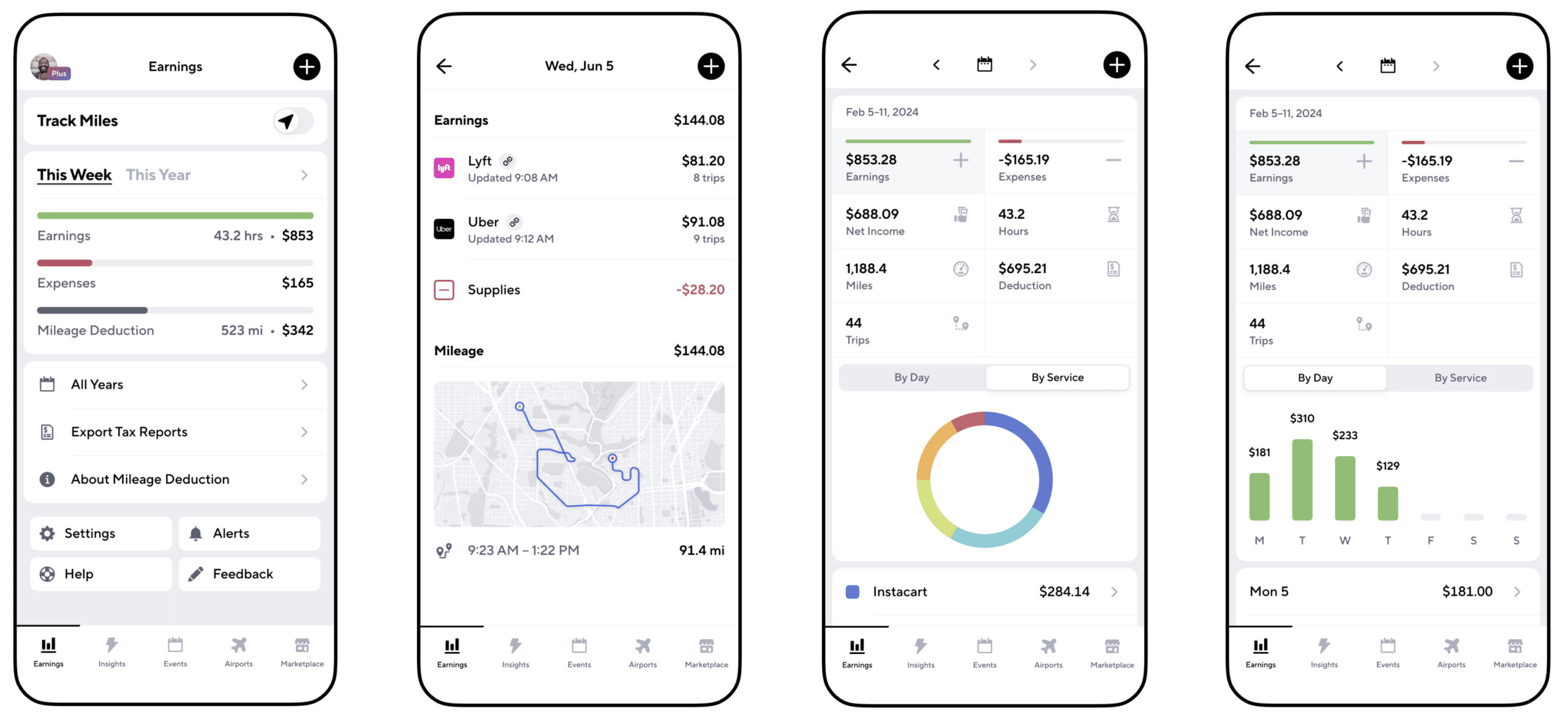
Gridwise App
Gridwise captures every deductible mile you drive, including the distance you cover between the trips your driving app records. Know what expenses you can deduct, and put them to work for you when tax time comes. Learn more about tax deduction strategies in the Gridwise Tax Guide for drivers.
Boost earnings with referrals
As an independent contractor, you’re probably looking for ways to make even more money than you can with Uber Eats. And most gig workers like you enjoy getting passive income. With Uber Eats, there’s a really easy way to do that, referrals!
All you need to do is find friends and encourage them to deliver for Uber Eats. If they make a certain number of deliveries within a specified time, you will get paid for doing nothing more than having them sign up under your referral code! Rates of pay vary by city, so check your Uber Eats app to find out what the current deal might be, and learn more about the referral program on the Uber Eats website.
Also remember: “friends” don’t have to be your best buds. Many delivery people carry cards with a QR code linking to their referral information, so just about anyone you encounter can join Uber Eats and boost your earnings. You could meet a source of passive income at the gas station, on social media, or at your high school reunion. The more you hustle, the more there is to gain, right?
Master the art of self-employment
As an Uber Eats driver, you’re an independent contractor. That means the company isn’t going to withhold your taxes, provide insurance, keep track of your earnings, or tell you about tax deductions. You’ll have to do all these things for yourself.
If you want to maximize your tax advantages, open an official business entity. You can incorporate (create a corporation) or you can work as a limited liability corporation (LLC). You can also work with a DBA (Doing Business As) arrangement, but the corporation or LLC will do a better job of protecting you from liability.
Establishing a corporation or LLC offers better tax advantages than being a sole proprietor. For instance, if you simply collect your earnings into your private account, you’ll be charged self-employment taxes in most states. And paying extra taxes is something we all want to avoid, within legal limits, as much as possible.
Every Uber Eats driver needs to learn about self-employment, and there are some great resources you can review. Check out the CareerOneStop website about self employment which will help explain the basics. You can also check with a professional tax accountant, or look other websites to learn more about actually creating a business.
Scope out your market
Look at the area around you to see where you’re likely to get the most deliveries. Where are all the restaurants? Where might people be more inclined to order deliveries? What hours do you want to drive? What activities might be going on around those times? Think about late-night and after-school times as well as breakfast, lunch, and dinner times.
Be realistic about the potential for your area and aware of new services opening up. For example, in New York, there is already a tab on the Uber Eats app that allows customers to order groceries. In our article about the best food delivery service to work for you’ll see that Uber Eats stacks up well against other delivery companies, mainly because of its potential for expanded opportunities for drivers to earn.
So, is Uber Eats good money? As we said, it isn’t an automatic guarantee that everyone will make $1,000 a week with Uber Eats. Trying out the suggestions we give you here, though, should put you on the right track! Go out there and start stacking up those orders and raking in some impressive earnings!
Get more inside information on Uber Eats in these posts from the Gridwise blog:
- The delivery driver guide: Using the Uber Eats app
- Everything you need to know about driving for Uber Eats
- Uber Eats Pro: What drivers need to know
- Looking for a different gig, part-time or full time job? Check out the Gridwise Job board.
Uber Eats FAQ
How does the Uber Eats platform work for drivers?
Uber Eats is a food delivery service that connects customers with local restaurants and independent delivery partners. As an Uber Eats driver, you'll receive notifications of nearby delivery requests, which you can accept and complete. The platform provides flexibility, allowing you to work on your own schedule and earn money based on the number of deliveries you complete.
What are the requirements to become an Uber Eats delivery partner?
To become an Uber Eats delivery partner, you'll need to meet certain requirements, such as having a valid driver's license, a registered vehicle, and passing a background check.
How can I choose the right delivery zone to maximize my earnings?
Selecting the right delivery zone can significantly impact your earnings, as some areas may have higher demand and better-paying orders. It's important to research and identify the zones in your area that tend to have the most consistent and lucrative delivery opportunities.
How can I take advantage of peak delivery hours and surge pricing?
Understanding peak delivery hours, such as mealtimes and weekends, and taking advantage of surge pricing can boost your earnings. Be aware of when demand is highest in your area and adjust your schedule accordingly to capitalize on these peak periods.
What are some tips for maximizing tips and customer satisfaction?
Providing excellent customer service and going the extra mile to ensure a positive experience can lead to more tips and repeat business. Prioritize communication, timeliness, and attention to detail to keep your customers happy and satisfied.
How can I set realistic weekly goals to reach my $1000 target?
To make $1000 a week with Uber Eats, it's essential to set realistic weekly goals and track your earnings and expenses. Start by determining your target earnings and breaking it down into achievable daily or weekly goals. This will help you stay on track and make adjustments as needed.
What are some strategies for efficient route planning and navigation?
Effective route planning and navigation can save you time and fuel, allowing you to complete more deliveries. Utilize mapping apps and take advantage of features like real-time traffic updates and turn-by-turn directions to find the quickest routes.
How can I balance my Uber Eats deliveries with other commitments?
Develop a schedule that allows you to capitalize on peak delivery hours while still maintaining a healthy work-life balance. Consider using tools like calendar apps to plan your availability and track your hours to ensure you're maximizing your earning potential without sacrificing your personal life.
What are the key considerations for maintaining my vehicle as an Uber Eats driver?
Keeping your car clean and well-maintained is crucial for maximizing your Uber Eats earnings. Regularly scheduled oil changes, tire rotations, and other preventive maintenance can help extend the life of your vehicle and minimize downtime. Additionally, budgeting for vehicle-related expenses, such as fuel, insurance, and repairs, will ensure you're accounting for these costs and maximizing your net earnings.
What are the tax obligations and legal considerations for Uber Eats drivers?
As an Uber Eats delivery driver, it's essential to understand the tax obligations and legal considerations that come with being an independent contractor. This includes properly reporting your earnings, deducting eligible business expenses, and making quarterly estimated tax payments. Additionally, you'll need to ensure you have the appropriate insurance coverage, such as personal auto insurance and possibly commercial auto insurance, to protect yourself and your vehicle while on the road making deliveries.

The Gridwise Job Board: Find Your Ideal Job or Gig Work
Gridwise is an essential assistant app created by gig workers for gig workers. Our mission is to support those engaged in gig work in every way possible. We understand how challenging it can be to deal with income instability, a lack of benefits, and job insecurity that often comes with gig work. The Gridwise app tracks and organizes earnings and expenses, and offers a wide array of discounts, deals, and services that make the lives of independent contractors easier and more rewarding.
We firmly believe it’s possible to make a viable living and create a gig experience that offers flexible hours, variety, and excitement. With issues such as consistent earnings and job security in mind, Gridwise is proud to offer a centralized platform that shows you how to find gig work and secure reliable opportunities. We’re proud to introduce the Gridwise Job Board.
The Gridwise Job Board: Key features
Because Gridwise is dedicated to serving the gig worker community, we’ve filled the Gridwise Job Board with useful features that won’t waste your precious time.
- Comprehensive listings. Find part-time, full-time, temporary, and per-task work. Drive or deliver with your vehicle, utilize an employer’s vehicle, or even find non-driving gig work.
- User-friendly interface. Find the jobs that are right for you with a tap of your screen.
- Verified opportunities. We vet the jobs before they are listed to ensure you’re getting high-quality job postings.
How to get more gig work, seasonal, part-time or full-time jobs with the Gridwise Job Board
Looking specifically for “gig work apps” or “gig jobs near me?” You’re in luck. Our filters and search functions send you directly to the listings you seek.
Here’s how it works.
- Access the Job Board via the Gridwise website.
- Search for jobs by type, location, and more.
- Select the job that interests you, and read all about it.
- Scroll through the description, and if it appeals to you, click “Apply for job.”
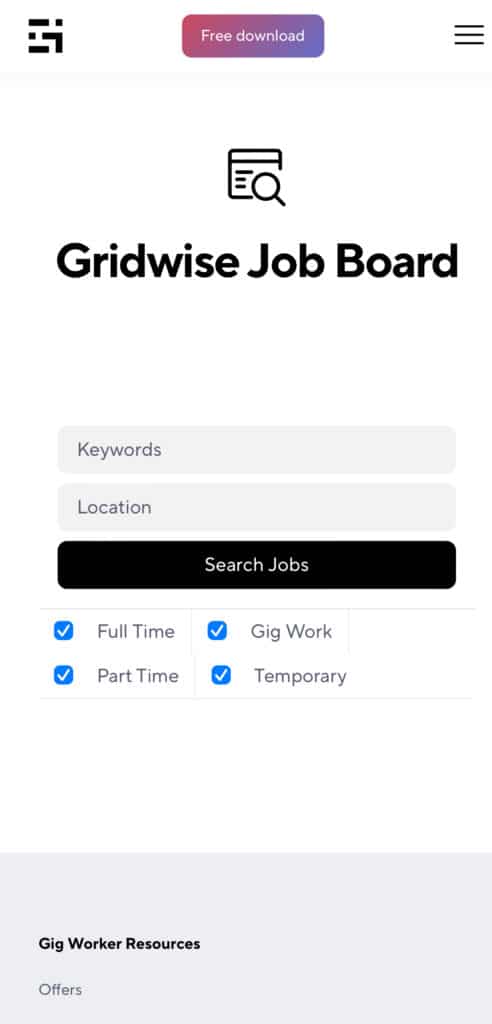
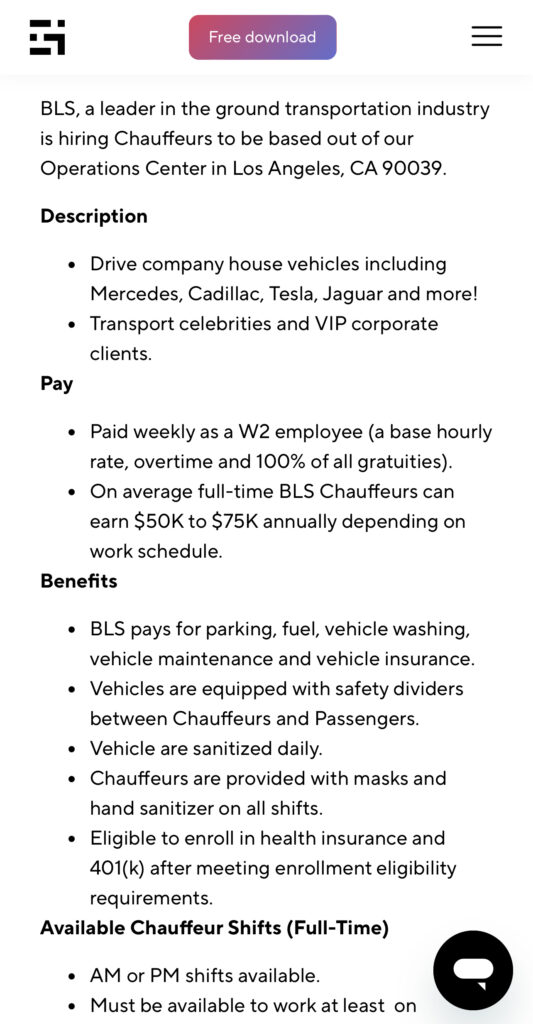
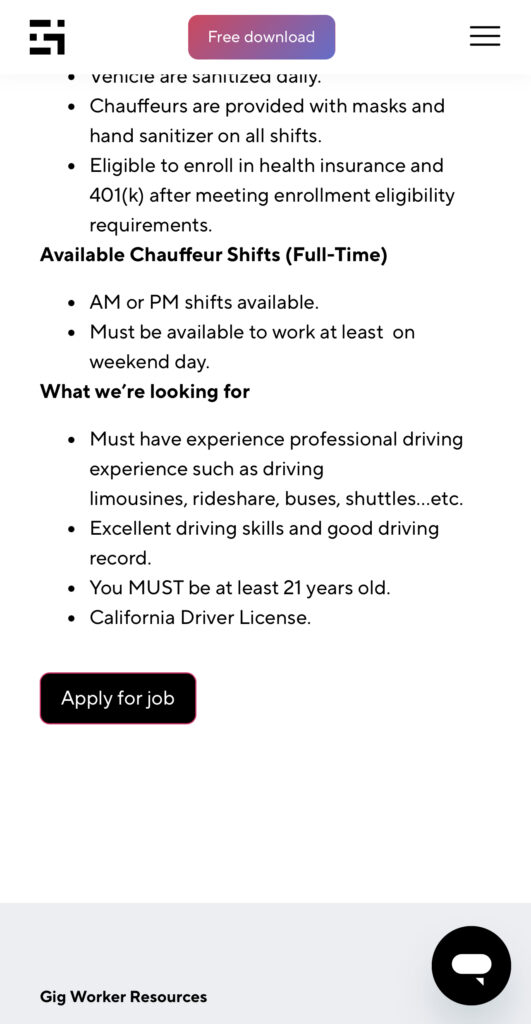
Many types of jobs are available. Adjust the search filter to see the full variety of opportunities that will let you cash in. Deliver food, set up catering, do rideshare driving, get paid for doing package delivery, and much more. You’ll find short-term gigs, long-term contracts, and part-time positions.
Perks of the Gridwise Job Board for gig workers
Gig workers who know how to make extra money will appreciate how the Gridwise Job Board lets you multiply your chances of bringing in big earnings. Here’s how:
- Increased stability. Use the Gridwise Job Board to find part-time or permanent jobs in addition to the part-time gigs you already have. Always keep a steady stream of earning opportunities flowing toward you.
- Flexibility and autonomy. Choose jobs that fit your schedule, work around other jobs and family duties, and still leave room for some fun in your life. Discover side hustles to supplement your full-time job, permanently or just for the season.
- Skill development. Find part-time work that lets you use a skill you already have, or try your hand at something new. It’s a smart way to develop a portfolio to showcase what you can do, or even to find permanent employment.
Get Gridwise and stay up to date on the Gridwise Job Board
Gig workers need plenty of information and assistance, and Gridwise is here to give it to you. Download the app and get essential features such as
- seamless earnings tracking
- mileage tracking
- expense recording, including notes
- low-cost and no-cost insurance benefits
- access to affordable medical, dental, vision, mental health, and alternative care
- professional services including legal and financial help
- deals and discounts
- weather, events, and traffic reports
- inside information on where and when to drive
More to know about gig work:

5 Best Mileage Trackers For Gig Drivers
Many drivers ask, “Do I really need a mileage tracking app?” The answer is simple: only if you want to have an accurate count of all the miles you can legally deduct from your taxable income! You might think your rideshare or delivery driving app has got you covered. After all, they do quite a good job of logging the miles you drive while you’re on a trip or delivery. But, if you want to have the best app to track mileage for Uber, Lyft, Doordash, Instacart, or the other apps you may use, you need more. Why is that?
Without a separate tracker, you’re missing the miles you drive in between pings. Did you realize that all the miles you drive, from the moment you begin your shift until it’s over (as long as you don’t drive several miles on a break to hang with your friends), are tax deductible! That means you need something besides your driving app to keep an accurate count of your travels. Read this Gridwise post to see how important it is to keep track of every deductible mile.
You won’t be surprised to hear that there’s an app for tracking miles. In fact, there are several of them. Here, we’re going to tell you about five top mileage tracking apps, and help you figure out which one is best for you.
Before we get to the list and identify the best mileage tracker app, let’s clarify what exactly a mileage tracking app is. According to G2.com’s technology glossary, mileage tracking is done for the purpose of keeping a log of mileage that is either reimbursable or tax deductible.
And yes, of course you can track your miles simply by taking readings on your odometer. But are you really prepared to account for how many miles you drove for personal reasons and subtract them from the total to get your business mileage? Even if you can remember all that and do the arithmetic, if you want an accurate reading of the miles you drive for business, and can therefore deduct, a mileage tracking app will save you a lot of trouble and prevent you from making costly errors.
Plus, as a gig driver, you have specific needs when it comes to a mileage tracker. Ideally, you’d be able to handle mileage tracking and several other functions all in one app. It can be maddening enough to deal with driving apps, particularly if you’re an avid multi-apper. You would want your mileage tracker app to help you keep account of other aspects of your business, including income, expenses, and inside information about the art of gig driving.
Not all mileage apps are equal, to be sure! Let’s look at five of the best apps to track mileage and figure out which is the best app to track mileage with Uber and Lyft, or what mileage tracker app is best for DoorDash.
1. Zoho Expense
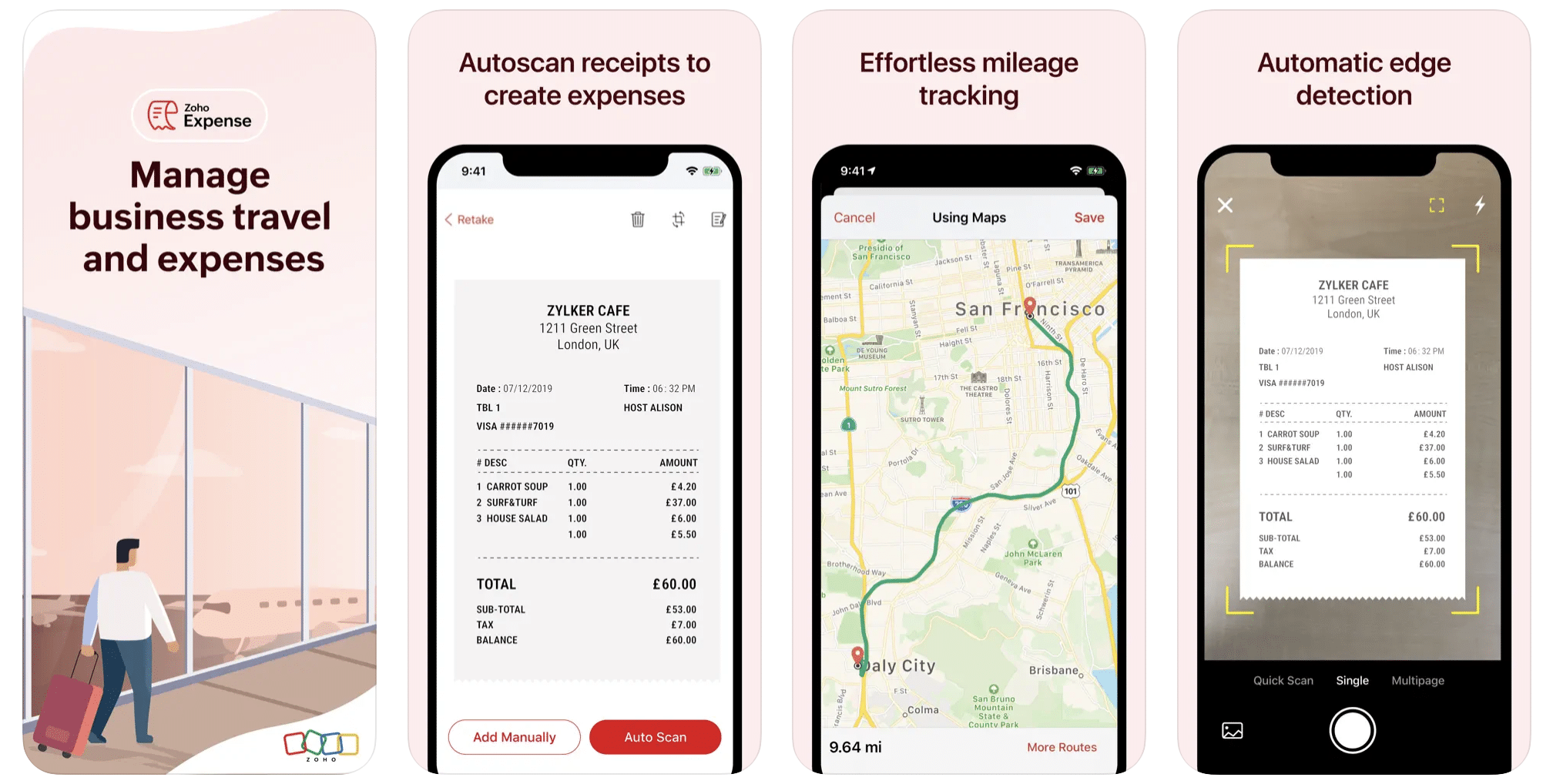
First up is Zoho Expense, which does exactly what its name says. This app is designed to allow companies to give employees a uniform way to create and submit expense reports. It can be used by individuals, including gig drivers, as well.
It includes a mileage tracker, as well as features that let you track other deductible expenses, including the ability to scan and record receipts.
Available on Android and Apple: Yes
Ratings: 4.8 stars on App Store, 4.7 stars on Google Play
Free Version: Yes
Subscription price: $3 per month, billed annually
Created specifically for gig drivers: No
2. Quickbooks Online
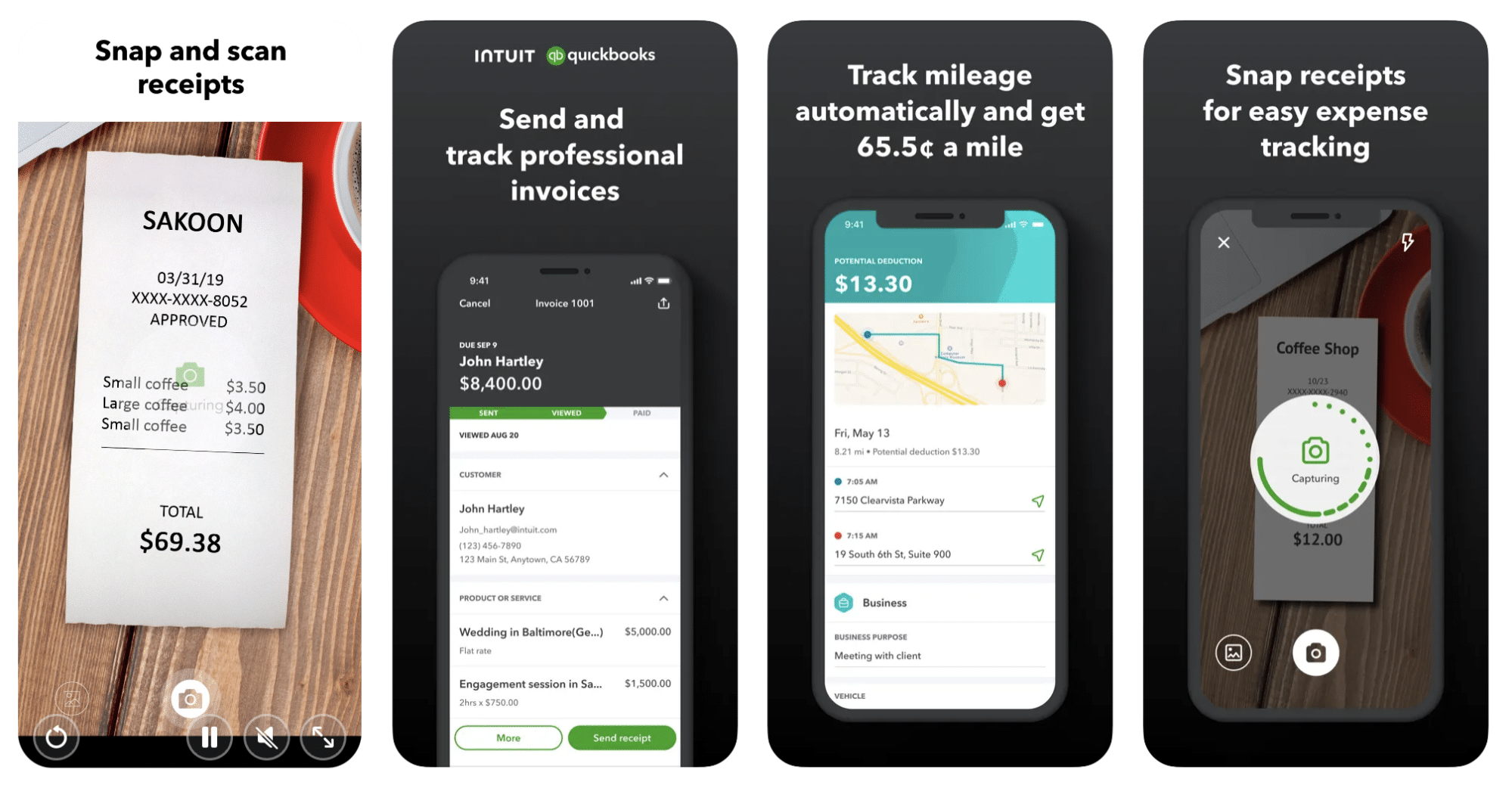
Quickbooks Online is a cloud-based app that allows you to track your mileage, earnings, and expenses. The information you enter can then be used to generate various reports that prepare you for tax time. It also allows you to create graphs that illustrate your cash flow, and includes a receipt scanner so you can instantly record deductible expenses. Quickbooks is popular, highly reliable, and designed mainly to help people keep track of their small businesses.
Available on Android and Apple: Yes
Ratings: 4.7 stars on App Store, 4.4 stars on Google Play
Free version: 30-day free trial
Subscription price: $15 per month for basic version if purchased for 3 months or more
Created specifically for gig drivers: No
Source: quickbooks.intuit.com
3. Shoeboxed
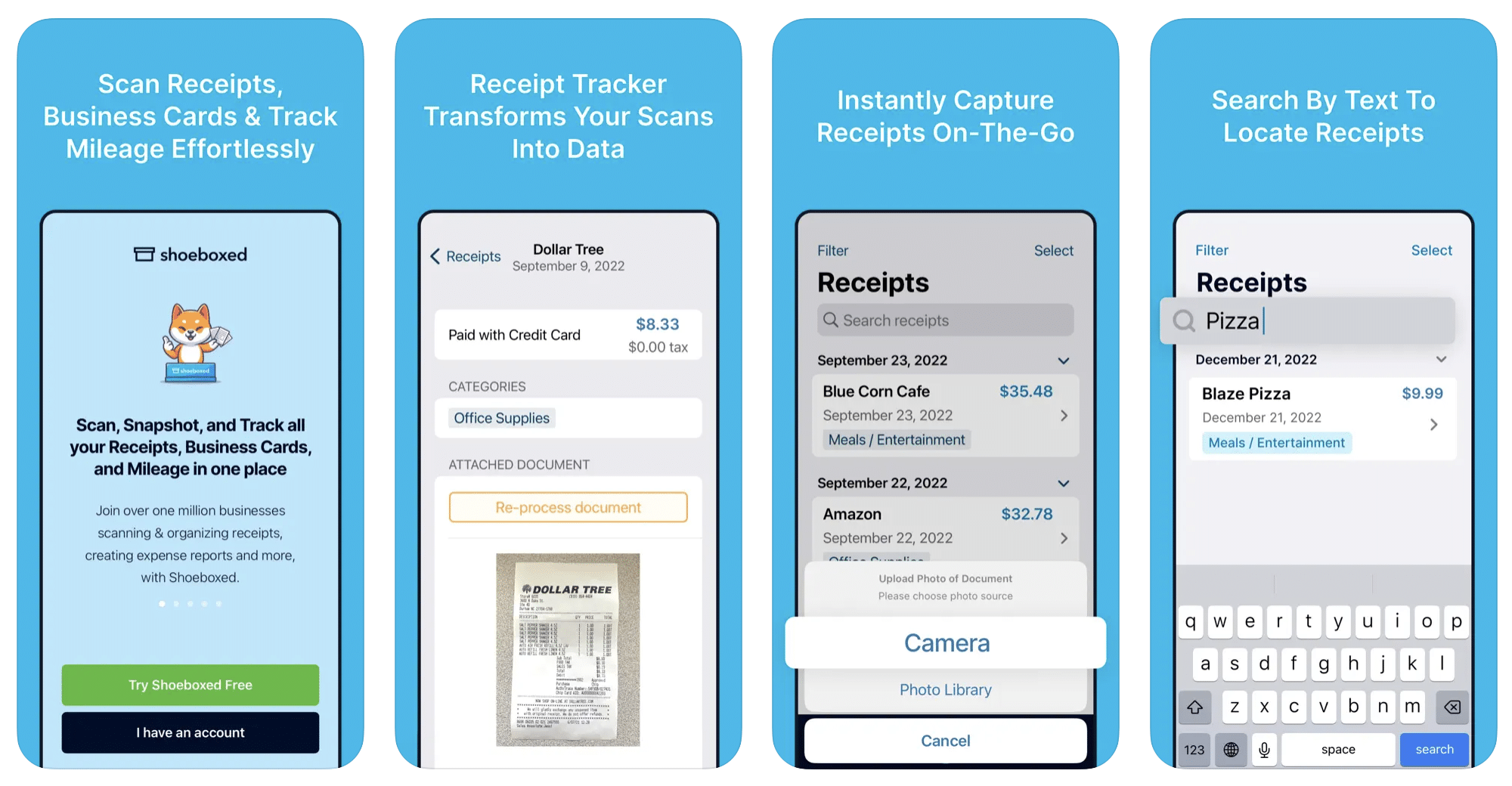
Shoeboxed started in 2007 as a service for scanning paper receipts into digital form. Now the app offers a free mileage tracker and has enabled users to scan receipts directly. It touts itself as the best mileage tracking app for DoorDash, but there are some elements missing that Dashers might like to have. While it provides features that record your expenses and prepare you for tax season, it doesn’t automatically track your earnings. The mileage tracker has a system where you can drop pins along your routes to make the tracking more precise, identifying those legs of a trip that you make for business purposes. The mileage tracker is “free” once you sign up for the basic version.
Available on Android and Apple: Yes
Ratings: 4.5 stars on App Store, 2.3 stars on Google Play
Free version: No
Subscription price: $18 per month for basic version
Created specifically for gig drivers: No
Source: blog.shoeboxed.com
4. Stride
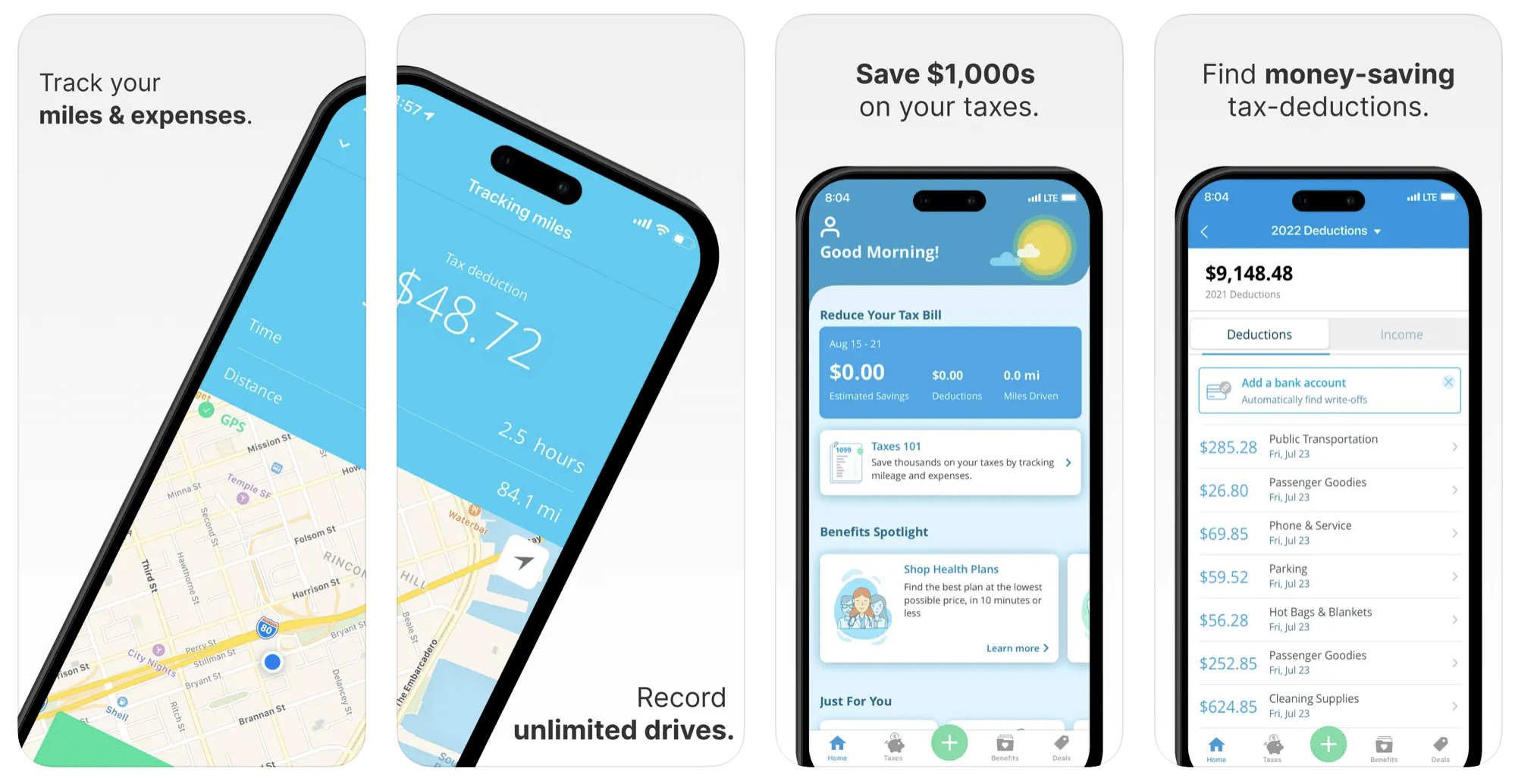
This free mileage tracker does a fair job of keeping track of the distances you rack up while gig driving, but it doesn’t automatically track earnings. It can be a big help, though, in tracking your expenses. You can link Stride to your bank account, and it will automatically scan your expenses to identify items you can potentially deduct. The app is totally free. This could make it the best free mileage tracker app, but there is a small price to pay. The app will persistently push you to consider various insurance plans that they are affiliated with. If you don’t mind that, this is a solid mileage tracker, even if it doesn’t track your earnings.
Available on Android and Apple: Yes
Ratings: 4.8 stars on App Store, 4.6 stars on Google Play
Free version: Yes
Subscription price: None. The app is free.
Created specifically for gig drivers: No
5. Gridwise
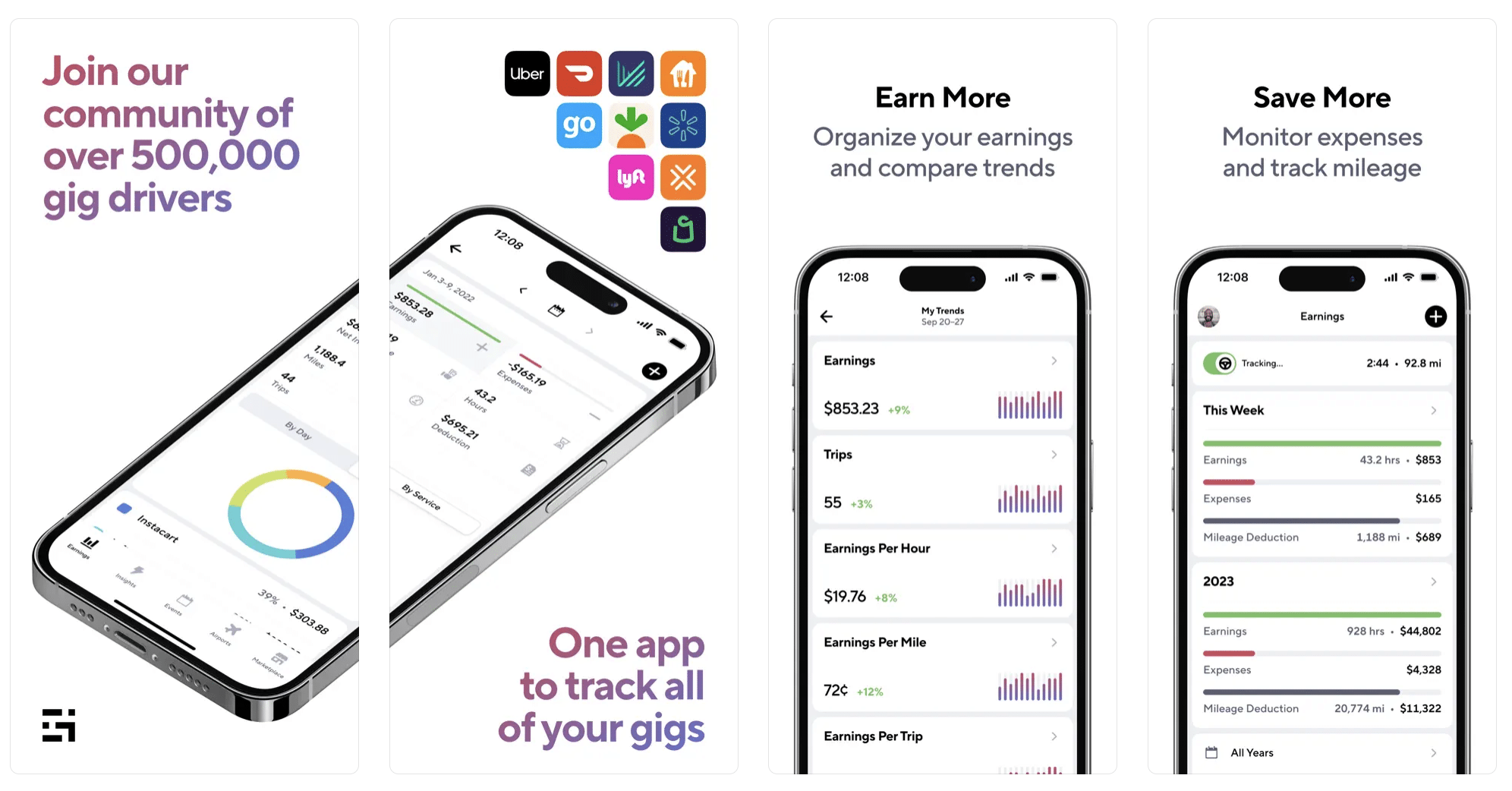
Gridwise has a free mileage tracker and free features that record your income and expenses. It gives you access to insurance and benefits, as well as insights about the best times and places to make the most money while gig driving. The Gridwise mileage tracker captures all the miles you drive while you’re on your driving shift, and it can be used if you have other trips you need to make which qualify as business travel.
Drivers love it because it is geared toward the needs of rideshare and delivery workers, providing free information about airport departures and arrivals, event start and let out times, weather, traffic, and more. The Gridwise Plus subscription adds value by providing additional insights and reports, discounts on benefits, the ability to export data in .csv format,, and more.
Available on Android and Apple: Yes
Ratings: 4.9 stars on App Store, 4.6 stars on Google Play
Free version: Yes
Subscription price: $9.95 per month for Gridwise Plus, or $95.99 per year (a $23.41 savings)
Created specifically for gig drivers: Yes!
What is the best mileage tracking app?
Now that we’ve checked them all out, we’re positive about the answer to that. Hands down, it’s Gridwise. Are we biased? You bet we are! But drivers love it too. Gridwise is the best mileage tracker app, and so much more. So many of the features are free, and the subscription to Gridwise Plus will pay for itself with additional insights to boost your earnings and deeper discounts on products and services.
Most important, Gridwise is designed specifically for gig drivers by experts who were once gig drivers themselves! Knowing what gig drivers need is a crucial step in creating an app that rideshare and delivery drivers can really use! Here are a few of the features, besides mileage tracking:
- seamless earnings tracking
- automatic, on/off toggle and manual mileage tracking
- mileage categorization
- airport, traffic, weather, and events information
- insights into where to drive and when to drive
- reports showing earnings across the platforms you use
- discounts on countless products and services for drivers
- additional resources for finding side gigs
- an informative and comprehensive blog
- affordable benefits, including insurance, medical, dental, and alternative practitioner discounts
- a community of drivers just like you
Don’t settle for just any app. Get the best mileage tracker, and so much more, from Gridwise!
How to Protect Yourself as a Rideshare Driver
Worldwide, Uber drivers completed an incredible 4.98 billion trips in 2020, according to a report by the website BusinessofApps.com. Thanks to the pandemic, those numbers were down from the 6.9 billion trips in 2019. Lyft, which only operates in the U.S. and Canada, did not come close to those heady numbers, but it still ranked in the millions.
That’s incredible. Each day millions of people, transported by hundreds of thousands of drivers, get safely from one location to another.
The reality is the number of assaults against drivers is very small. According to a 2019 Uber report, well more than 99.9% of trips are completed without a safety incident. Lyft’s numbers are very similar.
But if you’re a rideshare driver who has been assaulted, that doesn’t matter. The only thing that matters is that you’ve been assaulted, and it does happen. There are things you can do, however, to protect yourself, and in many cases recognize and avoid this danger.
Questions we’re answering about rideshare driver safety
The reality is that drivers get assaulted every day, but there are things you can do to prevent assaults or defend yourself if you are assaulted.
The questions we are answering in this blog post include
- Is it safe to be an Uber or Lyft driver in 2022?
- What are rideshare drivers experiencing in 2022?
- Should rideshare drivers carry weapons?
- What can rideshare drivers legally do to stay safe?
- Uber and Lyft: What are they doing for driver safety?
- What do you do if you are assaulted?
An assault—or just a rude passenger?
There is a question we should address at the beginning of this discussion. What is an assault versus who is a passenger you just don’t like?
The reality is that you’re likely to encounter passengers you don’t particularly like every time you drive. They are rude. They micromanage your choice of routes. They don’t like your music. They lecture you on their view of the world, including whether major league baseball’s designated hitter rule is a good thing.
These are not problem passengers and are not likely to assault you. They are not the passengers you should be taking self-defense measures against.
THESE are the problem passengers
The reality is that Uber and Lyft driver safety is a problem, although it is not an epidemic. Compared to the number of rides the two services handle each day, the number of assaults is low.
Still, there are incidents of violence against drivers, even recent ones:
- In late April, The Philadelphia Inquirer reported that a rideshare driver was shot in the back and left arm, causing him to crash his car into a pole. Paramedics found the 50-year-old driver on the street and rushed him to the hospital, where he was listed in critical but stable condition.
- In February of this year, the Kansas City Star reported that a female passenger attacked a Lyft driver in St. Louis after she threw his phone out of the car. During the ensuing struggle, she bit off a portion of his ear. The driver got out of the car, and the woman took his place behind the wheel and drove off. Police later found the car involved in a traffic accident. The woman, of course, fled the scene.
- Fox 5 Atlanta reported that two women with a gun carjacked a five-year veteran of Uber in Norcross, GA, this past November. The driver was uninjured. She still had the ignition key in her pocket and activated the automatic shut-off feature. Police recovered her car not far away when it stopped running.
The question of whether to carry a weapon
Lyft has a policy of forbidding any type of weapon, including “stun guns, explosives, knives, slingshots, and tasers.” Uber’s safety policy only talks about firearms, not mentioning any of the items that Lyft prohibits: “Uber prohibits riders and their guests, as well as driver and delivery partners, from carrying firearms of any kind while using the app, to the extent permitted by applicable law.”
Both rideshare services have banned drivers from the app for incidents in which they had a gun while driving. There are legal services specializing in defense of rideshare drivers. They will defend you and work to get you reinstated. Whether the rideshare services can actually prohibit drivers from carrying weapons is a thorny issue. Opponents maintain that the companies are infringing on drivers’ 2nd Amendment rights. There has been at least one driver lawsuit, as reported in a previous blog post on Gridwise.
However, it is important that if you do choose to carry a weapon, you are trained in how to use it. Firearms are dangerous, and there is always the danger that you could be disarmed and have that gun used against you.
Drivers can still protect themselves
Still, drivers have ways and techniques to protect themselves while transporting passengers. Some of them are surprisingly simple.
“I have a philosophy,” said one rideshare driver. “For me, it all comes down to attitude and expectations. If you expect the best out of people, you are apt to get the best out of people. If you expect the worst out of people, you will probably get the worst out of people. I tell my passengers this all the time.”
What that driver is talking about is control of your car. You are sharing your car, as many rideshare drivers do, even if you are renting. Act as if it is your car. Control the environment. Play your music. Talk it up with drivers. Be likable. If the ne’er-do-well is contemplating misbehavior, the fact that you are a nice person might make them think twice. Do you have a family? Put a picture of them on your dashboard, anything to make an attacker reconsider.
There are also more specific things you can do to ensure your safety in case of an attack.
Be mentally prepared to give up your car
This is a decision you should make beforehand. Your life is more important than your car. In case of an attack, your priority should be to get out of the car and get away. You can get another car. You have only one life.
Seatbelts
Ask passengers to wear their seatbelts. This is standard safety practice, and it also gives you a heads-up. If you hear the seatbelt unlock in the middle of a ride, something might be up.
Carry a small metal flashlight
You can get one at one of the big-box hardware stores for less than $15. It should be six to eight inches long so that it protrudes from either end of your closed fist. Keep it within arm’s reach. If someone grabs you from behind or from the side, smash it against their hand or even their face. Your justification for carrying it: you need to read addresses for late-night residential pick-ups.
Carry a steel-barrelled ball-point pen
This can function similarly to a flashlight. If someone tries to grab you from behind, jam it into their hand or arm. Ladies, you can go one step further and carry a nail file. Either way, you have a justifiable reason for having these items.
Perfume instead of mace
This one is not just for the ladies, either. Male drivers can maintain that a lady passenger left it. Either way, you have a justifiable reason for carrying it. According to the Fragrances Lover website, perfume has several vision-threatening types of chemicals. Blinding someone is not your goal, though. You just want to make their life miserable enough that you can escape.
In-car cameras
In-car cameras not only protect you from false allegations, but they ward off would-be thieves and bad guys. Discourage someone from simply taking the camera by posting a sign in your car that says the camera uploads the digital footage to the cloud, even if it doesn’t.
Self-defense techniques
You don’t need a second-degree black belt in martial arts to know some basic defense maneuvers. Here are a few common ones.
- Recline your seat
If someone grabs you from behind and you can’t break their hold, reach down and recline your seat. This move takes away their angle of advantage. Be aware, though, that this allows them to strike you in the face easier, but you just need enough time to twist out of their grip and run away.
- Know the helmet guard move
As a rideshare driver, most striking attacks come from your right side, the side where there is enough open space to maneuver. Learn the helmet guard. Reach up and grab the back of your head with your right arm and press your elbow tightly against your head and face. This gives you protection from injury while you reach with your other hand to open the door and get out.
- Focus on vision and breath
An attacker needs two things: they need to see and they need to breathe. Gouge or slash at the eyes with fingers stretched out and apart, temporarily blinding them. A solid punch in the nose will make your eyes water. Professional tip: Punching with a closed fist will get you a broken knuckle if you don’t know what you're doing. Better to use an open palm. It often does more damage, too.
As for breathing, a punch to the throat leaves most people unable to breathe, allowing you to escape.
Practice your rideshare driver safety
Don’t wait for an attack to use these techniques. Practice them every day before you start driving. It only takes a few minutes. Drill yourself on reclining your seat and undoing your seatbelt simultaneously. Be able to reach the inside door handle with your eyes closed. These reactions should be spontaneous and instinctive.
Also, remember that you have the right as a rideshare driver to refuse a ride. If you see the passenger from a distance and they are visibly drunk, agitated, or otherwise suspicious, drive right past and cancel the ride.
Pay attention to passenger ratings, too. If a passenger has a low rating, there is a reason. You don’t need to find out why.
Consider carrying a limited amount of cash when you drive. You might also think about not carrying ATM cards or maintaining large balances on your apps such as PayPal, CashApp, and others. Many thieves like to drain the apps while holding you at gunpoint or make you withdraw money from your ATM.
How have Uber and Lyft handled the issue of assaults against drivers?
As reported by The Verge and many other sources, Uber’s previously mentioned study, released in 2019, documented 3,045 sexual attacks in 2018 (235 of them were rapes, according to Uber. The others were groping, unwanted kissing, etc.). During this time Uber drivers delivered an average of 3.1 million rides per day.
Lyft issued its report in 2021, also reported by The Verge. Lyft released it a full two years after they promised it would come out. The company reported 1,807 sexual assaults in 2019, but they failed to differentiate between assaults on drivers or passengers and gave no reason why. They also did not disclose how many total rides were considered in the study.
When it comes to assaults on drivers, both companies have skin in the game. They don’t want to see anything that discourages individuals from signing up to be drivers. Drivers on the app are part of the formula of how Uber and Lyft earn their revenue.
Assaults of drivers are also widely publicized, too, thanks to in-car videos posted on YouTube and replayed by the broadcast media.
Recent driver safety measures from both Lyft and Uber
To their credit, both rideshare services have enacted safety measures in the last few years. Both apps now have a panic button. TechCrunch reported on Uber’s launch of an audio documentation feature on their app in December 2021. It debuted in three markets: Raleigh, NC, Kansas City, MO, and Louisville, KY. Uber is also monitoring individual rides for unexpected route changes or stops and contacting drivers when they are detected. Both measures are app-based.
In July 2021, Lyft released its own safety measures in partnership with ADT. Drivers confronted with a situation can contact ADT surreptitiously. If the situation warrants, ADT will alert the police. You can now program the Lyft app to allow a friend or family member to monitor your location. Lyft is also using tracking features similar to Uber, again monitoring unexpected route changes or prolonged stops.
What should you do if you're attacked during your driving shift?
If you are attacked in your role as a rideshare driver, the first thing you need to do is care for your own safety. Report it to 911. Too many attackers return, confident in the knowledge that they got away with it the first time.
Remember the recommendation about choosing your life over your car? We mean it. You can replace the car, but you can’t replace your life, and your family will not be able to replicate you, either.
Contact driver support for your respective rideshare service. You can either do this through the app or call their service number. Make sure they know an attack happened.
Lastly, know that you can also take advantage of a number of legal aid services available to rideshare and other gig drivers. There have been anecdotal reports, more than a few, of rideshare services not giving attacks serious attention. A quick Google search will result in the names of a number of law firms specializing in rideshare driver advocacy. Some of them advertise no up-front fees.
Don’t forget Gridwise
Gridwise is another partner you can use while driving. In addition to offering free mileage and earning tracking, Gridwise will be launching a partnership with LegalRideshare, the only legal firm that advocates for gig drivers. Soon you'll be able to contact LegalRideshare directly from the Gridwise app to receive legal assistance if you've been attacked or been in an accident. Make sure you've downloaded the free Gridwise app to track your miles and earnings, and get updated when the partnership launches.
Stay safe out there!
How To Earn More As a Rideshare Driver
“If Lyft and Uber ever realize how much fun I have out here, I’ll have to pay them.”
Those are the sentiments of at least one rideshare driver, and we hear comments like this whenever we talk to drivers.
There are few jobs that can offer you the flexibility of being a rideshare driver. You make your own hours and work when you want, and you can tailor the job to your working style.
Better than that, though, there are few jobs where you have as much fun. Every night you meet new people. If you drive a full eight-hour shift, that could be as many as 20 or 30 new acquaintances. At least once a week a passenger’s destination takes you to someplace you never even knew existed in a community where you’ve lived for decades, maybe even your entire life.
You have no boss leaning over your shoulder. No one is micromanaging your every move. And if you work a strategy and use the tools available to you, including the Gridwise app, you can make a decent living.
Challenges exist for rideshare drivers
Let’s be honest though. This post-pandemic world holds challenges for rideshare drivers. Fuel prices are as high as we’ve ever seen them. Inflation is also ravaging the money you bring in. There are more reports of unruly passengers. It is getting more and more difficult to make money as a rideshare driver. We all know the challenges. We also know some of the solutions.
Questions we’re answering in this blog post
Read on to discover answers to the most commonly asked questions by rideshare drivers, both veterans and those who are just starting. We will answer:
- How much are rideshare drivers making in 2022?
- How much do rideshare drivers make per hour? What about tips? Trip earnings? Median monthly pay?
- Uber vs. Lyft. Which one pays more?
- What should I know about rideshare if I’m new to the job?
- What can experienced rideshare drivers do to earn more?
- How can drivers increase tips?
- What are the best tools rideshare drivers can use on the job?
Uber vs. Lyft: How much are rideshare drivers making in 2022?
Drivers for Uber and Lyft realized comparable earnings in the first quarter of 2022, with Uber mostly in the lead, sometimes by pennies.
Gross earnings per hour
The days surrounding Christmas and New Years are bountiful, with lots of people shopping and many more going to or coming from the airport. By the first week of January, though, everyone is back to work and school and settling back into a routine. Business drops, especially depending on what kind of driver you are. The nightlife business will be down a little, enough to notice a difference. The relative quietness of January resulted in Uber drivers averaging $19.47 per hour and Lyft drivers $19.33 per hour. By February, hourly earnings bumped up noticeably, with Lyft drivers making $22.32 per hour and Uber drivers bringing home $22.10 per hour.
In March, Uber returned drivers averaged a healthy $24.57 per hour. Lyft was not far behind with their drivers averaging $24.27 per hour.
Gross earnings per trip
In January, Uber drivers averaged gross earnings of $12.53 per ride. Lyft drivers followed at $11.79 gross earnings per ride.
In February, Uber driver earnings went up almost 80 cents an hour, to $13.32 gross earnings per trip. Lyft was not far behind, though, at $13.08 an hour.
With March came a big increase for Uber drivers. Gross earnings per trip shot up more than two dollars an hour to $15.42. Lyft driver earnings went up, too, to $14.24 per hour.
Tip earnings
Tips edged up over the course of Q1 2022. Uber drivers averaged $3.83 in tips per trip in January, with Lyft drivers bringing in $3.24 in tips per trip.
By February, Uber drivers brought in an average of $4.00 in tips per trip. Although still behind Uber, Lyft saw a bigger boost, up to $3.59 per hour.
In March, Uber inched up to $4.10 in tips per trip. Once again, Lyft also realized a good increase to $3.80 per hour.
Median monthly earnings
Uber driver monthly pay came out to $348.22 during the first three months of 2022. Lyft's monthly driver pay was not too far behind at $329.24.
By February, Uber drivers increased their median monthly earnings to $463.71. Lyft was also up more than $100.00, to $442.49.
March saw another healthy increase, although not as good as February. Even so, the numbers were robust. Lyft and Uber monthly driver pay was almost the same, with a difference of mere pennies. Lyft drivers brought in a median monthly income of $537.94. Uber drivers were right behind at $537.29.
Biggest factors eating into Uber and Lyft driver pay
Fuel Costs
Astronomical fuel prices, in some regions of the country, are eating into the profits of rideshare drivers. The AAA website reported that by late April the average cost of a gallon of gas was $4.134. Some of the biggest rideshare markets paid even more. Rideshare drivers in New York saw prices as high as $4.242 per gallon. Their colleagues in California paid $5.680 a gallon at the pumps.
In mid-March, Uber announced a surcharge of 45 cents to 55 cents per trip, as reported by numerous media sources and a release from Uber on their website. The rideshare company said they would pass 100% of those surcharges on to the driver. The surcharges should last for at least 60 days, after which they will be re-evaluated.
Lyft followed its competitor, announcing that it would add a 55-cent surcharge to each ride, with all the money also going to the drivers. Lyft also announced that drivers can apply for a Lyft Direct debit card that will save drivers another 4% to 5% on fuel purchases through June 30, 2022.
Many drivers are also turning to Gridwise to help them offset fuel prices. Gridwise Gas is a great way to save a chunk of your earnings that are now going to fuel. The sign-up is free and you get immediate access to discounts at the more than 95% of service stations accepting the Gridwise Gas Card.
Maintenance
Keeping your car running and in top working order is important for rideshare drivers. No one wants a car breakdown on the road, and there is nothing worse than having a breakdown with a passenger in the car.
When it comes to paying for oil changes, you will pay top dollar for maintenance at dealerships, as opposed to independent service shops. Another trick is to ask about tire rotation the next time you purchase new tires. With most tire stores it is part of the package, and it is free.
Gridwise is also helping drivers with maintenance costs. Gridwise + CarAdvise offers drivers an opportunity to check out different auto shops, talk with experts, compare prices, and even schedule their car’s service appointment online. Drivers report huge discounts, as much as 40%, on maintenance and repair services.
Cell Service
Cell service is a chunk of the monthly expense of being a rideshare driver, but there is good news. According to CNN Business, cell phone charges are not expected to rise appreciably in the near future. The three big carriers, Verizon, AT&T, and T-Mobile, are in intense competition, and price cuts are their main weapon.
You can use this competition between the cell carriers as a bargaining chip to reduce the amount you pay. The prospect of losing you to the competition is enough to get most carriers to grant concessions or outright lower your bill. If you are 55 or older, also ask about senior citizen discounts. Call up your cell carrier’s customer service department and ask them to review your plan and see if there are any discounts available. One driver with a family plan called his carrier, one of the big three, and by the time he got off the phone, he saved $95 a month. During the sign-up process, or when you purchase a new phone, cell carrier sales representatives will convince you to add services that sound like a good idea at the time. The reality is you never use them.
Also, look at this Gridwise article that outlines the best cell phone plans for rideshare and delivery drivers.
What new rideshare drivers need to know
Work a strategy
The most successful rideshare drivers know that you can’t rely on pure happenstance to get rides. You need a strategy. Some drivers find their niche in special events—concerts, sporting events, large conventions. Others work the airports. Still again, others find lots of business with the weekend crowds. New drivers should experiment and find which strategy works for them.
Navigation
If you frequent a particular area regularly, keep in mind local traffic conditions. Construction is not always reflected in navigation apps. Take note of roadwork and how to get around it. Experiment with Google Maps and Waze. Most drivers find they prefer one over the other.
Update Your Apps
Apps change regularly. If you don’t update your Uber or Lyft app, it will eventually stop working, or work so inefficiently that you receive few rides. Updating twice a week keeps your app fresh. Restart your phone regularly to clear old data and free memory, and keep the operating system updated. Also, don’t forget the free mileage tracking app on Gridwise.
Working both apps simultaneously
This is a tactic that should be saved for experienced drivers, but you will hear about it. Some call them Lubers, drivers who work both apps at the same time. When you get a ride from one of them, you turn the other off. Check out this blog post on multi-app strategies for rideshare drivers.
How can experienced rideshare drivers make more money?
The Gridwise app is a must-have tool for rideshare drivers. It allows you to check earning trends data from When to Drive and Where to Drive to find the most profitable times of day and the most lucrative neighborhoods.
The app is also a trusted reference source. Use it to monitor your personal earning trends or to see whether Uber or Lyft pays more over a period of time.
The Gridwise app also monitors special events such as concerts or professional sporting events, and even airports, so that you’ll know when passenger demand is about to surge. You can make a lot of money if you are in the right spot when a concert concludes, or the airport is about to hit a surge of incoming or departing flights.
One driver summed it up: “Since I downloaded this, my dollars per mile has improved from barely $0.88/mile to over $1.50/mile consistently, which has allowed me to work fewer hours, put less wear and tear on my vehicle, and reduce the mental strain that comes with driving an excessive amount of miles just to pull in some decent money. This app even helps me anticipate airport traffic to see if it is worth it to sit in the lot after doing an airport drop-off.”
Download Gridwise now to know when and where driver demand is
How to increase rideshare tips from customers
Getting more tips is an ongoing discussion among rideshare drivers. Recent stories have surfaced about some innovative ways drivers are impressing passengers and earning extra rewards.
Seeing that female passengers are safe
“I’m a father and I have daughters,” said one driver. “I started watching single female passengers walk to the door and get in safely when I dropped them off at their home at night. I wanted to make sure they got inside okay. But it became apparent that some women were uneasy with me watching them. So I started telling them that I would watch them get in the door and make sure they were safe. The unexpected result: 75% of them leave me a tip in the app. They really appreciate it.”
Giving passengers a little more in shared or pool rides
A blog called The Verge recently reported that as the pandemic eases, riders are also seeing a return of pool riders (if you are an Uber driver), or shared rides (which is what Lyft calls them).
As least one Lyft driver was excited about the return: “Lots of drivers whine about shared rides. Not me. It’s a great way to get extra rides and earn those sprint bonuses. But the thing that always troubled me was that I noticed that as soon as the second passenger got in the car, all conversation stopped. There is something about the dynamics of a shared ride that makes people not want to talk. So I took some initiative. The next time I got a shared drive, we played an icebreaker called ‘Two Truths and a Lie.’ Everyone in the car takes a turn telling three things about ourselves. Two of those things are true. One of them is a lie. Everyone else gets to guess which is the lie. People must really like it because I noticed a definite increase in the tips I received from shared rides. Who knew?”
Other tools and ways rideshare drivers are saving money
Online Resources
The shrewdest rideshare drivers are always searching for every way to save a buck. They know that the Gridwise app is a great place to realize extra savings on things you might not otherwise think about, including things such as lost income protection, dental and vision insurance, life insurance, buying a new car, or renting one.
There are other blogs, podcasts, and YouTube videos specifically for food delivery drivers that offer tips on maximizing earnings. Gridwise also offers a free mileage tracking app. It is the best one around.
Buying a new car
Check into the Gridwise Auto-Buying Program, run in conjunction with TrueCar. You research the vehicle you want and compare prices. The savings are substantial. You can get as much as $3,500 off the MSRP. You can also get good deals on used vehicles.
Renting a car
Both Uber and Lyft make rental cars available to their drivers, but the rates are steep, more than $300 a week. For it to make financial sense, you need to be a full-time driver. The advantages of renting a car are three-fold:
- Mileage—Serious rideshare drivers put as much as 60,000 or 70,000 miles a year on their car. Those kinds of miles can devastate resale value.
- Wear and Tear—That kind of mileage also means lots of wear and tear on your car. The cost of repairs adds up quickly. When the car is rented, not your problem.
- Maintenance—The rental companies pick up the maintenance of the cars, including tires and brakes. Those are big savings.
Taxes
Gig driving jobs are contract positions. Uber and Lyft do not deduct taxes from your earnings. You must make quarterly payments, so at the end of the year you don’t owe a huge chunk of money. You can save on taxes by tracking mileage and expenses. Gridwise offers the best mileage tracking app for rideshare drivers by tracking every single mile for FREE, which allows you to maximize your tax deduction.
Download the free Gridwise app now
You can save more money on taxes by keeping meticulous records of mileage, maintenance, and insurance expenses. Check out these blog posts on Gridwise to maximize deductions and understand standard vs. actual cost deduction. As a rideshare driver you are self-employed. You can deduct many of the items you might use in your business.
There is money to be made as a rideshare driver
For people who need to augment their income, rideshare is a great job, and you can have fun while you do it. Most passengers genuinely appreciate the ride. But the climate is getting tougher out there. High fuel prices, inflation, and COVID have all affected business. Smart rideshare drivers use all the tools available to them. Watch the industry blogs, podcasts, and YouTube channels. And by all means, use the Gridwide app and regularly visit these pages.
And have fun out there.
How Much Can Food Delivery Drivers Actually Earn
Things have been tougher, but it’s hard to remember when that was. For food delivery drivers, things are about as tough as they can get.
There is the off-and-on pandemic. Between the fear of getting sick yourself or encountering a delivery customer who has arrived at their COVID threshold of they-just-can’t-take-it-anymore, you remain in a constant state of concern.
Inflation continues ravaging the economy, putting the pinch on diners and giving them second thoughts about ordering food for delivery. Added to that, the skyrocketing price of fuel digs into your profits.
With this blog post, we’ll look at some of the trends and answer some questions:
- How much do food delivery drivers make in 2022?
- What is the hourly pay for food delivery drivers? Tip pay? Trip pay? Monthly pay?
- How can you make more driving for DoorDash, Uber Eats, and Grubhub?
- What should I know about food delivery if I’m new to the job?
- What can experienced food delivery drivers do to earn more?
- What are the best tools food delivery drivers can use on the job?
How much did food delivery drivers make in Q1?
How much do food delivery drivers make? Here is a brief rundown according to Gridwise numbers for the first quarter of 2022. Although we’ve included how much food delivery drivers make per order, gross earnings per hour is how we determined who came out on top.
January—January saw Grubhub vs. DoorDash compete for the top spot. Grubhub led for the month with gross earning per trip of $10.49 and gross earnings per hour of $16.13. DoorDash lagged not far behind, at $7.83 and $15.61, respectively. Uber Eats came in third for January with $9.30 and $15.34.
February—Gross earnings per trip increased modestly for Uber Eats to $9.40, but gross earnings per hour jumped to $15.68, enough to take the lead. DoorDash came in second with $7.89 in gross earnings per trip but $15.49 in gross earnings per hour. Grubhub dropped slightly to $10.16 per trip, but gross earnings per hour fell more than a dollar, to $14.98.
March—By March it was DoorDash vs. Uber Eats. Uber Eats continued its climb to $16.50 an hour, the highest number of the three months, but earnings per trip inched up to only $9.42. DoorDash remained in second place with $7.98 gross earnings per trip and $16.07 for gross earnings per hour. Grubhub gross earnings per trip inched up to $10.18. Gross earnings per hour came back by almost a dollar, to $15.85.
Grubhub and Uber Eats drivers led in tips
How much did food delivery drivers make in tips? Grubhub and Uber Eats ranked almost even in tips per order, with DoorDash substantially down.
January—Grubhub tips averaged $5.00. Uber Eats followed at $4.89. DoorDash drivers came up short at $4.13.
February—Uber Eats and Grubhub flip-flopped this month, but remained close. Uber Eats rose to $4.91, and Grubhub dropped to $4.89. DoorDash held at $4.13.
March—Uber Eats dropped a penny to an average tip of $4.90, but that was enough to edge out Grubhub, which dropped two more pennies to $4.87. DoorDash continued hanging out at the low end with tips averaging $4.10.
DoorDash shined in monthly driver earnings
DoorDash drivers really made out in median monthly earning, and by the end of the quarter, Gridwise recorded sizable gains for them.
January—DoorDash drivers came in first with median gross earnings a month at $220.16. Grubhub recorded $131.26. UberEats trailed at $128.89.
February—DoorDash rose modestly to $224.26. Uber Eats came in second at $130.12. Grubhub dropped to the bottom at $121.37.
March—DoorDash had a big bump this month, coming in more than $20 higher at $244.86. Grubhub got back up to second place at $126.97, with Uber Eats dropping to $114.81.
One explanation for DoorDash’s strong March performance might have been the firm’s announcement on March 15 that drivers were eligible for 10% cashback on gas purchases through a prepaid Visa debit card, as reported by CNBC and on the DoorDash website. The other services also announced measures to offset rising fuel costs, but DoorDash inexplicably got more traction.
Other costs eating into delivery driver earnings
Fuel Costs—As we enter Q2, skyrocketing fuel prices lead the way in eating into the profits of food delivery drivers. According to AAA, by late April the average cost of a gallon of gas was $4.134. Californians paid $5.680, while New Yorkers shelled out $4.242 per gallon.
The same week that DoorDash announced their cashback Visa card offer, Restaurant Business reported that Uber Eats announced a surcharge of 35 to 45 cents per delivery order, depending on location. Grubhub drivers started getting paid more per mile on March 9.
Maintenance–Keeping your car running and in top working order is important for food delivery drivers. When it comes to paying for oil changes, you will pay top dollar for maintenance at dealerships as opposed to independent shops. When you buy new tires, ask for free rotation. It is often a standard service, and again, it is free.
Cell Service—One bright horizon is the cost of cell service. According to CNN Business, this is attributed to intense competition between the big three carriers, Verizon, AT&T, and T-Mobile. True, cell phone services remain a major expense for food delivery drivers, but it does not appear as if costs will worsen.
You can use this competition between the cell carriers as leverage to lower your bill. Carriers would rather grant concessions than risk losing you to the competition. One driver with a family plan recently called his carrier, one of the big three, and by the time he got off the phone, he saved $95 a month. Often you agree to services that sound like a good idea at the time, but you never use them. A quick phone call can get those services off your plan and save money.
Also, learn about the best phone plans for rideshare and delivery drivers.
Other ways to retain more of your driver pay
Online Resources—Smart drivers look for every way they can save money. Look for discounts for DoorDash, Uber Eats, and Grubhub drivers. You can realize substantial savings through the Gridwise app, including lost income protection, dental and vision insurance, life insurance, buying a new car, or renting one. There are other blogs, podcasts, and YouTube videos specifically for food delivery drivers that offer tips on maximizing earnings.
Complimentary Coffee—Certain fast-food restaurants provide a cup of coffee at no charge to food delivery and rideshare drivers. How do you find out which ones? The best way is to keep your app visible on your phone and in your hand when you stop for a cup so that you are easily identified as a food delivery driver. This is not a policy in any restaurant chains as far as we know. Mostly it is individual managers who see the value of food delivery drivers to their evolving business model.
Taxes—Gig driving jobs are contract positions, meaning that the company does not deduct taxes from your earnings. You are on your own to make those quarterly payments so at the end of the year you don’t owe a chunk of money that will be difficult to produce. Getting into debt with the IRS or the state tax agencies is not fun. Use Gridwise for your food delivery mileage tracker. It is the best app available.
You can save more money on taxes by keeping meticulous records of mileage, maintenance, and insurance expenses. Check out these blog posts on Gridwise to maximize deductions and understand standard vs. actual cost deduction. You can deduct many of the items you might use in your business. Those thermal bags you use to keep food warm or cold—yeah, those are tax-deductible.
What should new food delivery drivers know about the job?
There are several important tips you should keep in mind as new food delivery drivers.
Navigation—If you frequent a particular area regularly, keep in mind local traffic conditions. Construction is not always reflected on navigation apps. Take note of construction areas and how to get around them.
Also, take note of the location of schools and when students are arriving or leaving. You don’t want to get caught in school-related traffic.
Check Your Orders—How often have you gone to a restaurant and not received what you ordered? It happens all the time with food delivery drivers, too. Always double-check your orders to ensure they are correct and that everything is there.
Pro-tip: Communication—Staying in touch with the customer is vital. Even when things have gone wrong, emphasize what you did for them: finding a problem with the order, avoiding a traffic jam, anything else. People indeed tend to remember the last thing you did for them. A customer remembering that you went above and beyond to get their order to them is a good thing.
Update Your Apps: Apps change regularly. Updating twice a week keeps your app fresh. Restart your phone regularly to clear old data and free memory, and keep the operating system updated. Also, don’t forget the free mileage tracking app on Gridwise.
Develop a Strategy: Successful delivery driving is not hit and miss. Ensure more business by monitoring key hours and places to drive on the Gridwise app. You can learn many of these things on your own, but also take time to learn from others. This driver strategy optimization post on Gridwise is a good start. The key is to learn from everything you do as a delivery driver and incorporate it into your strategy.
How can experienced food delivery drivers make more?
Things are always changing. Resist falling into the trap of thinking you know everything about delivery driving.
Stay Abreast of Things—Follow the Gridwise’s app Where to Drive and When to Drive as well as industry blogs. These things change all the time. You don’t want to miss opportunities.
Watch News Events—Always look at local news and events and ask yourself, how will this affect the food delivery business? In 1994 football star O.J. Simpson, suspected of the murder of his wife and another person, led police on an hour’s-long police pursuit, televised from start to finish. It happened at dinner time on the West Coast and drew more than 95 million viewers nationwide. Domino’s Pizza reported record sales that night.
Events such as the Academy Awards and the Super Bowl always generate more orders, but also look for smaller events, even local ones.
Multi-Apping–Some drivers will operate multiple food delivery apps. Multi-apping is a technique reserved for more experienced food delivery drivers, which can help you capture a great deal more business. This Gridwise blog post from less than a year ago discusses multi-apping in detail.
There is money to be made
For people who need to augment their income, food delivery is a great job, and you can have fun while you do it. But like many jobs, there are simple things you can do to make it more profitable. Watch the industry blogs, podcasts, and YouTube channels. And by all means, use the Gridwide app and regularly visit these pages.
And have fun out there.
Uber and Lyft's Mask Policy: Do Drivers Still Have to Wear Masks
Big changes in the mask policy at Uber and Lyft have drivers and passengers equally excited, if for very different reasons. Many feel that it’s about time they stop having to mask up for hours while doing a driving gig. Others fear that passengers without masks could threaten their health and put them out of work until they can recover from the virus.
In this blog post, we’ll update you on the status of mask mandates for rideshare drivers, and how they’ll affect the way drivers do their jobs. Here’s what we’ll “cover,” if you’ll pardon the pun:
- What exactly is the mask policy for drivers and passengers?
- Will the “masks optional” policy cause driver vs. passenger conflicts?
- Is driving for Uber or Lyft worth it?
What exactly is the rideshare mask policy for drivers and passengers?
Driving for Uber or Lyft under the fearful specter of COVID-19 has presented huge challenges. Drivers have had to take extra precautions, and so have passengers. Following the recommendations of the federal government, the TNCs (Transportation Network Companies) placed mask mandates on drivers and passengers. Both had to let the app snap photos of them wearing masks before they would be able to fully unlock the screen and go about their business.
This policy has been in effect since 2020, at the height of the pandemic. Often, drivers have been put in the position of enforcing the mask policy and were given the option, if not the authority, to refuse rides if customers didn’t comply. Similarly, drivers who worked maskless could be reported, and potentially deactivated, for not following the masking policy.
The masking mandates Uber and Lyft placed on the people who provided and used their services represented the companies’ efforts to make both drivers and passengers feel safe and comfortable. There was no federal mandate until January 29, 2021, when the CDC required anyone using public transportation to wear a mask.
Before and after the mandate, masks were routinely worn on buses, subways, airplanes, and ferries, as well as taxicabs and rideshare vehicles. This was “the new normal,” until recently. On April 18, 2022, the federal mandate was struck down by a court order. Upon the signing of this federal court order, the CDC removed the mandates for masks on public transportation nationwide. Now the TNCs have followed suit and stopped requiring drivers and passengers to wear masks. They’re also dropping the “no passengers in the front seat” policy at the same time.
You might think this means that no one wears masks in rideshare cars anymore, but that isn’t entirely true. According to the new Uber mask policy, masks are no longer required. However, Uber points out that the CDC recommends wearing a mask if people have certain personal risk factors, or there is a high rate of cases in a given area.
Furthermore, the ruling is under appeal by the US Department of Justice. The legal argument against the mandate is that the CDC does not have the statutory power to impose such a requirement on the public. A higher court might disagree.
That means that it’s possible the mask mandate might be back, if the government wins its appeal. In the meantime, everyone in rideshare vehicles are left to work it out for themselves.
Uber asks drivers and passengers to be respectful of one another’s preferences. What does this mean? If a driver prefers passengers wear masks, and one of them refuses, the driver can cancel the trip. The cancellation fee will be paid in full. The same goes for passengers. They can cancel if they want the driver to wear a mask and the driver refuses.
Lyft uses similar language in its announcement about lifting the mask mandate. The company adds that riders and drivers can cancel any ride they don’t feel safe taking or giving, but “not wearing a mask” will no longer be an available option in the app as a reason for the cancellation.
According to Uber and Lyft, everyone is supposed to consider one another’s needs and follow “community guidelines.” While this all sounds simple, it might not always work out that way, especially for drivers.
Will Uber and Lyft's “masks optional” policy cause driver vs. passenger conflicts?
Anyone who’s driven for Uber or Lyft since the spring of 2020, or taken a ride for that matter, can tell you the answer to that. It’s an unequivocal yes. Throughout the many months of the pandemic, the onus of enforcing the mask policies in both directions was placed on drivers and passengers.
To put it quite mildly, there was a lot of strain, and even some abuse. Knowing it was possible to get a cancellation fee, passengers would report drivers for not wearing masks, whether or not it was true. Conversely, drivers would cancel rides they might not have wanted to take, and say they did it because the customer wasn’t wearing a mask. That’s equally wrong. What’s more, it probably will continue to happen.
With the recent change in masking policy, coming to mutual agreement with customers isn’t going to be any easier. In fact, the issue could become even more contentious, now that masking is a matter of personal preference. There isn’t an obvious way around this issue, so drivers are going to have to continue to be patient, and very careful.
If you as a driver want to wear a mask, and your passenger doesn’t, you might spend more time arguing over your differences than you would completing the ride. If the passenger insists that you wear a mask, you could put one on, or you could resist and respectfully remind the passenger that masks are optional. While it seems reasonable to argue for your right to act on your own preferences, doing so is likely to open up a can of worms you may not want to deal with.
With the possibility of arguments erupting and no one else in the car to settle them, the games passengers (and drivers) play with the cancellation fees could potentially get worse. It’s worth remembering, though, that while you can get a few dollars’ worth of cancellation fee for refusing a ride, when passengers retaliate, they can exercise certain powers that come with a very high price. If they file a complaint and say things about you that make your company believe you committed a major violation, you could be deactivated.
Nobody wants that. Even if you successfully appeal your case and get reinstated, you could be out of work for a few days, a week, or maybe longer. Read more about deactivation, how to avoid it, and how to protect yourself from the negative impacts of losing your gig in this Gridwise blog post.
Now that the masks are off, some people will be relieved, while others will feel unsafe. How might this affect Lyft and Uber driver pay? If more people decide to ride because they can do so without masks, this could be a good thing for rideshare business. However, if the driver doesn’t feel safe, it can make working a rideshare gig downright difficult. Passengers who don’t feel safe with unmasked drivers would probably avoid rideshare trips.
There are many drivers and passengers who suffer from immune deficiencies or live with high-risk household members. To them, taking a chance by sharing the close quarters of a car with an unmasked companion isn’t an option. It’s easy to see that taking or canceling rides is a dilemma that each driver must solve based on individual needs.
It’s hard to say at this point whether more or fewer people will be driving and riding for Uber and Lyft. The new policy regarding masks is certainly something we will continue to monitor.
By lifting the mask mandate, the companies are avoiding the possible court cases that might come up if they try to enforce a mandate that’s essentially been ruled unconstitutional. It has to be assumed that they’d rather risk incoming flak from people who might get sick as a result of using their services or working with them. Then, of course, the mask order could be reinstated if the appeal is successful.
With or without the mask mandate, the possibility of driver–passenger conflict over masking is real. Discussions about it can get you into the very nastiest kind of socio-political mud puddle. You might start to ask some serious questions about driving for Uber and Lyft under these circumstances.
Is driving for Uber or Lyft worth it?
Just as you would with any job, you have to weigh things such as Lyft or Uber driver requirements against the money you’re likely to make. Check out these Gridwise posts that detail Uber and Lyft earnings for the first quarter of 2022. They’ll tell you that the earnings are pretty solid, and on the upswing.
Still, there are personal considerations that factor into your decision. If you don’t want to wear a mask, and you don’t want to have to put one on to make your passengers happy, you might not want to deal with driving right now.
If you don’t mind wearing masks, or simply feel safer wearing one, the new masking policy may not bother you at all. You’ll be able to benefit from your rideshare gig without making many changes.
Whether you drive with or without a mask, do make sure you make the most money possible, with the very best free mileage tracker app for Uber/Lyft!
Gridwise keeps a record of each mile you drive for every platform you use. That’s not all. Gridwise also tracks your earnings and lets you account for all expenses, so you can get a full view of your business and its success.
On top of all that, Gridwise gives you
- airport traffic information
- event locations and timing
- weather and traffic alerts
- real time data on Where to Drive and When to Drive
- deals, discounts, and benefits for drivers that help you make more money!
Download the free app now!
How Much Are Lyft Drivers Getting Paid
As the weather heats up, rideshare earnings are also on the rise. Wondering if this is the year to start driving for Lyft? Or if you’re earning what you should be?
We took a look at the data for the year so far to give you real insights into what drivers are making right now in 2022. And we’re not just guessing; we tapped into our Gridwise network of 250,000+ active drivers to give you the insights necessary to make the most from your time on the road.
See how your earnings compare, how to maximize your rideshare earnings, and who’s leading the Uber vs. Lyft battle.
Let’s cut to it.
How much are Lyft drivers making in 2022?
According to our data from 250,000+ real drivers on the road in 2022, Lyft drivers earned an average of $21.97 per hour from January to March of this year.
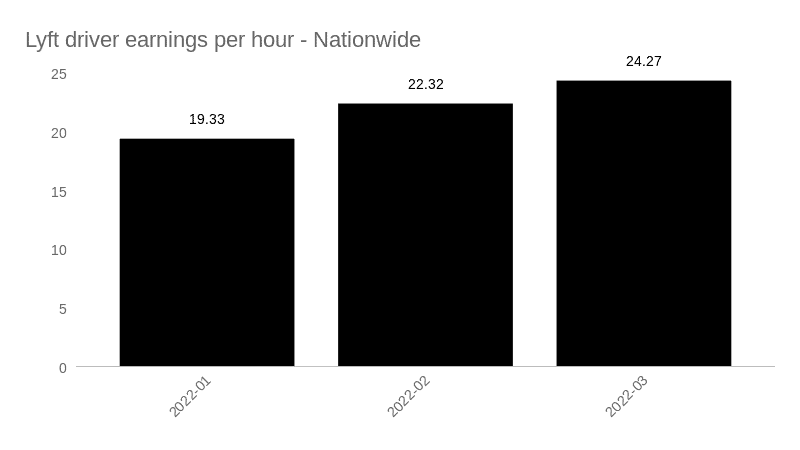
Hourly driver wages increased steadily to start the year from $19.33 in January to $24.27 by March. This is a promising trend for drivers who want to pick up more rideshare gigs throughout the summer.
Breaking it down further, Lyft drivers earned an average of $13.04 per trip and pulled in an average of $3 to $4 in tips.
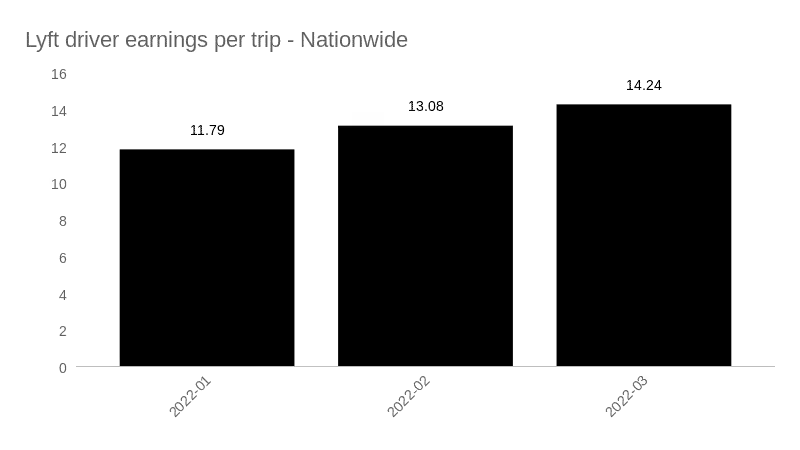
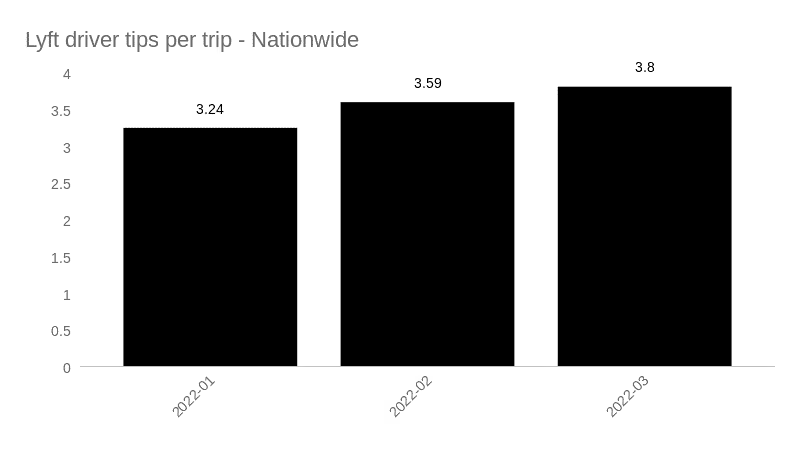
Putting it all together, Lyft drivers earned an impressive $537.94 in gross earnings for March 2022. This number was up from $329.24 in January and made Lyft drivers the highest earning gig drivers across all major platforms for March 2022.

Have the rising gas prices impacted Lyft driver pay?
According to AAA, the national average price for regular gas has risen from $2.863/gal a year ago to $4.073/gal by mid-April of this year.
To help drivers stay on the road, Lyft introduced a $0.55 fuel surcharge in March that goes directly to drivers. Lyft stated that drivers should expect this surcharge to remain in place until at least mid-May when they will reevaluate the situation.
Note: Lyft is not offering a fuel surcharge for drivers based in New York City.
If you’re looking for additional ways to offset higher fuel costs, consider the Gridwise Gas program and get instant cash back on gas from GasBuddy—and find the lowest price on gas in your area with ease.
What opportunities are there for Lyft drivers to increase their pay in 2022?
For 2022, Lyft drivers have a few opportunities to maximize their earnings including bonuses and referrals.
Bonuses aren’t new to Lyft, but it’s helpful to know the latest on how to capitalize on them.
Lyft offers both real-time and scheduled bonuses to get more drivers on the road during high-demand hours. “Bonus Zones” appear in real time in the app, and you earn the bonus for accepting rides within the zone.
Pro tip: Don’t want to scramble all over town to find bonus zones already crowded with drivers? Use the Gridwise app to find out where and when demand is typically highest in your area to get ahead of the competition.
Lyft also offers bonuses for ride streaks and for completing “Ride Challenges” which reward drivers for completing a set amount of rides in a given time frame.
What are the biggest expenses for rideshare drivers?
Unfortunately, the number in your app at the end of the week isn’t quite as much you’ll take home. As a contractor, you’re responsible for covering all expenses associated with your business.
And if you’re not tracking those expenses, you’re probably losing more of your earnings than you need to. Here’s a list of common expenses to pay attention to:
- Vehicle depreciation
- Fuel costs
- Maintenance and repairs
Other expenses
- Phone bill
- Self-employment tax and compliance expenses
- Medical expenses
As a driver, your vehicle is essential to your business—and it’s also your greatest expense.
According to a yearly analysis from AAA (American Automobile Association), the average annual cost of owning a new car was $9,666 in 2021.
Most of that cost is hidden in depreciation, accounting for nearly 40% of total ownership expenses. Maintenance costs are a close second, with our data showing that rideshare drivers spend an average of $163 a month on maintenance costs.
Gridwise drivers get access to exclusive driver benefits like CarAdvise.
Just because you’re self-employed doesn’t mean you can’t enjoy the benefits of group rewards. CarAdvise helps drivers access discounts, compare prices, get online expert , and easily schedule online— plus Gridwise users receive 10-40% off retail prices.
The great debate: Uber vs. Lyft [2022]
Almost every driver has probably asked the question, should I drive for Uber or Lyft?
While the answer varies based on your location and the goals of your rideshare business, here’s the real data on earnings this year.
Lyft drivers earned slightly less than Uber drivers per trip and hour from January to March of 2022, except for February when Lyft drivers earned an extra $0.20 per hour on average.
However, Lyft drivers earned more overall by March of 2022, with both rideshare services seeing a significant increase in median earnings as the year has progressed.
As always, it’s a close battle. Who do you drive for and why? We’d love to hear about your experience. Share it with our collaborative driver network on Facebook!
Amazon Flex Driver Pay Q1 2022: What is Amazon Paying Their Drivers
Amazon Flex drivers tore it up in the first quarter of 2022. Flex earnings are one of the highest among driving gigs, and they stayed strong long after the holiday peak season ended.
Before we applaud too loudly, though, let’s take a deeper look at the Q1 numbers and study some trends that could affect the future flushness of the Amazon Flex gig. We’ll also offer suggestions for Flex drivers who are intent on fighting back against the corrosive currents of oncoming economic forces.
Here’s the way we’ll slice it up:
- First-quarter showing: how much do Amazon Flex drivers make?
- Possible obstacles: economic and social factors that could drag down earnings
- Limit your expenses: how Amazon Flex drivers can cut back on what they lay out
- Amplify your earning power: tips for making more
First quarter showing: how much do Amazon Flex drivers make?
Thus far 2022 has been a bang-up year for Amazon Flex drivers. Even though pandemic-related shutdowns have eased, and people are free to shop in stores again, there’s no sign that shoppers have stopped ordering from Amazon. Amazon Flex driver pay has continued on an upward trend. Let’s look at the numbers by first asking, how much do Amazon Flex drivers make per hour?
Nationwide the average hourly gross earnings for Amazon Flex drivers from January–March 2021 amounted to $20.21. In the first quarter of 2022, Amazon flex pulled in hourly earnings of $22.47. That’s an 11% increase in 2022 over the same time period in 2021.
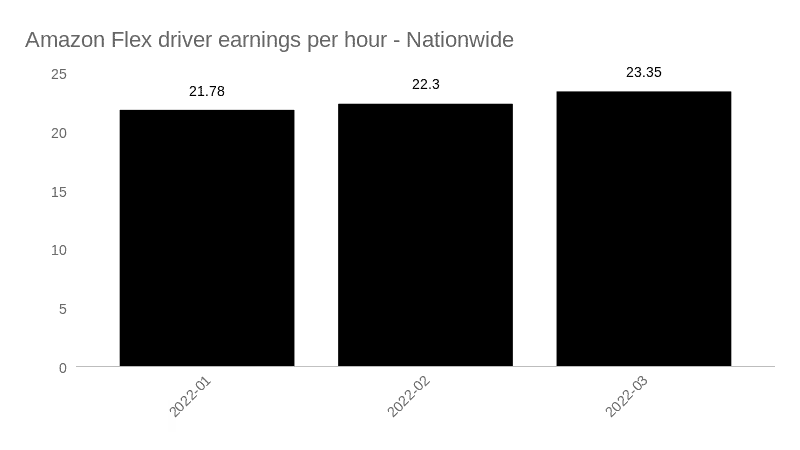
More encouraging news can be found in the fact that earnings rose steadily through Q1 of 2022. Beginning in January at $21.78, Amazon flex hourly pay went up to $22.30 in February, and ended the first quarter at $23.35. These numbers exceed those of all the rideshare and delivery companies for which Gridwise has data.
Now, how much do Amazon drivers make per order or per trip? Looking at this metric isn’t the best measure of monetary success because a “trip” or “order” for the Amazon Flex driver is the delivery of just one package. It’s not surprising to find that when it comes to this measure, Amazon Flex per trip pay is lower than that of all the other gig companies. Yet the upward trend in the earnings per trip number is consistent with the trend displayed in the hourly earnings.
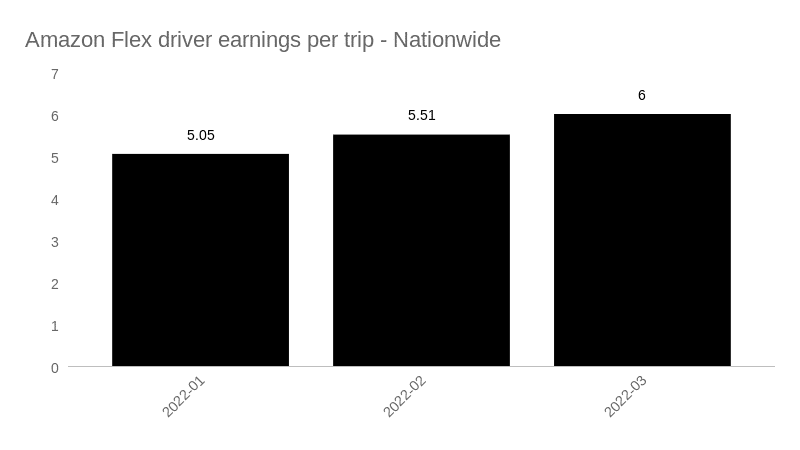
Earnings per trip began at $5.05 in January, inched up to $5.51 in February, and then rose to $6.00 in March. This steady climb is another indication that Amazon Flex drivers are on a roll in 2022.
Average monthly earnings for the first quarter also sized up well. Amazon Flex drivers earned more than drivers for other delivery companies and were outdone by rideshare drivers at only Uber and Lyft. Monthly gross earnings began the year at $341.50 in January, then dipped down to $330.00 in February, which is a slightly shorter month. By March they rose to $419.50. The average monthly gross earnings for Amazon Flex drivers for the quarter was $363.67.
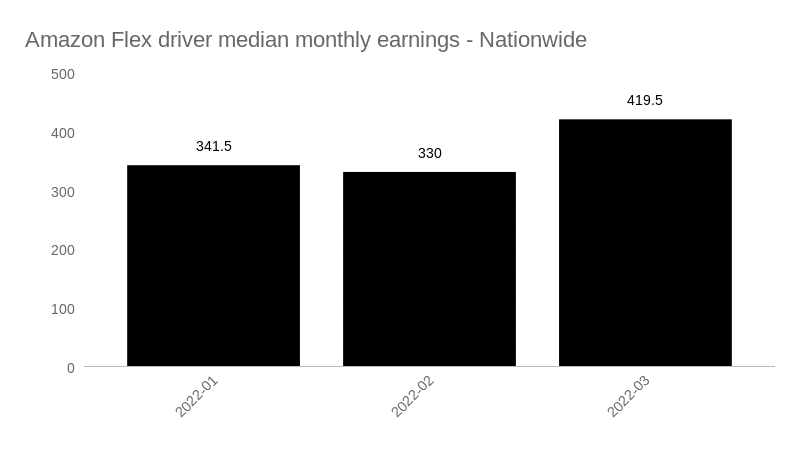
Amazon Flex seems to be the leader in package delivery driver pay in general. When we compare Amazon Flex vs. Shipt monthly earnings, Flex looks rather fabulous. Shipt shopper average earnings for the quarter added up to just $259.22. A look at Amazon Flex vs. Instacart shows the difference to be even more drastic. Instacart shopper pay fell short with an average monthly earnings figure of just $185.58.
The year has started out well for Flex drivers, indeed, but what about the future? How will events and conditions affect Amazon Flex driver pay for the rest of 2022 and beyond?
Possible obstacles: economic and social factors that could drag down earnings
The haunting specter of high gas prices is probably the biggest concern on the minds of Amazon Flex drivers in 2022. (We will go deeper into the details surrounding this issue in the next section.) It is a big concern. Gas prices have risen much faster than earnings have, so in effect, Amazon Flex drivers are starting out with a deficit. What’s more, Amazon is just about the only gig company that hasn’t offered direct relief for drivers paying the higher prices at the pump. While they placed a surcharge on sellers due to rising fuel costs, they have yet to address the hardship their Flex drivers have had to take on.
The price of gas isn’t the only factor that could impact Amazon driver pay in the future, though. Here are a few more:
Potential unionization
Amazon’s gargantuan size suits its name perfectly, but it also brings about problems that indicate how its corporate culture might suffer from the company being too big. Warehouse workers as well as drivers have made attempts to join unions in the past. Amazon has been quite aggressive about avoiding unionization, but that hasn’t stopped their workers from continuing their efforts.
Because the COVID crisis changed the face of the labor market in general, Amazon workers believe they can use the current labor shortage as leverage to bring in unions and, they hope, improve their working conditions. There are positive aspects to unionizing, to be sure, but there are also potential concerns.
One of these might be that Amazon is less open to allowing workers to choose their own hours, or that they would impose stricter standards and quotas that are even more difficult to meet than current ones. Worse yet they may be forced to eliminate the option to work as an Amazon Flex driver.
Inroads that are favorable to the treatment of drivers have been made in California, where Proposition 22 has taken effect. The companies defeated the state’s efforts to classify drivers as full-blown employees, but they did wind up offering drivers minimum earnings and other benefits.
In Oregon a COVID-related sick pay policy is in effect, allowing drivers to be paid while they are ill and unable to work due to being infected. Still, companies are investing a lot of money in opposing measures like this one, as well as resisting worker efforts to unionize.
There is plenty of room for Amazon to upgrade its working conditions and improve the way the company treats its Flex drivers. Whether unionization is the way this gets accomplished remains to be seen. If Amazon Flex drivers do become unionized, there is a real potential that the life of the average Amazon Flex driver will change, in some ways that are favorable, and in others that are not so desirable.
Inflation
Amazon Flex drivers deliver goods that are ordered online by consumers who are accustomed to having everything they want and being able to pay for it without much pain or trouble. With inflation becoming a concern in the 2022 economic picture, consumers might become more cautious about spending. If people cut back on the number of things they buy, the demand for Amazon Flex drivers would be reduced.
Amazon Flex pay structure
The first thing that’s important to realize is that earnings with Amazon Flex vary based on location, how long it takes for you to complete your deliveries, and a few other factors, such as
- Amazon’s minimum contribution (varies by location)
- increased contribution at high demand times
- tips you may receive
- Amazon Flex rewards
Amazon’s hourly earnings contribution ranges from $15.00–$19.00. As evidenced by the figures in the previous section, drivers across the country averaged slightly higher earnings. This could be due to tips and surge pricing.
Tips are not a large portion of the typical Amazon Flex driver’s pay. Only certain deliveries leave an option for the customer to tip, and the average amount is based on what drivers have typically received for similar deliveries. Drivers keep 100% of their tips.
Amazon Flex Rewards is a way for Amazon to recognize its Flex drivers for superior service. Under the Amazon Flex Rewards program, drivers earn points, and then they receive rewards ranging from cash back on purchases to preferred scheduling. Amazon Flex drivers are independent contractors, and reimbursement for mileage, gas, and maintenance is not part of the deal. The cash back offers could be the company’s way of rewarding drivers for their hard work, and indirectly helping them to defray expenses.
There is no doubt that the costs of being a driver are substantial. There are smart ways of keeping expenses down, however, and every driver needs to be aware of them.
Limit your expenses: how Amazon Flex drivers can cut back on what they lay out
It’s true. There are ways to cut down on the amount you spend on unavoidable expenses. All you need is some information and a willingness to see your driving gig as what it is to you: your way of making money and a business geared toward turning a profit.
Keeping your overhead costs down will mean looking at what you have to spend and finding ways to limit your layout. Here are some big ones:
Gas
The price of fuel might have slowed down its steady escalation for now, but it hasn’t retreated much from where it was in March, at its peak national average of $4.23 for a gallon of regular gas. A week ago the price went down as low as $4.07, but has recently gone back up to $4.12 per gallon, according to AAA.
This time last year, prices stood at an average of $2.88 per gallon. That means that now, drivers pay nearly 47% more for gasoline. While Amazon Flex driver pay is higher than last year, this year’s pay doesn’t come close to covering that differential. To make it worse, as we mentioned earlier, Amazon has done nothing that directly benefits drivers looking to get a break from high fuel prices.
To make the cost to drivers even more of a burden, the vehicle requirements for Amazon Flexcreate the need for drivers to use vehicles that are not focused on fuel efficiency. You can read more about how to become an Amazon Flex driver here. When you do, you’ll find that in order to drive for Amazon Flex, you must use a four-door sedan, SUV, or truck with a flatbed cover.
Unless you can afford to drive an Electric Vehicle (EV) in this size range, you’re going to get a lot less for the gallon than you would driving more fuel efficient cars. You can’t change the price of gas or the fact that you’ll have to buy more gas as an Amazon Flex driver, but you can limit the amount of financial damage you might sustain in today’s high gas price environment. Gridwise Gas will save you a lot of money!
Powered by Gas Buddy, your Gridwise Gas card is honored at 95% of service stations and will let you save up to $0.25 per gallon on fill-ups. Along with being more cautious about your driving habits, using Gridwise Gas will help you conserve on consumption and cut down costs. Sign up free for Gridwise Gas and start saving now. You’ll also want to follow Gridwise on Facebook, where you can get in on frequent gas card giveaways.
Maintenance
No one who uses a vehicle for business can afford to skimp on maintenance. Yet the price of maintaining a vehicle is also going up. This is largely due to a shortage of parts, and a shortage of qualified technicians. Those technicians who are still working are asking for higher wages, as they must develop their skills to meet the level of sophistication of modern vehicles. Inflation could also fuel demand for higher pay, and pump up the price you must pay to keep your car running.
As an Amazon Flex driver you will have to be even more vigilant than most rideshare and delivery drivers about maintaining your vehicle. When you’re carrying packages on a daily basis, the added weight creates greater wear and tear on your brakes, and could possibly place extra stress on your engine. Frequent oil changes will help, but they do add to your overhead.
On average, drivers told us that they pay about $163 per month on maintenance. This is a lot of money to spend when you’re not being reimbursed; but as we stated, you can’t afford to skimp on maintenance. What you can do is limit your maintenance costs.
Gridwise + CarAdvise helps you do exactly that. The app will allow you to scope out local car repair and maintenance shops, talk to experts, get free estimates, and find the best value for your money. Gridwise + CarAdvise is a surefire way to know you’re only trusting the care of your vehicle to professionals whose competence and integrity you can trust.
Depreciation
This cost, though you might not think about it much, could be the hardest one of all to accept. It’s a fact that your car loses about 8% of its value as soon as you drive it off the lot, which is the moment it becomes “used.” Each year the value of your vehicle goes down more. At the end of one year, you’ve lost 19%, after year two, 31%. By the end of five years, your car’s value will have depreciated some 60%, making it worth only 40% of its original value.
To put that in dollar terms, this article from Carfax tells us that a vehicle worth $30,000 will be worth only $12,000 after five years. This means that, in effect, the owner is losing $3,600 each year.
Obviously, you’re going to want to look at the real value of your vehicle before you put more money into it for major repairs or enhancements. If and when you decide it’s time to get a new car, don’t panic. Use the Gridwise Auto Buying Program to make the transition to a new vehicle a lot easier.
You’ll get as much as $3,500 off the MSRP of a new car and find the best prices on used vehicles. This program is geared for drivers like you who need to make sure they’re losing as little money as possible while making wise decisions about retiring an old vehicle and buying a new one.
There are plenty of expenses involved in driving for Amazon Flex, but don’t let them get you down. Now that you know how to minimize the biggest drains on your earnings, let’s look at how you can strategize and up your game so you can make more money.
Amplify your earning power: tips for making more
With all the rising costs and extra expenses you face, you might wonder, is driving for Amazon Flex worth it? We believe it can be, but if you want to turn up the volume on your ability to earn more as an Amazon Flex driver, you’ll have to get proactive about it. Here are some things you can do:
Increase the number of deliveries you make
When you turn on the app to choose your work for the day, you don’t have to settle for any old block. If you want to make more money, you’ll have to work in areas where Amazon Flex drivers get paid more. How would you know that? Where to Drive, a valuable Gridwise feature, shows you the places in your area where Flex drivers are pulling in the most cash. Now you can schedule your blocks in areas that will really pay off.
Do all you can to get better tips and top customer ratings
There’s not a lot you can do to make sure your block is one that makes you eligible for tipping, but it pays to do the kinds of things that make you score high with customers in any case. These include
- protecting packages from wet weather and dirt
- using car mats or other cushioning to prevent damage
- taking a dolly along to make dropping and breakage next to impossible
Get savvy, and diligent, about tracking tax deductible expenses
Remember, Amazon won’t reimburse you for the mileage you accrue while working as a Flex driver. You need the best Amazon Flex mileage tracker—Gridwise! This trusty free app automatically tracks your mileage on every shift and separates the count from your regular driving.
Gridwise also tracks your earnings. Simply sync your Amazon Flex app with Gridwise, and your earnings will be seamlessly recorded. You can also manually enter other expenses, such as automotive equipment, food, beverages, and amenities you might purchase for your customers. Later you can see how well you’re doing with simple and informative graphs. Gridwise is a powerful tool that will help you keep earning more, even in the face of changing economic conditions. Don’t wait another minute.
Download the free Gridwise app today!
Shipt Shopper 2022 Pay: Q1 Earnings Trends
Shipt is a delivery service that’s owned by Target, but it operates as a completely separate entity. Shipt shoppers take a customer’s list, go through the stores on their behalf, then make the delivery. They might be called to deliver goods from a variety of sellers, including grocery stores, big box operations, pharmacies, and pet stores.
Being a Shipt shopper has its good and not-so-good points, but when we look at Shipt shopper earnings during the first quarter of 2022, it appears that things are looking up! In this post, we’ll delve into the details of the quarterly earnings and share some insight into how current economic conditions and Shipt’s corporate vision might affect earnings. Then, we’ll offer strategies and recommendations for pushing your earnings higher and keeping them that way.
Here’s what we’ll cover:
- Shipt shopper pay: facts, figures, and trends
- The bigger picture: customer demand and Shipt corporate policy
- Shipt shopper expenses: how to keep them down
- Shipt shopper earnings: how to raise them up and keep them there
Shipt shopper pay: facts, figures, and trends
Shipt shoppers have to do more than just shop and drive their deliveries to their destinations. The company is very big on customer service. That means shoppers are often asked to make extra efforts when it comes to getting customers exactly what they want, delivered promptly, courteously, and accurately.
Fortunately, it appears that Shipt shoppers were rewarded rather well for their work in the first quarter of 2022. Let’s look at the earnings data:
How much do Shipt shoppers make per hour?
Our nationwide figures show that Shipt shopper hourly pay in January was $18.51 and has gone down only slightly over the course of the first quarter. In February, gross earnings per hour amounted to $17.63, and in March the average earnings were $17.62.
While there has been a slight drop since the beginning of the year, there was only a very minor change between the second and third months of the quarter. With a quarterly average of $17.92, Shipt shoppers made about 14% more than Instacart shoppers, whose average hourly pay for the quarter was $15.78.

How much do Shipt shoppers make per order?
Gross earnings per order is an important angle to take when analyzing grocery delivery driver pay. This is a number that answers questions such as “Is driving for Shipt worth it?” From what the Q1 2022 figures indicate, the earnings per trip show a trend that’s somewhat unsettling.
Gridwise data show that earnings per trip, or order, for Shipt shoppers dropped by 22% over the course of the quarter. January’s figure was $19.67. In February, the earnings per trip fell down to $18.87 and then took a dive to $15.30 in March. While this isn’t encouraging, Shipt shoppers still out-earned those doing similar work with Instacart. Instacart shopper earnings per trip averaged $16.06, compared with $17.95 for Shipt shoppers. This Shipt vs. Instacart comparison isn’t as dramatic as the hourly earnings, but it still shows Shipt earnings to be somewhat higher.

What about Shipt shopper monthly earnings?
Median gross monthly earnings figures for Shipt shoppers are is far more encouraging. January earnings averaged $290.50, and after going down to $203.70 in February, rebounded to $283.46 in March.
Here, the difference between Shipt and Instacart is much more obvious. Shipt shoppers’ monthly average for Q1 2022 was $259.22, while Instacart shoppers earned an average of only $185.58. That means Shipt shoppers made 39% more than Instacart shoppers in monthly earnings during the first quarter.

The bigger picture: customer demand and Shipt corporate policy
As we look more deeply at the Q1 2022 Shipt shopper earnings trends, it’s easy to see how changing economic factors could impact both net and gross earnings. Inflation and rising gas prices have certainly given both customers and Shipt shoppers pause before creating large orders or automatically filling up the gas tank.
Customer demand and expectations
Fortunately for Shipt shoppers and the online grocery delivery business in general, customers are more eager than ever to gobble up their services. Some 71% of consumers have ordered other packaged goods online within the last quarter. While this number is down 2% from a year ago, the growth and security of online delivery work is evident when compared with the 2017 figure of 17%.
The top reasons people give for shopping online are saving time, avoiding the inevitable impulse buys that happen at random inside the store, and personal safety. The practice of online ordering has become so common, a report from Powerreviews.com points out that 68% of all consumers have ordered online and have either picked up their items or had them delivered.
While it’s encouraging to note that customers are placing online orders as furiously as they did at the height of the pandemic, it’s important to realize that customer expectations are on the rise, too. Customers want to be able to get their goods when they want them, but they also expect personalized service.
Shipt corporate policy: service first
There’s plenty of buzz around the topic of time and delivery. Companies such as Doordash have put a huge emphasis on super-fast deliveries by launching a new New York city based Dashmart. Other, smaller, companies have invested heavily in delivering within 15–30 minute time windows and have not been terribly successful.
This scenario is what drives the corporate policy as stated by Shipt CEO, Rina Hurst, in this article from Forbes.com. Hurst is certain that while customers expect to receive deliveries on time, those small delivery windows are not what most of them really want from a service like Shipt. Hurst asserts that her research shows that Shipt customers value the quality of service, rather than speed.
While stating that only 50% of orders received by Shipt are for delivery within an hour, she emphasizes that Shipt’s practices involving the personalization of online shopping are much more widely desired by customers. These include everything from shoppers working directly with the customer when substitutions are necessary, to allowing customers to designate a “preferred” shopper with whom they can work on a regular basis.
A recent survey of online grocery shoppers conducted by Coresight.com shows that speed of delivery was sixth on the list of customer needs, behind low or no delivery fee, availability of items, and quality of service. As Shipt attempts to balance service, speed, and cost for their customers, Hurst notes that Shipt customers are likely to set up large orders, rather than send for a few simple convenience items. Most of the time, large orders don’t require quick turnover.
The company’s desire to keep service at the forefront is a long-term strategy that might well pay off. If it does, it will have a stabilizing effect on the amount of work available for Shipt shoppers. Given that orders are larger for service-minded Shipt customers, tip earnings will be higher as well.
With larger economic forces on the horizon, such as inflation and supply chain disruptions, keeping earnings high will depend on how well Shipt shoppers can minimize expenses.
Shipt shopper expenses: how to keep them down
While gross earnings might be staying high, many expenses for Shipt shoppers are increasing. This means that net earnings for Shipt shoppers could be going down, due to general inflation and intensely higher prices on essentials. Here are a few things Shipt shoppers need to do:
Out-maneuver the high price of gas
National average retail prices as of mid- to late April are hovering around $4.10 per gallon. While a huge increase over the same time in 2021, when the average price was $2.87 per gallon, it’s an improvement over mid-March of 2022, when the average price spiked at $4.26 per gallon.
Will gas prices ever go back to where they were a year ago? Considering current global conditions, probably not now, and maybe never. Consider the fact that, while prices often rose by twenty or thirty cents per day on their way toward the $4.00 mark, they are coming down at a much slower speed.
Shipt, like many other rideshare and delivery companies, has just announced plans to help Shipt shoppers with the extra fuel expenses. They’re offering driver discounts on gas fill ups, bonuses for the busiest of their shoppers, and the addition of in-app language to encourage customers to tip drivers generously.
This probably won’t make that much of a difference for most drivers. What Shipt shoppers need is a highly reliable way to get consistent discounts at more than 95% of available service stations. Gridwise Gas offers all that and more. Powered by Gas Buddy, Gridwise Gas sends you to the stations that have the biggest discounts and helps you save up to $0.25 per gallon. Follow Gridwise on Facebook, and get a chance to win in our frequent gas card giveaways.
Measures like these, along with changing your driving habits to avoid wasting gas, will help you keep high gas prices from eating away at your earnings.
Invest in maintenance…cautiously
Your vehicle is essential to your livelihood, so you must take good care of it. Information that Gridwise got from drivers indicates that they spend around $163 per month on maintenance. That’s pretty substantial!
There’s every reason to cut this cost down to a much smaller size, and you can do that with Gridwise + CarAdvise. This great Gridwise benefit lets you shop around for service centers in your area, talk to experts who actually know what they’re doing, and then get up to 40% off retail prices on maintenance and repairs.
Keep an eye on depreciation
That cliché about your car losing much of its value the moment you leave the lot is true. This car depreciation tool from Omnicalculator.com indicates that it goes down to 91% of its retail value as soon as your car is “used,” even for one minute.
By one year, you’re down to 81% of its original value, at two years 69%. Three years in, your car is only worth 58% of the initial price, and by year four the value goes down to 49%. In five years’ time, your car is only worth 40% of its value. These sobering numbers might push you to reconsider investing in maintenance and repair items, from brakes and tires to fuel pumps and radiators.
When you use your car to be a Shipt shopper, your worries about depreciation can become even bigger. Odometer readings and wear and tear rack up faster for delivery drivers and reduce the car’s value at even more prodigious rates.
It pays to make sure your vehicle is still worth investing in—that is,for repairs and maintenance, and even registration. Carfax states that the owner of a $30,000 vehicle is looking at losing $18,000 over five years, or $3,600 annually.
If you’re facing sad facts like this about your car, it could be time to get a new vehicle. Let the Gridwise Auto Buying Program help you out. You can get as much as $3,500 off MSRP and find the best prices on used vehicles. Depreciation is a fact of life, and when your car is a crucial component of your ability to make money, you can’t afford to let it wipe you out.
Now that you know how to keep costs down, let’s look at ways to drive your Shipt shopper earnings up!
Shipt shopper earnings: how to raise them up and keep them there
Maximizing earnings often means working even harder. While sweat equity certainly helps, that’s not all Shipt shoppers can do. Before looking at the ways to make even more, let’s examine the Shipt shopper pay structure and how you can make the most of it.
Know how Shipt shoppers get paid.
Shipt shoppers deliver more than groceries. They can also be called upon to deliver a whole host of items, including electronics, personal care products, and in some areas, alcohol. The Shipt app tries, to as great of an extent possible, to make customers feel as though they’re really shopping in the store, virtually going down the aisles to choose their items.
Shipt shoppers are the ones who actually choose the items, and they do so after accepting an offer. A display known as an Offer Card appears on the shopper’s screen. The shopper chooses whether to take the offer or not. If the choice is to accept the offer, the shopper heads to the store and gets to work. Once the items are selected, the shopper drives the order to its destination.
The pay per offer depends on several variables, such as the size of the store, how much driving is involved, how complex the order is, whether substitutions are likely, etc. If an order has been sitting in the system for a while and doesn’t get picked up, Shipt adds on extra money they call Promo Pay to incentivize drivers to give the customer a high-quality service experience from Shipt.
In general, drivers get a minimum pay of $5.00 per order, plus 7.5% of the total order cost. Shoppers keep 100% of their tips.
The Shipt Earnings Standard applies to every market. This is the company’s guarantee that every offer will be paid at $16 per hour or more, based on time and effort estimates. This is a part of Offer Pay, and it doesn’t count as an extra payment, the way bonuses and tips do.
If you want to learn how to become a Shipt shopper, click here to see the requirements. Note that Shipt shoppers are paid weekly on Mondays for work completed Monday–Sunday. Unlike Uber or Instacart, there are no instant or 2-hour pay windows with Shipt.
Bank on Bonuses & Referrals.
Like most gig companies, Shipt offers bonuses to shoppers that can help boost earnings. These might be based on timeliness, a specific date or time, or for specific retailers. Bonuses do not apply to Promo orders, but it’s good to know that Shipt invested a lot of money in Shipt shopper bonuses in 2021, offering them twice the amount that was doled out in the previous year.
Shipt’s shopper referral program pays $50 for each shopper that joins Shipt after being referred by the shopper, provided the new shopper completes a required number of orders. Bonuses and referrals are great ways to boost income because they don’t require any extra work. If you have a way of distributing your referral code widely, through a social media channel or newsletter, you could gather a rather respectable pile of passive income.
Increase Orders.
This requires some hustle, but it’s worth it. The more orders you deliver, the more money you make. If you can deliver just one extra order per shift, it might make up for the added costs you’re paying for gas and other items.
Know your store layout.
It’s easy to get into a zombie-like state of overstimulation while you’re shopping in a big store, but if you want to be speedy about your service, you need to learn the layout. The Shipt app will help; but if you already know where most things are kept, you won’t even have to look at a map to find your way around.
Scope out your neighborhoods.
You might stay with just one or two stores or shop around, but in every case you need to know your neighborhood. Use Gridwise to alert you to traffic delays and tip you off about events and the crowds they may create in your area.
Go where the money will be.
It helps when you’re shopping for Shipt to go to the highest paying neighborhoods. The Gridwise Where to Drive feature will show you real data on what drivers are making in various parts of town. Equipped with this kind of info, you can increase your income, and maybe not have to work so hard for it.
Hustle for higher tips.
It doesn’t take all that much to get customers to part with a few extra dollars. If you pour your heart into your job and deliver good service, they’ll gladly give you that something extra. Here are some things you can do to ensure they notice just how hard you’re trying:
- Complete orders on time. Customers love it when deliveries arrive in the first 15 minutes of the delivery time window.
- Communicate clearly, and bend over backwards to make acceptable substitutions.
Keep working. The more experience you get, the better you’ll be at your job. - Use sturdy bags, crates, and boxes for groceries.
- Build relationships with repeat customers—you could become their preferred shopper!
Maximize deductions and mind your business.
Tracking your miles is an important aspect of maximizing your tax deductions. When you let Gridwise be your mileage tracker for Shipt shopping, you’ll get plenty of additional features as part of the package. Simply sync your app to Gridwise, and your earnings will be seamlessly recorded, along with your mileage. You can enter your expenses as they arise and produce graphs that let you see all the crucial data you need to manage your business!
With all these features, plus great access to benefits, deals, and discounts, you need Gridwise!
Download the Gridwise app for free!
How To Boost Rideshare Driver Earnings and Earn Bigger Tips
Rideshare driving has its challenges, and the biggest, most important one is keeping earnings high. It’s hard to control all the many factors involved in the way drivers make money, especially with inflation taking a bite out of everyone’s wallet. Even those big company bonuses don’t always help when you have no idea how much more you’ll have to pay for gas, car maintenance, or energy to charge your EV.
Meanwhile, if you’re among the drivers just getting back on the road after the pandemic, you’ll have to hustle to get back up to speed. It’s a whole new world out there, but if you play it right, you can make the money you need to make a living, even with inflation and changing passenger patterns. Your first step is to get a handle on what aspects of your earning power you can control.
Fortunately, there are a few aspects of gig driver earnings that you can easily influence, and push your earnings skyward. The most flexible and powerful of these is tips. In this blog post, we’ll present some strategies to help you move your earnings upward with suggestions about how you can make more and get more tips. Here’s how we’ll cover the topic:
- Tips: how they factor into earnings
- Driving strategies: a road to better tips and bigger earnings
- Surefire tip getter: Play Octopus
- Get your tip-grabbing tentacles on your very own Play Octopus
Tips: how they factor into earnings
Not all rideshare customers are used to tipping their drivers. In the early days of gig driving, Lyft encouraged tipping, but Uber didn’t even offer riders an invitation or opportunity to give tips. Since then, that’s changed. Both Lyft and Uber make drivers eligible for tips. Still, when it comes to passenger behavior, evidence supports the timeworn adage: old habits die hard. In other words, drivers need to work hard at inspiring customers to give them tips.
When we leave a gratuity, say, in a restaurant, we usually plunk down at least 15% of the total. Other service providers, such as massage therapists, barbers, or hair stylists, might inspire most of us to tip around 20%. Sadly, when it comes to rideshare, drivers are not getting as much green. Anonymized data collected by Gridwise shows that tips from rideshare customers amount to just under 9% of driver earnings.
This is due in large part to the fact that not all passengers tip, and this discouraging piece of data could arise from a few factors. Companies are charging more to incentivize gig workers to come back to work and end the continuing driver shortage. Recently, they’ve added even more surcharges to cover higher gas prices. With the rising cost of rides, many customers may be more hesitant than ever to compensate drivers for all they do.
That’s why you need to work harder and put in lots of extra effort. Strive to give your passengers reasons to reach deeper into their pockets and come up with the tips you deserve.
Tip-worthy behavior for drivers begins with sending advance messages to your riders, telling them what direction you’re coming from, and while you’re at it, adding that while tips aren’t mandatory, you do appreciate them. Add to your coffers by being sensitive yet engaging with your customers, offering advice on how to have fun in your town and thanking them for riding with you.
They’re likely to pay you extra to carry shopping bags and luggage, or for offering kindly help with a stroller or wheelchair. If you’ve already mastered these tip-grabbing techniques, that’s fabulous. But there’s even more you can do to add to your basic earnings and get even more tips.
Driving strategies: a road to better tips and bigger earnings
Because tips are a percentage of your earnings, you need to make as much money as possible on every ride. While it’s nice to get those long, juicy airport runs and intercity trips, you can’t do them all the time. A solid driving strategy is essential if you want to give yourself a good running start toward a better income. This blog post on optimizing your rideshare driving strategy lists 5 ways you can improve your earnings in general.
We’ve established that if you want bigger tips, you’ll want to step up and be conscious of the way you interact with passengers and cater to them as much as possible. Before you can do that, though, you’ll have to know where to find passengers and how to spend as little time as possible riding around looking for them.
You need to be aware of where passengers are likely to be and at what times of day most of them will be looking for rides. You can conduct your own experiments, if you have the time, trying out different places and times of day to observe various traffic patterns. You can look at your company’s app for places where there might be high volume, but by the time you get to those surge zones, you could be out of luck.
Gridwise, the best mileage tracker app, provides solutions that put you right where the action is. Where to Drive gives you live data from fellow drivers on where the big money is in your area, while When to Drive clues you in on the times when funds are high in certain spots on your gig driving beat. Armed with this information, you can make the most of every minute you’re out there on the road.
Use Gridwise to track mileage and other expenses, too. Recording your financial transactions produces sizable returns at tax time. Those deductions add up and keep your tax bill to a minimum. As you can see, Gridwise is the best free mileage tracker app, and so much more.
Another part of a smart driving strategy is multi-apping, or moving from one service to another to take advantage of bonuses, including which company seems to attract the biggest tippers. Because Lyft has always had tips as part of the passenger routine, that might be a good place to start. There’s much to consider when it comes to driving for Uber vs. Lyft. This side-by-side comparison shows that Lyft lets drivers make more per ride overall, but that’s only part of the picture.
Much will depend on your area and how well each company has done at marketing their services to the public. Doing your own research by testing all your options is a really good way to see which company is going to bring home the most bucks for you.
No matter which company you drive for more often, you’re going to get more and bigger tips when you put together a positive rider experience.
Surefire tip getter: Play Octopus
If you want to create a rider experience your passengers will never forget, you need Play Octopus! Play Octopus is a F R E E (yes, that’s right) tablet that you mount onto your back seat. It’s designed specifically to entertain and fascinate your passengers. They can play free games, receive special offers from top brands, and because they see some short ads…YOU get paid for having Play Octopus in your car.
Play Octopus shares ad revenue with drivers, and that can add up to as much as $100 per month. Better yet, the tablet helps you to build relationships with your passengers. Playing the games opens them up, and while they’re playing they’ll start to talk to you. Before you know it, they can’t help but like you. Not surprisingly, when people like their drivers, they’re more likely to give them big tips. Whether they get the high score of the day playing their Uber game or not, you both win. They get to have fun on their ride, and you get more tips!
Even better, you get cash rewards every time your passengers play a game. As long as you log 100 trips per month, or drive while you’re online with your driving app for 40 or more hours per month with the Octopus tablet on board, you will get paid! Add on the extra tips you’ll get, and you’ve got an inflation-beating, conversation-starting, fun and engaging feature your passengers are sure to love.
You’ll also be pretty fond of the referral cash Play Octopus has to offer. Get a $25 bonus for every driver you turn on to this amazing way to earn more money and get bigger tips. Sweet, right? Before you start to tap your list of driver friends, though, you’d best get one of your own.
Get your tip-grabbing tentacles on your very own Play Octopus
No worries, you don’t have to dive into the deep blue sea to get your hands on one of these money-making machines. All you have to do to get your Octopus tablet is apply here.
Approval from the Octopus team will take about 3–5 days, but once you get the Octopus OK, your tablet will be mailed to you. Then, you simply mount it, let your passengers play with it, and start watching the money roll in. In case you’re wondering, the data plan you need for the tablet will be set up for you, and it too is free.
Great news for drivers that stopped driving due to the pandemic! Reapply for Octopus as soon as you’re ready to get back on the road! Getting into the post-pandemic groove can be challenging. Play Octopus is a must-have when you’re going back out there. Why not start with not just one, but eight, legs up? The Play Octopus tablet will instantly help you make more money and bring in bigger tips.
We can’t imagine how you could wait this long to get your own Octopus, the free tablet for Uber drivers, but in case you haven’t yet…
Sign up now to get your free Play Octopus tablet!
Work smarter. Earn more.
Whether you drive, deliver, or pick up shifts — Gridwise helps you track earnings, mileage, and performance so you stay in control of your work. Download the app and take charge today.
