Gridwise blog
Tips, insights, and advice to help you earn more and work smarter, whether you do gig work, hourly, or shift work.
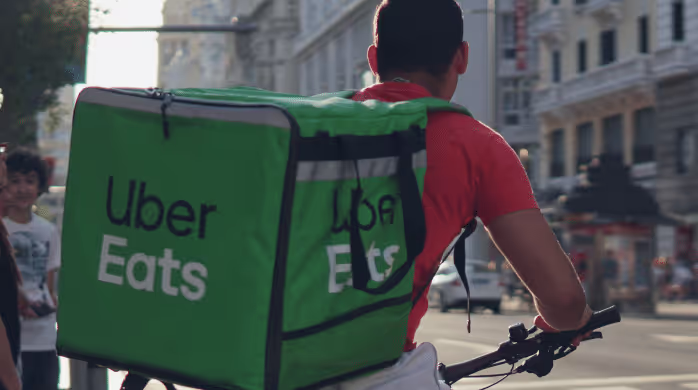
How to Make $1,000 a Week With Uber Eats in 2026 (Tips + Hourly Data)
In this blog, we'll explore the strategies and techniques that can show you how to earn $1000 per week as an Uber Eats delivery driver. We'll cover everything from optimizing your delivery zones and schedules to maximizing your tips and customer satisfaction. Whether you're a seasoned Uber Eats driver or just starting out, this guide will provide you with the insights and actionable steps to take your Uber Eats driver earnings to the next level.
Becoming an Uber Eats delivery partner can be a lucrative opportunity, especially if you're able to consistently earn $1000 a week. By understanding the platform, optimizing your delivery strategies, and focusing on customer satisfaction, you can maximize your earnings and turn Uber Eats into a reliable source of income.
We’ll cover the following topics to provide coaching and ideas to help you push your earnings up to that $1000 per week level:
What do Uber Eats drivers do?
Uber Eats drivers deliver prepared food most of the time, but they also might shop for and deliver goods from convenience outlets and grocery stores. The job is pretty simple. You get a request for an order, you drive to the restaurant or store to pick it up, and then you deliver it to the customer. If you already drive for Uber, you can choose to take orders for Uber Eats delivery any time.
If you’re not an Uber Eats driver yet, it’s pretty easy to become one. This Gridwise post tells you what you need to do if you want to sign up and start making money Uber Eats style. Many rideshare drivers welcome the chance to deliver food rather than people. This article from Nerdwallet covers the Uber Eats gig from that angle.
There are some sweet advantages to working with Uber Eats. In lots of cities you don’t even need to have a car. You can use a bike or a scooter, or even walk, to make your rounds. If you do use a car, Uber Eats’ requirements are a lot easier to meet than they are for Uber rideshare driving.
You also have a lot of flexibility. You can shop and deliver convenience items and groceries, but you don’t have to. And, like most driving gigs, you can choose your own hours, and map out the locations where you want to work.
Use Gridwise features When to Drive and Where to Drive to help you figure out what work hours and which specific areas will be the most profitable for you. Real data from real delivery people will show you earning patterns for drivers in your town.
How much can you earn doing Uber Eats?
The honest answer to this question is: basically, as much as you want! It all depends on how many hours you put in and how strategic you are about your gig. Earnings vary from one area to another, as this article from Entrepreneur points out. To give you a baseline, let’s look at the earnings of Uber Eats drivers who tracked their earnings with Gridwise.
Remember that these numbers show us only average earnings. To make $1,000 a week with Uber Eats, you’re going to have to be better than average, and we’ll show you how. For now, though, it’s good to have these figures so you get a ballpark number of where to start.
How much do Uber Eats drivers make?
Gridwise data tell us the following:
- Monthly earnings average around $444.00 per month.
- Gross earnings per trip are between $9.00 and $10.00.
- Tips make up about 50% of most Uber Eats drivers’ income, which amounts to about $225.00 per month.
Is Uber Eats good money? It can be. While there are other gigs that pay more per trip, if you drive for Uber Eats, you’ll always be pretty busy.
https://datawrapper.dwcdn.net/HPAz8/3
You can also see that, unlike many other gigs, tips play a huge role in Uber Eats earnings.

With these numbers as a baseline, what can we say about how to earn $1,000 a week with Uber Eats? As we said in the introduction, it’s going to be a hustle, but it’s really possible. To figure out how to make the most money with Uber Eats, let’s start by looking at how many trips these “average” drivers made each month.
We know that average gross earnings were $444.00 per month, and drivers got around $10.00 per trip. That means they took 44 or 45 trips per month, which breaks down to 11 trips per week. That’s not a lot of Uber Eats delivery, is it?
The fact that Uber Eats drivers averaged so few trips shows us that many drivers use more than one app at the same time. This is called multi-apping, and you can learn more about it in this Gridwise post. If you want to answer the question of how much you can make with Uber Eats, then you need to stick with the app and keep plugging away at those orders. You also need solid strategies, as well as some inside tips and tricks.
How to make the most money on Uber Eats: Delivery driving tactics
Getting to that $1,000 a week with Uber Eats isn’t so hard when you remember that the drivers we saw making about $111 a week were only taking around 11 trips in the same time period. That’s not much at all! If you work the Uber Eats app like a boss, you’ll soon have many more trips than that, easily reaching the number needed to get you to $1,000 a week. Now, let’s get to some tactics you’ll need to make that kind of bank.
- Stay with the Uber Eats app, and track your earnings. Gridwise can easily do that for you. Simply sync your Uber Eats app with Gridwise, and you’ll be able to see how much you’ve earned with Uber Eats, what times were most profitable, and your average hourly pay. Racking up trips with Uber Eats has other benefits, including perks and bonuses that are awarded to top drivers.
- Leverage surge pricing and promotions. Surge pricing is applied when there is a lot of demand. When surge pricing is in effect, many of the trips you make will pay more than usual. Promotions are offered to drivers who complete a given number of trips in a certain time period. High traffic volume days, nights, and times give you these chances to get extra earnings. Challenging yourself to complete the right number of trips for promotions will add to the number of trips you can count on for big bucks, too. Learn more about Uber Eats surge pay, boosts, and promotions in this Gridwise blog post.
- Say yes to doubling up on orders. With Uber Eats, you can get back-to-back orders or receive batched orders. Back-to-back orders happen when you receive a new request while you’re on the way to deliver an original order. The Uber Eats app routes these trips automatically, so you won’t be sent out of your way.
Batched orders are Uber Eats’ way of bundling together orders from either the same restaurant, or two nearby eating establishments. You get money, and trip count credit, for all the orders you complete, plus customer tips, without having to make a bunch of separate trips.
- Turn on the charm and get bigger tips. Being nice really is part of the Uber Eats driver’s job, and getting tips is one way people who drive for Uber Eats make money beyond their basic pay.. Bring along those extra napkins and condiments, use equipment that keeps food and drinks at the right temperatures and prevents spilling, and consider your customers’ needs. If you deliver groceries, be extra careful with delicate items such as bread and eggs.
And, most important, follow your customers’ directions, and stay in communication with them if you are going to be delayed, or if you have questions about their order. This Gridwise post will tell how to get bigger tips as a delivery driver.
- Use even more charm to keep your ratings high. As an Uber Eats driver, you will be rated by the restaurant or store where you pick up the orders as well as the customers who are waiting for the deliveries. This two-way rating system is designed to keep you on your toes, so Uber can keep people satisfied with your service. Don’t worry, you get to rate them, too.
There’s another reason why your rating as a driver is important. It not only keeps you in good standing with Uber; it helps you to qualify for the Uber Eats Pro incentive program. To learn more about Uber Eats Pro, and what it takes to earn perks such as preferred services, discounts, and deals, check out this Gridwise blog post.
Smart business moves that seal the deal
Now that you know how to gobble up the deliveries you need to make $1,000 a week with Uber Eats, it’s going to be a breeze to get there. Let’s make it even easier, with business moves that boost your earnings and shrink your expenses. If you use these, it will also be easy to say yes when people ask, “Can you make good money with Uber Eats?”
Minimize expenses. Avoid racking up big fast-food bills by bringing your own food and beverages. You might not think you’re hungry when you first start your Uber Eats run, but once the aroma of pepperoni pizza, premium cheeseburgers, and piping hot fries start wafting through your car, that might change. Bring a sandwich or other healthy food from home, and buy bottled water in bulk to save tons of cash compared to what it costs to buy single servings.
Maximize tax deductions. Another way to minimize your expenses is to maximize your tax deductions. Start by tracking mileage with Gridwise.
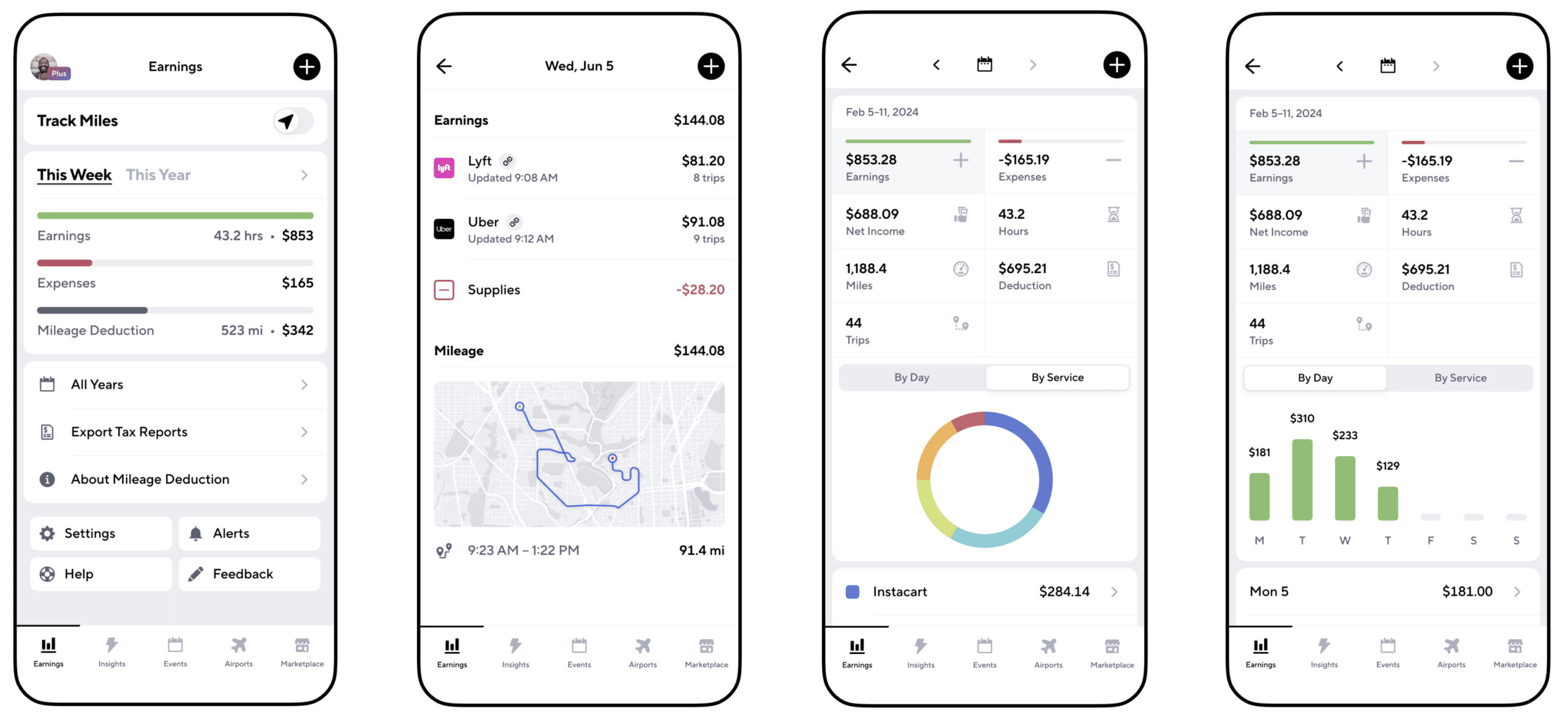
Gridwise App
Gridwise captures every deductible mile you drive, including the distance you cover between the trips your driving app records. Know what expenses you can deduct, and put them to work for you when tax time comes. Learn more about tax deduction strategies in the Gridwise Tax Guide for drivers.
Boost earnings with referrals
As an independent contractor, you’re probably looking for ways to make even more money than you can with Uber Eats. And most gig workers like you enjoy getting passive income. With Uber Eats, there’s a really easy way to do that, referrals!
All you need to do is find friends and encourage them to deliver for Uber Eats. If they make a certain number of deliveries within a specified time, you will get paid for doing nothing more than having them sign up under your referral code! Rates of pay vary by city, so check your Uber Eats app to find out what the current deal might be, and learn more about the referral program on the Uber Eats website.
Also remember: “friends” don’t have to be your best buds. Many delivery people carry cards with a QR code linking to their referral information, so just about anyone you encounter can join Uber Eats and boost your earnings. You could meet a source of passive income at the gas station, on social media, or at your high school reunion. The more you hustle, the more there is to gain, right?
Master the art of self-employment
As an Uber Eats driver, you’re an independent contractor. That means the company isn’t going to withhold your taxes, provide insurance, keep track of your earnings, or tell you about tax deductions. You’ll have to do all these things for yourself.
If you want to maximize your tax advantages, open an official business entity. You can incorporate (create a corporation) or you can work as a limited liability corporation (LLC). You can also work with a DBA (Doing Business As) arrangement, but the corporation or LLC will do a better job of protecting you from liability.
Establishing a corporation or LLC offers better tax advantages than being a sole proprietor. For instance, if you simply collect your earnings into your private account, you’ll be charged self-employment taxes in most states. And paying extra taxes is something we all want to avoid, within legal limits, as much as possible.
Every Uber Eats driver needs to learn about self-employment, and there are some great resources you can review. Check out the CareerOneStop website about self employment which will help explain the basics. You can also check with a professional tax accountant, or look other websites to learn more about actually creating a business.
Scope out your market
Look at the area around you to see where you’re likely to get the most deliveries. Where are all the restaurants? Where might people be more inclined to order deliveries? What hours do you want to drive? What activities might be going on around those times? Think about late-night and after-school times as well as breakfast, lunch, and dinner times.
Be realistic about the potential for your area and aware of new services opening up. For example, in New York, there is already a tab on the Uber Eats app that allows customers to order groceries. In our article about the best food delivery service to work for you’ll see that Uber Eats stacks up well against other delivery companies, mainly because of its potential for expanded opportunities for drivers to earn.
So, is Uber Eats good money? As we said, it isn’t an automatic guarantee that everyone will make $1,000 a week with Uber Eats. Trying out the suggestions we give you here, though, should put you on the right track! Go out there and start stacking up those orders and raking in some impressive earnings!
Get more inside information on Uber Eats in these posts from the Gridwise blog:
- The delivery driver guide: Using the Uber Eats app
- Everything you need to know about driving for Uber Eats
- Uber Eats Pro: What drivers need to know
- Looking for a different gig, part-time or full time job? Check out the Gridwise Job board.
Uber Eats FAQ
How does the Uber Eats platform work for drivers?
Uber Eats is a food delivery service that connects customers with local restaurants and independent delivery partners. As an Uber Eats driver, you'll receive notifications of nearby delivery requests, which you can accept and complete. The platform provides flexibility, allowing you to work on your own schedule and earn money based on the number of deliveries you complete.
What are the requirements to become an Uber Eats delivery partner?
To become an Uber Eats delivery partner, you'll need to meet certain requirements, such as having a valid driver's license, a registered vehicle, and passing a background check.
How can I choose the right delivery zone to maximize my earnings?
Selecting the right delivery zone can significantly impact your earnings, as some areas may have higher demand and better-paying orders. It's important to research and identify the zones in your area that tend to have the most consistent and lucrative delivery opportunities.
How can I take advantage of peak delivery hours and surge pricing?
Understanding peak delivery hours, such as mealtimes and weekends, and taking advantage of surge pricing can boost your earnings. Be aware of when demand is highest in your area and adjust your schedule accordingly to capitalize on these peak periods.
What are some tips for maximizing tips and customer satisfaction?
Providing excellent customer service and going the extra mile to ensure a positive experience can lead to more tips and repeat business. Prioritize communication, timeliness, and attention to detail to keep your customers happy and satisfied.
How can I set realistic weekly goals to reach my $1000 target?
To make $1000 a week with Uber Eats, it's essential to set realistic weekly goals and track your earnings and expenses. Start by determining your target earnings and breaking it down into achievable daily or weekly goals. This will help you stay on track and make adjustments as needed.
What are some strategies for efficient route planning and navigation?
Effective route planning and navigation can save you time and fuel, allowing you to complete more deliveries. Utilize mapping apps and take advantage of features like real-time traffic updates and turn-by-turn directions to find the quickest routes.
How can I balance my Uber Eats deliveries with other commitments?
Develop a schedule that allows you to capitalize on peak delivery hours while still maintaining a healthy work-life balance. Consider using tools like calendar apps to plan your availability and track your hours to ensure you're maximizing your earning potential without sacrificing your personal life.
What are the key considerations for maintaining my vehicle as an Uber Eats driver?
Keeping your car clean and well-maintained is crucial for maximizing your Uber Eats earnings. Regularly scheduled oil changes, tire rotations, and other preventive maintenance can help extend the life of your vehicle and minimize downtime. Additionally, budgeting for vehicle-related expenses, such as fuel, insurance, and repairs, will ensure you're accounting for these costs and maximizing your net earnings.
What are the tax obligations and legal considerations for Uber Eats drivers?
As an Uber Eats delivery driver, it's essential to understand the tax obligations and legal considerations that come with being an independent contractor. This includes properly reporting your earnings, deducting eligible business expenses, and making quarterly estimated tax payments. Additionally, you'll need to ensure you have the appropriate insurance coverage, such as personal auto insurance and possibly commercial auto insurance, to protect yourself and your vehicle while on the road making deliveries.

The Gridwise Job Board: Find Your Ideal Job or Gig Work
Gridwise is an essential assistant app created by gig workers for gig workers. Our mission is to support those engaged in gig work in every way possible. We understand how challenging it can be to deal with income instability, a lack of benefits, and job insecurity that often comes with gig work. The Gridwise app tracks and organizes earnings and expenses, and offers a wide array of discounts, deals, and services that make the lives of independent contractors easier and more rewarding.
We firmly believe it’s possible to make a viable living and create a gig experience that offers flexible hours, variety, and excitement. With issues such as consistent earnings and job security in mind, Gridwise is proud to offer a centralized platform that shows you how to find gig work and secure reliable opportunities. We’re proud to introduce the Gridwise Job Board.
The Gridwise Job Board: Key features
Because Gridwise is dedicated to serving the gig worker community, we’ve filled the Gridwise Job Board with useful features that won’t waste your precious time.
- Comprehensive listings. Find part-time, full-time, temporary, and per-task work. Drive or deliver with your vehicle, utilize an employer’s vehicle, or even find non-driving gig work.
- User-friendly interface. Find the jobs that are right for you with a tap of your screen.
- Verified opportunities. We vet the jobs before they are listed to ensure you’re getting high-quality job postings.
How to get more gig work, seasonal, part-time or full-time jobs with the Gridwise Job Board
Looking specifically for “gig work apps” or “gig jobs near me?” You’re in luck. Our filters and search functions send you directly to the listings you seek.
Here’s how it works.
- Access the Job Board via the Gridwise website.
- Search for jobs by type, location, and more.
- Select the job that interests you, and read all about it.
- Scroll through the description, and if it appeals to you, click “Apply for job.”
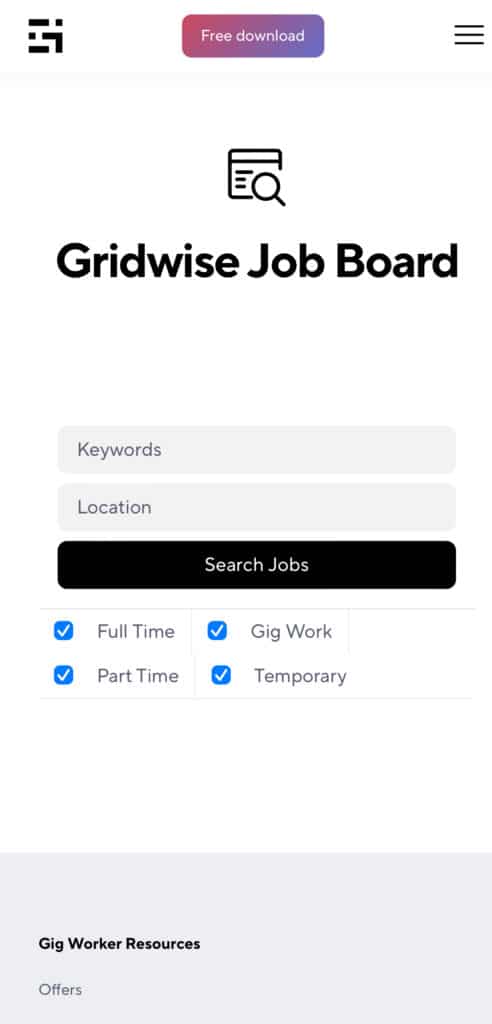
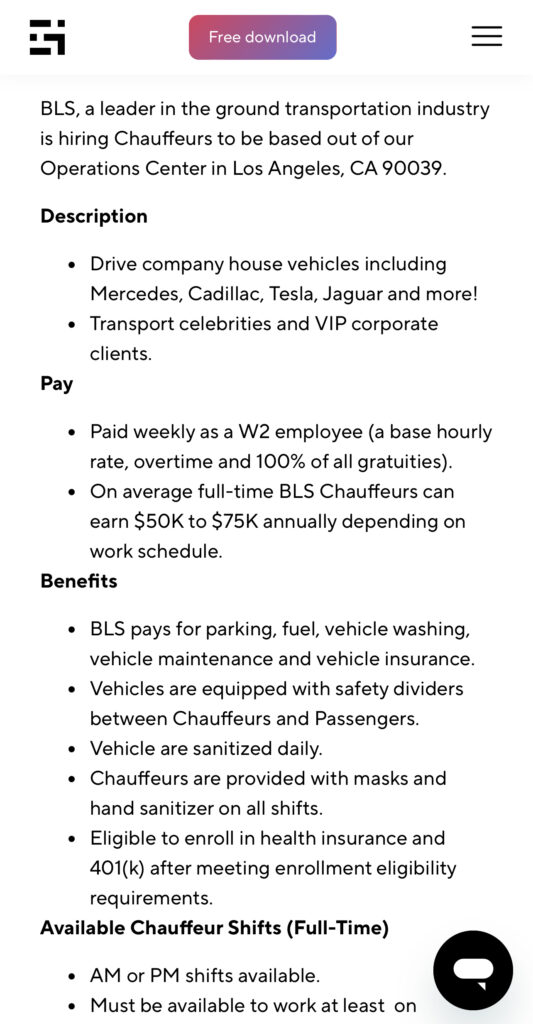
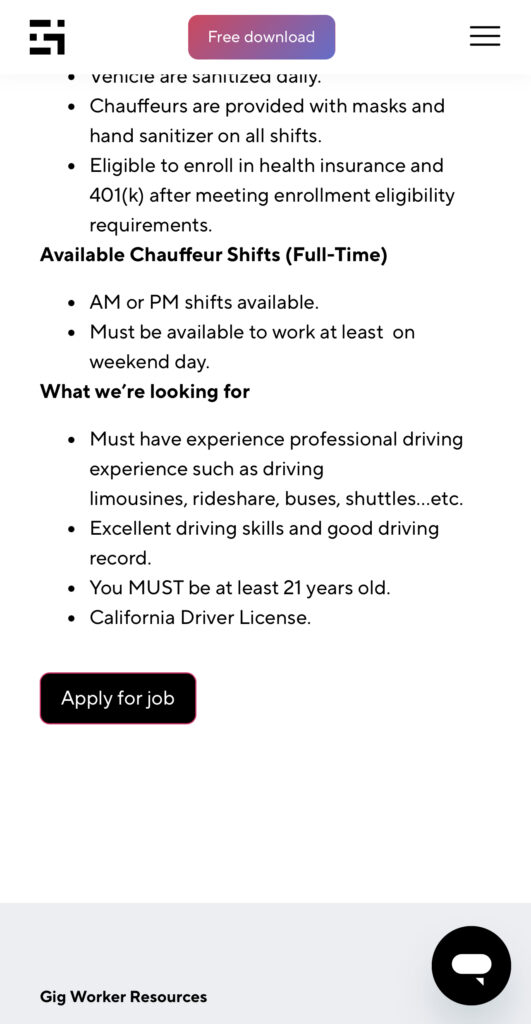
Many types of jobs are available. Adjust the search filter to see the full variety of opportunities that will let you cash in. Deliver food, set up catering, do rideshare driving, get paid for doing package delivery, and much more. You’ll find short-term gigs, long-term contracts, and part-time positions.
Perks of the Gridwise Job Board for gig workers
Gig workers who know how to make extra money will appreciate how the Gridwise Job Board lets you multiply your chances of bringing in big earnings. Here’s how:
- Increased stability. Use the Gridwise Job Board to find part-time or permanent jobs in addition to the part-time gigs you already have. Always keep a steady stream of earning opportunities flowing toward you.
- Flexibility and autonomy. Choose jobs that fit your schedule, work around other jobs and family duties, and still leave room for some fun in your life. Discover side hustles to supplement your full-time job, permanently or just for the season.
- Skill development. Find part-time work that lets you use a skill you already have, or try your hand at something new. It’s a smart way to develop a portfolio to showcase what you can do, or even to find permanent employment.
Get Gridwise and stay up to date on the Gridwise Job Board
Gig workers need plenty of information and assistance, and Gridwise is here to give it to you. Download the app and get essential features such as
- seamless earnings tracking
- mileage tracking
- expense recording, including notes
- low-cost and no-cost insurance benefits
- access to affordable medical, dental, vision, mental health, and alternative care
- professional services including legal and financial help
- deals and discounts
- weather, events, and traffic reports
- inside information on where and when to drive
More to know about gig work:

5 Best Mileage Trackers For Gig Drivers
Many drivers ask, “Do I really need a mileage tracking app?” The answer is simple: only if you want to have an accurate count of all the miles you can legally deduct from your taxable income! You might think your rideshare or delivery driving app has got you covered. After all, they do quite a good job of logging the miles you drive while you’re on a trip or delivery. But, if you want to have the best app to track mileage for Uber, Lyft, Doordash, Instacart, or the other apps you may use, you need more. Why is that?
Without a separate tracker, you’re missing the miles you drive in between pings. Did you realize that all the miles you drive, from the moment you begin your shift until it’s over (as long as you don’t drive several miles on a break to hang with your friends), are tax deductible! That means you need something besides your driving app to keep an accurate count of your travels. Read this Gridwise post to see how important it is to keep track of every deductible mile.
You won’t be surprised to hear that there’s an app for tracking miles. In fact, there are several of them. Here, we’re going to tell you about five top mileage tracking apps, and help you figure out which one is best for you.
Before we get to the list and identify the best mileage tracker app, let’s clarify what exactly a mileage tracking app is. According to G2.com’s technology glossary, mileage tracking is done for the purpose of keeping a log of mileage that is either reimbursable or tax deductible.
And yes, of course you can track your miles simply by taking readings on your odometer. But are you really prepared to account for how many miles you drove for personal reasons and subtract them from the total to get your business mileage? Even if you can remember all that and do the arithmetic, if you want an accurate reading of the miles you drive for business, and can therefore deduct, a mileage tracking app will save you a lot of trouble and prevent you from making costly errors.
Plus, as a gig driver, you have specific needs when it comes to a mileage tracker. Ideally, you’d be able to handle mileage tracking and several other functions all in one app. It can be maddening enough to deal with driving apps, particularly if you’re an avid multi-apper. You would want your mileage tracker app to help you keep account of other aspects of your business, including income, expenses, and inside information about the art of gig driving.
Not all mileage apps are equal, to be sure! Let’s look at five of the best apps to track mileage and figure out which is the best app to track mileage with Uber and Lyft, or what mileage tracker app is best for DoorDash.
1. Zoho Expense
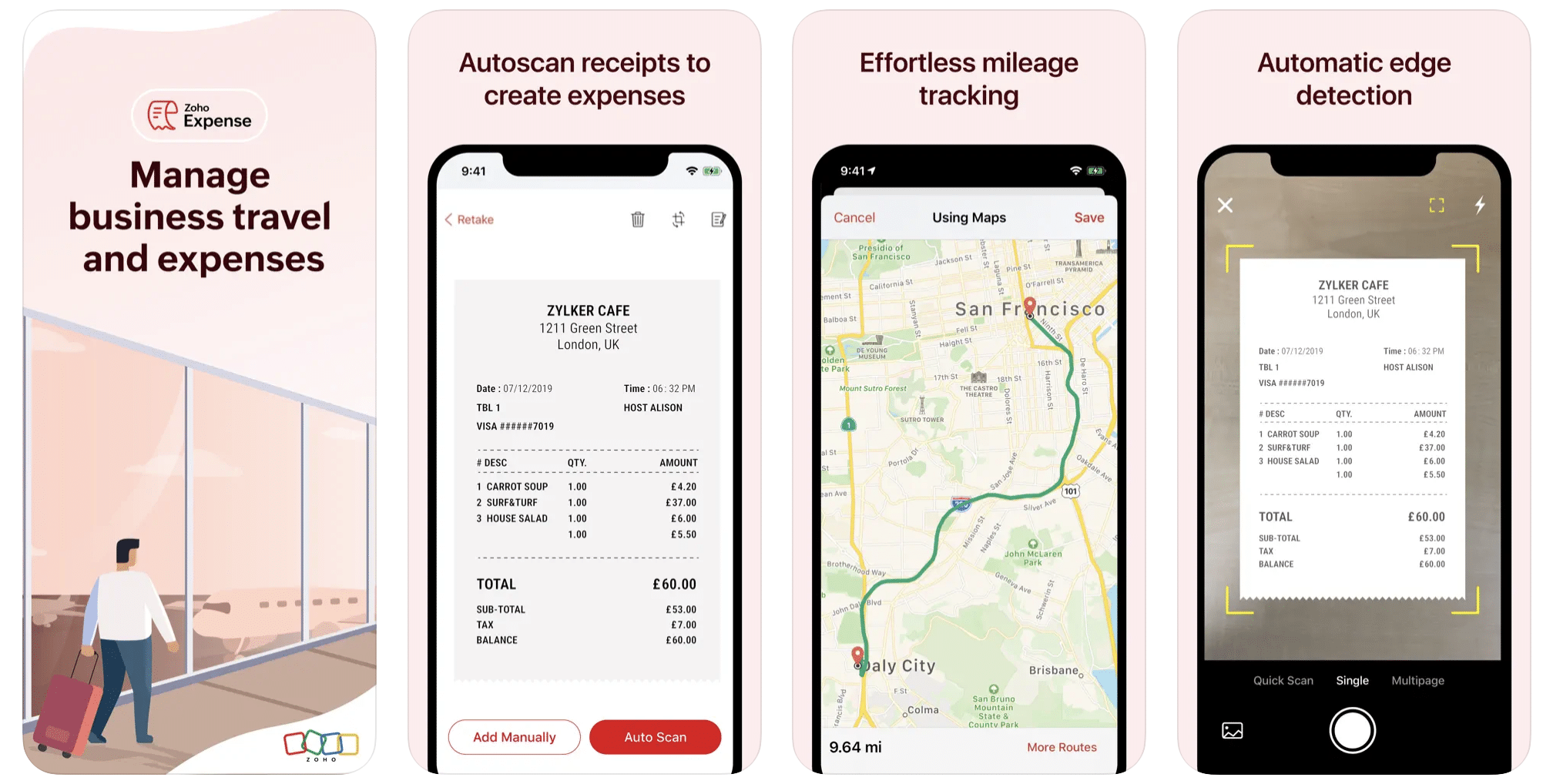
First up is Zoho Expense, which does exactly what its name says. This app is designed to allow companies to give employees a uniform way to create and submit expense reports. It can be used by individuals, including gig drivers, as well.
It includes a mileage tracker, as well as features that let you track other deductible expenses, including the ability to scan and record receipts.
Available on Android and Apple: Yes
Ratings: 4.8 stars on App Store, 4.7 stars on Google Play
Free Version: Yes
Subscription price: $3 per month, billed annually
Created specifically for gig drivers: No
2. Quickbooks Online
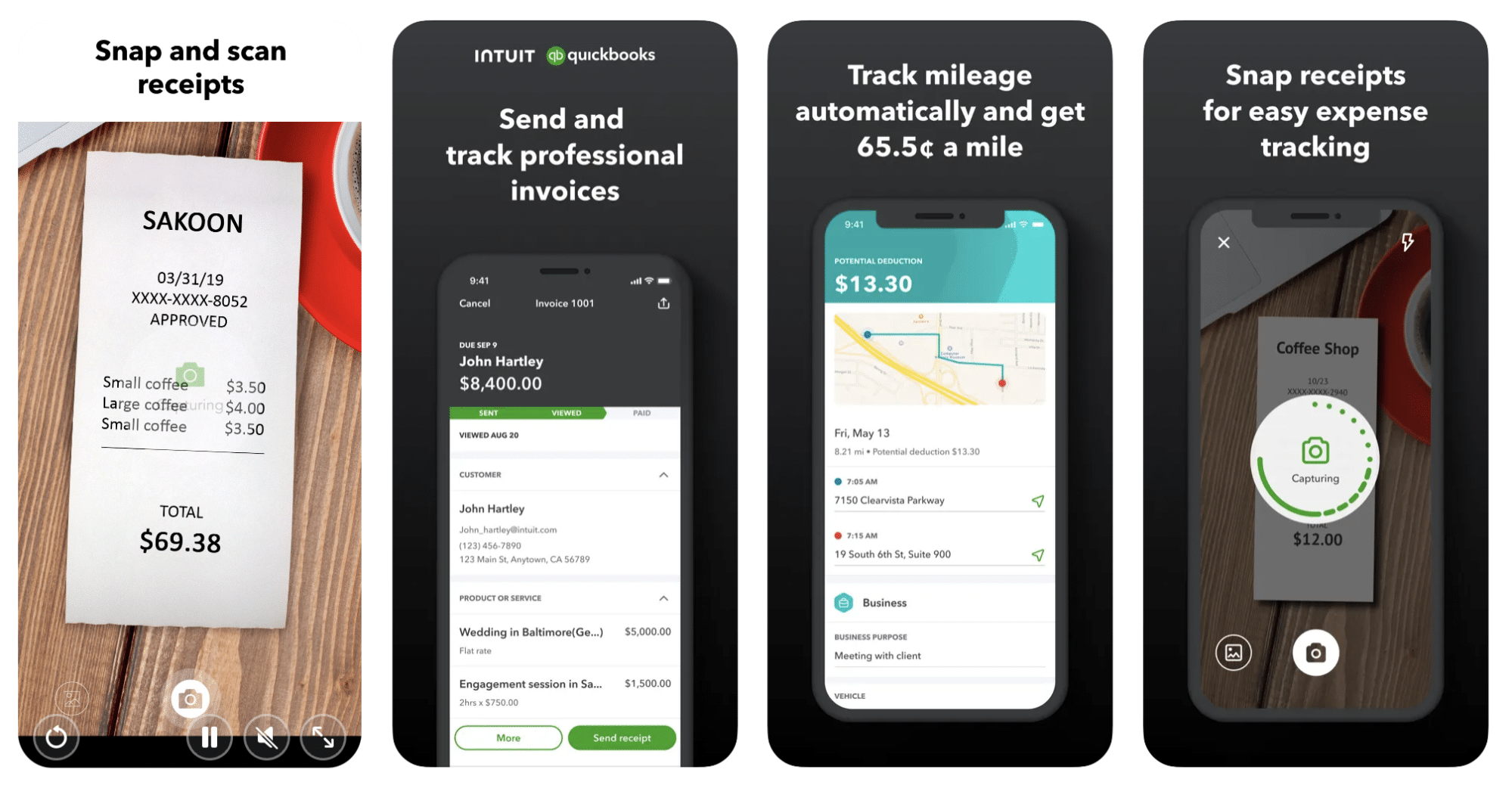
Quickbooks Online is a cloud-based app that allows you to track your mileage, earnings, and expenses. The information you enter can then be used to generate various reports that prepare you for tax time. It also allows you to create graphs that illustrate your cash flow, and includes a receipt scanner so you can instantly record deductible expenses. Quickbooks is popular, highly reliable, and designed mainly to help people keep track of their small businesses.
Available on Android and Apple: Yes
Ratings: 4.7 stars on App Store, 4.4 stars on Google Play
Free version: 30-day free trial
Subscription price: $15 per month for basic version if purchased for 3 months or more
Created specifically for gig drivers: No
Source: quickbooks.intuit.com
3. Shoeboxed
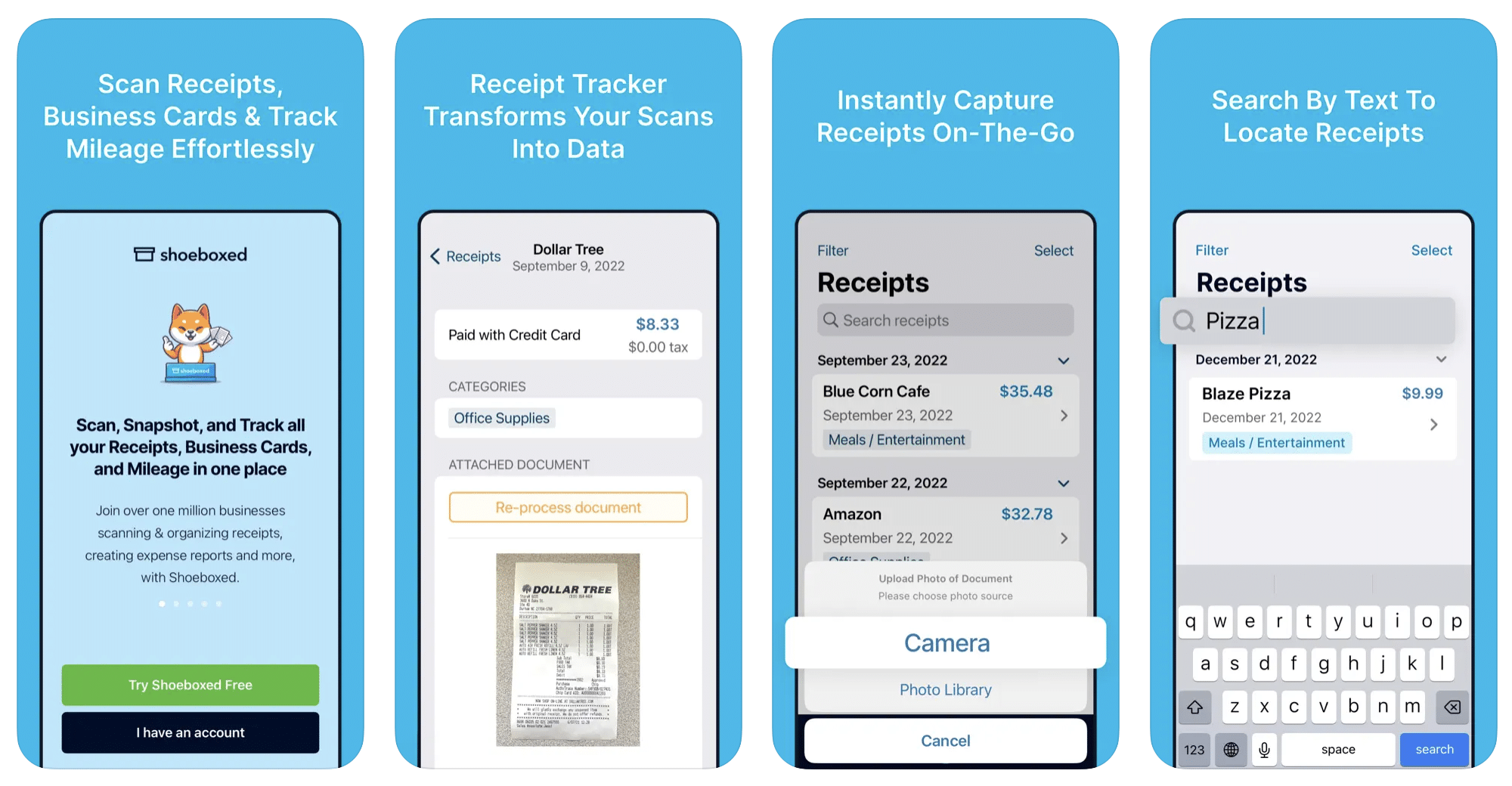
Shoeboxed started in 2007 as a service for scanning paper receipts into digital form. Now the app offers a free mileage tracker and has enabled users to scan receipts directly. It touts itself as the best mileage tracking app for DoorDash, but there are some elements missing that Dashers might like to have. While it provides features that record your expenses and prepare you for tax season, it doesn’t automatically track your earnings. The mileage tracker has a system where you can drop pins along your routes to make the tracking more precise, identifying those legs of a trip that you make for business purposes. The mileage tracker is “free” once you sign up for the basic version.
Available on Android and Apple: Yes
Ratings: 4.5 stars on App Store, 2.3 stars on Google Play
Free version: No
Subscription price: $18 per month for basic version
Created specifically for gig drivers: No
Source: blog.shoeboxed.com
4. Stride
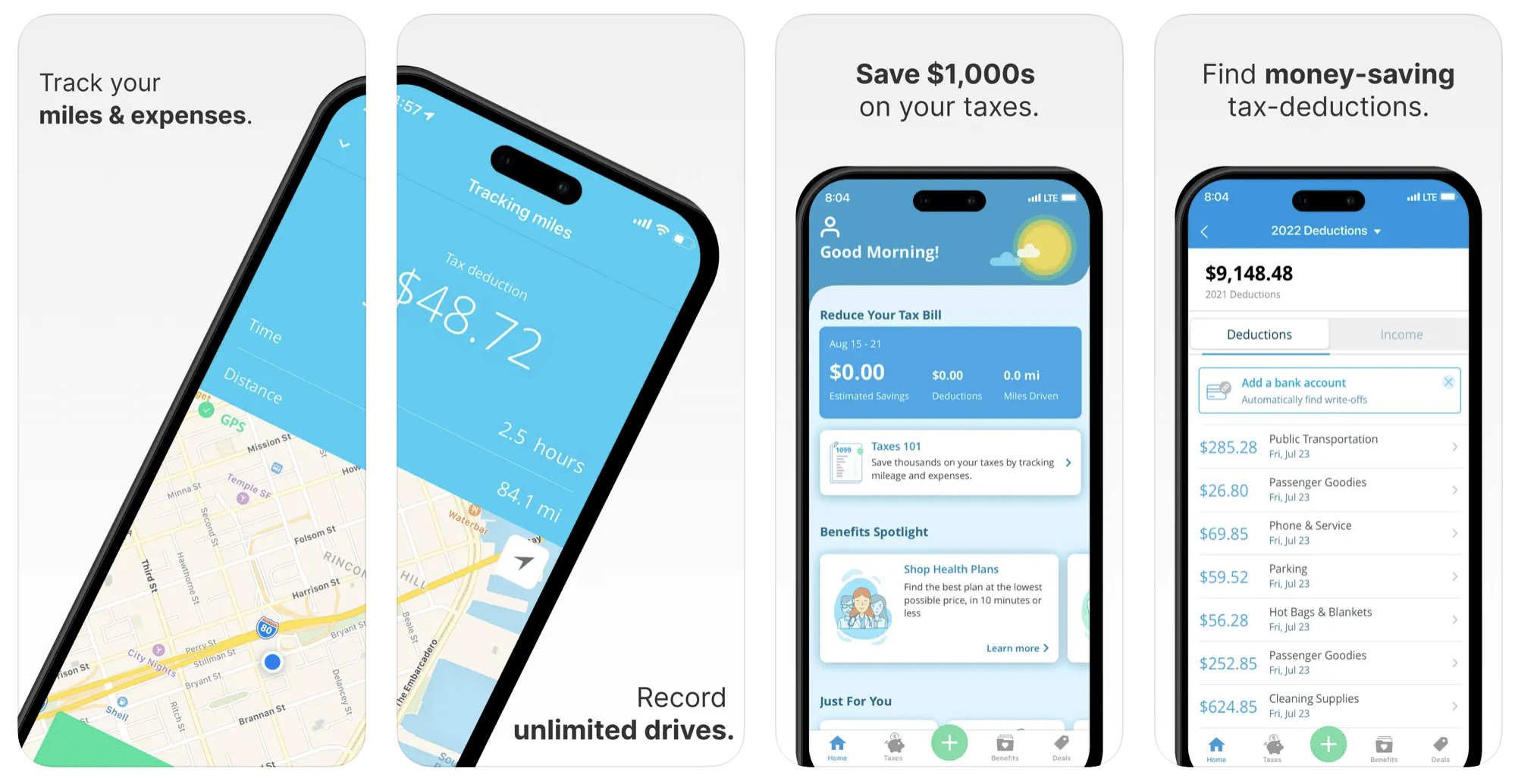
This free mileage tracker does a fair job of keeping track of the distances you rack up while gig driving, but it doesn’t automatically track earnings. It can be a big help, though, in tracking your expenses. You can link Stride to your bank account, and it will automatically scan your expenses to identify items you can potentially deduct. The app is totally free. This could make it the best free mileage tracker app, but there is a small price to pay. The app will persistently push you to consider various insurance plans that they are affiliated with. If you don’t mind that, this is a solid mileage tracker, even if it doesn’t track your earnings.
Available on Android and Apple: Yes
Ratings: 4.8 stars on App Store, 4.6 stars on Google Play
Free version: Yes
Subscription price: None. The app is free.
Created specifically for gig drivers: No
5. Gridwise
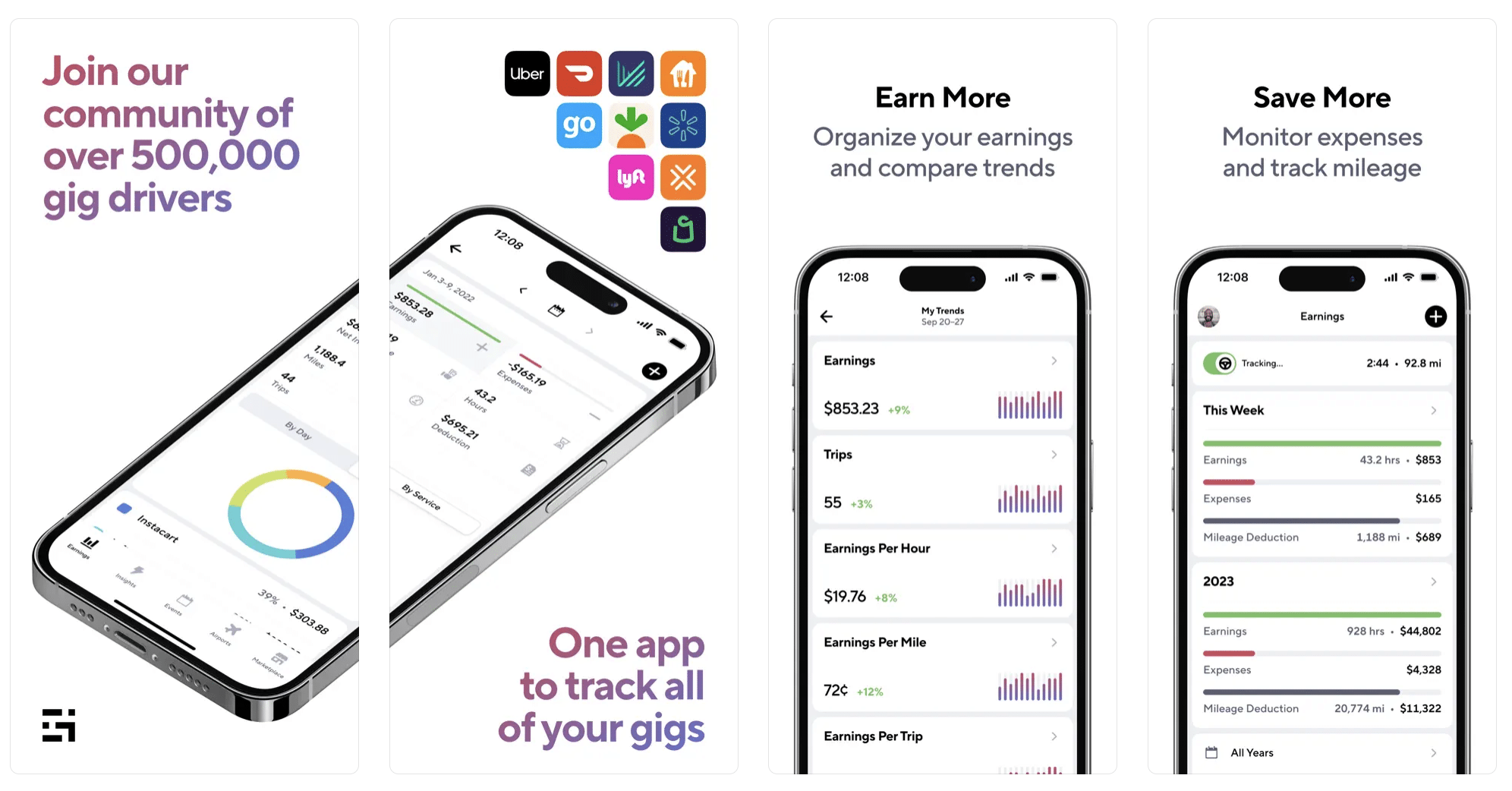
Gridwise has a free mileage tracker and free features that record your income and expenses. It gives you access to insurance and benefits, as well as insights about the best times and places to make the most money while gig driving. The Gridwise mileage tracker captures all the miles you drive while you’re on your driving shift, and it can be used if you have other trips you need to make which qualify as business travel.
Drivers love it because it is geared toward the needs of rideshare and delivery workers, providing free information about airport departures and arrivals, event start and let out times, weather, traffic, and more. The Gridwise Plus subscription adds value by providing additional insights and reports, discounts on benefits, the ability to export data in .csv format,, and more.
Available on Android and Apple: Yes
Ratings: 4.9 stars on App Store, 4.6 stars on Google Play
Free version: Yes
Subscription price: $9.95 per month for Gridwise Plus, or $95.99 per year (a $23.41 savings)
Created specifically for gig drivers: Yes!
What is the best mileage tracking app?
Now that we’ve checked them all out, we’re positive about the answer to that. Hands down, it’s Gridwise. Are we biased? You bet we are! But drivers love it too. Gridwise is the best mileage tracker app, and so much more. So many of the features are free, and the subscription to Gridwise Plus will pay for itself with additional insights to boost your earnings and deeper discounts on products and services.
Most important, Gridwise is designed specifically for gig drivers by experts who were once gig drivers themselves! Knowing what gig drivers need is a crucial step in creating an app that rideshare and delivery drivers can really use! Here are a few of the features, besides mileage tracking:
- seamless earnings tracking
- automatic, on/off toggle and manual mileage tracking
- mileage categorization
- airport, traffic, weather, and events information
- insights into where to drive and when to drive
- reports showing earnings across the platforms you use
- discounts on countless products and services for drivers
- additional resources for finding side gigs
- an informative and comprehensive blog
- affordable benefits, including insurance, medical, dental, and alternative practitioner discounts
- a community of drivers just like you
Don’t settle for just any app. Get the best mileage tracker, and so much more, from Gridwise!

How to Make More Money on Uber Eats
As an Uber Eats driver, you're part of the bustling gig economy, delivering satisfaction one meal at a time. Yet, in the hustle of zipping from restaurants to doorsteps, you might wonder how you can earn more, work smarter, and turn each delivery into an opportunity for greater profit. The first thing you can do is download the Gridwise app. From tracking your mileage and expenses to tracking your earnings, Gridwise is the best friend of every Uber Eats driver.
The truth is, you're not alone in this quest for efficiency and increased earnings. Whether you're a seasoned delivery pro or new to the scene, there's always that lingering question: "Am I making the most out of my time on the road?"
What is it like to work for Uber Eats?
Working for Uber Eats can be a no-brainer for many gig drivers. First of all, there are fewer hoops to jump through when starting. If you qualify as an Uber rideshare driver, you automatically qualify as an Uber Eats driver. You might also discover that Uber Eats is your market's dominant food delivery service (more about that later).
Gridwise also recently published a blog post, 2023 Uber Eats Earnings Report. It contains facts, and information that every Uber Eats driver needs to know.
How much do Uber Eats drivers earn?
To better understand Uber Eats earnings, check out this recent Gridwise blog post, How Much Do Uber Drivers Make?
Understand the breakdown of Uber Eats driver base pay
According to the Uber website, Uber Eats driver base pay depends on several factors.
1. Base amount
Uber Eats calculates the base amount using estimated delivery time, distance, and multiple drop-offs if the trip requires them. There are also fluctuations in price according to supply and demand in any given area.
2. Trip supplement
A trip supplement might be added to the base amount if there is a great deal of traffic or unusually long wait times expected at the restaurant. Uber Eats also adds supplements when there is a limited availability of drivers in an area.
3. Promotions
These come in the form of surges and Uber Quest promotions. Uber Quest is a bonus for completing a designated number of rides within a specified time frame. An example might be a $20 bonus for eight deliveries in a five-hour period.
Understanding the changing food delivery market
Remember when we mentioned earlier that we would discuss one of the reasons for the decline in hourly pay for Uber Eats drivers? We are now having that discussion.
Ghost kitchens started popping up in major markets before the pandemic. Ghost kitchens are food preparation kitchens that cater to the delivery-only market. They have no area for dining. They exist in several forms, including kitchens set up in industrial parks or clusters of kitchens (as many as 20 to 30 or even more, conducting business in modified warehouses or other buildings).
Some traditional restaurants prepare ghost kitchen brands in their kitchens, with the second brand being for delivery only. Applebee’s and Chuck E. Cheese are just a few of the brands that have been doing this.
You will also hear ghost kitchens called virtual kitchens or dark kitchens.
Existing prior to the pandemic, these kitchens became part of the growing surge in delivery-only orders that blossomed during lockdowns. Drivers in markets with a strong ghost kitchen presence did quite well. Gridwise has mentioned them several times as part of the evolving food scene.
Most recently though, the ghost kitchen market has shown signs of problems, as chronicled in TheTakeout.com. Travis Kalanick, the cofounder of Uber who has since left the rideshare leader, went on to found City Storage Systems (CSS). This past November, Kalanick acknowledged that they were laying off employees. According to an article in Friday Takeaway, problems included high customer churn, software issues, and customers generally preferring a brick-and-mortar restaurant, even for takeout.
Consumers prefer ordering from brick-and-mortar restaurants, the National Restaurant Association found in a survey this year, with 70% of diners saying it’s important for their food to come from a publicly accessible, physical location.
Not all restaurant leaders and industry observers believe the ghost kitchen sector will collapse. This decline might be little more than an adjustment in an oversaturated market. If you're an Uber Eats driver who relies on ghost kitchens for business, you might see a downturn. Only time will tell.
How to make more money on Uber Eats
There is still a market for Uber Eats drivers, but the ones who will prosper are those who have developed a strategy or a set of guidelines that help them realize maximum earnings. We’ve included ten such strategies to help you boost your earnings.
- Know when to drive Uber delivery
Food delivery has its hours. Orders cluster around the lunch hour from 11:30 am to about 2:00 pm and from 5:00 pm to 9:00 pm. Weekends can be busier, especially around sporting events. Uber Eats drivers will receive fewer orders during off hours.
- Know when to multi-app
One solution is to multi-app, wherein you work simultaneously with two or more apps. You can either deliver on several food delivery platforms or work as a rideshare driver for Uber or Lyft. Check out a Gridwise blog post that discusses the intricacies of multi-apping, The Art of Multi-apping: How-Tos and Strategies for Gig Drivers.
- Know if you're in an Uber Eats market
Uber Eats has a solid hold on the US’s #2 spot in the food delivery market, with a 24% market share. But Uber Eats is dwarfed by DoorDash, which has a 65% market share, according to Bloomberg’s Second Measure. Still, the food delivery market is competitive, and the #1 spot varies from city to city. According to a 2021 report by McKinsey & Company, Ordering in: The Rapid Evolution of Food Delivery, Uber Eats dominates with a greater than 50% market share in Houston, San Jose, San Antonio, and Philadelphia. It’s worth noting that this report is two years old. Things might have changed since then in the ever-shifting world of food delivery.
- Know when to pass on an order on your Uber Eats driver app
The most successful Uber Eats drivers look for orders that pay a base fee minimum of a dollar a mile. Some even push it to two dollars a mile. That’s what they need to make their target earnings. Many drivers also look at the destination. It might appear like a good order, but it might not be worth it if the customer's destination takes you away from the action.
- Watch the promotions page on your Uber Eats driver app
Have you been offered an Uber Quest, or a bonus for finishing a set amount of Uber Eats deliveries within a specified time? These appear on the Promotions page of your Uber Eats driver app. Many drivers look for these as a way to earn extra money. Uber Quests also come by email or SMS.
- Drive during surges
You know your market area and when demand surpasses the supply of drivers. Position yourself to take advantage of this. Surges can boost your earnings. They are transitory, though. You don’t want to go chasing them. Position yourself where you know, from experience, that a surge will likely appear. That’s the best way. Check out the When to Drive and Where to Drive features on the Gridwise app for information on where a surge might occur.
- Have an extra thermal bag or two
Sometimes Uber Eats will double up on orders for you, or you decide to push the multi-apping envelope and simultaneously deliver for two different platforms. Either way, if you only have one thermal bag, at least one order is left out in the cold (yes, that was a joke. Har!). Carry one or two extra.
- Know your restaurants
Some restaurants need to be better managed for Uber delivery takeout. Orders are chronically late, must be corrected, or the food is cold. Whatever the case, it’s a waste of your time and energy. You’re better off going to restaurants where they know and like you.
- Consider a bicycle or scooter instead of a car

In densely populated inner city areas, some drivers are much more successful on two wheels, whether by bicycle or scooter. You instantly rid yourself of most traffic and parking problems. Uber delivery has a dedicated page for bicycle deliveries. You can often accomplish more deliveries per hour with a bike or scooter, driving up your hourly earnings. Check out the Gridwise blog post, The Ultimate Guide to Gigs You Can Do on a Bicycle or Scooter.
- Work those tips
Tips can make up half your pay as an Uber Eats driver, as discussed in a previous Gridwise post, How to Make $1,000 a Week with Uber Eats. Prompt deliveries, a courteous demeanor, a winning smile, and extra packets of condiments make all the difference in tips.
Take advantage of everything you can from the Gridwise app

The Gridwise app can instantly tell you your earnings for each platform you drive
Gridwise is the best companion app for Uber Eats drivers. There are valuable tools such as the Gridwise Mileage Tracker and the Gridwise Expense Tracker. These two features alone can save you thousands at tax time with more accurate deductions. The Gridwise Earnings Tracker tracks your earnings from all the platforms you drive and breaks down your income, providing a clearer picture of where your best earnings originate.
Download the Gridwise app today and earn more as an Uber Eats driver.
Get more Uber Eats driver earnings insights from Gridwise
Check out these Gridwise articles to learn more about Uber Eats earnings:
How Much Do Roadie Drivers Make in 2025
Delivery drivers are already inundated with options, but new platforms keep popping up with big promises.
Roadie and Curri are two newcomers to package delivery that have gained momentum in recent years. While more options for drivers is generally a good thing, it can also lead to a big question: What is the best delivery option for drivers?
This article focuses on the Roadie delivery service. We’ll help you understand what it is, how it works, how much drivers can earn, its advantages and disadvantages, and whether it’s worth your time.
What is Roadie?
Roadie describes itself as a crowdsourced “on-the-way” delivery platform that matches drivers with delivery gigs on routes they are already traveling or plan to travel. That sounds great on paper (or rather, on a screen), but how does it work in practice?
The Roadie app connects drivers with senders to make deliveries happen. Senders create delivery gigs that are sent as alerts to nearby Roadie app drivers. Drivers can look at the gigs and submit offers for those they find worthwhile, ideally those that align with their routes and schedule.
This is different from other package delivery services that require drivers to book a slot in advance, pick up shipments, and deliver as directed without any control over routes.
Roadie is primarily used for same-day, on-demand, or scheduled local deliveries. It is used by businesses as well as private individuals to send items. Brands such as Home Depot, Coca-Cola, AT&T, Verizon, Walmart, Best Buy, Delta Air Lines, Tractor Supply Co., and other recognizable names use Roadie to varying degrees for their first-mile and last-mile deliveries.
Launched in 2014, Roadie has seen growth in recent years, particularly during the pandemic. The company claims to have over 200,000 registered drivers and coverage in more than 20,000+ zip codes nationwide, reaching 90 percent of US households. During the last quarter of 2021, Roadie was acquired by UPS.
What are the requirements to be a Roadie driver?
Now that you know how the Roadie app works, let’s look at the requirements and process to become a driver on Roadie. Anyone can sign-up to become a verified Roadie driver as long as you:
- Have a vehicle with valid auto insurance;
- Are at least 18 years old;
- Have a Social Security number;
- Have a valid US driver’s license.
If you meet these criteria, you can fill out an online application on Roadie’s website or mobile app to become a Roadie driver.
Since Roadie is a parcel delivery service, it has various driver certifications to match drivers and their vehicles with the appropriate gigs. Available Roadie certifications include Trusted Driver, Cargo Trailer, Extra Equipped, and TSA Certification.
Each of these certifications has separate eligibility requirements based on the number of completed deliveries, vehicle type and size, extra equipment for loading and unloading, etc.
What are the responsibilities of a Roadie driver?
As a Roadie driver, when you are selected for a gig, you’re expected to pick up and deliver the shipment on time, have friendly communication with both the sender and the receiver when needed, and maintain a minimum four-star rating from senders for completed gigs.
How much do Roadie drivers make?
Roadie claims drivers can make an average of $15 per trip for local deliveries (with most gigs paying between $8 and $50) and up to $650 on long trips carrying oversized items.
But do these claims match reality? Not really, at least according to our 2021 earnings data collected from over 200,000 Gridwise drivers.
Roadie driver earnings per trip
The median earnings per Roadie trip ranged from $12.82 to $15.11 in 2021, which is lower than the advertised average earnings by ~$1.25 per trip. The shortfall looks even worse when you consider the fact that our data includes earnings from supposedly high-paying long trips as well.
Roadie driver earnings per hour
The median earnings per work hour, meanwhile, ranged from $13.93 to $17.49 in 2021, which is again on the lower side compared to Roadie’s competitors. In January 2022, the per-trip and per-hour median earnings were $13.87 and $15.52, respectively.
We recently published an in-depth article about drivers’ 2021 earnings across different services, including Roadie. According to our analysis, in 2021 Roadie drivers made less money than drivers for other package delivery services such as Amazon Flex and Curri.
It’s worth pointing out that Roadie does things a little differently from the other package delivery services. Curri deals with oversized construction items, while Amazon Flex doesn’t offer the kind of flexibility drivers enjoy on Roadie. Because of this, earnings on Roadie are not directly comparable to those from Amazon Flex or Curri.
Also, like all other platforms, earnings on Roadie are notoriously dependent on your location. For example, Roadie claims its drivers in Pittsburgh make on average $39 per hour, which is 2.6 times the national average.
Expenses for Roadie drivers
Roadie drivers have to cover all the fuel, maintenance, and other vehicle-related expenses. However, any toll and parking charges incurred while on an active delivery will be reimbursed by Roadie after verification of receipts.
How do Roadie drivers get paid?
Roadie pays weekly via direct deposit on Tuesdays. (Note: it may take one to three business days for the money to be available in your account.) Roadie drivers are automatically enrolled for weekly payouts unless they specifically opt for Instant Pay.
Instant Pay allows delivery and rideshare drivers to cash out instantly at any time. Roadie drivers qualify for Instant Pay when they complete at least five deliveries. Eligible drivers will see a message in the app telling them how to enable the feature.
Is being a Roadie driver worth it?
All of this analysis brings us to the most important question of this exercise: Is it worth driving for Roadie?
Yes – as long as you think of it as an on-the-way delivery service to either make some extra income or to recoup your gas and travel costs. Here’s what Gridwise recommends:
- The central idea behind Roadie is, why not make a few deliveries along travel routes to make some money? These gigs can bring down your operational costs for delivery and improve profitability.
- Roadie is better suited as an intermittent side hustle rather than a full-time income. If you are considering delivery jobs as a full-time occupation, then Roadie probably is not your best option. Other package delivery platforms offer better and more reliable pay.
- You can drive for Roadie in conjunction with your other jobs. The more travel your primary job involves, the higher the income you can make from Roadie. Since the platform offers a high degree of flexibility to drivers, you can likely do it alongside your primary job.
- Roadie doesn’t ask you to book a slot or mark yourself as online to get gig offers. It’s passive by design; you can choose to use it only when you find gigs that fit into your routes and schedule. There is no commitment or downside to registering as a Roadie driver.
- Roadie learns with use. Roadie says the app will become smarter and more personalized as you use it more. This should result in more gigs that match your preferences over time.
Make more money as a Roadie driver
You can improve your earnings on the app by following a few proven tips. These suggestions may not immediately increase your earnings, but they add up over time without demanding much from you.
- Choose your orders wisely by calculating your costs, including the opportunity cost of your time and efforts.
- Roadie supports and even encourages tipping drivers. Being punctual, proactive, and courteous can encourage customers to tip well and give higher ratings.
- Investing in tools such as a collapsible dolly, car mat, mileage tracker, etc. may not directly increase your earnings, but they can increase professionalism (and make your life a little easier).
- Roadie runs a driver bonus program and other promotions in select markets. Keep track of when they’re on and aim for the extra income when possible.
- Use our Gridwise driver assistant app to easily track your mileage and save thousands of dollars on tax deductions. Our free app also offers easy-to-understand insights into your earnings and performance across various platforms to help you make data-driven decisions about your earnings.
- Roadie collaborates with their partners to provide discounts and other benefits to their drivers, so keep an eye out for the ones that fir your business.
- Download our Gridwise app today for access to even more exclusive driver perks
What Does Uber Eats Driver Pay Look Like
Uber Eats is growing—and fast. With the acquisition of Postmates, Uber Eats is attempting to position itself as the only real alternative to DoorDash. This growth also leads many to wonder about Uber Eats driver pay.
Let's take a look at the data from 250,000 real Gridwise drivers to find the answers.
How much does Uber Eats pay?
Just like DoorDash, driver pay on Uber Eats consists of three core components: standard delivery fare, customer tips, and promotions.
The Uber Eats Pay rate includes flat amounts for each pickup and drop-off and is calculated by using trip distance and time. Promotions include conditional bonus payments for completing a set number of deliveries in a certain amount of time or for driving during busy times in certain locations.
Uber drivers earn a median average of $18.99 at the time of this article being written.
When it comes to Uber driver bonus and tip pay per work hour, a $3.55 would be a median average number drivers could refer to.
Uber Eats drivers monthly take home pay is less than most other rideshare and delivery drivers. However, it is worth noting that this is median average and can depend on many factors.
A survey of Gridwise drivers indicates that drivers are restricting how often they're on the road to cut down on gas costs. Although their driving has decreased, these stats show that Uber Eats drivers are still making the same amount of money despite accepting fewer trips.
Uber Eats pay in popular US cities
How much do Uber Eats drivers earn in NYC?
- On average, Uber Eats drivers in NYC earn $13.96 per hour.
How much do Uber Eats drivers earn in LA?
- On average, Uber Eats drivers in LA earn $18.93 per hour.
How much do Uber Eats drivers earn in Chicago?
- On average, Uber Eats drivers in Chicago earn $14.05 per hour.
How much do Uber Eats drivers earn in Dallas/Fort Worth?
- On average, Uber Eats drivers in Dallas/Fort Worth earn $13.92 per hour.
How much do Uber Eats drivers earn in Miami?
- On average, Uber Eats drivers in Miami earn $12.05 per hour.
What factors impact Uber Eats Driver Pay?
- Where you drive - Your location is easily the most important factor in determining your earnings as an Uber and Uber Eats driver. Our analysis of earnings data confirmed this by showing variances in driver pay across different cities. But generally, you earn more in urban areas and less in rural areas.
- When you drive - Driving when demand is high improves your earnings through surge pricing and promotions. You can earn more if you’re willing to forgo some of the flexibility of driving on your own terms.
- How often you drive - Drive more. Earn more. It’s that simple! Strategizing to improve your earnings per trip and per hour will not yield much if you aren’t spending enough time behind the wheel.
What are the most significant expenses for Uber Eats drivers?
Gross earnings alone never tell the whole story about your gig earnings. You have to consider all the expenses involved to know your take-home wages.
And that’s not always simple. You have to carefully track of all your expenses (the Gridwise app can help) to accurately calculate your net earnings from the job. Some of the most common expenses include:
- vehicle financing or rental costs
- registration and licensing costs
- vehicle maintenance
- vehicle repair costs
- vehicle depreciation costs
- phone bill, taxes, insurance, and other operating expenses
- the opportunity cost of your time and resources
- medical expenses
Though most drivers do a good job of tracking their direct and recurring expenses, hidden expenses like vehicle depreciation don’t get the same treatment.
According to AAA , depreciation can account for nearly 36% of the total vehicle ownership costs in a year. Still, most drivers don’t account for this expense according to the Wall Street Journal.
Have the rising gas prices impacted driver earnings?
The national average price for regular gas rose by 43.65% (nearly 45%) in a year, going from $2.864/gal to $4.114/gal, according to data from AAA.
The price of diesel saw an even bigger surge during the same period, jumping from $3.083/gal to $5.042/gal in a year, which translates to a staggering increase of 63.54%.
This sharp rise in fuel prices adversely affects the net earnings of all gig economy drivers, including those delivering for Uber Eats.
In an effort to reduce the burden and keep drivers on the road, Uber has started charging customers a fuel surcharge of either $0.45 or $0.55 on every Uber trip and $0.35 or $0.45 on every Uber Eats delivery, with all the money going to Uber Eats Driver Pay.
The exact rates depend on the location and will take into account the average trip distance and increase in gas prices in different states. This temporary relief measure came into effect on March 16, 2022, and will last for a minimum of 60 days, after which Uber will reassess its driver relief program.
Here are a few other options available to help drivers stay on the road despite rising costs:
- join Gridwise for to access driver-specific benefits.
- use Gridwise mileage tracker for Uber Eats to save on taxes.
- follow our guides for tips on lowering fuel costs.
- qualify for the Uber Eats Pro benefits program for better rates and more trips.
So, is it worth driving for Uber Eats in 2024?
Though Uber Eats drivers earn more per hour, overall earnings are fairly consistent across the major food delivery apps.
If you’re deciding between Uber Eats and another service like rideshare or package delivery, it’s worth noting that food delivery pays the lowest per hour.
A hybrid business that includes food delivery during peak hours but focuses more on high-earning gigs like rideshare and packages is likely the best option. For this tactic, Uber does come out on top since drivers can easily switch between rideshare and food delivery jobs in a single platform.
Here are some more resources for delivery drivers:
Intelligent Investing for Gig Drivers: Unlock Your Financial Potential
Gig drivers work hard for their money and getting your savings to grow can be even harder. Drivers keep their eyes on the road so much, it’s almost impossible to do the kind of research that’s needed to make sound investments.
Still, investing your earnings is important. As you accumulate savings, it’s crucial to place your money where it can grow and provide you with the funds you need. Fortunately, you no longer have to get an MBA to make solid investment choices.
Magnifi: a simple and smart way to invest
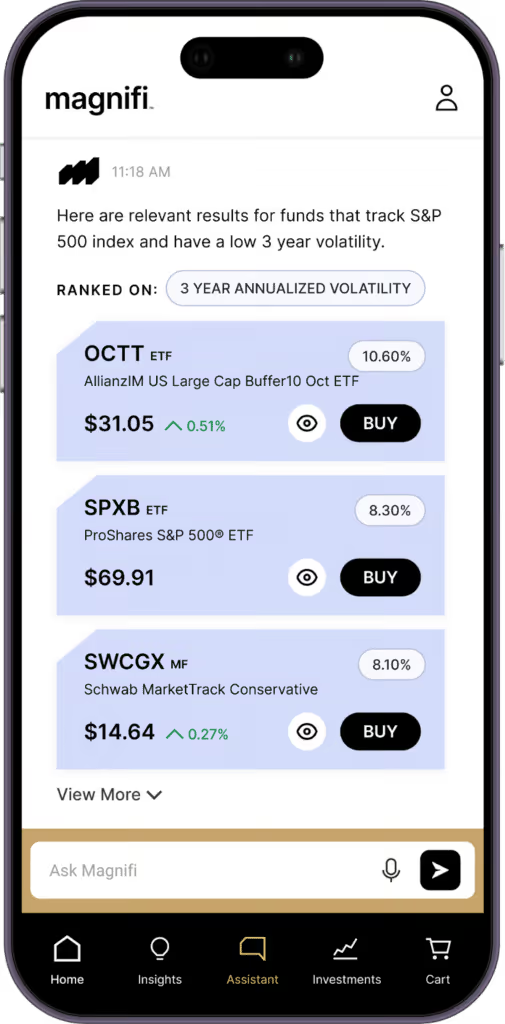
Now there’s a perfect way for drivers to invest their earnings and achieve their financial goals that simplifies the process and saves time. Magnifi helps you make key investment decisions. This AI-driven app does research faster and better than many advisors or brokers. Now you can plan for a goal, manage your portfolio, and learn while you invest.
The advanced search engines that power Magnifi will analyze existing investments, evaluate stocks, compare ETFs*, and build a highly personalized portfolio for you, based on your investment personality. Magnifi’s AI assistant provides a conversational interface that answers all your questions, from basic investment know-how to guidance on how to reach your financial goals.
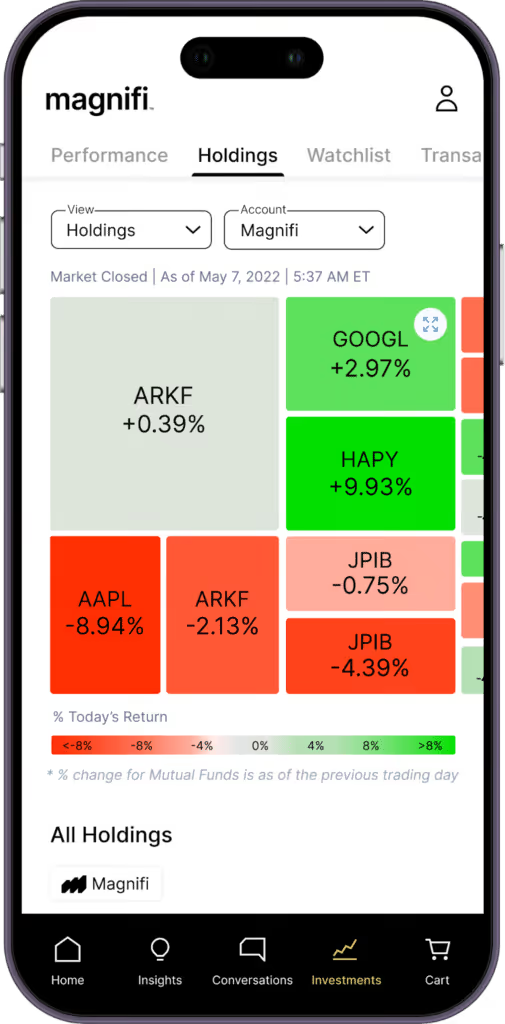
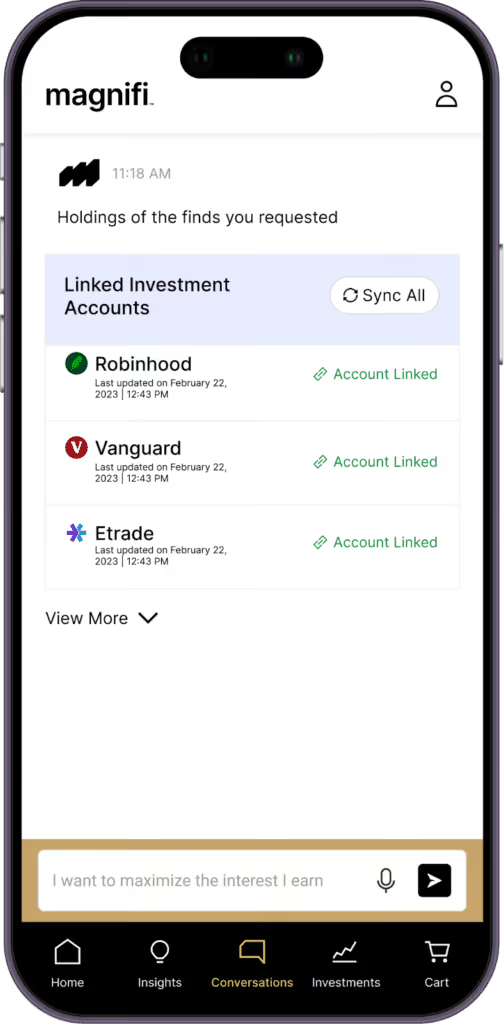
How does it work? Magnifi uses AI technology to grab pertinent information from industry-leading sources like Morningstar, Factset, and Fi360. It scans financial and pro-level data, along with business news, to give you data-driven tips that make you confident about your investment choices. You can even trade stocks and funds through Magnifi’s commission free brokerage, and link to your accounts from other brokerage houses, such as E*Trade, Robinhood, Vanguard, and Charles Schwab to view all of your investments in one place.
Why you need Magnifi
Because you work so hard, you deserve to do everything you can to prepare for your future. As an independent contractor, you don’t have the kinds of safety nets many people fall back on when they retire. Without a pension fund set aside for you, you’re going to have to use the money you earn now to create a nest egg you can count on. Let Magnifi ai help you build a more confident financial future with the amazing features you’ll get with your $11 per month membership**:
- powerful conversational AI assistant
- investment search engine
- on-demand data
- external links to your brokerage accounts
- access to Magnifi ai commission-free brokerage, plus a high-yield savings account
- choices based on your investment personality
- financial goal planning
- the ability to find pockets of hidden risk and growth
- up-to-date knowledge based on news, trends, and new investment types
- simple connectivity to your existing bank account
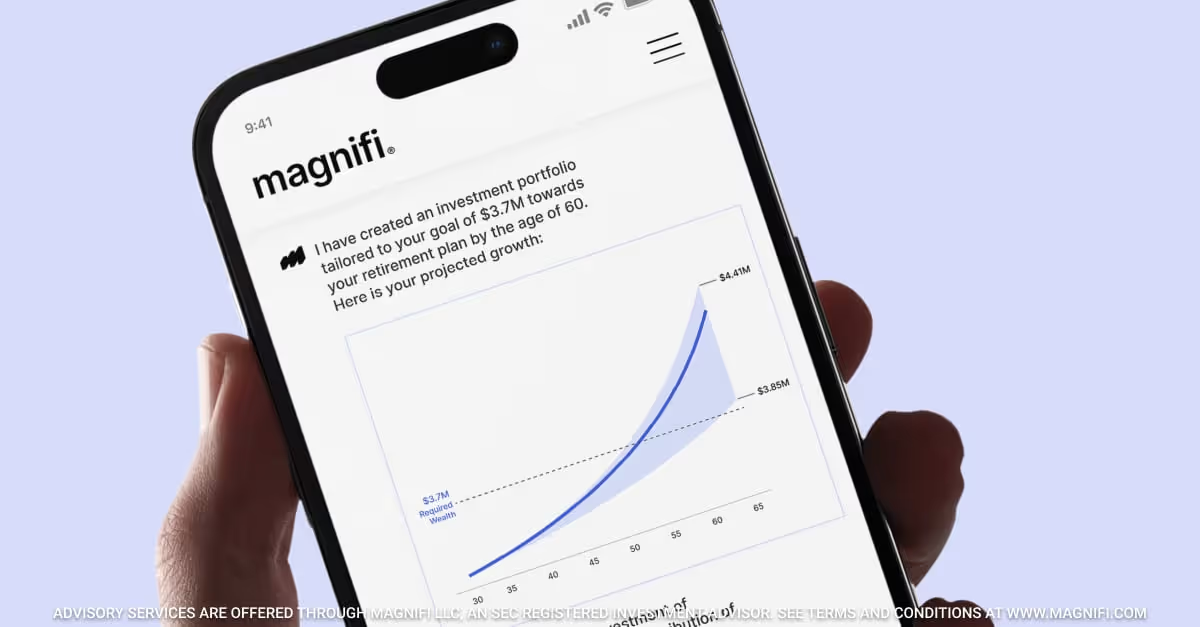
The power of Magnifi gives you all the information you need to be a better investor. You’ll navigate the unwieldy world of investments with intelligent guidance, efficiency, and constant support. Find new investments, research the possibilities, compare stocks and funds, and then build and manage a full portfolio you can call your own.
Act fast and start your free trial. Download the Magnifi app for Apple or Google and start smart investing right away!
*Mutual Funds and Exchange Traded Funds (ETF’s) are sold by prospectus. Please consider the investment objectives, risks, charges, and expenses carefully before investing. The prospectus, which contains this and other information about the investment company, can be obtained from the Fund Company or your financial professional. Be sure to read the prospectus carefully before deciding whether to invest.
**based on annual membership

Everything You NeedHow Much Do Amazon Flex Drivers Make
Have your “people skills” been tested to the max by rideshare and food delivery work? If so, Amazon Flex could be an excellent option for you. Flex is Amazon’s platform for drivers who want to deliver “smiles,” the company’s way of describing Amazon packages, to online shoppers. Most of the time, you won’t even see the people at the other end of the delivery, so this gig is likely to give you a break from the pain and angst of dealing with the general public.
That’s not the only good thing about Amazon Flex, though. In this post, we’ll cover more pluses and a few things that aren’t so great, so you can decide if this could be a good gig for you.
Amazon Flex basics
How does Amazon Flex work? Amazon Flex drivers are independent contractors who use their own vehicles to deliver items ordered from Amazon, including
- packages: picked up at a delivery station and then delivered to customers within a given time frame, usually a 3–6 hour block
- Prime Now and Amazon Fresh: groceries and household items picked up from an Amazon delivery station, then delivered, usually in 2–4 hour blocks
- store orders: pickups of items from local stores, in blocks of 2–4 hours
- instant offers: last-minute restaurant deliveries completed in 15–45 minutes, separate from scheduled blocks, and available only in select areas
The Amazon Flex app handles all the tasks drivers must complete, which include
- scheduling
- scanning barcodes on packages
- plotting the delivery route
- re-scanning the package again at the delivery point
- providing photo evidence of the delivery
Drivers for Amazon Flex work on schedule blocks, meaning they must prearrange work times, show up at the delivery station on time, and complete all the deliveries within the scheduled block. This YouTube video from the Side Gig Guy describes how schedule blocks work, and offers general tips about working for Amazon Flex.
To schedule a block as a Flex driver, start by selecting the warehouse you want to work from. The app will then show you what’s available and how much you’ll be paid; then select the block that works for you.
You must be on time for your scheduled block if you expect to maintain a high driver rating with Amazon Flex. When you arrive at the delivery center, you will need to scan the package codes into your app.
You are expected to get all the goods delivered within the scheduled time block. While that usually isn’t an issue, it can become problematic, depending on the number of items, traffic, and other delays. If you work beyond your scheduled block, you won’t be paid for the extra time it takes to finish all your deliveries.
You can always get help from Amazon Flex when you run into problems. This Gridwise blog post describes situations when you might need to get in touch with Amazon Flex support and how you can best obtain help.
Knowing all these things, you’ll be ready to go out and complete your deliveries. This is how individual deliveries may appear within the Amazon Flex app:
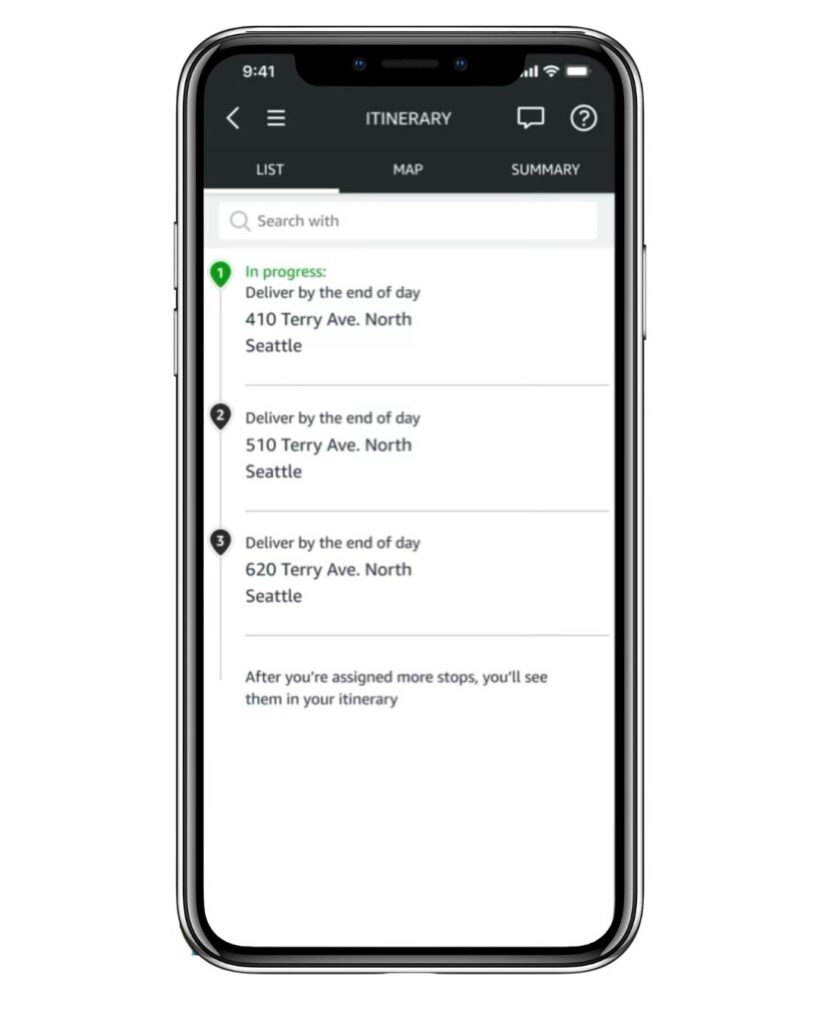
When you click on the individual deliveries, the app will direct you to the customer’s address.
As you can see, you will depend on your app for almost everything you do as a Flex driver. Fortunately, you’ll get opportunities to learn more about how to use it once you sign up and are accepted as a driver. First, though, you need to meet the Amazon Flex driver standards.
What are the requirements for Amazon Flex drivers?
The requirements for Amazon Flex drivers differ some from those you need to meet to do rideshare or food delivery driving. There are a few things to consider before you even think about signing up.
- You will have to do some moderate-to-heavy lifting in the course of delivering packages.
- You will need to deal with being outside in extreme weather.
- You must live in a city where Amazon Flex operates. Check the Amazon website to see if it’s possible to drive for Amazon Flex in your city.
- There must be slots available for drivers in your area. To make working for Amazon Flex desirable, the company limits the number of drivers they approve. That way they can guarantee there will be enough work for them. Be prepared to be placed on a waiting list if there are already enough drivers in your town.
Once you get past these considerations, you’ll need to meet these company requirements:
- be 21 years of age or older
- have a SocialSecurity number
- pass a background check (criminal and DMV)
- have a valid U.S. driver’s license
- have a vehicle large enough to carry delivery loads, specifically, a midsize four-door sedan or larger; except for Prime Now, which permits the use of any reliable four-door vehicle
- carry sufficient insurance on your vehicle, beyond the insurance Amazon provides, as shown on the Amazon website
- own a suitable smartphone, as shown in the table below
AndroidiPhoneAndroid 7.0 or newer
2 GB or higher RAM
Camera with flash
GPS location services
SIM cardiPhone 6s or newer
iOS 14 or higher
Granted, qualifying to be an Amazon Flex driver, and dealing with the logistics involved in scanning and delivering once you’re on board, can sound daunting. But there’s a really good reason why so many drivers love working for Amazon Flex, and that has to do with the way we can answer this question: How much do Amazon Flex drivers make?
Amazon Flex driver pay
It’s true. Amazon Flex drivers make more than most rideshare and delivery drivers, at least as far as earnings per hour and earnings per delivery are concerned. In 2022, Gridwise data showed that Amazon Flex drivers averaged $23.35 per hour. This exceeds the rates raked in by drivers for just about any other rideshare or delivery app.
Some other factors might give us a bit of a different picture, though. Let’s answer this question:
How much do Amazon Flex drivers make a week?
As it turns out, Amazon Flex drivers are limited to working 40 hours per week. Drivers won’t get assigned more than 8 hours of work per day, and most times it will be less than that. If we take the $23.35 per hour figure and apply it to a full 40-hour week, a very busy Flex driver will earn about $934.00 per week. More common would be a driver working around 30 hours a week, bringing the potential 7-day work figure down to around $700.00.
How much do Amazon Flex drivers make a month?
If we look at the maximum figure again and average four weeks in a month, a very busy (and lucky) Amazon Flex driver could stand to earn $3,736 per month. The more likely figure, however, based on a 30-hour work week, would be $2,800.
These estimates are very high in terms of the average number of hours Amazon Flex drivers actually work. This Gridwise post reveals that the average Flex driver made about $420 for the whole month. That would mean that, on average, most Amazon Flex drivers worked only about 18 hours a month.
That base hourly earnings figure, or $23.35, is derived from actual data collected by Gridwise. Other sources report lower figures. Indeed.com estimates the national average hourly pay for Amazon Flex drivers to be $16.34.
If you want to get granular about analyzing Amazon Flex earnings, read this Gridwise blog post.
So, it appears that while the average hourly earnings are higher than most other gig driving opportunities, the maximum number of hours most Amazon Flex drivers work is low. There are ways, though, to maximize earnings with Amazon Flex, as shown in this Gridwise blog post. Also, there are some perks available for Flex drivers. This Gridwise post tells you about the extras Amazon has to offer.
Now that we have a rundown of what it takes to work for Amazon Flex, and how much you’re likely to be paid, let’s lay out the good points and bad points of using this app for your driving gig.
Perks and considerations of driving for Amazon Flex
Like any job in the gig economy, Amazon Flex has its plus points and a few considerations to think about before you sign up. Here are some interesting items to consider on both sides of the equation.
Amazon Flex PerksAmazon Flex ConsiderationsLittle or no interpersonal interaction necessaryYou should expect to practice your logistics skills (e.g. scheduling, scanning)High hourly payYour hours could be limited by available schedule blocksSolid company and reliable businessMust be able to do moderate to heavy lifting Additional offers such as Amazon Fresh and instant offersAmazon Fresh delivery opportunities are not common.Drivers use their own vehiclesDrivers must have vehicles large enough to accommodate packagesDrivers get perks and discounts from AmazonDrivers must carry additional insurance for your own protection Amazon restricts the number of Flex drivers so there is not too much competitionDrivers are independent contractors and do not receive fuel reimbursement or company benefits
Fitting Flex into your driving routine
If you happen to decide that you want to make more money by multi-apping, and Flex is going to be one of them, you’ll need Gridwise.
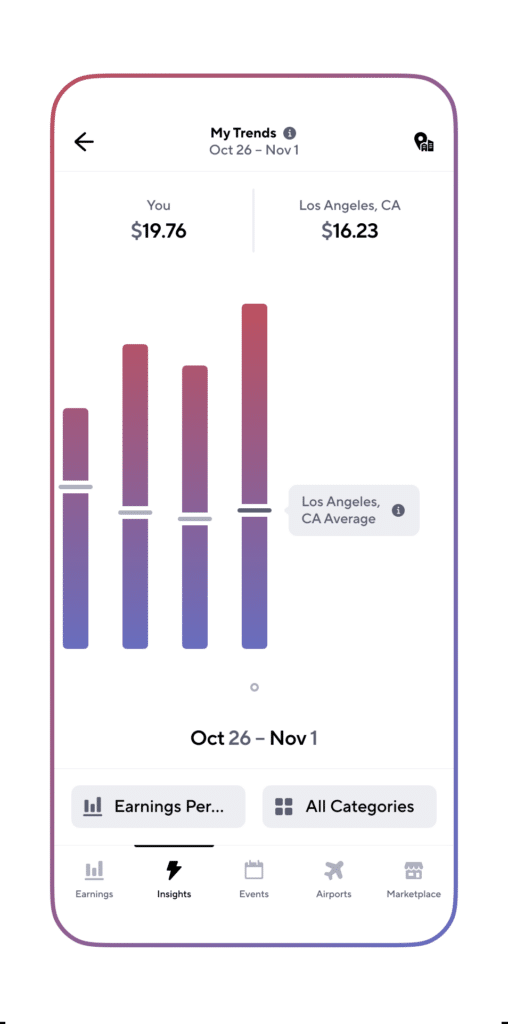
Not only is it a free Amazon Flex mileage tracker, Gridwise has its finger on the pulse of what’s happening in your area. Discover profitable times to schedule your blocks so you can earn more on your shifts!
Gridwise also tracks earnings and expenses for the rideshare and food delivery apps you might use in addition to an app such as Flex. Add in the $50/month gas discount, and you’ll start to save a lot.
Here are some additional resources for you to check out!
- How To Make $1000 A Week With Amazon Flex
- Check out the Gridwise Job Board
- How Much Do Uber Drivers Make?
- How Much Do Lyft Drivers Make?
- How Much Do DoorDash Drivers Make?
- Walmart Spark Delivery Driver Pay: How Much Does a Walmart Spark Driver Make?
- How Much Can You Make on Instacart?
- How Much Do Shipt Shoppers Make?
- How Much Do Uber Eats Drivers Make?
Gig Driving: Best Times To Drive
If you want to make more money, you have to make the most out of every moment you spend on every shift. You can’t waste time aimlessly riding around or sitting in a parking spot, waiting forever for the next ping to come. You need to drive at times when demand—and pay—will be at their peaks.
How do you know what the best times to drive are, and where would you get this information? This article from Ridelancer.com agrees that it’s good to know the right times to drive, and gives very general ideas about when certain peaks might be. This rough estimate, while somewhat useful, leaves much to be desired. If you want to know the best times to drive, there is a much better way to find out.
In this post, we’ll show you how the When to Drive feature from Gridwise can change your driving gig and make it far more profitable. Here’s what we’ll feature:
- When to Drive: Boost your earnings with real data.
- What special days and events create demand in your area?
- What are the best times to drive for Uber and other rideshare apps?
- What are the best times to drive for Doordash and other delivery apps?
- Additional insight into rideshare and delivery driving from Gridwise.
Let’s get started.
When to drive: Boost your earnings with real data
The When to Drive feature from Gridwise is based on far more than mere guesswork. It lists the best times to drive, specifically in your area, based on the actual experience of real drivers. This data from drivers just like you reflects the unique aspects of your area and lets you see when drivers make the most money.
Here’s how it works.
First, download Gridwise, the app designed for gig drivers by gig drivers.
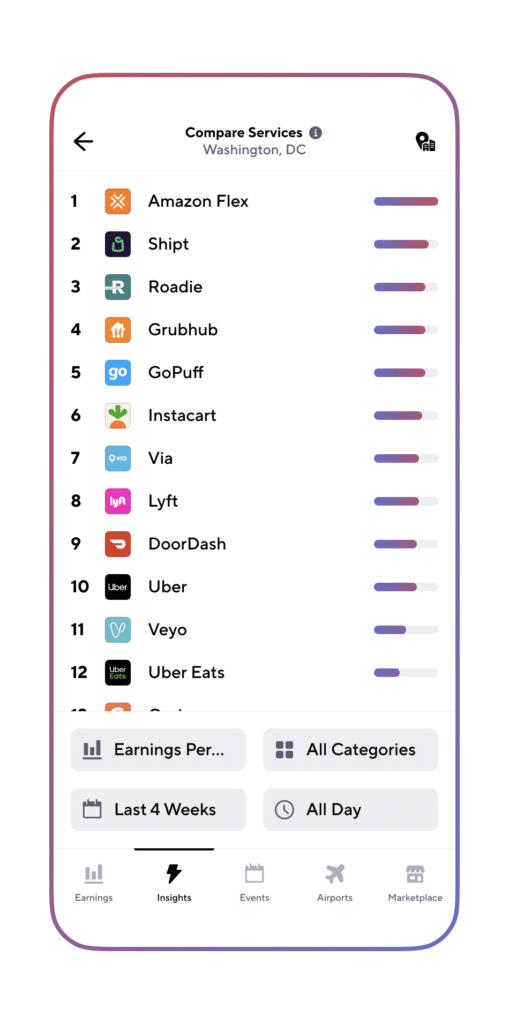
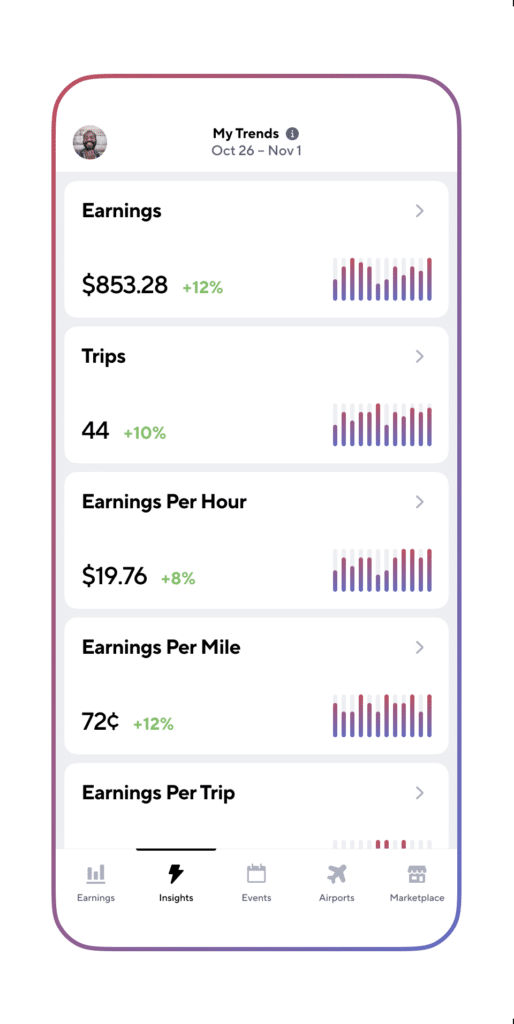
Sign in, and click on the Insights tab. You’ll see a chart showing the days that yield the most earnings in your town. You can also compare services to get insight into hourly rates across the apps you use.

Insights such as these can really boost your earnings, and you can’t have too many of them! That’s why you need Gridwise Plus, a premium service that offers extended features, benefits, and utility. For just $9.99 per month, you can boost your earnings up to 30% by taking advantage of extended features in When to Drive. Check out just how detailed the data telling when to drive can be:

The Gridwise Plus version of When to Drive gives you
- a history of earnings by time and by service, for at least 4 weeks
- airport departure and arrival patterns 24/7
- real-time flight details, including plane sizes and delays
- custom airport alerts
- unlimited information about local events
This insight is, obviously, like gold when it comes to knowing when to drive, but there is even more you need to be aware of.
What special days and events create demand in your area?
You can always count on When to Drive from Gridwise to show you the peak times to drive in your area. The app will clue you in on huge events such as pro sports games and major concerts. Don’t miss out, though, on smaller, more localized happenings that are bound to bring in the pings. Here are some to consider.
College comings and goings
Stay aware of academic calendars that govern life at the colleges and universities around you. There are bound to be surges when the studious ones are ready to take a break. This can happen at the beginning of terms, in the middle, and certainly at winter and spring breaks. In addition to airport runs, there are bound to be plenty of parties and school events surrounding these important dates. Move-in time is sure to bring you business when students are stocking their living spaces with creature comforts and junk food staples.
High school sports and events
Savvy parents are sick of trying to park at school sporting events and other auditorium-worthy presentations. It’s far easier for them to watch their favorite player, dancer, or budding violinist without the worries of dealing with their own vehicles. Delivery drivers can make out, too, with the after parties that are sure to take place. Check for signs around schools, local postings, and the school district website for dates and times of events. Be cautious about carrying under age kids, though. This article from Gridwise covers services that are best suited for those not yet enjoying adulthood.
Taco Tuesdays and Thirsty Thursdays
Most drivers think of midweek evenings as “dead,” but they might not be! Cruise your local neighborhoods to check advertisements outside of bars and restaurants, and keep a close eye on When to Drive and Where to Drive on the Gridwise app. They will tip you off on where people will be looking for gig drivers after indulging in the deals to be had. The conversations that go on in your back seat could make these “off” nights some of the best times to drive for Lyft.
Community events
Beyond games, shows, and other gatherings related to schools in your area, crowds gather for many events sponsored by the community at large. From Fourth of July fireworks and Pride parades to Santa’s arrival and solemn religious holidays, you’ll find activities and events that draw people who need your services. Check out your community calendars and stay on top of all local happenings.
“Smaller” holidays
You may not want to give up your own “big” holiday traditions so you can work, but what about a less major celebration such as Halloween? It can be one of the best times to drive for Uber. Not only can it be lucrative, it offers a bit of fun too. Check out this Gridwise post to get ideas for driving during the halloween. Then think about other “smaller” holidays that inspire you to dress up your driving to join in on the fun. Hearts on your car for Valentine’s passengers or Easter bunny ears, anybody?
Always check the Events Feature in Gridwise to pinpoint times and places for events Now that we know where to go to get real data on when to drive, and have some other ideas to go on, let’s look at how you can capitalize on different peak times, depending on your driving gig.

What are the best times to drive for Uber and other rideshare apps?
Gridwise data show us that the best times to drive can vary from one place and one season to another. However, time windows that are open to rideshare drivers everywhere can pay off in big ways.
Early morning airport runs
If you like to stay up all night or get up very, very early, you’ll find plenty of customers pinging for rides to the airport. With scheduling options now available for Uber and Lyft, you could even get the advance notice you need to plan for a little shut-eye before or after your trips. And always remember to check Gridwise for up-to-the-minute airport info!
Before and after work hours
For starters, there’s a rule of thumb, according toFast Track Leasing LLC, that cites early mornings as the best time for rideshare drivers. With the price of parking in numerous cities, many workers prefer to let you do the driving. It’s true that not all office buildings are back to pre-pandemic numbers in terms of rides, but this is still fertile ground for harvesting plenty of pay.
Weekends and party hours
So many passengers enjoy the freedom rideshare offers in terms of staying away from driving after they’ve had a few, and certainly after a few too many. The lack of parking fees and the hassle of worrying about one’s car add to the incentives people have for calling an Uber or Lyft when they have plans to party hard.
Big events
Concerts, sporting events, festivals, and all types of crowded gatherings are likely occasions for passengers to call Uber, Lyft, or their other favorite rideshare services. Be careful here, though. Try to drive around the big event, say for tailgating or pre-stage play or concert meals. That way, you won’t spend your entire shift hoping the traffic jam you’re sitting in, at or near the event venue, will clear.
What are the best times to drive for Doordash and other delivery apps?
You’ll find out the details from When to Drive from Gridwise, but we also want to give you some general ideas to keep in mind for grabbing ping-rich delivery shifts. Don’t miss out on the best times to drive for Uber Eats, Grubhub, or Instacart. Here are a few.
Nighttime noshing
Never underestimate the ability of college students or late night bar hoppers to devour entire pizzas or burgers piled high with gooey extras during the wee hours. Most delivery drivers focus their efforts on “customary” meal times, but the late night can be a great time to scoop up big orders. Hang around the eateries that attract this crowd, and you’ll be heaving bags full of comfort food, and possibly collect bonus money and big tips for hanging out long after dark. Don’t believe us? Teecycle.com has more about evolving late-night eating habits.
Pre- and post-game parties
The majority of people dig making their own munching material at tailgate parties, but some will probably want to have you bring their favorite restaurant wings instead. As for those who are watching big games at home, you’ll be their favorite person when you deliver the cheesy nachos and bottomless barrels of salsa. Stay alert to game times, including halftime and final whistles. If you deliver beer, you could be bringing it for a celebration or for something your customers can cry into. Either way, you get to keep your profits high!
Pre-holiday prep time
When people are in the throes of putting together gigantic feasts for upcoming holidays, the first thing they’ll want is today’s dinner delivered…now. You can bet on more than a few orders coming your way on holiday eves. And if your app involves delivering groceries, there’s a lot of last-minute order potential for forgotten, and drastically needed, items too.
Bad weather
It pays to have your delivery vehicle ready for service in rain, snow, sleet, and even blazing sun. When the weather gets disagreeable, customers just might flock to their delivery apps to order comforting grub without having to leave the welcoming heat of their homes. When are the best times to deliver for Uber Eats? you ask. Even with a keen eye on the weather, it can be hard to tell.

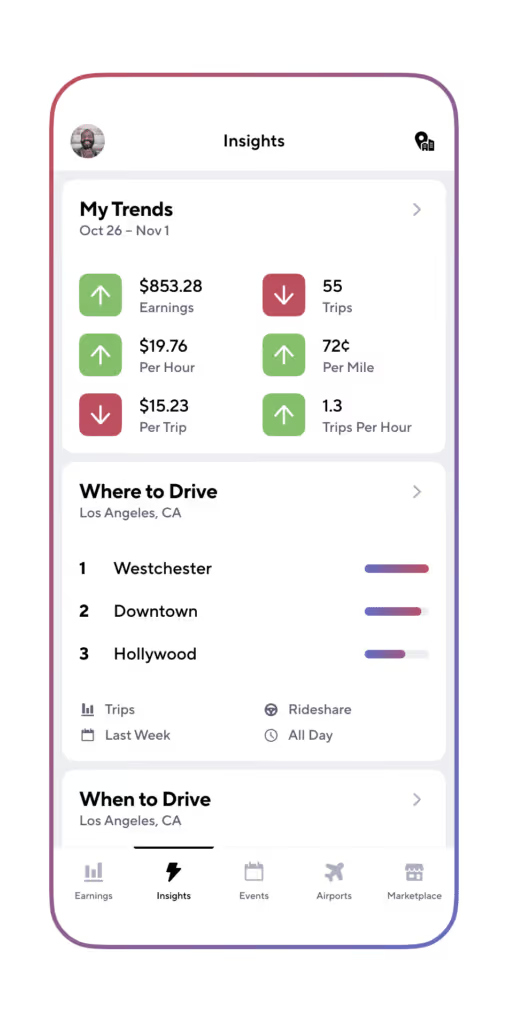

You need solid knowledge and personalised data from When to Drive from Gridwise. Then you’ll know for sure when you can make more money, any time of the day or night, and in any weather!
Download the Gridwise App
Additional insight into rideshare and delivery driving from Gridwise:
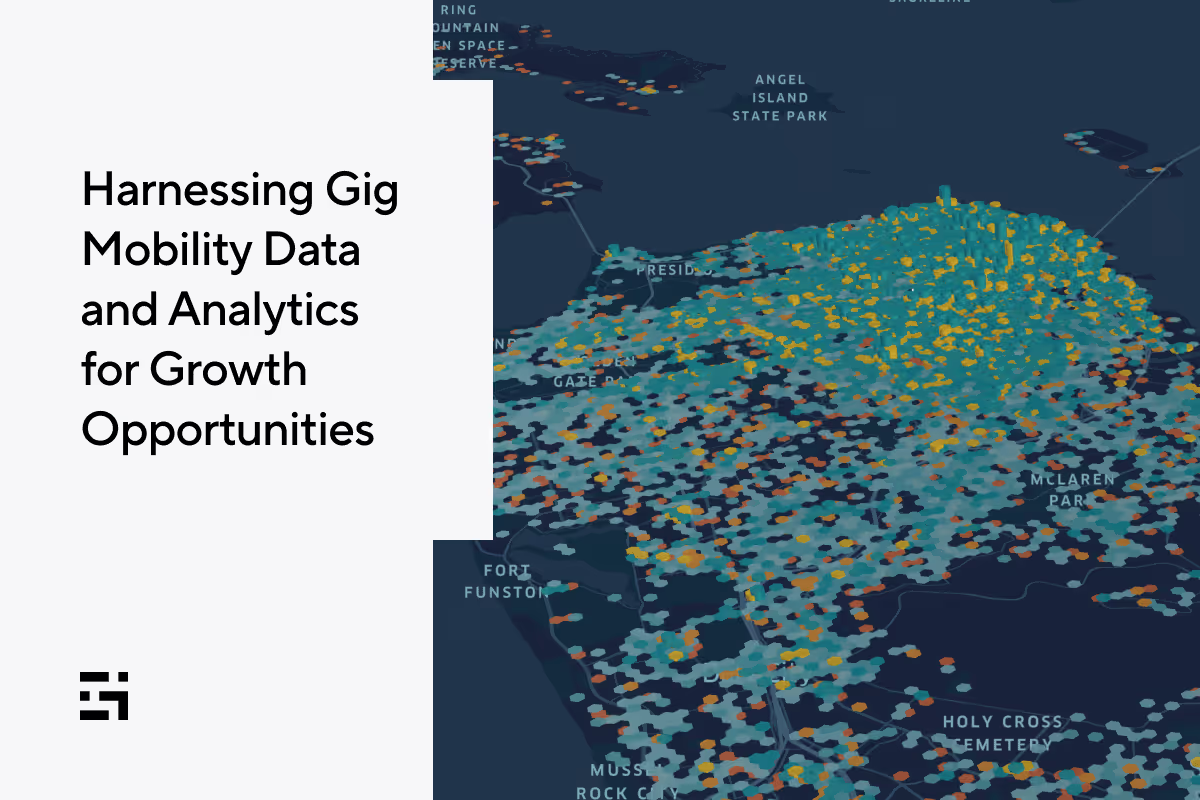
Harnessing Gig Mobility Data and Analytics for Growth Opportunities
Gig mobility data may be one of the most valuable business tools in the last few years. In the post-pandemic shift to hybrid work and working from home, traffic patterns in downtown areas have changed. Major residential communities are springing up in the suburbs, seemingly fully developed, as the commuter base around metropolitan areas creeps further from the interstate. For instance, what was once an hour’s drive from downtown Los Angeles to the outer suburbs during evening rush hour now often exceeds two hours.
What does this mean for mobility-related businesses? How do rideshare companies determine surge policies and driver incentives in these quickly growing and continually changing areas? How does the competitive food delivery business determine market penetration strategies in a constantly expanding and changing environment? How do services like Amazon Flex and Roadie look at logistics analytics to determine their scheduling?
Equally important, how does the investment community evaluate mobility-related opportunities powered by new technology and new ideas, especially in a business sector where change is the only constant?
The secret is knowledge. Who’s driving where? When do they drive? What route do they take? Gig mobility data answers many of these questions.
Gridwise Analytics gathers vehicle trip data across all significant gig service platforms, receiving information from over 500,000 gig drivers who have downloaded the Gridwise app. This input allows Gridwise to aggregate gig mobility data and translate it into transportation analytics. The result is the ground truth: What’s happening on our streets and freeways? This information helps businesses in all sectors operate more efficiently.
What are mobility data, gig mobility data, and transportation analytics?
Before discussing the opportunities within mobility data, gig mobility data, and transportation analytics, it is crucial to understand the definitions and the differences between the applications of these terms.
Mobility Data
This is the broader of the two terms, referring to any data related to the movement of people or goods across different transportation modes. It can encompass public transportation, private vehicle usage, pedestrian traffic, and more. It also encompasses shuttles, scooters, and rideshare.
Gig Mobility Data
Gig mobility data is more specific and indicates that the data is related to the gig economy segment of mobility, such as rideshare and delivery services (including prepared food, groceries, and parcels). This would be particularly relevant to gig drivers and companies interested in understanding patterns, demand, and operational efficiencies within the gig sector.
Transportation Analytics
Transportation analytics is the interpretation of the related data. As Harvard Business School Online explains, “Data analytics refers to the process and practice of analyzing data [in this case, gig mobility data] to answer questions, extract insights, and identify trends.”
For instance, rap star Snoop Dogg appeared at the Ball Arena in Denver, Colorado, this past July 2023. An analysis of gig mobility data surrounding that event can reveal
- where concert attendees came from (the geographic reach of a rap performer in the Denver metropolitan area)
- what route they took (how will traffic be affected?)
- how far in advance of the event they arrived (what’s the potential impact on restaurants in the area pre-event?)
- how long attendees remained afterward (rideshare companies can use this input to determine the time and length of surge periods)
In each case, data from different times and different places tells a different story, of interest to a different entity.
Gig mobility data refers to the individual points of information. Transportation analytics refers to interpreting that information to develop a story and its potential effect on a business.
What can gig mobility data show us?
Gig mobility data can help us see the overall picture
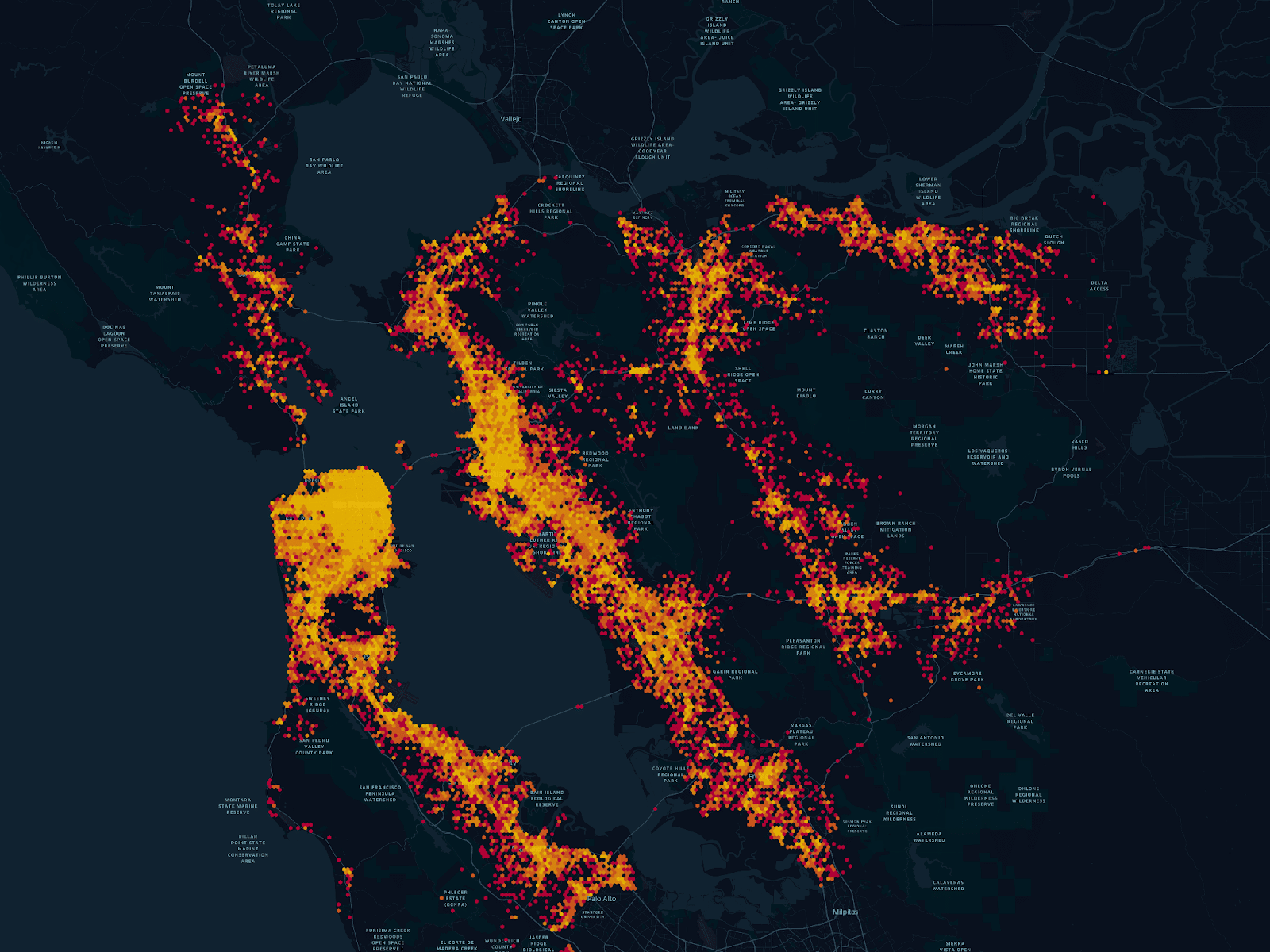
The image above is a bird’s-eye view of San Francisco and the surrounding suburbs. Red and gold heat map points indicate rideshare pickup locations. Heavily populated areas turn almost solid gold with activity, centralized in the San Francisco city area on the left of the image, with the next most active area across the bridge to the right (east) in Oakland.
This map highlights other sites that may be less popular but still show significant activity. If a new entrant wants to enter this market but is still determining where they want to focus, this gig mobility data information can help answer that question.
Incumbents can also use this data to identify where their competitors’ are active. By understanding where competitor activity happens, rideshare companies can position their businesses to capitalize on their unique advantages in ways that competitors can’t, leading to more profitable market share. Maybe rural markets are underserved, presenting an opportunity.
Gig mobility data can help us see the activity of different gig platforms
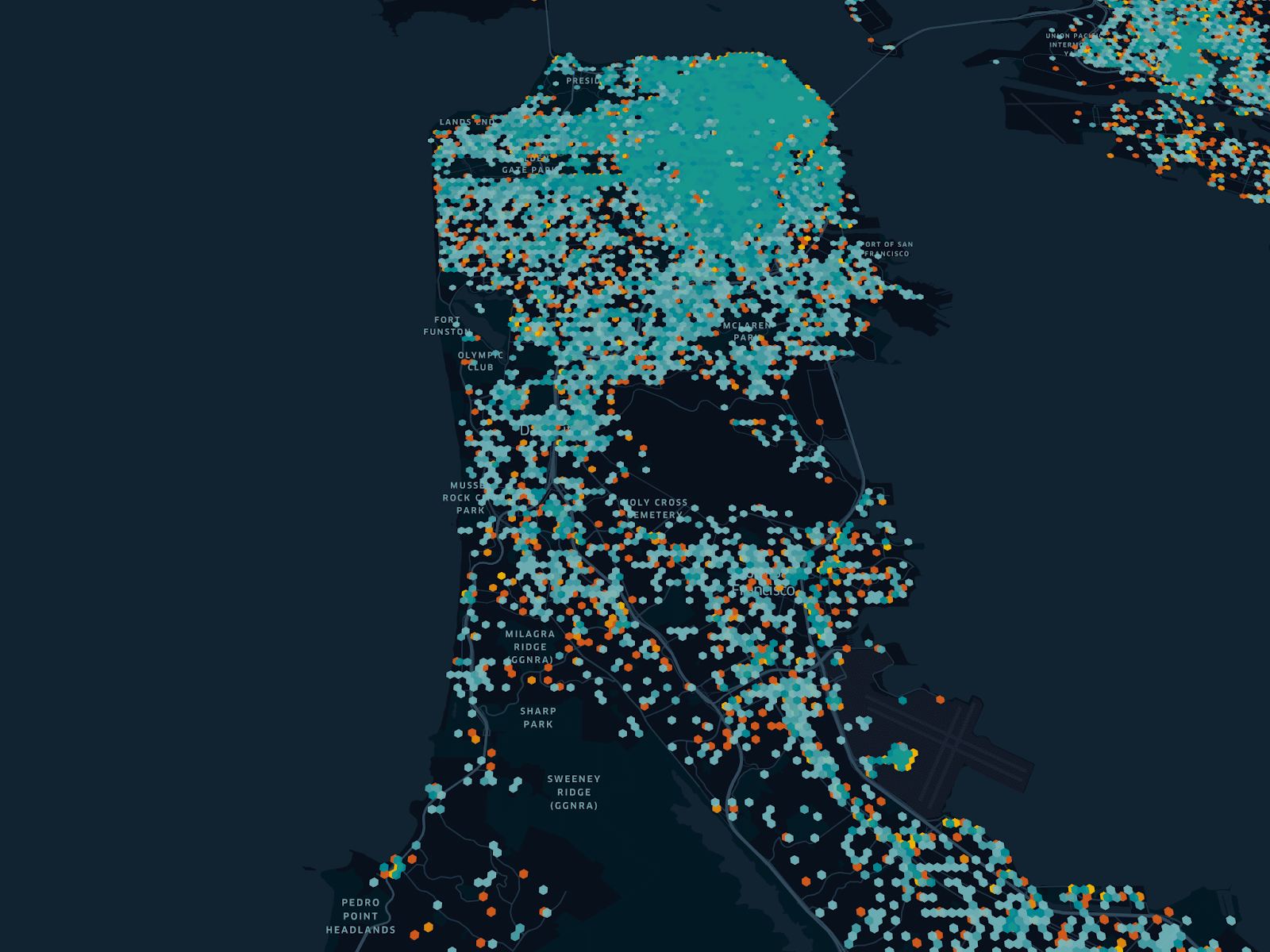
Gridwise Analytics can overlay gig mobility data from two companies, as we have done here again with San Francisco, providing a view of rideshare market domination.
The orange points represent areas of activity for Company A, while the blue points represent activity for Company B. If you were a new industry entrant, you could see where your competitors are focused.
Gig mobility data can identify points of activity
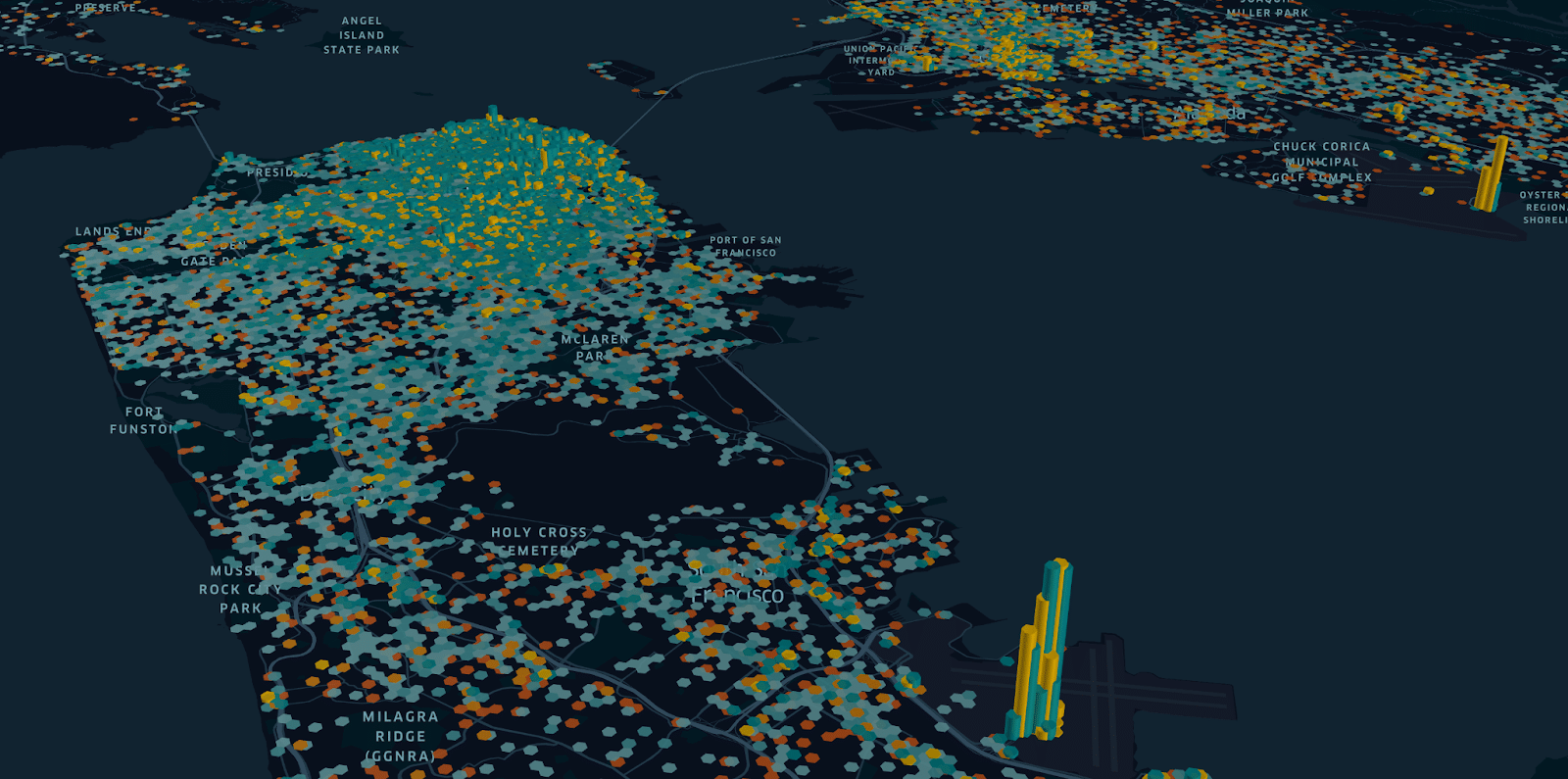
Gridwise can help companies visualize this data by adding a three-dimensional element to represent more trips occurring in the same area. Both clusters of columns (in the lower center-right and the far center-right), represent rides at airports, showing the popularity of those locations for rideshare drivers.
Different colored points represent the different rideshare services. This type of transportation analysis can also be done for grocery and food delivery services, showing clusters of restaurants and even individual establishments that generate substantial orders. These merchant insights are key in developing strategies based on ground truth data.
How does gig mobility data identify and leverage hotspots?
Residential development
Construction is near completion on a hypothetical new community of 350 homes in a suburb 30 miles from a major metropolitan area. Rideshare companies want to know the kind of traffic the community will generate at key times, both from commuters and for trips to regional airports, among other destinations.
In advance of that community opening, analytics companies can locate similar communities in the area (similar income and demographics), procure transportation data analytics for commuter rideshare, and predict what the new community will generate. Based on this information, rideshare companies can determine driver incentive programs to service this community, such as surge pricing and other promotions.
Origin and destination data can optimize route efficiency, reducing fuel costs and travel time. Grocery delivery platforms will also be interested in the information and what it means for the demand for their services.
Retail establishments, like supermarkets and restaurants, and services like health clubs can also procure gig mobility data to determine the feasibility of new locations to serve the community.
New entertainment and sports venues
A recent AP article predicts that by 2028, Major League Baseball will likely add two new franchises, meaning new teams in new cities. Cities running for the new franchises include Charlotte, NC; Nashville, TN; Portland, OR; and Montreal. According to AP, Salt Lake City, UT, and Austin, TX, have also expressed an interest. The Tampa Bay Rays are finalizing plans for a new ballpark in St. Petersburg, FL, and the Athletics are leaving Oakland, CA, to head for Las Vegas.
This means those cities and the rideshare companies that serve them will seek gig mobility data to predict the volume of passengers on game days. One tactic will be to examine game day transportation data analytics from stadiums in similar cities. At a minimum, the gig mobility data will again help rideshare companies determine how many new drivers they need to attract to their platforms and what kinds of promotions they will need to draw those drivers out.
These facilities will no doubt host other events, including concerts and other sporting events. Member companies in the transportation network will be interested in gig mobility data so they know how to serve attendees best.
Gig mobility data has value for the investment community and hedge fund managers
Investment companies, hedge fund managers, and venture capitalists have also found opportunities to use gig mobility data and transportation data analytics to solidify their investment strategies. The increasing integration of technology and data analytics has opened new avenues for investors to gain insights into various industries, and the mobility sector is no exception. Here are just a few examples.
- Opportunities in the gig industry. First, it was rideshare, then food and grocery delivery, followed by parcel delivery. Airbnb and Vrbo rent out vacation homes, and Outdoorsy helps RV owners justify the expense of their rigs by renting them out when they’re not in use. All these industries and their investors will benefit from gig mobility data.
- Infrastructure investments. Investment firms often seek opportunities related to infrastructure development. Transportation analytics can identify locations where there is a need for improved transportation infrastructure. Cities can use gig mobility data and transportation analytics to structure bond offerings to finance infrastructure projects. Cities are also now considering broadband as part of the infrastructure, which will put more focus on this sector.
- Regulatory impact. Regulations and policy decisions heavily influence the gig driver industry. Gig mobility data and predictive analytics can help investors determine how proposed regulations may impact companies in this sector. Anticipating these regulatory shifts allows investors to evaluate investment opportunities better. Industry principals can use predictive analytics to mount campaigns that ensure legislators consider all options and ramifications of potential regulations.
- Insurance. Automobile insurance companies base their rates on the zip code of where the insured lives. Gig mobility data can contribute to risk management strategies by providing a more accurate view of risks and challenges in a zip-code area. This includes traffic congestion, supply chain disruptions, and environmental considerations.
- Impact of technological advances. The mobility sector is undergoing rapid technological advancements, including the development of autonomous vehicles, electric transportation, and smart city solutions. Investment companies and hedge fund managers can use gig mobility data for predictive analytics, evaluating investment opportunities in companies involved in this technology. Companies in the autonomous vehicle and electric vehicle charging industry have used Gridwise gig mobility data to make decisions that have had considerable financial impact.
- Economic indicators. Changes in gig mobility data often reflect broader economic trends, providing investors with early signals about economic downturns or upswings. A decrease in regional commuting activity could indicate layoffs, while an increase in vacation travel could indicate economic growth.
Gig mobility data does not exist in a vacuum
Much of the decision-making regarding transportation and related projects relies on online research, observations, and unscientific studies. Often this information presents a conflicting picture of what’s happening.
Gig mobility data and transportation analytics provide a more definitive answer. Gridwise Analytics has encountered several companies that were stymied by conflicting perspectives. Once they added gig mobility data from Gridwise, the picture became clearer.
“We always knew we needed TNC data, but before Gridwise Analytics, there were only limited sources out there,” said one company official.
Gig mobility data from Gridwise Analytics
Gig mobility data from Gridwise Analytics offers unique insights for companies involved in and serving the transportation infrastructure, showing how people and goods move from one location to another. The granular data shows where trips originate, where they end, and the major travel corridors. Gridwise Analytics is the who, what, where, when, why, and how of gig mobility data.
Data teams can sort this information to reflect daily, monthly, and annual patterns. Gridwise data comes in a clean format, with little or no need to manipulate it to fit into the model you might be using. Models can be quickly updated with new information, too.
For a demonstration of how Gridwise Analytics vehicle trip data can sharpen your transportation analytics, contact us below.
Are you looking for more articles about Gridwise Analytics?

How to Become a Lime Juicer: A Guide to Being a Lime Charger
Mixing it up is a sound strategy for gig drivers. For rideshare drivers, this means working for Uber and Lyft simultaneously. For food delivery drivers, this is working for several companies in the same way. And then some drivers mix rideshare and food delivery.
Other gig drivers add to the mix when they get involved in micromobility, sometimes referred to as the last mile. We’re talking specifically about Lime scooters. As most of us know, the opportunity is to get involved as a Lime scooter charger, or as Lime refers to it, a Lime Juicer.
What is Lime and how does it work?
Lime is one of the two big players in the rentable electric scooter market, part of the larger micromobility arena. Bird was the first company to launch rentable electric scooters in 2017. Lime, which was actually founded before Bird, has been giving them a run for their money ever since. Who’s on top in market shares switches back and forth, with the other players back in the pack. Those other players include Uber, Lyft, Spin, and Skip.
Lime scooters and their competitors are electric scooters, also known as e-scooters. They are rented through an app and typically used in congested city areas for short trips. Lime and Bird scooters have a top speed of about 15 miles an hour, and a range of about 15 miles before the scooter needs to be recharged. Both companies also have e-bikes, but that market is not part of this article.
Where will you find Lime scooters?
Like all scooter companies, Lime is looking for target-rich environments where the scooters get a lot of use and are easy to find and harvest. This means large downtown areas, the beach, and some resort areas. The Lime website lists 53 cities in the US, although this number is constantly growing. Users skew toward millennials and Gen Z, especially the hipster and bougie crowd.
You will also find Lime, as well as the other electric scooter companies, around the world. Europe is a big market, larger than the US in terms of cities. If you live in the US, then there is a city near you that offers Lime scooters and its competitors.
Some cities have banned e-scooters
From the very start, there have been problems with this emerging mode of micromobility. Many cities banned them, citing accidents caused by reckless scooter users, scooters abandoned in the middle of streets, and other issues. Many of these were legitimate concerns.
Other cities later invited them back, often in trial programs. A city might invite Lime to be part of the program, along with a few others, but exclude Bird. It’s all dependent on which company made a good proposal. E-scooters are a very fluid market.
How to reserve a Lime scooter
If you want to use a Lime scooter, download the Lime app and link it to your debit card. The app will then show you available scooters in your area. When you select a scooter, it is reserved (usually for about ten minutes), and the app gives you the scooter number and the address of its location.
Once you locate the scooter, you scan the QR code on it, which unlocks the scooter. You give it a push, crank the electric accelerator, and off you go. Charges can vary slightly from one city to another, but unlocking the scooter is generally $1, and then there’s a per-mile cost of 15 cents, although it goes as high as 30 cents. When you arrive at your destination, Lime asks you to leave the scooter someplace safe (which doesn’t always happen). Deactivate the scooter on your app, and you’re done.
Becoming a Lime scooter charger
Charging Lime scooters is where the gig work comes in. Lime calls them Lime Juicers. At a designated time, usually 9:00 p.m. or 10:00 p.m. (it can vary by market), the Juicer portion of the Lime app will start displaying scooters that need a charge. The Lime Juicers reserve their scooters and hit the street to find them. Lime calls this harvesting.
You get three or four Lime charger cords when you sign up as a Lime Juicer. If you were one of the early ones to sign on, there is a good chance you received them free from Lime. You are more apt to pay for a Lime charger now though. Figure about $15 or $20 for each charger from Lime. You can also find them on Amazon and eBay (both new and used) for lower prices. Also, look on OfferUp and similar sites.
Once a Juicer has completed their harvesting activities for the night, it is back to their home to charge the scooters. This process takes about five hours and probably involves a power strip or two or three (Amazon has some chargers that will juice up to six scooters at a time). According to various reports by Lime Juicers, it costs less than 20 cents in electricity to charge a scooter. Other Juicers say they don’t notice a change in their electricity bill.
Once the scooters are charged, Lime requires that they be back on the street, generally starting at about 4:00 a.m. for the early rush hour users, and no later than 7:00 a.m. (these times may vary from city to city). Lime says it will not compensate Juicers for scooters dropped off after 7:00 a.m., although some Juicers claim they have been paid for late drop-offs.
How much do Lime Juicers make?
When a Lime Juicer looks at the app, they see how much Lime is paying to juice each scooter. Rates are based on how much of a charge the scooter needs and how easy the scooter is to find. A scooter on a major street in a downtown area might get the Juicer $3 to $7, depending on the charge needed. If the scooter is on a side street and it’s drained, the pay might go as high as $12.
Then you have the scooters that are abandoned in difficult-to-find locations: a residential neighborhood, an alley on the outskirts of downtown, or some other strange location. The app may even be reading a scooter that someone is keeping on the porch or garage, intending to ride it to work the next morning. These are probably better left alone.
How do these rates translate hourly?
Lime Juicers can easily make $15 or $20 an hour once they figure out how to harvest scooters and be efficient about it. Some claim to make as much as $30 an hour. How well you do really comes down to how well you hone your strategy, and everyone has their own strategy on how to do it.
The big takeaway to remember is that Lime Juicers have limited hours. The earliest you can go to work is 9:00 p.m., and the scooters get picked up quickly.
Lime can also be very seasonal. The business drops off during the rainy months. Does it snow in your area? Not much scooter business then, either.
Winning strategies: How much do Lime Juicers make a month?
This depends on your strategy. Everyone has a different approach, but there are three main categories:
Full-time Juicers
These are Juicers with a truck or van and a good number of chargers. They hit it hard, are constantly looking on the app for new scooters, and might charge 30 or 40 scooters a night, maybe more. They claim they make $4,000 a month minimum. Check out this Reddit thread about a Juicer who claims $400 a night.
Part-time Juicers
Some Lime Juicers have shared their strategy for maximizing part time earnings. One Juicer harvests a scooter with a charge on his way home from work and then uses it as his Lime Juicer scooter to locate others, which he then stacks on the first scooter. Then he rides the stack home. Their reported record is seven scooters stacked at once while driving down the street, but this Juicer is most comfortable with four scooters at once. In the morning they stack the charged scooters and checks the app for the nearest drop-off location indicated on the app. Working part-time, this Juicer says he once made $1,000 in one month as a Juicer. Other Juicers on Reddit claimed this strategy, too.
Hoarders
This is the type of activity that will get you kicked off the Lime app or any other scooter app. Still, it happens a lot. Hoarders go out before the appointed 9:00 p.m. hour and corral as many scooters as they can, ideally hiding them in a truck or van. At 9:00 p.m., they start scanning the scooters to see which ones require a charge. When the honest Juicers come out, all the easy-to-find scooters are gone. As you can guess, hoarders who don't get caught bring in good money.
Another strategy regards the easy-to-find scooters vs. the hard-to-find ones which command a bigger price. Wise Juicers will disregard the hard-to-find scooters, knowing they can pick up five easy-to-find scooters in the same amount of time and make more money.
Lime vs. Bird
In markets where both Lime and Bird are active, it’s a toss-up as to whether it is better to be a Lime Juicer or a Bird Charger. Rates are different in every market and they tend to fluctuate. According to Kevin Ha from FinancialPanther.com, the same chargers work for both Lime and Bird scooters (that is, at least some generations of the scooters), so it is easy to work for both companies.
Also, remember that there are markets where Lime or Bird are excluded. Obviously, that limits your choices.
Bird is also going through some changes that affect the gig charger community. Read on to find out about those changes.
How to sign up to be a Lime Juicer
The steps to being a Lime Juicer are about as straightforward as the other app-based jobs in transportation and micromobility. Here are the qualifications. You must
- be at least 18 years old
- be in possession of a valid US driver’s license (despite Juicers who claim they don’t use a car)
- be in possession of a Social Security number
- own a vehicle that can store at least one scooter (again, even though some Juicers don’t use their car)
- own a smartphone, iPhone or Android
As far as the actual sign-up process, it is easiest to download the app and navigate to the Juicer section. Fill out the online form, send it in, and wait for Lime to contact you.
This is where it gets frustrating in some markets
Lime’s latest innovation is their Gen 4 scooters. These models have a rechargeable battery pack. As of this writing, they are not being used in all markets, but according to an article in TechCrunch, that’s where the company is headed. In markets with the Gen 4 scooters, Juicers are out of business.
Lime has created a new gig position called movers, using contract workers to pick up scooters in outlying areas and bring them into the city, but most of the Juicers are complaining loudly. You can read about a Juicer on Reddit and their Lime experience in Denver.
Lime is purportedly paying movers around $3.50 per scooter they relocate. Most people don’t like change, but there are former Juicers and others who will undoubtedly embrace the model and figure out a strategy to make it work.
Changes to the Bird charger program
Bird instituted a program in which they created fleet managers. See this Gridwise report from a few months ago. The managers purchase Bird scooters, which Bird finances. Bird also retains ownership of the scooters (it’s strange, but the contracts are hard to come by and the fleet managers sign a non-disclosure agreement). The managers are in business for themselves. They get a bigger share of the profits but are responsible for warehousing, maintenance, and repair of the scooters in addition to charging. Again, in markets where Bird fleet managers are active, gig chargers are out of a job.
The arrangement has worked well for some, not so well for others, according to an article by SmartCitiesDive.com.
What’s the future for gig workers in the scooter sector?
If there is one constant in the micromobility and rideshare/delivery business for gig workers, it is that things will change. Who knows? Lime’s Gen 4 scooters may have a manufacturer recall, or they may encounter some other kink. According to the TechCrunch article, Lime would have rolled out the Gen 4 program earlier but there were supply chain issues.
Scooters seem to be here to stay, so if you're looking for an extra gig, it's worth checking out.
Whether you're already working as a charger or you're considering it, make sure you download the free Gridwise app to track your miles as a Lime Juicer.
More resources you might enjoy
Work smarter. Earn more.
Whether you drive, deliver, or pick up shifts — Gridwise helps you track earnings, mileage, and performance so you stay in control of your work. Download the app and take charge today.
