Gridwise blog
Tips, insights, and advice to help you earn more and work smarter, whether you do gig work, hourly, or shift work.
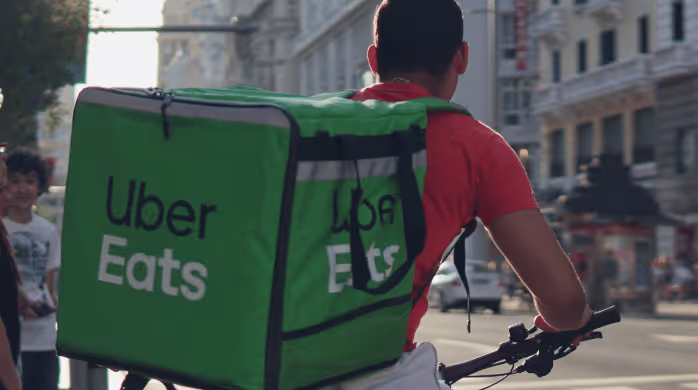
How to Make $1,000 a Week With Uber Eats in 2026 (Tips + Hourly Data)
In this blog, we'll explore the strategies and techniques that can show you how to earn $1000 per week as an Uber Eats delivery driver. We'll cover everything from optimizing your delivery zones and schedules to maximizing your tips and customer satisfaction. Whether you're a seasoned Uber Eats driver or just starting out, this guide will provide you with the insights and actionable steps to take your Uber Eats driver earnings to the next level.
Becoming an Uber Eats delivery partner can be a lucrative opportunity, especially if you're able to consistently earn $1000 a week. By understanding the platform, optimizing your delivery strategies, and focusing on customer satisfaction, you can maximize your earnings and turn Uber Eats into a reliable source of income.
We’ll cover the following topics to provide coaching and ideas to help you push your earnings up to that $1000 per week level:
What do Uber Eats drivers do?
Uber Eats drivers deliver prepared food most of the time, but they also might shop for and deliver goods from convenience outlets and grocery stores. The job is pretty simple. You get a request for an order, you drive to the restaurant or store to pick it up, and then you deliver it to the customer. If you already drive for Uber, you can choose to take orders for Uber Eats delivery any time.
If you’re not an Uber Eats driver yet, it’s pretty easy to become one. This Gridwise post tells you what you need to do if you want to sign up and start making money Uber Eats style. Many rideshare drivers welcome the chance to deliver food rather than people. This article from Nerdwallet covers the Uber Eats gig from that angle.
There are some sweet advantages to working with Uber Eats. In lots of cities you don’t even need to have a car. You can use a bike or a scooter, or even walk, to make your rounds. If you do use a car, Uber Eats’ requirements are a lot easier to meet than they are for Uber rideshare driving.
You also have a lot of flexibility. You can shop and deliver convenience items and groceries, but you don’t have to. And, like most driving gigs, you can choose your own hours, and map out the locations where you want to work.
Use Gridwise features When to Drive and Where to Drive to help you figure out what work hours and which specific areas will be the most profitable for you. Real data from real delivery people will show you earning patterns for drivers in your town.
How much can you earn doing Uber Eats?
The honest answer to this question is: basically, as much as you want! It all depends on how many hours you put in and how strategic you are about your gig. Earnings vary from one area to another, as this article from Entrepreneur points out. To give you a baseline, let’s look at the earnings of Uber Eats drivers who tracked their earnings with Gridwise.
Remember that these numbers show us only average earnings. To make $1,000 a week with Uber Eats, you’re going to have to be better than average, and we’ll show you how. For now, though, it’s good to have these figures so you get a ballpark number of where to start.
How much do Uber Eats drivers make?
Gridwise data tell us the following:
- Monthly earnings average around $444.00 per month.
- Gross earnings per trip are between $9.00 and $10.00.
- Tips make up about 50% of most Uber Eats drivers’ income, which amounts to about $225.00 per month.
Is Uber Eats good money? It can be. While there are other gigs that pay more per trip, if you drive for Uber Eats, you’ll always be pretty busy.
https://datawrapper.dwcdn.net/HPAz8/3
You can also see that, unlike many other gigs, tips play a huge role in Uber Eats earnings.

With these numbers as a baseline, what can we say about how to earn $1,000 a week with Uber Eats? As we said in the introduction, it’s going to be a hustle, but it’s really possible. To figure out how to make the most money with Uber Eats, let’s start by looking at how many trips these “average” drivers made each month.
We know that average gross earnings were $444.00 per month, and drivers got around $10.00 per trip. That means they took 44 or 45 trips per month, which breaks down to 11 trips per week. That’s not a lot of Uber Eats delivery, is it?
The fact that Uber Eats drivers averaged so few trips shows us that many drivers use more than one app at the same time. This is called multi-apping, and you can learn more about it in this Gridwise post. If you want to answer the question of how much you can make with Uber Eats, then you need to stick with the app and keep plugging away at those orders. You also need solid strategies, as well as some inside tips and tricks.
How to make the most money on Uber Eats: Delivery driving tactics
Getting to that $1,000 a week with Uber Eats isn’t so hard when you remember that the drivers we saw making about $111 a week were only taking around 11 trips in the same time period. That’s not much at all! If you work the Uber Eats app like a boss, you’ll soon have many more trips than that, easily reaching the number needed to get you to $1,000 a week. Now, let’s get to some tactics you’ll need to make that kind of bank.
- Stay with the Uber Eats app, and track your earnings. Gridwise can easily do that for you. Simply sync your Uber Eats app with Gridwise, and you’ll be able to see how much you’ve earned with Uber Eats, what times were most profitable, and your average hourly pay. Racking up trips with Uber Eats has other benefits, including perks and bonuses that are awarded to top drivers.
- Leverage surge pricing and promotions. Surge pricing is applied when there is a lot of demand. When surge pricing is in effect, many of the trips you make will pay more than usual. Promotions are offered to drivers who complete a given number of trips in a certain time period. High traffic volume days, nights, and times give you these chances to get extra earnings. Challenging yourself to complete the right number of trips for promotions will add to the number of trips you can count on for big bucks, too. Learn more about Uber Eats surge pay, boosts, and promotions in this Gridwise blog post.
- Say yes to doubling up on orders. With Uber Eats, you can get back-to-back orders or receive batched orders. Back-to-back orders happen when you receive a new request while you’re on the way to deliver an original order. The Uber Eats app routes these trips automatically, so you won’t be sent out of your way.
Batched orders are Uber Eats’ way of bundling together orders from either the same restaurant, or two nearby eating establishments. You get money, and trip count credit, for all the orders you complete, plus customer tips, without having to make a bunch of separate trips.
- Turn on the charm and get bigger tips. Being nice really is part of the Uber Eats driver’s job, and getting tips is one way people who drive for Uber Eats make money beyond their basic pay.. Bring along those extra napkins and condiments, use equipment that keeps food and drinks at the right temperatures and prevents spilling, and consider your customers’ needs. If you deliver groceries, be extra careful with delicate items such as bread and eggs.
And, most important, follow your customers’ directions, and stay in communication with them if you are going to be delayed, or if you have questions about their order. This Gridwise post will tell how to get bigger tips as a delivery driver.
- Use even more charm to keep your ratings high. As an Uber Eats driver, you will be rated by the restaurant or store where you pick up the orders as well as the customers who are waiting for the deliveries. This two-way rating system is designed to keep you on your toes, so Uber can keep people satisfied with your service. Don’t worry, you get to rate them, too.
There’s another reason why your rating as a driver is important. It not only keeps you in good standing with Uber; it helps you to qualify for the Uber Eats Pro incentive program. To learn more about Uber Eats Pro, and what it takes to earn perks such as preferred services, discounts, and deals, check out this Gridwise blog post.
Smart business moves that seal the deal
Now that you know how to gobble up the deliveries you need to make $1,000 a week with Uber Eats, it’s going to be a breeze to get there. Let’s make it even easier, with business moves that boost your earnings and shrink your expenses. If you use these, it will also be easy to say yes when people ask, “Can you make good money with Uber Eats?”
Minimize expenses. Avoid racking up big fast-food bills by bringing your own food and beverages. You might not think you’re hungry when you first start your Uber Eats run, but once the aroma of pepperoni pizza, premium cheeseburgers, and piping hot fries start wafting through your car, that might change. Bring a sandwich or other healthy food from home, and buy bottled water in bulk to save tons of cash compared to what it costs to buy single servings.
Maximize tax deductions. Another way to minimize your expenses is to maximize your tax deductions. Start by tracking mileage with Gridwise.
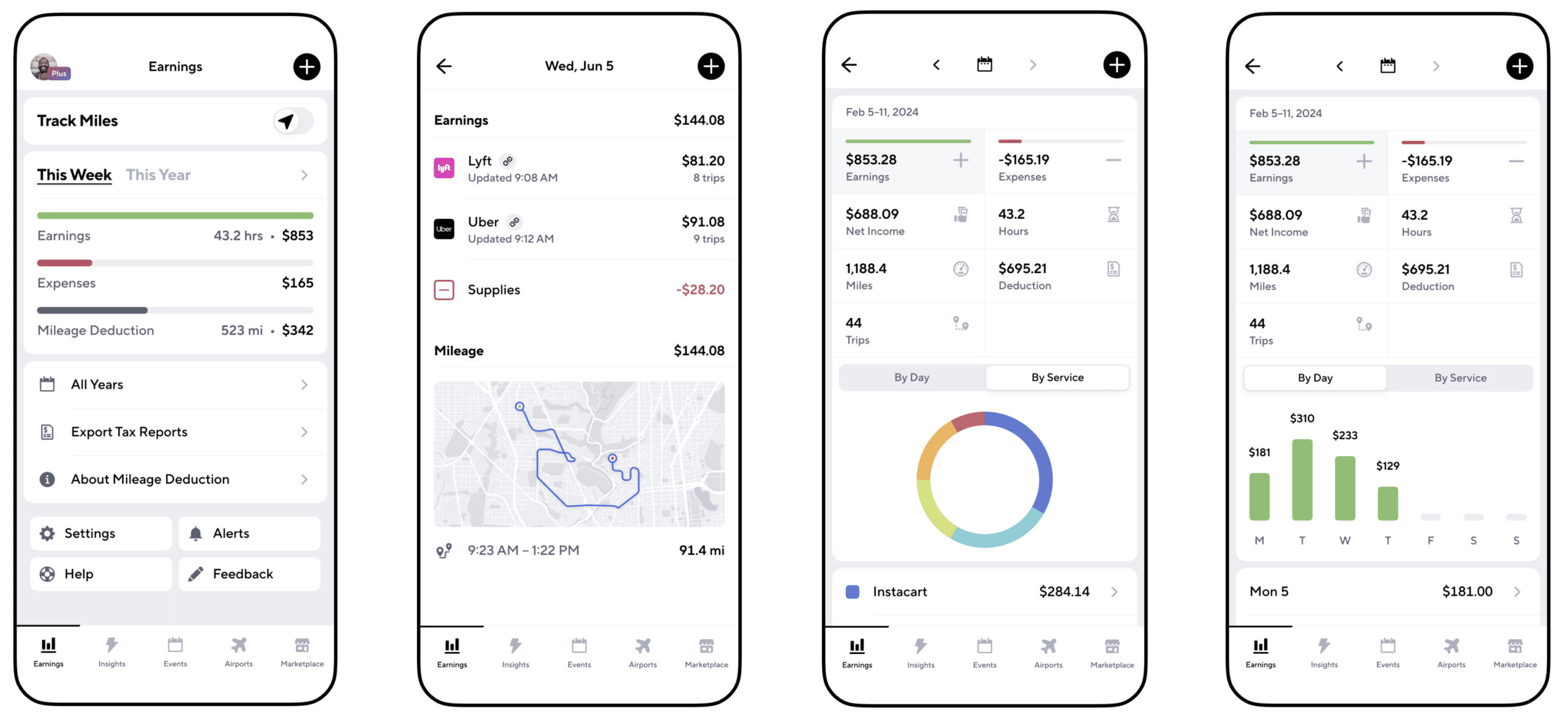
Gridwise App
Gridwise captures every deductible mile you drive, including the distance you cover between the trips your driving app records. Know what expenses you can deduct, and put them to work for you when tax time comes. Learn more about tax deduction strategies in the Gridwise Tax Guide for drivers.
Boost earnings with referrals
As an independent contractor, you’re probably looking for ways to make even more money than you can with Uber Eats. And most gig workers like you enjoy getting passive income. With Uber Eats, there’s a really easy way to do that, referrals!
All you need to do is find friends and encourage them to deliver for Uber Eats. If they make a certain number of deliveries within a specified time, you will get paid for doing nothing more than having them sign up under your referral code! Rates of pay vary by city, so check your Uber Eats app to find out what the current deal might be, and learn more about the referral program on the Uber Eats website.
Also remember: “friends” don’t have to be your best buds. Many delivery people carry cards with a QR code linking to their referral information, so just about anyone you encounter can join Uber Eats and boost your earnings. You could meet a source of passive income at the gas station, on social media, or at your high school reunion. The more you hustle, the more there is to gain, right?
Master the art of self-employment
As an Uber Eats driver, you’re an independent contractor. That means the company isn’t going to withhold your taxes, provide insurance, keep track of your earnings, or tell you about tax deductions. You’ll have to do all these things for yourself.
If you want to maximize your tax advantages, open an official business entity. You can incorporate (create a corporation) or you can work as a limited liability corporation (LLC). You can also work with a DBA (Doing Business As) arrangement, but the corporation or LLC will do a better job of protecting you from liability.
Establishing a corporation or LLC offers better tax advantages than being a sole proprietor. For instance, if you simply collect your earnings into your private account, you’ll be charged self-employment taxes in most states. And paying extra taxes is something we all want to avoid, within legal limits, as much as possible.
Every Uber Eats driver needs to learn about self-employment, and there are some great resources you can review. Check out the CareerOneStop website about self employment which will help explain the basics. You can also check with a professional tax accountant, or look other websites to learn more about actually creating a business.
Scope out your market
Look at the area around you to see where you’re likely to get the most deliveries. Where are all the restaurants? Where might people be more inclined to order deliveries? What hours do you want to drive? What activities might be going on around those times? Think about late-night and after-school times as well as breakfast, lunch, and dinner times.
Be realistic about the potential for your area and aware of new services opening up. For example, in New York, there is already a tab on the Uber Eats app that allows customers to order groceries. In our article about the best food delivery service to work for you’ll see that Uber Eats stacks up well against other delivery companies, mainly because of its potential for expanded opportunities for drivers to earn.
So, is Uber Eats good money? As we said, it isn’t an automatic guarantee that everyone will make $1,000 a week with Uber Eats. Trying out the suggestions we give you here, though, should put you on the right track! Go out there and start stacking up those orders and raking in some impressive earnings!
Get more inside information on Uber Eats in these posts from the Gridwise blog:
- The delivery driver guide: Using the Uber Eats app
- Everything you need to know about driving for Uber Eats
- Uber Eats Pro: What drivers need to know
- Looking for a different gig, part-time or full time job? Check out the Gridwise Job board.
Uber Eats FAQ
How does the Uber Eats platform work for drivers?
Uber Eats is a food delivery service that connects customers with local restaurants and independent delivery partners. As an Uber Eats driver, you'll receive notifications of nearby delivery requests, which you can accept and complete. The platform provides flexibility, allowing you to work on your own schedule and earn money based on the number of deliveries you complete.
What are the requirements to become an Uber Eats delivery partner?
To become an Uber Eats delivery partner, you'll need to meet certain requirements, such as having a valid driver's license, a registered vehicle, and passing a background check.
How can I choose the right delivery zone to maximize my earnings?
Selecting the right delivery zone can significantly impact your earnings, as some areas may have higher demand and better-paying orders. It's important to research and identify the zones in your area that tend to have the most consistent and lucrative delivery opportunities.
How can I take advantage of peak delivery hours and surge pricing?
Understanding peak delivery hours, such as mealtimes and weekends, and taking advantage of surge pricing can boost your earnings. Be aware of when demand is highest in your area and adjust your schedule accordingly to capitalize on these peak periods.
What are some tips for maximizing tips and customer satisfaction?
Providing excellent customer service and going the extra mile to ensure a positive experience can lead to more tips and repeat business. Prioritize communication, timeliness, and attention to detail to keep your customers happy and satisfied.
How can I set realistic weekly goals to reach my $1000 target?
To make $1000 a week with Uber Eats, it's essential to set realistic weekly goals and track your earnings and expenses. Start by determining your target earnings and breaking it down into achievable daily or weekly goals. This will help you stay on track and make adjustments as needed.
What are some strategies for efficient route planning and navigation?
Effective route planning and navigation can save you time and fuel, allowing you to complete more deliveries. Utilize mapping apps and take advantage of features like real-time traffic updates and turn-by-turn directions to find the quickest routes.
How can I balance my Uber Eats deliveries with other commitments?
Develop a schedule that allows you to capitalize on peak delivery hours while still maintaining a healthy work-life balance. Consider using tools like calendar apps to plan your availability and track your hours to ensure you're maximizing your earning potential without sacrificing your personal life.
What are the key considerations for maintaining my vehicle as an Uber Eats driver?
Keeping your car clean and well-maintained is crucial for maximizing your Uber Eats earnings. Regularly scheduled oil changes, tire rotations, and other preventive maintenance can help extend the life of your vehicle and minimize downtime. Additionally, budgeting for vehicle-related expenses, such as fuel, insurance, and repairs, will ensure you're accounting for these costs and maximizing your net earnings.
What are the tax obligations and legal considerations for Uber Eats drivers?
As an Uber Eats delivery driver, it's essential to understand the tax obligations and legal considerations that come with being an independent contractor. This includes properly reporting your earnings, deducting eligible business expenses, and making quarterly estimated tax payments. Additionally, you'll need to ensure you have the appropriate insurance coverage, such as personal auto insurance and possibly commercial auto insurance, to protect yourself and your vehicle while on the road making deliveries.

The Gridwise Job Board: Find Your Ideal Job or Gig Work
Gridwise is an essential assistant app created by gig workers for gig workers. Our mission is to support those engaged in gig work in every way possible. We understand how challenging it can be to deal with income instability, a lack of benefits, and job insecurity that often comes with gig work. The Gridwise app tracks and organizes earnings and expenses, and offers a wide array of discounts, deals, and services that make the lives of independent contractors easier and more rewarding.
We firmly believe it’s possible to make a viable living and create a gig experience that offers flexible hours, variety, and excitement. With issues such as consistent earnings and job security in mind, Gridwise is proud to offer a centralized platform that shows you how to find gig work and secure reliable opportunities. We’re proud to introduce the Gridwise Job Board.
The Gridwise Job Board: Key features
Because Gridwise is dedicated to serving the gig worker community, we’ve filled the Gridwise Job Board with useful features that won’t waste your precious time.
- Comprehensive listings. Find part-time, full-time, temporary, and per-task work. Drive or deliver with your vehicle, utilize an employer’s vehicle, or even find non-driving gig work.
- User-friendly interface. Find the jobs that are right for you with a tap of your screen.
- Verified opportunities. We vet the jobs before they are listed to ensure you’re getting high-quality job postings.
How to get more gig work, seasonal, part-time or full-time jobs with the Gridwise Job Board
Looking specifically for “gig work apps” or “gig jobs near me?” You’re in luck. Our filters and search functions send you directly to the listings you seek.
Here’s how it works.
- Access the Job Board via the Gridwise website.
- Search for jobs by type, location, and more.
- Select the job that interests you, and read all about it.
- Scroll through the description, and if it appeals to you, click “Apply for job.”
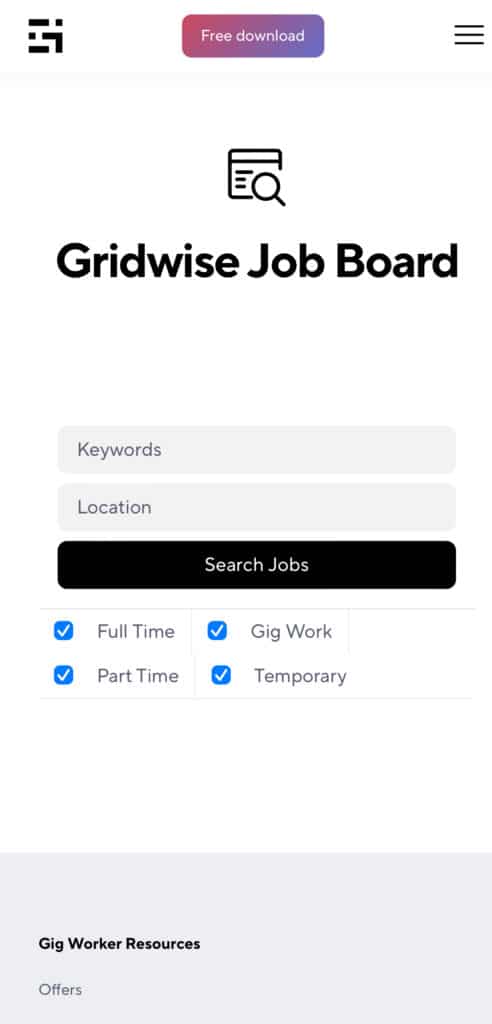
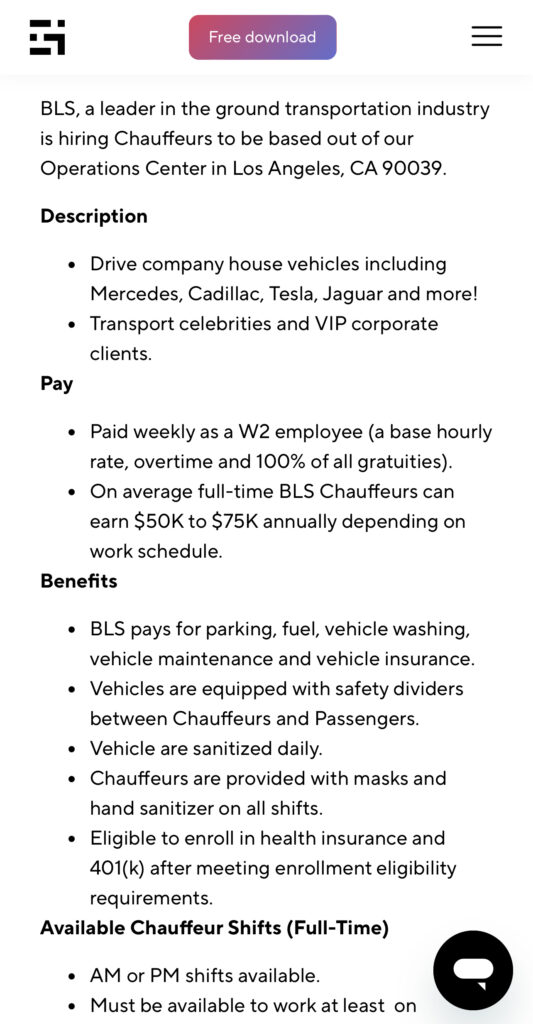
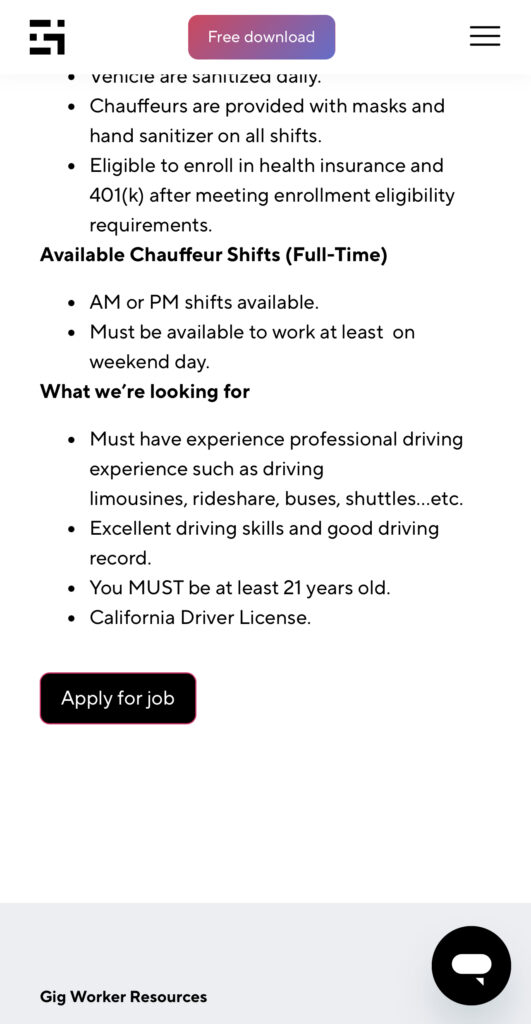
Many types of jobs are available. Adjust the search filter to see the full variety of opportunities that will let you cash in. Deliver food, set up catering, do rideshare driving, get paid for doing package delivery, and much more. You’ll find short-term gigs, long-term contracts, and part-time positions.
Perks of the Gridwise Job Board for gig workers
Gig workers who know how to make extra money will appreciate how the Gridwise Job Board lets you multiply your chances of bringing in big earnings. Here’s how:
- Increased stability. Use the Gridwise Job Board to find part-time or permanent jobs in addition to the part-time gigs you already have. Always keep a steady stream of earning opportunities flowing toward you.
- Flexibility and autonomy. Choose jobs that fit your schedule, work around other jobs and family duties, and still leave room for some fun in your life. Discover side hustles to supplement your full-time job, permanently or just for the season.
- Skill development. Find part-time work that lets you use a skill you already have, or try your hand at something new. It’s a smart way to develop a portfolio to showcase what you can do, or even to find permanent employment.
Get Gridwise and stay up to date on the Gridwise Job Board
Gig workers need plenty of information and assistance, and Gridwise is here to give it to you. Download the app and get essential features such as
- seamless earnings tracking
- mileage tracking
- expense recording, including notes
- low-cost and no-cost insurance benefits
- access to affordable medical, dental, vision, mental health, and alternative care
- professional services including legal and financial help
- deals and discounts
- weather, events, and traffic reports
- inside information on where and when to drive
More to know about gig work:

5 Best Mileage Trackers For Gig Drivers
Many drivers ask, “Do I really need a mileage tracking app?” The answer is simple: only if you want to have an accurate count of all the miles you can legally deduct from your taxable income! You might think your rideshare or delivery driving app has got you covered. After all, they do quite a good job of logging the miles you drive while you’re on a trip or delivery. But, if you want to have the best app to track mileage for Uber, Lyft, Doordash, Instacart, or the other apps you may use, you need more. Why is that?
Without a separate tracker, you’re missing the miles you drive in between pings. Did you realize that all the miles you drive, from the moment you begin your shift until it’s over (as long as you don’t drive several miles on a break to hang with your friends), are tax deductible! That means you need something besides your driving app to keep an accurate count of your travels. Read this Gridwise post to see how important it is to keep track of every deductible mile.
You won’t be surprised to hear that there’s an app for tracking miles. In fact, there are several of them. Here, we’re going to tell you about five top mileage tracking apps, and help you figure out which one is best for you.
Before we get to the list and identify the best mileage tracker app, let’s clarify what exactly a mileage tracking app is. According to G2.com’s technology glossary, mileage tracking is done for the purpose of keeping a log of mileage that is either reimbursable or tax deductible.
And yes, of course you can track your miles simply by taking readings on your odometer. But are you really prepared to account for how many miles you drove for personal reasons and subtract them from the total to get your business mileage? Even if you can remember all that and do the arithmetic, if you want an accurate reading of the miles you drive for business, and can therefore deduct, a mileage tracking app will save you a lot of trouble and prevent you from making costly errors.
Plus, as a gig driver, you have specific needs when it comes to a mileage tracker. Ideally, you’d be able to handle mileage tracking and several other functions all in one app. It can be maddening enough to deal with driving apps, particularly if you’re an avid multi-apper. You would want your mileage tracker app to help you keep account of other aspects of your business, including income, expenses, and inside information about the art of gig driving.
Not all mileage apps are equal, to be sure! Let’s look at five of the best apps to track mileage and figure out which is the best app to track mileage with Uber and Lyft, or what mileage tracker app is best for DoorDash.
1. Zoho Expense
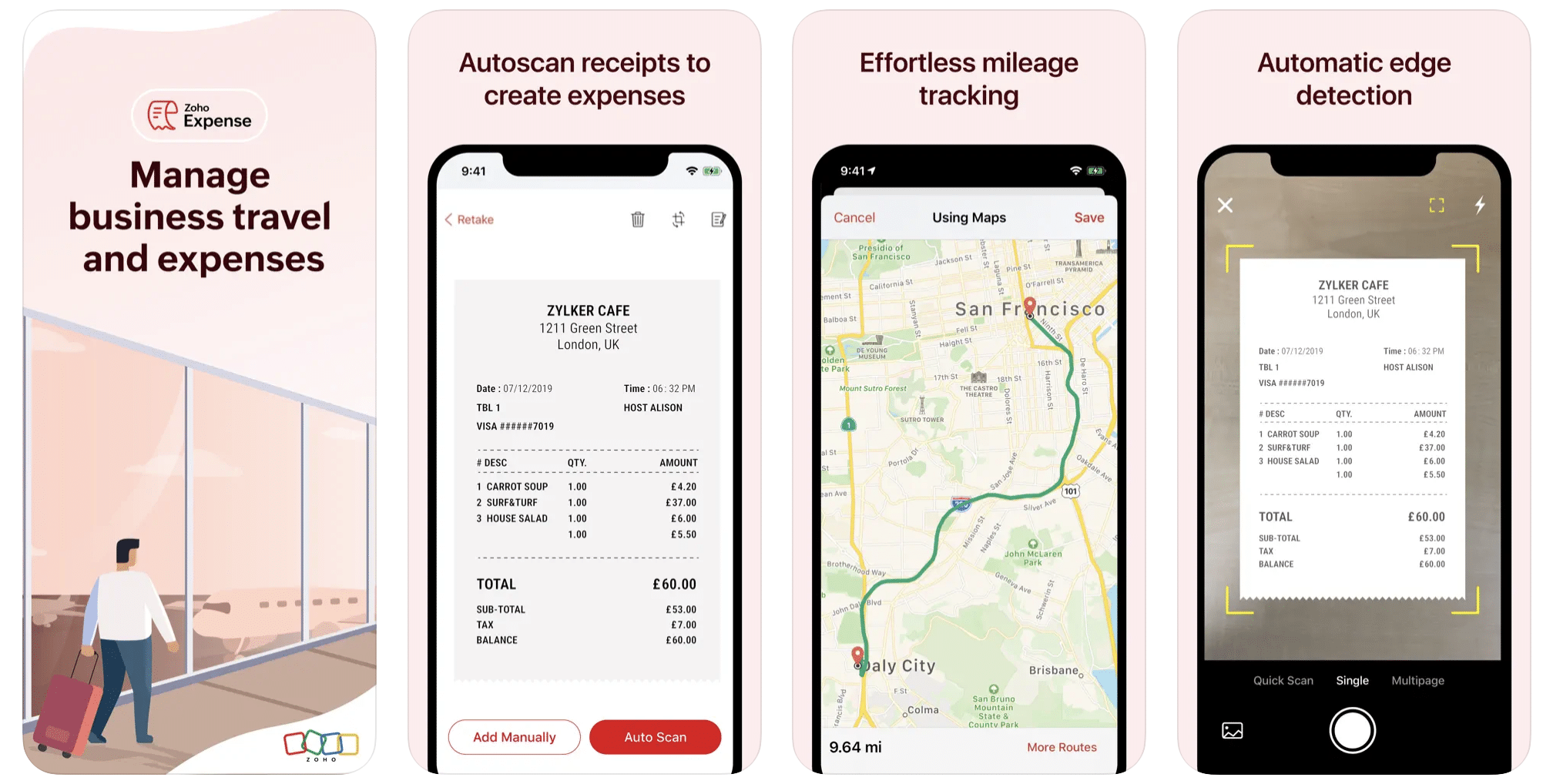
First up is Zoho Expense, which does exactly what its name says. This app is designed to allow companies to give employees a uniform way to create and submit expense reports. It can be used by individuals, including gig drivers, as well.
It includes a mileage tracker, as well as features that let you track other deductible expenses, including the ability to scan and record receipts.
Available on Android and Apple: Yes
Ratings: 4.8 stars on App Store, 4.7 stars on Google Play
Free Version: Yes
Subscription price: $3 per month, billed annually
Created specifically for gig drivers: No
2. Quickbooks Online
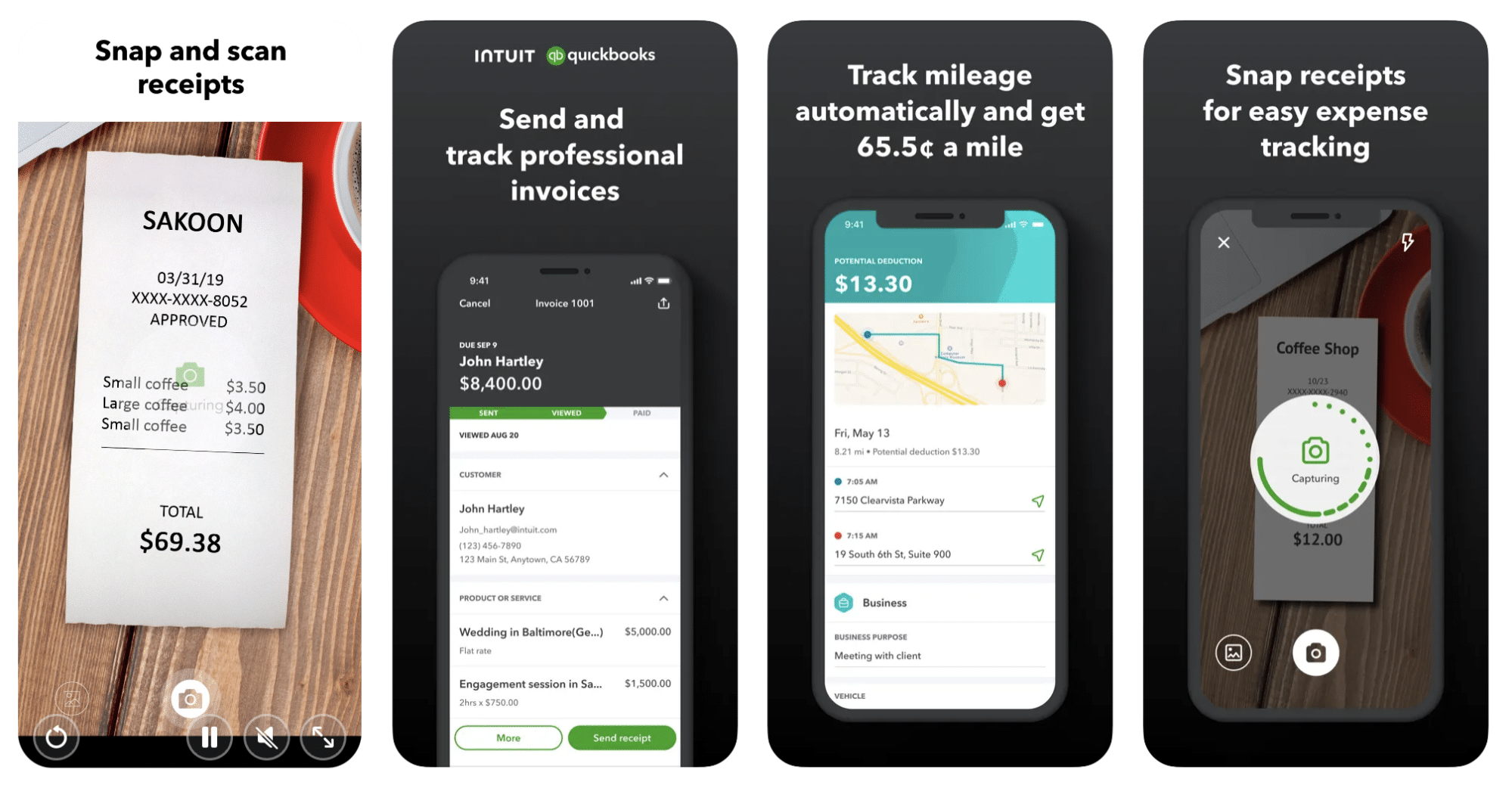
Quickbooks Online is a cloud-based app that allows you to track your mileage, earnings, and expenses. The information you enter can then be used to generate various reports that prepare you for tax time. It also allows you to create graphs that illustrate your cash flow, and includes a receipt scanner so you can instantly record deductible expenses. Quickbooks is popular, highly reliable, and designed mainly to help people keep track of their small businesses.
Available on Android and Apple: Yes
Ratings: 4.7 stars on App Store, 4.4 stars on Google Play
Free version: 30-day free trial
Subscription price: $15 per month for basic version if purchased for 3 months or more
Created specifically for gig drivers: No
Source: quickbooks.intuit.com
3. Shoeboxed
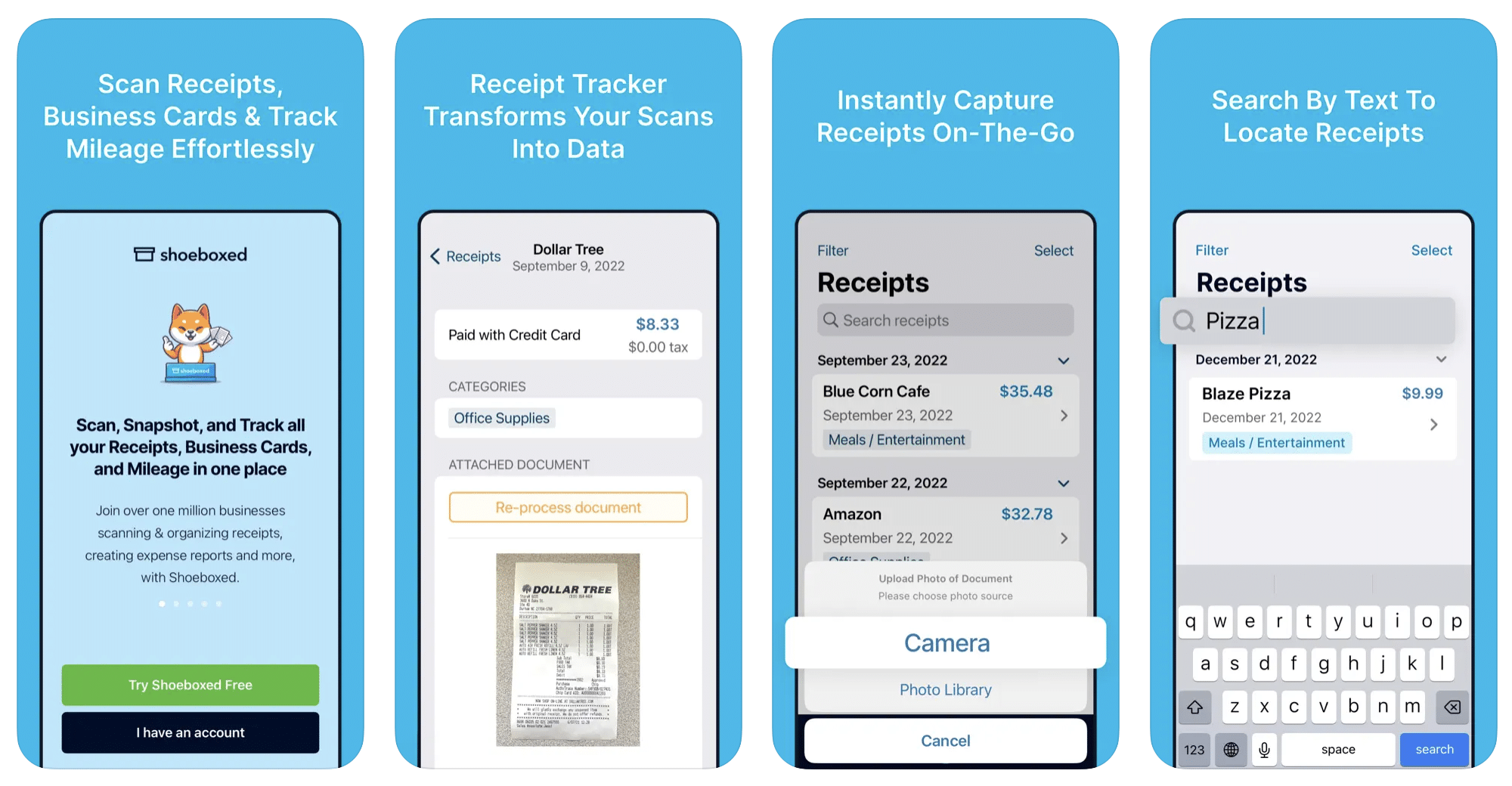
Shoeboxed started in 2007 as a service for scanning paper receipts into digital form. Now the app offers a free mileage tracker and has enabled users to scan receipts directly. It touts itself as the best mileage tracking app for DoorDash, but there are some elements missing that Dashers might like to have. While it provides features that record your expenses and prepare you for tax season, it doesn’t automatically track your earnings. The mileage tracker has a system where you can drop pins along your routes to make the tracking more precise, identifying those legs of a trip that you make for business purposes. The mileage tracker is “free” once you sign up for the basic version.
Available on Android and Apple: Yes
Ratings: 4.5 stars on App Store, 2.3 stars on Google Play
Free version: No
Subscription price: $18 per month for basic version
Created specifically for gig drivers: No
Source: blog.shoeboxed.com
4. Stride
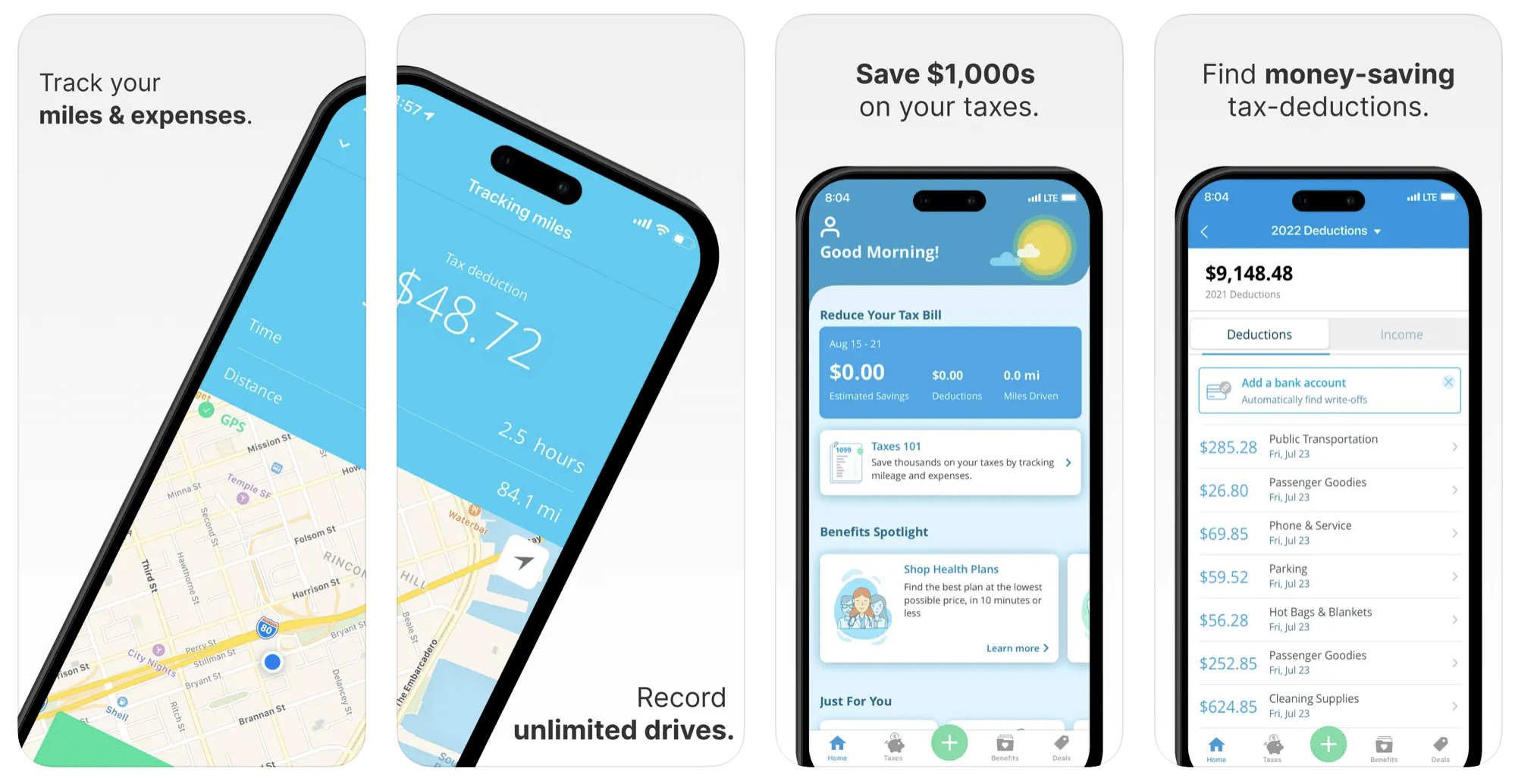
This free mileage tracker does a fair job of keeping track of the distances you rack up while gig driving, but it doesn’t automatically track earnings. It can be a big help, though, in tracking your expenses. You can link Stride to your bank account, and it will automatically scan your expenses to identify items you can potentially deduct. The app is totally free. This could make it the best free mileage tracker app, but there is a small price to pay. The app will persistently push you to consider various insurance plans that they are affiliated with. If you don’t mind that, this is a solid mileage tracker, even if it doesn’t track your earnings.
Available on Android and Apple: Yes
Ratings: 4.8 stars on App Store, 4.6 stars on Google Play
Free version: Yes
Subscription price: None. The app is free.
Created specifically for gig drivers: No
5. Gridwise
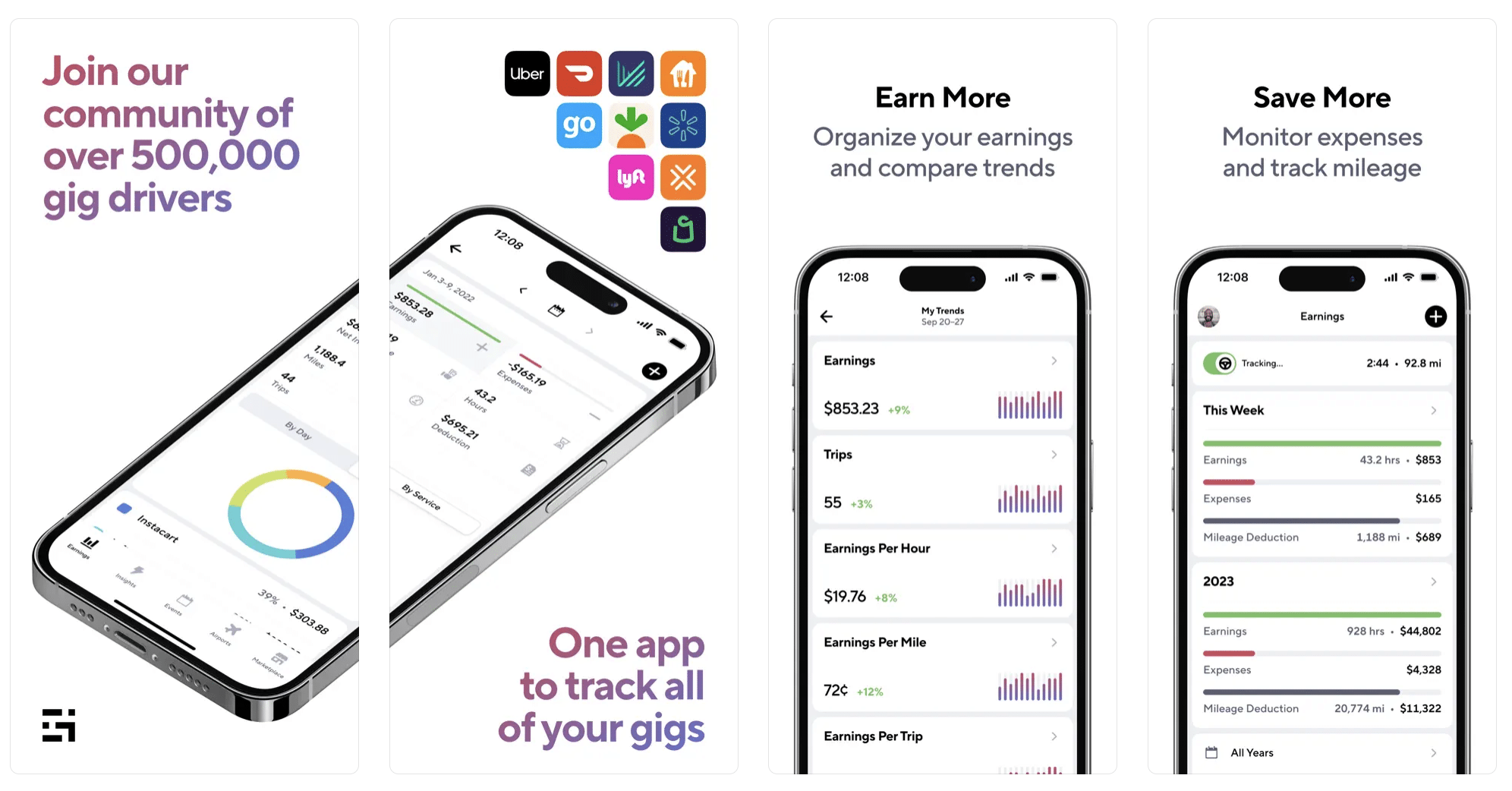
Gridwise has a free mileage tracker and free features that record your income and expenses. It gives you access to insurance and benefits, as well as insights about the best times and places to make the most money while gig driving. The Gridwise mileage tracker captures all the miles you drive while you’re on your driving shift, and it can be used if you have other trips you need to make which qualify as business travel.
Drivers love it because it is geared toward the needs of rideshare and delivery workers, providing free information about airport departures and arrivals, event start and let out times, weather, traffic, and more. The Gridwise Plus subscription adds value by providing additional insights and reports, discounts on benefits, the ability to export data in .csv format,, and more.
Available on Android and Apple: Yes
Ratings: 4.9 stars on App Store, 4.6 stars on Google Play
Free version: Yes
Subscription price: $9.95 per month for Gridwise Plus, or $95.99 per year (a $23.41 savings)
Created specifically for gig drivers: Yes!
What is the best mileage tracking app?
Now that we’ve checked them all out, we’re positive about the answer to that. Hands down, it’s Gridwise. Are we biased? You bet we are! But drivers love it too. Gridwise is the best mileage tracker app, and so much more. So many of the features are free, and the subscription to Gridwise Plus will pay for itself with additional insights to boost your earnings and deeper discounts on products and services.
Most important, Gridwise is designed specifically for gig drivers by experts who were once gig drivers themselves! Knowing what gig drivers need is a crucial step in creating an app that rideshare and delivery drivers can really use! Here are a few of the features, besides mileage tracking:
- seamless earnings tracking
- automatic, on/off toggle and manual mileage tracking
- mileage categorization
- airport, traffic, weather, and events information
- insights into where to drive and when to drive
- reports showing earnings across the platforms you use
- discounts on countless products and services for drivers
- additional resources for finding side gigs
- an informative and comprehensive blog
- affordable benefits, including insurance, medical, dental, and alternative practitioner discounts
- a community of drivers just like you
Don’t settle for just any app. Get the best mileage tracker, and so much more, from Gridwise!
Rideshare Refined: How Alto Is Upgrading The Rideshare Driver Experience
If you’re a rideshare driver and take your job very seriously, you deserve to be treated like a professional. The popular companies you’ve always worked with are familiar mainstays, but they don’t always treat you like you’re valued or skilled. But now there’s a new way to work that’s a real upgrade to the rideshare driver experience. In this post we’ll share information about Alto, including
- Alto: a new take on the rideshare driving experience
- how to earn more money as a rideshare driver with Alto
- the Alto difference
Alto: a new take on the rideshare driving experience
Taking rideshare driving up a notch starts with innovative thinking. Entrepreneur Will Coleman demonstrated exactly that when he conceived and developed Alto. He wanted his customers and drivers to have a distinctive experience that set his company apart from popular rideshare apps. The first way he did this was to change the way transactions would be viewed.
With traditional rideshare arrangements, companies such as Uber and Lyft serve merely as technology platforms that facilitate connections between passengers and drivers. The companies collect fees from both sides of the transactions in order to compensate themselves for providing the software which enables their rideshare business to work.
Alto is quite different. Quoted in this article on the Robb Report, Coleman explains Alto’s approach this way:
“We made the decision very early on to say we’re not a tech company, we’re a service and hospitality company.”
What exactly does this mean? Alto has created consistent, high-quality rideshare experiences for both customers and drivers. The cars are owned and maintained by the company. Alto’s fleet consists of company branded Buick Enclaves, chosen for their practical mix of luxury, comfort, utility, and most of all, safety.
Customers know that when they call an Alto, they’re going to get a clean and well-maintained vehicle driven by a trained professional. Alto goes beyond the ordinary to create a customer experience that allows riders to be greeted with familiarity, from the recognizable exterior to interior features such as lighting and even a specific Alto scent.
The idea is to make passengers feel as though they are getting into their own car. Riders can even use the Alto app to create the exact environment they desire while in the vehicle or before it arrives. They can select the music or lower the volume, change interior lighting, and if they choose, put the driver on “Do not disturb!”
So far, Alto is available in select cities in Texas and California, as well as Miami and Washington, D.C. The company has plans for expansion, which would be a big boost to the rideshare scene. Alto’s focus on customer service and high quality, plus its innovative membership model, make Alto an attractive upgrade for customers. Now let’s explore what kinds of advantages it offers to rideshare drivers.
How to earn more money as a rideshare driver with Alto
Alto wants to attract serious and highly skilled drivers to work for them, so all drivers who work for Alto are hired as W-2 employees. This means they are provided with
- predictable work hours
- a company owned luxury SUV
- payment by the hour, not by the ride
- company coverage of expenses such as fuel and auto/liability insurance
- healthcare, dental, and vision insurance
- paid time off and sick leave
- safe driving bonus awards
- 401(k) with company match after 6 months’ working for Alto
- extensive training in hospitality and defensive driving
- repeat customers who subscribe to Alto memberships
Alto’s vehicles provide drivers with
- HEPA air filters that keep the interior air clean and fresh
- leather seats and captain’s chairs
- telemetric tracking for safe driving
- in-vehicle wifi and chargers
- bottled water and umbrellas for passengers
- in-car security cameras
- plexiglass barriers
- 24-hour live support
If all these aspects of driving for Alto appeal to you, you’ll need to know that the company is very selective about the background and experience of the drivers it brings on board. Drivers for Alto must
- be over the age of 21
- fill out an application and upload a résumé
- successfully complete an interview process
- pass an extensive drug-screening test
- clear a thorough, fingerprint-based background check
If you are a professional driver with a charming, friendly personality that is perfect for the hospitality business, you’re the kind of driver Alto is looking to employ. Apply to be an Alto driver and take a step up to a new level of rideshare driving.
The Alto difference
When you work with the traditional apps as an independent contractor, rideshare driver pay gets eaten away by gas, maintenance, and vehicle depreciation expenses. Most good Uber driver advice or Lyft driver advice will include other things you need to think about, such as mileage deduction for gig drivers and rideshare insurance for your personal auto policy.
With Alto, these expenses and concerns are completely absorbed and handled by the company. Woo-hoo! This is a big change from being an independent contractor, and many full-time drivers would find these, along with the other benefits of being an employee that we’ve mentioned, to be great incentives to drive with Alto.
Drivers who can’t or don’t want to drive full time, or to be obligated to work at certain times of day, might not want to work for a service that hires drivers as full W-2 employees. They would be better off sticking to gigs that let them remain independent contractors. They might also find that a free mileage tracker app such as Gridwise helps them keep tabs on their earnings and deductions, and keep on top of local events, traffic, and weather alerts that affect their driving.
Drivers who live where Alto operates and who want to be full-time professionals, who receive predictable earnings and all the benefits of being employees of this innovative company, now have the perfect place to work. Alto definitely upgrades the rideshare driver experience. If you think Alto is right for you, give it a try.
Apply to be an Alto driver!
13 Ways To Save Money On Gas As A Rideshare Or Delivery Driver
High gas prices!
You hear it at the airport, waiting for spectators to leave events, or at the coffee shops and restaurants where rideshare and food delivery drivers congregate. After hitting record-breaking levels, gasoline prices started inching downward and then went back up. According to the American Automobile Association, the current national average is $3.944 a gallon. In California, expect to pay $6.246.
Tough times.
But as a gig driver, these are costs that you have to incur since this is how you make your living.
You can do things, however, to eke out an extra mile or two at the pump or on the road. In this post, we will cover how to save money on gas. Topics include
- behind the wheel and at the pump
- things you can do behind the wheel to increase mileage
- things you can do at the gas pump to save money
- download the Gridwise app
Behind the wheel and at the pump
There are two areas where you can save money on fuel costs. The first is behind the wheel. Short of buying an electric car, the tips that increase mileage will get you only so far, but everything helps. Changing your driving habits is a significant part of saving fuel.
The second is changing your habits at the pump.
Things you can do behind the wheel to increase mileage
- Slow down
According to MotorBiscuit.com, breaking the habit of sudden acceleration and deceleration can increase mileage by as much as 30%. Don’t be a lead foot. It is also safer for you and your passengers and keeps you from getting bad ratings because folks don’t like your driving.
Here is another alarming factoid from Motor Biscuit: for every five miles an hour over 50 mph that you drive, it’s like paying an additional $0.20 per gallon of gas. Aerodynamics is your friend to a certain point, but then it starts to work against you.
- Check your tire pressure
According to the Department of Energy, for every pound per square inch your car tires are underinflated, you lose 0.2% in mileage. Check those tires regularly. There is also a belief that overinflating your tires by a couple of pounds gets you additional mileage because there is less surface contact between the tires and the road. According to a test conducted by Popular Mechanics, overinflation to improve mileage is a myth. The best thing you can do is keep your tires inflated to factory specifications. You can find those numbers on the tire sidewalls, in the owner’s manual, or on a plate mounted to the side post of most cars. Open the driver’s door from the outside, look down and to the right, and there it is.
- Adopt the ten-second rule of idling, or shift to neutral
Okay, fess up. How many of you food delivery drivers let the car idle in park while you drop off an order? Likewise, how many of you rideshare drivers idle your car in gear while waiting for passengers? Too many. According to the Geico insurance website, letting your car idle excessively consumes as much as a quarter to half a gallon per hour. Restarting the engine only consumes about ten seconds' worth of gas. Whenever you can do so, turn the engine off. If you are still in the car, at least put it in park or idle, which consumes less fuel.
- Make sure the gas cap is on tight and works properly
Lauren Fix of Car Coach reports, “About 17 percent of the vehicles on the roads have gas caps that are either damaged, loose, or missing altogether, causing 147 million gallons of gas to vaporize every year.” Make sure your gas cap is on tight and in good condition. Most new cars operate on a sealed system, and a loose gas cap is a problem for that system.
- Use the right motor oil, and change it on schedule
Friction is the enemy of efficiency in your car’s engine. To combat that friction, automotive designers ensure that all moving parts are well-lubricated. You can do your part by changing the oil regularly and using the correct engine oil. If the manual says 30-weight oil, use 30-weight oil, regardless of what your brother-in-law says. Many newer cars use synthetic oil, which is two or three times more expensive, but that’s what you signed up for when you purchased the car. Besides, synthetic oil is good for your car and good for mileage.
Changing your oil on schedule is another priority. If you neglect to change your oil, it thickens and turns to sludge, reducing its ability to circulate throughout the engine and provide lubrication. In addition to lubrication, oil redistributes heat in the engine. If the oil is not changed regularly, it is not as efficient at moving that heat. You risk damaging gaskets, warping components from excessive heat, and ruining the engine.
- Change the engine air filter on schedule
A gasoline engine operates on the efficient burning of gasoline and oxygen. Your car pulls air (with oxygen) through the under-the-hood air filter and into the engine. A dirty air filter means the engine must work harder to get air into the combustion chamber. The harder your engine works, the less fuel efficient it is, and eventually it will stop running. Check out What Will Happen If I Don’t Change My Car’s Air Filter? on The Newswheel website.
- Keep your windows rolled up when you drive
You like the feel of the wind on your face, but open windows in your car mean more wind turbulence and resistance, again causing the engine to work harder. For maximum fuel efficiency, keep the windows rolled up.
- Take off the ski or surfboard racks from your car
You have a bumper sticker on your car that reads, “I’d rather be skiing.” Those racks on the roof of your car are a status symbol, letting everyone know that you are a gig driver, so you have the flexibility to bomb the slopes or shred the waves whenever you want. The reality, though, is that those racks cause wind resistance, reducing the aerodynamics of your car and affecting your mileage. Keep those racks in the garage where they belong.
Things you can do at the gas pump
- Track your mileage
By tracking your mileage (we mean with an app and a calculator) you see what works and what doesn’t. If you are the obsessive-compulsive type (and today’s gas prices will make you that way), monitoring your mileage transforms you into a mileage maniac, testing new ways to conserve gas. Keep records.
- Don’t top off the gas tank
While attempting to pump every ounce possible into your tank, you spill gas. That’s just throwing money away. In some cars, repeated overfilling can damage emissions components, making your car run less efficiently. “Gasoline needs room to expand, your tank needs extra room for that expansion,” explains an article on Automoblog.net. “If you try to top off, the extra gas you’re trying to add may actually evaporate into your vehicle’s vapor collection system. This can ruin the mechanism, making it work improperly, and cause your car to run less efficiently.”
- Fuel up in the morning
If you really want to ensure that you get all the gas in your tank that you can and do it safely, fuel up in the morning while it is still cool. The liquid expands as it gets warmer in your tank. Besides, many gas stations change their prices mid-morning after they have figured out what the competition is charging.
- Fuel up on a schedule
It is best to fuel up before you start your gig activity. We all have a favorite gas station with lower prices than other stations. With a full tank, you won’t get caught up in the heat of accepting passengers or delivering food, only to realize at the last minute that you need to gas up and are forced to stop at the first station you see, which could cost you more.
Download the Gridwise app
Last, but not least - downloading the Gridwise app might be the best thing you can do to save on gas as a gig driver. Once you've downloaded the app, you can sign up for Gridwise Gas and save up to $50/month on gas.
There's also other ways to minimize gas costs, like using Gridwise to know when and where to drive so you don't waste gas waiting for trips. Gridwise has other features, including information on peak times for arrivals and departures at the airports and special events such as concerts and sporting events. These features mean you can drive with a purpose and a goal in mind rather than just aimlessly waiting for the rideshare or food delivery app to find you a passenger or a meal to be delivered.
Download Gridwise now to save on gas!
Insurance Basics For Rideshare and Delivery Drivers
It’s a natural reflex to yawn at the mere mention of insurance, but when you’re a gig driver, you need to pay close attention to this important topic. In this post we’ll analyze the insurance situation for gig drivers, and focus on how you can decide what’s best for you.
Here’s what we’ll look at:
- The basics: minimum coverage for gig drivers
- What policies such as Uber insurance will, and won’t, do for you
- Extras or essentials? Additional coverage you can buy
- Beyond your vehicle: important insurance for gig drivers
The basics: minimum coverage for gig drivers
Insurance requirements are a part of onboarding for virtually every rideshare or delivery service where you are required to use your own vehicle. Without that proof of basic auto coverage, you won’t be accepted onto the gig platforms.
Given that it’s illegal in most places to drive without insurance, even if you’re not on a gig, that’s a no-brainer. But there’s something you might not realize. You will need to notify your insurance carrier that you’re gig driving, and purchase additional coverage.
If you fail to do this, you’re risking a lot. Your primary auto policy probably doesn’t cover you if you’re using your vehicle for commercial purposes, such as gig driving. So if you submit a claim, even if you have an accident while you’re not gig driving, your insurance carrier has the right to reject it.
Although there is an extra expense involved, it’s worth it to get a personal policy that offers additional coverage. In some states you may be required to get a commercial policy, while in others you can add on an endorsement for rideshare or delivery driving, which covers the extra risk you’re taking by using your vehicle for this kind of work.
What policies like Uber/Lyft insurance will do for you
Your rideshare or delivery company will offer you some insurance, it’s true, but it might not be enough to cover the damage to the vehicles involved, or the medical costs you or others who may have incurred injury. You'll want to double check to see if you need additional insurance while you’re driving for a company like DoorDash, Uber, or Instacart. Read the fine print to get all the details.
A look at Uber’s insurance policy, which is like most other companies, reveals how much and when you’ll be covered as a driver. The amount of coverage varies according to where you are in the ride or delivery process. Uber Eats insurance mirrors the terms for rideshare drivers, apart from accidents involving uninsured or underinsured drivers. Also, Uber’s insurance for delivery drivers doesn’t apply to accidents that occur in New York State. In New York, delivery drivers need to purchase separate policies, as stated in this article from New York Motor Insurance.
In stage 1—offline or driving while the driver app is off—Uber does not cover you. You must rely on your personal vehicle insurance policy.
In stage 2—online waiting for a trip or delivery request—Uber provides third-party liability (for those other than yourself and your car) if your personal insurance doesn’t apply, up to
- $50,000 per person for bodily injury
- $100,000 in bodily injury per accident
- $25,000 in property damage per accident
In stage 3—en route to pick up or execute a delivery, or during a rideshare trip—Uber maintains insurance for covered accidents in these amounts:
- $1,000,000 third-party liability
- uninsured/underinsured motorist bodily injury and/or first-party injury insurance (rates vary by state)
- contingent comprehensive and collision, if you hold a personal policy with these features, up to the actual cash value of your car
Note that if you place a claim through Uber’s policy, the deductible as of March 1, 2022 is $2,500.
You’ll definitely want to consider that Uber’s driver insurance covers third parties, not the drivers (except in California, or if you’re hit by an uninsured or underinsured motorist in any state). It’s possible to purchase a low-cost policy that would cover any personal injury that might occur, but coverage for you is not available without making that purchase.
Read more about Uber’s insurance and options for additional coverage on the Uber website, and keep checking it to stay up to date on emerging developments. There is also a list of insurance providers that offer rideshare and delivery endorsements that will protect you under any set of circumstances.
Extra or essential? Additional coverage you can buy
It’s obvious that getting a commercial policy or an endorsement on your personal auto policy is essential, even though it will cost extra money, but there’s more. Another type of insurance might not seem so important; but when you need it, you could find yourself in big trouble if you don’t have it.
Gap insurance protects you from having to pay off a loan on a car you can no longer drive. When you have an accident and your car is deemed a total loss, the insurance company will pay you for your car according to its age, mileage, and maintenance history. This amount will most likely be less than the total amount you owe on your loan.
For example, if you purchased a car that was valued at $25,000, and an accident renders it a total loss, you might get paid $15,000, depending on the factors mentioned above. Your insurance company won’t pay that extra $10,000. That’s why gap insurance is essential, not just an extra layer of protection.
You would purchase gap insurance, normally, at the time you secure your car loan. While you’re adding up all the costs of your car purchase, it might seem like another gimmick the insurance company is trying to sell you, but it’s wise to take them up on their offer. If you don’t have gap insurance now, it might be a good idea to look for a policy that would cover you, just in case.
There are other types of insurance you might want to consider:
- Collision coverage repairs damage to your own car, if you hit a pole or a mailbox, for instance. This coverage also can be used to pay for damage you incurred if someone else is at fault. Your insurer then chases down the other person’s insurance for reimbursement.
- Comprehensive coverage covers damage that occurs beyond driving, such as weather, natural disasters, acts of nature, and vehicle theft.
- Uninsured/underinsured motorist coverage keeps your personal policy strong, providing the same coverage your gig company gives you when you’re actively working on a rideshare trip or delivery. It doesn’t hurt to have this protection on your personal policy for the rest of the time you’re using your vehicle.
- Rental car reimbursement is very useful if you expect you’ll need to get around while your car is being repaired.
- Transportation reimbursement pays for the cost of getting you back home or to a place where you can rent a car after an accident.
These extras can be obtained from your insurance carrier, but they still might not fulfill all your needs. You can’t afford to be set back by a breakdown or problems involving your smartphone.
As a driver you should have
- roadside assistance: towing costs, battery jumps, battery replacements, and tire changes are facts of every driver’s life. Gridwise Benefits provides affordable protection that keeps you covered.
- cell phone protection: a low-cost policy from Gridwise Benefits shields you from the high costs of repairing or replacing your phone, should it be lost or stolen. Your benefits cover up to three phones, which makes the deal even sweeter.
- accident medical insurance: offers small amounts of cash to help cover expenses from minor accidents.
Beyond your vehicle: important insurance for gig drivers
Now that you’re savvy about the insurance you need for your vehicle, it’s time to think about what goes on beyond your car. As a gig driver, you don’t get company benefits such as health insurance, and coverage for accidental death and disability.
Gridwise Benefits is designed to cater to the needs of gig drivers. Once you've downloaded Gridwise and signed up for Gridwise Dollar Benefits, you can get essential benefits for $1/week AND $5k of insurance at no additional cost to you:
- life insurance
- telehealth
- dental and vision insurance
- roadside assistance
- accidental medical and critical illness coverage
- chiropractic and alternative medicine services
- identity theft protection
- on-demand fitness and nutrition programs
Choose from the Gridwise Dollar Benefits menu and purchase only the policies you need. Signing up is easy! Download the Gridwise app, go to the Benefits tab, and tap on any of the policies with a dollar sign icon. You’ll be able to start your coverage right away.
Whether you just need the basics, or want some bells and whistles, Gridwise Dollar Benefits provides coverage that keeps you and your family protected, safe, and healthy.
Get the coverage you need with Gridwise
How To Improve Your Rideshare Driver Ratings
Unless you’re totally new to rideshare driving, we don’t have to tell you how important it is to keep your driver rating high. Each and every passenger you have gets the opportunity to rate you, and most of them will.
You typically have to keep ratings at a certain minimum, which is a good reason to keep reading so you can discover how to improve your ratings. Here’s what we’ll cover:
- the importance of the driver rating
- basic care and courtesy points
- scoring the five-star drive
- drive at the top of your game
The importance of driver ratings
Ratings for rideshare drivers are more than just a point of pride. Your driver rating determines where you are in the “pecking order.” Highly rated drivers get first priority from their app’s algorithm when it comes to assigning rides. They also get more perks and higher rankings in programs such as Uber Pro and Lyft Rewards for drivers.
While it’s almost impossible to have a perfect rating, you’re expected to meet minimum requirements. Companies state these rather clearly, and they enforce them quite diligently.
Uber drivers must maintain a rating of 4.6 or higher, while Lyft drivers are encouraged to maintain a rating of 4.8 or better. Low ratings will be flagged by the company, and drivers may be asked to take measures to bring them up—or face deactivation.
The days of passengers being grateful simply because you showed up are over. In 2022 and beyond, you have to hustle if you want to stand out and give your passengers memorable experiences that will yield high driver ratings.
Basic care and courtesy points
Everyone gets low ratings from time to time. Crabby customers, or those with unreasonable demands, tend to give drivers fewer stars than they might deserve. There are some situations you won’t be able to change, but there are also many ways to cover your bases and make it hard for passengers to give you anything less than a Lyft or Uber five-star rating. Here are some basic, common sense issues to consider.
- Cleanliness: Even if you get your vehicle washed every few days and vacuum it regularly, a lot of stuff can accumulate in your backseat over the course of a shift. Make it a point to check for gum wrappers, ticket stubs, store receipts, and lost articles after each ride. Wipe down those muddy shoe marks and greasy handprints, too.
- Car maintenance: No one wants their Lyft or Uber car to have a breakdown or run out of fuel. Keep your car in working order. It’s an investment you can’t afford to skimp on.
- Courtesy: Always greet your passengers warmly, confirming their names and that they’re in the right car. Treat them with respect, even when you have to establish boundaries with those who are impaired or unruly.
- Navigation: As a driver, you know your GPS is going to show you a good route to your destination. However, your passenger might have a different idea about what the “best” way might be. Ask if there’s a route they’d prefer and be willing to take their suggestion if they ask you to do so.
- Safety: Drive like you have your own child (or grandma) in your back seat. Obey traffic laws and speed limits, drive defensively, and do not indulge in road rage. Also, remind riders to wear their safety belts.
- Comfort: Ask your customer if they’d like a temperature change, shift in musical choice, or volume adjustment, and do your best to comply with their wishes.
- Conversation: Let the passenger take the lead on how much, if any, conversation you’ll have. There may be times when you don’t feel like talking, but if you carry on friendly convos with your pax, you’ll make a better impression. If any of your customers would rather have a quiet ride, make sure you give it to them.
- Appearance: No one expects you to be dressed to the nines, but you should be decently clothed in clean, respectable duds, with other signs of good grooming eminently evident.”
- Aroma awareness: Your car will pick up smells from your passengers, from food they’re carrying to their post-workout scent, and whatever they might have been smoking. Carry an effective air freshener, and use it regularly to prevent your car from committing olfactory offenses.
- Proactive measures: If you know you’re going to get a low rating from a customer who has been unreasonable, be proactive. Remember, you can rate your passengers, too. In extreme cases, it pays to contact your company and describe your customer’s unruly behavior before they get a chance to complain about you.
If you stick to these basics, you’ll have a hard time slipping below those company minimums, and you’ll know how to be a good Uber driver or Lyft rideshare hero. But if you’re interested in making your ratings soar, there’s more you can do.
Scoring the five-star drive
Drivers call the overall five-star rating the “Holy Grail” because it’s so difficult to achieve. You may not get all the way to a 5.0, but you can raise your ratings to a 4.95 or higher with some of these extra measures:
- Take a positive attitude: While this sounds so obvious, it might be the hardest thing for a driver to maintain. Your people skills are the key to being a successful Uber driver or Lyft superstar. Develop a thick skin and a big heart, and you’ll give customers great things to say about you.
- Provide amenities: When you’re in the backseat of a rideshare car, isn’t it nice when the driver offers you water, mints, hand sanitizer, or other little essentials? Your passengers will delight in being treated to the little things that make their rides more pleasant.
- Offer basic conveniences: Phone chargers, a flashlight, and recommendations for good places to go should always be available to your riders. You might want to have pen and paper handy for those who want to jot down notes, too. Having these little things on hand can be an effective Uber and Lyft rating driver.
- Open doors for passengers: When you can, it’s always nice to make it easy for your passenger to enter the car. This is especially true for those who might have problems getting around or who need crutches or a walker. Make passengers feel valued from the moment they approach your vehicle, and they will remember you.
- Help with luggage and shopping bags: Always offer to help people load their extras into your car. Since it’s your vehicle, you have the most experience with effectively stashing things, and your kind and insightful hand is bound to earn you extra rating points.
- Provide entertainment: Consider installing a backseat tablet such as Play Octopus, so your customers have something to do while they’re waiting in traffic after a big event, or want to keep themselves busy on a long-range ride.
- Furnish personal care items: If you’re a nighttime driver that hits the bar scene, sick bags are very important to have on hand. A simple first aid kit could also save the day if a passenger has a minor cut or needs some Neosporin. Avoid doling out meds, though, including the over the counter kind. You never know what someone might accuse you of giving them, even if it was just a baby aspirin. Cough drops are pretty safe, and people appreciate them year round. Just make sure they’re in their original wrappings.
- Gently suggest a good rating: There’s a fine line between encouraging high ratings and sounding as though you’re begging for them, so tread lightly here. It doesn’t hurt to remind your customers how important it is for you to know you did a good job, and to point out how they can do that for you. You can read more about these and other ways to get good ratings, and tips, in this Gridwise blog post.
Drive at the top of your game
Getting and keeping good ratings depends on your ability to be the best driver you can be. You need to know what’s going on in your area and the best ways to get around traffic. Keep yourself equipped with deals and discounts that make your driving gig easier. Make sure you're tracking the miles you drive - including the miles with passengers in the back seat - with Gridwise's free mileage tracker.
Drivers also use Gridwise to:
- see event information, including starting and let-out times
- get airport details, such as the number of flights departing and arriving
- track earnings and expenses
- find deals and discounts on everything from gas to car maintenance, healthcare, and insurance.
Top-rated drivers always drive with Gridwise to keep them at the top of the gig driving game.
Download the Gridwise app now!
4 Ways For Gig Drivers To Reduce Auto Costs
Prices on everything are soaring, and auto maintenance is no exception. Running a gig driving business demands that you find out how to reduce maintenance costs and maximize profits—so you have to do all you can to stop maintenance costs from taking a huge bite out of your earnings.
That’s why we want you to have these 4 ways to reduce your gig driver car maintenance costs.
They include
- Know before you go; feel the power of FIXD
- Get the best discounts for gig drivers
- Forget about wear and tear—rent!
- Track depreciation to make every mile count
1. Know before you go; feel the power of FIXD
If you’ve struggled with the crippling costs of car maintenance and haven’t found a mechanic you can fully trust, FIXD is here to bring you rideshare and delivery driver help. The people behind FIXD realize that drivers need to know what care their cars require, rather than leaving it to rogue mechanics to diagnose and fix things that aren’t broken to begin with.
The mission of FIXD, according to its founders, is “to democratize car care by giving every driver access to the transparent and easy-to-understand information they need to confidently fix and maintain their vehicle - without breaking the bank.”Because car care should be stress-free!
FIXD is a comprehensive support system for you and your vehicle. In addition to a free, encyclopedia-like volume of information and resources about car maintenance, FIXD offers a low-cost sensor that communicates directly with your car’s computer to find out what needs to be addressed. Utilizing Bluetooth, the FIXD app on your phone then takes this information and produces descriptions of the diagnostic device’s findings that you can easily understand.
Every driver needs FIXD, if just to run the end-around on greedy mechanics. What you might not realize, though, is how much more FIXD has to offer. The FIXD team has their own upstanding mechanics on call 24/7 to answer your questions, and a built-in system that alerts you when your car needs regular maintenance.
Now you won’t have to keep checking on, or be asked to believe, overeager dealers and repair shop owners when they insist you need a $90 oil change 2,500 miles before it’s really called for.
The caring, customer-service focused team at FIXD is dedicated to empowering drivers with knowledge and high-quality care. You can buy the FIXD sensor at low cost or subscribe to FIXD for a low monthly fee, and receive the sensor free, as part of the deal.
Subscribers also receive
- access to the mechanic hotline
- confirmed description of the fix and estimated cost
- a forecast of future problems related to the issue
- an incident history report
- an emissions compliance precheck
The FIXD car repair sensor is saving drivers $1,000s every day! Click here to find out more about how you can get FIXD for your vehicle, and empower yourself right away.
2. Get the best discounts for gig drivers
Now that you’ve got the key to saving yourself from merciless mechanics, you need to find more deals and discounts that will cut your car maintenance costs. Gridwise provides options that help you save:
- Gridwise + CarAdvise gives you access to discounts to thousands of auto shops all over the country. Compare prices, consult with experts, and schedule online. As a Gridwise user, you’ll get 10–40% off retail prices.
- Gridwise + ForeverCar lets you save up to 44% on a Vehicle Service Plan. When an unexpected car breakdown happens, this policy will keep you and your wallet covered.
- Gridwise Tires helps you deal with the sad fact of life, namely, your tires will wear out. When you have to purchase a new set, Gridwise Tires gives you a $10 discount per tire, which makes the pain in your pocketbook a little less.
- Gridwise Gas offers discounts for the most important thing you need to buy if you want to maintain your car: fuel! Download the app for discounts offered to free users. Join Gridwise Plus to save up to $50 per month, and get even deeper discounts on other Gridwise Benefits.
3. Forget about wear and tear—rent!
If all this talk about maintenance costs and the thought of the wear and tear you put on your vehicle as a gig driver is giving you pause, rest easy. With Gridwise Rental, you can put your depreciation concerns aside for good! While it’s true that most rental car companies have draconic restrictions when it comes to renting for rideshare or delivery driving, things are much different with Gridwise Rental.
When you sign up for Gridwise Rental, you can search for available cars in your area, apply to drive, then pick up the keys and go! Even better, delivery and rideshare insurance are included in the rental cost.
Where do the cars come from? The Gridwise partnership with HyreCar makes it possible. Drivers like you who want to make money with their cars even when they aren’t driving rent them out! That means, if you’re not so concerned about wear and tear on your vehicle, you can rent it out and put it to work for you. Find out more about both ways to take advantage of Gridwise Rental, and sign up here!
4. Track depreciation to make every mile count
Depreciation is a fact of life for every vehicle owner, but gig drivers have a more pressing need to pay extra attention to it and find ways to track it. Some of the best Lyft driver advice or Uber driver advice you’ll ever get will show you how to deduct miles as a rideshare/delivery driver, so you can recoup the unavoidable costs of depreciation.
Gridwise features a free mileage tracker, plus a way to record expenses, so you can account for every mile you put onto and every penny you put into your vehicle. Mileage deduction for gig drivers is a huge deal these days, considering how much you have to cough up just to cover fuel costs. Gridwise does this for you seamlessly. All you need to do is log in each time you start a shift.
And once you get hooked up with FIXD and find yourself the best deals on car maintenance through Gridwise, you can record shop expenses and keep track of all the repairs and maintenance your vehicle has on record. FIXD and Gridwise are a winning combination. Scoop up this opportunity to put them to work for you! Download Gridwise and…
Save more with FIXD now!
Driving On Halloween: A Gig Drivers' Guide To The Spookiest Earnings Of The Year
Halloween can be lots of fun, and it’s also a great time for gig drivers to make more money. With haunting going on for several days at a stretch, parties, parades, and other events will attract lots of business for rideshare and delivery drivers. You can probably go out as usual and still make a little more than you normally do, but why settle for that?
In this post, we’ll tell you how to make Halloween gig driving as rewarding as it is fun. We’ll talk safety, strategy, and how to earn bigger tips. Here’s how we’ll lay it out:
- getting in on the fun with Lyft or Uber on Halloween
- delivery tricks to earn you treats
- knowing where to drive and when
- staying safe and keeping clean
Getting in on the fun with Lyft or Uber on Halloween
You might not be a huge Halloween person, but a whole lot of your customers are. From parents with small ones who want to keep them dry and safe on the way to school events to hardcore party people who dive into the Halloween holiday spirit headfirst, you’re bound to come across a lot of passengers during this super busy week.
Since so many will be super excited about this spooky season, the way you approach your gig could make them extra generous and appreciative. Here are a few pieces of sound Lyft and Uber driver advice:
- Remain professional. Always greet your passengers as you would at any other time, and stay away from getting overly dramatic about acting like a scary zombie, axe murderer, or vampire, especially with young kids in the car.
- Dress up with discernment. If you decide to dress up, keep it to common sense costume choices. Make sure your face is recognizable, and avoid makeup, clothing, or props that make seeing clearly or moving freely while driving difficult. If you don’t want to get too wildly creative, you can always put together a Lyft or Uber driver Halloween costume! Slap a sign on your chest that says “Scary good driver” and you’re good to go.
- Offer treats. Even jaded business travelers on the way to the airport might enjoy a sweet Halloween treat. Put a smile on passengers’ faces by ensuring your offerings are in their original wrappings, so they can feel safe eating them. You might want to offer bottled water, too. All that sugar can make all goblins, big and small, mighty thirsty.
- Present your Halloween playlist. You’ll want to do this carefully, of course, but a subtly crafted sequence of songs appropriate to the season will make you stand out with your passengers, who’ll just have to tip you for your great musical taste.
- Decorate your car. A temporary Halloween wrap for the exterior or some subtle orange and white lights on the interior could make yours the car they all want to be in when they celebrate their Lyft or Uber Halloween holiday.
Delivery tricks to earn you treats
It would be sad for delivery drivers to be left out of Halloween fun, so here are some things Dashers, Uber Eats, Instacart, Shipt, and Grubhub drivers can do to share in the festive spirit.
- Dress up, but keep it subtle. As a delivery driver, you’re going to have to move fast and be able to see where you’re going, even when you’re not piloting your car. Pay special attention to footwear, and if your company wants you to wear their branded hat or shirt, don’t let your costume cover it up.
- Carry treats for restaurant workers. You might see these people more than once a week, or you might only have one encounter with them ever. In either case, offering them a little something will keep them cheerier, and get you better ratings from the restaurant.
- Follow the Halloween spirit. If the restaurant workers or customers seem to be celebrating, it’s fine to chime in with a spooky comment or funny quip. But if it looks like the people you’re dealing with have no idea there’s anything special about this time of year, just act like you always do, with friendliness, grace, and professionalism.
- Make your delivery bags say “boo!” Customers might get a kick out of the way you put a few lights, some stickers, or spider webbing on the outside of your thermal bag or carrying crate. Just make sure none of that stuff comes close enough to contaminate the food.
- Tread lightly through backyard Halloween displays. So many people get extremely serious about decorating their yards with blow-up ghosts, gravestones, skeletons, and witches. What’s fun the rest of the day can be downright treacherous for delivery drivers. A headlamp or other means of shining light on what’s under foot might be called for, so you don’t hurt yourself or destroy a well-thought-out ghoulish (and garish) display.
Knowing where to drive and when
Keeping track of Halloween events can be tricky. That’s why you’re so lucky to have Gridwise. It’s not just the best mileage tracking app out there. Use the Gridwise events calendar to see where the parades, shows, scare houses, and public parties are. Having this info at your fingertips will make it easy to put together a winning Lyft or Uber driving strategy—but Gridwise has even more to offer.
Gridwise features Where to Drive and When to Drive give you real-time data on where drivers are making the most in your neighborhood. Studying the patterns in these features will tip you off as to when the peak passenger and delivery traffic is humming, and where you can go to find the most business. With Gridwise, you get all this and a free mileage tracker, too!
You may also pay attention to where and when schools are letting out around Halloween. Many parents will hope to see their little superheroes, princesses, and mermaids march at their school parade but be wary about driving with all that glitter, facepaint, and fake blood in their high-end SUVs. That’s when they’ll call you, so you’ll need to take some measures to look out for little ones, stay safe, and protect your own car, both inside and out.
Staying safe and keeping clean
The truth about Halloween is that it can be fun, but there are hidden dangers and inconveniences you’ll want to beware of. Consider these tips for keeping yourself and your passengers safe, and for preventing damage to your vehicle.
- Identify your passengers and delivery customers. Dress some people in a costume, and they can get downright silly, and sometimes. even dangerous. Don’t be shy about asking a passenger who appears somewhat sketchy to remove their mask so you can make sure you’re picking up the right person. Same goes for delivery. The word “trick” is very popular this time of year, and there could be a masked imposter hoping to pilfer that awesome spread of wings, burgers, and fries you’re carrying.
- Use in-app phone safety features. In case someone is acting out a Halloween stalker movie, you won’t want to become their prey. Your app most likely includes features that let a friend or family member follow your trips and know your whereabouts, and will let you contact emergency services with one swipe or tap. Get familiar with these features, and use them. It’s better to be overcautious than to find yourself in some real trouble.
- Demand full visibility. The chowderhead in your backseat dressed up in a giant lobster costume might be cute and creative, but if the oversized claws are blocking your view, you’ll need to ask that they come off till the ride is over.
- Look everywhere. Halloween is a very exciting time, particularly for children. Drive slowly and carefully, looking in as many directions as possible for people who might walk right in front of or behind your car. Make sure your lights are on at all times, even in the daytime. This really does help people notice there’s a car in their vicinity.
- Carry daycare equipment for drunks. For many of the party-prone among us, Halloween is a huge opportunity to tie on more than a costume. Carry sick bags, a roll or two of paper towels, cleaning solution, and plastic garbage bags to take care of any spills or “upheavals” that might occur. Sparkling bottled water could be convenient to have on hand at times like this, too. And remember, if they make a mess, your passengers have to pay to clean it up. Make a claim with your company to cover detailing costs.
- Try a tarp. This sounds somewhat extreme, but if you’re creative, you can turn a protective seat cover into an enticing Halloween decoration for your car. You’ll want this not just for the messes mentioned above. Glitter, face paint, green slime, and other costume components might look fabulous on your customers, but when they get ground into your upholstery, it’s not such a great look.
- Choose parking spots carefully. This one is mainly for delivery drivers, but even rideshare drivers stopping for a quick bevvy or a bio break have to park somewhere. Remember that people still use Halloween as an excuse to soap windows and smash pumpkins. Avoid parking where they might be able to make this mischief with your car.
- Keep your cool. Even if you see a clan of kids TP-ing your pine trees when you come in from a long night, try to remember Halloween is all about the fun of being just a little bit naughty. That thing about everybody being “nice” all the time is for a totally different holiday.
Enjoy your Halloween driving, and may you avoid tricks and get many tips! Be sure to bring Gridwise along for the ride to track your awesome earnings during this spooky holiday time!
Download the Gridwise app now!

What Is It Like To Be A Shipt Shopper In 2022?
Looking for a new company to add to your driving gig, or new to the gig driving game? Shipt is a popular delivery service that offers high earnings, variety, and plenty of business. Is Shipt the right kind of company for you? After you read this post, you’ll have a much better idea. We’ll cover
- the Shipt difference
- what it takes to be a Shipt shopper
- Shipt vs. Instacart: which is better?
- pro tips for Shipt shoppers
The Shipt difference
What makes Shipt so special? It’s a “shop and deliver” service, meaning that drivers gather items ordered by customers, and then deliver them to their doorsteps. If you enjoy shopping and the variety it offers, that could be enough right there to attract you to working for Shipt. Consider these factors as well:
- High pay. Shipt says shoppers can make up to $22 per hour. Gridwise data, as shown in this previous post, reflects a 2022 average hourly pay rate of $18.15 and an average rate of $19.22 per trip.
- Financial backing. Shipt is a wholly owned subsidiary of Target. This behemoth company won’t be going away anytime soon. That tells you that your Shipt gig will be secured by deep corporate pockets.
- Company expansion. This same Gridwise post discusses Shipt’s aggressive moves to partner with companies virtually everyone uses, such as Walgreens and 7-Eleven.
- Company image. Shipt depicts its workers as ordinary people going out of their way to do an extraordinary job. This company image can make Shipt shoppers feel as though they’re getting some respect from the company.
What it takes to be a Shipt shopper
Shipt makes it easy to become a Shipt shopper, but they do have standards you need to know about. Here are the requirements, according to the Shipt driver website:
Shipt shoppers must
- be at least 18 years old
- have a valid current mailing address
- hold a valid U.S. driver’s license and auto insurance
- have a reliable vehicle (1997 or newer)
- possess knowledge of produce selection
- be able to lift up 45 pounds
- have a current smartphone, such as an iPhone (iOS 10 or newer) or Android (5.1 or newer)
- pass a comprehensive (criminal and DMV) background check
At first glance, the basics of how to become a Shipt shopper don’t look very challenging, and they’re not. The one some drivers might balk at is “knowledge of produce selection.” There’s a lot to learn for almost anyone there, so if you’re game for getting schooled on how to pick fresh fruits and veggies, this website is a great place to get started.
The other thing you need to have if you want to be a Shipt shopper is patience. Lines in grocery stores can be long and slow, and your customers’ tempers can be short. A professional attitude toward customer service will take you far, keep you sane, and earn you bigger tips.
Shipt vs. Instacart: Which is better?
The biggest advantage Shipt has over Instacart becomes obvious when you ask the question: “How much do Shipt shoppers get paid?”As we stated above, Shipt shopper pay is, on the whole, higher than Instacart pay. Instacart does offer the option to work as an in-store employee, which Shipt does not. The pay for these positions is lower than that for independent contractor shopper/drivers, however.
Shipt shoppers also work on-demand, and not on shift blocks. This means Shipt doesn’t require you to select blocks when you’ll be available to shop. You can choose your own times and work for as long as you like.
Positive Shipt shopper reviews point out the flexibility of being your own boss, the same as other driving gigs, and shoppers agree the Shipt shopper app is easy to use. Many Shipt shoppers express a high degree of satisfaction with the pay they receive and the way the company treats them.They also say that Shipt training is very thorough and helpful.
However, if you live in a small town, away from a large urban area, Shipt may not be able to offer a lot of work for you. While some Shipt shoppers say they can do well working as one of a few shoppers in their areas, if you want to earn enough from Shipt to equate to full-time earnings, you’ll do better if you are located in a large, densely populated region.
Both companies are expanding their focus from grocery and convenience store deliveries into other types of products. This post from the Gridwise blog provides a side-by-side comparison of Shipt vs. Instacart. You can read more about the distinctions between these two companies and decide which one would best serve your driving gig and lifestyle needs.
Pro tips for Shipt shoppers
If you’ve already got the basics of the Shipt shopper job down, that’s great—but you’ll get more gratuities and make more money if you follow these pro tips:
- Communicate. Your customers’ orders matter to them, and you need to show them that they matter to you as well. Don’t wait until you’re done with the order to text and tell your customers what you couldn’t find. Instead, engage them from the outset, keeping them abreast of where you are in the process.This includes telling them about any delays you might encounter in the store or in traffic.
- Follow up. After your order is complete, let your customer know you appreciate their business. If you drop off the order without seeing the customer, snap a photo and send that along. Point out that they’ll be getting a confirmation email, where they can rate the service and add a tip.
- Reach out to Shipt support. If you need to get a response from a customer and don’t hear back from them, contact Shipt support to let them know what has happened. That way you’ll have documentation to back you up should the customer express disappointment—for example, if they complain about wanting a substitution and not getting through to you in time.
- Equip yourself. Organize and protect your customers’ orders by using the right equipment. Crates for the interior of your storage area, as well as thermal bags and padded containers, will prevent breaks, spills, and other accidents that could cause customer dissatisfaction.
- Create a winning strategy. Use Gridwise to find out the best times and places to shop. When to Drive and Where to Drive show you where Shipt shoppers are making the most money in your area.
- Make friends with store employees. There will be times when you need help, whether it’s to find out which produce is more desirable, or in which section you can find the truffle oil. Building relationships with people who work in the stores will pay dividends that help you do your job more quickly and easily. They will also let you have the kinds of friendly interactions that make your work even more fulfilling.
- Make friends with repeat customers. Depending on the size of your service area, you might encounter the same customers more than once. Even if they don’t remember you, showing that you remember them is sure to add extra ka-ching to your virtual tip jar.
- Run your gig like a business. While lots of people shop for Shipt as a part-time side gig, it’s always wise to remember that it’s still a business. Use Gridwise to track your mileage and earnings, so you can keep account of your income and expenses. Count on Gridwise Benefits for insurance and other services, including telehealth, vision coverage, discounts on gas, roadside assistance, and life insurance policies.
Take advantage of these tips and watch your earnings soar!
Download the free Shipt mileage tracker
Uber Launches UberX Share Rebranding Uber Pool
In another sign that companies are reverting to pre-pandemic practices, Uber brought back pool rides earlier this past June. They’ve tweaked the program, giving it a new name—UberX Share.
Many drivers groaned when they heard the news that pool rides had returned. Others, admittedly a smaller percentage, welcomed the return. It fits their driving strategy.
This blog post answers questions about the UberX Share program, how it works, and how it might benefit drivers. Here’s what we’ll cover:
- Is Uber Pool back?
- What is UberX Share?
- Driver response to UberX Share.
- UberX Share as part of a driving strategy.
- Lyft has a similar program.
- Tracking your Uber earnings and miles.
Is Uber Pool back?
Yes, but in a different form. Uber Pool was a program originally launched in 2014. Uber and Lyft canceled pool rides during the pandemic, fearing that having too many people in a car would spread COVID. Uber has reactivated the program, but they rebranded it with a new name, UberX Share, and made a few changes to benefit the passenger.
Passengers who selected a pool ride agreed, in exchange for a lower fare, to share the ride with passengers headed in the same general direction. As a driver, this meant that once you picked up the first passenger, you could still receive ride requests from additional passengers traveling in the same direction. With Uber Pool, a driver could have as many as four passengers in their car traveling to a maximum of three destinations in the same general direction.
Often a pool ride ended with the driver never having to stop for another passenger, as there were no other pool riders in that area. Other times there could be multiple passengers. There were unconfirmed urban legends of passengers that spent as many as two hours in a rideshare pool because the driver kept getting ride requests.
What is UberX Share?
Is it the same as Uber Pool? Not quite. UberX Share launched in June of this year with a few changes to Uber Pool. Most significantly, the company addressed passenger concerns about rides taking too long. According to an Uber release, the two major changes are:
- Passengers receive an automatic discount for choosing UberX Share. The discount increases to as much as 20% if the driver picks up another passenger along the way.
- The Uber algorithm matches passengers in UberX Shared rides with other passengers only when it is determined that the second passenger adds no more than eight minutes to the ride.
Additional changes include that UberX Share rides are limited to a maximum of two passengers, and each passenger can reserve only one seat. Uber Pool allowed a passenger to reserve up to two seats. Under the new rules, this still allows for passengers in the back seat to have an empty seat between them, according to Uber.
According to BGR.com, a website that reports on technology and trends, Uber tested the new UberX Share program in the Miami market early June. The program rolled out to more markets later that month in New York, Los Angeles, Chicago, San Francisco, Phoenix, San Diego, Portland, Indianapolis, and Pittsburgh, with plans for future expansions. There is no word on how, when, and where those future expansions will occur. An Uber representative also told Gridwise that UberX Share is available in several international markets, including Argentina, Ghana, Nigeria, Kenya, Saudi Arabia, Qatar, and Australia. The company has plans to expand UberX Share to even more international cities in the future.
Driver response to UberX
Shared rides have never been a favorite among many rideshare drivers. With Uber Pool, they complained that they received a single fee for these pool rides, while the rideshare company charged each passenger and got paid up to three times, perhaps even more. Drivers also claimed passengers would occasionally argue about whose destination would be first, and the driver found themselves transformed into a referee. The Uber Pool algorithm determined the order that passengers were picked up and dropped off, the driver having no control over it. The same is true with UberX Share rides.
Other drivers reported little or no problems with Uber Pool rides and are likely to find little fault with the new version.
“I drove for 15 months before the pandemic,” said one former full-time rideshare driver based in the Los Angeles area. “Unless I went looking for shared rides, they never made up more than 5% of my total ride volume. Out of 5,700 rides in 15 months, I had one shared ride that went in a bad direction. My initial passenger was a young woman. My next passengers were two men who had been drinking. They were aggressive and used bad language. I warned them twice. It was a short ride, though. I got them out before it became a problem, and I made sure the young lady was okay. I immediately reported the incident through the app. I later received a message that Uber contacted the drunken passenger that paid for the ride and banned him from the app for six months.”
Other drivers complain that passengers sometimes used Uber Pool for a trip to the airport or train station, where arriving on time can be critical. Drivers had to be vigilant and remind passengers that the addition of passengers could jeopardize their arrival time. If the new eight-minute factor works out in UberX Share rides, arriving late is less likely to be a problem. Still, drivers should warn passengers.
Uber Pool and the new UberX Share program also have positive stories. Pocket-lint.com, a website that reports on “tech that matters,” cited stories from Uber about Uber Pool rides that turned into “singalongs, new friends, and other chance encounters.”
Although Uber could not provide hard numbers on the use of the UberX Share program, a company spokesperson did say that Uber was happy with the level of driver and rider engagement.
UberX Share as part of a strategy
Those drivers who like shared rides report using UberX Share rides as part of their overall driving strategy. If a driver picks up a shared ride, each passenger counts as a ride. This is a boost if a driver is working on an Uber Quest, an incentive which includes drivers getting a bonus for completing a specified number of rides in a given time period.
Drivers report that they are more likely to get shared rides near colleges and universities and other places where younger people using rideshare are looking to save money.
Other drivers like the shared rides because the dynamics of strangers in a car leads to interesting conversations and encounters—and happy passengers are passengers who tip.
Lyft has a similar program
Prior to the pandemic, Lyft had a competing program to the Uber Pool ride program. Lyft called it “shared” rides. Like Uber, they shut down the shared ride program when the pandemic started. Lyft reinstated shared rides in July 2021, almost a year earlier than Uber. The rides are limited to two passengers per car, and all passengers plus the driver have to wear masks. There has been no news on whether the mask mandate has been lifted on shared rides, and there is no mention in Uber releases whether Uber passengers must wear masks.
Tracking your Uber earnings and miles
If you're doing UberX Share or other gig services, you need to track your miles and earnings. Thousands of gig drivers are using Gridwise's free mileage tracker to increase their mileage deduction. On top of the free mileage tracker, Gridwise users can take advantage of:
- Additional features like When to Drive and Where to Drive, which direct drivers to the best earning opportunities
- Graphs that show peak arrival and departure times at airports
- Alerts that notify you when people are likely to leave concerts, sporting events, and other large gatherings
- A $50/month gas discount, sponsored by GasBuddy
Start earning and saving more
Work smarter. Earn more.
Whether you drive, deliver, or pick up shifts — Gridwise helps you track earnings, mileage, and performance so you stay in control of your work. Download the app and take charge today.
